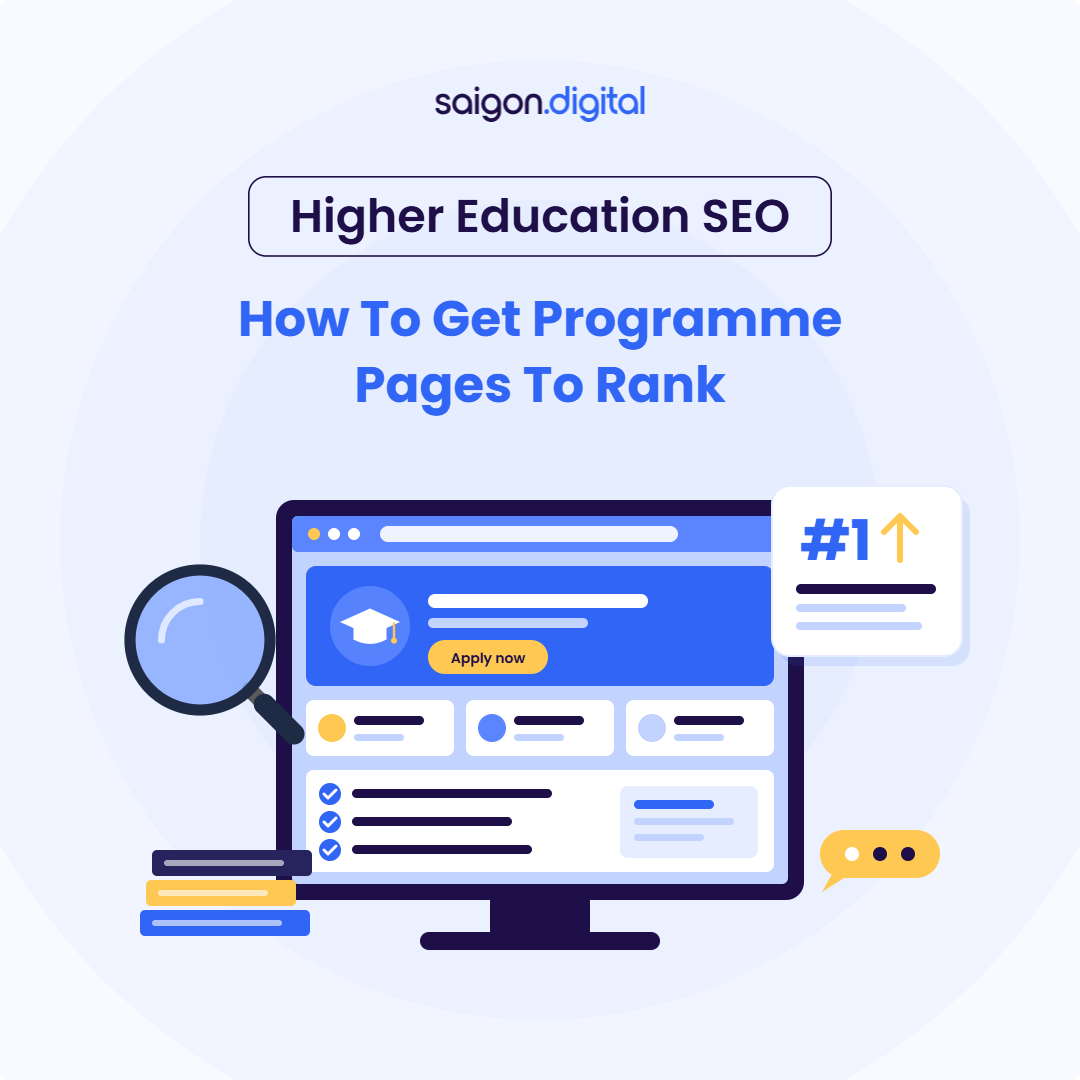
Higher education SEO is not the same discipline as SEO for a retail site or a local service business. A single institution can have hundreds of programme pages, each competing against its own faculties and rival universities across several countries at once.
Most programme pages underperform for the same reasons: thin content, near identical wording across similar courses, missing schema and a site architecture nobody has audited since launch. The fix is rarely a full rebuild.
This guide walks through keyword research, page structure, schema and international search behaviour for programme pages. At Saigon Digital, we have applied these exact fixes for international schools across Ho Chi Minh City.
Key Takeaways
- Programme pages usually underperform because of duplicate or near duplicate content, not because the keyword is unwinnable.
- Prospective students, parents and international applicants search differently, so one generic page cannot serve all of them well.
- Google retired the classic Course rich result in June 2025. The schema vocabulary still matters for AI search, but chasing the old snippet does not.
- Canonical tags, pruning stale programme pages and sensible internal linking usually move rankings faster than publishing more content.
- International education brands increasingly use offshore SEO partners to run this work at a fraction of the cost of an in-house team or a home market agency.
Why Higher Education SEO Works Differently to Other Industries
A university website is closer to a large enterprise site than a typical business website. One institution might run undergraduate, postgraduate and short course pages across multiple faculties, several intakes a year and two or three campuses. Each of those pages has its own audience, fee structure and search intent.
That scale creates a specific problem. Your homepage cannot rank for twenty different programmes at the same time, and neither can one generic "our programmes" page. Each course needs its own URL, its own heading structure and its own clear answer to the question a prospective student is actually asking: what does this cost, how long does it take, what will I be qualified to do afterwards, and can I apply from overseas.
Competition is also unusual. Institutions are not just competing against other universities for the same search terms. They are competing against national brand names with decades of backlinks, comparison sites, scholarship directories and, increasingly, AI generated summaries that answer a student's question before they click through to any website at all.
The Programme Page Problem: One Institution, Hundreds of Competing Pages
Full time and part time versions of the same MBA. A "Bachelor of Business" page and a nearly identical "Bachelor of Business (Marketing)" page. Fee pages duplicated by faculty because nobody wanted to maintain one shared page. Individually, none of these look like a crisis. Together, they quietly split ranking signals across pages that are all trying to rank for the same handful of terms, so none of them rank well.
Who Is Actually Searching for a Programme Page
Four groups typically land on the same page with very different needs: the prospective student researching options, a parent or guardian checking cost and reputation, an education agent shortlisting institutions for an overseas applicant, and an existing student looking for module details. Writing one page to satisfy all four usually means satisfying none of them particularly well.
Understanding Search Intent Behind Programme Pages
Search intent for education queries splits cleanly across the enrolment funnel, and treating every keyword the same way is one of the most common reasons programme pages stall in the rankings.
Mapping Keywords Across the Enrolment Funnel
At the top of the funnel, queries are exploratory: "is a marketing degree worth it" or "careers in data science". In the middle, they become comparative: "best digital marketing degree Vietnam" or "part time vs full time MBA". At the bottom, they are transactional: "[programme name] entry requirements" or "[institution] application deadline 2026".
Trying to rank one programme page for all three stages is why so many of these pages feel generic. A stronger approach is to let the programme page itself target the bottom of the funnel, and build supporting blog content, such as career outcome guides and comparison articles, to capture the earlier stages and funnel readers down toward the programme page through internal links.
Local Applicants and Cross-Border Applicants Are Not the Same Audience
A domestic student searching in their home market is usually cost and reputation driven. An international applicant researching from the UK, the US or Australia is thinking about visas, cost of living, English language requirements and how the qualification will be recognised at home. If your programme pages only answer the local question, you are invisible to the second group, even though they are often the higher value applicant.
The Technical Foundation: Fixing Programme Page Architecture
Before touching a word of content, it is worth auditing the structural problems that quietly cap how well programme pages can perform. This is usually where the biggest, fastest wins are, and it is the part of higher education SEO that gets skipped most often.
Duplicate and Near Duplicate Programme Pages
This is the single most common technical issue on university websites. A full time MBA page and a part time MBA page with 90 percent identical copy. A tuition fee page duplicated per faculty. HTTP and HTTPS versions of the same admissions page still both indexed. Search engines struggle to decide which version deserves to rank, so ranking signals get split and neither page performs as well as it should.
The fix depends on the situation. Where two pages genuinely serve different search intent, such as full time versus part time study, give each its own unique content, worded independently rather than copied and lightly edited. Where two pages exist purely for historical or administrative reasons, consolidate them and use a redirect. Our guide to duplicate content covers the full diagnostic process if you want to run this audit yourself.
Pagination, Filters and Course Catalogue Navigation
Course catalogues are often built with filters for subject area, level, intake and campus, each generating its own crawlable URL. On a site with a few hundred programmes, that can quietly produce thousands of near identical filtered pages, all fighting for crawl budget that should be going to your actual programme pages. Getting pagination in SEO right, through self-referencing canonicals and sensible indexing rules, stops the catalogue itself from working against you.
Orphaned Programme Pages and Broken Crawl Paths
Specialised programmes, dual credit options and graduate certificates are frequently left out of the main navigation and only linked from a single, buried faculty page. If a search engine cannot find a clear path to a page, it is unlikely to rank it, no matter how good the content is. A faculty level hub page that links out to every programme underneath it solves this in one pass.
A Fast Technical Health Check for University Websites
- Crawl the site and flag any pages above 85 to 90 percent textual similarity.
- Check whether filtered catalogue URLs are being indexed when they should be canonicalised instead.
- Confirm every live programme has at least one internal link from a navigation menu or hub page.
- Check for mixed HTTP and HTTPS or www and non-www versions of the same pages still being crawled.
- Run through our full technical SEO checklist before moving on to content changes.
On-Page Optimisation for Programme Pages That Convert
Once the technical foundation is sound, the content itself needs to do two jobs at once: answer the applicant's question immediately, and give search engines a clear, unique signal about what the page is about.
What Every Programme Page Needs Above the Fold
A strong programme page states, without forcing a PDF download, the duration, delivery mode, entry requirements, indicative fees, start dates and realistic career outcomes, in that order. If a prospective student has to hunt through a brochure to find the fee, they will simply search for a competitor's page that states it plainly. Our on-page SEO checklist covers the full set of elements worth reviewing on every page, not just programme pages.
Writing for Applicants, Not Just for Search Engines
Templated programme descriptions are extremely common in higher education, and they are also extremely easy for both readers and search engines to spot. Each page needs something genuinely specific: named modules, real graduate outcomes, faculty expertise, or an industry partnership unique to that course. Generic language such as "world class facilities" and "internationally recognised faculty" appears on so many competing pages that it carries almost no ranking value on its own.
Answering the Questions Applicants Actually Type Into Google
Prospective students search in full questions far more than most institutions plan for: "can I work while studying this degree", "is this degree accredited internationally", "what jobs can I get after this course". Structuring a section of the page, or a linked FAQ, around these exact phrasings is one of the simplest ways to capture long-tail traffic. Our breakdown of question keywords explains how to find the specific phrasing your applicants are using.
Keyword Research for Higher Education: Beyond "Best University in [City]"
Generic, high-competition terms like "best university" or "top MBA" are the least useful place to focus keyword research, because they are dominated by national brand names and third party ranking sites. Programme level, long-tail terms convert better and are genuinely winnable.
Programme Level Long-Tail Keywords
Instead of competing for "MBA Vietnam", target the specific combinations applicants actually search: "part time MBA for working professionals Ho Chi Minh City", "accelerated nursing degree online", or "hybrid counselling masters programme". These phrases have far lower competition and, because they closely match a specific programme page, they convert at a noticeably higher rate. Our guide to keyword analysis covers the process for uncovering these programme level opportunities systematically.
Career Outcome and Salary Intent Keywords
Research into higher education content consistently shows that pages with detailed, current career outcomes and salary data perform better than programme pages that only describe the curriculum. Terms such as "average salary after [degree]" or "jobs you can get with a [qualification]" bring in applicants who are close to a decision and actively comparing options.
Structured Data for Higher Education: What Actually Works in 2026
Schema markup gets recommended constantly for higher education sites, but a lot of the advice circulating online is out of date. Getting this section wrong wastes development time on a feature that no longer exists.
Course Schema, EducationalOccupationalProgram, and the Rich Result Google Retired
Course and EducationalOccupationalProgram are two distinct schema types that are frequently confused. Course describes an individual class or unit. EducationalOccupationalProgram describes the credential itself, such as a full degree or diploma, including its duration, delivery mode and prerequisites.
Our view: in June 2025, Google retired the classic Course rich result, the detailed search card that once displayed price, start date and enrolment information directly on the results page. The Course List carousel is still active, but the individual rich snippet is gone, and no amount of markup will bring it back. The schema vocabulary itself remains genuinely useful for how AI search tools like ChatGPT and Google AI Overviews parse and cite programme information, so it is still worth implementing. Just do it for AI visibility, not in the hope of a rich snippet that no longer exists.
Organisation and CollegeOrUniversity Schema
Every institution should have a single, consistent entity defined at the organisation level, using logo, address, accreditation bodies and social profiles, before layering programme level schema on top. This is what allows search engines and AI systems to confidently connect every programme page back to a single, trusted institution rather than treating each page as an unrelated entity. Our guide to organisation schema covers the implementation details and common mistakes.
FAQ Content Without Chasing the Retired FAQ Rich Result
Google also retired the FAQ rich result from search results in May 2026. The dropdown snippet is gone for the vast majority of sites, so there is no ranking or search appearance benefit left in marking up an FAQ purely to trigger it. Well-structured FAQ content on programme pages is still genuinely useful, because it directly answers the specific questions applicants ask, and that same structure is exactly what AI answer engines look for when deciding what to cite. Our full breakdown of FAQ schema explains what still matters now that the classic rich result is gone.
Local and International SEO for Cross-Border Student Recruitment
Most institutions recruiting internationally are effectively running two SEO strategies inside one website, and treating them as one usually means both underperform.
Serving Local Applicants and International Families in the Same Market
A domestic applicant and an expat family relocating for work are searching the same institution for entirely different reasons: one wants proximity and cost, the other wants curriculum recognition and international transferability. Location pages, campus specific content and consistent business information across directories all help here, and the fundamentals are the same ones covered in our guide to local SEO.
Answer Engine Optimisation for AI-First Research
A growing share of prospective students now research options through AI tools before ever reaching a university website, asking direct questions rather than typing keyword strings. Structuring programme content so it can be lifted cleanly and cited by these tools, clear headings, direct answers stated early, consistent factual details, is becoming as important as ranking in traditional search. Our strategies for answer engine optimisation go into the specific techniques that help here.
Content Pruning and the Programme Page Lifecycle
Programme pages are not permanent. Intakes close, courses get discontinued, fee structures change every academic year, yet many institutions leave outdated pages live indefinitely, sometimes still ranking and misleading applicants with last year's fees. Auditing programme pages on a regular cycle, redirecting discontinued courses to their closest live equivalent and updating fee and date information before each intake, keeps the whole site trustworthy in the eyes of both applicants and search engines. Our guide to content pruning explains how to decide what to update, redirect or remove.
Enterprise-Scale SEO for Multi-Faculty, Multi-Campus Institutions
Larger institutions face a coordination problem as much as a technical one. Content approval often has to move through faculty heads, marketing, and sometimes a central communications office, before a single programme page can go live. That process, left unmanaged, is usually the real reason SEO fixes stall for months rather than weeks. Treating a university website with the same governance discipline used for large corporate sites, shared style guides, a single source of truth for fees and dates, and a clear editorial calendar, solves this. Our guide to Enterprise SEO covers how to run SEO at this scale without every change becoming a months-long approval cycle.
Why International Education Brands Choose Offshore SEO Partners
Running this level of technical and content work well requires a genuinely senior team: someone who understands schema, someone who can audit crawl architecture, and someone who can write programme content that does not read like a template. Hiring that team in the United States, the United Kingdom or Australia is expensive, and building it in-house takes time most admissions cycles do not allow for.
This is why a growing number of international schools, universities and training providers now work with an offshore SEO partner instead. Saigon Digital is based in Ho Chi Minh City, and we deliver the same senior-level SEO, content and technical work at a fraction of the cost of hiring locally in a first-world market, without the usual trade-off in quality that offshoring can imply. We have worked with international schools in Ho Chi Minh City, including ABCIS and LPE, on exactly this kind of bilingual, cross-border content and technical SEO, and the same principles, clear programme-level content, sound site architecture and search intent mapped by audience, apply directly to universities and training providers.
If you are weighing up outsourcing this work, our guide to SEO outsourcing lays out the real trade-offs, and our guide on how to choose an SEO agency in the current AI-driven search landscape is worth reading before you commit to any partner, us included.
Turning Programme Pages Into Your Best Recruiters
Higher education SEO rewards institutions that treat every programme page as its own small product: a specific audience, a specific search intent, and a clear, honest answer to what that applicant actually wants to know. Fixing duplicate content, tidying crawl architecture, and writing content that answers real questions will usually move the needle faster than any amount of additional publishing.
If your programme pages are not converting the way they should, get in touch with our team for a conversation about what an audit of your site would actually find.
Frequently Asked Questions
1. How long does higher education SEO take to show results?
Most institutions see meaningful ranking movement within four to six months, though this varies with how competitive the target programme is and how much technical work the site needs first. Organic results compound over time, unlike paid advertising, which stops generating enquiries the moment spend stops.
2. What is the real difference between SEO for universities and SEO for other industries?
Scale and audience complexity. A university website can hold hundreds of programme pages serving multiple audiences at once, students, parents, and agents, across several countries, competing against national brand names rather than a handful of local rivals.
3. Do universities still need Course schema on programme pages?
The classic Course rich result was retired by Google in June 2025, so it will no longer produce the old search card. The underlying schema vocabulary is still worth implementing, mainly because AI search tools rely on it to understand and cite programme details accurately.
4. How do you stop programme pages from competing against each other in search?
Identify genuinely duplicate or near-duplicate pages, give pages that serve different intent, such as full time versus part time study, their own distinct content, and consolidate or redirect pages that exist for administrative reasons rather than genuine search demand.
5. Should international schools and universities target different keywords to domestic institutions?
Yes. International applicants search with visa, cost of living, and qualification recognition concerns that rarely appear in domestic search behaviour, so programme content aimed at overseas applicants needs to address those questions directly rather than assuming local context.
6. Why do international education brands work with an offshore SEO agency?
Cost is the initial driver, since senior-level SEO talent is considerably cheaper in Vietnam than in the United States, the United Kingdom, or Australia, but the deciding factor is usually that offshore teams like ours can deliver the same technical and content depth without the overhead of a large domestic agency.
Want to be the brand AI engines recommend?
We make businesses visible on Google and inside AI answers, measured in leads, not vanity metrics.