Restaurant local SEO decides who gets booked and who gets ignored.
Most guides stop at your Google profile. That is only one third of the job.
This guide covers the other two thirds, step by step.
Key Takeaways
- “Best restaurants in [city]” is not a map pack query. It is mostly won by third-party lists such as TripAdvisor, Time Out and local food blogs, so your strategy has to reach beyond your own website.
- Your Google Business Profile is the foundation, not the finish line. Your primary category, attributes, photos and review flow feed every other surface, including AI answers.
- Getting onto other people’s lists is a repeatable process, not luck. You can identify exactly which pages rank, then work through them one at a time.
- AI assistants now recommend restaurants directly. They read your structured data, your HTML menu and your reviews, which means machine-readable information is now a commercial asset.
- Measure covers, calls and direction requests, not rankings alone. Local rankings shift by street corner, so revenue signals tell you far more than a position number.
What Restaurant Local SEO Actually Means in 2026
Restaurant local SEO is the work of making your venue the obvious answer when someone nearby is deciding where to eat. That decision now happens across several surfaces at once: Google Search, Google Maps, Apple Maps, review platforms, social apps and AI assistants such as ChatGPT, Gemini and Perplexity.
The important shift is that hungry people are rarely browsing. They are choosing. Research from Craver’s 2025 restaurant consumer survey found that 88% of mobile users who run a local business search visit or call a business within 24 hours. In other words, the gap between the search and the booking is now measured in minutes, not days.
That urgency is exactly why restaurant local SEO pays back faster than most other marketing channels. You are not building demand from nothing. You are intercepting demand that already exists.
The three signals Google uses to rank local businesses
Google has been consistent about how it ranks local results, and understanding these three signals makes every later decision in this guide easier to follow.
- Relevance: how well your business matches what the person typed. This is driven by your category, your menu, your website content and the words people use in your reviews.
- Distance: how far you are from the searcher, or from the location they named. You cannot change this, which is why the other two matter so much.
- Prominence: how well known and well regarded your restaurant is. This comes from reviews, mentions on other websites, press coverage and links.
Since distance is fixed, almost all of your effort should go into relevance and prominence. Keep that in mind as you read on, because every tactic below is really a way of improving one of those two.
Why “near me” and “best in [city]” are completely different searches
This distinction is the single most useful thing in this article, and it is where most restaurant marketing goes wrong.
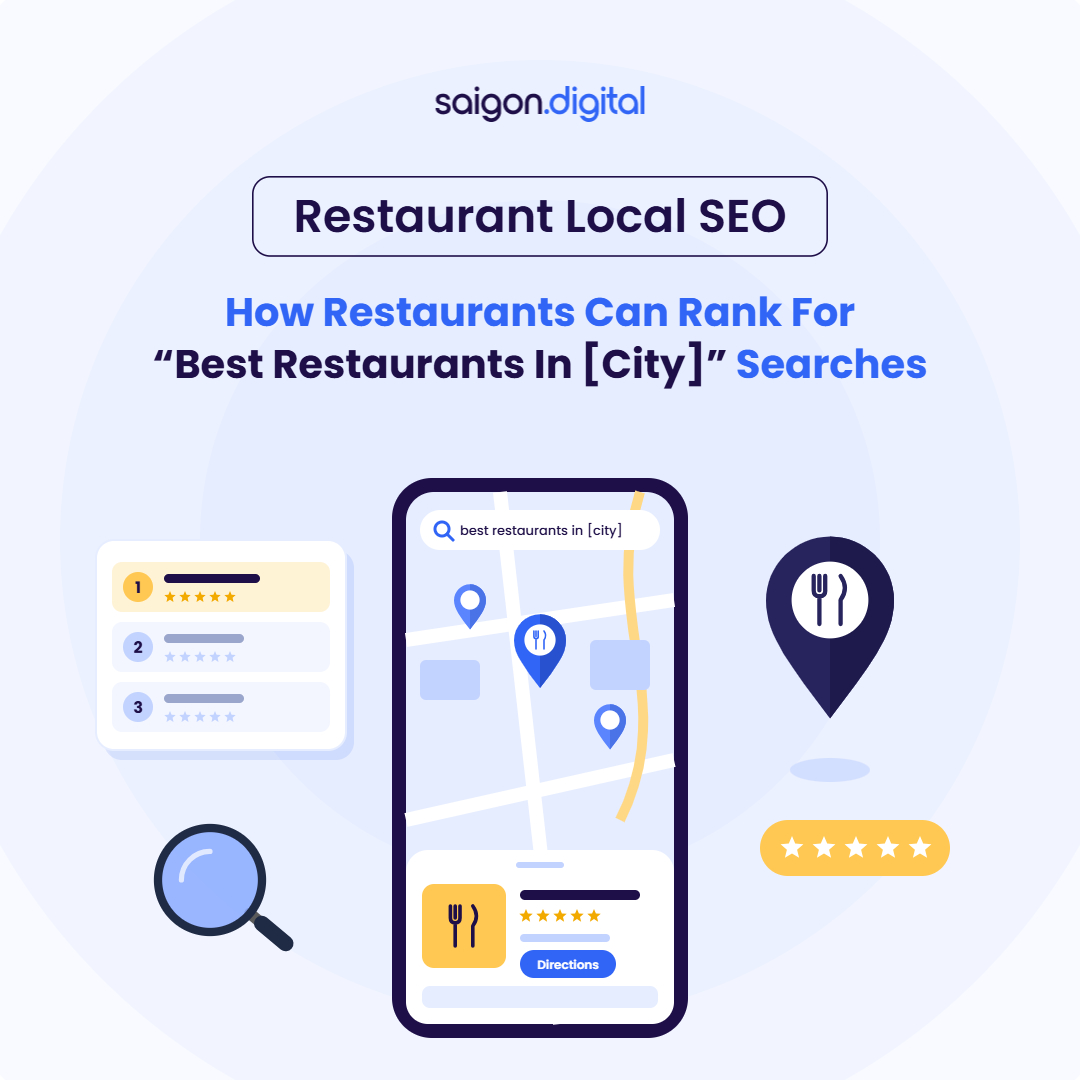
When someone searches “pho near me”, Google assumes they are standing somewhere and want to eat soon. It returns a map with three business listings, known as the map pack. Your Google Business Profile is what competes there.
When someone searches “best restaurants in Ho Chi Minh City”, Google reads that as research. The person is planning, comparing and probably not in the neighbourhood yet. So Google serves a different page: a map pack near the top, and then a long run of editorial lists from TripAdvisor, Time Out, Eater, The Infatuation, Michelin Guide and local food publications.
Here is what that means in practice. You cannot rank your own restaurant’s homepage first for “best restaurants in [city]”, because Google does not want a single restaurant claiming to be the best. It wants a list. So the goal changes from ranking to being included in the pages that rank.
Our view at Saigon Digital, after running local SEO programmes for hospitality and F&B brands across Vietnam and Europe, is that most restaurants lose this query simply because nobody ever told them it was a different game. They spend a year polishing a profile that was never going to appear there, and never send a single email to the editor who controls the list that does.
Why “Best Restaurants in [City]” Is the Hardest Query to Win, and How to Win It Anyway
Let us look at who actually owns that search result before deciding what to do about it.
Who owns the SERP
Open an incognito window and search “best restaurants in” plus your city. You will usually see a mix like this:
- An AI Overview or AI summary at the very top, naming a handful of restaurants.
- A map pack of three businesses with ratings, price bands and a “More places” link.
- Then roughly eight to ten third-party list pages: TripAdvisor, Time Out, Michelin Guide, Eater, a national newspaper, and two or three local blogs or expat publications.
- Sometimes a video carousel pulling from TikTok, YouTube and Instagram Reels.
Notice that individual restaurant websites appear almost nowhere. That is not a failure of your SEO. It is the shape of the result.
The practical conclusion: to win “best restaurants in [city]”, you need to appear inside the results rather than as a result.
The three-layer strategy
Because that page has three distinct types of result, the strategy has three matching layers. Work through them in order, since each one feeds the next.
Layer one: own the map pack
Your Google Business Profile is what qualifies you for the map results that sit above the lists. It also supplies the data that AI assistants read later, so this layer has to come first.
Layer two: get into the lists
This is the outreach layer. You identify the exact pages that rank, then work to get your restaurant added to each one. Some are self-service, such as claiming a TripAdvisor listing. Others require a conversation with an editor.
Layer three: become the source AI can quote
AI assistants build their recommendations from your profile, your reviews and your website. If your menu is a PDF and your opening hours only exist as an image, you are invisible to them. This layer is about making your information machine-readable.
The rest of this guide walks through each layer in detail, with the exact steps to follow.
Layer One: Build a Google Business Profile That Actually Ranks
Your Google Business Profile (GBP) is the free listing that appears in Maps and in the map pack. It is the highest-leverage asset in restaurant local SEO, and the good news is that almost all of it is within your control.
According to the 2026 Whitespark Local Search Ranking Factors survey, your GBP primary category is the single highest-weighted individual signal for map pack rankings, with the profile as a whole accounting for roughly a third of local pack ranking influence. That is a large return for work that takes an afternoon.
Step 1: Choose the most specific primary category
Your primary category tells Google what kind of business you are. Most restaurants pick something broad like “Restaurant” and lose immediately, because a generic category matches generic searches while your competitors match specific ones.
Be as specific as your concept honestly allows:
- “Vietnamese Restaurant” beats “Asian Restaurant” for anyone searching pho or banh mi.
- “Sushi Restaurant” beats “Japanese Restaurant” for sushi queries.
- “Breakfast Restaurant” beats “Cafe” if mornings are your trade.
Then add up to four secondary categories for every service you genuinely offer, such as Takeaway Restaurant, Delivery Restaurant, Fine Dining Restaurant or Caterer. Be honest here. Google cross-checks your categories against your reviews, photos and website, and profiles that claim services they do not provide can lose visibility rather than gain it.
Step 2: Complete every field, not just the obvious ones
Now that Google knows what you are, give it the detail it needs to match you to specific searches. Each field below corresponds to filters real diners use.
- Attributes: outdoor seating, vegan options, halal, wheelchair accessible, good for groups, live music, dog friendly. These power the filter chips in Maps.
- Opening hours, including holidays: inaccurate hours are both a ranking problem and the most common cause of one-star reviews.
- Menu link and price band: point this at an HTML menu page on your own site, not a PDF.
- Booking and ordering links: connect your reservation system so guests can book without leaving the result.
- Business description: 750 characters describing your cuisine, neighbourhood and what makes you distinctive. Write it for a human, but include your city and cuisine naturally.
Step 3: Post photos on a schedule
Photos are not decoration. Photo views and engagement are inputs Google uses to judge how compelling your listing is, and diners routinely choose based on a single dish image.
A simple, sustainable routine:
- Upload three to five new photos every week. Phone photos in good natural light are fine.
- Cover the full set: exterior (so people can find the door), interior, individual dishes, drinks, and staff.
- Name the files descriptively before uploading, for example grilled-pork-vermicelli-district-1.jpg.
- Refresh seasonal dishes as the menu changes, and delete anything that no longer reflects what you serve.
Step 4: Build a review engine
Reviews affect relevance, prominence and conversion at the same time. Google has confirmed that review count, rating, recency and velocity all influence local rankings, and for restaurants they matter even more because diners rely so heavily on social proof.
How to ask for reviews without breaking the rules
You may ask for reviews. You may not incentivise them, filter for positive ones only, or write them yourself. Within those limits, here is a process that works:
- Generate your review link from your GBP dashboard, then shorten it and turn it into a QR code.
- Place the QR code where the meal ends: the bill folder, the receipt, the table card, the takeaway bag.
- Train your team to mention it once, naturally, when a guest says they enjoyed the meal.
- Follow up digitally if you take bookings or online orders, with a short message the day after the visit.
- Set a monthly target, for example fifteen new reviews, and track it like any other operational KPI.
Steady flow matters more than total count. Twenty reviews spread across the last three months signals a busy, current restaurant far better than two hundred reviews that all stopped two years ago.
How to reply
Reply to every review, positive and negative, within about 48 hours. Replies are public, indexed text, and they demonstrate to both Google and future diners that someone is paying attention.
- For positive reviews, thank the guest and mention the dish or occasion they named. This naturally adds relevant terms to your profile.
- For negative reviews, acknowledge the specific issue, apologise plainly, explain what has changed, and move the conversation offline. Never argue.
Layer Two: Get Into the Lists That Rank for “Best Restaurants in [City]”
With your profile in order, you can now go after the pages that actually occupy that search result. This layer is often called barnacle SEO: attaching your business to a website that already has the authority you lack.
Step 1: Build your target list
Start by making the opportunity visible. Open a spreadsheet and search your target queries in incognito mode.
- Search “best restaurants in [your city]” and record every result on page one.
- Repeat for narrower variations that suit you better: “best [cuisine] in [city]”, “best restaurants in [neighbourhood]”, “best brunch in [city]”, “where to eat in [city]”.
- For each page, note the publication, the URL, whether you already appear, when it was last updated, and how to contact the author or editor.
You will usually end up with fifteen to thirty target pages. That is your workload for the next quarter, and it is far more concrete than “do more SEO”.
Step 2: Claim and correct the self-service listings first
Some of those target pages are directories you can update yourself today, at no cost. Do these before any outreach, because they are quick wins and they also fix your citation consistency.
- TripAdvisor: claim the listing, complete the cuisine tags, price band, features and photos.
- Yelp, Apple Business Connect, Bing Places, Facebook, Foursquare: claim each one and make the details identical.
- Delivery and booking platforms relevant to your market, since these frequently rank and are frequently cited by AI assistants.
- Local and expat directories in your city, which often outrank national sites for neighbourhood queries.
Why identical details matter so much
Your name, address and phone number, usually shortened to NAP, must appear in exactly the same format everywhere. Every inconsistency, even something as small as “St” versus “Street” or an old phone number on a listing you forgot about, reduces Google’s confidence that your business data is reliable.
Audit this by searching your restaurant name in quotation marks and working through the first five pages of results. Keep a master record of your correct details and update every listing against it.
Step 3: Earn a place on the editorial lists
The remaining targets are curated by journalists and bloggers. You cannot buy your way in, but you can make yourself easy to include. Editors are constantly updating these pages and are always looking for a reason to add something new.
What actually works:
- Lead with news, not a request. A new head chef, a seasonal menu, a first-in-the-city dish or an award gives the editor a reason to update the page.
- Send usable assets. Attach two or three high-resolution, properly licensed photographs. Many pitches fail purely because there is no image.
- Keep it to five sentences. Who you are, where you are, what is new, why their readers would care, and a line offering a tasting visit.
- Target the near-misses first. Lists that include your direct competitors but not you are the easiest additions to argue for.
- Follow up once, about ten days later, then move on.
Step 4: Build genuinely local links and mentions
Beyond the lists themselves, local relevance is strengthened by being mentioned across your city’s wider web. These opportunities usually already exist in your business.
- Sponsor a neighbourhood sports team, market or charity event, and ask for a link from their website.
- Host or supply local events, supper clubs and pop-ups, all of which generate coverage.
- Partner with nearby hotels, co-working spaces and tour operators who publish “where to eat” recommendations.
- Offer your chef as a source for local food journalism.
These mentions build the prominence signal from earlier in this guide. If you want to go deeper on the mechanics, our guide to high-quality backlinks explains what separates a link that helps from one that does nothing.
Layer Three: Make Your Website a Source That Google and AI Can Quote
Your website will rarely win “best restaurants in [city]” on its own, but it does something more valuable. It is the reference source that Google, AI assistants and the journalists writing those lists all check to confirm facts about you.
This has become commercially significant because AI assistants now answer “where should I eat” questions directly. They cannot recommend what they cannot read.
Put your menu in HTML, never in a PDF
This is the most common and most expensive technical mistake in restaurant websites. A PDF menu is effectively a picture to a search engine. Dish names, prices, allergens and dietary tags inside it are difficult to extract and often ignored entirely.
Instead, build a proper menu page:
- Use real HTML text with headings for each section (starters, mains, desserts, drinks).
- List each dish with a one-line description, its price, and dietary tags such as vegan, vegetarian, gluten-free or halal.
- Include local dish names alongside English ones where relevant, since diners search both.
- Keep it updated, because AI assistants confidently quoting a dish you stopped serving creates real guest disappointment.
The payoff is direct: when someone asks an assistant “which restaurants in District 1 have good vegetarian options”, the ones with readable, tagged menus are the ones that can be recommended.
Give every location its own page
If you operate more than one venue, each needs a dedicated page rather than one combined “Locations” list. Google associates a page with a specific address, and a single page covering five branches dilutes all five.
Each location page should contain the address in text, the phone number for that branch, that branch’s opening hours, an embedded map, parking and transport notes, neighbourhood context, photos of that specific venue, and its own booking link.
Add structured data so machines understand you
Structured data is code added to your pages that states facts in a standardised format, so search engines and AI systems do not have to guess. For restaurants it is unusually valuable, because so much of what diners want to know is factual.
The types worth implementing:
- Restaurant or LocalBusiness schema covering name, address, phone, opening hours, cuisine type, price range and accepted payment methods. Our guide to local business schema walks through the implementation.
- Menu schema connecting your menu sections and individual dishes.
- Review or AggregateRating schema, where it reflects genuine first-party reviews.
- FAQPage schema on pages that answer common guest questions.
- Service schema for offerings such as private dining, catering or events. See our guide to service schema for how this supports local search.
One point of accuracy that many older articles get wrong: Google retired the FAQ rich result in search listings, so FAQ markup no longer produces those expandable questions for most sites. It remains worth adding, because it presents clean question-and-answer pairs that AI systems can parse, but do not implement it expecting a visual result in Google.
Write the content that answers real diner questions
Finally, publish pages that answer the questions people actually ask before booking. These are the pages that get cited in AI answers and quoted by journalists.
Good topics for a restaurant:
- “Where to eat near [landmark or district]”
- “Best [your cuisine] dishes to try in [city]”
- “Is [your restaurant] good for large groups, families or dietary requirements?”
- Seasonal and event guides tied to your city’s calendar
Structuring these well matters as much as writing them. Our guides to how to structure FAQ content cover the formats AI systems find easiest to lift.
A 90-Day Restaurant Local SEO Plan
Three layers can feel like a lot at once, so here is how to sequence them. Each phase builds on the one before it.
Days 1 to 30: fix the foundations
- Claim and fully complete your Google Business Profile, including primary category, attributes and hours.
- Audit your NAP across every directory you can find and correct the inconsistencies.
- Replace your PDF menu with an HTML menu page.
- Start the weekly photo routine and the review request process.
- Build your target list of pages ranking for “best restaurants in [city]”.
Days 31 to 60: build relevance and reach
- Implement Restaurant, Menu and FAQPage structured data.
- Claim every self-service directory listing on your target list.
- Publish your first two or three diner-question pages.
- Begin editorial outreach, starting with the lists that already include your competitors.
- Set up reporting so you have a baseline to compare against.
Days 61 to 90: compound the gains
- Continue outreach and follow-ups on the remaining target pages.
- Build local partnerships and sponsorships that generate links and mentions.
- Test your visibility in AI assistants by asking them where to eat in your city, and note whether you appear.
- Review your metrics, identify which layer is producing results, and reallocate effort accordingly.
Expect meaningful movement somewhere between month three and month six. Local results tend to respond faster than national ones, but review velocity and editorial placement both take time to accumulate. Our guide to the realistic SEO results timeline sets out what to expect at each stage.
How to Measure Restaurant Local SEO Properly
Rankings are a poor primary metric in local search, because your position changes depending on where the searcher is standing. Someone two streets away may see you first while someone across the city never sees you at all. Measure outcomes instead.
The metrics that actually matter
- Direction requests from your Google Business Profile. These are close to a commitment to visit.
- Phone calls generated from your listing.
- Booking and order clicks from Google and Maps.
- Review velocity and average rating, tracked monthly.
- Organic impressions and clicks for city and neighbourhood queries in Google Search Console.
- Placements earned on your target list of third-party pages, which is the clearest measure of layer two.
The tools to use
- Google Business Profile Insights for calls, direction requests and the queries you appear for. Free.
- Google Search Console for organic performance, filtered by queries containing your city or district.
- Google Analytics 4 for what happens after the click, especially menu page views and booking completions.
- A grid-based local rank tracker such as BrightLocal, Whitespark or Local Falcon, which shows visibility across a map rather than a single misleading number.
For a broader framework on choosing what to report on, our guide to marketing metrics covers how to connect marketing activity to commercial outcomes. To check whether AI assistants are recommending you, our guide to AI citation tracking explains how to monitor where you are being referenced.
Common Restaurant Local SEO Mistakes
These are the issues we find most often when auditing restaurant and hospitality websites.
- The PDF menu. Still the most damaging single technical decision a restaurant website makes.
- A generic primary category. “Restaurant” when you could be “Vietnamese Restaurant” costs you every specific query.
- Hours that are wrong on holidays. This produces angry reviews and damages the accuracy signals Google trusts.
- Ignoring negative reviews. An unanswered complaint is far more damaging than an answered one.
- One page for multiple locations. This splits the relevance every branch needs.
- Keyword stuffing the business name. Adding “Best Italian Restaurant” to your legal name breaches Google’s guidelines and risks suspension.
- Treating it as a one-off project. Local SEO decays. Competitors add reviews, editors refresh lists, and Google updates its systems.
- Chasing the city-wide query only. “Best restaurants in [city]” is valuable, but “best [cuisine] in [neighbourhood]” converts better and is far easier to win.
Running Restaurant Local SEO Across Multiple Locations and Markets
Everything above is manageable for a single venue. It becomes considerably harder for a group with eight restaurants, or for an international hospitality brand operating in three countries.
The difficulty is that local SEO cannot be run centrally. Each venue has its own profile, its own reviews, its own neighbourhood context and its own set of local publications. Multiply the 90-day plan by the number of sites and you have a permanent operational workload rather than a project.
Where offshore delivery changes the economics
This is the point at which many international brands look at offshore delivery, and it is worth being straightforward about why.
The work involved is genuinely labour-intensive: auditing dozens of directory listings, maintaining photo schedules, replying to reviews daily, running editorial outreach and keeping structured data current across many locations. Hiring that capacity in London, Sydney or New York is expensive, and it is rarely a good use of a senior in-house marketer’s time.
An offshore team in Vietnam delivers the same standard of work at a materially lower cost, which usually means a brand can cover every location properly rather than only the flagship.
At Saigon Digital, this is the work we do for F&B, hospitality and retail brands across Vietnam, the UK, Australia and Europe. Our case studies include the premium Vietnamese gin brand Saigon Baigur, where we built a bilingual English and Vietnamese site on a modern Jamstack architecture that reached a perfect 100 Lighthouse score for both performance and SEO. That combination matters for restaurants too, because a fast, bilingual, technically clean site is exactly what both local diners and international visitors need to find you.
Conclusion: Turn Restaurant Local SEO Into Covers, Not Just Clicks
The restaurants that win “best restaurants in [city]” are not the ones with the cleverest website. They are the ones that show up in three places at once: the map pack, the editorial lists that dominate that result, and the AI answers that increasingly sit above everything else.
None of it requires technical expertise. It requires a specific primary category, a complete profile, a steady flow of reviews, a readable menu, correct structured data, and a patient outreach process against a list of pages you can identify in an afternoon.
The work is not complicated. It is simply constant, which is exactly why most of your competitors will start it and stop. If you would rather it was run properly and consistently, contact Saigon Digital and we will walk you through what a local search programme would look like for your venues.
Frequently Asked Questions About Restaurant Local SEO
1. How long does restaurant local SEO take to work?
Profile improvements such as fixing your category, hours and attributes can shift map pack visibility within two to four weeks. Review velocity and editorial placements take longer, so plan for meaningful results between three and six months. Anyone promising a first-page result in a fortnight is not describing how local search works.
2. Can my restaurant rank first for “best restaurants in [city]”?
Your own website almost certainly cannot, because Google prefers to serve curated lists rather than a single restaurant claiming to be the best. What you can do is appear in the map pack that sits above those lists, get included in the lists themselves, and be named in the AI summary at the top. In practice that delivers more bookings than a single blue link would.
3. Do I still need a website if my Google Business Profile is strong?
Yes. Your website is where Google, AI assistants and journalists verify facts about you. It hosts the HTML menu, the structured data and the location pages that feed every other surface, and it is the only place where you fully control the booking experience.
4. How many Google reviews does a restaurant need?
There is no fixed threshold. What matters is being competitive with the restaurants currently ranking for your target searches, and maintaining a steady flow of recent reviews. Check the review counts of the three businesses in your map pack and use that as your benchmark, then aim for consistent monthly additions rather than a single burst.
5. Does social media help restaurant local SEO?
Indirectly, but meaningfully. Social posts are not a direct ranking factor, yet TikTok, Instagram and YouTube content frequently appears in video carousels on food searches, drives branded searches, and gives journalists a reason to notice you. Treat it as a discovery channel that supports your local search work rather than a replacement for it.
6. Should a multi-location restaurant group manage local SEO centrally or per venue?
Standards, templates and structured data should be set centrally so every venue is consistent. Execution has to be local, because each site needs its own profile, reviews, photos, location page and neighbourhood outreach. Most groups find the practical answer is a central team that runs the work location by location, which is one of the more common reasons they outsource the delivery.
Want to be the brand AI engines recommend?
We make businesses visible on Google and inside AI answers, measured in leads, not vanity metrics.