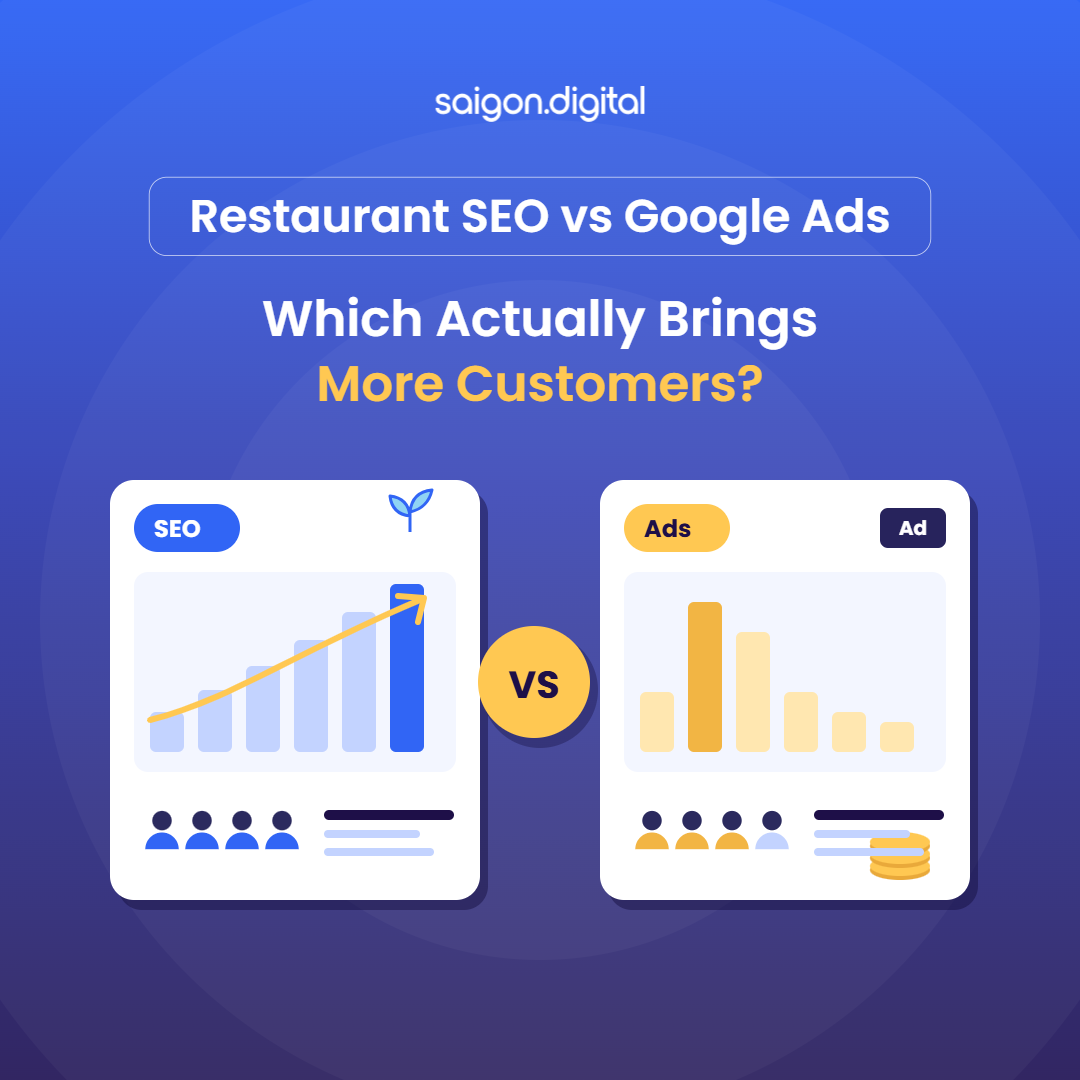
Restaurant SEO vs Google Ads is the budget question every operator eventually asks. One channel buys you customers today. The other earns them for years.
Here is the maths, the honest answer, and exactly when each one wins.
Key Takeaways
- Google Ads is the cheapest lead source in the restaurant sector, but the thinnest on margin. Restaurants and food average a $2.05 cost per click and a $30.57 cost per lead, which is often more than the contribution margin of a single booking.
- Restaurant SEO costs more upfront and nothing per customer afterwards. The cost per cover falls every month you keep the rankings, rather than resetting to zero the day you pause.
- Ads win on speed, seasonality and control. New openings, quiet midweek services, event nights and brand defence are all jobs paid search does better than organic ever will.
- SEO wins on discovery, delivery independence and compounding returns. "Near me" searches, direct orders and repeat custom all live on the organic side of the page.
- AI search has quietly settled the argument. Around 83% of restaurant locations never appear in AI-generated recommendations, and there is no ad auction that can buy your way in.
Restaurant SEO vs Google Ads: What You Are Actually Choosing Between
Before comparing costs, it helps to be precise about what each channel does, because most operators are sold a caricature of both. Paid search is not "instant customers" and SEO is not "free traffic". They are two different ways of buying attention at the exact moment someone decides where to eat.
What restaurant SEO actually covers
Restaurant SEO is the work that makes Google, Maps and AI assistants confident enough to recommend you without being paid to. In practice, it breaks into four parts:
- Your Google Business Profile. Hours, cuisine categories, photos, menu, ordering links, attributes and review responses. For most restaurants this is the single highest-return asset you own, and it is free.
- Your website. Location pages, a crawlable HTML menu rather than a PDF, fast mobile loading, and booking or ordering paths that work on a phone in under ten seconds.
- Structured data. Marking up your address, opening hours, menu and cuisine so machines can read them without guessing. Our guide to local business schema walks through the exact code.
- Local signals. Consistent name, address and phone details across directories, a steady flow of recent reviews, and links from local press, food writers and community sites.
None of that requires a technical background to understand. It does require somebody to actually do it, consistently, for months.
What Google Ads actually covers for restaurants
Google Ads places you above the organic results and inside Maps for searches you choose to bid on. You pay each time somebody clicks. The moment you stop paying, you disappear.
For restaurants the useful campaign types are narrower than most agencies admit:
- Search campaigns targeting cuisine plus city or neighbourhood, such as "italian restaurant shoreditch".
- Local campaigns and Maps ads, which promote your location inside Google Maps when somebody is already nearby.
- Performance Max, which most independent restaurants should avoid until they have clean conversion tracking, because it spends your budget across channels you cannot see.
- Brand defence, bidding on your own restaurant name so an aggregator does not intercept the click.
The one difference that matters most
Here is the distinction that should shape your decision. Google Ads rents attention. SEO builds an asset.
A paid campaign is an expense line that resets to zero every month. A ranking position, a strong profile and a bank of reviews are balance sheet items that keep producing after the invoice stops.
That does not make ads wasteful. It means you should judge them on completely different criteria, which is exactly where the maths comes in.
The Numbers Most Comparison Articles Leave Out
Almost every article on this topic tells you that SEO is slower but cheaper long term. Very few show you the arithmetic, and the arithmetic is where restaurants get caught out. Restaurants run on thinner margins than nearly any other business that advertises on Google, so a cheap click can still be an unprofitable one.
What a Google Ads customer really costs a restaurant
The published 2026 benchmarks for the restaurants and food category are genuinely attractive at first glance. Average cost per click sits at $2.05, against a cross-industry average of $5.42, making it one of the three cheapest verticals on the platform. Average click-through rate is roughly 6.8%, conversion rate around 8%, and cost per lead $30.57.
Now apply those numbers to a real restaurant rather than a spreadsheet.
Worked example: a 60-cover neighbourhood bistro
Imagine a bistro spending $1,000 a month on Google Ads. Working through the benchmark figures step by step:
- Step one, clicks. $1,000 divided by a $2.05 cost per click gives roughly 488 clicks a month.
- Step two, conversions. At the 8% benchmark conversion rate, those clicks produce about 39 bookings, calls or order clicks.
- Step three, cost per booking. That works out at roughly $25 to $31 per booking, which matches the published cost per lead.
- Step four, what the booking is worth. Say the average booking is two covers at $30 each, so $60 of revenue.
- Step five, what you actually keep. After food cost and the labour to serve that table, a typical prime cost of 60% to 65% leaves you roughly $21 to $24 of contribution.
Read those last two lines together. You spent $25 to $31 to win a table worth $21 to $24. On the first visit, that campaign loses money.
This is the single most important fact about restaurant Google Ads, and almost nobody says it out loud. Paid search for a restaurant is rarely profitable on the first cover. It becomes profitable through three levers, and you need at least one of them working:
- A higher average cheque. Tasting menus, fine dining, function bookings and private hire change the sums completely. A $400 group booking absorbs a $30 acquisition cost without blinking.
- Larger party sizes. Bidding on "private dining", "group booking" and "set menu for" terms attracts tables of eight, not two.
- Repeat visits. If a guest returns three times in a year, your effective acquisition cost falls to about $10 per visit. This is why an email or SMS capture at the point of booking is not optional if you run ads.
There is also a trend worth watching. Restaurant click-through rates fell nearly 10% year on year in the most recent benchmark data, which is the largest drop of any vertical measured. More of the page is being taken up by AI answers and map packs, and paid ads are being pushed further from the point of decision.
What restaurant SEO really costs
SEO pricing is less standardised, which makes honest comparison harder. For a single-location independent restaurant working with a competent agency, a realistic retainer sits between $800 and $2,500 a month, depending on market competitiveness and how much content and technical work is included. A multi-location group will pay more.
The critical difference is that this is not a cost per customer. It is a cost per month of building, regardless of how many covers the work delivers.
Worked example: the same bistro, twelve months of SEO
Take the same bistro on a $1,500 monthly retainer, which is $18,000 over a year. A realistic trajectory looks something like this:
- Months one to three. Profile overhaul, menu made crawlable, schema added, review flow set up, local citations cleaned. Very little traffic change. This is the phase that makes owners nervous, and it is unavoidable.
- Months four to six. Movement in the local pack for cuisine plus neighbourhood searches. Perhaps 300 to 600 organic sessions a month and a visible lift in direction requests and calls from your profile.
- Months seven to twelve. Steady growth towards 1,200 or more organic sessions a month. At a 6% booking conversion rate, that is roughly 72 bookings a month.
At that point, the month's $1,500 is buying about $21 per booking, which looks similar to paid search. The difference appears in month thirteen. Stop the ads and you get nothing. Stop the SEO retainer and the rankings, the reviews and the profile keep producing for months, usually at a reduced but meaningful level.
Over a two-year horizon, the blended cost per booking from organic typically falls into single digits. Paid search stays exactly where it started. If you want a more detailed picture of what to expect and when, our SEO results timeline breaks it down by industry at three, six and twelve months.
These figures are illustrative models built from published benchmarks, not guarantees. Your market, cuisine, average cheque and competition will move every number.
Restaurant SEO vs Google Ads: side by side
| Factor | Restaurant SEO | Google Ads |
| Time to first results | 3 to 6 months | 24 to 72 hours |
| Typical monthly cost | $800 to $2,500 retainer | $500 to $5,000 ad spend, plus management |
| Cost per booking, year one | Roughly $20 to $40, falling | Roughly $25 to $31, flat |
| Cost per booking, year two | Often under $10 | Unchanged or higher |
| What happens if you stop | Gradual decline over months | Traffic ends the same day |
| Best for | Discovery, "near me" searches, direct orders, repeat custom | Openings, promotions, events, quiet services, brand defence |
| Works in AI answers | Yes, directly | No |
| Who it suits | Established venues with a twelve month horizon | Venues needing covers this week |
Where Google Ads Genuinely Wins
Any agency that tells you never to run ads is selling you their own service rather than solving your problem. There are five situations where paid search is clearly the better use of the next dollar.
New openings with no search history
A restaurant that opened last week has no reviews, no ranking authority and no reason for Google to trust it. Organic visibility for a new venue realistically takes three to six months. Ads close that gap immediately, and the covers they bring generate the first reviews, which in turn feed the organic work. Treat the opening ad budget as the seed capital for your SEO.
Filling perishable inventory
This is the argument for ads that applies to almost no other industry. An empty table on a Tuesday is revenue that can never be recovered. You cannot sell it tomorrow. If your Tuesday covers run at 40% capacity, a tightly geo-targeted campaign running Monday to Wednesday only, promoting a specific midweek offer, is often the fastest profitable spend available to you.
Testing demand before you commit
Thinking of adding a brunch service, a vegan menu or a private dining room? Two weeks of ads against those exact search terms will tell you whether local demand exists before you commit kitchen capacity to it. Organic research tools estimate demand. Ads measure it. The same logic applies when you are weighing up how to choose keywords for SEO, since paid data is the cheapest way to validate which terms actually convert.
Defending your own restaurant name
Search your restaurant's name right now. If a delivery aggregator or a booking platform is bidding above you, every click they intercept costs you a commission of 15% to 30% on an order you had already won. Brand terms are cheap because your quality score on your own name is high. This is usually the highest-return campaign a restaurant can run.
Multi-location roll-outs and seasonal peaks
Opening a fifth site, or trying to fill Valentine's Day, Mother's Day and the December party season, are time-boxed problems. SEO cannot be switched on for a fortnight. Ads can.
Where Restaurant SEO Genuinely Wins
Now the other side. These are the situations where paid search simply cannot do the job, no matter how large the budget.
Discovery and "near me" searches
The majority of restaurant demand is not brand led. It is somebody standing on a street asking their phone where to eat. These searches convert with extraordinary speed, with roughly 76% of people who run a nearby search visiting a business within a day.
Crucially, most of that discovery happens in Maps and the local pack, where organic signals decide the ranking. You can buy a promoted pin, but the three organic results underneath it get the majority of the taps. Strong local SEO is the only way into that space reliably.
Winning direct orders back from delivery aggregators
If a third of your revenue flows through an aggregator charging 25% commission, that is not a marketing problem, it is a margin problem. On $300,000 of delivery revenue, commission costs you $75,000 a year.
Here is how SEO attacks it, step by step:
- First, fix the ordering link on your Google Business Profile so it points at your own ordering system rather than the aggregator's. This single change is free and often shifts several percent of orders.
- Second, rank your own site for your own name plus "delivery" or "order online", which is the search a returning customer runs.
- Third, give people a reason to switch, such as a loyalty offer or a dish only available direct, then make sure that offer appears on the page they land on.
Every order you move from aggregator to direct earns you back the full commission, permanently. No ad campaign produces that kind of compounding return.
Compounding returns and a falling cost per cover
Paid search has a fixed floor. You will never pay less than the auction price. Organic has the opposite shape: the work you did in month three is still earning in month thirty. This is the core argument for treating search as organic marketing rather than as a media buy.
Reviews, trust and the things ads cannot fake
Ratings move revenue directly. Research across thousands of restaurants suggests each additional star is worth roughly 5% to 9% in revenue, and a venue at 3.5 stars can earn substantially more than an otherwise identical venue at 3.0. Reviews are an SEO asset, a conversion asset and, increasingly, an AI ranking factor. No amount of ad spend substitutes for them.
The Layer That Changes the Answer: AI Search
Most articles comparing these two channels were written for a search results page that no longer exists. Between early 2025 and early 2026, the share of restaurant queries triggering an AI Overview rose from roughly 10% to 78%, the sharpest shift in any vertical tracked. Separately, around 45% of consumers now report using generative AI tools for local business recommendations, up from a very low base a year earlier.
This matters for one blunt reason: there is no ad slot inside an AI recommendation. When a diner asks an assistant for the best ramen near them with vegetarian options, the answer is assembled from profiles, reviews and structured data. Your budget is irrelevant.
Why most restaurants never appear in AI answers
A May 2026 study found that 83% of restaurant locations never appear in AI-generated recommendations, despite 86% being present on Google. The gap between "listed" and "recommended" is where the opportunity sits. Analysis also suggests AI is dramatically more selective than traditional local search, recommending only a small fraction of the locations that would appear in a conventional local pack.
The usual reasons a restaurant is skipped are dull and fixable:
- No structured data, so the assistant cannot confirm your cuisine, hours or price band.
- Inconsistent listings across directories, which lowers confidence in your data.
- Thin or stale reviews. Observed rating floors sit at roughly 4.3 stars for ChatGPT, 4.1 for Perplexity and 3.9 for Gemini, and review recency and volume matter as much as the score.
- A PDF menu, which is effectively invisible to machines.
- Content that never answers specific questions such as whether you take walk-ins, have a gluten-free menu or allow dogs.
What to do about it
Specificity is where independent restaurants beat chains. A large group struggles to describe each site distinctly, while you can write genuinely detailed answers about your own dining room. Our guides to local AI SEO and how to improve AI search visibility cover the implementation in detail, and the wider context sits in our breakdown of AI Overviews and what they mean for rankings.
There is a related consequence worth understanding. As AI answers absorb more clicks, more searches end without anyone visiting a website at all, a pattern explored in our analysis of zero-click SEO. For restaurants this is not necessarily bad news, because the "conversion" is often a phone call, a direction request or a Maps tap rather than a session on your site. It does mean your profile has to carry more weight than your homepage.
So Which Actually Brings More Customers? Saigon Digital's Verdict
The honest answer is that the question has a different answer depending on how old your restaurant is, and anyone giving you a single answer is not paying attention to your situation.
A decision framework by stage
Stage one: pre-opening to month three
Google Ads brings more customers. Comfortably. You have no authority, no reviews and no time. Put roughly 70% of your search budget into paid, 30% into the SEO foundations that will carry you later. Every cover the ads bring should be asked for a review, because those reviews are what make stage two possible.
Stage two: months four to twelve
It is close, and you should run both. Organic starts producing around month four to six. Shift towards a 50/50 split, and narrow the ad campaigns to the jobs ads do best: brand defence, quiet services and high-value bookings. Cut broad cuisine terms where organic is now ranking, because you are paying for clicks you would have received anyway.
Stage three: year two and beyond
SEO brings more customers, at a far lower cost per cover. Move to roughly 70% organic and 30% paid. The remaining ad budget should be almost entirely tactical: events, seasonal peaks, new menu launches and defending your name.
Recommended budget split
| Stage | SEO | Google Ads | Primary goal |
| Pre-opening to month 3 | 30% | 70% | Covers and first reviews |
| Months 4 to 12 | 50% | 50% | Build rankings while holding volume |
| Year 2 onwards | 70% | 30% | Lower cost per cover, defend position |
| Multi-location group | 60% | 40% | Scale organic, use paid for new sites |
Our honest opinion
If you can only fund one channel and you have twelve months of runway, choose SEO. If you need covers this month to make payroll, choose ads and start the SEO work the moment cash flow allows. The wrong answer is running a small, unmanaged ad account indefinitely while never building anything you own.
We say this having run both sides. Saigon Digital rebuilt Saigon Boat Company's Google Ads strategy from the ground up and delivered a 350% return on ad spend within four months, which you can read about among our case studies alongside hospitality and premium food and drink brands such as Saigon Baigur. Paid search works. It simply works best when it is doing a job that suits it, funded alongside an organic asset that keeps growing.
How to Run Both Together Without Wasting Budget
Most restaurants waste money not by choosing the wrong channel but by running both badly at the same time. The following sequence is designed to be worked through in order, because each step depends on the one before it.
Step one: fix your Google Business Profile before you spend anything
Your profile is the landing page for the majority of restaurant searches, including the ones your ads trigger. Complete every field, add fifteen or more current photos, upload your full menu as text, set accurate holiday hours, and point the ordering link at your own system. Until this is done, every dollar spent elsewhere is being poured into a leaky bucket.
Step two: set up conversion tracking that reflects reality
With the profile fixed, you need to be able to see what it produces. Restaurants have unusual conversions, so track all of them: reservation completions, phone calls longer than 30 seconds, direction requests, menu views and online order submissions. If you cannot measure calls, you cannot measure restaurant marketing at all, because the phone is still where a large share of bookings land.
Step three: run brand defence ads first
Now that you can measure, start with the cheapest, highest-return campaign. Bid on your own restaurant name, your name plus "menu", "booking" and "delivery". Budget should be small. This protects revenue you have already earned before you spend anything chasing new demand.
Step four: add one tightly targeted acquisition campaign
Only once brand defence is running cleanly should you expand. Choose a single objective, such as filling midweek dinner service or driving private dining enquiries. Set a radius of three to eight kilometres depending on your city. Use negative keywords aggressively to exclude "jobs", "recipe", "franchise" and competitor names you do not want to pay for.
Step five: build the organic foundations in parallel
While ads are running, start the compounding work: a crawlable menu, a proper location page, local business schema, citation clean-up and a reliable process for requesting reviews after service. This is unglamorous and it is the part that determines where you stand in a year.
Step six: review monthly and shift the split
Each month, compare cost per booking by channel and check which organic terms have started ranking. When a term ranks in the top three organically, pause the ad for it and move that budget somewhere organic has not reached yet. This single discipline is what turns two channels into one system rather than two competing invoices.
How to Measure Which Channel Is Actually Bringing Customers
The comparison only settles once you can attribute covers properly, and restaurants are unusually hard to attribute.
The metrics that matter
- Cost per booking by channel, not cost per click or cost per session.
- Cost per cover, which divides by party size and immediately reveals that group bookings are where paid search becomes profitable.
- Direct order share, tracked as a percentage of total delivery revenue. Rising direct share is the clearest proof SEO is working.
- Profile interactions, meaning calls, direction requests and website taps from your Google Business Profile.
- Review volume and recency, since these now feed both local rankings and AI recommendations.
If you want a broader framework for choosing what to report on, our guide to marketing metrics covers how to avoid tracking numbers that look impressive and change nothing.
Three attribution traps specific to restaurants
- The walk-in blind spot. Somebody finds you on Maps, walks past two hours later and comes in. No digital system records that. Ask at the point of booking, even informally.
- Branded search inflation. Ads on your own name will show a superb return, but many of those people were coming anyway. Run a two-week pause test once a year and measure the real incremental effect.
- Last-click distortion. A diner discovers you through an AI answer, then searches your name and clicks an ad. Paid takes the credit for a customer organic created.
The Cost Question: Why Where You Hire Matters
There is a third variable in this comparison that rarely gets mentioned. Whichever channel you choose, somebody has to run it, and management cost often exceeds media cost for smaller restaurant budgets.
A specialist agency in London, Sydney or New York typically charges $2,500 to $6,000 a month for combined SEO and paid search management. For a restaurant group spending $1,500 on media, that is an absurd ratio. It is why so many operators end up either doing it themselves badly or paying an agency more than they spend on advertising.
This is the gap offshore delivery fills. Working with a Vietnam-based team gives international restaurant and hospitality brands senior-level strategy at a fraction of domestic agency rates, which changes the arithmetic on every calculation in this article. If you are weighing that option, our guides to SEO outsourcing, how to choose an SEO agency and whether hiring an SEO company is worth it are the right places to start.
Conclusion: Restaurant SEO or Google Ads? Choose by Stage, Not by Slogan
Google Ads brings customers faster. Restaurant SEO brings more of them, for longer, at a lower cost per cover. That is the whole comparison in two sentences, and the only genuinely wrong decision is picking one permanently and ignoring the other.
If you are opening, advertise. If you are established, build. If you are somewhere in between, run both and let the data move the budget. And whatever you decide about paid search, do not put off the organic and AI visibility work, because 83% of restaurants are currently invisible in the answers diners increasingly trust most, and that gap will not stay open forever.
Saigon Digital helps ambitious F&B, hospitality and retail brands turn search into measurable revenue, combining SEO, AI search optimisation and paid media from our team in Ho Chi Minh City. Explore what we do at Saigon Digital, or get in touch for a straight answer on where your next marketing dollar should go.
Frequently Asked Questions
1. Is SEO or Google Ads better for a new restaurant?
Google Ads is better for the first three months. A new restaurant has no reviews and no ranking authority, so organic visibility realistically takes three to six months to arrive. Use ads to fill tables immediately, ask every guest for a review, and start the SEO foundations in parallel so you are not dependent on paid traffic a year from now.
2. How much should a restaurant spend on Google Ads per month?
Most independent restaurants should start between $500 and $1,500 a month. At the benchmark $2.05 cost per click, $1,000 buys roughly 488 clicks and around 39 bookings. Start at the lower end, run brand defence first, and only increase spend once you can see cost per booking rather than cost per click.
3. How long does restaurant SEO take to work?
Expect meaningful movement in the local pack between months four and six, and reliable booking volume from month seven onwards. Profile and technical fixes can produce visible changes in weeks, but competitive cuisine plus city rankings take longer. A twelve month commitment is the minimum for a fair assessment.
4. Can Google Ads help my restaurant appear in AI search answers?
No. AI assistants assemble restaurant recommendations from business profiles, reviews, structured data and website content. There is no paid placement inside those answers. The only route in is the organic work: complete structured data, consistent listings, recent reviews above the observed rating thresholds, and content answering specific diner questions.
5. Should I run Google Ads on my own restaurant name?
In most cases yes, because delivery aggregators and booking platforms frequently bid on restaurant brand names and intercept clicks you have already earned. Those clicks are cheap due to high quality score. Run a short pause test annually to confirm the spend is genuinely incremental rather than buying traffic you would have received free.
6. Is it cheaper to hire an offshore agency for restaurant SEO and Google Ads?
Usually, yes. Agencies in the UK, US and Australia commonly charge $2,500 to $6,000 a month for combined management, which is disproportionate for a restaurant spending $1,500 on media. An offshore team in a market such as Vietnam delivers comparable senior expertise at a materially lower rate, leaving more of the budget for media and content.
Want to be the brand AI engines recommend?
We make businesses visible on Google and inside AI answers, measured in leads, not vanity metrics.