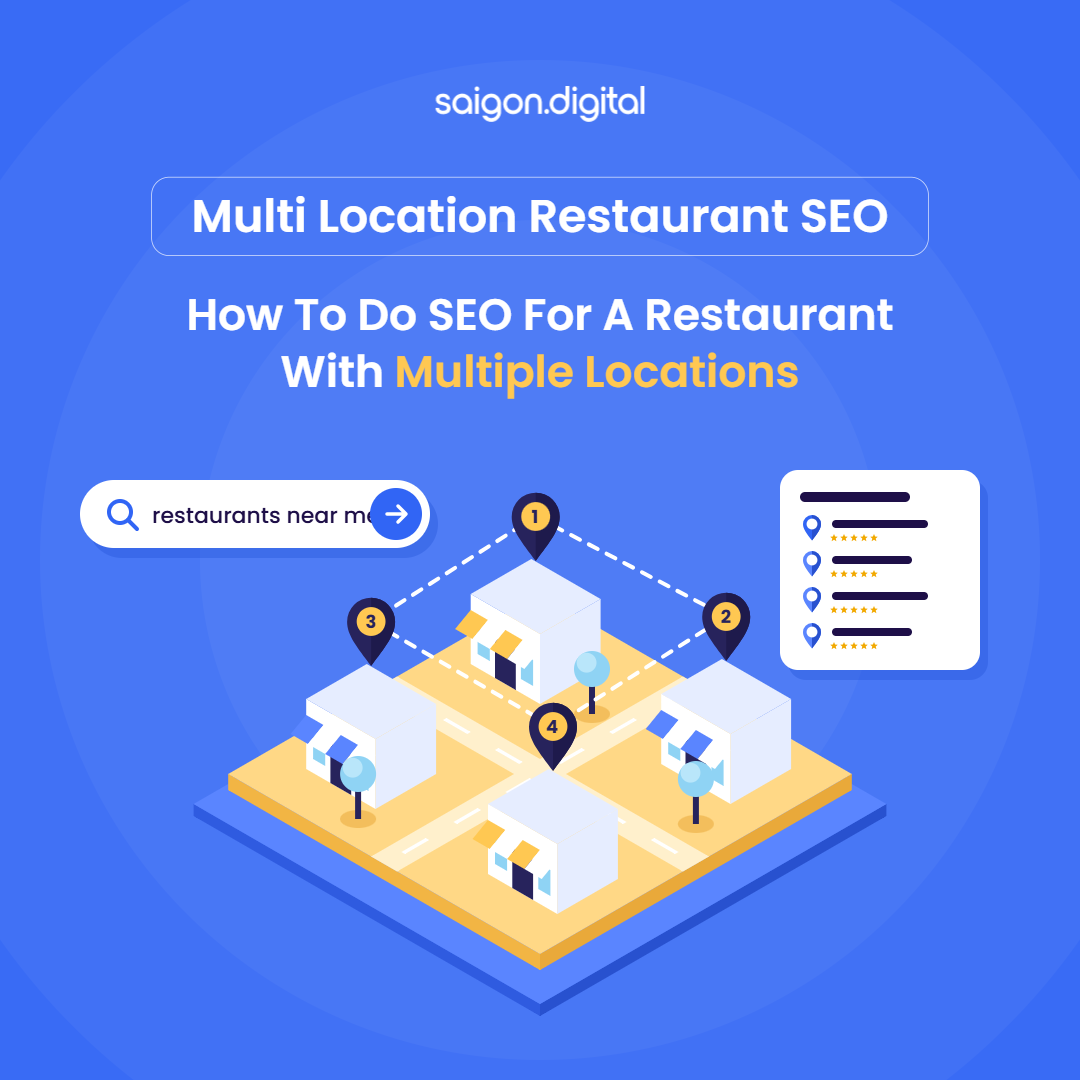
Multi location restaurant SEO decides which of your branches a hungry searcher actually sees first. Most restaurant groups optimise the brand, then wonder why individual venues stay invisible.
This guide shows you how to fix that, one location at a time.
Key Takeaways
- Every location competes on its own. Google ranks venues, not brands, so each branch needs its own profile, its own page and its own reviews.
- Duplicate location pages are the most common failure. If your pages differ only by address, Google will pick one and bury the rest.
- AI search now sits above the map pack. Fewer local businesses get surfaced in AI answers than in the classic three-pack, so structured data and reviews matter more than ever.
- This is an operations problem as much as a marketing one. The groups that win have a clear split between what head office controls and what each venue manager handles.
- Report by location, never only by group. Brand-level traffic hides the two or three branches quietly losing calls, bookings and orders every month.
What Is Multi Location Restaurant SEO?
Multi location restaurant SEO is the practice of making every individual venue in a restaurant group visible in its own local market, while keeping one consistent brand across all of them. It combines Google Business Profile management, dedicated location pages, structured data, review generation and per-location reporting into a single repeatable system.
Put simply, you are not running one SEO campaign. You are running the same campaign five, twenty or two hundred times, with local variation in each one.
How It Differs From Single Location SEO
A single restaurant has one address, one phone number, one set of opening hours and one Google Business Profile. Everything points in the same direction, so effort compounds quickly.
A group has none of that simplicity. Each venue has its own competitors, its own neighbourhood searchers, its own review profile and often its own manager with their own way of doing things. Therefore, the work shifts from tactics to systems. You stop asking "what should we publish next?" and start asking "what does every location need, and who makes sure it happens?"
Because of that shift, the skills involved look closer to enterprise SEO than to small business marketing, even for a group with only four venues.
The Two Forces You Are Always Balancing
Every decision in multi location work pulls between two poles:
- Brand consistency. Guests should recognise your group instantly, whichever venue they find. Consistency also protects your entity signals, which is how search engines and AI assistants understand that all your venues belong to one trusted brand.
- Local relevance. Google rewards pages that clearly belong to a specific place. Neighbourhood references, local landmarks, venue-specific menus and genuine local photography all lift a location page above a generic template.
Lean too far towards consistency and your pages become interchangeable. Lean too far towards local freedom and your brand fragments across twenty inconsistent listings. The answer, as we explain later, is a deliberate split of ownership rather than a compromise on either side.
Why Local Search for Restaurant Groups Changed in 2026
Before you touch a single listing, it helps to understand what has actually changed. The fundamentals of local SEO still apply, but the surface where guests see your restaurant has moved.
AI Answers Now Sit Above the Map Pack
When somebody searches "best ramen near me" or "brunch in District 1", Google increasingly answers the question directly before showing any map results. Industry tracking through 2026 puts AI Overviews in front of billions of users every month, with a majority of searches now ending without a click because the answer appears on the results page itself.
That matters enormously for restaurants, because a guest deciding where to eat tonight rarely needs to visit a website. They need a name, a rating, a distance and an opening time.
Fewer Venues Get Surfaced Than Before
The bigger shift is compression. Studies of AI local packs in 2026 found they surface only around a third as many businesses as the traditional map pack does across the same queries. Where three venues used to appear, AI answers often name one or two, chosen for the completeness and trustworthiness of their online presence rather than proximity alone.
For a restaurant group, that turns an even spread of "reasonably good" listings into a liability. A venue with a thin profile no longer ranks fourth. It simply does not appear.
Reviews Became a Citation Source, Not Just a Ranking Signal
Review text is now read, summarised and quoted by AI systems when they assemble local recommendations. In practice, this means the words your guests use describe your restaurant to the machine. If twenty reviews mention "great for kids" and "quiet on weekday evenings", those phrases become part of how your venue is matched to queries.
Saigon Digital's view: reviews have quietly become the most under-managed asset in restaurant marketing. Groups spend heavily on photography and almost nothing on a system that asks every satisfied guest for a review, in the right language, at the right moment. That imbalance is now the easiest advantage to take.
What This Means Practically
Three implications follow, and they shape everything below:
- Profile completeness beats profile volume. Ten fully built profiles outperform forty half-finished ones.
- Structured data is no longer optional, because AI systems rely on it to extract facts confidently.
- Your weakest location now drags on group performance more than it used to, since it may vanish from results entirely rather than simply rank lower.
If you want to understand how your brand currently appears inside these AI answers, our guide to local AI SEO covers the tracking side in more detail.
Step 1: Get Your Location Data Right Before Anything Else
Everything else you build sits on top of your location data. If the underlying facts are wrong or inconsistent, no amount of content will rescue your rankings, because search engines will not trust conflicting signals about the same business.
Fix NAP Consistency Across Every Branch
NAP stands for Name, Address and Phone number. The rule is simple: these three details must match exactly everywhere they appear, including your website, Google Business Profile, delivery platforms, review sites and directory listings.
Exactly means exactly. "Street" and "St." are different strings to a machine. So are "Ho Chi Minh City" and "HCMC".
Here is how to run the audit in a way that a non-technical team can actually complete:
- Build a master sheet. One row per venue, with columns for the official name, full address, phone number, opening hours and website URL. This becomes your single source of truth.
- Search each venue by name plus city. Record every listing you find in the first three pages of results.
- Compare each listing against the master sheet. Flag any mismatch, however small.
- Fix in priority order. Google Business Profile first, then major aggregators and delivery platforms, then directories, then everything else.
Naming deserves one extra rule. Use the same brand name for every venue and never add keywords, but do allow Google to associate a location descriptor through the address rather than the title. "Pho House" at three addresses is correct. "Pho House Best Pho District 3" risks suspension.
Claim One Google Business Profile per Physical Venue
Your Google Business Profile is the single most important asset each venue controls, because it feeds the map pack, Google Maps and increasingly the AI answers above them. Each physical venue needs exactly one profile, verified by someone who still works for your company.
Choose Categories Carefully
Your primary category carries more weight than almost any other setting. Pick the most specific option that genuinely describes the venue. A Japanese restaurant serving mainly ramen should choose "Ramen restaurant" rather than "Restaurant", because specificity helps Google match you to narrower, higher-intent queries.
Add secondary categories for genuine offerings, such as "Vegan restaurant" or "Bar", but resist the urge to add everything remotely related. Irrelevant categories dilute relevance rather than expanding reach.
Keep Hours, Attributes and Holiday Hours Current
Hours drift is the most common and most damaging data error in restaurant groups. A guest who arrives at a closed restaurant leaves a one-star review, and Google notices when users repeatedly correct your hours.
Set a recurring calendar task to update holiday hours before every major local occasion. In Vietnam that means Tet above all. In the UK it means bank holidays. In the United States it means Thanksgiving and Independence Day weekends. Regional teams should own this because only they know which venues actually close.
Attributes matter more than most operators expect, since AI systems and filtered searches read them directly. Complete every relevant one: outdoor seating, wheelchair access, reservations accepted, delivery options, payment methods and dietary provisions.
Post and Upload Photos per Venue, Not per Brand
Uploading the same twelve brand photographs to every profile is a missed opportunity. Google and your guests both respond to images that clearly show that specific room, that specific street frontage and that specific dish as it is plated in that kitchen.
Aim for a small, sustainable cadence rather than a burst: a handful of fresh photos per venue each month, plus one Google Post covering an offer, event or seasonal menu. If you want to go further with image and location signals, our guide to geotagging explains how location data attached to your media supports local visibility.
Hunt Down Duplicate and Orphaned Listings
Restaurant groups accumulate ghost listings. A venue relocates and the old address stays live. A franchisee creates a second profile because they lost access to the first. An aggregator auto-generates a listing from a delivery menu.
Each duplicate splits your signals, your reviews and sometimes your traffic. Search Google Maps for your brand name in every city you operate in, list every result, and either claim, merge or report each duplicate. This is unglamorous work, but it routinely produces the fastest ranking improvements we see on new multi location accounts.
Step 2: Build a Location Page Architecture That Scales
With your data clean, the next job is your website. Your Google Business Profile gets you into the map pack, but your location pages are what allow each venue to rank organically, feed AI systems detailed information and convert searchers into bookings.
Use a Three-Level Structure
The structure that works consistently is a simple hierarchy:
- /locations/ is a crawlable hub listing every venue with its name, neighbourhood and a link.
- /locations/city/ gathers all venues in one city, which lets you rank for "brand name + city" queries.
- /locations/city/venue-name/ is the individual page that does the heavy lifting.
Two technical warnings apply here. First, the locator must be crawlable as text and links, not rendered only inside an interactive map widget, otherwise search engines may never find your venue pages. Second, skip the city level only if you genuinely have one venue per city, because an empty middle tier adds clicks without adding value.
If your group is large enough that the locator itself spans several pages, review your technical SEO checklist before launch to confirm crawl paths, canonical tags and mobile rendering all behave as intended.
Define What Belongs on Every Location Page
Give your team a template so that quality does not depend on who writes the page. We divide the template into two halves.
The Non-Negotiables (Identical in Structure, Different in Content)
- H1 containing the brand name and the location, for example "Pho House Thao Dien".
- Full NAP details in crawlable text, not inside an image.
- Opening hours, including any kitchen-closing time that differs from the venue-closing time.
- An embedded map plus written directions from a recognisable local landmark.
- The venue's own menu, in text rather than as a PDF, since PDFs are harder for search engines and AI systems to parse reliably.
- Clear booking, ordering and calling actions above the fold on mobile.
- Three to five FAQs specific to that venue.
The Local Differentiators (Genuinely Unique per Venue)
- A description of the room, the atmosphere and who the venue suits, written by someone who has been there.
- Neighbourhood context: nearby landmarks, transport links, parking realities and which office towers or schools sit close by.
- Venue-exclusive dishes, set menus or happy hour timings.
- Local events the venue hosts or takes part in.
- Original photography of that venue, including the entrance as it appears from the street.
- A selection of reviews left for that specific branch.
Avoid the Duplicate Content Trap
This is where most restaurant groups lose. If all twelve of your location pages open with the same 300-word brand story and differ only in the address block, Google treats them as near-identical, consolidates them and ranks one while suppressing the rest. Our guide to duplicate content explains the underlying mechanics in full.
As a working rule, aim for a page that is roughly 60% unique to the venue and 40% shared brand content. In practice, that usually means 250 to 400 genuinely original words per page alongside your standard brand and contact blocks.
Saigon Digital's view: the cheapest way to hit that ratio is to interview each venue manager for fifteen minutes. Ask what guests always ask, which dish surprises people, what the neighbourhood is like at 7pm on a Tuesday, and who walks in most often. You will get more distinctive, more useful copy in fifteen minutes than a copywriter could invent in an afternoon.
Link Your Pages Together Deliberately
Internal links tell search engines how your locations relate. Each venue page should link up to its city page and back to the locator hub. City pages should link down to every venue they contain. Where venues are genuinely close together, cross-link them with useful anchor text such as "our Thao Dien venue" so guests can find an alternative when one branch is fully booked.
Location FAQs also deserve structure rather than a loose list of questions. Our guide on how to structure FAQ content covers the formatting that AI systems parse most reliably.
Step 3: Add Structured Data for Every Venue
Structured data is code that states your facts explicitly rather than leaving search engines to infer them from your page copy. For restaurant groups it is especially valuable, because it is how you tell a machine that twelve separate addresses belong to one brand.
Mark Up Each Location as a Restaurant
Every venue page should carry Restaurant schema, which is a more specific type of LocalBusiness. Include the name, full address, geographic coordinates, telephone number, opening hours, price range, served cuisine, menu URL and accepted reservation details. Our guide to local business schema walks through the syntax step by step if you are implementing this yourself.
Connect Each Venue to the Parent Brand
Two properties do the connective work. Give each venue a unique @id, usually its own page URL, so that every reference across your site points at the same entity. Then use parentOrganization on each venue to point back at your group's Organization markup on the homepage.
Done properly, this builds a clean entity graph: one brand, many venues, each independently identifiable. That structure is exactly what AI systems need in order to recommend the right branch to the right searcher.
Mark Up Menus, Bookings and Ordering
Three additions repay the effort quickly:
- Menu markup lets search engines read your dishes, sections and prices, which supports dish-level queries such as "burrata salad District 2".
- Reservation and order actions declare where guests can book or order, which increases the chance that Google surfaces your own booking path rather than an aggregator's.
- Breadcrumb markup on locator, city and venue pages helps both users and crawlers understand where each page sits.
Validate every implementation before launch, and validate it again after any template change, since a single malformed field can invalidate the whole block.
Step 4: Build a Review System, Not a Review Habit
Reviews influence local rankings, conversion and AI citations simultaneously, which makes them the highest-leverage recurring task in the whole programme. The problem is that most groups treat reviews as something venue managers do when they remember.
Set a Velocity Target per Venue
Recency and steadiness matter more than a large historic total. A venue with 180 reviews and none in six months looks less alive than one with 60 reviews arriving every week.
Set a modest, achievable target for every venue, such as eight to twelve new reviews a month, and track it on the same dashboard as covers and revenue. Make the ask easy at the moment of highest satisfaction: a QR code on the bill folder, a line in the post-visit message, or a card handed over with the change.
Respond to Everything, in the Guest's Language
Response rate is a visible quality signal and a genuine differentiator, because most restaurants ignore all but the worst reviews. Reply to every review within a few days, in the language the guest used.
For international groups operating in Vietnam, that usually means English and Vietnamese, and sometimes Korean or Japanese depending on the neighbourhood. Responses written in the wrong language read as automated and undermine the trust the review was meant to build.
What Not to Do
- Never buy reviews. Detection now looks at device clustering, IP patterns and timing, and enforcement sweeps remove large batches at once, which can drop a venue out of the map pack within days.
- Never incentivise positive reviews specifically. Asking for a review is fine. Offering a free dessert for a five-star review is not.
- Never copy and paste the same response to every review, because identical replies signal indifference to both guests and machines.
Step 5: Deal With Delivery Aggregators Honestly
Search "your brand + delivery" and you will often find Grab, ShopeeFood, Deliveroo, Uber Eats or DoorDash ranking above your own location pages. Those platforms carry enormous domain authority and publish a page per venue, which means they compete with you on your own brand terms.
Why This Happens
Aggregators win because they satisfy the query faster. A guest searching for delivery wants a menu, prices and an order button. If your location page buries ordering behind two clicks, the aggregator page is objectively the better result.
How to Reclaim Direct Orders
- Put ordering above the fold on every venue page, with delivery radius and typical timing stated plainly.
- Add your own ordering URL to each Google Business Profile so Google can link guests directly to you.
- Publish your full menu as text on your site, so your page can compete on dish-level searches rather than only on brand searches.
- Give guests a reason to order direct, such as a loyalty scheme or a modest discount, and say so on the page.
- Keep aggregator listings accurate anyway, since inconsistent hours or menus there still confuse both guests and search engines.
A per-market review of who actually outranks you, using the approach in our guide to SEO competitor analysis, will usually reveal that your real competitor is a platform rather than another restaurant.
Step 6: Adapt When You Operate Across Multiple Countries
Most guides on this topic assume a single-country chain. International restaurant groups, including those expanding into Vietnam from Europe, Australia or North America, face a harder version of the problem.
Structure URLs and Languages Deliberately
Decide early whether markets sit in subfolders, such as /vn/ and /uk/, or on separate domains. Subfolders are usually the stronger choice for restaurant groups, because they concentrate authority on one domain rather than forcing each market to earn trust from scratch.
Where you publish the same page in two languages, implement hreflang so that Vietnamese speakers receive the Vietnamese version and English speakers the English one. Without it, the two versions compete with each other and dilute both.
Accept That Local Search Behaviour Differs
Search habits are not universal, and assuming otherwise is expensive. In Vietnam, a significant share of restaurant discovery happens on Facebook, Zalo, TikTok and delivery apps rather than on Google alone, and Vietnamese searchers frequently type without diacritics. In Japan and South Korea, different platforms dominate again.
Therefore your keyword research must be done per market rather than translated. Our guide on how to choose keywords for SEO covers the research method, but the principle here is simple: research in the language your guests actually search in, using local search data.
Translate Menus Without Losing the Search Term
Dish names create a genuine dilemma. Guests search for "pho" rather than "Vietnamese beef noodle soup", but they also search for "banh mi" and "bánh mì" in roughly equal measure depending on their keyboard.
The practical approach is to lead with the name your guests use, then explain it. "Bún chả: grilled pork with rice noodles and herbs" captures both the branded dish term and the descriptive phrase a newcomer might type.
Step 7: Decide Who Owns What
A multi location programme fails on ownership far more often than on tactics. Centralise everything and local nuance disappears while the queue grows. Devolve everything and quality becomes a lottery.
The Hybrid Split That Works
A division we recommend to most groups looks like this:
| Head office or agency owns | Venue manager owns |
| Strategy, keyword research and templates | Review responses |
| Location page builds and technical SEO | Weekly photo uploads |
| Structured data and site architecture | Holiday hours and short-term closures |
| NAP audits and citation management | Local event and offer information |
| Reporting and prioritisation | Community and neighbourhood relationships |
The logic is straightforward. Centralise anything that requires specialist skill or must be identical across venues. Devolve anything that depends on knowledge only the people in the room possess.
Be Realistic About the Workload
Here is the part most articles leave out. Multi location work is not intellectually difficult, but it is relentless. For a twenty-venue group, a typical month includes twenty profile checks, roughly two hundred review responses, twenty photo uploads, twenty Google Posts, a NAP spot-check, location page updates and a per-venue report.
That is a part-time role at minimum, and a full-time one for larger groups. It is also work that stops producing results the moment it stops happening, which is why so many restaurant groups start strong and drift within a quarter.
Why Offshore Delivery Suits This Work Particularly Well
Saigon Digital's view: recurring, high-volume, process-driven work is exactly where an offshore team earns its keep. The work needs consistency and capacity more than it needs a senior strategist in London or Sydney reviewing every photo upload. A Vietnam-based team can run the full operating rhythm across every venue for a fraction of the cost of an equivalent in-house hire or domestic agency retainer in a first-world market, while the strategic decisions stay with you.
We work this way across borders regularly. Our project with Saigon Baigur, a premium Vietnamese gin brand, involved building a bilingual English and Vietnamese site with a strong SEO and performance foundation, which is the same dual-language discipline an international restaurant group needs in Vietnam. Our work with Ski.com, a destination-led travel brand, applied the same location-page thinking at scale across many destinations. You can browse both on our case studies page.
If you are weighing this model against hiring locally, our guide to SEO outsourcing sets out how the arrangement works in practice.
Step 8: Measure Multi Location Restaurant SEO Properly
Group-level reporting is comforting and misleading. Total organic traffic can rise 15% while three venues quietly lose a third of their calls, because the strong branches mask the weak ones.
Report by Venue, Always
Build one row per venue and review it monthly. At minimum, track:
- Google Business Profile actions: calls, direction requests, website clicks and bookings, per venue.
- Map pack position for three to five priority queries in that venue's own neighbourhood, measured from a location near the venue rather than from head office.
- Location page traffic and conversions, where a conversion means a booking, an order or a call rather than a page view.
- Review volume, average rating and response rate, tracked monthly to expose drift.
- Share of brand searches that land on your page rather than an aggregator's.
Tag Every Link You Control
Add unique UTM parameters to the website link on each Google Business Profile, and to each venue's ordering link. Without this, all profile traffic collapses into one undifferentiated bucket in your analytics and you lose the ability to tell which venue is actually working.
Track AI Visibility Alongside Rankings
Because a growing share of discovery now happens inside AI answers, rankings alone understate or overstate your real position. Check periodically whether AI assistants recommend your venues for the obvious local prompts in each market, and record the result. Our guide on how to track AI visibility explains a repeatable method.
Set Expectations on Timing
Data fixes such as duplicate listings and wrong hours often show results within weeks. New location pages typically need two to three months to settle, and competitive urban markets take longer. Our guide to the SEO results timeline sets out realistic milestones by stage.
A 90-Day Rollout Plan for Restaurant Groups
If the scope above feels large, sequence it. The order below front-loads the work that pays back fastest.
Days 1 to 30: Fix the Foundations
- Build the master location sheet and confirm every detail with venue managers.
- Claim, verify and complete every Google Business Profile.
- Find and resolve duplicate or orphaned listings.
- Correct hours, categories and attributes everywhere.
- Establish baseline reporting per venue so you can prove progress later.
Days 31 to 60: Build the Assets
- Design the location page template and agree the unique-content ratio.
- Interview venue managers and write genuinely local copy for each page.
- Launch the locator, city and venue page structure with internal links in place.
- Implement Restaurant schema, parentOrganization links, menu and booking markup.
- Start the review generation system at every venue.
Days 61 to 90: Run the Rhythm
- Establish the monthly cadence of posts, photos and review responses.
- Review per-venue performance and identify the three weakest branches.
- Run a competitor check per market, including aggregators.
- Begin local link and citation building for the weakest venues first.
- Report, prioritise and repeat.
Common Mistakes That Quietly Cost Restaurant Groups Traffic
- One page listing all locations. A table of addresses cannot rank for any individual neighbourhood.
- Template copy with the city name swapped in. Machines detect this instantly, and so do guests.
- Keyword-stuffed profile names. A short-term ranking gain against a real risk of suspension.
- Menus published only as PDFs. Hard to parse, hard to read on mobile and invisible for dish-level searches.
- Profiles verified by former employees. Access recovery can take weeks at exactly the wrong moment.
- Launching and stopping. Local signals decay. A profile that goes quiet loses ground to one that does not.
- Reporting only at group level. The single most reliable way to miss a failing venue for six months.
Multi Location Restaurant SEO Rewards Systems, Not Heroics
Ranking a restaurant group is not about finding a clever tactic. It is about deciding what every venue must have, building it once as a template, and then making sure it happens every month across every location without exception.
Get the data right, give each venue a page that could only describe that venue, mark it all up so machines can read it, and keep reviews arriving steadily. Then report by location so the weak branches surface early rather than after a bad quarter. That is the whole system, and it works whether you run three venues or thirty.
At Saigon Digital, we build and run exactly this kind of programme for international brands, combining senior strategy with the delivery capacity that multi location work demands, at Vietnam-based cost. If you operate a restaurant group and want your locations found in both local and AI search, contact us for a conversation about what your current setup is missing.
Frequently Asked Questions About Multi Location Restaurant SEO
1. How many Google Business Profiles does a restaurant group need?
One per physical venue where guests can eat, with no exceptions. Do not create separate profiles for a delivery-only service at the same address, and do not run a single profile covering several branches. If you operate a ghost kitchen with no guest access, Google's guidelines treat it differently, so check the current rules for that model before creating a listing.
2. Should each restaurant location have its own website?
Almost never. Separate domains split your authority, multiply your maintenance work and force every venue to build trust from zero. A single domain with a clear locator, city and venue page structure concentrates authority while still allowing each venue to rank in its own market. The exception is a group running genuinely distinct brands rather than one brand in several places.
3. How much unique content does each location page really need?
Aim for roughly 250 to 400 genuinely original words per page, covering the room, the neighbourhood, venue-specific dishes and local FAQs, alongside your shared brand blocks. What matters is distinctiveness rather than length. A short page describing real local detail outperforms a long one built from swapped city names.
4. How long does multi location restaurant SEO take to work?
Data corrections such as duplicate listings, wrong hours and missing categories often show results within two to six weeks. New location pages generally need two to three months to settle and three to six months to compete properly in dense urban markets. Groups starting from a poor baseline usually see the sharpest early gains, because the foundational fixes remove active problems.
5. Can one person manage SEO for ten or more restaurant locations?
One person can maintain roughly ten to fifteen venues once the system is built, provided venue managers handle reviews, photos and hours locally. Building the system in the first place, including page templates, structured data and audits, needs specialist skill and more capacity. This split is the reason many international groups keep strategy in-house and delegate ongoing execution to an offshore team.
6. Do delivery platforms like Grab or Deliveroo hurt my restaurant's SEO?
They do not damage your rankings directly, but they compete with you for your own brand searches and capture orders you could take yourself. The fix is not to leave those platforms. It is to make your own venue pages faster to act on, with visible ordering, a text menu and your direct ordering link added to every Google Business Profile.
Want to be the brand AI engines recommend?
We make businesses visible on Google and inside AI answers, measured in leads, not vanity metrics.