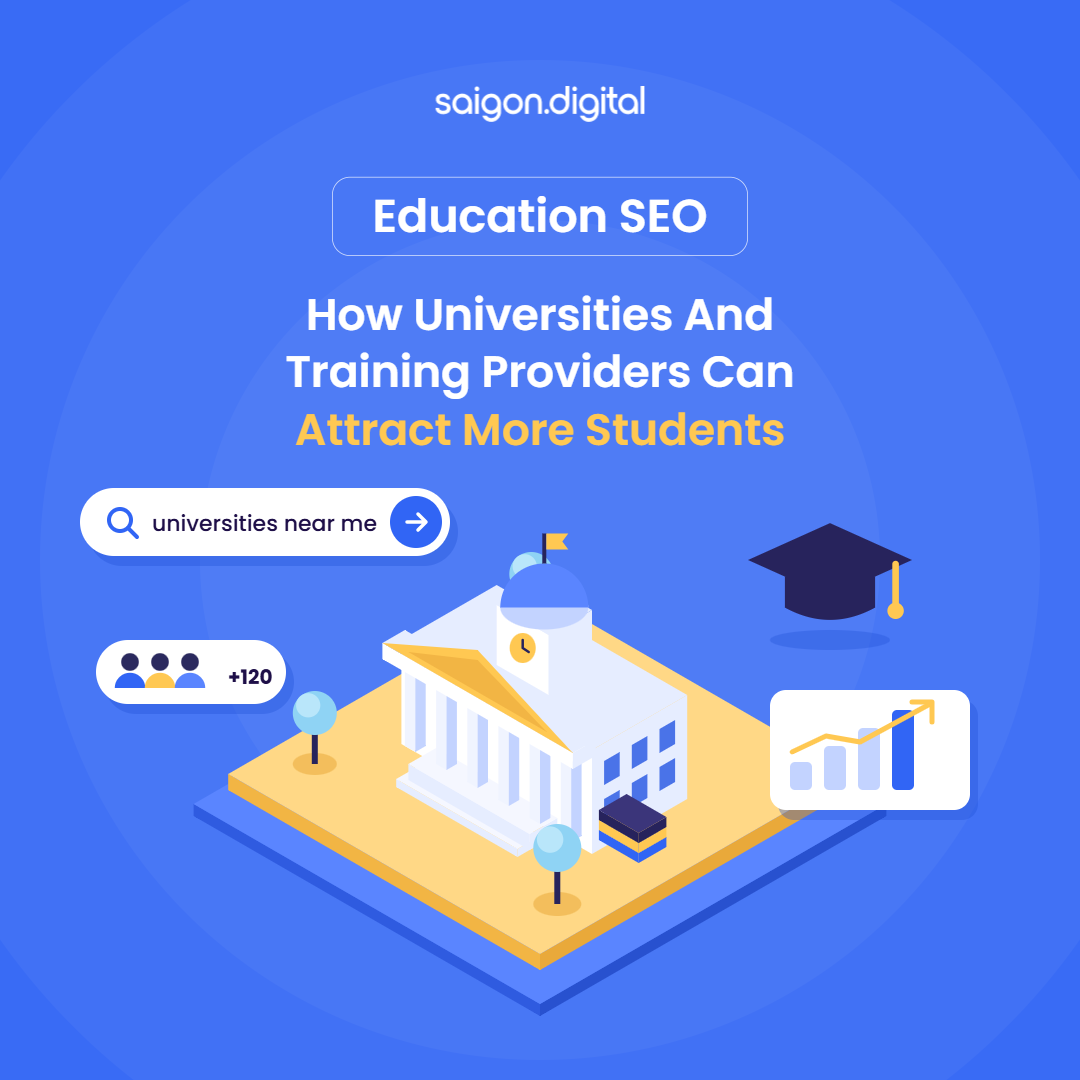
Education SEO is how universities, colleges, international schools and training providers earn visibility when prospective students and parents search on Google. Search is now the first stop in almost every enrolment journey.
Most education websites are large, complex and built around dozens of near-identical programme pages. That combination makes education SEO genuinely harder than SEO for a typical small business site, and it is why so many strong institutions still rank poorly.
This guide sets out what education SEO actually involves, how student and parent search behaviour differs from other industries, and what a working strategy looks like in 2026, including for institutions recruiting across borders.
Key Takeaways
- Education SEO covers universities, colleges, international schools, training providers and EdTech platforms, but each type of institution needs a different strategy because the audience, funnel and competition are different.
- Programme and course pages, not the homepage, do most of the work. A single dedicated page per programme, built for search rather than as a downloadable prospectus, is the foundation everything else sits on.
- Several structured data types education sites once relied on, including the detailed Course rich result and FAQ rich results, have been retired by Google. Structured data is still worth implementing, but for AI and entity clarity rather than for a guaranteed search snippet.
- International and cross-border recruitment is one of the most underused opportunities in education SEO, particularly for institutions operating in growth markets such as Vietnam.
- Local SEO, technical site health and content built around real student questions matter as much in education as they do in any other sector, and are frequently the weakest part of an otherwise strong institution's website.
What Is Education SEO?
Education SEO is the practice of optimising a school, university, college or training provider's website so it ranks for the searches that prospective students, parents and, in some cases, employers, run before they enquire or apply. It sits across technical SEO, on-page optimisation, content strategy and, increasingly, visibility in AI-generated answers.
The term covers a wide range of institutions: universities and colleges recruiting undergraduates and postgraduates, international schools recruiting expat and local families, vocational and training providers recruiting career-changers, and EdTech platforms recruiting self-directed learners. Each of these groups searches differently, which is the first thing that makes education SEO harder than it looks.
Why Education SEO Is Different From Other Industries
Universities, Colleges, International Schools and Training Providers Are Not the Same Audience
A university competing for a computer science undergraduate is fighting a completely different search battle to an international school competing for a family relocating to Ho Chi Minh City. The university needs subject authority, research visibility and hundreds of well-built programme pages. The school needs strong local signals, admissions clarity and content that answers the practical questions a relocating parent actually has.
Treating all education content the same way, which is common in generic SEO advice, produces a website that half-serves both audiences and ranks well for neither.
Long, Multi-Stage Decision Journeys
Very few people enrol on the first visit to an education website. A parent researching international schools, or a student comparing degree programmes, typically returns to the same institution's site multiple times across weeks or months, alongside visits to several competitors. That means content has to serve early research, mid-journey comparison, and late-stage decision-making, not just the moment someone is ready to apply.
The International and Cross-Border Dimension
Most education SEO advice available online is written for a single domestic market, usually the United States or the United Kingdom. It rarely addresses institutions that recruit across borders: an international school attracting expat families from several countries, or a training provider marketing to students in a market it does not physically operate in.
This is a genuine gap, and it is where institutions operating in international hubs such as Vietnam have an underused advantage. A well-optimised site can capture search demand from parents and students researching a move to the region long before they arrive, not just once they land.
How Students and Parents Actually Search
Search intent in education shifts noticeably as a prospective student or parent moves through their decision.
Early-Stage Research Queries
At this stage, queries tend to be broad and comparative: which curriculum is best for my child, what can I do with a marketing degree, is a bootcamp worth it. This is informational intent, and it is best served by genuinely useful guides rather than admissions pitches.
Comparison-Stage Queries
Once a shortlist starts forming, searches become named and specific: institution against institution, curriculum against curriculum, fees compared across two or three options. Getting proper keyword research right at this stage means mapping the actual comparisons your audience is making, not just the terms an institution would prefer to be found for.
Decision-Stage Queries
Close to applying, searches turn practical: entry requirements, application deadlines, term dates, visa and relocation questions for international families. Building content around genuine question keywords at this stage, rather than a generic FAQ bolted on for SEO purposes, is one of the highest-value and most neglected parts of education content.
Building a Site Structure That Supports Education SEO
One Page Per Programme, Not a Digital Prospectus
The single most common structural failure in education SEO is hiding programme detail inside a downloadable PDF prospectus. PDFs rank poorly, extract badly into AI-generated answers, and are frustrating to read on a phone, which is how most prospective students and parents are browsing. Every programme, course or campus that can realistically attract its own search demand deserves its own indexable web page, with the PDF offered as a supplement rather than the main event.
A programme page that actually converts tends to follow a predictable shape: a clear heading naming the programme, an opening paragraph that states what it is and who it suits, then the detail prospective students search for, including modules or curriculum, entry requirements, outcomes, fees, and a clear path to apply or enquire.
Avoiding Duplicate and Templated Programme Pages
Universities and larger training providers often run into a second, related problem: dozens of programme pages that are templated so heavily they read as near-identical to search engines. This is a form of duplicate content, and it dilutes the ranking potential of every page involved rather than just the weakest one. Large course catalogues also frequently mishandle listing pages, which is where sensible pagination in SEO practice matters, so that browsing a course list does not create dozens of thin, competing URLs.
The fix is not a template rewrite alone. Each page needs genuinely distinct information: real outcomes data, specific entry requirements, and detail that could only apply to that particular programme or campus.
Local SEO for Every Campus
For international schools, hospitality-adjacent training providers, and any institution with a physical campus, local SEO is one of the most underused channels in education marketing. Searches such as "international schools near me" or "training providers in Ho Chi Minh City" are high-intent, and most education websites are not competing seriously for them. Every physical campus needs its own accurate, verified Google Business Profile, and its own local landing page where the institution has more than one site.
Internal Linking and Crawlability
Education websites are frequently among the largest and most technically complex sites in any given sector, sometimes running to thousands of pages across faculties, campuses and course variants. A proper technical SEO checklist and a disciplined approach to on-page SEO matter more here than in almost any other vertical, simply because of the scale involved. Subdomain sprawl across faculties, libraries and alumni portals, along with fragmented content management systems, is one of the most common reasons a genuinely strong institution still underperforms in search.
On-Page SEO for Programme and Course Pages
What a High-Converting Programme Page Needs
Beyond the basics of a clear heading and a strong opening paragraph, the programme pages that perform well share a few consistent traits: they answer the practical questions a student actually has, they include real outcomes and destination data rather than marketing language, and they link naturally to adjacent programmes and to the campus or faculty page that gives them context.
Structured Data for Education in 2026: What Still Works
Structured data for education has changed significantly, and it is worth being precise about what remains useful.
What Google Retired
Google retired the detailed Course rich result, the version that could display price, start date and instructor directly in search results, in June 2025. FAQ rich results were retired for the vast majority of websites in May 2026. Neither change affects rankings directly, since both were search-appearance features rather than ranking signals, but they do mean the old justification for implementing this markup, a visible snippet in the results page, no longer applies.
What Still Helps in 2026
That does not make structured data pointless for education sites. Organisation, BreadcrumbList and Article schema continue to produce rich results where relevant, and correctly implemented EducationalOrganization and Course markup still helps search engines and AI systems understand what a page actually describes, which supports the kind of schema markup for AI search that increasingly determines whether an institution gets cited in an AI-generated answer. The honest framing for 2026 is that structured data on education sites is now an entity and AI-retrieval tool rather than a rich-snippet tactic, and it should be scoped accordingly.
Winning AI Search Visibility for Education Brands
Prospective students and parents increasingly research education decisions through AI tools as well as traditional search, asking a chatbot to compare curricula or summarise entry requirements rather than clicking through several results pages themselves. Being cited correctly in those answers depends on the same fundamentals as traditional SEO, applied more strictly: clear entities, accurate facts, and content structured so it can be extracted cleanly. The broader discipline here, answer engine optimisation, and the practical steps to improve AI search visibility, apply directly to education content, and a sensible internal linking structure is part of what makes that possible, as covered in our guide to site architecture for AI.
Why Education Sits Close to YMYL Territory
Education decisions carry real financial and life consequences for the people making them, which places the sector close to what Google calls YMYL, or Your Money or Your Life, content. That is a genuine reason to treat accreditation, inspection results, named academic staff and verifiable outcomes data as core SEO assets rather than as compliance details to mention in passing. Institutions that make this proof visible and easy to find tend to earn more trust from both search engines and the humans reading the page.
International Student Recruitment and the Cross-Border SEO Advantage
Why Vietnam-Based Education Providers Have a Genuine Opportunity
International schools and training providers based in fast-growing hubs such as Ho Chi Minh City are usually competing against larger, better-resourced institutions in the United States, the United Kingdom or Australia for the same pool of internationally minded families and students. What is less often recognised is that this can work the other way as well. Institutions based in Vietnam, and the agencies that support them, are often better placed than a Western competitor to understand exactly how an expat family, an FDI-backed employer relocating staff, or an international student actually searches when researching a move to the region.
It is our view at Saigon Digital that this local search knowledge, combined with properly built international SEO fundamentals, is one of the more defensible advantages an education provider based in Vietnam can build, precisely because so few competitors are writing for that specific searcher.
What This Looks Like in Practice
We have worked directly on this kind of engagement. Our SEO content work with The ABC International School, a British-curriculum school in Ho Chi Minh City with four consecutive BSO Outstanding inspection grades and over 95 percent university progression annually, has focused on building topical authority across its blog content and improving eligibility for AI Overview citations, alongside monthly organic reporting. Separately, our long-running content engagement with La Petite École Ho Chi Minh City, a French-English bilingual international school and part of the Odyssey Education group, is built around growing organic visibility both globally and locally within Vietnam, alongside a genuine bilingual content programme rather than a translated one. Full detail on both engagements, and others across the education sector, sits on our case studies page.
Content Strategy: What to Publish Beyond Programme Pages
Content Mapped to the Enrolment Funnel
A useful education content library mirrors the search behaviour set out earlier: broad, informational guides for early-stage researchers, named comparisons and outcomes data for the middle of the funnel, and highly practical, logistics-focused content, covering entry requirements, fees, visas and relocation, for anyone close to a decision. Publishing only prospectus-style pages leaves the entire top and middle of that funnel to competitors.
FAQs That Answer Real Questions
Even without a guaranteed rich-result snippet, a well-built FAQ section built around genuine question keywords remains one of the most efficient ways to capture the specific, practical questions prospective students and parents are typing into Google and into AI assistants. The content itself is doing the work, not the markup wrapped around it.
Choosing the Right Partner for Education SEO
Education SEO sits at the intersection of a technically demanding site, a genuinely long decision journey, and, for internationally minded institutions, a cross-border audience that most generalist agencies rarely serve well. Institutions weighing up an internal hire, a local agency, or an offshore specialist should treat this the same way they would any other significant vendor decision: our guide on how to choose an SEO agency sets out the right questions to ask before signing anything.
For institutions based in, or recruiting into, markets such as the UK, the US, Australia or Germany, working with a Vietnam-based team is also a genuine cost advantage over hiring locally or building an in-house function from scratch, without giving up senior-level delivery. Our overview of SEO outsourcing covers how that model actually works in practice.
Turning Search Visibility Into Enrolments
Education SEO rewards institutions that treat their website as genuinely different from a typical commercial site: larger, more technically demanding, and answering to a longer and more considered decision journey than almost any other sector. The institutions that build dedicated programme pages, get their technical foundations right, and publish content that answers real questions at every stage consistently outperform those still relying on a downloadable prospectus and a homepage.
If your institution is exploring what a proper education SEO strategy could look like, Saigon Digital works with universities, colleges, international schools and training providers on exactly this. Get in touch to talk through where your site currently stands and what the opportunity looks like for your institution.
Frequently Asked Questions
1. What is education SEO?
Education SEO is the process of optimising a school, university, college or training provider's website so it ranks well for the searches prospective students, parents and employers run when researching programmes, campuses and courses. It combines technical SEO, on-page optimisation for programme pages, local SEO for physical campuses, and increasingly, visibility within AI-generated search answers.
2. How long does it take to see results from education SEO?
Technical fixes and structured data corrections typically show measurable improvement within four to eight weeks. New or rebuilt programme pages usually start ranking within eight to twelve weeks, though competitive subjects can take longer. International recruitment content tends to move more slowly, often six to twelve months, since it depends on a longer overseas decision cycle.
3. Do universities still need FAQ schema or Course schema in 2026?
The detailed Course rich result was retired by Google in June 2025, and FAQ rich results were retired in May 2026, so neither markup type now guarantees a visible snippet in search results. Well-structured FAQ content and correctly implemented Course and EducationalOrganization markup are still worth having, but as a way to help AI systems and search engines understand a page accurately, not as a guaranteed rich-result tactic.
4. How is education SEO different for institutions recruiting internationally?
International recruitment adds a layer most domestic SEO advice ignores entirely: search behaviour that starts in a family or student's home country, months before any relocation. Institutions that build content addressing that earlier research stage, alongside the practical logistics of moving, visas and enrolment from abroad, capture demand that a domestically focused competitor typically misses.
5. Should an education provider hire a specialist education SEO agency?
It depends on the scale and complexity of the site and the recruitment goals involved. A small single-campus provider may manage well with a generalist freelancer or a focused in-house effort. A university, multi-campus training provider, or internationally recruiting international school generally benefits from a specialist agency that understands both the technical scale of education websites and the specific search behaviour of students and parents at each stage of a long decision journey.
Want to be the brand AI engines recommend?
We make businesses visible on Google and inside AI answers, measured in leads, not vanity metrics.