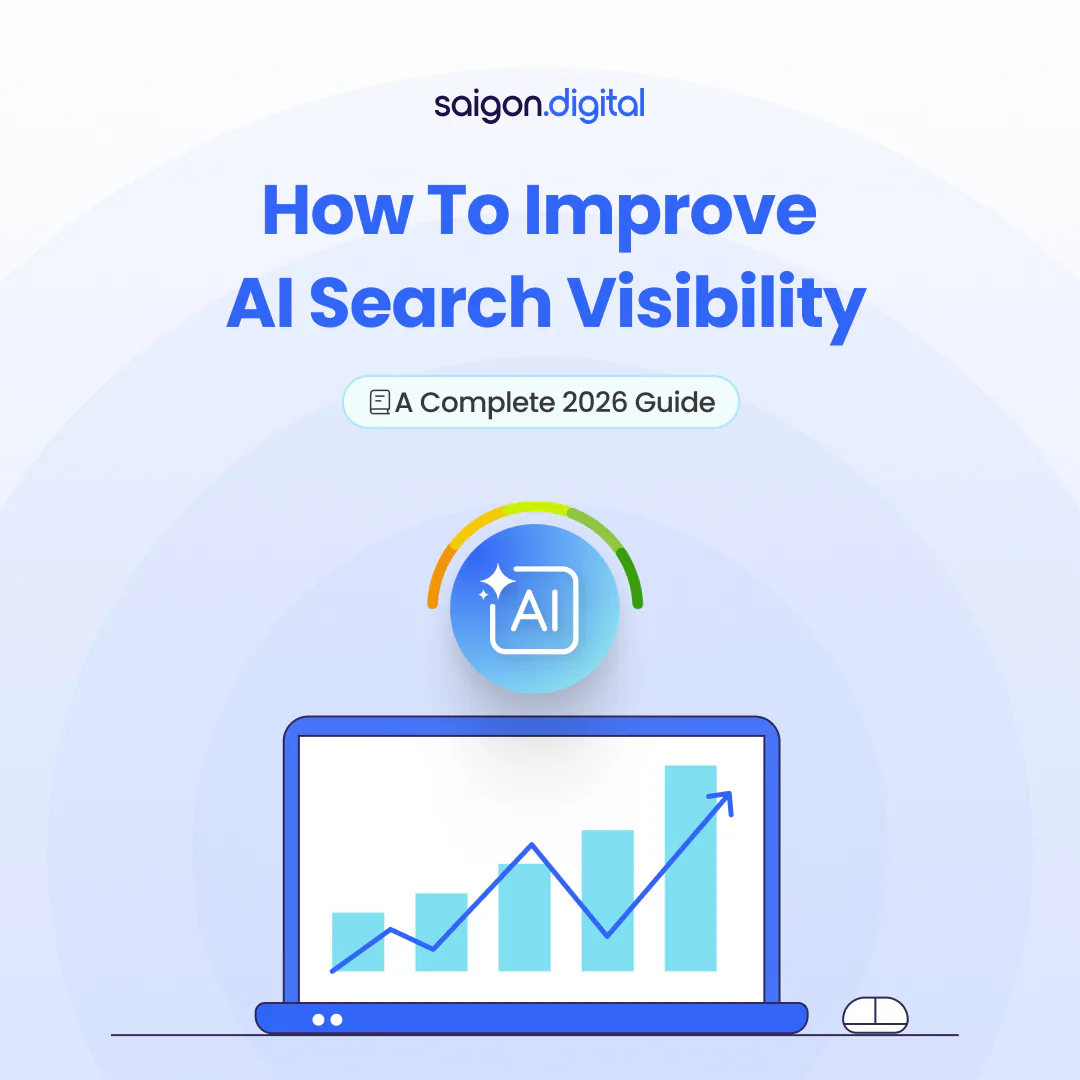
Knowing how to improve AI search visibility is now as important as knowing how to rank on Google. Tools such as ChatGPT, Gemini, Perplexity, Copilot and Google's AI Overviews answer questions directly, and the brands they cite or recommend win attention before a single click happens.
The good news is that AI visibility is not a mystery. It rests on four things you can control: whether AI systems can access your content, whether that content clearly answers real questions, whether your brand is trusted beyond your own website, and whether you measure and improve over time. This guide turns those into 13 practical steps.
Key Takeaways
- AI search visibility is how often, and how accurately, your brand appears in AI-generated answers.
- Google says there are no special optimisations or markup needed for AI Overviews or AI Mode. Strong SEO is the foundation.
- Off-site reputation matters most. An Ahrefs study of 75,000 brands found branded web mentions had the strongest correlation (0.664) with visibility in AI Overviews, ahead of backlinks.
- Crawler access matters. OpenAI states that sites blocking OAI-SearchBot will not appear in ChatGPT search answers.
- Answer-first, well-structured, citation-worthy content gives AI systems something worth quoting.
- Measure prompts, citations and mentions, not just rankings and traffic.
What Is AI Search Visibility?
AI search visibility is how often and how prominently your brand appears in AI-generated answers, including citations, recommendations and mentions. It is the outcome that generative engine optimisation (GEO) and answer engine optimisation (AEO) aim to improve. If you are unsure how these terms relate, read our guide to SEO vs GEO vs AEO.
It matters because fewer searches end in a click. Pew Research Center found users clicked a traditional result on 8% of visits with an AI summary, compared with 15% without one. If your brand is not part of the answer, it may never be considered.
How AI Search Engines Choose Which Sources to Cite
AI search differs from traditional search in one important way: instead of ranking pages, it assembles an answer and cites the sources it relied on. In simple terms, most AI search tools:
- Interpret the full question, including intent and context, rather than matching keywords.
- Break it into sub-questions. Google calls this query fan-out in AI Mode: one question triggers several related searches behind the scenes.
- Retrieve candidate pages from a search index, so pages that are not crawled and indexed cannot be cited.
- Pick the clearest, most trustworthy passages and combine them into one answer, with links to sources.
This means a single page that answers a question and its natural follow-ups is more useful to AI than several thin pages. Our explainer on how AI search engines work goes deeper.
Core Principles of AI Search Optimisation
| Principle | What it means in practice |
|---|---|
| Clarity Over Cleverness | Plain, direct language that states the answer. Puns and vague brand slogans are hard for AI to quote. |
| Authority and Trust Signals | Named experts, credible sources and consistent information about your brand across the web. |
| Contextual Relevance | Pages that target specific questions and intents, not broad keyword lists. |
| Structured Data Compatibility | Clear HTML structure and accurate schema that help machines understand what each page is about. |
How to Improve AI Search Visibility: 13 Steps
Here is how to improve AI search visibility in four phases. Work through them in order, because later steps depend on earlier ones.
Phase 1: Make Sure AI Can Find You
1. Make Sure AI Crawlers Can Access Your Content
If AI systems cannot crawl your pages, nothing else matters. Check your robots.txt, CDN and firewall settings for each crawler you care about. OpenAI, for example, uses OAI-SearchBot for ChatGPT search and a separate GPTBot for model training, so you can allow one and block the other. Our guide to AI crawlers explains the main bots.
- Allow Googlebot and Bingbot, which feed Google's AI features and Microsoft Copilot
- Decide deliberately on search crawlers such as OAI-SearchBot and PerplexityBot
- Serve key content in the HTML rather than relying only on JavaScript, since many AI crawlers do not render scripts
- Make sure important pages are indexed and eligible to show a snippet in Google
2. Build Topical Authority
AI systems favour sources that cover a subject in depth. Start by defining your focus: the problems you solve best, the topics you want to be known for, and the questions your ideal clients actually ask. Then build a pillar page for each core topic, supported by interlinked articles. A topical authority map helps you plan this without gaps or overlap.
Phase 2: Give AI Something Worth Quoting
3. Create Answer-First Content
Lead every section with a direct one or two sentence answer, then add detail, examples and context. AI tools often lift the opening lines of a section, so put the most important information there.
4. Optimise for Conversational Queries
People ask AI tools full questions, such as "Which SEO agency in Vietnam works with UK SaaS companies?", rather than short keywords. Collect real questions from sales calls, support tickets, reviews and People Also Ask, and answer them in natural language. Cover the follow-up questions too, because query fan-out means AI is looking for them.
5. Structure Content for Machines
- Use one clear H1 and descriptive H2 and H3 headings that match real questions
- Keep paragraphs to one idea each
- Use lists for steps and tables for comparisons
- Add FAQs where they genuinely help readers, following our guide on how to structure FAQ content
- Add accurate schema markup, such as Organization, Article, Product, LocalBusiness and BreadcrumbList, where it fits
6. Create Citation-Worthy Content
AI tools cite sources that add something others do not. The original research on generative engine optimisation found that adding statistics, quotations and citations to content improved its visibility in AI-generated answers. In practice, that means:
- Original data, surveys or benchmarks from your own work
- Named expert commentary and clear frameworks
- Case studies with real outcomes
- Sources cited for every important claim
Phase 3: Build Trust Beyond Your Website
7. Strengthen E-E-A-T Signals
Show who is behind your content and why they are qualified. Add author bios with credentials, a detailed About page, case studies and transparent contact details. Our guide to E-E-A-T for AI content covers how to keep these signals strong when AI is part of your workflow.
8. Earn Brand Mentions Beyond Your Website
This is where many brands fall short. In the Ahrefs study, branded web mentions correlated more strongly with AI Overview visibility than backlinks, domain rating or the number of pages on a site. Brands in the top quartile for mentions averaged 169 AI Overview mentions, compared with 14 for the next quartile down. Correlation is not causation, but the pattern is clear: AI reflects what the web says about you.
- Pitch expert commentary and original data to publications your audience reads
- Contribute to podcasts, industry roundups and partner content
- Keep listings on trusted directories, review sites and marketplaces accurate
- Take part genuinely in forums and communities such as Reddit and LinkedIn
- Encourage satisfied clients to leave detailed reviews
Our guide on how to boost brand authority with SEO covers this in more detail.
9. Keep Your Entity and Brand Information Consistent
AI systems build a picture of your brand from many sources. If your services, locations or descriptions differ across your website, Google Business Profile, LinkedIn and directories, that picture becomes blurred. Use the same name, positioning and core facts everywhere, and connect them with Organization schema and sameAs links. Read more in our guide to entity SEO.
10. Optimise for Local AI Search
For businesses with physical locations, keep your Google Business Profile complete and current, gather reviews and create location-specific pages. AI assistants increasingly recommend local businesses directly. See our guide to local AI SEO.
Phase 4: Keep Improving
11. Focus on Content Freshness
Review your most important pages regularly. Update statistics, add new questions and remove outdated advice. Show a clear "last updated" date so readers and AI systems can see the content is current.
12. Develop Multi-Format Content
Support key articles with images, diagrams, short videos and transcripts. Use descriptive alt text and captions. AI search is increasingly multimodal, and video platforms such as YouTube also appear among cited sources.
13. Monitor AI Mentions and Performance
Build a list of 20 to 50 prompts your buyers are likely to ask, then track how often your brand appears, how it is described and which competitors appear instead. Review the results monthly.
- Google Search Console includes AI Overviews and AI Mode clicks in its overall Web search data
- Bing Webmaster Tools now has an AI Performance report showing citations in Microsoft Copilot and Bing AI summaries
- GA4 referral reports show visits from ChatGPT, Perplexity, Gemini and Copilot
- Dedicated tools track mentions and share of voice; see our guides to tracking AI visibility, AI citation tracking and benchmarking AI visibility against competitors
Platform-Specific Tips
| Platform | What matters most | Quick win |
|---|---|---|
| Google AI Overviews and AI Mode | Being indexed, snippet-eligible and genuinely helpful | Strengthen pages that already rank on page one for target questions |
| ChatGPT search | OAI-SearchBot access, clear answers, third-party mentions | Check robots.txt and earn coverage on sites ChatGPT cites for your topic |
| Perplexity (how to appear in Perplexity) | Fresh, well-sourced, clearly structured pages | Update key guides and cite your sources |
| Microsoft Copilot | Bing indexing and authority | Verify your site in Bing Webmaster Tools and review the AI Performance report |
| Gemini | Google index, entities and brand information | Keep Google Business Profile and Organization details consistent |
For a wider view of what influences citations, read our breakdown of AI search ranking factors.
Quick Wins by Industry
| Industry | Focus first |
|---|---|
| B2B services and SaaS | Comparison and use-case pages, case studies, expert commentary in industry publications (AI visibility for B2B and SaaS) |
| E-commerce and retail | Product schema, detailed product content, reviews and marketplace listings (AI visibility for e-commerce) |
| Hospitality and F&B | Google Business Profile, reviews, menus and booking details, local press coverage |
| Education | Clear course, fee and admissions information, parent FAQs, expert-led guides |
AI Search Visibility Checklist
- Key AI and search crawlers can access important pages
- Priority pages are indexed and eligible for snippets
- Each core topic has a pillar page and supporting articles
- Sections open with direct answers to real questions
- Pages use clear headings, lists, tables and accurate schema
- Content includes original data, examples and cited sources
- Authors and company credentials are visible
- Brand facts are consistent across the web
- You are earning mentions on trusted third-party sites
- A prompt list is tracked monthly against competitors
Common Mistakes to Avoid
- Relying on shortcuts. Google says no llms.txt file or special AI schema is needed for its AI features.
- Accidentally blocking AI search crawlers while trying to block training crawlers.
- Writing for bots instead of people. Clear writing for humans is what AI quotes.
- Ignoring off-site reputation. What others say about you shapes AI answers.
- Measuring only traffic. Zero-click visibility still influences buying decisions.
How Long Does It Take to Improve AI Search Visibility?
Technical fixes, such as unblocking a crawler, can show results within days or weeks. Content and authority improvements usually take several months, because AI systems depend on search indexes and on how widely your brand is mentioned. Track trends over quarters rather than week-to-week changes.
Start Improving Your AI Search Visibility Today
AI search rewards brands that are easy to find, easy to understand and widely trusted. The earlier you build those foundations, the harder your position is for competitors to take.
Saigon Digital helps international businesses in the UK, US, Australia, Europe and across Asia grow visibility on Google and inside AI answers, measured in leads rather than vanity metrics. Explore our AI search optimisation and SEO services, or contact us for an AI visibility audit of your brand.
FAQs About How to Improve AI Search Visibility
1. What is the fastest way to improve AI search visibility?
Check that AI search crawlers can access your site, then rewrite your most important pages so each section opens with a clear, direct answer. These two steps often deliver the quickest gains.
2. Do I need an llms.txt file to appear in AI search?
Not for Google. Google says no special files or markup are needed for AI Overviews or AI Mode. Focus on crawlability, helpful content and authority instead.
3. Does traditional SEO still help AI visibility?
Yes. Most AI search tools retrieve information from search indexes, so pages that are crawlable, indexed and authoritative are far more likely to be cited.
4. Why does ChatGPT mention my competitors but not my brand?
Usually because competitors are mentioned more often on trusted third-party sites, describe their services more clearly, or have content that answers the question more directly. Audit the sources AI tools cite for your key prompts and close the gaps.
5. How do I measure AI search visibility?
Track a fixed list of buyer prompts across AI platforms, and monitor citations, mentions, sentiment and share of voice against competitors. Combine this with Search Console, Bing Webmaster Tools and GA4 referral data.
6. Is AI search visibility the same as GEO?
Not quite. AI search visibility is the outcome. GEO is the practice of improving it, alongside AEO and traditional SEO.
Want to be the brand AI engines recommend?
We make businesses visible on Google and inside AI answers, measured in leads, not vanity metrics.