Saigon Digital helps international schools with three things: the technology platforms they run on, the data they make decisions with, and the digital channels that drive enrolment. This post is what five years of that work has taught us, told through the projects themselves.
I co-founded Saigon Digital, and over the past five years education has become one of our most valuable sectors. We have built a student assessment platform for a school in the Nord Anglia Education network, run SEO programmes for boutique international schools, and replatformed an education nonprofit that operates in 36 countries. Being based in Ho Chi Minh City keeps us close to one of the most competitive international school markets anywhere, and we have spent years talking to the people who run them: heads of school, admissions directors, marketing managers and founders.
One pattern sits underneath all of it, so I will start there.
Why do schools need more than a marketing agency?
Because most of the "marketing problems" schools bring to us are not marketing problems.
A school that Vietnamese parents cannot find in local search has a content and technical problem. An admissions team that cannot say which channel produced last term's enquiries has a data problem. Teachers running reading assessments by hand across hundreds of students have a technology problem. In every one of those cases, buying more marketing on top would have meant pouring budget into a machine that was not working.
We are a technical team first. We design and build platforms, not just campaigns, so when a school says "we need more enrolments", we look at the whole system: what the school runs on, what it can measure, and how families actually find it. The three sections below are those three layers, each with a real project behind it.
What does school technology work look like beyond the website?
School technology work goes well beyond the marketing site. The projects that change how a school operates are usually platforms: assessment tools, dashboards for teachers and administrators, and content systems the school's own staff can run without a developer.
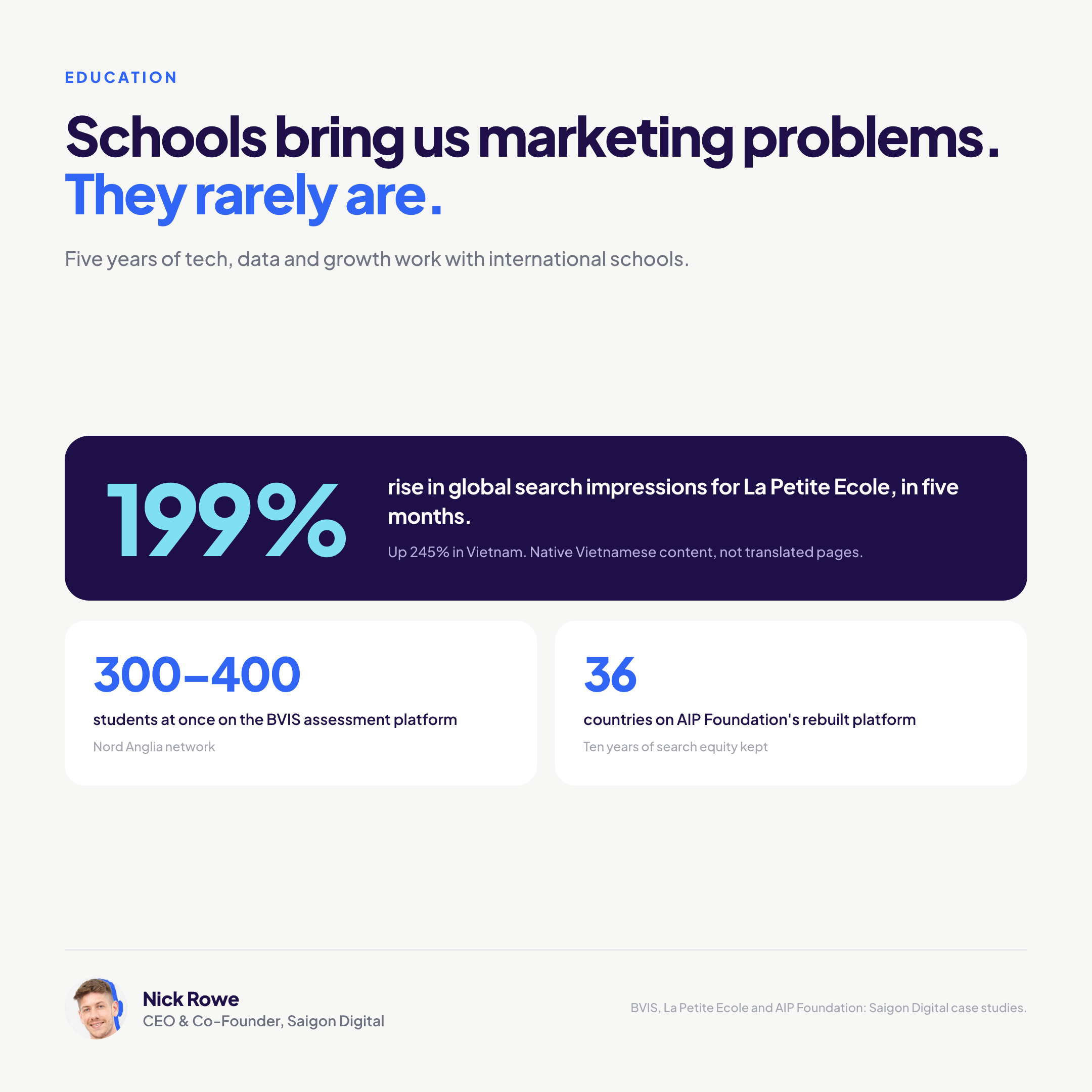
The clearest example in our portfolio is BVIS, the British Vietnamese International School, part of the Nord Anglia Education network. BVIS needed to replace manual reading assessments with a centralised digital system: three user roles (student, teacher, admin), each with its own dashboard, a progression engine that stops students passing quizzes below their reading level, and the stability to handle 300 to 400 students taking quizzes at the same time during peak class sessions.
We ran it in phases: discovery and system architecture with BVIS teachers, IT staff and Nord Anglia representatives first, then UI/UX design for an audience that spans young students and administrators, then the build itself on Next.js, NestJS, MongoDB and AWS. The result is a platform where students follow a structured reading journey, and teachers get real-time class overviews instead of spreadsheets.
The same engineering mindset applies to education organisations more broadly. AIP Foundation, which runs road safety education programmes across 36 countries, came to us with a WordPress site more than ten years old. We rebuilt it headless on Sanity and Next.js, migrated a decade of programme content record by record, mapped the old URLs across so ten years of search equity survived the move, and built a custom donation flow on Raisely and Stripe. We still host and support the platform today.
The lesson for school leadership teams: ask a digital partner what they have built, not just what they have ranked. The hardest problems in education are product problems.
How should schools use data to drive decisions?
Start by fixing measurement, because in our experience it is broken more often than anything else.
When La Petite Ecole came to us, one of their three core challenges was a lack of insights: no data-driven reporting and no clarity on digital performance. That is typical. Most schools we meet can tell you their open day attendance but not which channels produced it, and their agencies send reports built from impressions rather than enquiries.
So the data layer of our school work is unglamorous and essential: custom dashboards, monthly reporting with actionable insights, and a clear line from channel to enquiry. Once La Petite Ecole could see performance properly, strategy stopped being a quarterly guess and became something the school could adjust month by month. That is the real value of data-driven decision making: not prettier charts, but faster, safer decisions about where the next dong or dollar goes.
If your current reporting cannot answer "which channel produced our last ten enquiries?", fix that before you spend another cent on campaigns.
What does growth look like for an international school?
Growth for a school means a fuller enrolment pipeline, not a vanity traffic graph. But the published numbers from La Petite Ecole show what the visibility side can do when the foundations are right.
Five months of SEO work took La Petite Ecole to 1.4 million impressions, up 199% globally and 245% in Vietnam. What drove it was not volume for its own sake:
- Native Vietnamese content written for local parents, not translated English pages, ranking for both competitive and low-competition keywords.
- A deliberate mix of global and localised keywords, because an international school competes in two markets at once: the city it sits in and the countries its families relocate from.
- On-page and technical SEO fixes so the content could actually rank.
The timescale matters too. Five months is fast for SEO, and we tell schools honestly that results compound rather than arrive overnight. If you are weighing it up, our guide to how long SEO takes to show results sets realistic expectations.
Where do parents search for schools now?
Increasingly, parents start with an AI assistant rather than a search engine. They ask ChatGPT or Gemini to compare curricula, explain fees and shortlist schools, and the answer comes back as a recommendation, not ten blue links.
I wrote a full piece on this shift, The AI Discovery Revolution in education marketing, so I will not repeat it here. The short version: when we audit a school's AI visibility, we test the prompts parents actually use, and school leaders are regularly surprised by who the AI recommends and who it leaves out. Appearing in those answers is now its own discipline, with its own playbook, which is why we built an AI search optimisation service alongside classic SEO. If you want the mechanics, start with how to appear in ChatGPT answers.
The schools that treat AI visibility as an extension of the same system (sound technology, measurable data, content worth citing) will take the early advantage. It is the same machine, with a new front door.
What should a school leadership team do first?
Not a rebuild, and not a bigger ad budget. Start with an audit.
Every successful school engagement we have run started by measuring the current state: what the platform can and cannot do, what the data can and cannot answer, and where the school shows up (or does not) in Google and in AI answers. From there the priorities usually pick themselves, and they are rarely the ones in the original brief.
If that sounds like a conversation worth having, our education sector page covers the full picture of how we work with schools, or you can talk to us directly.
Frequently asked questions
Does Saigon Digital only work with schools in Vietnam?
No. We are based in Ho Chi Minh City with a UK presence, and we work with international schools and education organisations across Southeast Asia and beyond. Our education work spans Nord Anglia network schools, boutique international schools and education nonprofits operating in dozens of countries.
How long does SEO take to work for a school?
Expect compounding results rather than instant ones. La Petite Ecole saw impressions rise 199% within five months, which is quick for SEO. Our SEO results timeline guide explains what typically moves at one, three, six and twelve months.
What does a school website or platform project cost?
It depends on scope: a marketing site, a replatform with content migration, and a custom student-facing platform are very different builds. Our guide to the cost of building a website explains the drivers, and we scope every school project individually after a discovery conversation.
Can you work with our existing website and CMS?
Usually, yes. We audit what you have before recommending anything. Sometimes the right answer is targeted fixes and ongoing support; sometimes, as with AIP Foundation's ten-year-old WordPress site, the honest answer is a replatform that preserves your search equity.
Want to be the brand AI engines recommend?
We make businesses visible on Google and inside AI answers, measured in leads, not vanity metrics.