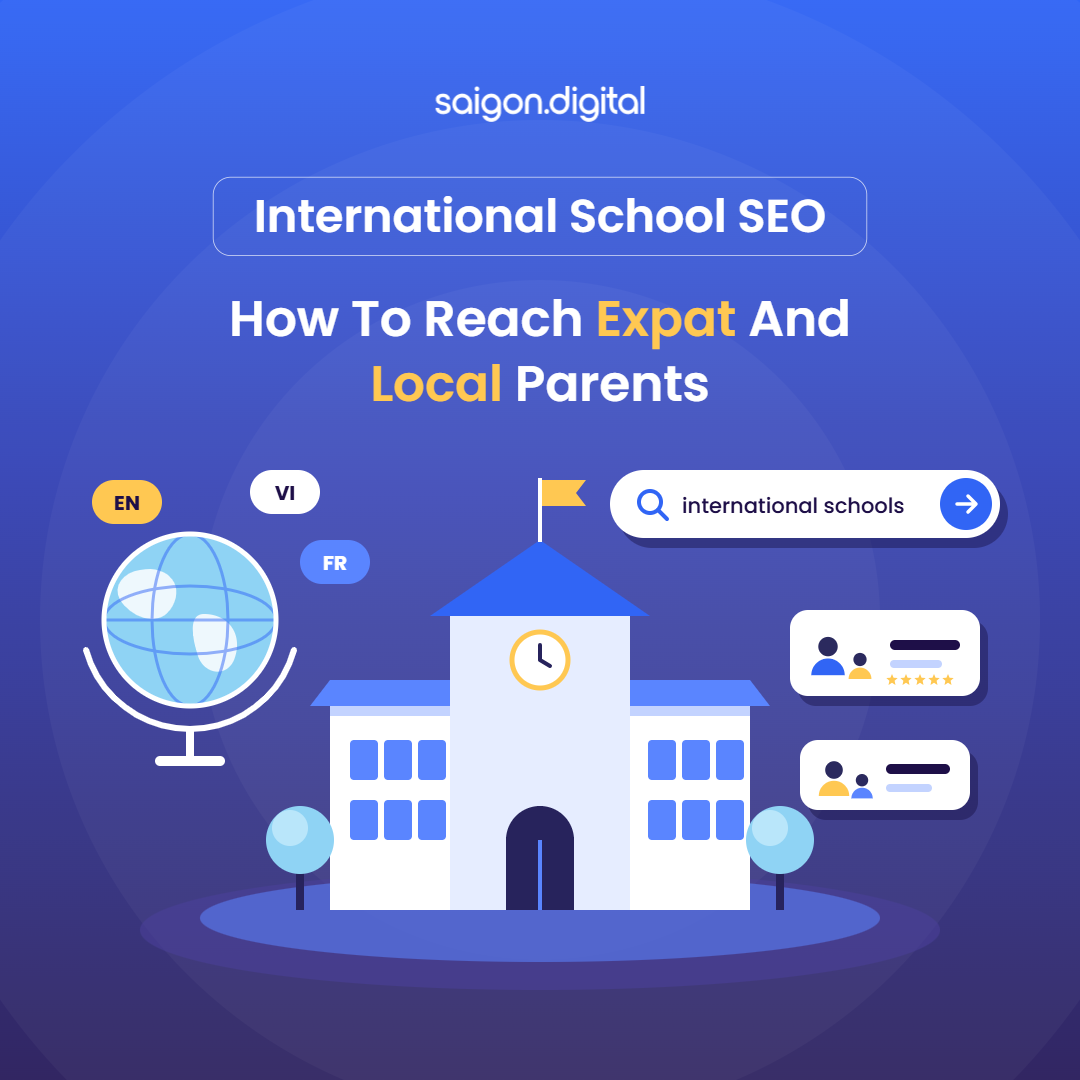
Two very different families are searching for a school right now. One is planning a move to Ho Chi Minh City from London and has never set foot in Vietnam. The other lives ten minutes from your gate. International school SEO is how you show up for both.
Most school websites are built with one of these families in mind and simply hope the other one finds their way in anyway. That gap is exactly where enquiries quietly leak away to a competitor school with a clearer, more complete search presence.
This guide walks through what actually works: keyword research, local SEO, bilingual content, technical fixes, and the AI search tools that parents are increasingly asking instead of typing into Google.
Key Takeaways
- Most demand for international education is now local rather than expat, so international school SEO has to work at least as hard on Vietnamese-speaking parents as it does on relocating families.
- Expat and local parents search differently: one Googles in English months before landing in the country, the other compares schools in Vietnamese through community groups, Zalo, and Google reviews.
- Winning both audiences means combining keyword research, local SEO, bilingual content, technical SEO, and answer engine optimisation, rather than relying on any single lever.
- Practical fixes such as an accurate Google Business Profile, curriculum-specific landing pages, and FAQ content built around real parent questions move enquiries faster than a generic "about us" rewrite.
- A Vietnam-based, bilingual content team has a natural advantage here, since it understands both search cultures from the same city the school operates in.
What Is International School SEO?
International school SEO is the practice of improving a school's visibility for the searches that lead to enrolment, across two overlapping but distinct markets at once: families relocating from abroad, and families who already live in the city. It draws on the same building blocks as any other SEO discipline, keyword research, on-page content, technical performance, and local search, but applies them to an admissions funnel rather than a shopping cart.
Two Audiences, One Website
Most businesses have one core buyer persona to write for. An international school genuinely has two, and they rarely search the same way. An expat family in Seoul or Sydney is researching a school they cannot yet visit, in a language that is probably not their first, months ahead of a move. A local Vietnamese family may already know the school by name and is comparing it against two or three others down the road, often in Vietnamese, often influenced by a parent group chat.
A website, and the content strategy behind it, has to serve both journeys without confusing either one.
Why This Niche Is Still Wide Open
Search demand around individual school names and generic phrases such as "international school in Ho Chi Minh City" is real, but it is narrow. Most of the useful search volume sits in the layer just beneath that: curriculum comparisons, admissions questions, tuition and fee queries, and relocation content. Very few school websites build content for that layer deliberately, which leaves an unusually open opportunity for a school willing to treat SEO as a genuine content programme rather than a one-off brochure rewrite.
Market researchers who track the international schools sector, such as ISC Research, have found that in many markets local families, not expatriates, now make up the majority of demand for international education. That single fact changes how a school should think about search. A strategy built only around "families abroad" misses the larger and often faster-growing half of the audience.
"In our work with international schools across Ho Chi Minh City, the schools that grow enrolment fastest are rarely the ones with the flashiest homepage. They are the ones whose website answers a relocating parent's questions in clear English and a local parent's questions in natural Vietnamese, on the same day, in the same reassuring tone," says the SEO team at Saigon Digital.
How Expat and Local Parents Search Differently
Before writing a single page of content, it helps to separate these two journeys clearly. They do not just use different languages, they ask different questions, at different points in the decision, through different channels.
Expat Parents: Researching From Thousands of Miles Away
Expat parents typically begin researching months before a move is confirmed. They search in English, often comparing curricula (British, American, or IB) rather than individual schools by name, because at this stage they may not know which schools exist in the destination city. Common patterns include:
- Curriculum plus city searches, such as "British curriculum school Ho Chi Minh City"
- Comparison searches between curricula or between cities
- Relocation-adjacent searches: cost of living, visas, and housing near international schools
- Tuition fee and scholarship queries, usually researched early and revisited close to application
Because this family cannot visit yet, the website itself has to do the reassuring that a campus tour would normally do: clear facilities information, staff qualifications, safeguarding policy, and honest answers about what daily life at the school actually looks like.
Local Parents: Comparing Down the Street
A local Vietnamese family often has a shorter, more comparative journey. They may already know several schools by name and are weighing practical factors: fees, bilingual balance, campus location relative to home or work, and what other parents in their network say about the school. Search behaviour here leans on:
- Vietnamese-language queries, sometimes mixed with English school or curriculum names
- "Near me" and district-based searches, especially in a large, spread-out city such as Ho Chi Minh City
- Google reviews and star ratings, which carry significant weight in a market where word of mouth still drives major decisions
- Community groups on Facebook and Zalo, where parents ask other parents before they ever ask the school directly
A school that only publishes in English, and only optimises for "international school" style keywords, is often invisible to exactly the audience now driving the majority of its enquiries.
Where AI Assistants Fit In Now
A growing number of both parent types now start their research inside an AI assistant rather than a search engine, asking something like "which international schools in Ho Chi Minh City offer a British curriculum for a six year old". How a school appears, or fails to appear, in these answers depends on the same structured, well-organised content that supports traditional SEO, with a few additional considerations covered later in this guide.
Keyword Research for International School SEO
Start With Real Decisions, Not Just "International School Ho Chi Minh City"
The obvious keyword, "international school Ho Chi Minh City", is worth targeting, but it is also the most competitive and the least specific about what a parent actually wants to know. Sound keyword research for a school looks further down the decision path, mapping the specific questions and comparisons parents make along the way.
Curriculum and Location Keywords
Pair the curriculum type with the location and the campus, rather than relying on one generic page to cover everything: "IB school District 2", "British curriculum primary school Thao Dien", "American curriculum secondary school Ho Chi Minh City". Each combination represents a genuinely different search intent and deserves its own page rather than a shared paragraph on a general admissions page.
Admissions and Funnel Keywords
These are the commercial keywords that sit closer to enquiry: admissions process, entrance requirements, application deadlines, tuition fees, and scholarships. They rarely have huge search volume individually, but they convert at a far higher rate than a broad awareness keyword, because the parent typing them is already seriously considering the school.
Question Keywords Parents Actually Type
Parents rarely search in polished marketing language. They type real questions: "how do I switch my child to a new school mid year", "what questions should I ask on a school tour", "is a bilingual school better for my child". Structuring content around question keywords like these captures both traditional search traffic and, increasingly, AI Overview and chatbot answers, which tend to favour content written in direct, question-and-answer form.
Building a Bilingual Keyword List
English and Vietnamese keyword research should run as two connected but separate exercises, not one list translated word for word. A literal translation of "best international school Ho Chi Minh City" rarely matches how a Vietnamese parent phrases the same intent, and it misses local-language modifiers around fees, bilingual education, and specific districts that carry real search volume of their own. Building both lists properly, and connecting them through the site structure rather than merging them onto the same page, keeps each audience's experience focused.
On-Page Content That Turns Visitors Into Enquiries
Curriculum and Programme Pages
Every curriculum or age stage the school offers deserves a dedicated page, written for the parent who is specifically comparing that option elsewhere. A single "Our Curriculum" page trying to describe early years, primary, and secondary all at once tends to satisfy none of the three searches driving people to it.
The Admissions Journey, Mapped Page by Page
Rather than a single admissions page, break the journey into the stages a parent actually moves through: eligibility and entry requirements, the application process and timeline, fees and payment options, and what to expect at an assessment or interview. Each stage answers a distinct question and can rank for the specific keywords tied to it.
Trust and Proof Content
Because a large share of a school's audience cannot visit before applying, or is weighing several familiar names against each other, trust content carries unusual weight. Accreditation details, inspection outcomes, exam and university progression results, and genuine parent testimonials all belong prominently on the site rather than buried in a downloadable PDF. Working across schools such as La Petite Ecole Ho Chi Minh City and The ABC International School has shown us how much of a difference clear, specific proof points make compared with generic claims about "excellence" or "a world class education".
Local SEO: Winning the "Near Me" and City Searches
Google Business Profile for a School, Not a Shop
A Google Business Profile matters just as much for a school as it does for a restaurant or a clinic, if not more, because it is often the first result a parent sees for a "near me" style search. That means an accurate category, current opening hours for the admissions office, correct campus photos, and a steady flow of genuine parent reviews, actively encouraged rather than left to chance.
Multiple Campuses? Build Location Pages, Not One Big Page
Schools with more than one campus should give each campus its own dedicated page, complete with its own address, contact details, and locally relevant content, rather than folding every campus into a single "Our Campuses" page. This mirrors local SEO best practice for any multi-location business, and it gives search engines a clear signal about which page to show for which district. Consistent geotagging and location data across each page and its accompanying images reinforces exactly where each campus sits.
Reviews and Local Trust Signals
In a market where word of mouth carries enormous weight, a steady stream of recent, specific Google reviews does more for local credibility than another paragraph of marketing copy. Encourage reviews at natural moments, such as after a successful open day or a positive parent-teacher conference, rather than in a single annual push.
Bilingual and Multilingual SEO for Mixed Audiences
English for Reach, Vietnamese for Trust
English content typically does the work of reaching relocating families and building the school's broader authority, while Vietnamese content builds trust and local relevance with the audience now driving the majority of enquiries. Treating Vietnamese content as a genuine localisation, written by someone who understands how Vietnamese parents actually phrase these decisions, rather than a direct translation of the English page, consistently performs better in both rankings and tone.
Avoiding Duplicate Content and Cannibalisation Across Language Versions
Each language version of a page should be properly connected to its counterpart through hreflang tags, so search engines show the right version to the right audience instead of treating both as competing pages targeting the same intent. Left unmanaged, this is one of the most common technical issues on bilingual school websites, and it quietly suppresses visibility in both languages at once.
Technical SEO Foundations for School Websites
Mobile Performance and Core Web Vitals
A significant share of school research now happens on a phone, often during a commute or between meetings. Slow loading times or a layout that shifts around as it loads will lose a parent's attention before they ever reach the admissions information they came for.
Structured Data: Helping Google and AI Understand Your School
Structured data such as EducationalOrganization and Course schema gives search engines, and increasingly AI systems, a clear, machine-readable summary of what the school is, what it teaches, and where it operates. This does not replace well-written content, but it does help that content get interpreted and surfaced correctly, particularly in the newer AI-driven search results covered next.
Answer Engine Optimisation: Getting Recommended by ChatGPT and Google AI
Why This Matters for School Admissions Specifically
School choice is exactly the kind of high-stakes, research-heavy decision where a parent is increasingly likely to ask an AI assistant for a shortlist before doing their own search. If a school's content is thin, inconsistent across pages, or missing entirely on a key topic such as fees or curriculum comparisons, it simply will not be part of the answer an AI system gives.
What to Actually Do About It
Answer engine optimisation for a school largely comes down to the same fundamentals covered throughout this guide: clear, well-structured, genuinely comprehensive content, written in direct question-and-answer form where it makes sense. Understanding how AI Overviews select and summarise sources also helps prioritise which pages to strengthen first, since pages that already rank reasonably well in traditional search are usually the fastest ones to also start appearing in AI-generated answers.
Turning Search Visibility Into Enrolment
Map Content to the Admissions Funnel
Not every piece of content should aim at the same stage of the decision. Curriculum and "why choose us" content typically attracts a family at the very start of their research, while fee, application, and tour-preparation content serves a family who has already shortlisted the school. A healthy content plan covers all three stages deliberately, rather than producing more of whichever stage is easiest to write.
Measure Enquiries, Not Just Clicks
Traffic and rankings are useful diagnostic signals, but the metric that actually matters to a school is admissions enquiries and, ultimately, enrolments. Tracking which pages and keywords lead to a completed enquiry form, rather than simply which pages get the most visits, shows where the content strategy is genuinely working and where it still needs attention.
How We Help International Schools Grow Enrolment Through SEO
Saigon Digital is a Ho Chi Minh City-based SEO and AI search agency, which puts us in an unusual position for this particular niche: we work inside the same bilingual, dual-audience search environment that international schools are trying to reach, every day. Our content teams produce both English and genuinely localised Vietnamese content, rather than translating one into the other, and we have applied that approach directly to schools such as La Petite Ecole Ho Chi Minh City and The ABC International School.
Because we are based in Vietnam rather than commissioning work from a home-market agency at home-market rates, schools working with us typically get senior-level SEO strategy and consistent bilingual content production at a lower cost than an equivalent in-house hire or a domestic agency in the UK, the US, or Australia would charge for the same scope of work. You can see more of how this plays out across industries in our case studies.
Ready to Reach Every Parent Searching for Your School?
International school SEO works best when it is treated as an ongoing programme rather than a one-off website refresh: keyword research that reflects both audiences, content that answers real questions at every stage of admissions, technical foundations that keep the site fast and readable for both search engines and AI systems, and local, bilingual SEO that meets Vietnamese-speaking parents where they already are.
If your school's website is currently built for one audience while quietly losing the other, that is usually the fastest problem to fix, and often the one with the biggest impact on enquiries.
Get in touch with our team to talk through where your school currently stands and what a focused SEO plan could look like for your admissions goals.
Frequently Asked Questions
1. What is international school SEO?
International school SEO is the process of improving an international school's visibility in search engines and AI search tools for the queries that lead to admissions enquiries, covering both expat families researching from abroad and local families comparing schools within the same city.
2. How is SEO for international schools different from regular local SEO?
Standard local SEO usually focuses on one nearby audience searching in one language. International school SEO has to serve two overlapping audiences at once, relocating families researching in English from abroad, and local families often searching in Vietnamese, each with different questions, timelines, and trust signals.
3. Should our school target expat parents or local parents first?
Most schools benefit from planning for both from the start, since research increasingly shows local families make up the majority of demand in many markets. Prioritisation usually comes down to which audience currently drives more of the school's actual enrolment, rather than which one is easier to write content for.
4. How long does it take to see results from international school SEO?
Technical fixes and Google Business Profile improvements can influence visibility within weeks, while new content generally needs a few months to rank and build enough authority to compete for the most valuable admissions keywords. A realistic content programme is usually planned in quarters rather than single months.
5. Do international schools need to worry about AI search tools like ChatGPT?
Increasingly, yes. School choice is a research-heavy decision that fits naturally into how parents already use AI assistants, and schools with thin or inconsistent content risk being left out of the shortlist an AI system suggests, even if they rank reasonably well in traditional search.
6. Should our website be in English only, or do we need Vietnamese content too?
If local families make up a meaningful share of current or target enrolment, genuine Vietnamese-language content, not a direct translation, is one of the highest-impact additions a school can make, since it addresses an audience that an English-only site is largely invisible to.
Want to be the brand AI engines recommend?
We make businesses visible on Google and inside AI answers, measured in leads, not vanity metrics.