Search has changed more in the last few years than it did in the decade before. In 2026, we are no longer optimising only for blue links and ten results per page. We are optimising for AI-driven discovery, conversational answers, multimodal search, and systems that judge quality with far more nuance than simple keywords.
At Saigon Digital, we help ambitious brands design, build, and scale digital experiences that drive real results. That means staying ahead of how search engines and AI platforms actually decide what to surface. This guide explains the most important AI search ranking factors in 2026 and, more importantly, what you can do today to improve your visibility, relevance, and performance.
Our goal is simple: turn strategy, creativity, and data into measurable growth for your business.
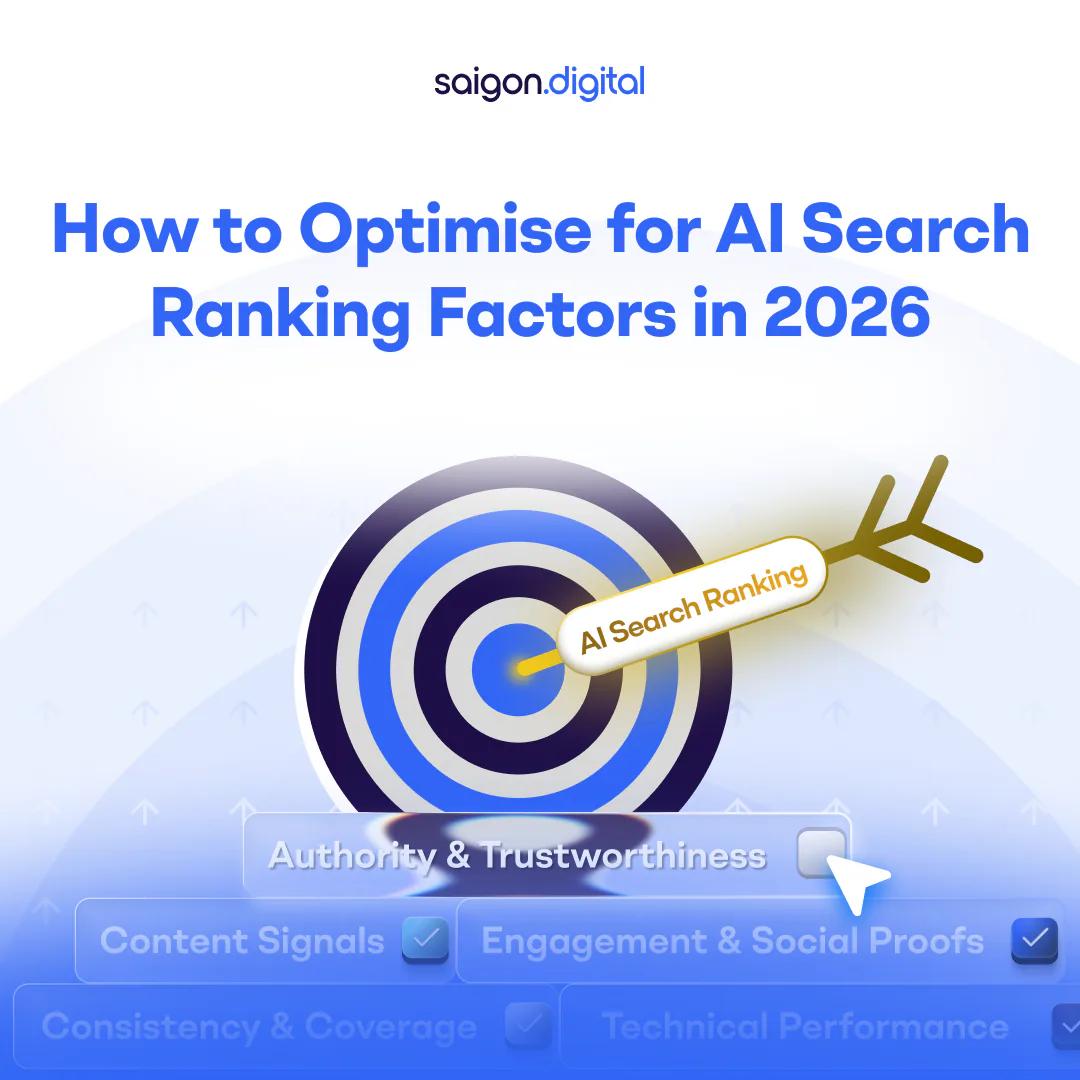
What “AI Search” Really Means in 2026
AI search is not a single platform. It is an ecosystem of:
- Search engines using large language models to summarise and recommend content
- Assistants that answer questions directly, often without a traditional results page
- Multimodal systems that understand text, images, video, and audio together
- Personalised results shaped by context, intent, and past behaviour
In this environment, AI search ranking factors are less about gaming an algorithm and more about proving genuine value, clarity, and trust at scale.
Think of it this way: instead of asking “How do I rank for this keyword?”, the better question in 2026 is “How do I become the best possible answer for this audience and this problem?”
The Core AI Search Ranking Factors You Must Master
In 2026, ranking well in AI-driven search is not about chasing shortcuts. Instead, it is about aligning your content, website, and brand with how modern systems evaluate quality, relevance, and trust.
Let us break down the factors that matter most, and how to optimise for each of them in practical terms.
1. Demonstrable Expertise and Real-World Credibility
First and foremost, AI search systems increasingly prioritise content that reflects genuine expertise and real-world experience. Rather than relying only on surface-level signals, modern models analyse patterns across your site, your authors, and your wider digital footprint to determine whether your brand truly understands its subject matter.

For this reason, your content should go beyond general explanations. Instead, it should show evidence of hands-on experience, original thinking, and practical insight. This builds trust not only with readers, but also with AI systems trained to recognise depth and authenticity.
How to strengthen this signal:
- Clearly show who is behind your content and why they are qualified
- Include case studies, examples, or lessons learned from real projects
- Support claims with data, experience, or credible sources
- Keep key pages updated to reflect current best practice
Example: If you run an SEO or digital marketing agency, do not just explain what SEO is. Show how you improved a client’s performance, what challenges you faced, and what decisions made the difference. This kind of detail signals real expertise and helps AI systems distinguish your content from generic summaries.
In short, expertise is no longer something you can simply claim, you must demonstrate it consistently.
2. Search Intent Understanding (Not Just Keywords)
While keywords still play a role, AI search ranking factors in 2026 place far greater emphasis on search intent, that is, what the user is actually trying to achieve. AI systems are now highly effective at interpreting context, conversational queries, and implied needs.
As a result, successful content starts with understanding the problem behind the search, not just the phrase typed into a search box. When your page fully satisfies that intent, it is far more likely to be surfaced, summarised, or recommended by AI-driven search experiences.
How to optimise for intent:
- Identify whether the user wants information, comparison, guidance, or a solution
- Structure each page around one primary intent
- Answer the main question early, then expand with helpful detail
- Anticipate and address common follow-up questions within the same page
Example: A search for “best project management software for small teams” is not asking for a definition of project management. The user wants options, trade-offs, pricing considerations, and setup advice. A page that covers these points clearly and logically will perform far better than one that simply lists tools without context.
By focusing on intent, you move from “optimising for keywords” to “optimising for people”, which is exactly what AI search systems are designed to reward.
3. Content Depth, Clarity, and Usefulness
Next, content quality is no longer judged by length alone, but by how useful, clear, and complete it is. AI systems are increasingly good at identifying whether a page genuinely helps the reader or merely fills space.

This means your content should aim to solve a problem thoroughly, using plain language and a logical structure. At the same time, it should be easy to scan, easy to understand, and easy to act upon.
To improve this factor:
- Focus each page on one clear topic or question
- Use headings, bullet points, and summaries to improve readability
- Explain concepts in simple terms before moving into detail
- Include actionable steps, checklists, or practical guidance
Example: If you are writing about improving website conversions, do not just discuss theory. Explain what to change, why it matters, and how to implement it. For instance, show how simplifying a form or clarifying a call-to-action can improve results, and explain the reasoning behind each recommendation.
Ultimately, the more helpful your content is in real-world terms, the stronger its performance will be across AI-driven search surfaces.
4. User Experience as a Ranking Signal
In 2026, user experience is no longer just a design concern, it is a core part of AI search ranking factors. AI systems increasingly use behavioural signals to understand whether users find your site helpful, accessible, and easy to use.
If visitors struggle to navigate your site, wait too long for pages to load, or leave quickly because they cannot find what they need, these signals can undermine even the best content.
Key areas to focus on:
- Fast loading times across all devices
- Clear page layouts with minimal distractions
- Simple navigation that helps users find related content
- Mobile-first and accessibility-friendly design
Example: Two pages may offer equally good advice. However, the one that loads quickly, uses clear headings, and presents information in a calm, readable layout will almost always perform better than one cluttered with pop-ups or confusing menus.
In other words, great content needs a great environment to succeed and AI systems are paying close attention to that environment.
5. Structured Data and Clear Context
Because AI systems process vast amounts of information, they rely heavily on structure and clarity to understand what your content is about and how it should be used. The clearer your structure, the easier it is for both users and machines to interpret your pages.

This is not just a technical exercise. It is about reducing ambiguity and making your meaning obvious at a glance.
Practical steps include:
- Using a clear heading hierarchy (H1, H2, H3, and so on)
- Writing descriptive titles and summaries that match the page content
- Implementing structured data where it genuinely fits (such as FAQs or product information)
- Keeping URLs and internal links logical and consistent
Example: A well-structured guide with clear sections, summaries, and frequently asked questions is far easier for an AI system to summarise or reference than a long, unbroken block of text, even if both contain similar information.
Clarity, in this sense, is not just good writing practice. It is a direct contributor to better visibility in AI-powered search.
6. Brand Signals and Consistency Across the Web
AI search does not evaluate your website in isolation. Instead, it cross-checks your brand across the wider digital ecosystem, including reviews, mentions, social platforms, and third-party sites. Consistency and credibility across these touchpoints strengthen your overall trust signals.
This means your brand story, positioning, and expertise should be coherent wherever people encounter you.
To build stronger brand signals:
- Keep your business information accurate and consistent across platforms
- Encourage genuine reviews and testimonials from real clients
- Publish thought leadership content in relevant industry spaces
- Ensure your messaging and positioning align across your website and external profiles
Example: If your site presents you as a specialist digital agency, but there is little evidence of this elsewhere online, AI systems may treat your claims cautiously. On the other hand, consistent mentions, reviews, and expert contributions reinforce your authority and reliability.
Over time, these signals combine to make your brand a more trusted source in AI-driven discovery.
7. Multimodal Content: Beyond Text Alone
Search in 2026 is fully multimodal. This means AI systems understand and combine text, images, video, and audio to form a richer picture of what your content offers. As a result, relying on text alone can limit both reach and engagement.

However, the goal is not to add media for its own sake. Instead, each format should support understanding and improve the user experience.
How to approach multimodal content:
- Use images or diagrams to explain complex ideas more clearly
- Add short videos where a visual walkthrough is more effective than text
- Optimise all media with clear descriptions and context
- Ensure every asset serves a purpose, not just decoration
Example: A step-by-step guide to improving website performance might benefit from a simple diagram of site structure or a short screen recording showing where to make changes. This makes the content more accessible for users and easier for AI systems to interpret in context.
The result is content that communicates more clearly, across more surfaces, to more people.
8. Freshness and Ongoing Relevance
Finally, many AI search ranking factors take into account how current and reliable your content is, especially in fast-moving fields such as marketing, technology, and e-commerce. Outdated advice can quickly lose both trust and visibility.
For that reason, optimisation in 2026 is not a one-off task. It is an ongoing process of review, refinement, and improvement.
To maintain relevance:
- Regularly audit and update your most important pages
- Add new insights rather than creating near-duplicate articles
- Clearly show when content has been reviewed or refreshed
- Merge or retire pages that no longer serve a clear purpose
Example: A guide to SEO or AI marketing from three years ago may still attract traffic, but parts of it are likely inaccurate. Updating it with current practices, tools, and examples can significantly improve both user trust and search performance.
Fresh, accurate content sends a clear signal: your brand is active, reliable, and focused on delivering real value.
How to Build an AI-Ready Content Strategy in 2026
Understanding AI search ranking factors is only part of the picture. The real advantage comes from turning that understanding into a structured, repeatable content strategy. In 2026, the most successful brands do not create content at random. Instead, they build systems that consistently produce useful, relevant, and high-performing content aligned with both user needs and AI-driven discovery.
The following framework outlines a practical, business-focused approach to building an AI-ready content strategy that delivers long-term results.
1. Start with Clear Business Goals
Before creating or updating any content, it is essential to define what you want that content to achieve. Too often, content strategies focus on traffic alone, without considering how that traffic supports wider business objectives. In an AI-driven search environment, relevance and impact matter more than volume.

Begin by linking your content efforts directly to outcomes such as lead generation, product discovery, brand authority, or customer education. This ensures that every piece of content has a clear purpose and measurable value.
Practical steps:
- Define your primary goals (for example, more qualified enquiries or better product visibility)
- Map content types to each goal (guides, case studies, comparison pages, FAQs, and so on)
- Set simple success metrics, such as conversions, engagement, or assisted sales
- Prioritise topics that support both user needs and business growth
Example: If your goal is to generate more quality B2B leads, in-depth guides and case studies will usually be more valuable than short news-style posts. These assets can answer complex questions, build trust, and support decision-making, exactly what both users and AI systems look for.
By starting with clear objectives, you ensure your content strategy remains focused, efficient, and commercially relevant.
2. Research Real User Problems, Not Just Keywords
Once your goals are clear, the next step is to understand what your audience genuinely needs. In 2026, AI search systems are highly effective at matching content to real-world problems, which means surface-level keyword targeting is no longer enough.
Instead, your research should focus on the questions, challenges, and decisions your customers face at each stage of their journey. Keywords can support this process, but they should not define it.
Ways to uncover real user needs:
- Review sales conversations, support tickets, and customer emails
- Analyse on-site search queries and frequently asked questions
- Speak directly with customers or client-facing teams
- Group topics by problems to solve, not just terms to rank for
Example: Rather than targeting a keyword like “marketing automation tools” in isolation, explore what users actually want to know: How do these tools save time? What do they cost? What are the risks? How hard are they to implement? Building content around these questions leads to far more useful and relevant pages.
This approach naturally aligns your content with AI search ranking factors that reward relevance, depth, and genuine problem-solving.
3. Create One Clear “Best Answer” Per Topic
With your topics defined, the focus should shift from quantity to quality. In an AI-driven search landscape, it is far more effective to create one strong, comprehensive resource per topic than several overlapping or shallow articles.

Each core topic should have a clear “best answer” page that covers the subject thoroughly, logically, and practically. Supporting content can then link back to this main resource, strengthening its authority and clarity.
How to apply this in practice:
- Identify your key topics and assign one primary page to each
- Structure that page to move from fundamentals to practical guidance
- Answer the main question early, then expand with useful detail
- Link related articles back to this central resource
Example: Instead of publishing multiple short posts about “AI SEO audits”, “technical SEO checks”, and “SEO audit tools” with overlapping content, create one authoritative guide to SEO audits. Then, use supporting articles to explore specific tools or techniques in more depth.
This makes your content easier for users to navigate and easier for AI systems to recognise as a reliable, comprehensive resource.
4. Design for People First, AI Second
Although we often talk about AI search ranking factors, the most effective optimisation still starts with human readers. Modern AI systems are designed to reward content that people find clear, helpful, and easy to use.
Therefore, good content design is not about manipulating algorithms. It is about making information accessible, readable, and actionable.
Key principles to follow:
- Use clear structure, headings, and summaries to guide the reader
- Write in plain, professional language and avoid unnecessary jargon
- Break complex ideas into manageable sections
- Make it easy to take the next step, whether that is learning more or getting in touch
Example: A long guide that begins with a short summary, uses clear subheadings, and includes practical examples will almost always perform better than an unstructured article, even if both contain similar information.
When you design for clarity and usefulness, you naturally align with the way AI systems evaluate quality and relevance.
5. Build Feedback Loops: Measure, Refine, Improve
Finally, an AI-ready content strategy is never “finished”. Search behaviour, user expectations, and competitive landscapes all continue to evolve. For that reason, continuous improvement is a core part of long-term success.
By regularly reviewing performance data and user behaviour, you can identify what is working, what is underperforming, and where the biggest opportunities lie.
What to review on a regular basis:
- Which pages attract the most engaged visitors
- Where users drop off or fail to convert
- Which topics drive meaningful business outcomes
- Which content needs updating, expanding, or simplifying
Example: If a guide attracts plenty of traffic but few enquiries, it may need clearer calls to action, better examples, or more specific next steps. Small, targeted improvements can often make a significant difference to results.
Over time, this cycle of measurement and refinement ensures your content stays aligned with both user needs and evolving AI search ranking factors.
A Simple Optimisation Checklist
By this point, the principles behind AI search ranking factors should be clear. However, when you are working on real pages, real campaigns, and real deadlines, it helps to have a simple framework you can return to again and again. This checklist is designed to turn strategy into action and ensure that each important page on your website meets modern standards for AI-driven search visibility.
Rather than treating optimisation as a one-off task, use this list as a regular quality control tool when publishing new content or updating existing pages.
1. Does the Page Solve One Clear User Problem?
Every high-performing page should have a single, well-defined purpose. In an AI-driven search environment, pages that try to do too much at once often end up doing nothing particularly well. Clear focus, by contrast, makes it easier for both users and AI systems to understand when and why your content should be recommended.

Before publishing or updating a page, ask yourself what specific question it answers or what specific problem it solves. Then, check whether everything on the page supports that goal.
How to check this in practice:
- Can you summarise the page’s purpose in one sentence?
- Does the introduction clearly state what the reader will gain?
- Are there sections that do not support the main topic and could be removed or moved elsewhere?
- Would a reader leave with a clear next step or clearer understanding?
Example: A page titled “How to Improve Website Conversion Rates” should focus on practical methods for improving conversions, not drift into unrelated topics like general branding theory or social media trends. The tighter the focus, the stronger the signal to AI systems and users alike.
2. Is the Content Informed by Real Expertise?
AI search ranking factors increasingly reward content that reflects genuine experience and authority. This means your page should not read like a summary of what already exists elsewhere. Instead, it should add perspective, insight, or practical guidance based on real-world knowledge.
When reviewing a page, look for signs that it demonstrates understanding rather than repetition.
Questions to ask:
- Does the content include examples, case studies, or lessons learned?
- Is it written with confidence and clarity, rather than vague generalities?
- Does it explain not just what to do, but why it works?
- Is it clear who this advice is for and in what context it applies?
Example: Rather than saying “improve your page speed to rank better”, a stronger page would explain which changes typically make the biggest difference, what trade-offs to consider, and how these improvements affect real users and results.
This kind of depth helps build trust with readers and strengthens your authority signals for AI-driven search.
3. Is the Page Fast, Easy to Use, and Accessible?
Even the best content will struggle if the experience around it is poor. User experience is now a core part of how AI systems evaluate quality, which means performance, clarity, and accessibility all directly influence your visibility.

A good rule of thumb is simple: if a user feels friction, confusion, or frustration, that is a problem worth fixing.
What to review:
- Does the page load quickly on both mobile and desktop?
- Is the layout clean and easy to scan?
- Are key points easy to find without excessive scrolling?
- Is the page readable and usable for a wide range of users?
Example: If your guide is well-written but buried under pop-ups, slow-loading images, or cluttered design, many users will leave before they benefit from it. A cleaner, faster version of the same page will almost always perform better in both engagement and search visibility.
4. Is the Structure Clear for Both Readers and Machines?
Clarity of structure helps people understand your content quickly and helps AI systems interpret and summarise it accurately. A well-structured page sends strong signals about what the content covers and how its ideas are organised.
When reviewing structure, think about how easily someone could skim the page and still grasp its main points.
Key elements to check:
- Is there a clear main heading that reflects the page’s topic?
- Do subheadings follow a logical order and hierarchy?
- Are lists, summaries, and sections used to break up complex ideas?
- Is the page easy to navigate from top to bottom?
Example: A long article with clear sections, descriptive subheadings, and short summaries is far easier to understand, and far easier for AI systems to process, than a single block of uninterrupted text.
Good structure improves comprehension, retention, and discoverability at the same time.
5. Does the Content Include Practical, Actionable Guidance?
Information alone is rarely enough. In 2026, both users and AI systems increasingly favour content that helps people do something, not just learn something. Actionable guidance turns knowledge into results, which is exactly what builds trust and engagement.

As you review your pages, look for opportunities to make advice more concrete and usable.
Ways to strengthen actionability:
- Add step-by-step instructions where appropriate
- Include checklists, frameworks, or decision criteria
- Use examples to show how advice works in practice
- Clarify what a reader should do next after finishing the page
Example: Instead of saying “optimise your internal linking”, show how to identify key pages, how to choose anchor text, and how to structure links within an article. This transforms a general recommendation into something a reader can apply immediately.
The easier it is to act on your content, the more valuable it becomes in both human and AI-driven evaluation.
6. Is the Content Up to Date and Aligned with Your Brand?
Finally, even strong content can lose impact if it is outdated or inconsistent with your wider brand presence. Freshness and coherence are important signals within modern AI search ranking factors, especially in fast-changing fields like digital marketing and technology.
Regular reviews help ensure your content remains accurate, relevant, and aligned with your current positioning.
Things to review regularly:
- Are statistics, tools, and examples still current?
- Does the page reflect your latest services, messaging, and expertise?
- Are there newer insights or approaches that should be added?
- Are there overlapping or outdated pages that should be merged or removed?
Example: A guide written two years ago may still be useful, but adding updated examples, refining the advice, and aligning it with your current service offering can significantly improve both credibility and performance.
Consistency and freshness reinforce trust and trust is central to long-term success in AI-driven search.
Turn AI Search Change into Business Growth
The future of digital growth is here. AI will continue to change how people discover, evaluate, and choose brands. The good news is that the direction is clear: better content, better experiences, and better alignment with real user needs.
At Saigon Digital, we believe in solving digital challenges with forward-thinking, user-centric, and bespoke solutions. From SEO and high-performance websites to automation and AI-powered marketing, we help brands turn visibility into meaningful growth.
If you would like to future-proof your search strategy and build a stronger, more resilient digital presence, now is the time to start.
Get in touch with us and start ranking on AI search engines today!
Want to be the brand AI engines recommend?
We make businesses visible on Google and inside AI answers, measured in leads, not vanity metrics.