Shopify Development Services: Stores Built to Sell
THE SHORT ANSWER
What Shopify website development covers
Shopify website development comes in two forms. The first is a custom Shopify store: designed from scratch around your products and customers, with Shopify looking after hosting, security and updates. That is the right build for most brands, and it is a different thing from a bought theme with the colours changed.
What headless Shopify is
Headless Shopify keeps Shopify running everything behind the scenes (products, orders, payments, stock and checkout) and puts a fully custom website in front of it. Shopify's own toolkit for this is called Hydrogen. Checkout stays on Shopify, so payments and security are unchanged. What you gain is complete freedom over the shopping experience. What you take on is a bigger build and a site you have to maintain yourself, which is why most stores should not do it.
THE DECISION
Should you go headless? Usually not.
We would rather say this before you spend anything. For most brands under about ten million in revenue, the right first move is to get the existing store working properly. Shopify's default performance is better than its reputation suggests: around four fifths of Shopify domains already have good server response times, ahead of the web average. If your store is slow, a store with eleven apps bolted to it is the more likely cause than the platform.
Go headless when
- ✓You need a storefront that genuinely cannot be built in a theme, not one that would be nicer
- ✓You are combining commerce with substantial editorial or content experiences
- ✓You run several markets or regions with meaningfully different front ends
- ✓Your catalogue is large and variant-heavy, roughly five hundred products upward
- ✓Your other business systems need to work with the store in ways a standard Shopify store resists
Stay on standard Shopify when
- →Your customer journey is a normal ecommerce journey
- →You need to launch in weeks rather than months
- →Your store leans heavily on Shopify apps, because most are built for themes and need custom work or replacing in a headless build
- →Nobody on your side wants to look after a custom website long term
- →Your current store is fine and the frustration is really with the content or the merchandising
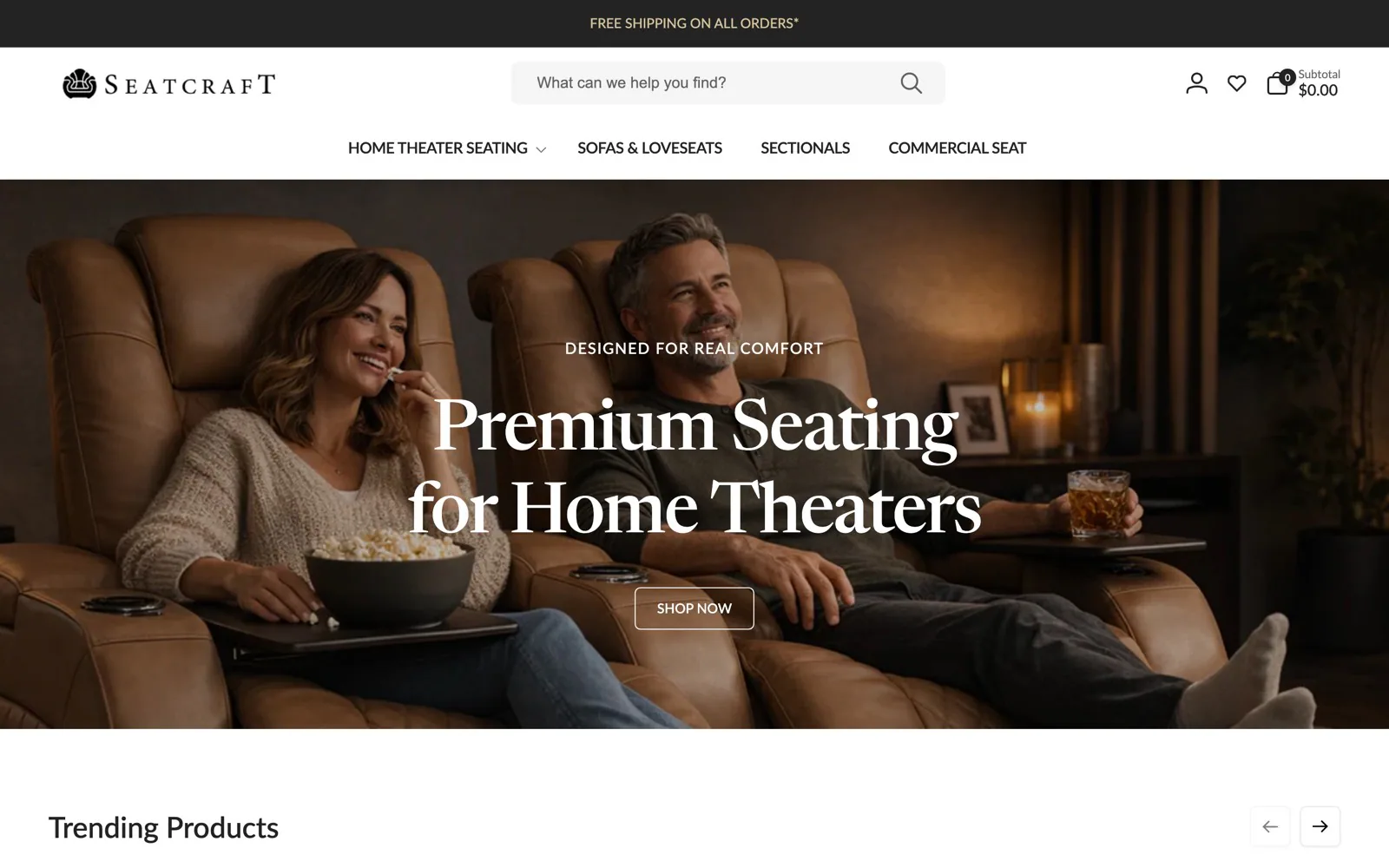
Staying on standard Shopify does not mean settling for a template. A custom Shopify store can make a large, configurable range easy to shop, which is what Seatcraft's does.
Is something your current store cannot do costing you sales you can point at? If you cannot name it, headless will not pay for itself.
What our Shopify development delivers
A store your customers find easy to buy from
We design around how people actually shop for what you sell, not around a template. Seatcraft's range runs from single recliners to full sectionals across leathers, fabrics and power options, and their store makes that range easy to browse and configure.
A business that is easier to run
When part of your operation does not fit what Shopify does out of the box, we build the piece that makes it fit, so your team stops working around the store. At Seatcraft, each integration was aimed at a problem the business was already carrying.
A store that gets found from launch day
SEO is planned into the build rather than added afterwards, so you launch ready to rank on Google and to be named in AI answers, instead of spending six months recovering lost traffic.
A store that loads fast and stays fast
We keep the store lean and check every app before it goes in, because a handful of apps slows a store down more than Shopify ever does.
Pages your team can change without waiting on a developer
New campaigns, landing pages and content go live when marketing is ready.
Room to grow
If you later need several markets, a content-led experience, or a fully custom headless site, the store is built so that move is a step rather than a rebuild.
HOW IT WORKS
How we take you from brief to revenue
Assess
We look at your current store, your numbers and your apps, and tell you plainly whether you need a new build, a better version of what you have, or headless. Most of the time it is not headless.
Design
We map how your customers browse and buy, then design the store around that journey and test it before anything is built.
Build
We build the store and the integrations your operation needs, with SEO, speed and editing tools in from the start.
Launch
We move your products, customers and search rankings across with a full redirect plan, so you keep the traffic you have already earned.
Grow
After launch we keep improving conversion and search visibility. For Seatcraft, revenue reached an all-time high within three months, and the growth work continues.
WHY US
A Shopify development agency that builds and grows
We are a Shopify Partner, so builds come with direct platform support. We designed and built Seatcraft's store, wrote the integrations around it, and ran SEO alongside the launch. Within three months revenue was at an all-time high, and Seatcraft is now named in AI answers for home cinema seating.
Most Shopify development companies hand over the store at launch and leave growth to someone else. We do both, which means the store is built to be found and to convert, and the team that built it is the one improving it.
We also build custom and headless sites for a living, so we can do either. That gives us no reason to push you towards the bigger project. If a better version of your current store is the answer, we will build that, or tell you to fix what you have.
Questions, answered straight
Is headless Shopify worth it?
For most stores under about ten million in revenue, no. A well-built custom Shopify store does the job for less money, launches in weeks, and is kept up to date by Shopify. Headless pays off when something your store cannot do is costing you sales you can point at, or when shopping is one part of a much larger content experience.
How much does headless Shopify cost?
Market ranges run from around ten to twenty-five thousand for a lean build to sixty thousand and up at scale, against low thousands to around fifteen thousand for a custom Shopify store. The costs nobody quotes up front are content editing tools, search, monitoring and ongoing upkeep, and they belong in the budget from day one.
Do we lose Shopify checkout if we go headless?
No. Customers still check out on Shopify, so payments, security and orders work exactly as before. This is the part people worry about most and it is the part that changes least.
Will headless make our site faster?
It can, and it is not automatic. A badly built headless site is slower than a good Shopify store. Shopify is faster than most people assume, so if speed is the only reason, fix the store and the apps first and keep the money.
What happens to our apps?
This is the real trade-off. Most Shopify apps are made for standard Shopify stores, so going headless means rebuilding or replacing each one. If your store depends on eight apps, review them before committing, because that list is usually where the budget goes.
Can our marketing team still edit pages?
Yes. We set the store up so your team can publish pages, campaigns and content without a developer. On headless builds this gets left out surprisingly often, and it is the most common regret after launch.
Is headless bad for SEO?
Only when it is built badly, which is often. Search engines and AI tools need to be able to read every product and page, and on headless sites that takes deliberate work. Ask any agency how they handle it before they quote.
Do you also build standard Shopify stores?
Yes. Custom ones, designed and built from scratch, like the store we built for Seatcraft. If all you need is a small change to an off-the-shelf theme, a theme specialist will be faster and cheaper than us, and we will say so.
How long does a build take?
One to four weeks for a custom Shopify store. Two to six months for most headless builds. Weigh the difference against what the delay costs you.
Who looks after the store afterwards?
With a standard Shopify store, Shopify keeps the platform up to date and we can support the store and keep growing it. With headless, someone has to own the upkeep permanently. We offer ongoing support, and if you would rather run it in-house we hand over documentation written for a team that did not build it.
Can you move us onto Shopify from another platform?
Yes, and the move matters as much as the build. Protecting your search rankings during the switch is its own piece of work, covered by our Shopify migration services.
What if we are not sure headless is right?
Then start there rather than with a build. An assessment costs a fraction of the project, and its most common conclusion is that you do not need the bigger one.
SELECTED WORK
A new storefront, and revenue at an all-time high
Ready for a store that sells more?
Tell us what your current store is holding back. If the answer is that it could do the job with some work, we will say so before anyone writes a proposal.