Search has changed dramatically over the past two years. With AI-generated summaries, conversational search, and large language models (LLMs) reshaping how users discover information, many brands are asking the same question: Do backlinks matter for AI?
At Saigon Digital, we work at the intersection of SEO, performance marketing, and AI-driven growth. We design digital strategies that are forward-thinking, user-centric, and measurable. So let’s answer this properly, not with outdated tactics, but with a complete 2026 SEO perspective.
This guide will explain:
- Whether backlinks still matter in an AI-first search landscape
- How AI search engines evaluate authority and trust
- What has changed in link building
- How to build a future-proof SEO strategy for 2026
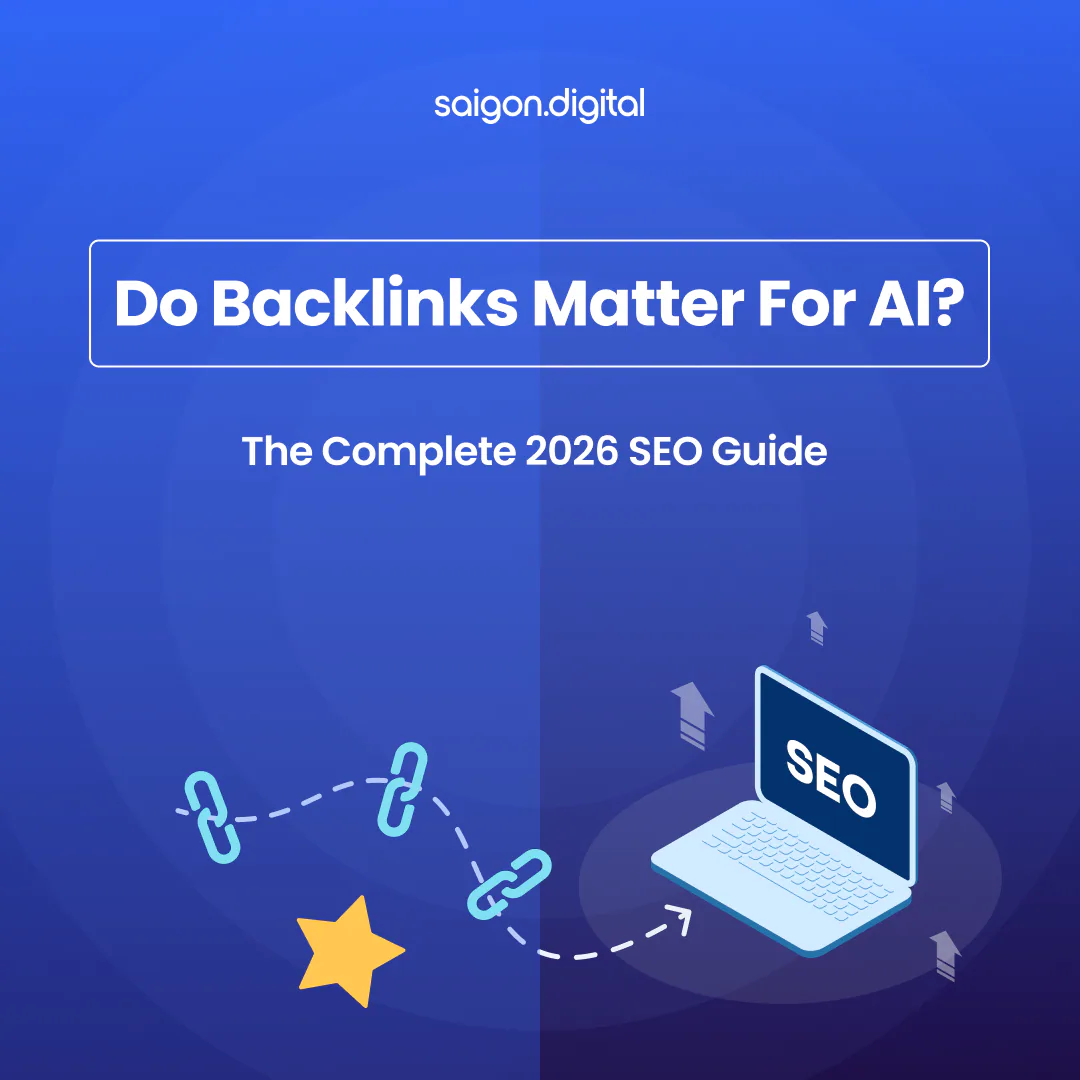
The Short Answer: Do Backlinks Matter for AI?
Yes, but not in the same way they did in 2015.
Backlinks still matter for AI-driven search because they remain one of the strongest signals of:
- Authority
- Trust
- Topical expertise
- Brand credibility
However, AI systems interpret links differently. They no longer reward volume. They reward context, reputation, and semantic relevance.
In 2026, backlinks are no longer about manipulation. They are about earned authority within a trusted digital ecosystem.
How AI Search Has Changed the Game
AI has not simply updated search, it has redefined how information is interpreted, prioritised, and delivered. To properly answer the question “do backlinks matter for AI?”, we must understand how modern AI search engines process data and evaluate authority.
Below, we expand on each shift in detail, with practical guidance you can implement immediately.
1. AI Uses Large Language Models to Generate Summaries
First and foremost, AI-driven search engines no longer display only a list of ranked pages. Instead, they generate contextual summaries using large language models (LLMs). These systems analyse multiple sources, synthesise information, and present a consolidated answer at the top of the results.
This means your content is no longer competing just for a click, it is competing to become part of the answer itself.
In practical terms, AI systems:
- Extract key insights from multiple trusted pages
- Identify recurring consensus across authoritative domains
- Prioritise structured, well-organised information
- Favour sources with strong credibility signals
As a result, your content must be written in a way that AI can easily interpret, extract, and trust.
Clear instructions for optimisation:
- Structure content using logical headings (H2, H3)
- Provide concise definitions before expanding in depth
- Use clear paragraph breaks and structured formatting
- Support claims with data, research, or industry references
- Avoid vague or overly promotional language
For example, if you are answering “do backlinks matter for AI”, begin with a clear, direct response before diving into nuance. AI prefers clarity before complexity.
Additionally, consider how your information might appear in a summarised format. If a paragraph were extracted and displayed independently, would it still make sense? If not, refine it.
In the AI era, clarity equals visibility.
2. AI Extracts Answers Directly From Content
Unlike traditional search, which relied heavily on ranking signals, AI systems now extract specific passages that directly answer user intent. Rather than ranking your page broadly for a keyword, AI looks for answer-level precision.
This fundamentally changes how we write content.
Instead of optimising entire pages around a phrase, you must optimise individual sections to satisfy micro-intents.
For example, a user might ask:
- Do backlinks matter for AI rankings?
- Are backlinks important in 2026?
- Does AI ignore links?
Although similar, each query has slightly different intent. AI systems detect these nuances and pull the most precise answer block available.
To optimise for answer extraction:
- Include direct question-and-answer sections
- Use natural language variations of key phrases
- Avoid burying critical information halfway through a paragraph
- Keep answer paragraphs between 40–120 words for clarity
Here is a practical content structure that works well:
- Direct answer in 1–2 sentences
- Supporting explanation
- Broader strategic context
By doing this, you increase the probability that AI selects your content as a cited source.
3. AI Analyses Context and Meaning, Not Just Keywords
Previously, SEO revolved around keyword matching. Today, AI understands semantics, relationships, and contextual meaning.
In other words, it no longer asks, “Does this page repeat the keyword?” Instead, it asks, “Does this page demonstrate true topical understanding?”
This is where many outdated strategies fail.
For instance, simply repeating “do backlinks matter for AI” throughout a page will not improve authority. However, discussing related concepts such as:
- Domain authority
- Digital PR
- Entity recognition
- Topical clusters
- Trust signals
- Brand citations
… demonstrates subject depth.
AI systems map these relationships to determine expertise.
How to implement semantic optimisation:
- Build topic clusters around core themes
- Use related terminology naturally
- Cover subtopics comprehensively
- Internally link to supporting resources
- Avoid thin or repetitive content
For example, if you write about backlinks, you should also discuss:
- The evolution of link algorithms
- The role of authority in AI-generated summaries
- The relationship between brand strength and citations
Depth signals expertise. Expertise builds trust. Trust increases AI visibility.
4. AI Evaluates Brand Reputation Across Multiple Signals
Perhaps the most significant change is that AI evaluates brand authority holistically.
Backlinks still matter, but they are only one part of a much larger credibility framework.
AI systems assess:
- Media mentions
- Branded search volume
- Industry citations
- Social references
- User engagement signals
- Consistency of expertise across content
In other words, AI builds an entity profile of your brand.
If your company consistently appears in credible publications, produces expert insights, and earns natural backlinks, AI associates your brand with authority in that field.
Conversely, if your site has links but lacks broader brand presence, your authority ceiling will be limited.
Strategic recommendations:
- Invest in digital PR campaigns
- Publish original data and research
- Encourage branded searches through awareness campaigns
- Maintain consistent thought leadership
- Monitor brand mentions beyond backlinks
For example, a cybersecurity brand cited repeatedly in respected industry reports will likely be favoured in AI summaries, even if it has fewer total backlinks than competitors.
Authority today is ecosystem-based, not link-count-based.
Backlinks in the AI Era: What Has Changed?
If you are seriously asking, do backlinks matter for AI?, you must also ask a second question: what kind of backlinks actually matter now?
The role of links has not disappeared, it has matured. AI-driven search engines have become exceptionally effective at detecting manipulation, evaluating context, and assessing genuine authority. Consequently, the link-building strategies that worked a decade ago are no longer just ineffective, they can actively limit your growth.
Let us break down what has fundamentally changed, and more importantly, how you should respond in 2026.
1. Quantity Is Irrelevant
For years, SEO conversations revolved around numbers: how many links a site had, how quickly they were acquired, and how they compared to competitors. Today, that mindset is outdated.
AI systems analyse link patterns at scale. They detect unnatural growth spikes, irrelevant placements, and network-based manipulation with far greater accuracy than traditional algorithms ever could.
In practical terms, 1,000 low-quality directory links will not outperform five strong editorial links from reputable, relevant publications.
Why? Because AI evaluates:
- The authority of the linking domain
- The topical relevance between both sites
- The context surrounding the link
- The historical credibility of the source
- The naturalness of the link profile
Therefore, link-building volume without strategic alignment is not only inefficient, it is risky.
Clear strategic shift for 2026:
- Audit and remove toxic or irrelevant backlinks
- Prioritise industry-aligned publications
- Focus on editorial placements rather than self-submitted links
- Slow down acquisition velocity to maintain natural growth
For example, a fintech brand would gain far more authority from one mention in a respected financial technology journal than from hundreds of unrelated blog comments.
AI rewards signals of real endorsement, not manufactured popularity.
2. Context Matters More Than Anchor Text
Historically, anchor text was heavily optimised. Exact-match phrases were aggressively pursued because they sent strong ranking signals.
However, AI now interprets meaning at a semantic level. It understands that a link within a well-written paragraph about “digital authority in AI search” contributes relevance, even if the anchor text simply says “this study” or “industry research”.
What matters most today is contextual alignment.
AI evaluates:
- The surrounding paragraph content
- The broader topic of the linking page
- The thematic relationship between both domains
- Whether the link appears editorially integrated or artificially inserted
In other words, placement quality outweighs anchor manipulation.
How to adapt your approach:
- Avoid over-optimised, repetitive anchor text
- Aim for natural language citations
- Ensure linking content genuinely discusses related topics
- Contribute expert insights that justify the mention
For instance, if your agency publishes original research about whether backlinks matter for AI, and a marketing publication references your findings within a broader article on AI search evolution, that contextual integration sends a powerful signal, regardless of anchor phrasing.
AI understands relationships. It does not rely on keyword tricks.
3. Brand Mentions Count, Even Without Links
One of the most important developments in AI-driven search is entity recognition. Search engines increasingly treat brands as identifiable entities within a knowledge graph.
This means your brand does not need a hyperlink to contribute authority. Repeated, credible mentions across trusted platforms strengthen your entity profile.
AI models learn from patterns such as:
- Industry reports citing your company
- Interviews and expert commentary
- Conference speaker listings
- News coverage
- Academic or research references
Even unlinked mentions contribute to your perceived authority.
This represents a fundamental shift in how we interpret link value. Instead of asking only, “How many backlinks do we have?”, you should also ask, “Where and how is our brand being referenced?”
Strategic recommendations:
- Track unlinked brand mentions
- Reach out to convert high-value mentions into links where appropriate
- Increase thought leadership activity
- Participate in industry panels, podcasts, and expert round-ups
For example, if your brand is repeatedly cited in conversations about AI-powered marketing innovation, AI systems begin associating your entity with that topic, whether every mention includes a hyperlink or not.
Authority is now pattern-based, not purely link-based.
4. Authority Is Entity-Based, Not Page-Based
In traditional SEO, authority was often calculated at the page or domain level using metrics like Page Rank. Today, AI builds a much richer understanding of brands as entities operating within thematic ecosystems.
An entity-based model means AI evaluates:
- Consistency of expertise
- Topical focus
- Cross-platform reputation
- Historical trust signals
- Relationships with other authoritative entities
In other words, backlinks support authority, but they must align with your broader entity positioning.
If your website publishes content across unrelated niches, earns random links from disconnected sources, and lacks a coherent expertise narrative, AI struggles to classify your authority clearly.
Conversely, if your brand consistently publishes content within a defined area, such as AI-driven SEO strategy and earns links from aligned digital marketing publications, AI strengthens your entity association with that field.
Clear implementation strategy:
- Define your core topical pillars
- Align link-building efforts strictly within those themes
- Maintain consistent messaging across all channels
- Build long-term industry relationships rather than one-off placements
For example, if you want to dominate conversations around “do backlinks matter for AI”, you must:
- Publish authoritative content on AI search
- Earn citations from reputable marketing and tech publications
- Be mentioned alongside recognised industry players
- Maintain topical consistency over time
Entity strength compounds. Scattered signals dilute it.
Why Backlinks Still Influence AI Search Results
AI models require signals to determine:
- Which sources are reliable
- Which content deserves summarisation
- Which brand should be cited in AI-generated answers
Backlinks remain one of the clearest trust indicators because:
1. They represent editorial endorsement
2. They demonstrate external validation
3. They indicate real-world authority
If reputable industry publications link to your research, AI systems interpret this as credibility.
In an AI-powered SERP environment, this often influences:
- Inclusion in AI summaries
- Position in traditional rankings
- Visibility in conversational search responses
Backlinks may not operate exactly as they once did but they absolutely matter.
What AI Values More Than Links Alone
Backlinks remain important. However, in 2026, they are only one part of a much broader authority framework. If you are still asking “do backlinks matter for AI?”, it is essential to understand that AI systems evaluate far more than link profiles.
Modern AI search engines assess credibility holistically. They analyse structure, depth, expertise, engagement, and brand strength alongside traditional authority signals. Therefore, while backlinks support trust, they cannot compensate for weak foundations.
Let us explore what AI values more than links alone and how you should respond strategically.
1. Topical Authority
First and foremost, AI prioritises topical authority over isolated link signals. Rather than evaluating a single page in isolation, AI analyses whether your entire website demonstrates consistent expertise within a defined subject area.
In practical terms, this means your site must show depth, breadth, and coherence.
AI systems examine:
- How comprehensively you cover a topic
- Whether your content connects logically through internal links
- The consistency of terminology and expertise
- The relationship between pillar pages and supporting articles
If your content appears scattered, covering unrelated themes without clear expertise, AI struggles to categorise your authority. On the other hand, when your site builds structured topic clusters, authority compounds.
Clear instructions for building topical authority:
- Define 3–5 core subject pillars aligned with your services
- Create comprehensive pillar pages targeting competitive queries
- Develop supporting articles that explore subtopics in depth
- Use strategic internal linking to reinforce relationships
- Regularly update cornerstone content to maintain relevance
For example, if you want to dominate conversations around whether backlinks matter for AI, you should not publish a single article. Instead, build a complete content ecosystem covering:
- AI search evolution
- Digital PR strategies
- Entity-based SEO
- Technical optimisation for AI crawlers
- Brand authority in machine learning systems
Depth signals expertise. Expertise builds trust. Trust earns visibility.
2. Experience and Original Insight
Secondly, AI increasingly rewards content that demonstrates genuine experience and original thinking. Large language models are trained on vast datasets, meaning they can easily identify surface-level repetition.
If your content simply rephrases widely available information, it adds little value.
However, when your content includes:
- Unique insights
- Real case studies
- Data-driven analysis
- Professional expertise
- First-hand strategic observations
… it becomes significantly more authoritative in the eyes of AI systems.
This shift is critical. AI is designed to synthesise generic knowledge. Therefore, it prioritises sources that offer something beyond what it can generate independently.
Strategic implementation guidance:
- Publish original research and surveys
- Include anonymised client case results
- Share performance benchmarks
- Offer strategic commentary on industry trends
- Add expert quotes from your internal team
For instance, instead of simply stating that backlinks remain important, explain why you have observed link authority influencing AI summary inclusion in real campaigns. Provide examples, data, or measurable outcomes.
Originality increases citation probability. Citation probability increases AI visibility.
3. Data and Research
Closely related to original insight is the importance of proprietary data. AI systems consistently favour content that includes verifiable statistics and research-backed claims.
Why? Because data strengthens credibility signals.
When multiple reputable sources cite the same data point, AI interprets it as consensus. If your brand is the original source of that data, your authority multiplies.
Moreover, research naturally attracts backlinks, media coverage, and brand mentions, reinforcing the authority loop.
Practical steps to leverage data effectively:
- Conduct annual industry surveys
- Publish benchmark performance reports
- Analyse aggregated campaign results
- Release trend forecasts supported by data
- Provide downloadable resources with structured insights
For example, imagine publishing a “2026 AI Search Authority Report” analysing how backlinks influence AI-generated citations across industries. Not only would this position your brand as a thought leader, but it would also generate natural editorial links and industry discussion.
Data transforms opinion into authority.
4. Brand Strength
In the AI era, brand strength has become a decisive ranking factor. AI systems do not merely assess pages, they assess entities. The stronger your brand footprint, the more likely AI is to trust your content.
Brand strength includes signals such as:
- Branded search volume
- Direct website traffic
- Social engagement
- Media recognition
- Industry partnerships
- Consistent messaging
When users actively search for your brand, interact with your content, and reference your insights, AI interprets this as real-world validation.
Consequently, link-building strategies disconnected from brand-building are limited in impact.
How to strengthen brand authority in 2026:
- Invest in multi-channel visibility (SEO, social, digital PR)
- Maintain consistent expertise positioning
- Encourage branded search through awareness campaigns
- Participate in industry events and webinars
- Develop recognisable thought leadership voices
For example, when your agency is consistently associated with AI-powered marketing innovation, AI begins to classify your brand as an authority in that field. Backlinks reinforce this, but brand strength drives it.
In short, visibility fuels credibility.
5. Technical Excellence
Finally, none of the above matters without strong technical foundations. AI search engines must be able to crawl, interpret, and understand your site efficiently.
Technical weaknesses dilute authority signals, regardless of backlink strength.
AI prioritises:
- Fast-loading pages
- Mobile optimisation
- Clean site architecture
- Structured data implementation
- Secure browsing (HTTPS)
- Crawl efficiency
Structured data, in particular, plays an increasingly important role. It helps AI interpret:
- Article types
- Authors
- Organisations
- FAQs
- Product details
- Reviews
The clearer your structure, the easier it is for AI to extract accurate information.
Technical priorities for 2026:
- Optimise Core Web Vitals
- Implement schema markup strategically
- Maintain logical URL structures
- Eliminate crawl errors
- Ensure internal linking clarity
Think of backlinks as endorsements. Technical SEO ensures those endorsements are understood.
Without technical clarity, authority signals lose power.
The Real Question: Do Backlinks Matter for AI Rankings?
By now, the discussion has moved beyond simple yes-or-no answers. The more strategic question is not merely “do backlinks matter for AI?”, it is how they influence AI-driven rankings within a broader authority system.
In 2026, AI does not treat backlinks as a shortcut to the top of search results. Instead, it interprets them as one signal among many that contribute to trust, credibility, and entity strength.
To understand their true role, we must examine what backlinks actually help with and where their influence stops.
1. Backlinks Help Establish Domain Authority
First and foremost, backlinks remain a foundational authority signal. When reputable, relevant websites link to your content, they provide external validation.
AI systems interpret this as endorsement.
However, the key distinction in 2026 is who is linking, not how many.
AI evaluates:
- The authority and credibility of the linking domain
- The historical trustworthiness of the source
- The topical alignment between both sites
- Whether the link appears editorially earned
For example, if a respected industry publication references your research within an article about AI search trends, that endorsement strengthens your domain authority significantly more than dozens of unrelated links.
Strategic actions:
- Prioritise industry-aligned publications
- Focus on thought leadership contributions
- Develop research assets worth citing
- Build long-term editorial relationships
Authority compounds when links come from trusted ecosystems. AI recognises patterns of credibility, not isolated placements.
2. Backlinks Strengthen Trust Signals
Beyond authority, backlinks reinforce trust.
AI systems must determine which sources are reliable enough to:
- Rank prominently
- Be summarised in AI-generated answers
- Be cited within conversational search responses
Backlinks serve as external proof that other credible entities consider your content valuable.
However, trust signals extend beyond links alone. AI cross-references link profiles with:
- Content depth
- Brand reputation
- Engagement metrics
- Consistency of expertise
Therefore, backlinks work best when they align with genuine quality.
To strengthen trust strategically:
- Ensure linking pages are contextually relevant
- Avoid over-optimised anchor text patterns
- Maintain consistent publishing standards
- Remove or disavow toxic links
In practical terms, a smaller, cleaner, highly relevant link profile often performs better than a large, diluted one.
Trust is about coherence.
3. Backlinks Support Competitive Keyword Rankings
Despite the evolution of AI search, competitive keywords still require strong authority signals.
When multiple high-quality websites publish comprehensive content on the same topic, AI must differentiate between them. Backlinks often serve as a tie-breaker.
For example, imagine three well-written guides answering “do backlinks matter for AI”. If all three demonstrate depth and clarity, AI may prioritise the one with stronger editorial endorsements.
However, backlinks alone will not secure rankings if:
- The content lacks depth
- The page fails to satisfy search intent
- Technical SEO is weak
- User engagement is poor
Backlinks amplify quality. They do not replace it.
How to compete effectively:
- Combine comprehensive content with strong digital PR
- Align link-building efforts with high-value pillar pages
- Strengthen internal linking to distribute authority
- Regularly update cornerstone resources
In highly competitive niches, backlinks remain a decisive, though not exclusive, factor.
3. Backlinks Increase Discoverability
Another overlooked benefit of backlinks is crawl discovery.
Although AI-driven search engines are highly sophisticated, they still rely on links to discover new content and understand relationships between pages.
When authoritative websites link to your new research or guides, search engines can:
- Discover the page faster
- Associate it with related topics
- Understand its contextual importance
Furthermore, backlinks often drive referral traffic, which can generate:
- Branded searches
- Engagement signals
- Additional organic mentions
This creates a reinforcing cycle of visibility.
To maximise discoverability:
- Promote new content through digital PR campaigns
- Share research with journalists and industry analysts
- Collaborate with complementary brands
- Align launches with relevant news cycles
Visibility generates recognition. Recognition builds authority. Authority improves rankings.
4. Backlinks Enhance Brand Recognition
In the AI era, brand strength directly influences ranking potential.
When your brand is repeatedly referenced across credible websites, AI strengthens your entity association within that niche.
Over time, this can lead to:
- Greater inclusion in AI summaries
- Increased citation frequency
- Higher ranking stability
- Stronger competitive positioning
However, backlinks contribute most effectively when they reinforce a clear expertise narrative.
For example, if your brand consistently earns mentions within conversations about AI-powered marketing strategy, AI systems begin associating your entity with that domain.
This is where backlinks intersect with brand positioning.
Strategic focus areas:
- Maintain topical consistency
- Publish authoritative, research-backed content
- Align link-building efforts strictly with core pillars
- Invest in long-term brand development
Random links dilute positioning. Strategic links reinforce it.
5. Where Backlinks Alone Fall Short
It is equally important to clarify where backlinks do not provide impact in 2026.
Backlinks cannot:
- Rescue thin or duplicated content
- Compensate for poor user experience
- Mask technical SEO weaknesses
- Overcome lack of topical authority
- Sustain rankings without consistent updates
AI systems evaluate holistic quality. If your content lacks depth or fails to satisfy intent, even strong backlinks will not guarantee long-term success.
Therefore, backlink strategy must integrate into a wider SEO ecosystem.
The Balanced Conclusion
So, do backlinks matter for AI rankings?
Yes, but only within a multidimensional authority framework.
They help:
- Establish credibility
- Strengthen trust
- Support competitive rankings
- Improve discoverability
- Reinforce brand recognition
However, they must align with:
- Expert-level content
- Clear topical authority
- Strong technical foundations
- Cohesive brand positioning
How to Build Backlinks That Matter in 2026
If we accept that the real question is not simply “do backlinks matter for AI?” but rather “which backlinks matter, and why?”, then strategy becomes everything.
Below, we break down exactly how to build backlinks that matter in 2026, with clear guidance you can implement immediately.
1. Prioritise Digital PR Over Traditional Link Building
First and foremost, traditional outreach-based link building has largely been replaced by strategic digital PR.
Instead of asking websites for links, you create assets worth covering.
AI systems are highly effective at detecting patterns associated with transactional link acquisition. Conversely, they reward editorial placements earned through merit.
Digital PR focuses on:
- Original research
- Industry commentary
- Data-driven insights
- Timely trend analysis
- Expert opinion pieces
When journalists, editors, and industry publishers cite your work naturally, those links carry significant contextual authority.
How to execute effectively:
- Conduct original research tied to industry pain points
- Develop press-ready reports with strong headlines
- Pitch insights to relevant journalists
- Offer expert commentary on breaking news
- Build relationships with niche publications
For example, if you publish an annual report analysing whether backlinks influence AI-generated search citations, marketing and technology publications are more likely to reference your data. That editorial citation sends a strong trust signal to AI systems.
Earned coverage outperforms requested placement.
2. Build Topical Authority Hubs
Secondly, backlinks matter more when they point to strategically structured content hubs rather than isolated blog posts.
AI values interconnected expertise. When multiple authoritative sites link to a well-developed pillar page supported by related articles, it strengthens your topical footprint.
A topical authority hub typically includes:
- A comprehensive pillar page targeting a core theme
- Supporting cluster articles exploring subtopics
- Internal links reinforcing semantic relationships
- Structured headings that clarify hierarchy
Instead of spreading backlinks across random content, focus on strengthening cornerstone resources.
Clear implementation plan:
- Identify your highest-value service themes
- Create in-depth pillar guides (3,000+ words where appropriate)
- Develop supporting articles answering related long-tail queries
- Internally link from cluster pages to the pillar page
- Direct external link-building efforts towards these hubs
For instance, a complete guide exploring AI search evolution, digital PR, and entity-based SEO would serve as a stronger backlink target than a short opinion article.
Authority grows when depth meets structure.
3. Develop Strategic Industry Partnerships
In 2026, long-term partnerships outperform one-off link placements.
AI systems assess patterns over time. When your brand consistently appears alongside other reputable entities, it strengthens entity association and credibility.
Partnership-driven backlinks often come from:
- Industry collaborations
- Joint research projects
- Co-authored thought leadership
- Webinars and event sponsorships
- Technology integrations
These links are powerful because they reflect genuine professional alignment.
Strategic approach:
- Identify complementary brands within your niche
- Collaborate on research or content initiatives
- Participate in expert round-ups
- Host joint webinars or virtual events
- Contribute recurring columns to industry publications
For example, if you collaborate with a respected AI software provider to publish research on search trends, both brands reinforce each other’s authority. AI systems recognise these repeated co-occurrences.
Partnerships create credibility ecosystems.
4. Create Data Assets That Attract Natural Links
Data remains one of the strongest magnets for high-quality backlinks.
When you publish unique statistics, performance benchmarks, or annual trend reports, other websites reference your findings to support their own content.
AI systems prioritise original sources of data because they represent primary authority.
Effective data-driven assets include:
- Annual industry reports
- Performance benchmark studies
- Market trend analyses
- Survey results
- Interactive tools or calculators
Importantly, these assets should be structured clearly and easy to cite.
Best practice guidelines:
- Present key statistics in clear, quotable formats
- Include visual summaries such as charts and infographics
- Provide contextual explanations alongside data
- Update research annually to maintain relevance
- Promote findings through digital PR outreach
For instance, if your report shows measurable correlation between high-authority backlinks and inclusion in AI-generated summaries, other marketers will cite that data, strengthening your authority further.
Original data builds compound authority.
5. Align Link Building With Brand Positioning
Finally, backlink strategy must reflect your brand narrative.
Random link acquisition weakens entity clarity. Strategic alignment strengthens it.
Before pursuing any link opportunity, ask:
- Does this site align with our core expertise?
- Does this placement reinforce our positioning?
- Would this link make sense to a human reader?
- Does it support our long-term authority goals?
AI evaluates patterns. If your brand consistently earns links within a defined thematic ecosystem, AI strengthens your classification within that niche.
Strategic alignment checklist:
- Define clear expertise pillars
- Limit outreach to relevant verticals
- Maintain consistent messaging across placements
- Avoid opportunistic but misaligned link opportunities
- Monitor backlink profiles for thematic consistency
For example, if your brand specialises in AI-driven digital growth, backlinks from marketing technology publications reinforce positioning. Links from unrelated lifestyle blogs do not.
Relevance compounds authority.
The 2026 SEO Framework: A Balanced Approach
By this point, one thing should be clear: asking “do backlinks matter for AI?” in isolation misses the bigger picture.
Backlinks matter but only within a balanced, integrated SEO framework.
Below, we break down the four pillars of a balanced 2026 SEO framework with practical guidance for implementation.
1. Technical Foundations
Before AI can rank, summarise, or cite your content, it must understand it.
Technical SEO remains the silent enabler of authority. Without it, even the strongest backlink profile cannot deliver consistent results.
AI systems prioritise websites that are:
- Fast-loading
- Mobile-optimised
- Secure (HTTPS)
- Structurally organised
- Free from crawl errors
- Marked up with structured data
If your site architecture is unclear, AI may struggle to interpret relationships between pages. If your performance is slow, user engagement signals decline. Both scenarios weaken authority perception.
Clear implementation priorities:
- Optimise Core Web Vitals for speed and stability
- Use logical URL structures that reflect topic hierarchy
- Implement schema markup (Article, FAQ, Organisation, etc.)
- Maintain clean internal linking
- Conduct quarterly technical audits
For example, if you publish a comprehensive guide answering whether backlinks matter for AI, structured data can help search engines identify it as a primary resource. Clear architecture ensures that related cluster articles reinforce it.
Technical excellence does not drive authority alone but it allows authority to be recognised.
2. Strategic Content
Content remains the engine of SEO but in 2026, strategy matters more than volume.
AI rewards content that demonstrates expertise, satisfies user intent, and contributes meaningful insight. Thin or repetitive content no longer competes effectively.
Strategic content should:
- Address defined audience pain points
- Cover topics comprehensively
- Be structured for machine readability
- Provide clear, direct answers
- Offer depth beyond surface-level summaries
Moreover, content must align with a broader topical ecosystem. Random blog publishing does not build authority. Structured content clusters do.
Practical content framework:
- Identify core service pillars
- Create in-depth cornerstone guides
- Develop supporting cluster articles
- Update cornerstone pages annually
- Integrate expert insights and data
For example, instead of publishing scattered posts about SEO, AI, and digital marketing trends, build a cohesive AI search authority hub. Each article should strengthen the thematic footprint of the pillar page.
Depth signals expertise. Consistency reinforces credibility.
3. Digital Authority
Now we return to backlinks but in context.
Digital authority encompasses:
- Earned backlinks
- Media mentions
- Brand citations
- Industry recognition
- Thought leadership visibility
Backlinks remain powerful but only when they reflect genuine endorsement.
AI systems evaluate patterns across your digital footprint. When authoritative publications consistently reference your brand, it strengthens entity recognition.
However, link-building efforts must align with your strategic positioning.
Balanced authority-building approach:
- Invest in digital PR campaigns
- Publish proprietary research
- Participate in industry events and webinars
- Contribute expert commentary
- Build long-term editorial relationships
For example, if your agency consistently publishes data-backed insights on AI-driven marketing, and those insights are cited across industry platforms, backlinks reinforce a clear authority narrative.
Authority compounds when recognition is consistent.
4. AI Optimisation
Finally, SEO in 2026 requires intentional AI optimisation.
Traditional ranking factors remain relevant, but AI-generated search results introduce new considerations.
AI systems prioritise content that is:
- Clearly structured
- Contextually rich
- Directly answer-focused
- Semantically comprehensive
- Easy to extract and summarise
In other words, your content must serve both humans and machines.
AI optimisation best practices:
- Include direct question-and-answer sections
- Use natural language variations of key queries
- Avoid unnecessary complexity
- Break complex topics into digestible sections
- Ensure paragraphs remain clear and self-contained
For example, when answering “do backlinks matter for AI”, provide a concise summary before expanding into strategic nuance. This increases the likelihood of inclusion in AI-generated responses.
Additionally, monitor how AI surfaces your content. Adapt formatting and clarity where necessary.
AI optimisation is not manipulation, it is clarity engineering.
Final Verdict: Do Backlinks Matter for AI?
Yes. Backlinks still matter for AI but only when they reflect genuine authority.
In 2026:
- Quality beats quantity
- Relevance beats volume
- Authority beats tactics
Backlinks are no longer a game of numbers. They are a reflection of your brand’s credibility within your industry.
If you want to lead in AI-powered search, you must:
- Build authoritative content
- Earn strategic links
- Strengthen your brand
- Integrate SEO with AI innovation
That is how you create sustainable visibility.
The Future of SEO Is Authority-Led, AI-Enhanced Growth
Search is now about becoming the most trusted answer.
At Saigon Digital, we solve digital challenges with forward-thinking, user-centric, and bespoke solutions.
We turn strategy, creativity, and data into measurable business growth. From high-performance websites to SEO, automation, and AI-powered marketing, we equip ambitious brands with the speed, visibility, and innovation they need to lead.
Contact us today to enhance your brand AI visibility!
Want to be the brand AI engines recommend?
We make businesses visible on Google and inside AI answers, measured in leads, not vanity metrics.