We're hiring Data & Ads Specialist We're hiring Delivery Manager We're hiring Head of Marketing We're hiring SEO Manager We're hiring and always listening for the next

CASE STUDY · LOGISTICS · AI AGENTS & WORKFLOW AUTOMATION

An AI agent on the chartering desk, reading every enquiry before a person does

Built on Claude by Anthropic3 AI models, 9 AI skillsA person approves every send
802Emails read in the first live weekEvery message in the shared chartering inbox, checked every five minutes, with 176 correctly set aside as not an enquiry.
61 of 61Enquiries assigned automaticallyEach one logged with a reference and routed to a named person by language, workload and leave, with no manual sorting.
97%Accuracy at spotting what is not an enquiryUp from 74% on live mail, 37 of 38 against 28 of 38, after the triage step was re-tested and rewritten.

Built with

  • Claude
  • Anthropic API
  • Microsoft 365
  • Next.js
  • TypeScript
  • Supabase
  • PostgreSQL
  • Vercel

A chartering desk that ran on one shared inbox, and the people who had to read all of it.

The client is a global project logistics group with offices in a dozen countries. Its chartering desk finds ships for heavy and oversized cargo: transformers, machinery, anything too big for a container. We are not naming the group yet, so the details here are the work, not the brand.

Every enquiry arrived as an email. Someone had to read it, work out whether it was a real enquiry or a market circular, pull out the ports, the cargo, the weight and the dates, check the packing list, chase what was missing, then write to as many as 20 carriers and compare their replies by hand. The team named the time drains themselves: bad packing lists, incomplete enquiries and a stream of carrier emails.

We built an AI agent with a workflow around it, and called it Hermes, after the messenger of the gods. Fitting, for something whose whole job is getting messages to the right place. Hermes runs on Claude, the AI models made by Anthropic, and does the reading, sorting, checking and drafting. The people on the desk keep every commercial decision. It went live on the real mailbox on 27 October 2026, and the numbers on this page are from its first week. The same approach is what we now offer as AI agents and workflow automation.
THE AI INSIDE

Meet Hermes. Three models, nine skills.

Hermes is the AI inside the system. It runs on Claude, the family of AI models made by Anthropic. It does not use one big model for everything. Each job goes to the smallest model that can do it well, and anything predictable is left to plain rules.

FAST

Claude Haiku

The sorter. It reads every email and answers one question, is this a real enquiry? Quick and cheap, so it can look at all of them.

EVERYDAY

Claude Sonnet

The reader and writer. It pulls out ports, cargo and dates, reads packing lists and carrier rates, and drafts the replies.

DEEP

Claude Opus

The second opinion. Called only when a packing list's numbers do not add up, for a slower and more careful re-read.

NO AI

Plain rules

Everything predictable. Filing replies, issuing references, sharing out the work. No model, so no guessing and no cost per email.

Global logistics group, the delivered platform

03 THE WORK

Chapter by chapter.

01

The inbox becomes a queue

The agent checks the shared inbox every five minutes. Before any AI is involved, plain rules file the easy cases: carrier replies, the group's own copied-in mail, bounces and system messages go onto the right enquiry and never become fake new ones.

What is left goes to the model, which decides whether the email is a real enquiry and, if it is, extracts the load port, discharge port, cargo, weight, volume, shipment window and terms. Each enquiry gets a reference and is assigned to a named person by language, workload and leave.

In the first week it read 802 emails, set aside 176 that were not enquiries, and logged 61 enquiries. All 61 were assigned automatically.

802emails read in the first live week
02

Checked before a person sees it

Packing lists come as spreadsheets, PDFs and scans. The system reads spreadsheets with ordinary code and uses the model for PDFs and images. If a document cannot be read, the check is marked skipped, never passed.

Each enquiry is then validated: is anything missing, do the weight and volume in the email match the packing list, is the shipment window in the past. Of the first 61 enquiries, 18 passed and 43 were missing something.

For those, the agent drafts a reply that asks only for what is missing. The person in charge reviews it and sends it from their own mailbox.

40missing-information replies drafted in week one
03

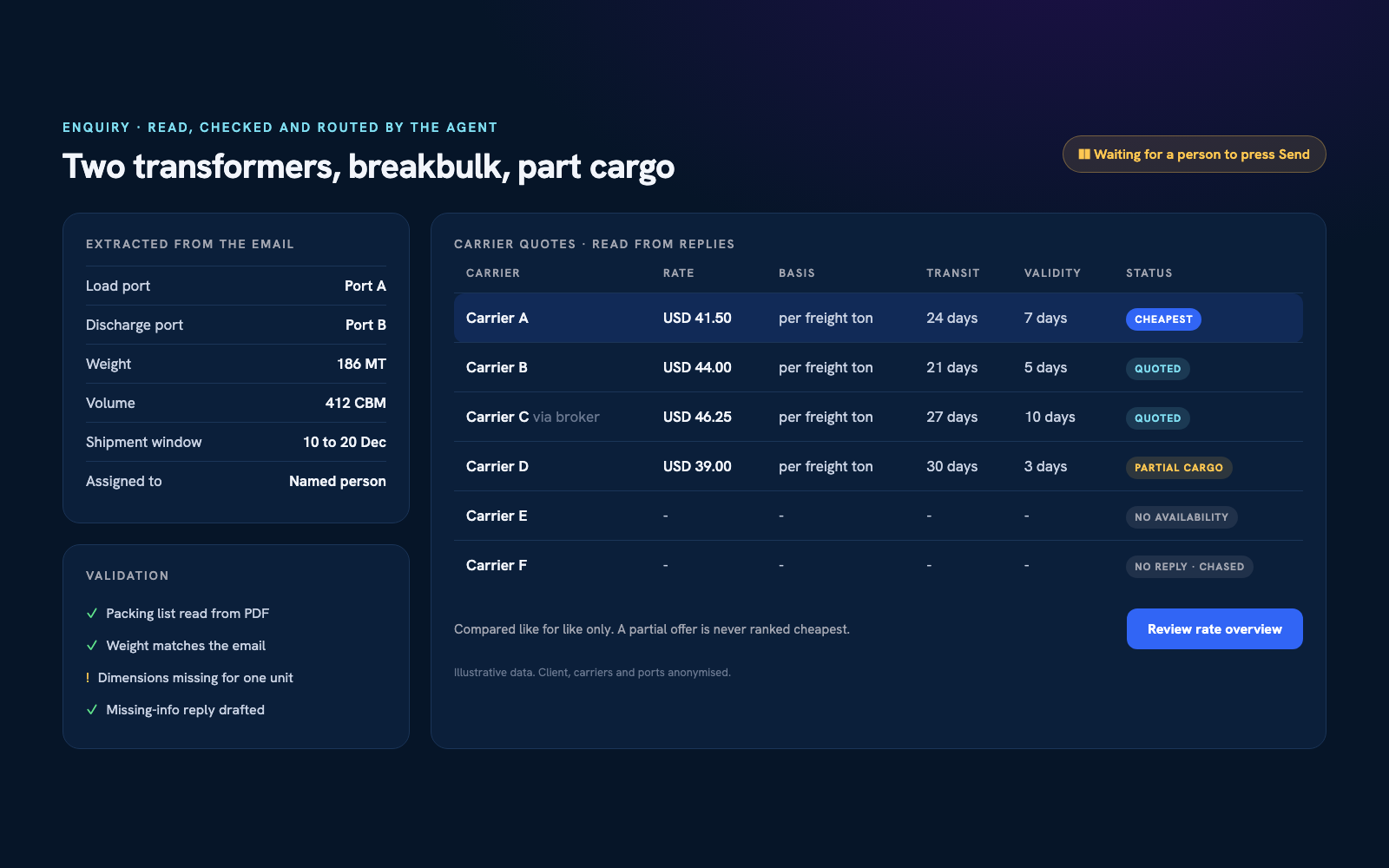
Every carrier rate in one table

The desk can write to as many as 20 carriers for one enquiry. The system suggests carriers with history on that trade lane, showing how often each replies and how often it is cheapest, then drafts the rate requests in the desk's own house format.

When carriers answer, the agent reads each reply into one quote table: rate, currency, basis, transit time, validity and where the offer differs from what was asked. Rates are compared like for like only, and a partial offer is never ranked cheapest.

Every rate ever quoted is kept, so the desk can see which carriers are cheapest and which reply on each lane over the last 90 days. A weekday digest lists the carriers who have gone quiet.

127carrier rate replies read in week one
04

A person presses Send, every time

Hermes is advisory. Nothing reaches a client or a carrier unless a person presses Send, from their own mailbox. Won or lost is always marked by a person, and a reply the system is not sure about is flagged for a human, never filed on a guess.

Every human and AI action is written to a history that nobody can edit or delete, including us. Staff sign in with their own company Microsoft accounts.

The desk raised 12 issues in the first week. All 12 have been fixed.

0emails sent to a client or carrier without a person
05

It gets better every week, without retraining

Hermes learns the way a new colleague does: by being corrected. When someone fixes a field it got wrong and says why, the system stores the AI's answer, the human's answer and the reason.

Those explained corrections become short written lessons that Hermes reads before its next job. There is no retraining and no fine-tuning, and the models are never trained on the client's data. A developer reviews the lessons before they stay. In week one, 34 corrections on 10 of 61 enquiries became 6 rule updates.

Every AI answer is stamped with the version of the instructions that produced it, so we can measure whether a change helped. A test run on real examples each night, plus six automated monitors, report to our developers. Re-testing the sorting step on live mail lifted its accuracy from 74% to 97%.

74% to 97%triage accuracy on live mail after one round of re-testing

By the numbers.

802emails read in the first live week
5 minbetween checks of the shared inbox
3Claude models, each matched to its job
9AI skills, each with one job
127carrier replies read for their rates
203carrier quotes put into comparison tables
854automated tests guarding the system
0emails sent without a person pressing Send
Now we're saving weeks to hours in our logistics pipeline with AI, automation and workflow with Saigon Digital. We couldn't have made a better investment for our team.
Global Logistics Director
Global logistics group

Questions about this project

What does the AI agent actually do on the chartering desk?

It reads the shared inbox every five minutes, works out which emails are real enquiries, pulls out the ports, cargo, weight, volume and dates, checks the packing list, assigns the enquiry to a named person and drafts the replies. When carriers answer, it reads their rates into one comparison table. See AI agents and workflow automation.

Which AI models does it use?

Hermes runs on Claude, the AI models made by Anthropic, through one interface. Claude Haiku, the fast model, sorts every email. Claude Sonnet reads the enquiries, packing lists and carrier rates and drafts the replies. Claude Opus, the most capable model, is called only for a careful second read when the numbers on a packing list do not add up. The model behind each job can be changed in one place.

Does the AI learn over time?

Yes, without retraining a model. When a person corrects Hermes and says why, the correction becomes a short written lesson that Hermes reads before its next job. A developer reviews the lessons, every AI answer is stamped with the version of the instructions that produced it, and a test run on real examples each night shows whether a change made things better or worse.

Does the agent send emails or make decisions on its own?

No. Nothing goes to a client or a carrier unless a person presses Send from their own mailbox, and marking a deal won or lost is always a human action. The system only sends internal notices, such as assignment emails and a daily list of carriers who have gone quiet.

How accurate is it, and what happens when it is wrong?

On live mail its accuracy at spotting what is not an enquiry went from 74% to 97% after the triage step was re-tested. When it gets a field wrong, the person corrects it and gives a reason. In the first week, 34 corrections on 10 of 61 enquiries became 6 rule updates, each reviewed by a developer before going live.

Is this built on a no-code tool or custom software?

Custom software. The first version used a no-code workflow tool, and we moved it into code when the job outgrew it. It now runs on Next.js, TypeScript and PostgreSQL, with every AI call going through one interface so the model can be changed in one place.

How is the data kept secure?

Staff sign in with their own company Microsoft accounts, access is limited by role, and every human and AI action is written to a history that cannot be edited or deleted, including by us. Models are used through a commercial API and are not trained on the client's data.

Want to be
the answer?

Tell us what you're working on. You'll get an honest answer about whether we can help, and exactly how.