



Search is changing rapidly.
Instead of simply clicking through a list of blue links, users are increasingly asking AI assistants like ChatGPT, Gemini, Perplexity and Google's AI Overviews to recommend products, explain services and compare brands.
For businesses, this represents a fundamental shift in digital visibility. Ranking well on Google is no longer the only measure of success. Your brand also needs to be discoverable, referenced and trusted by AI-powered search experiences.
This raises an important question:
How do you know whether your business is actually visible in AI and how do you compare your performance against competitors?
The answer is through AI visibility benchmarking.
In this guide, you'll learn how to benchmark your AI visibility against competitors, understand the metrics that matter, and download a practical benchmarking template that your team can use every quarter.
What Is AI Visibility?
AI visibility refers to how often and how accurately your brand appears within AI-generated answers.
Unlike traditional SEO, where success is measured by search rankings and clicks, AI visibility measures whether large language models (LLMs) consider your business a trustworthy source worthy of recommendation.
Examples include:
- ChatGPT recommending your business when users ask for providers
- Google AI Overviews citing your website
- Gemini mentioning your products
- Perplexity referencing your content
- AI assistants summarising information from your website
- Your brand appearing in AI-generated comparisons
Rather than competing solely for page-one rankings, businesses are increasingly competing to become part of AI-generated answers.
Why Benchmark AI Visibility Against Competitors?
Many organisations assume that if they rank highly on Google, they will naturally perform well in AI search.
That isn't always the case.
AI systems evaluate information differently. They consider factors such as:
- Entity recognition
- Topical authority
- Structured data
- Consistency across the web
- Brand mentions
- Trust signals
- Content clarity
- Expert credibility
It is now common to see businesses with lower traditional rankings appearing more frequently in AI-generated responses because they have stronger authority signals.
Benchmarking allows you to identify these gaps before they become competitive disadvantages.
Benefits of AI Visibility Benchmarking
Regular benchmarking helps your business:
- Understand how often AI recommends your brand
- Compare your AI presence against competitors
- Discover missing authority signals
- Prioritise SEO and GEO improvements
- Track progress over time
- Demonstrate ROI from AI optimisation initiatives
Instead of relying on assumptions, you gain measurable insights.
What Should You Benchmark?
Before you begin measuring your AI visibility, it's important to understand what you're actually benchmarking.
To gain a complete picture of your competitive position, your benchmark should measure multiple factors rather than relying on a single number. The following areas provide a practical framework for evaluating your AI visibility and identifying opportunities for improvement.
1. AI Brand Mentions
The most straightforward place to begin is by measuring how often AI platforms mention your business.
This gives you a baseline understanding of your current visibility. If your brand rarely appears in AI-generated responses while your competitors are mentioned repeatedly, it indicates that AI systems may not yet recognise your business as a leading authority within your industry.
To benchmark this, ask AI platforms questions that your potential customers are likely to use during their buying journey.
For example:
- Best restaurants in Ho Chi Minh City
- Recommended hotel booking software
- Top accounting firms for SMEs
- Best universities for business studies
- Which SEO agency specialises in AI optimisation?
For each prompt, record:
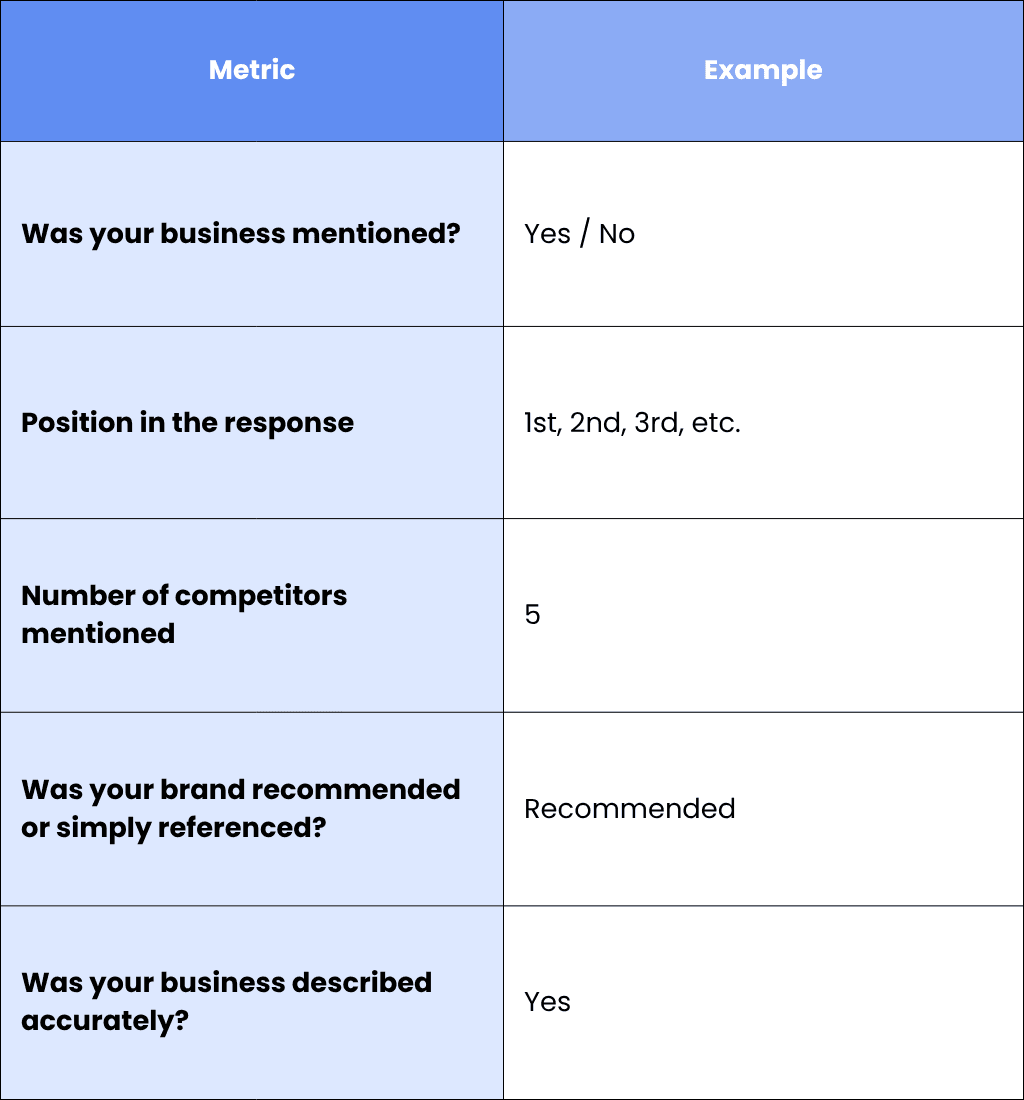
Suppose you test 20 prompts and receive the following results:
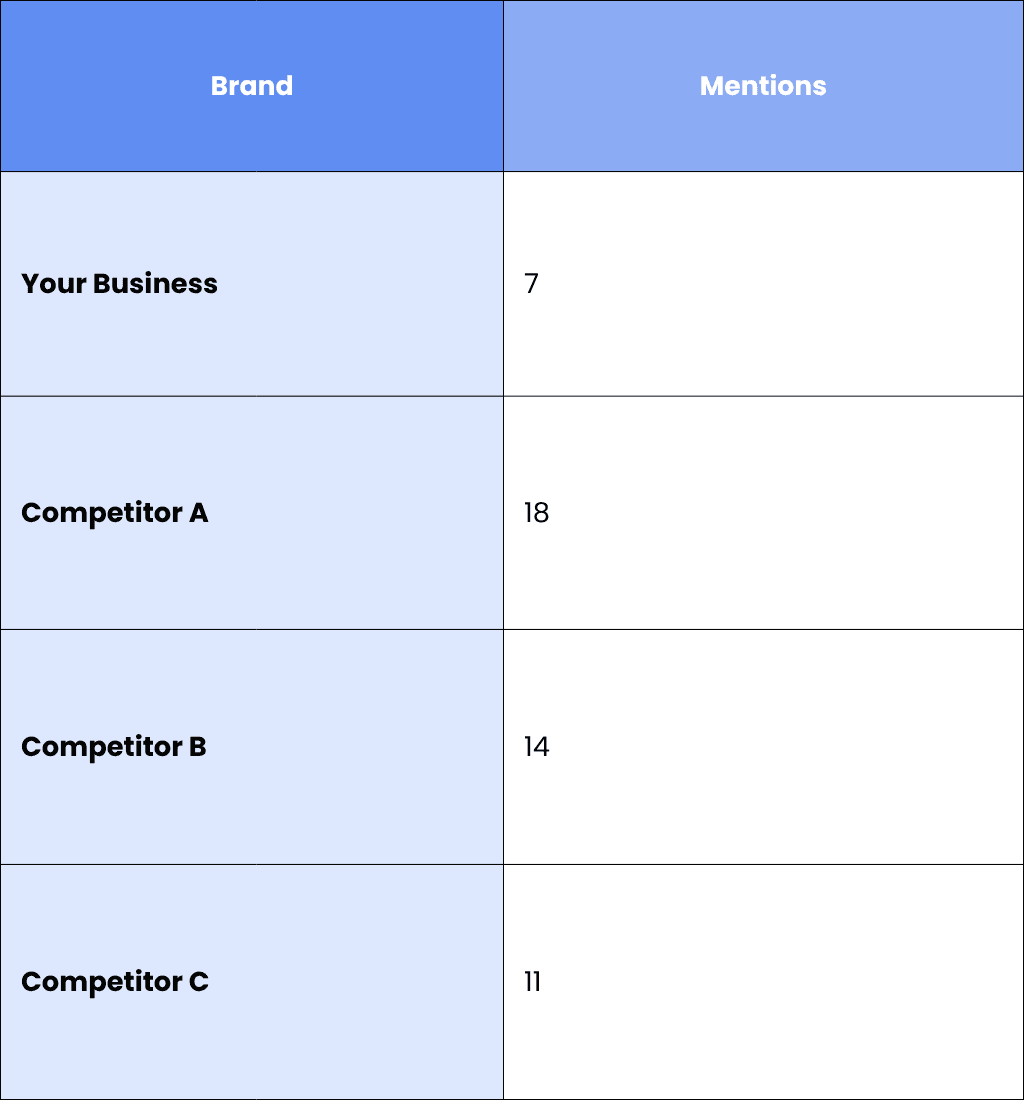
Although this simple comparison does not explain why competitors outperform you, it clearly shows where your brand currently stands.
However, visibility alone is not enough. The next question is whether AI platforms trust your content enough to reference it as a source.
2. AI Citation Frequency
After measuring how often your business is mentioned, the next step is to evaluate how often AI platforms cite your website or content.
This is an important distinction because a mention does not necessarily mean your website influenced the AI's response. AI citations indicate that your content has been recognised as a credible source of information.
Many AI search tools, including Perplexity and Google AI Overviews, regularly display references to the pages that support their answers.
As you benchmark, record details such as:
- Which page was cited
- How often your website appears
- Which competitors receive citations
- Whether citations come from your own website or third-party publications
For example:
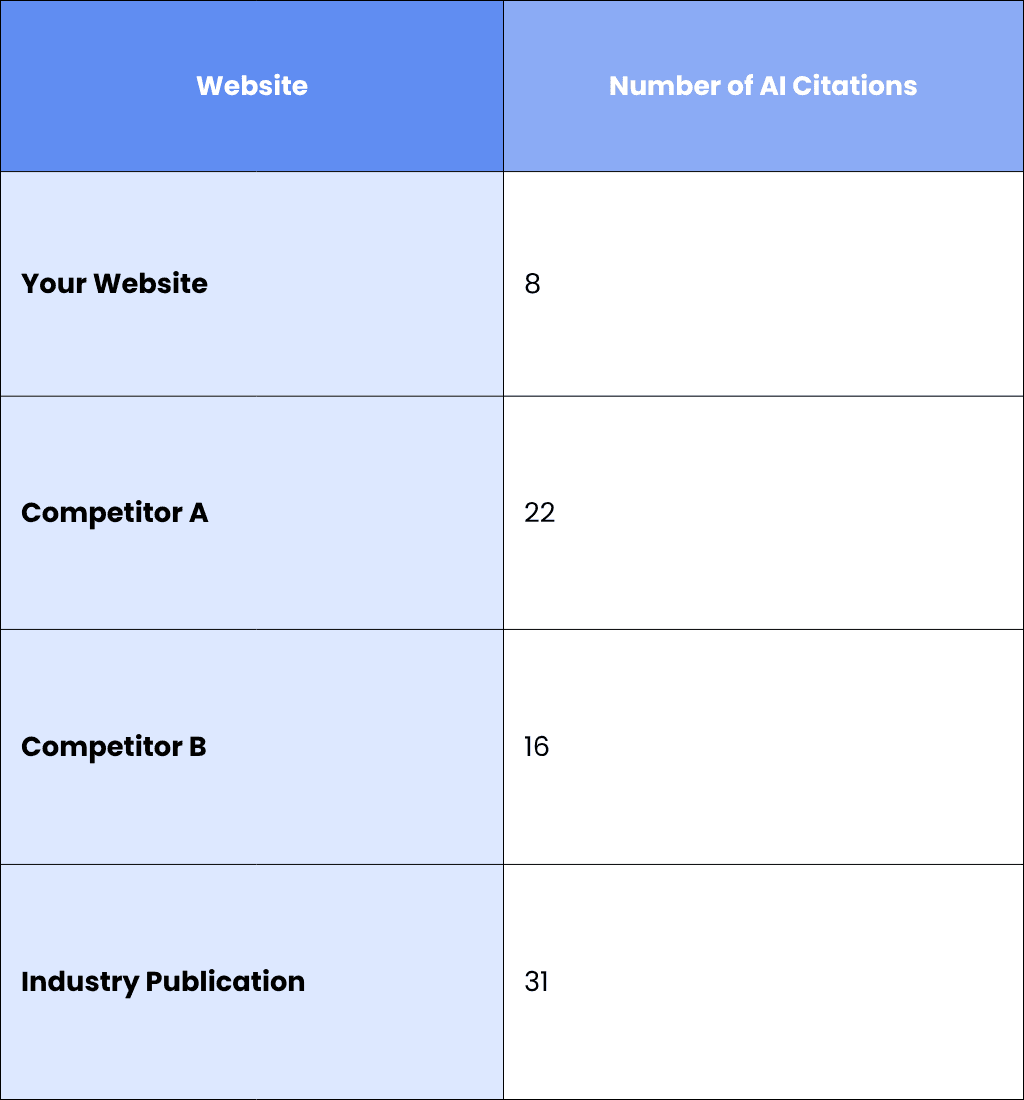
If AI systems consistently cite your competitors' content instead of yours, it may suggest that their pages are more comprehensive, authoritative or better structured.
This insight naturally leads to the next benchmark area: understanding whether your website demonstrates sufficient expertise across your chosen topics.
3. Topical Authority
Being visible in AI search is rarely the result of publishing a handful of blog posts.
Instead, AI systems tend to favour websites that demonstrate deep expertise within a particular subject area. This is known as topical authority.
In simple terms, topical authority measures how comprehensively your website covers the subjects that matter most to your audience.
For example, an AI SEO agency should not only publish articles about SEO basics. It should also cover related topics such as:
- Technical SEO
- Local SEO
- International SEO
- Content strategy
- AI search
- Generative Engine Optimisation (GEO)
- Website performance
- Schema markup
- Digital marketing strategy
The broader and more interconnected your content, the easier it becomes for AI systems to recognise your expertise.
When benchmarking, ask yourself:
- Do competitors publish more educational content?
- Are their articles more detailed?
- Do they regularly update existing content?
- Do they cover customer questions in greater depth?
- Do they provide unique insights rather than generic advice?
You could assess topical authority using a simple scoring framework:
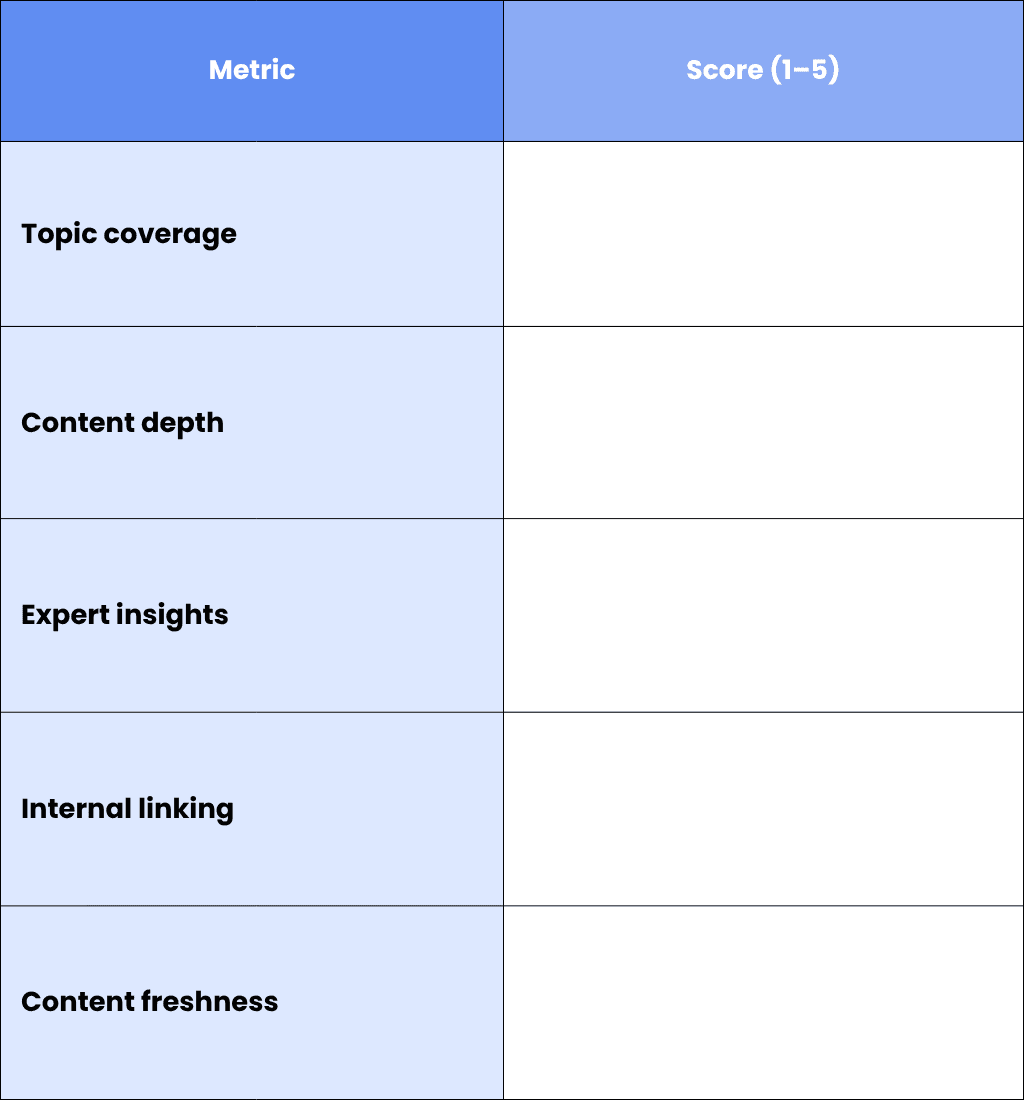
Once you've evaluated your content depth, the next logical step is to examine whether AI systems can easily understand that content from a technical perspective.
4. Structured Data
Even excellent content can be difficult for AI systems to interpret if it lacks proper structure.
This is where structured data, also known as schema markup, becomes valuable.
Structured data provides additional context that helps search engines and AI platforms understand what your pages are about.
When comparing competitors, check whether they use schema types such as:
- Organisation
- Local Business
- Article
- FAQ
- Product
- Review
- Breadcrumb
- Person
- Event
For example:
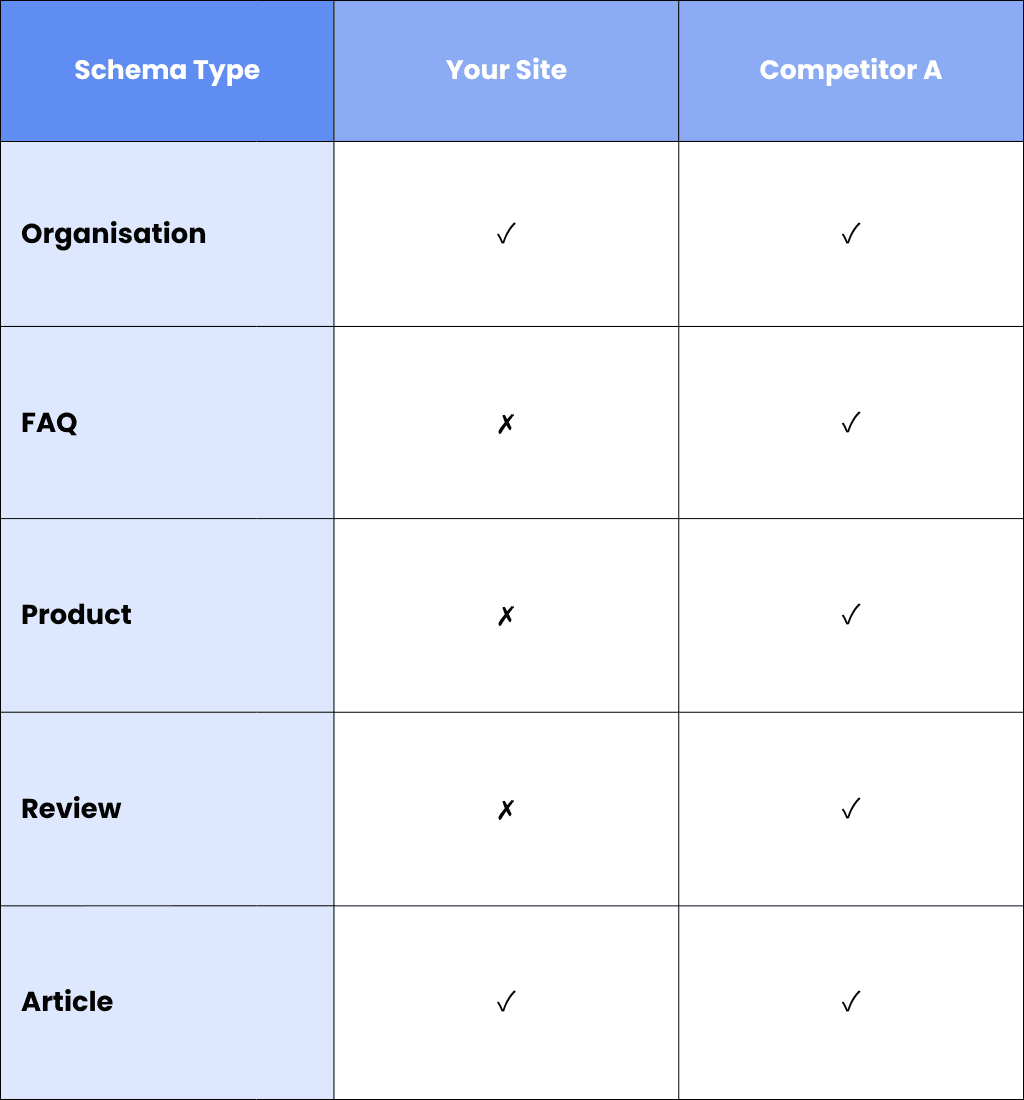
If competitors consistently implement richer structured data, AI systems may have a clearer understanding of their content.
Once your website is technically understandable, the next question becomes whether AI recognises your business as an established entity.
5. Knowledge Graph Presence
AI platforms increasingly rely on recognised entities rather than just individual webpages, this is why creating a knowledge graph is so important.
An entity is a clearly identifiable business, organisation, person or place that AI systems understand as a unique concept.
Businesses with stronger entity recognition often enjoy greater visibility because AI platforms have more confidence in the information associated with them.
Benchmark whether your competitors have:
- Google Knowledge Panels
- Wikidata entries
- Consistent organisation information
- Verified Google Business Profiles
- Strong presence across authoritative websites
For example:
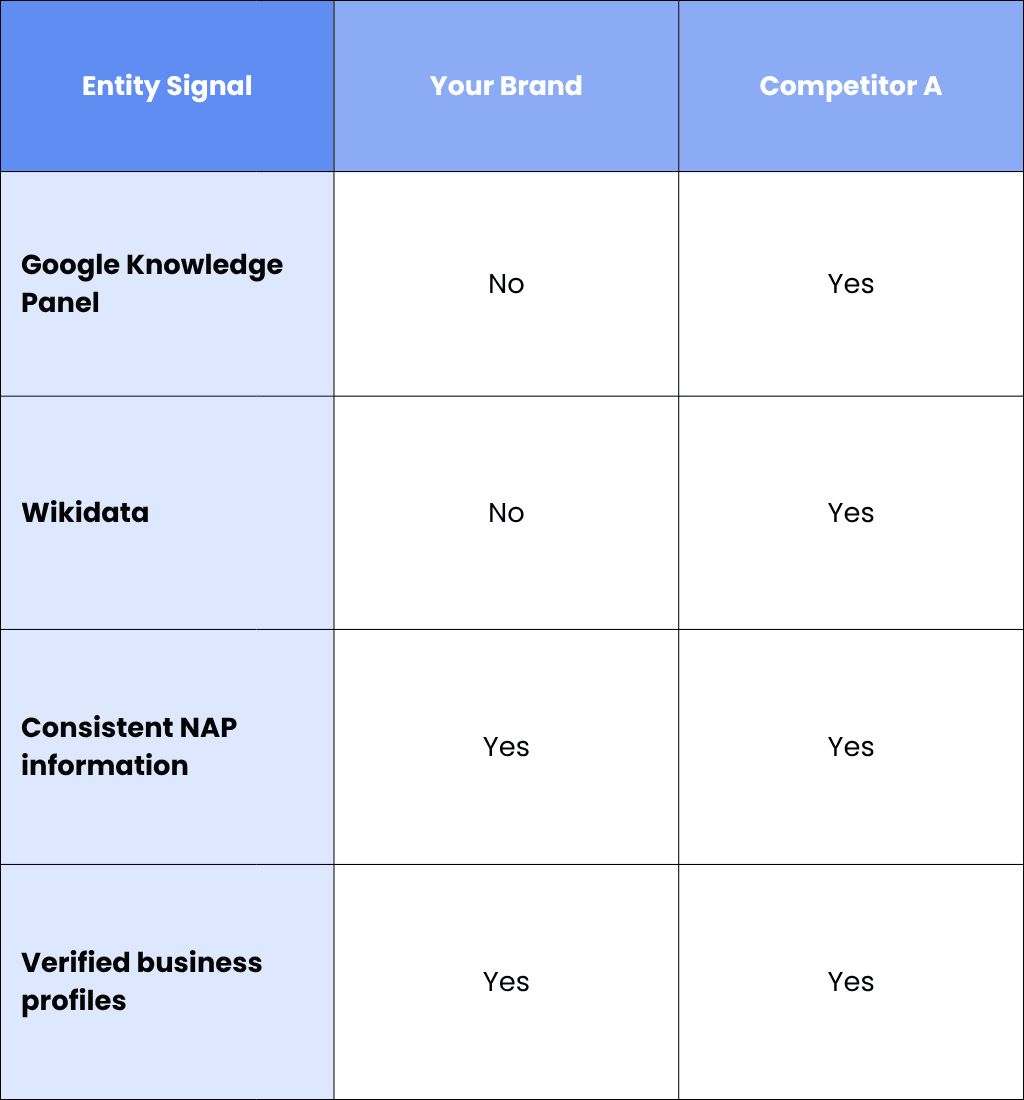
If competitors have stronger entity signals, this may explain why AI platforms reference them more frequently.
However, entity recognition depends heavily on consistency across the web, making brand consistency the next area to evaluate.
6. Brand Consistency
AI systems gather information from multiple online sources.
If your business name, services or company details differ across websites, AI may struggle to determine which information is accurate.
For this reason, benchmark the consistency of your online presence.
Check whether the following remain consistent across all platforms:
- Company name
- Business description
- Address
- Phone number
- Website URL
- Service offerings
- Brand messaging
Review sources such as:
- Your website
- Google Business Profile
- Industry directories
- Chamber of Commerce listings
- Social media profiles
You may also compare competitors to see whether they maintain stronger brand consistency than your organisation.
Once consistency has been established, you can then examine another important trust factor: external authority.
7. Authority Signals
AI systems do not rely solely on what your business says about itself.
They also consider what other reputable sources say about your business.
This is why authority signals remain an important benchmark.
Evaluate factors such as:
- High-quality backlinks
- Media coverage
- Industry awards
- Guest articles
- Research publications
- Professional certifications
- Conference speaking engagements
- Partnerships with recognised organisations
For example:
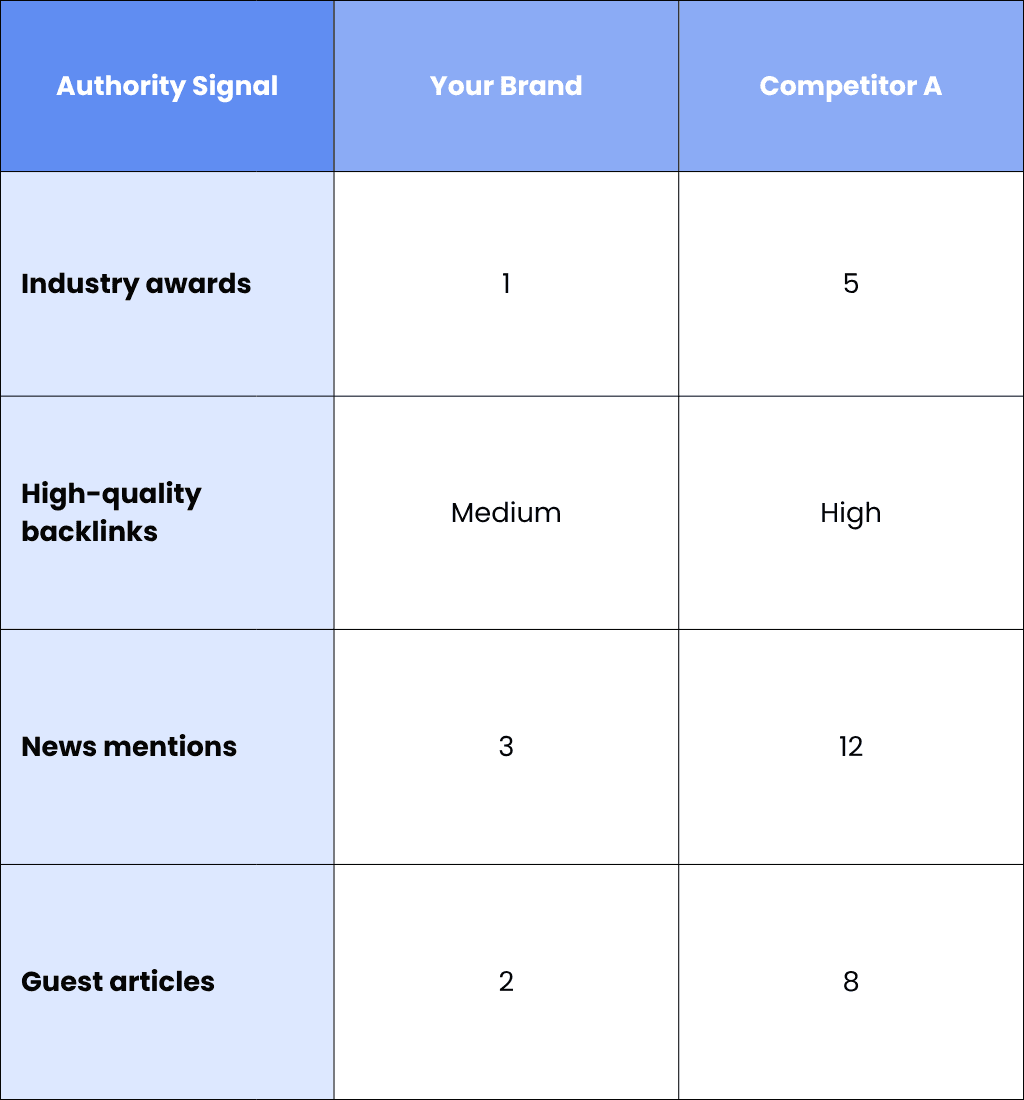
Authority is particularly valuable because many AI systems learn from trusted third-party sources rather than relying exclusively on company websites.
Once you've assessed your external credibility, there is one final area to benchmark: how easily AI can interpret your content.
8. AI Readability
Even authoritative content may struggle to perform well if it is difficult for AI systems to understand.
AI readability refers to how clearly your content communicates information to both users and AI models.
When benchmarking competitors, evaluate whether their content includes:
- Clear heading structures
- Logical page organisation
- Short, well-structured paragraphs
- Direct answers to common questions
- Bullet points and tables where appropriate
- Plain, accessible language
- Helpful examples and explanations
You might score readability using a checklist like this:
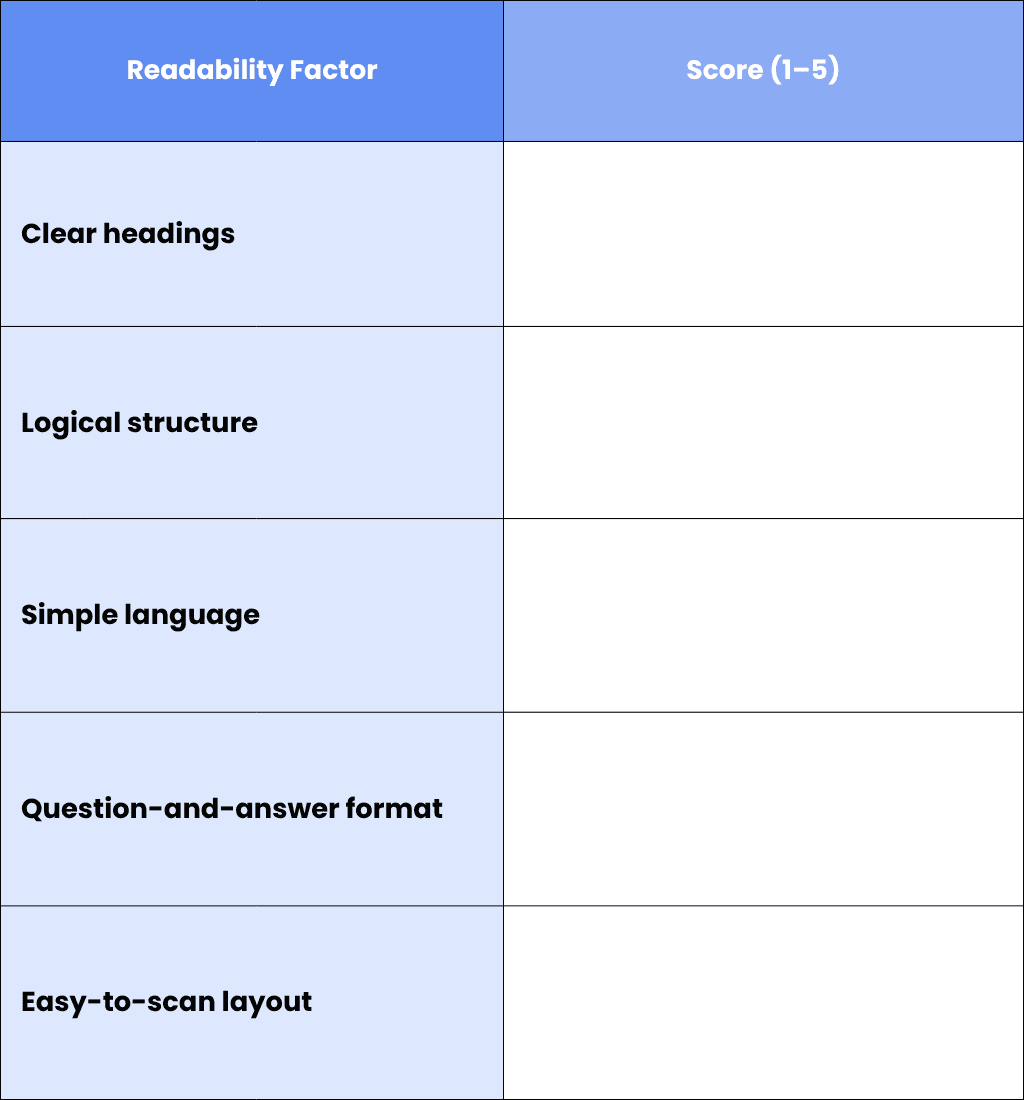
Well-organised content not only improves the user experience but also makes it easier for AI platforms to identify key information, summarise your content accurately and recommend your business in relevant responses.
Ultimately, AI visibility is influenced by all of the benchmark areas discussed above. Brand mentions and citations reveal your current performance, while topical authority, structured data, entity recognition, brand consistency, authority signals and AI readability explain why that performance exists. By evaluating these factors together rather than in isolation, you can build a comprehensive benchmarking framework that identifies meaningful opportunities to strengthen your visibility across AI-powered search experiences.
Step-by-Step Guide: How to Benchmark Your AI Visibility Against Competitors
Benchmarking your AI visibility is not about checking whether your brand appears in ChatGPT once or whether Google AI Overview happens to mention your business. Instead, it is a structured process that allows you to compare your brand against competitors, identify opportunities for improvement, and measure progress over time.
By following the steps below in order, you can create a repeatable benchmarking framework that produces meaningful insights rather than one-off observations.
Step 1: Identify Your Main Competitors
Before you begin measuring AI visibility, you first need to decide who you are benchmarking against. Without a clear list of competitors, your results may be inconsistent or difficult to interpret.
Aim to benchmark against three to five competitors that represent different parts of your market. This gives you a balanced view of where your business stands.
Your list could include:
- Direct competitors offering similar products or services to the same audience
- Local competitors operating in your city or region
- National or international competitors with a strong market presence
- Industry leaders that consistently appear in search results and AI-generated answers
- Emerging competitors that are gaining visibility quickly
For example, if you own a hotel in Ho Chi Minh City, your benchmark list might include:
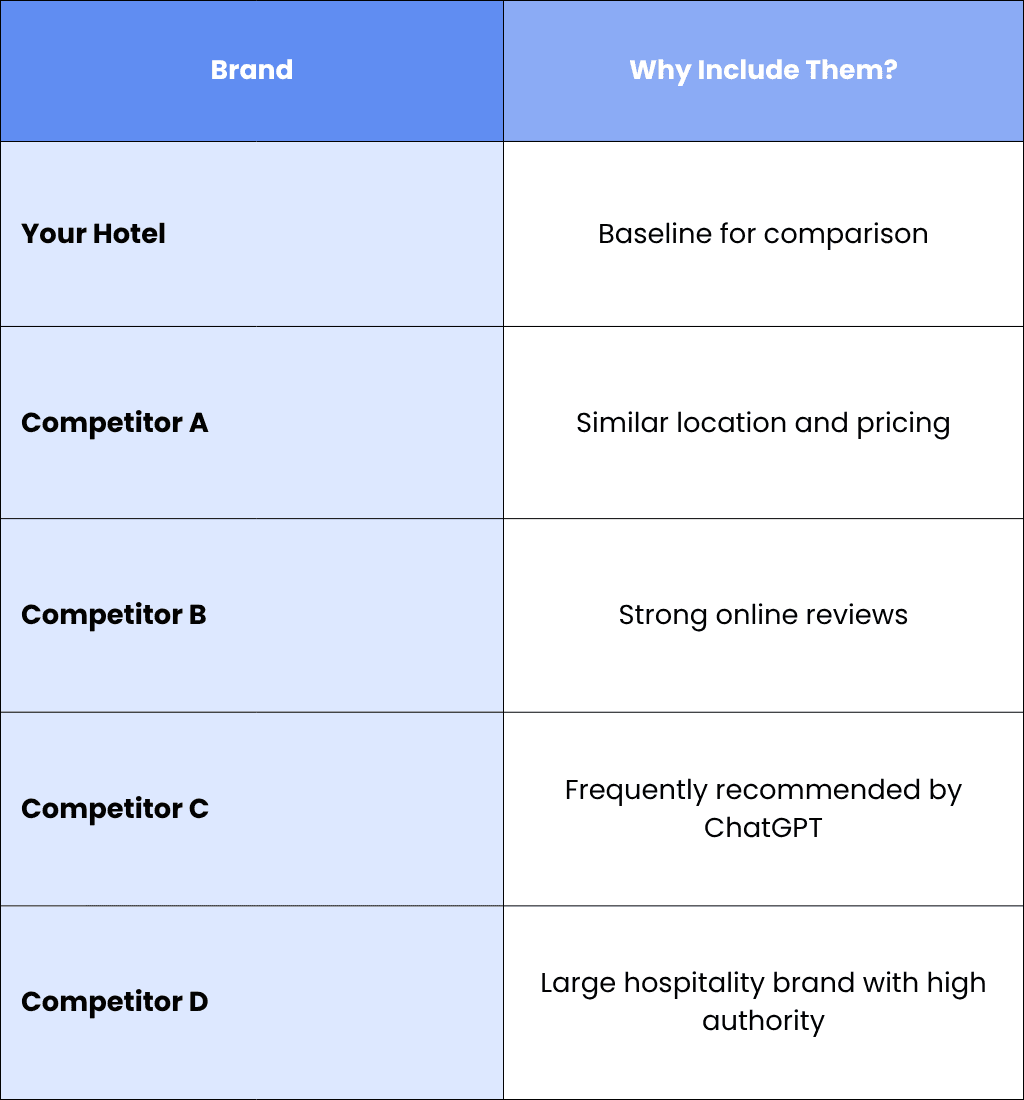
At this stage, avoid selecting competitors solely because they appear on Google's first page. Some businesses may have relatively modest SEO rankings yet perform exceptionally well in AI-generated responses due to stronger brand authority, structured content or wider recognition across the web.
Once you have established a fixed list of competitors, keep using the same businesses in future benchmark reports. This consistency makes it much easier to identify trends and measure improvements over time.
Step 2: Build a Standardised Prompt List
Now that you know which competitors you are measuring, the next step is to decide what questions you will ask AI platforms.
This is an essential step because AI responses depend heavily on the prompts you use. Asking different questions each time makes comparisons unreliable, as even slight wording changes can produce different results.
Instead, create a standard list of prompts that reflects how your potential customers naturally search for information.
For example, if you are an SEO agency, your prompt list could include:
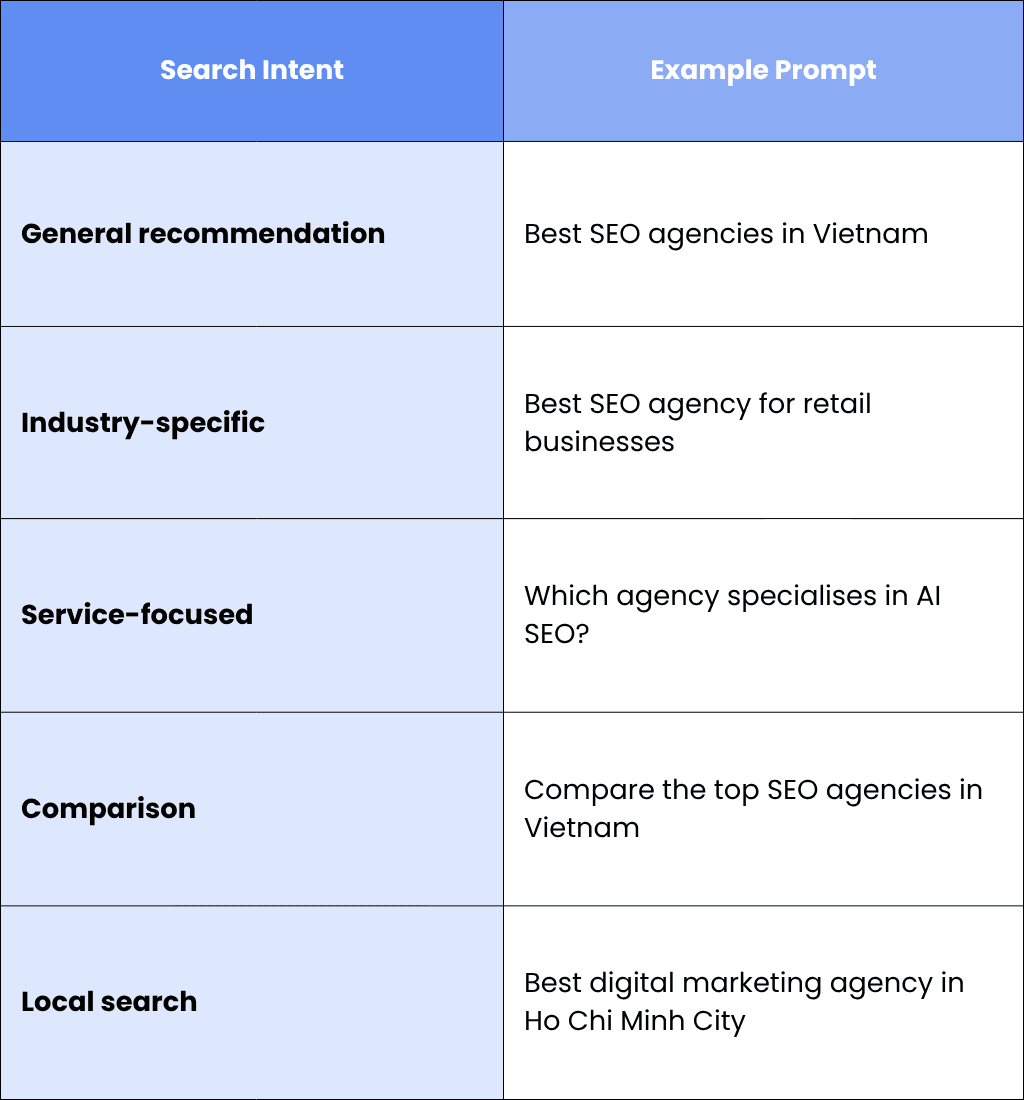
If you operate in education, your prompts might include:
- Best international schools in Ho Chi Minh City
- Top bilingual schools in Vietnam
- Which schools have the strongest academic reputation?
- Recommended schools for expatriate families
Likewise, an F&B business might test prompts such as:
- Best coffee shops in District 1
- Recommended Vietnamese restaurants
- Best catering companies for corporate events
When creating your prompt library, include a mixture of:
- Informational queries
- Recommendation-based queries
- Comparison queries
- Local searches
- Brand-specific searches
A good starting point is 15–30 carefully selected prompts. This provides enough data to identify patterns without making the benchmarking process unnecessarily time-consuming.
Because these prompts will be reused in every benchmarking cycle, they form the foundation for consistent and meaningful comparisons.
Step 3: Test Across Multiple AI Platforms
Once your prompt list is ready, you can begin collecting benchmark data.
Rather than relying on a single AI assistant, test each prompt across several AI platforms. Each platform has its own underlying models, ranking signals and data sources, meaning your visibility can vary significantly.
Consider benchmarking across:
- ChatGPT
- Google AI Overviews
- Google Gemini
- Perplexity
- Microsoft Copilot
For each prompt, record:
- Whether your business appears
- Which competitors appear
- The order in which brands are mentioned
- Whether the AI confidently recommends your business or simply references it
- Whether citations or external sources are provided
For example:
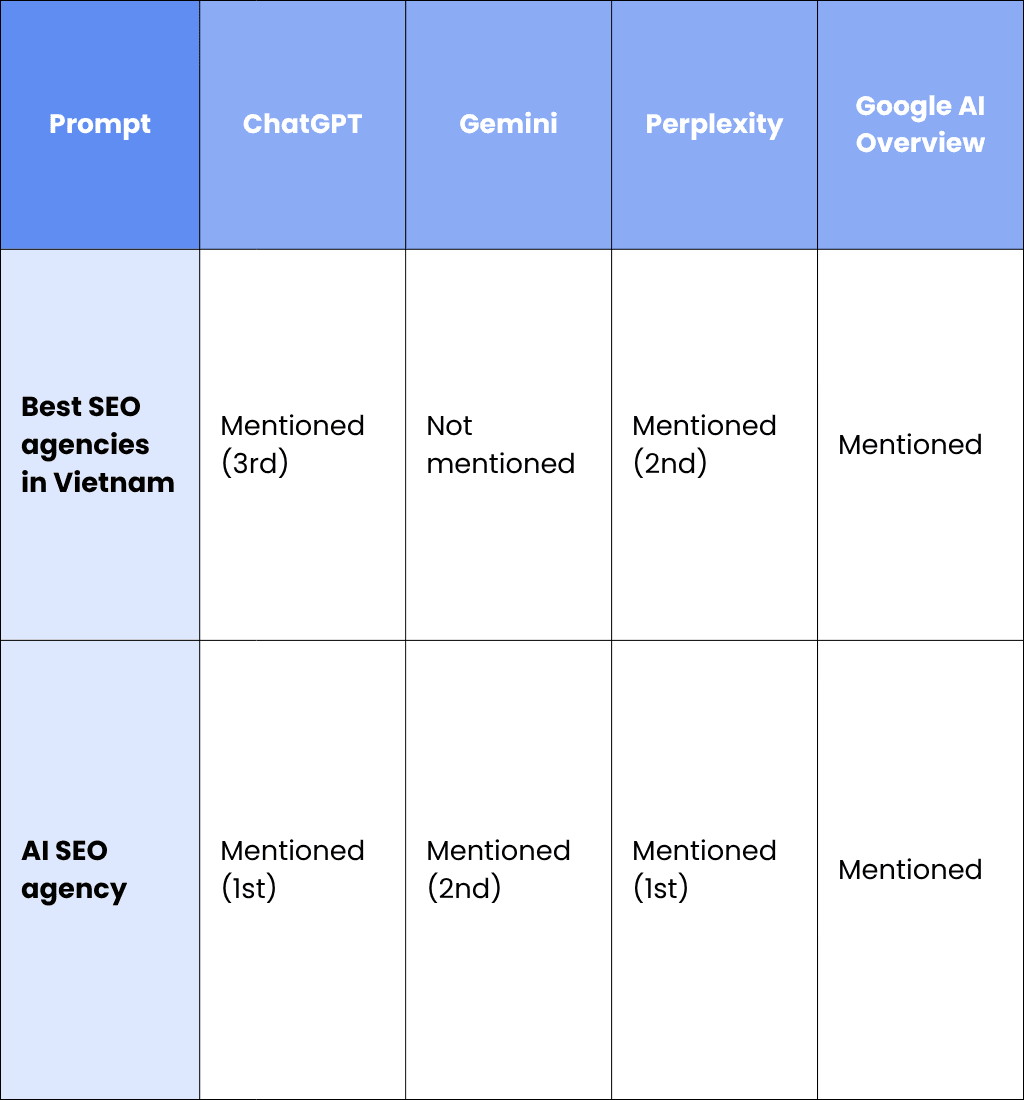
You may discover that your business performs strongly on one platform but is almost invisible on another. These differences often reveal opportunities to improve your content, authority signals or structured data.
Testing multiple AI systems also prevents you from drawing conclusions based on a single platform, providing a more comprehensive view of your AI visibility.
Step 4: Record Every Mention
After gathering responses from different AI platforms, the next step is to organise your findings into a structured format.
Simply remembering which brands appeared is not enough. Detailed records allow you to compare results over time and identify recurring trends.
For each prompt, capture information such as:
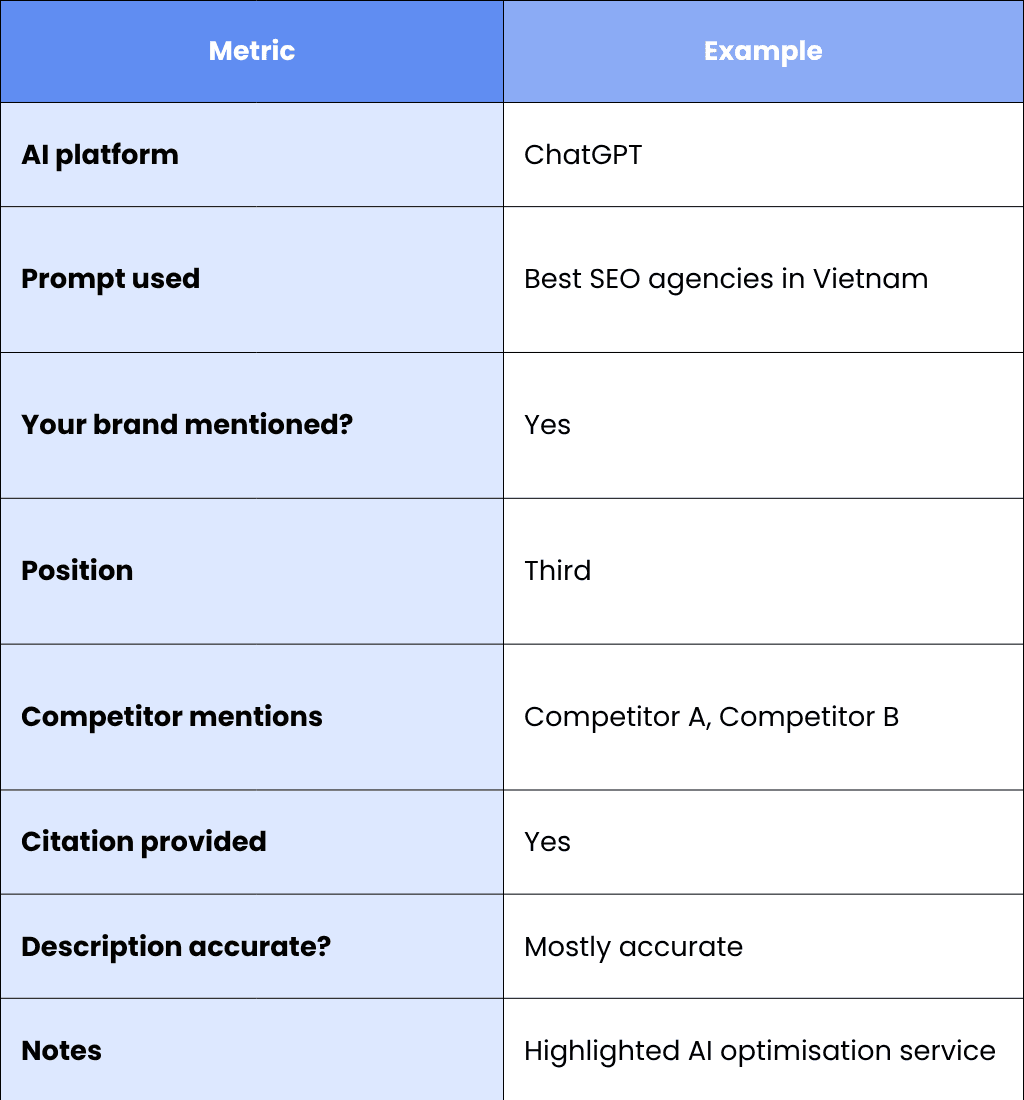
Recording qualitative observations can be just as valuable as quantitative data.
For instance, ask yourself:
- Did the AI accurately describe your services?
- Were outdated products or services mentioned?
- Did competitors receive stronger recommendations?
- Did the AI reference authoritative third-party sources?
These observations often reveal gaps that traditional SEO tools cannot detect.
By documenting everything consistently, you create a valuable historical record that supports future analysis.
Step 5: Compare Competitor Strengths
With your benchmark data organised, you can now begin interpreting the results.
Rather than simply noting which competitors appear more often, investigate why they are receiving greater AI visibility.
Look for patterns such as:
- Do they publish more educational content?
- Are they regularly featured by industry publications?
- Do they have stronger structured data?
- Are they cited by reputable websites?
- Do they answer customer questions more comprehensively?
- Is their brand mentioned consistently across trusted online sources?
For example:
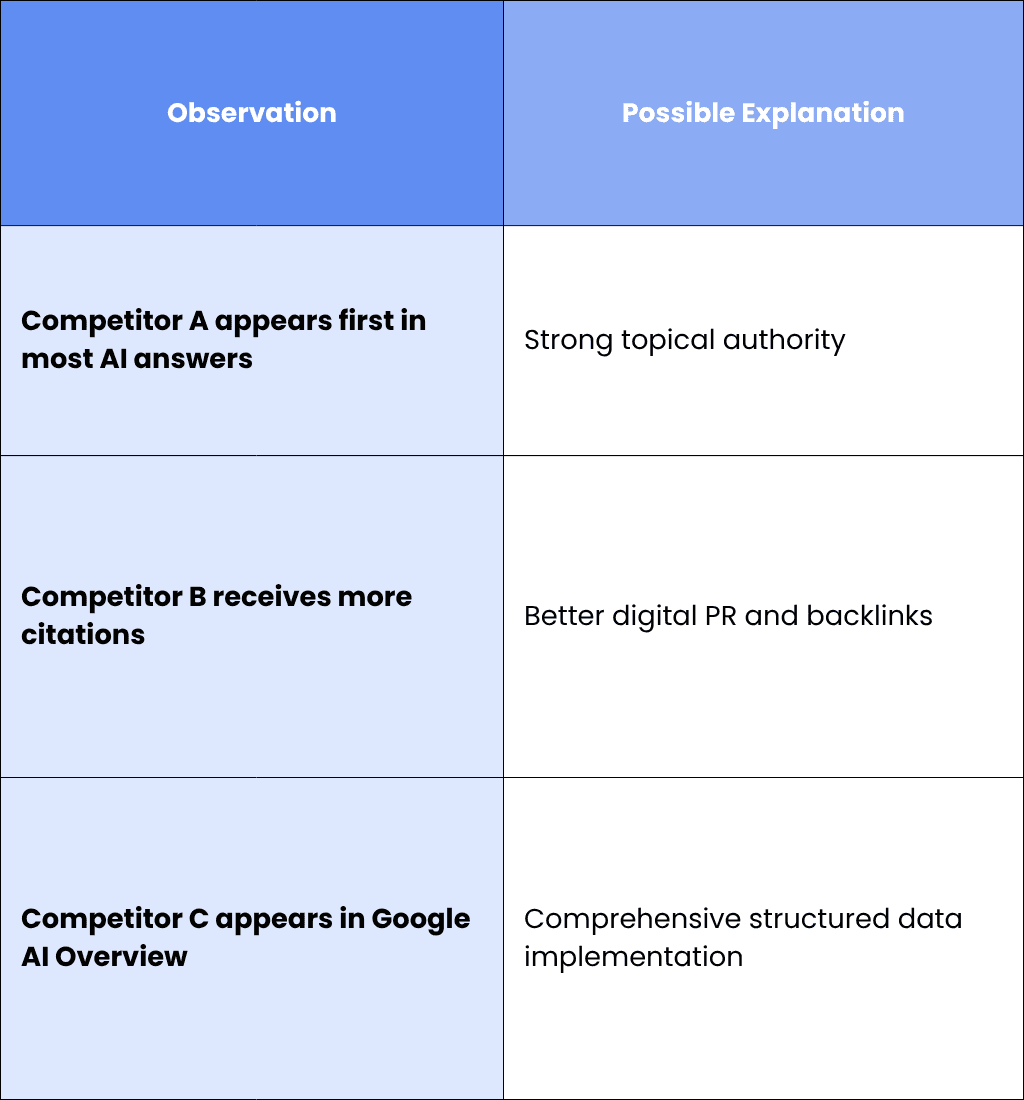
This analysis transforms benchmarking from a reporting exercise into a strategic planning tool.
Instead of asking, "Why aren't we appearing?", you begin asking, "What signals are AI platforms recognising in our competitors that we can strengthen ourselves?"
These insights help prioritise the improvements likely to have the greatest impact on your future AI visibility.
Step 6: Score Each Area
Once you understand your competitors' strengths and weaknesses, convert your observations into measurable scores.
A scoring system makes benchmarking easier to communicate with stakeholders and helps track progress objectively over time.
You might use a simple 1–5 scale, where:
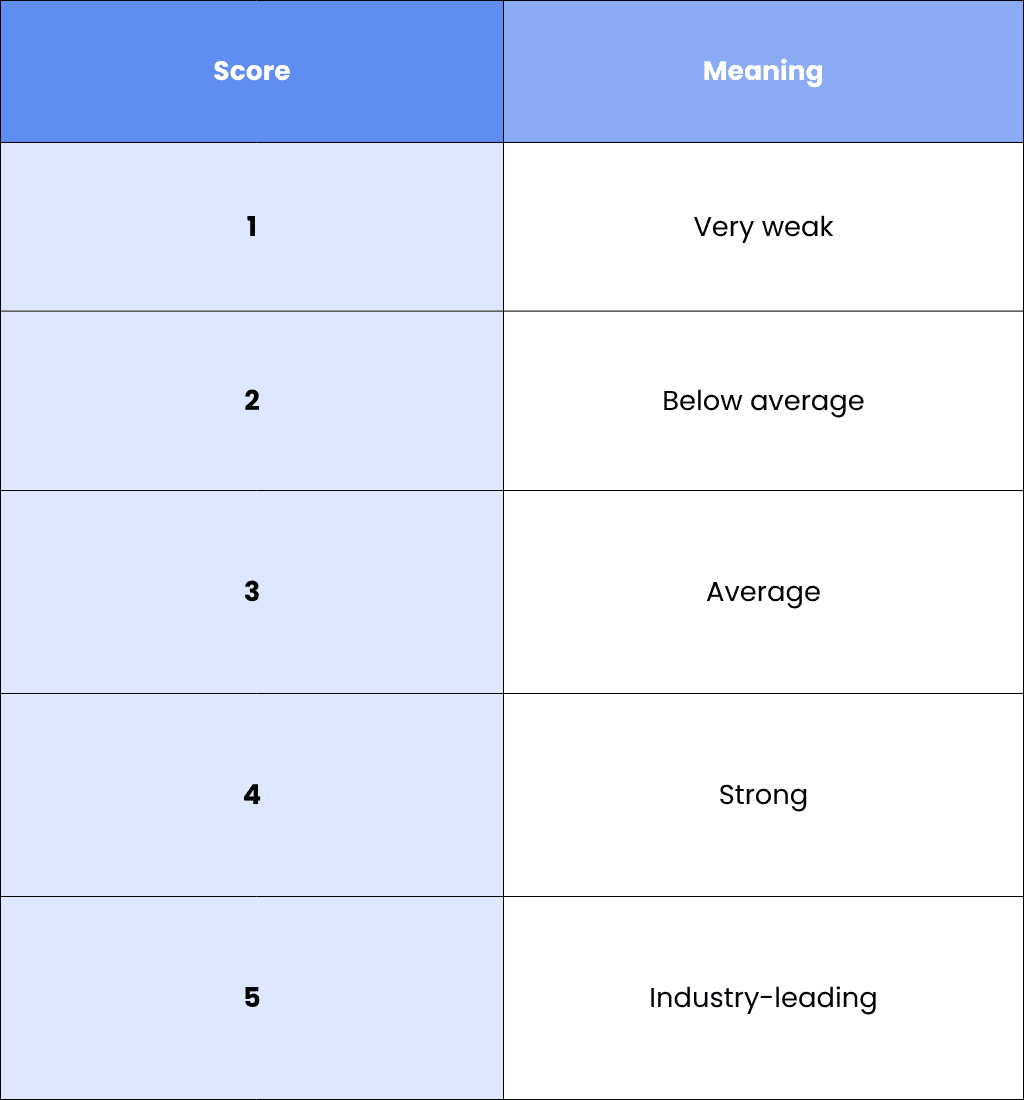
Then score each benchmark category.
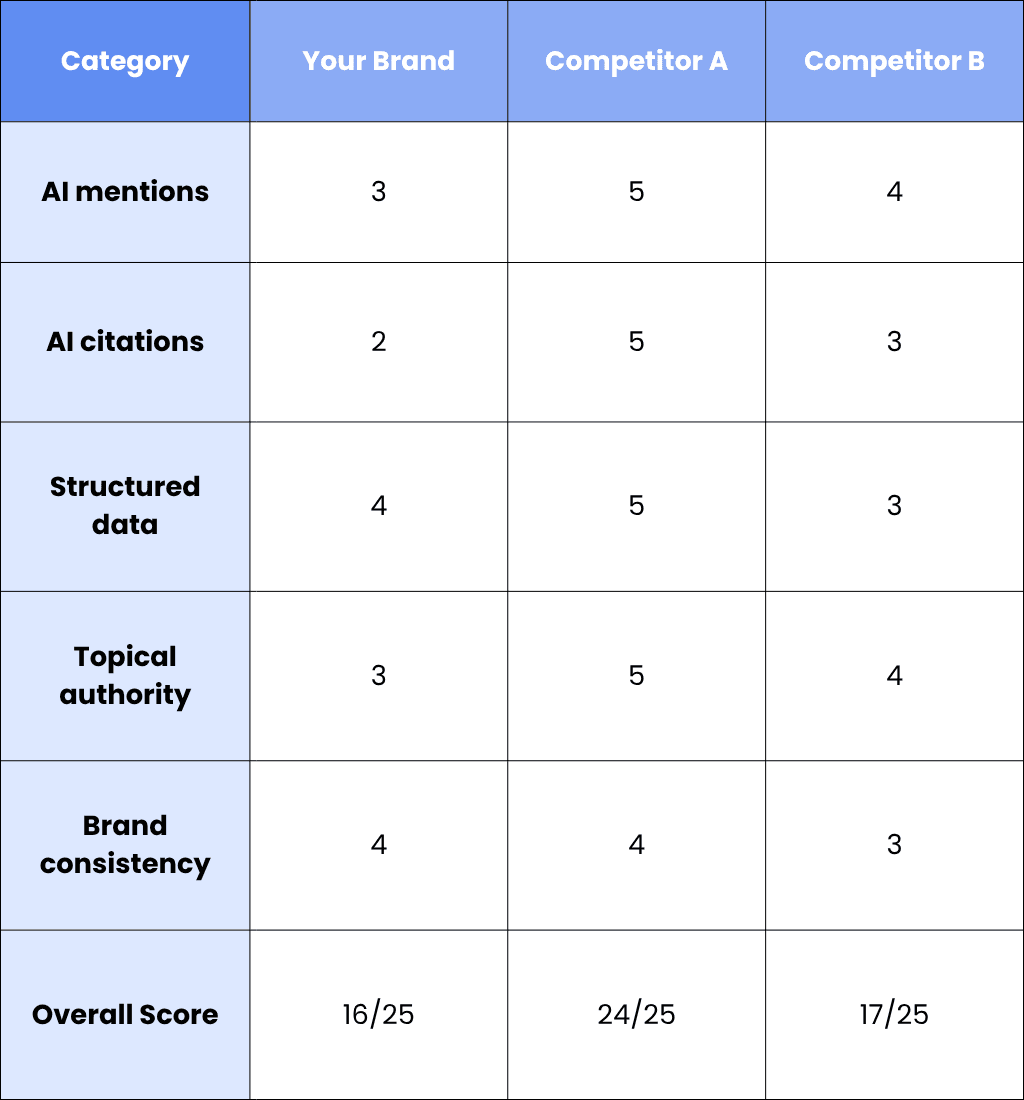
If certain metrics are more important to your business, you may choose to apply weighted scoring.
For example:
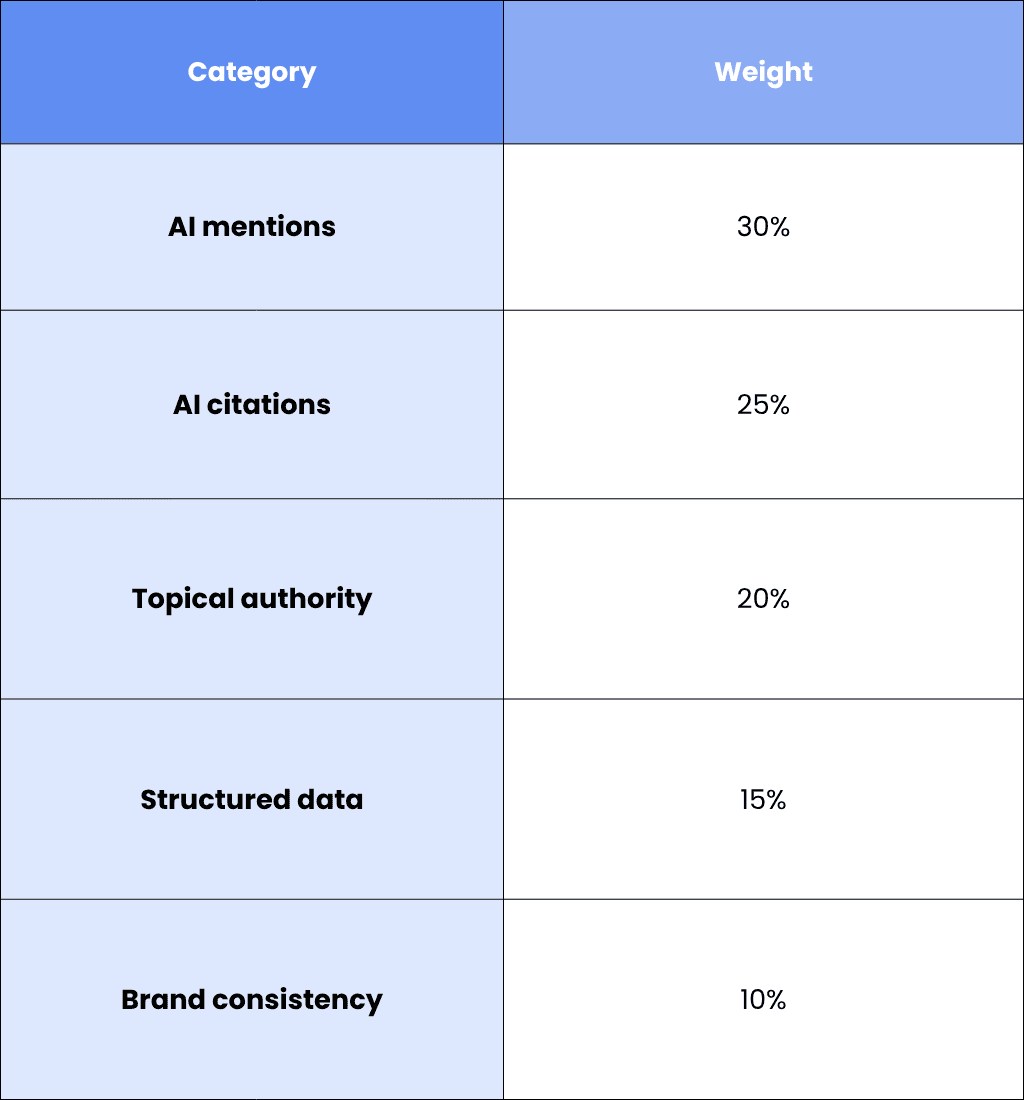
Weighted scoring can provide a more accurate reflection of overall AI visibility by giving greater importance to the factors that most influence AI-generated recommendations.
Most importantly, use the same scoring criteria during each benchmarking cycle to ensure results remain comparable.
Step 7: Repeat Quarterly
Benchmarking should not be treated as a one-off project.
AI platforms are evolving rapidly, with frequent updates to their underlying models, data sources and ranking methods. Likewise, your competitors are continuously publishing new content, earning media coverage and strengthening their online authority.
For these reasons, benchmarking should become part of your regular digital marketing reporting.
A quarterly review is generally recommended because it provides enough time for meaningful changes to become visible while allowing you to respond before competitors gain a significant advantage.
A typical quarterly benchmarking cycle might look like this:
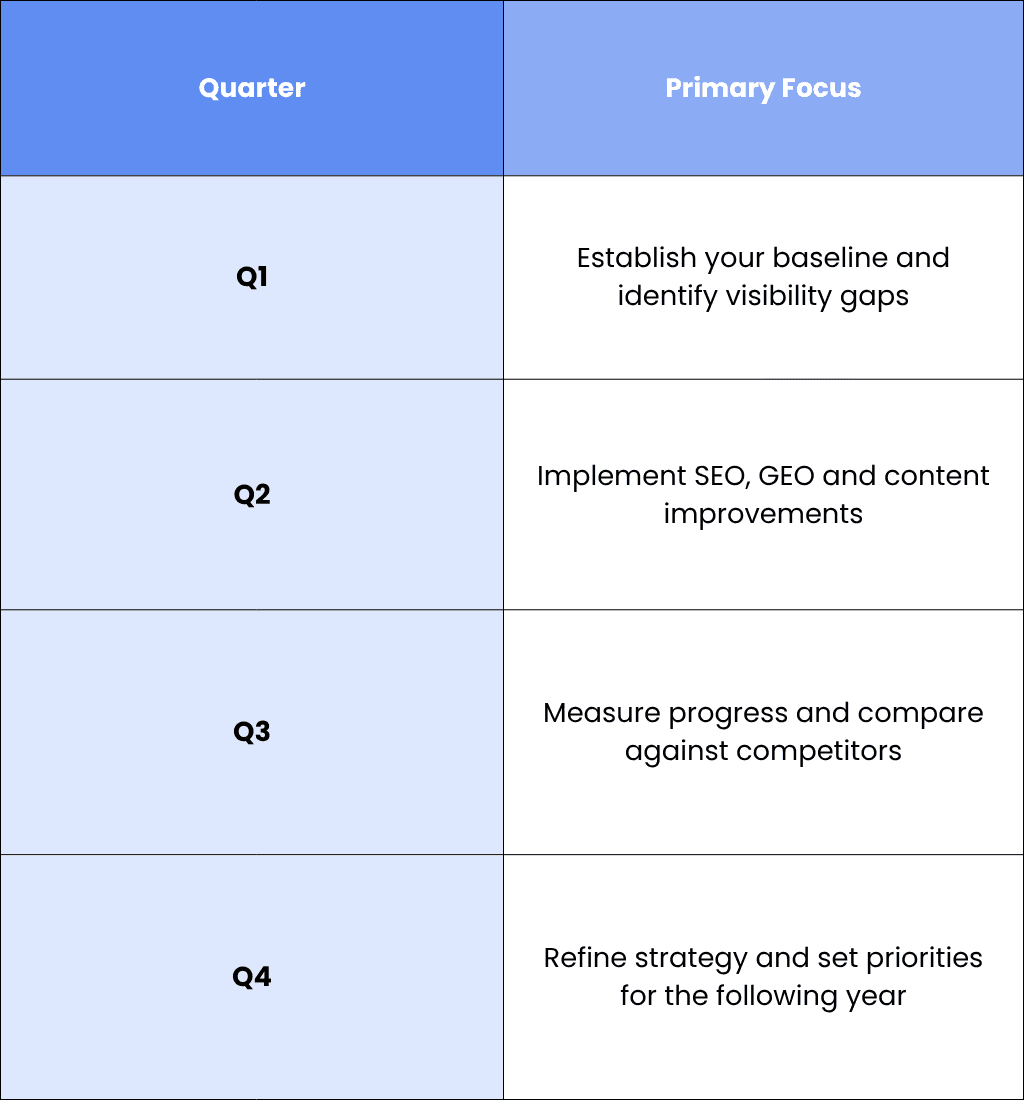
Over time, these reports will reveal valuable long-term trends. You may find that your AI citations are increasing, your brand is appearing more frequently across multiple platforms or your competitors have shifted their content strategy.
Rather than relying on assumptions, quarterly benchmarking gives you evidence-based insights that support smarter marketing decisions and demonstrate the impact of your SEO and Generative Engine Optimisation (GEO) efforts.
Ultimately, benchmarking is most valuable when it becomes an ongoing process. By repeating these seven steps consistently, your business can monitor its AI visibility, adapt to changes in AI-powered search and stay ahead of competitors in an increasingly AI-driven digital landscape.
Free AI Visibility Benchmark Template
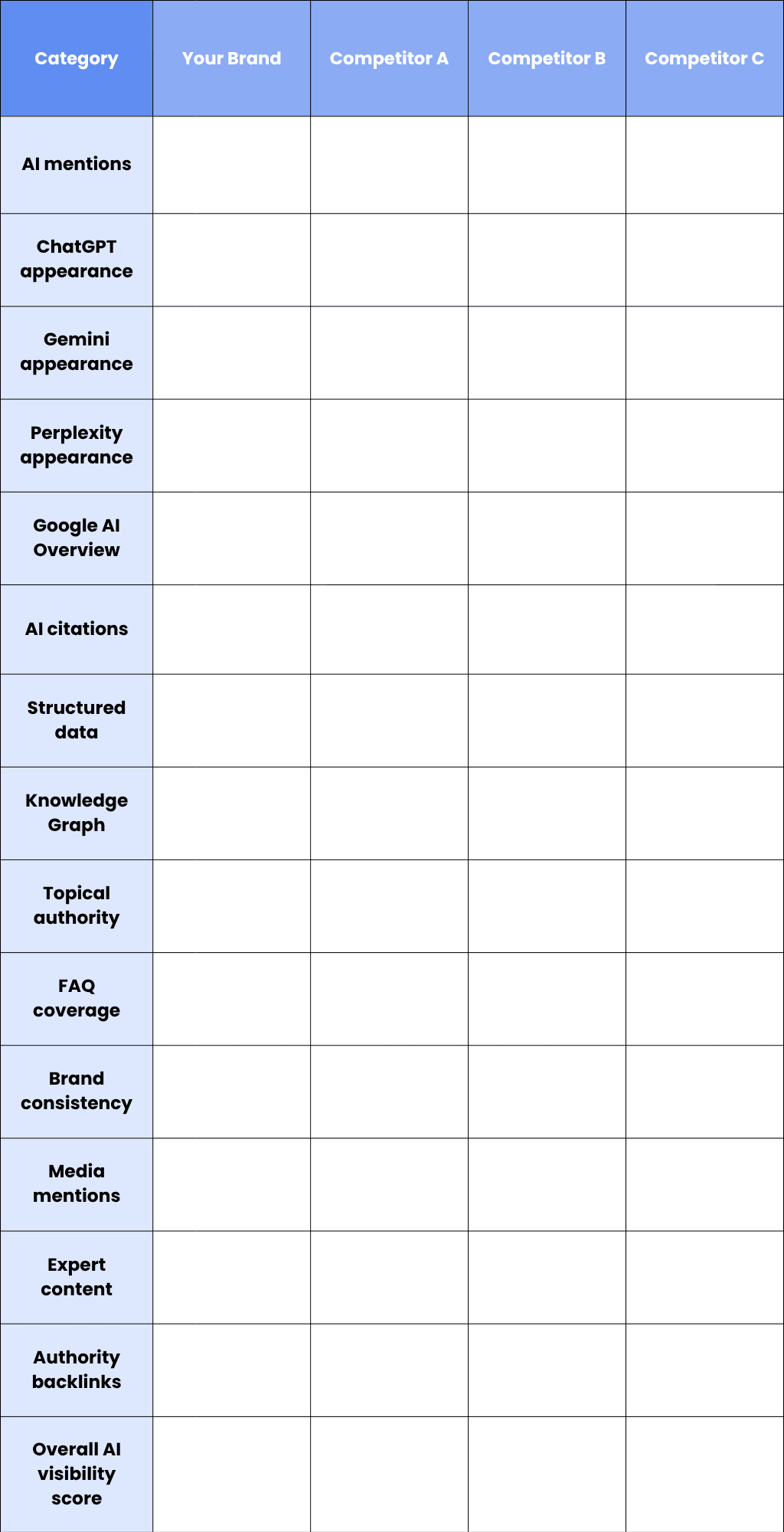
Now that you understand what to benchmark and how to benchmark your AI visibility against competitors, the next step is to record your findings in a structured and consistent way.
A benchmarking template helps you organise your observations, compare competitors using the same criteria and monitor your progress over time. Rather than relying on memory or scattered notes, you can build a clear record of how your AI visibility changes as you implement SEO, Generative Engine Optimisation (GEO) and content improvements.
The template below can be recreated in Microsoft Excel, Google Sheets, Notion or your preferred reporting tool. We recommend updating it once every quarter using the same competitors, prompts and scoring criteria. This consistency makes it much easier to identify trends and measure the impact of your optimisation efforts.
AI Visibility Benchmark Template
How to Use the Template
To get the most value from your benchmark, complete the template systematically rather than filling it in all at once. As you work through each category, use the same prompts and evaluation criteria for every competitor to ensure your comparisons remain fair and consistent.
A simple workflow could look like this:
Step 1: Record AI Mentions
Begin by testing your standardised prompts across multiple AI platforms, such as ChatGPT, Gemini, Perplexity and Google AI Overviews.
For each prompt, note:
- Whether your business appears
- The order in which it appears
- Which competitors are mentioned
- Whether the response recommends your business or simply references it
- Whether the information provided is accurate
This gives you a baseline understanding of your current AI visibility before you assess the factors influencing those results.
Step 2: Evaluate Technical and Authority Signals
Next, review each business against the benchmark categories covered earlier in this guide.
For example, ask questions such as:
- Does the website use structured data?
- Does the business have a recognised Knowledge Graph presence?
- Does it publish comprehensive educational content?
- Is its branding consistent across the web?
- Does it earn mentions from trusted industry websites?
You can record either a simple Yes/No, a numerical score or a short observation, depending on the level of detail you require.
Step 3: Add Supporting Notes
The Notes column is often one of the most valuable parts of the template because it captures observations that numbers alone cannot explain.
For example:
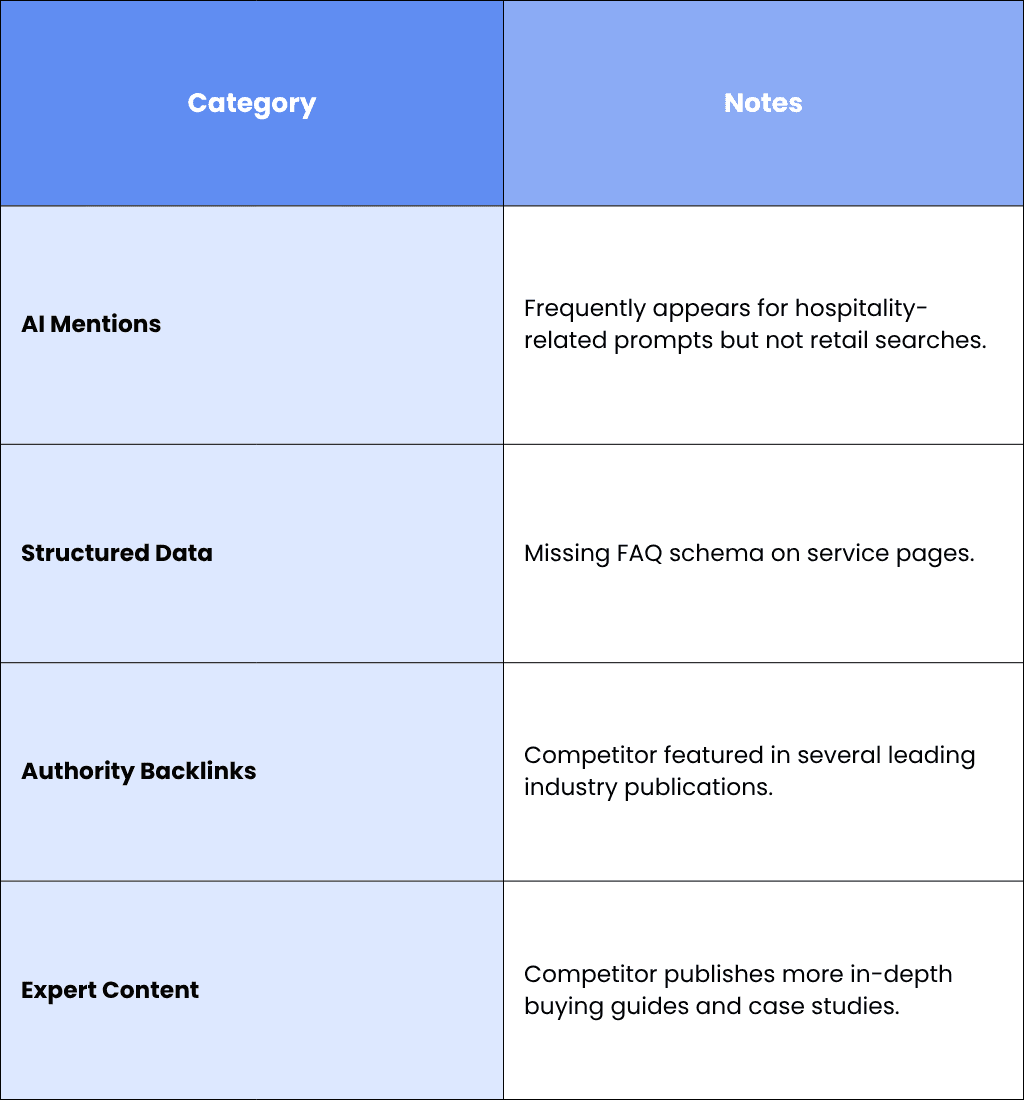
Recording these insights helps you identify practical actions rather than simply comparing scores.
Suggested Scoring System
To make comparisons easier, consider using a simple 1–5 scoring scale across each benchmark category.
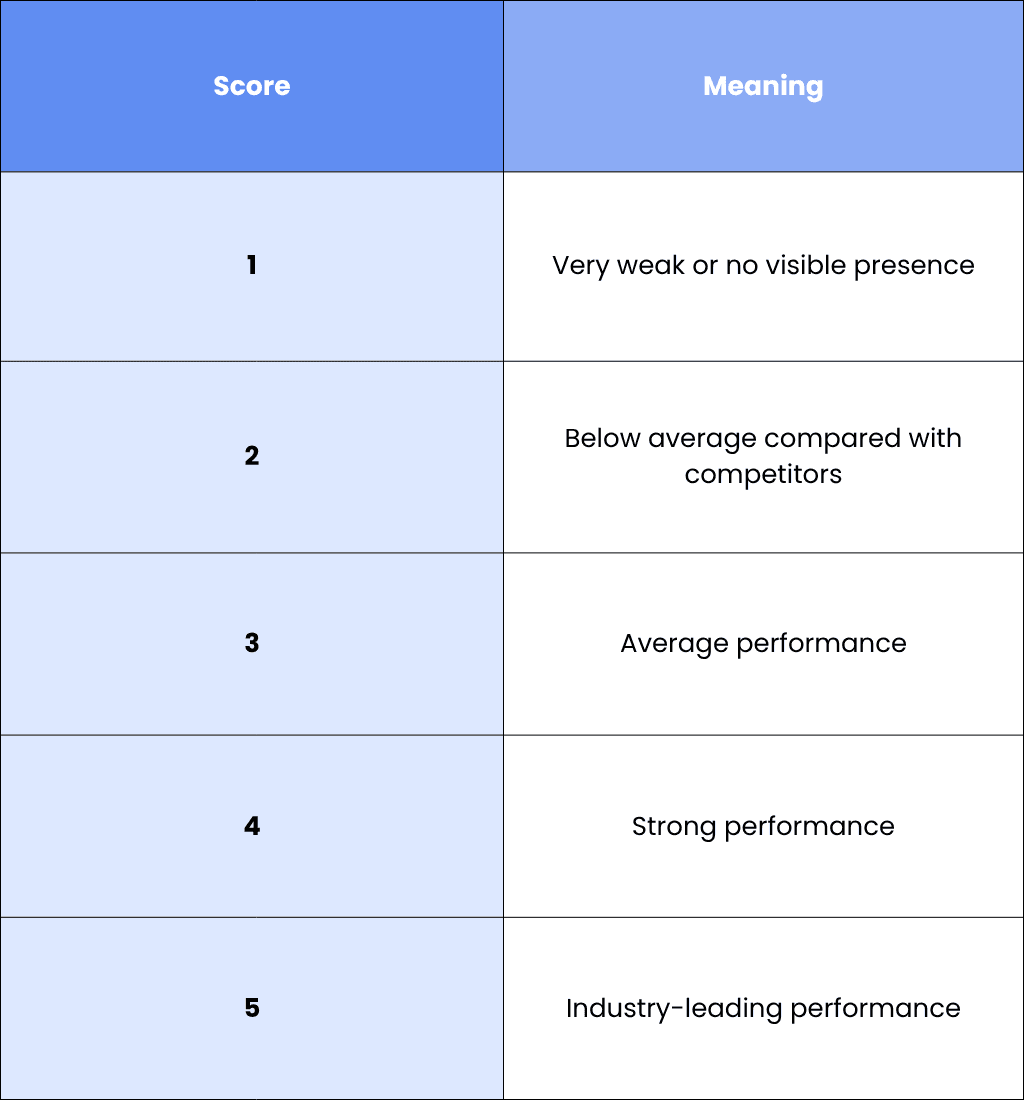
For example:
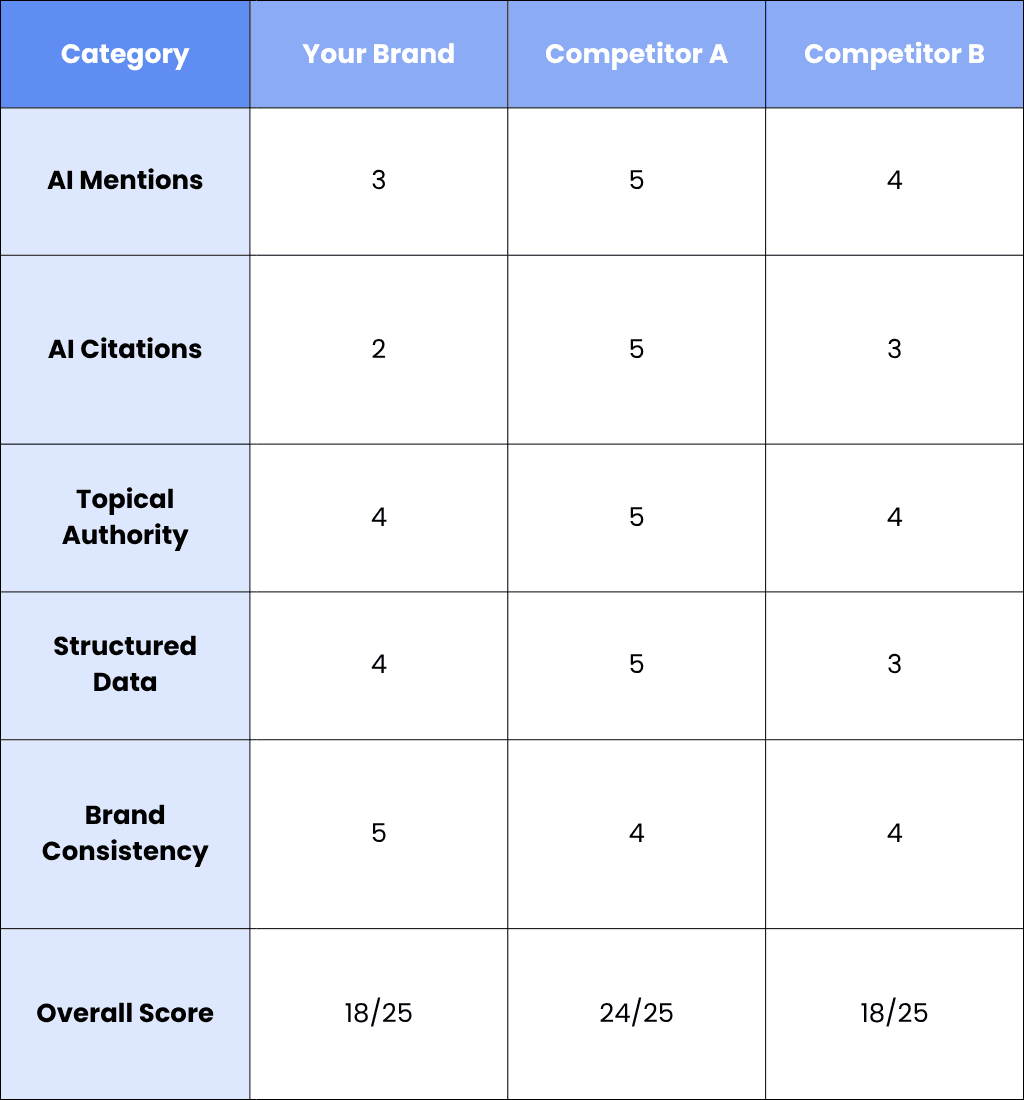
While this scoring system provides a useful snapshot of your competitive position, avoid focusing solely on the overall score. Instead, look for patterns that reveal where competitors consistently outperform your business.
For instance, you may find that your content is comprehensive but your authority signals are comparatively weak, or that your technical foundations are strong but your brand rarely appears in AI-generated recommendations.
Review Your Results Over Time
A single benchmark provides valuable insights, but the greatest benefit comes from tracking your progress over multiple reporting periods.
We recommend repeating your benchmark every three months and comparing your results against previous reports. This allows you to measure whether your SEO, content and GEO initiatives are having a meaningful impact on your AI visibility.
You may find it helpful to maintain a summary table like the one below:
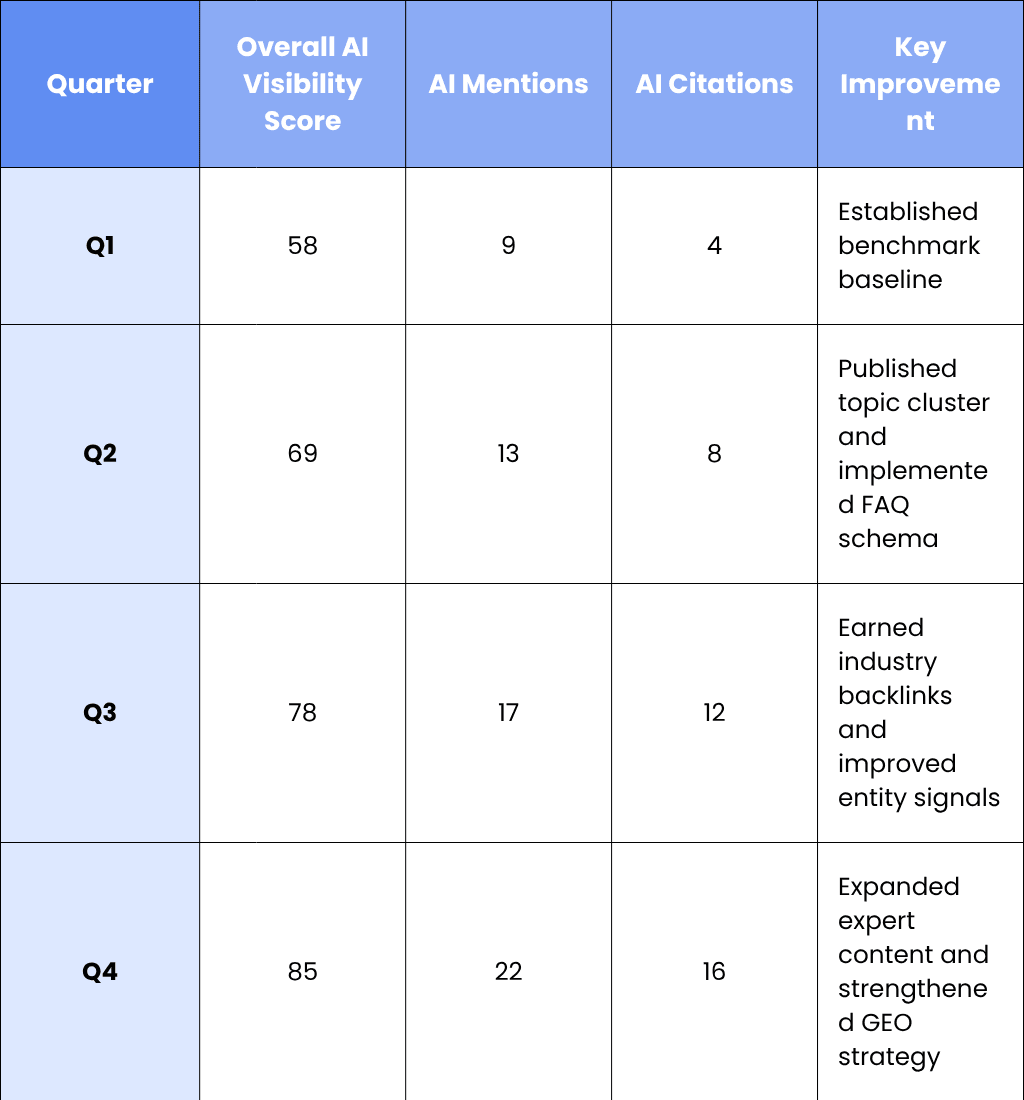
Over time, this historical view enables you to move beyond isolated observations and identify long-term trends. More importantly, it helps you demonstrate the impact of your optimisation efforts, prioritise future improvements and make informed decisions based on measurable data rather than assumptions.
How to Improve Your AI Visibility
Benchmarking your AI visibility is only the first step. The real value comes from using your findings to strengthen your brand's presence across AI-powered search platforms.
If your benchmark reveals that competitors are mentioned more frequently, cited more often or recognised as stronger authorities, don't view it as a setback. Instead, treat it as a roadmap that highlights where your business can improve.
Just as traditional SEO requires a long-term strategy rather than quick fixes, improving AI visibility is an ongoing process. The goal is to make your website easier for AI systems to understand, trust and recommend whenever users ask relevant questions.
The following strategies work together to build that foundation.
1. Publish Comprehensive, Expert-Led Content
The first and arguably most important step is to create content that genuinely demonstrates your expertise.
AI platforms are designed to provide users with accurate and trustworthy answers. As a result, they tend to favour websites that explain topics thoroughly rather than those that simply target keywords.
Instead of publishing multiple short articles covering similar subjects, focus on developing comprehensive resources that answer a topic from different angles.
For example, if you run a hospitality business, rather than writing a brief article titled "Hotel Marketing Tips", consider creating a detailed guide covering:
- Hotel SEO strategies
- Local search optimisation
- Managing online reviews
- AI-powered customer service
- Seasonal marketing campaigns
- Revenue optimisation techniques
- Common marketing mistakes to avoid
This approach helps establish your website as a reliable source of information while also strengthening your topical authority.
When creating content, ask yourself:
- Does this genuinely answer a customer's question?
- Is it more comprehensive than competing articles?
- Have I included practical examples or real-world insights?
- Would someone bookmark or share this resource?
The more useful your content is, the more likely it is to become a source that AI platforms recognise and reference.
However, publishing valuable content alone is not enough. You also need to make that information easy for both users and AI systems to find.
2. Create Answer-Focused Pages
Once you've developed comprehensive content, the next step is to structure it around the questions your audience is actually asking.
People increasingly interact with AI platforms using natural language. Instead of typing short keywords, they ask complete questions such as:
- Which hotel offers the best family facilities?
- What is the best SEO agency for retail businesses?
- How can schools improve student enrolment through digital marketing?
AI systems are designed to identify content that directly answers these types of queries.
To improve your visibility, consider including sections such as:
- Frequently Asked Questions (FAQs)
- Step-by-step guides
- Comparison articles
- Definitions of industry terms
- Practical checklists
- Decision-making frameworks
For example, instead of using a vague heading like: Our Services
You might write: How Can AI Workflow Automation Improve Operational Efficiency?
Similarly, rather than saying: Benefits of SEO
You could use: What Are the Benefits of SEO for Retail Businesses?
These question-based headings make it easier for AI systems to understand the purpose of your content and extract clear answers for users.
Once your content is organised around user intent, the next priority is ensuring your website demonstrates expertise across your entire industry rather than on isolated topics.
3. Strengthen Your Topical Authority
AI systems rarely evaluate individual pages in isolation. Instead, they assess how consistently your website covers an entire subject area.
This is why building topical authority should be viewed as a long-term content strategy rather than a series of disconnected blog posts.
Start by identifying your core areas of expertise and then create supporting content around each one.
For example, an SEO agency might organise its content like this:
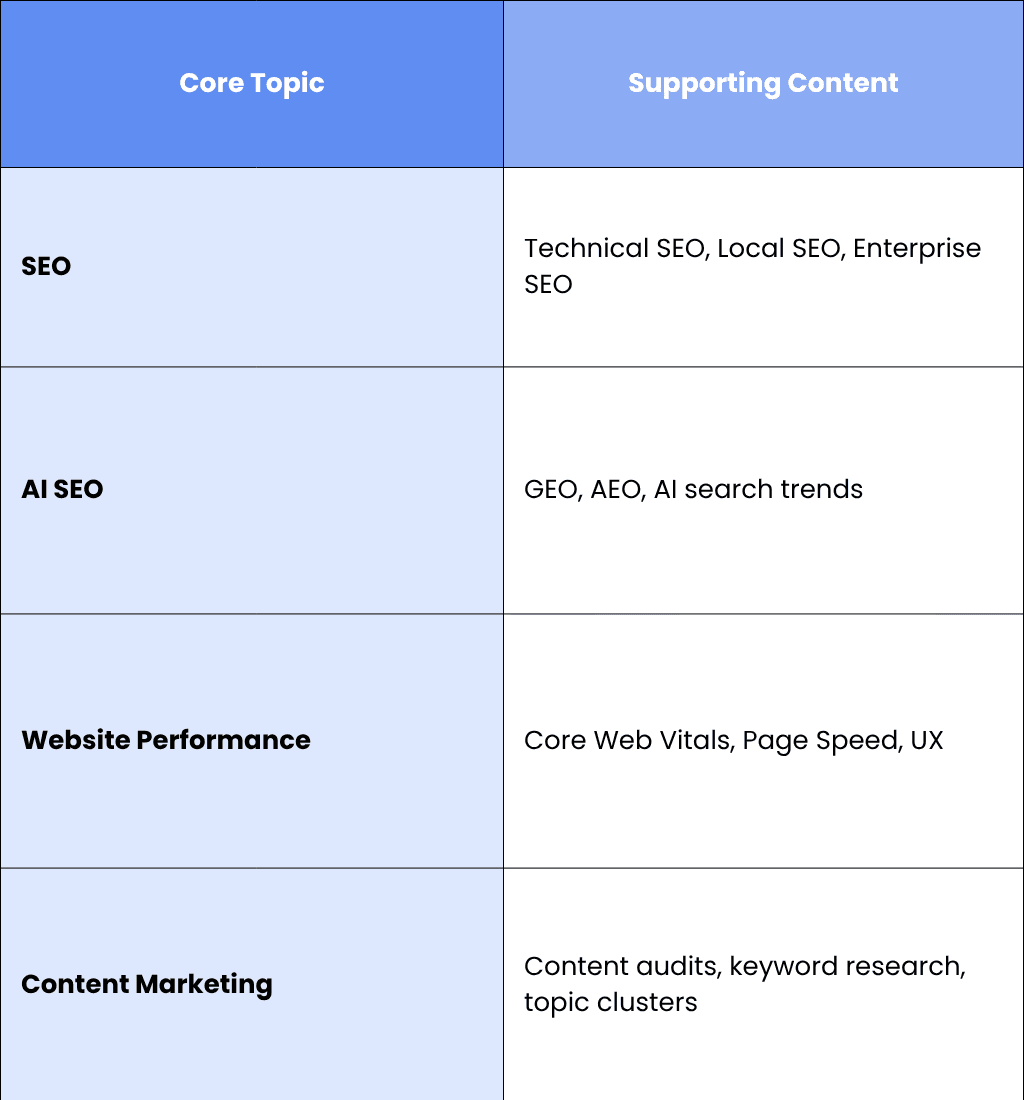
Each supporting article should link naturally to related resources, creating a network of content that demonstrates depth and expertise.
Over time, this interconnected structure helps AI systems recognise your website as an authoritative source within your industry.
Once your content strategy is in place, you should also make it easier for AI platforms to understand your website from a technical perspective.
4. Implement Structured Data
Even excellent content can be misunderstood if search engines and AI systems cannot clearly interpret it.
Structured data, commonly known as schema markup, provides additional context that helps machines understand the purpose of your pages.
Depending on your business, consider implementing schema such as:
- Organisation
- Local Business
- Article
- FAQ
- Product
- Service
- Review
- Breadcrumb
- Person
Although schema alone will not guarantee greater AI visibility, it improves the clarity and structure of your website, making it easier for AI systems to interpret your content accurately.
With the technical foundations in place, the next step is to ensure AI platforms recognise your business as a trusted entity rather than simply another website.
5. Build a Recognised Brand Entity
AI platforms increasingly rely on entity recognition when deciding which businesses to reference.
An entity is a clearly identifiable organisation that AI systems can distinguish from others.
You can strengthen your entity by maintaining consistent information across trusted online sources, including:
- Your website
- Google Business Profile
- Industry directories
- Professional associations
- News publications
Ensure that your:
- Company name
- Business description
- Website URL
- Contact information
- Services
- Branding
remain consistent everywhere they appear.
If possible, seek opportunities to establish your business on authoritative knowledge sources and industry websites, as these help reinforce your brand's credibility.
Once AI systems clearly understand who you are, they also need evidence that other reputable organisations trust your expertise.
6. Earn High-Quality Backlinks and Brand Mentions
External recognition remains one of the strongest signals of authority for both traditional search engines and AI systems.
Rather than focusing solely on acquiring large numbers of backlinks, prioritise mentions from trustworthy and relevant sources.
Examples include:
- Industry publications
- Professional associations
- Universities
- Government organisations
- Business directories
- Trade magazines
- Conference websites
You can increase your visibility by:
- Publishing original research
- Sharing industry insights
- Contributing guest articles
- Participating in interviews
- Speaking at events
- Collaborating with respected organisations
For example, a hospitality consultancy featured in several well-known tourism publications is more likely to be recognised by AI systems than a competitor with hundreds of low-quality backlinks.
Strong external authority reinforces the expertise demonstrated on your own website.
The next step is to ensure that authority remains accurate and relevant over time.
7. Update Your Content Regularly
AI platforms favour information that remains accurate and up to date.
Even comprehensive content can lose visibility if it becomes outdated.
Develop a content review schedule to ensure your key pages continue reflecting current information.
During each review, consider updating:
- Statistics
- Industry trends
- Product information
- Case studies
- Internal links
- External references
- Screenshots
- Examples
A practical approach is to review your highest-performing pages every three to six months.
Rather than creating entirely new articles, improving existing resources often delivers greater long-term value by preserving the authority those pages have already built.
As your content evolves, the final step is to monitor whether your improvements are producing measurable results.
8. Measure, Benchmark and Refine Your Strategy
Improving AI visibility is not a one-time project but an ongoing process of testing, learning and optimisation.
After implementing changes, revisit the benchmarking framework discussed earlier in this guide.
Compare your new results against previous reports by asking questions such as:
- Are we appearing more frequently in AI-generated answers?
- Have our AI citations increased?
- Are we ranking ahead of more competitors?
- Which improvements produced the greatest impact?
- Which areas still require attention?
Tracking these metrics over time helps you identify long-term trends, justify investment in SEO and Generative Engine Optimisation (GEO), and ensure your strategy continues evolving alongside AI-powered search.
Ultimately, improving AI visibility is not about chasing algorithms or trying to "game" AI systems. It is about building a website that consistently delivers accurate, trustworthy and well-structured information that genuinely helps users. Businesses that focus on expertise, authority and user value are far more likely to earn lasting visibility—not only in traditional search results but also across the growing ecosystem of AI-powered search experiences.
Why AI Visibility Will Become a Core Business Metric
Just as organic rankings became a key performance indicator over the past two decades, AI visibility is quickly emerging as a critical measure of digital success.
Decision-makers are beginning to ask new questions:
- Does AI recommend our business?
- Which competitors dominate AI-generated answers?
- Why are some brands consistently cited while others are overlooked?
- How can we improve our visibility across AI platforms?
Businesses that begin measuring these signals today will be better positioned to adapt as AI-powered search continues to reshape customer discovery and decision-making.
How Saigon Digital Can Help Businesses
Benchmarking is only the first step. Turning those insights into measurable improvements requires a strategic approach that combines technical expertise, high-quality content and an understanding of how AI systems evaluate information.
At Saigon Digital, we help ambitious brands build sustainable visibility across both traditional search engines and AI-powered discovery platforms.
Our services include:
SEO Services
We develop data-driven SEO strategies that improve technical performance, strengthen content authority and support long-term business growth.
Our SEO services include:
- Site optimisation and technical performance
- Content strategy and authority building
- Local and global search strategies
Generative Engine Optimisation (GEO)
As AI search becomes increasingly influential, our GEO services help businesses become trusted sources for platforms such as ChatGPT, Gemini, Perplexity and Google AI.
Our capabilities include:
- AI readability optimisation
- Generative Engine Optimisation (GEO)
- Answer Engine Optimisation (AEO)
- Knowledge Graph and schema implementation
- AI content audits and content restructuring
- AI performance dashboards
AI Workflow Automation
Beyond visibility, we help organisations improve operational efficiency through AI-powered automation.
Our AI automation services include:
- AI-driven business intelligence
- Pre-built workflow automation templates
- Custom AI agents tailored to your operations
Saigon Digital delivers forward-thinking, user-centric and measurable digital solutions that support long-term growth.
Ready to Improve Your AI Visibility?
Benchmarking your AI visibility is the first step towards understanding how your brand performs in an increasingly AI-driven search landscape. The real advantage, however, comes from acting on those insights with a strategy that strengthens your authority, improves your discoverability and keeps you ahead of the competition.
Whether you're looking to increase your presence in ChatGPT, Google AI Overviews, Gemini or other AI-powered platforms, Saigon Digital can help. Our team combines technical SEO, Generative Engine Optimisation (GEO), AI Readability Optimisation and data-driven content strategies to help ambitious brands become trusted sources across both search engines and AI experiences.
Ready to future-proof your digital visibility? Get in touch with Saigon Digital to discover how our SEO and AI optimisation services can help your business stand out where your customers are searching next.
Frequently Asked Questions
1. What is AI visibility?
AI visibility refers to how often and how accurately your business appears in AI-generated responses from platforms such as ChatGPT, Google AI Overviews, Gemini and Perplexity. Unlike traditional SEO, which focuses on search engine rankings, AI visibility measures whether AI systems recognise your brand as a trustworthy source and recommend or cite your content when answering users' questions.
2. How do I benchmark my AI visibility against competitors?
To benchmark your AI visibility against competitors, start by identifying your main competitors and creating a standardised list of prompts that reflect your customers' search intent. Test these prompts across multiple AI platforms, record how often your business and competitors are mentioned or cited, and compare key factors such as topical authority, structured data, brand consistency and external authority. Repeating this process every quarter helps you track progress and identify opportunities to improve.
3. Why is AI visibility becoming important for businesses?
As more people use AI assistants to research products, compare services and discover brands, businesses need to optimise for more than just traditional search engines. Strong AI visibility increases the likelihood that your business will be recommended by AI platforms, helping you reach potential customers earlier in their decision-making journey while strengthening your overall digital presence.
4. What factors influence AI visibility?
Several factors contribute to AI visibility, including the quality and depth of your content, topical authority, structured data implementation, brand consistency across the web, high-quality backlinks, recognised business entities, and clear, well-organised content that is easy for AI systems to interpret. Improving these areas can significantly increase your chances of appearing in AI-generated answers.
5. How can Generative Engine Optimisation (GEO) improve AI visibility?
Generative Engine Optimisation (GEO) focuses on making your website and content more discoverable, understandable and trustworthy for AI-powered search platforms. By combining high-quality content, AI readability optimisation, structured data, entity building and technical SEO best practices, GEO helps position your brand as a reliable source that AI systems are more likely to cite, reference and recommend in their responses.