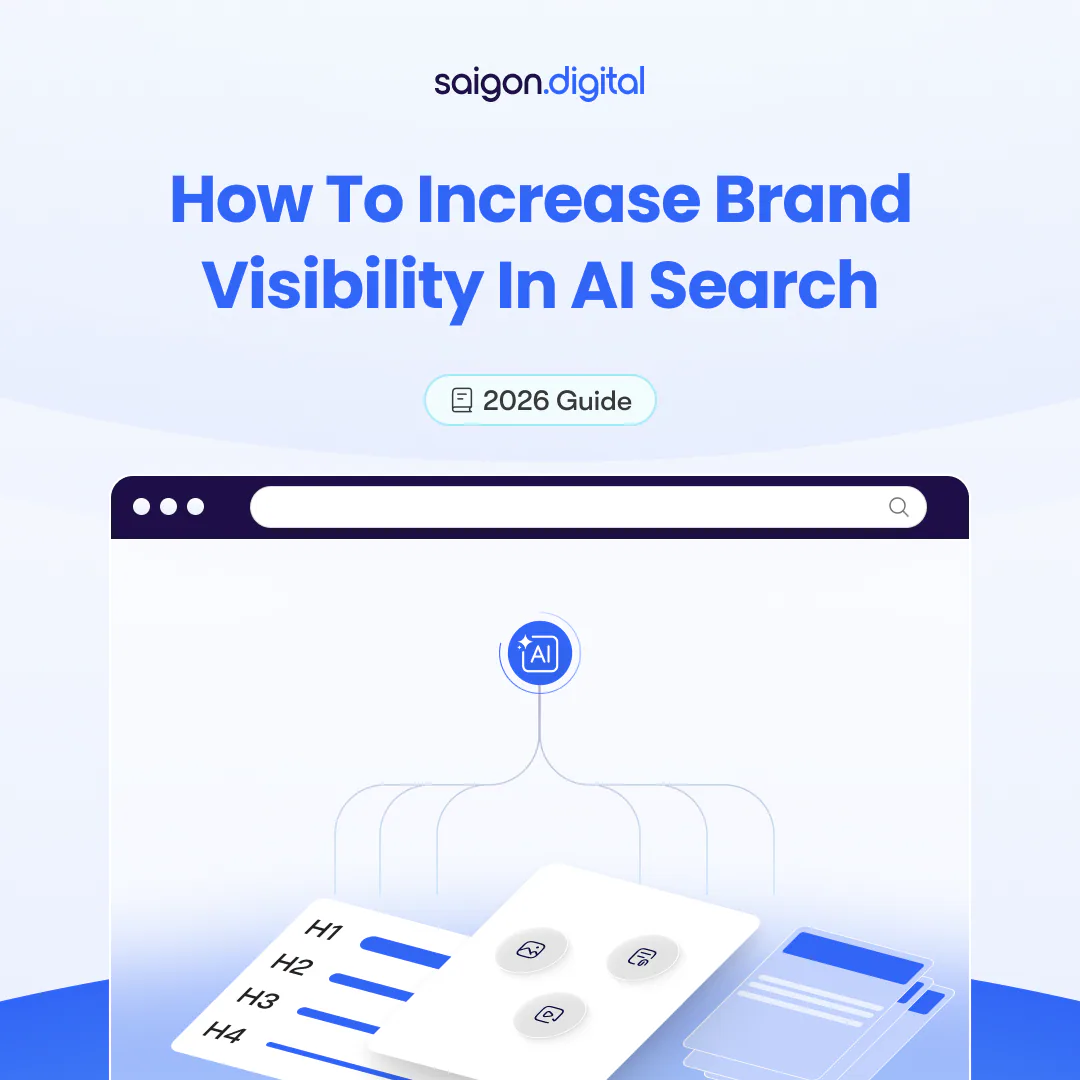
Artificial intelligence has fundamentally changed how people discover information online. Search is no longer confined to ten blue links. Today, users ask conversational questions and receive synthesised answers from platforms such as Google Search, ChatGPT, Microsoft Copilot, and Perplexity AI.
For brands, this shift introduces both a challenge and an opportunity. Traditional rankings still matter, but visibility increasingly depends on whether AI systems recognise, trust, and cite your brand in their generated answers.
In this 2026 guide, Saigon Digital explains how to increase brand visibility in AI search and position your business as a trusted source in an AI-driven discovery landscape.
Why Brand Visibility in AI Search Matters in 2026
Search behaviour has evolved rapidly, and in 2026 AI-driven engines increasingly shape how users discover brands. Rather than presenting a list of links, generative platforms now deliver synthesised, conversational answers.
As a result, visibility no longer depends solely on ranking positions, it depends on whether your brand is included in those AI-generated responses.
At the same time, users are placing greater trust in summarised recommendations. When an AI search engine highlights specific companies, definitions, or frameworks, it effectively filters the market on the user’s behalf. Consequently, brands that are not recognised or cited risk becoming invisible, even if their traditional SEO performance remains strong.
Moreover, AI systems rely on authority, entity clarity, and contextual consistency to determine which brands to surface. Therefore, businesses must ensure they are not only discoverable, but also clearly understood and trusted within digital knowledge ecosystems.
In short, brand visibility in AI search matters because it directly influences perception, credibility, and commercial opportunity. In an environment where AI curates attention, the brands it recognises are the brands that lead.
How AI Search Engines Choose What to Surface
To increase brand visibility in AI search, you must first understand how AI engines decide what to include in their responses. Unlike traditional search algorithms that primarily rank pages, AI-driven systems interpret, synthesise, and generate answers based on multiple trust and relevance signals.
Broadly speaking, AI search engines prioritise five core factors.
1. Relevance to Intent
First and foremost, AI systems assess whether your content directly answers the user’s question. However, relevance is measured semantically rather than through exact keyword matches.
For example, if a user asks:
“How can a B2B company improve brand visibility in AI search?”
An AI engine will prioritise content that:
- Addresses B2B contexts specifically
- Mentions AI search optimisation directly
- Provides structured, actionable guidance
- Demonstrates subject-matter depth
Generic articles about “SEO tips” may be ignored because they lack contextual alignment.
Therefore, clarity of intent alignment becomes critical. The more precisely your content answers defined questions, the higher the likelihood of inclusion.
2. Authority and Source Credibility
Beyond relevance, AI engines evaluate whether a source appears trustworthy. They do this by analysing signals across the wider digital ecosystem.
These signals may include:
- Mentions on reputable websites
- Backlinks from authoritative domains
- Expert authorship indicators
- Consistent brand positioning
- Structured organisation data
For instance, if your agency publishes a guide on AI optimisation and that guide is referenced by recognised marketing publications, AI systems gain stronger confidence in citing it.
Conversely, content hosted on low-quality or inconsistent domains is less likely to be surfaced, regardless of how well written it may be.
Authority, therefore, amplifies relevance.
3. Entity Recognition and Context
AI search engines operate on entity-based understanding. Rather than viewing your brand as a simple URL, they categorise it within knowledge graphs.
If your brand is consistently associated with:
- AI search optimisation
- Technical SEO
- Digital growth strategy
Then AI systems are more likely to connect your entity with related queries.
For example:
If multiple sources describe your business as “an AI-powered SEO agency”, that repeated categorisation strengthens your eligibility to appear when users ask for AI search specialists.
In contrast, inconsistent descriptions across platforms dilute entity clarity.
Contextual reinforcement builds inclusion probability.
4. Extractability and Structural Clarity
Even authoritative content can be overlooked if it is difficult to extract.
AI engines favour content that is:
- Clearly structured
- Logically segmented
- Concise in its explanations
- Supported by bullet points or step-based frameworks
For example, a clearly defined section titled:
“Five Steps to Improve Brand Visibility in AI Search”
followed by a numbered list is easier for AI systems to interpret than a dense, unstructured essay.
Additionally, direct definition statements increase extractability. For instance:
“Brand visibility in AI search refers to the likelihood of a brand being cited or referenced within AI-generated answers.”
Short, declarative sentences often become citation candidates.
Structure supports selection.
5. Cross-Platform Validation
Finally, AI systems compare signals across multiple environments. If your brand appears consistently across:
- Industry blogs
- Professional networks
- Conference listings
- Research reports
- Media interviews
Then confidence increases.
For example:
If your research report on AI search trends is referenced by industry commentators and discussed on professional platforms, AI engines detect reinforced thematic alignment.
This cross-platform validation reduces uncertainty and strengthens inclusion potential.
1. Build Topical Authority, Not Just Rankings
If you want to increase brand visibility in AI search, you must move beyond isolated keyword targeting and instead build genuine topical authority. AI systems are designed to identify subject-matter depth, contextual consistency, and demonstrable expertise. In other words, they reward brands that clearly “own” a topic.
Let us explore how to do this properly.
Create Content Clusters Around Core Themes
Rather than publishing standalone articles that loosely relate to your services, you should build structured content clusters around clearly defined themes. This approach helps AI systems understand the scope of your expertise while strengthening internal relevance signals across your site.
To begin with, identify your primary service pillars. For example, if you are an SEO and AI-focused agency like Saigon Digital, your pillars might include:
- AI-powered SEO
- Technical SEO
- Digital strategy
- Conversion optimisation
- Marketing automation
Once defined, build a central “pillar” page for each theme. This page should serve as a comprehensive, authoritative resource that covers the topic in depth. From there, develop supporting content that explores subtopics in greater detail.
For instance, under “AI-powered SEO”, you might create:
- A guide to optimising content for generative AI search
- A case study demonstrating AI-driven keyword expansion
- An article explaining structured data for entity recognition
- A comparison of traditional SEO versus AI-enhanced SEO
- A checklist for improving brand visibility in AI search
Each supporting article should link back to the pillar page and to one another where relevant. This internal linking structure reinforces thematic relationships and signals depth.
Why this works:
- AI systems evaluate semantic relationships between pages
- Consistent terminology strengthens entity association
- Comprehensive coverage increases citation likelihood
- Structured architecture improves crawl efficiency
Additionally, ensure each cluster maintains conceptual consistency. Avoid mixing unrelated themes within the same content silo. If your subject is AI search optimisation, stay focused on that domain rather than diluting authority with loosely connected topics.
The goal is clear: when an AI model processes your website, it should confidently identify your brand as a credible authority within specific digital domains.
Demonstrate First-Hand Experience
Topical coverage alone is no longer sufficient. AI-driven systems increasingly prioritise content that reflects real-world expertise and practical insight. Therefore, to increase brand visibility in AI search, you must demonstrate authentic experience.
Begin by embedding tangible proof within your content. Rather than stating, “We help brands improve AI visibility,” explain how you do it, why it works, and what results you achieved.
For example:
Instead of:
“Structured data improves visibility.”
Write:
“After implementing Organisation, Service, and FAQ schema for a B2B SaaS client, we observed increased inclusion in AI-generated summaries within eight weeks.”
Specificity builds credibility.
You can strengthen experience signals through:
- Detailed client case studies outlining challenges, strategies, and measurable outcomes
- Before-and-after performance data (traffic, impressions, brand mentions)
- Proprietary methodologies with named frameworks
- Commentary from identifiable experts within your organisation
- Screenshots or visual breakdowns of technical implementations
Consider introducing your own frameworks. For instance, a structured model such as:
The AI Visibility Framework
- Entity clarity
- Semantic depth
- Structured optimisation
- Authority amplification
- Cross-platform reinforcement
By consistently referencing and applying your framework across multiple articles, you create intellectual property that AI systems may associate with your brand.
Furthermore, use author profiles strategically. Include contributor bios that outline experience, qualifications, and industry involvement. AI models often analyse authorship signals when evaluating credibility.
To make experience-based content even clearer, include:
- Step-by-step breakdowns of your processes
- Insights into mistakes to avoid
- Observations from real campaigns
- Data-backed recommendations
- Industry trend commentary grounded in practice
Importantly, maintain a confident yet professional tone. Avoid exaggeration. AI systems increasingly detect promotional language patterns. Instead, prioritise clarity, evidence, and structured insight.
When your content reflects genuine expertise rather than generic advice, AI engines are far more likely to:
- Extract your explanations
- Reference your methodology
- Associate your brand with specific problem-solving areas
- Surface your insights in relevant queries
2. Optimise for AI Retrieval, Not Just Keywords
Traditional SEO has long centred on keyword targeting. However, increasing brand visibility in AI search requires a more advanced approach. AI-driven platforms do not simply scan for exact-match phrases. Instead, they interpret context, intent, semantic relationships, and structured clarity.
Therefore, rather than asking, “Which keyword should we rank for?”, the more relevant question in 2026 is:
“How easily can an AI system retrieve, understand, and summarise our expertise?”
Optimising for AI retrieval means structuring your content so that it is extractable, logically organised, and contextually rich. Let us examine how to do this effectively.
Focus on Conversational Search Intent
Search behaviour has evolved dramatically. Users now interact with AI engines in full sentences, often asking multi-layered or comparative questions.
For example:
- “How can I improve brand visibility in AI search for a SaaS company?”
- “Which SEO agencies specialise in AI-powered optimisation?”
- “What is the difference between traditional SEO and AI search optimisation?”
These queries are nuanced and intent-driven. AI systems analyse the full meaning of the question rather than isolating individual keywords.
To optimise for this shift, begin by mapping conversational intent. Instead of creating content around fragmented phrases, build content around real-world questions.
A practical approach includes:
- Reviewing People Also Ask data
- Analysing AI-generated query suggestions
- Gathering questions from sales calls or client discovery sessions
- Monitoring industry forums and LinkedIn discussions
Once identified, integrate these questions directly into your content structure.
For example:
Use clear subheadings such as:
- “How does AI search differ from traditional SEO?”
- “Why is brand visibility in AI search important for B2B companies?”
- “What technical steps improve AI retrievability?”
Then answer each question concisely before expanding with supporting detail.
Why this matters:
- AI systems often extract short answer blocks
- Clear question-answer formatting improves citation likelihood
- Direct responses increase the chance of being quoted in summaries
Additionally, prioritise clarity over complexity. Avoid unnecessary jargon. Write in structured, digestible paragraphs that transition naturally from one idea to the next.
For instance:
Begin with a direct explanation. Then elaborate with context. Follow with a practical example. Conclude with a takeaway.
This layered structure mirrors how AI engines synthesise information.
Structure Content for Extractability
Even strong insights lose impact if they are difficult to parse. AI retrieval systems favour content that is logically segmented and clearly organised.
To enhance extractability:
- Use descriptive H2 and H3 headings
- Keep paragraphs focused on one idea
- Use bullet points for frameworks or lists
- Define key concepts explicitly
- Summarise sections where appropriate
For example, when introducing a concept such as entity optimisation, provide a direct definition:
“Entity optimisation refers to structuring brand information so AI systems can clearly identify, categorise, and contextualise your business within knowledge graphs.”
This single sentence may become the portion that AI platforms extract and cite.
Furthermore, incorporate:
- Tables for comparisons
- Numbered steps for processes
- Highlighted frameworks
- Clear transitions between sections
Avoid dense, unstructured text blocks. They reduce clarity and hinder AI summarisation.
Implement Structured Data Strategically
Beyond written content, technical structure plays a critical role in improving brand visibility in AI search.
Structured data helps search engines and AI systems interpret your content with precision. It reinforces meaning and clarifies relationships between entities.
Key schema types to implement include:
- Organisation schema
- Service schema
- Article schema
- FAQ schema
- Author schema
For example:
- Organisation schema defines who you are
- Service schema clarifies what you offer
- Author schema reinforces expertise and credibility
- FAQ schema increases eligibility for structured answer extraction
However, do not implement schema mechanically. Align it with your content strategy.
For instance:
If you publish a comprehensive guide on AI search optimisation, include:
- Article schema to define the content type
- Author schema to establish authority
- FAQ schema to support conversational queries
- Breadcrumb schema to reinforce site hierarchy
Consistency is equally important. Ensure your brand name, service descriptions, and categorisations remain identical across structured data and on-page copy.
When aligned properly, structured data:
- Strengthens entity recognition
- Improves inclusion in knowledge panels
- Increases the likelihood of AI citation
- Enhances clarity in generative responses
Prioritise Semantic Depth Over Keyword Density
AI retrieval systems interpret topics holistically. Therefore, instead of repeating a target phrase excessively, expand your semantic coverage.
For example, if focusing on brand visibility in AI search, include related concepts such as:
- Entity recognition
- Knowledge graphs
- Generative search
- AI-driven indexing
- Conversational search intent
- Citation authority
This signals topical breadth.
A practical way to achieve semantic depth:
- Analyse competitor content gaps
- Use topic modelling tools
- Expand subtopics logically
- Answer adjacent questions within the same article
Importantly, ensure every additional concept connects naturally to your core topic. Avoid forced inclusion.
The aim is to create a content asset that feels comprehensive rather than optimised.
Test and Refine Through AI Platforms
Optimising for AI retrieval should not be theoretical. It should be iterative.
Regularly test your content within platforms such as:
- ChatGPT
- Microsoft Copilot
- Perplexity AI
Ask industry-relevant questions and observe:
- Whether your brand appears
- How it is described
- Which competitors are cited instead
- What information AI summarises
If your brand does not appear, analyse why. Is the content insufficiently structured? Is authority lacking? Are competitors providing clearer definitions?
Refine accordingly. This feedback loop enables continuous improvement in AI retrievability.
3. Strengthen Your Brand Entity
AI systems organise information using entity-based understanding. This means they categorise people, companies, services, locations, and concepts within interconnected knowledge graphs. If your brand is clearly defined and consistently reinforced across the digital ecosystem, AI engines can confidently reference and recommend it.
To increase brand visibility in AI search, you must deliberately strengthen your brand entity across the web.
Maintain Consistent Brand Information
Consistency is foundational to entity recognition. AI systems validate credibility by cross-referencing information across multiple sources. If your brand name, description, or service categorisation differs across platforms, it creates ambiguity.
Begin by auditing your digital footprint.
Ensure consistency in:
- Brand name (including punctuation and spacing)
- Tagline and positioning statement
- Service descriptions
- Founding year
- Office locations
- Contact details
- Leadership team information
For example, if your brand description reads:
“SEO Agency. Solving digital challenges with forward-thinking, user-centric and bespoke solutions.”
This positioning should appear consistently across:
- Your website’s About page
- Company profiles
- Business directories
- Social media bios
- Press releases
- Guest author bios
Even minor inconsistencies can weaken entity clarity. For instance:
- “AI SEO Agency” versus “SEO & AI Consultancy”
- Abbreviated brand names in some places but not others
- Different service descriptions across platforms
These variations may seem small to humans, yet AI systems interpret them as potential ambiguity.
To strengthen consistency:
- Create a formal brand entity document
- Standardise approved descriptions (short, medium, long versions)
- Align metadata, schema markup, and on-page copy
- Regularly audit third-party listings
Additionally, ensure your structured data mirrors your public descriptions. Organisation schema should match your visible brand narrative exactly.
When your digital footprint aligns seamlessly, AI systems gain higher confidence in your entity identity and that confidence improves your inclusion in generated responses.
Clarify Your Primary Category and Expertise
AI engines need categorical clarity. If your brand operates across multiple digital services, define your core expertise clearly rather than appearing overly broad.
For example:
Instead of describing your business as:
“A digital company offering various online services.”
Be specific:
“An SEO and AI-powered marketing agency specialising in high-performance websites, automation, and AI search optimisation.”
Specificity strengthens classification.
To reinforce expertise categorisation:
- Define primary and secondary service categories
- Align website navigation with those categories
- Use consistent terminology across articles
- Avoid frequent repositioning without clear signalling
For instance, if your focus is AI-driven SEO, ensure:
- Your pillar content reflects that niche
- Your case studies demonstrate AI-related success
- Your LinkedIn positioning reinforces AI marketing expertise
AI systems learn from repeated contextual reinforcement. The clearer your niche, the stronger your entity association.
Earn Mentions on Authoritative Platforms
While your own website defines your entity, external validation strengthens it.
AI systems rely heavily on trusted domains to verify credibility. Mentions on authoritative platforms signal legitimacy and industry relevance.
Focus on quality rather than volume.
Prioritise:
- Industry publications
- Recognised marketing blogs
- Professional networks
- Reputable news outlets
- Conference websites
- Academic or research references (where relevant)
When securing external mentions:
- Ensure your brand name appears clearly and correctly
- Maintain consistent service descriptions
- Request proper attribution where possible
- Provide a concise expert bio
For example, if a publication quotes your founder discussing AI search optimisation, that mention reinforces:
- Topical authority
- Expertise recognition
- Entity association within the AI marketing domain
Over time, repeated high-quality citations strengthen your knowledge graph presence.
Additionally, encourage:
- Podcast interviews
- Webinar appearances
- Panel discussions
- Guest articles
These broaden your digital footprint and provide new contextual associations.
The more reputable ecosystems reference your brand within specific topics, the more likely AI engines are to connect your entity with those subject areas.
Encourage Structured Brand Signals Across Platforms
Beyond mentions and consistency, actively structure your entity presence.
Practical steps include:
- Claiming and optimising business profiles
- Aligning social handles across platforms
- Maintaining accurate directory listings
- Updating company descriptions regularly
- Using identical branding visuals
Additionally, encourage branded search behaviour.
You can achieve this through:
- Thought leadership campaigns
- Data-driven content releases
- Educational resources
- Webinars and live sessions
- Industry collaborations
When users search your brand name alongside industry terms (for example, “Saigon Digital AI search strategy”), AI systems recognise increased relevance between your entity and that topic.
Branded search demand strengthens entity prominence.
Monitor and Refine Your Entity Presence
Finally, strengthening your brand entity is not a one-time exercise.
Regularly test how AI platforms interpret your brand. Use tools such as:
- ChatGPT
- Perplexity AI
- Microsoft Copilot
Ask:
- “Who is [your brand]?”
- “Which agencies specialise in AI search optimisation?”
- “What services does [your brand] offer?”
Evaluate the responses carefully.
4. Create Content Worth Citing
AI search engines do not simply index content, they synthesise it. When platforms generate answers, they draw from sources they consider reliable, well-structured, and authoritative. Therefore, if you want to increase brand visibility in AI search, you must create content that AI systems actively choose to reference.
In practical terms, this means producing material that is not only informative, but citation-worthy.
AI engines are more likely to cite brands that provide:
- Original insights
- Clear definitions
- Structured frameworks
- Data-backed findings
- Unique perspectives
- High signal-to-noise clarity
Let us explore how to build content that earns those citations.
Publish Original Research and Data
Original data is one of the strongest citation drivers in AI search. When you provide statistics, benchmarks, or trend analysis that cannot be found elsewhere, AI systems gain a reason to reference your brand directly.
Begin by identifying knowledge gaps within your industry. Ask:
- What questions lack reliable data?
- What trends are discussed but not quantified?
- What client-side insights could be anonymised and aggregated?
You might, for example:
- Conduct an industry survey on AI search adoption
- Analyse performance data across client campaigns
- Publish a benchmark report on structured data implementation
- Release a trend forecast based on measurable indicators
For instance, instead of writing:
“AI search is growing rapidly.”
Provide:
“In our 2026 Digital Visibility Report, 63% of mid-sized brands reported measurable traffic from AI-generated search responses within twelve months.”
Specific figures increase the likelihood of extraction.
To maximise citation potential:
- Present statistics clearly and concisely
- Include summary highlights at the top of the page
- Use charts or tables to clarify findings
- Provide contextual interpretation
- Offer downloadable reports to strengthen authority
Furthermore, ensure your data includes proper labelling and definitions. Ambiguous statistics reduce extractability.
When AI platforms encounter a well-structured statistic tied to a clearly defined source, they are more likely to reference your brand when responding to related queries.
Develop Clear Definitions and Conceptual Frameworks
AI engines frequently surface definitions when users ask explanatory questions. If you define key concepts clearly and consistently, your explanation may become the extracted reference.
For example, instead of relying on generic explanations of AI optimisation, define it in your own structured way:
“AI search optimisation is the process of structuring content, entity signals, and authority frameworks so generative engines can retrieve, interpret, and cite your brand within synthesised answers.”
Clarity and precision matter.
To strengthen this approach:
- Introduce proprietary models
- Create named methodologies
- Develop step-by-step systems
- Use consistent terminology across articles
For example:
You might introduce:
The AI Citation Framework
- Authority validation
- Extractable structuring
- Entity reinforcement
- Cross-platform credibility
- Data-backed substantiation
If you reference this framework consistently across multiple articles, AI systems may begin associating your brand with that methodology.
To increase extractability:
- Place definitions near the top of relevant articles
- Use single-sentence summary statements
- Avoid overly complex phrasing
- Follow definitions with practical examples
The clearer and more structured your explanation, the more likely it is to be cited in AI-generated responses.
Offer Unique Insight, Not Recycled Advice
AI models are trained on vast amounts of existing information. Repeating generic advice rarely improves brand visibility in AI search. Instead, offer insight that adds interpretative value.
Ask yourself:
- What do we see in real campaigns that others are not discussing?
- What mistakes do clients frequently make?
- What tactical nuance is missing from mainstream articles?
For example:
Rather than writing:
“Implement structured data for better results.”
Add depth:
“We have observed that FAQ schema often underperforms when applied to thin content pages. However, when integrated into long-form pillar assets exceeding 2,000 words, inclusion in AI-generated answer panels increases significantly.”
Specific observations build authority.
To elevate originality:
- Share anonymised campaign learnings
- Provide comparative analyses
- Critique common misconceptions
- Offer forward-looking predictions
- Link trends to measurable behaviour shifts
AI engines value interpretative context. When your content moves beyond surface-level explanation and into strategic reasoning, it becomes more valuable as a reference source.
Structure Content for Direct Quotation
If you want AI engines to cite you, make quoting easy.
This means:
- Writing concise summary paragraphs
- Including bullet-point breakdowns
- Presenting step-based processes
- Providing clearly segmented sections
For example:
Instead of embedding a key takeaway within a dense paragraph, isolate it:
Key Insight: Brands that align entity consistency, structured data, and authoritative mentions see faster improvements in AI search inclusion.
Short, high-signal statements are more likely to be extracted verbatim.
Additionally:
- Avoid overly promotional language
- Limit exaggerated claims
- Use objective phrasing
- Support assertions with reasoning
AI systems tend to favour informational tone over sales-driven messaging.
At Saigon Digital, we balance authority with clarity. We position expertise confidently while maintaining professional credibility, a tone that both users and AI engines trust.
Encourage Secondary Citations
When other websites reference your research or frameworks, citation probability increases further.
To stimulate secondary citations:
- Promote reports through digital PR
- Share insights with industry journalists
- Offer expert commentary for news features
- Publish executive summaries on professional networks
When multiple reputable sources reference your original research, AI systems gain additional validation signals.
In essence, your content moves from being a single source to becoming part of a broader authority network.
5. Enhance Technical Performance
Strong content and clear entity positioning are essential. However, without solid technical foundations, even the most authoritative insights may struggle to gain traction.
If your website is slow, poorly structured, or difficult to crawl, AI systems may overlook it in favour of technically stronger competitors.
Let us examine how to build the right technical infrastructure.
Prioritise Page Speed and Core Web Performance
Speed influences both user satisfaction and algorithmic trust. AI search engines increasingly integrate performance signals when assessing site quality.
Begin with measurable diagnostics:
- Analyse Core Web Vitals
- Review server response times
- Evaluate render-blocking scripts
- Assess image compression and file sizes
Slow-loading content reduces crawl efficiency and may limit how deeply AI systems explore your site.
To improve performance:
- Optimise image formats (e.g. WebP where appropriate)
- Implement lazy loading for non-critical assets
- Minimise unnecessary JavaScript
- Use server-side rendering where beneficial
- Enable caching and content delivery networks
For example, if a pillar guide on AI search takes six seconds to load fully, an AI crawler may allocate limited crawl budget to it. By reducing load time to under two seconds, you increase both accessibility and crawl depth.
Faster websites:
- Improve crawl frequency
- Increase index stability
- Reduce bounce rates
- Strengthen perceived authority
In a competitive AI landscape, performance becomes a differentiator.
Ensure Clean and Logical Site Architecture
AI systems interpret relationships between pages based on structure. A disorganised website confuses both users and machines.
Start by mapping your content hierarchy.
A strong architecture typically follows:
- Homepage
- Core service pillars
- Supporting cluster articles
- Case studies
- Resource hub
Avoid excessive click depth. Ideally, important content should be reachable within three clicks from the homepage.
Additionally:
- Use descriptive, consistent URL structures
- Maintain logical breadcrumb trails
- Avoid duplicate category pathways
- Consolidate overlapping pages
For instance:
Instead of: /blog/post-123-ai-search-tips
Use: /ai-search/brand-visibility-guide
Clear taxonomy reinforces topical authority.
Internal linking also plays a critical role. Rather than linking randomly, connect pages contextually within the same topic cluster. This strengthens semantic associations and supports AI understanding of your expertise domains.
A well-structured site communicates confidence and clarity, both essential for increasing brand visibility in AI search.
Optimise Crawlability and Indexation
Even the strongest content cannot contribute to visibility if it is not properly indexed.
Audit your technical setup regularly to ensure:
- No accidental noindex tags on key pages
- Robots.txt does not block essential resources
- Canonical tags are correctly implemented
- XML sitemaps are updated and submitted
- Redirect chains are minimised
Pay particular attention to:
- JavaScript-heavy content rendering
- Dynamic URLs
- Parameter-based duplication
- Pagination structures
If your site relies heavily on client-side rendering, consider pre-rendering or hybrid approaches to ensure AI crawlers can fully interpret content.
Additionally, remove low-value or thin pages that dilute crawl efficiency. AI systems may interpret excessive low-quality content as a trust signal weakness.
Refinement, rather than expansion, often improves overall authority perception.
Strengthen Structured Data Implementation
While discussed earlier from a content perspective, structured data also forms part of your technical foundation.
Implement schema systematically, not sporadically.
Key priorities include:
- Organisation schema for brand clarity
- Service schema for offering definition
- Article schema for content categorisation
- FAQ schema for extractable responses
- Breadcrumb schema for structural mapping
However, technical accuracy is essential. Validate schema using testing tools and monitor for errors in search console reports.
Common mistakes to avoid:
- Mismatched structured data and on-page content
- Incomplete required fields
- Duplicate schema blocks
- Incorrect nesting
Structured data reinforces machine readability. When implemented correctly, it increases the likelihood of:
- Enhanced SERP features
- Knowledge panel associations
- AI citation extraction
- Improved entity classification
Technical precision amplifies strategic intent.
6. Optimise for Multi-Platform Presence
AI search does not operate in isolation. Generative engines synthesise information from a wide range of digital environments, not just your website. They draw from professional networks, media publications, video platforms, podcasts, forums, and structured business listings.
Therefore, if you want to increase brand visibility in AI search, you must think beyond your domain. You must build a deliberate, credible, and consistent multi-platform presence.
The stronger and more coherent your presence across trusted ecosystems, the more confident AI systems become in recognising and surfacing your brand.
Expand Beyond Your Website
Many brands invest heavily in on-site SEO yet neglect external visibility. In the AI era, this is a limitation.
AI engines evaluate contextual mentions and authority signals from multiple platforms. If your expertise exists only on your own website, your credibility footprint remains narrow.
To broaden it, identify platforms aligned with your audience and industry.
For example, B2B digital brands may prioritise:
- Professional networks
- Industry publications
- Expert round-ups
- Conference websites
- Specialist forums
Meanwhile, consumer brands might focus on:
- Video platforms
- Review sites
- Influencer collaborations
- Community-based platforms
The key is not to be everywhere. It is to be strategically present where relevance and authority intersect.
Ask:
- Where does our audience discuss this topic?
- Where do journalists source expert commentary?
- Which platforms are frequently cited by AI engines?
Then prioritise accordingly.
Diversify Content Formats
AI systems analyse content across multiple media formats. Written articles remain essential, yet video transcripts, podcast summaries, and professional commentary increasingly contribute to entity recognition.
To strengthen brand visibility in AI search, diversify your output.
For instance, you might repurpose a comprehensive blog guide into:
- A LinkedIn thought leadership series
- A webinar presentation
- A podcast episode
- A slide deck for industry events
- A short-form explainer video
Each format reinforces the same core expertise but within different ecosystems.
Importantly, maintain consistency in messaging.
If your core positioning centres on AI-powered SEO and digital growth, ensure that theme appears consistently across:
- Video descriptions
- Podcast bios
- Social media summaries
- Guest articles
AI systems cross-reference these signals. When they detect repeated, aligned messaging across formats, entity confidence increases.
Additionally, include structured descriptions wherever possible. Many platforms allow detailed bios and summaries, use them to reinforce your primary expertise and service categories.
Encourage Branded Search and Recognition
Multi-platform presence influences user behaviour. When users encounter your brand across various channels, they are more likely to search for it directly.
Branded search queries reinforce relevance.
For example:
- “[Brand name] AI search strategy”
- “[Brand name] SEO case study”
- “[Brand name] digital growth agency”
When AI systems detect increasing branded query volume alongside industry keywords, they interpret stronger entity-topic alignment.
To encourage branded search:
- Promote proprietary research
- Host industry webinars
- Publish annual reports
- Share thought leadership consistently
- Engage in collaborative campaigns
Visibility creates curiosity. Curiosity drives search. Search strengthens entity recognition.
Maintain Consistent Cross-Platform Messaging
Multi-platform presence only strengthens AI visibility when messaging aligns.
Inconsistency creates confusion.
Ensure:
- Identical service categories across bios
- Unified brand description statements
- Consistent terminology for proprietary frameworks
- Updated contact and company details
For example, if your website describes your company as an “AI-powered SEO agency”, but your social media profile states “full-service marketing consultancy”, AI systems may struggle to categorise your primary expertise.
Clarity strengthens retrievability.
Create a messaging guide that includes:
- Approved short and long brand descriptions
- Core service positioning
- Key industry focus areas
- Tagline variations
- Defined terminology
Apply this consistently across every platform.
The Future of Brand Visibility in AI Search
AI search will continue evolving. Generative engines will become more personalised, predictive, and context-aware. Brands that rely on outdated SEO tactics will struggle to maintain exposure.
To lead in 2026 and beyond, you must:
- Establish topical authority
- Strengthen entity recognition
- Create citation-worthy content
- Maintain technical excellence
- Build cross-platform credibility
Increasing brand visibility in AI search is not about chasing algorithms. It is about building a recognisable, authoritative digital presence that AI systems trust and users value.
Final Thoughts
The future of digital growth is here. AI is reshaping how audiences discover and evaluate brands.
At Saigon Digital, we solve digital challenges with forward-thinking, user-centric and bespoke solutions. We combine strategy, creativity, and data to help ambitious brands design, build, and scale digital experiences that drive measurable growth.
If you want to increase your brand visibility in AI search, start by building authority, clarity, and trust, everywhere your audience and AI systems look.
The brands that adapt today will define tomorrow’s search landscape.
Ready to Optimise for the Future of Search?
At Saigon Digital, we shape trends, not follow them. Whether you’re looking to strengthen your content for semantic search, leverage vector-driven insights, or simply future-proof your SEO strategy, our team is ready to help you stand out where it matters most: in front of your audience.
Let’s build your next digital success story together. Get in touch with Saigon Digital today to start turning search intent into measurable results.
Want to be the brand AI engines recommend?
We make businesses visible on Google and inside AI answers, measured in leads, not vanity metrics.