



An AI search engine does not return ten blue links. It reads the web on your behalf, synthesises an answer, and cites a handful of sources. If you are not among those sources, you do not exist in that answer.
That shift is now measurable. ChatGPT crossed 900 million weekly users in early 2026 and handles an estimated 250 to 500 million search queries a week. Google still holds roughly 80% of total query volume, but AI platforms are absorbing an estimated 15 to 20% of informational query volume, which is precisely the segment that historically drove organic traffic to content sites.
This guide covers two things. First, the six AI search engines that actually matter in 2026, compared on market share, pricing and citation behaviour. Second, and more usefully for most readers, a practical process for how to optimise your website for AI search engines so your content is the one being quoted.
Key Takeaways
- ChatGPT dominates AI referrals, but its lead is narrowing. It accounted for 74.78% of AI referral traffic in 2026, down from 79.74% a year earlier, while Gemini grew 231% and Claude 320% year on year.
- AI referral volume is still small, and that is not the point. All AI chatbots combined sent roughly 0.29% of search referrals in May 2026 per Cloudflare Radar. The influence happens during research, before the click.
- Conversion quality is the real story. AI referral traffic has been reported converting at several times the rate of standard Google organic, because the user has already filtered and compared before arriving.
- Citation behaviour differs sharply by engine. Perplexity shows around 50% domain overlap with Google's organic top 10, while only about 4.2% of ChatGPT citations rank in Google's top 10. Ranking well on Google does not automatically mean being cited elsewhere.
- Optimisation is a structural problem, not a keyword problem. Extractable formatting, entity clarity, schema and crawler access determine citation far more than keyword density.
What Is an AI Search Engine?
An AI search engine is a search product that uses large language models and natural language processing to interpret the intent behind a query, retrieve relevant sources, and generate a synthesised answer with citations, rather than returning a ranked list of links for the user to evaluate.
For example, instead of searching "best CRM software small business" and clicking through ten links, an AI search engine may summarise the best options, explain why they are suitable, and cite sources, all in one response.
How an AI Search Engine Actually Works
Most AI search engines follow the same four-stage process, usually described as retrieval-augmented generation (RAG):
- Query interpretation. The engine parses what you actually mean, not what you typed. Google calls its version query fan-out, where a single question triggers multiple related searches across subtopics.
- Retrieval. The system pulls candidate passages from a search index, a vector database, or both. Note that it retrieves passages, not pages. This is why page-level ranking and passage-level citation are different problems.
- Synthesis. A language model composes an answer grounded in the retrieved passages, which reduces hallucination compared with generating from memory alone.
- Citation. The engine attributes claims back to sources. How prominently it does this varies enormously and directly determines how much traffic you receive.
The practical consequence is that your content is competing at passage level. A brilliant 3,000-word guide with one clean, extractable definition will often out-cite a mediocre article, and a brilliant guide with no extractable passages may not be cited at all. Our explainer on how AI search engines work covers the retrieval mechanics in more depth.
AI Search Engine vs Traditional Search Engine
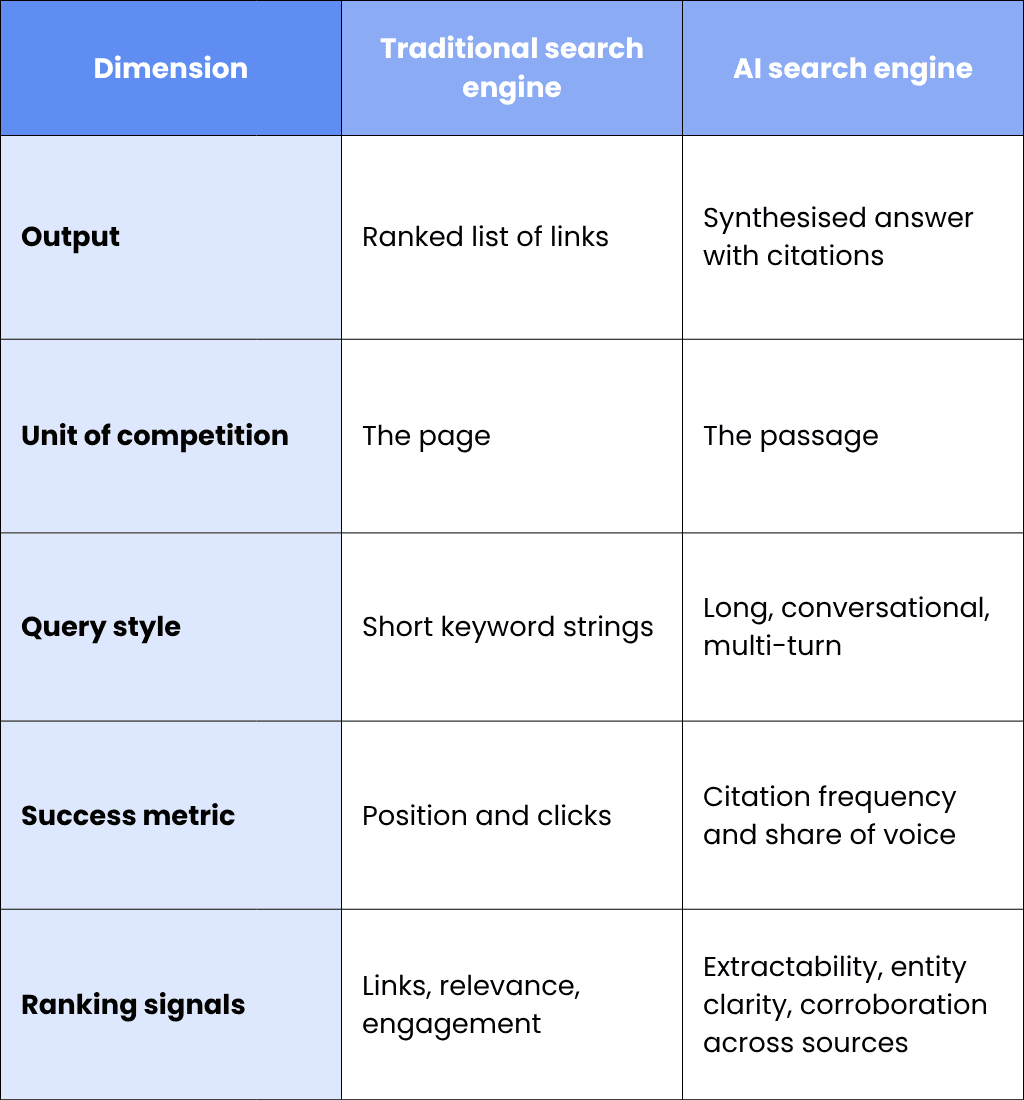
This is why the discipline has acquired its own name. If you are new to the terminology, our breakdown of SEO vs GEO vs AEO explains how the three overlap and where they genuinely differ.
AI Search Engine Market Share in 2026
Before choosing where to focus, it helps to see the actual distribution. Two different numbers get quoted in this space and they measure different things.
Share of AI referral traffic sent to websites (2026):
- ChatGPT: 74.78%, down from 79.74% in 2025, though its absolute traffic grew 27% year on year
- Gemini: 11.56%, up 231% year on year and now the second-largest AI traffic source
- Perplexity: 7.23%, roughly flat globally with US share declining
- Copilot: 3.51%
- Claude: 2.62%, but the fastest-growing platform at 320% year on year
The wider context: Cloudflare Radar data for May 2026 shows Google sending 87.63% of all search referral traffic, with every AI chatbot combined accounting for roughly 0.29%. AI search is not replacing Google traffic yet. What it is doing is capturing the research and comparison phase, which is where purchase decisions are actually formed. Treating AI visibility as a branding and influence channel rather than a traffic channel is the more accurate mental model, and it pairs closely with the wider zero-click search trend.
The 6 Best AI Search Engines in 2026
1. Google AI Mode and AI Overviews
Google continues to lead the evolution of the AI search engine in 2026. With AI Overviews now deeply embedded into standard search results, Google has shifted from simply ranking pages to actively interpreting, summarising and presenting information based on user intent.
What changed in 2026. Two things the previous version of this article did not cover. First, Gemini 3 became the default model powering Google AI Overviews globally in January 2026. Second, Google AI Mode is now a distinct conversational surface rather than a summary block, with a Deep Search feature that compiles multi-source research reports from dozens of pages at once.
Why it stands out:
- Unmatched access to real-time and historical data
- Advanced natural language understanding
- Integration with Google products such as Maps, Shopping and YouTube
- Strong emphasis on content credibility and experience
Limitation: AI Overviews compress clicks. Independent studies place the CTR impact anywhere between a 15% and a 61% decline depending on methodology and query type, so visibility here rarely translates into proportional traffic.
Best for: almost every business, because it remains the highest-volume surface by a wide margin.
2. ChatGPT Search
ChatGPT Search has evolved into one of the most influential AI search engines in 2026, particularly for users seeking guidance, problem-solving and strategic thinking. Rather than focusing purely on information retrieval, it helps users understand what to do next.
Scale: roughly 900 million weekly users across all ChatGPT surfaces, with ChatGPT Search alone handling an estimated 250 to 500 million weekly queries. It is now among the largest search properties in the world by query volume, and it is responsible for close to three-quarters of all AI referral traffic.
Why it stands out:
- Human-like conversational responses
- Strong contextual and multi-step reasoning
- Ability to synthesise information across multiple sources
- Effective handling of open-ended and strategic questions
The critical insight for SEO teams: research on large citation datasets found that only around 4.2% of ChatGPT citations also rank in Google's organic top 10. ChatGPT draws heavily on reference sources and corroborated brand mentions rather than mirroring Google's rankings. Winning here is a separate exercise from winning on Google.
Best for: brands whose buyers research strategically, particularly B2B, SaaS and professional services.
3. Google Gemini
Gemini has become the second-largest AI traffic source globally, growing 231% year on year and overtaking Perplexity in early 2026. It is now the model layer underneath Google's AI search surfaces as well as a standalone assistant.
Why it stands out: deep integration with Google Workspace, strong multimodal handling, and a broader citation mix than its competitors. Analysis of large citation datasets shows Gemini pulling from a wider range of source types, including a notably heavy reliance on YouTube.
Practical implication: if your category is well served by video, Gemini visibility may be easier to earn through YouTube than through written content. Also worth noting, roughly 84% of Gemini citation URLs now carry a text fragment, meaning it links to the specific sentence it used. Clean, self-contained sentences are directly rewarded.
Best for: brands with video assets and those already operating inside the Google ecosystem. If you are weighing the two leaders, our comparison of Google Gemini vs ChatGPT looks at where each performs better.
4. Perplexity AI
Perplexity AI has established itself as a trusted, research-focused AI search engine in 2026. Rather than trying to replace traditional search outright, it enhances it by prioritising clarity, accuracy and transparency.
What truly differentiates Perplexity is its commitment to verifiable answers. Every response is supported by clear source citations, allowing users to check facts and explore original materials with ease.
Why it punches above its weight. Perplexity handles roughly 50 million weekly queries, far fewer than ChatGPT, but BrightEdge data puts its CTR on cited sources at around 18 to 22%, materially higher than the click rate on sources cited in Google AI Overviews. Because citations sit prominently in the interface, being cited in Perplexity is a genuine traffic strategy rather than a pure visibility play.
The easiest entry point. Perplexity shows around 50% domain overlap with Google's organic top 10, the highest of any major AI search engine. If you already rank well on Google, Perplexity is the fastest place to convert that into AI citations. Our guide on how to appear in Perplexity AI answers sets out the specific tactics.
Best for: professionals, analysts, researchers and any brand that can support claims with evidence.
5. Microsoft Bing with Copilot
Microsoft Bing has quietly transformed into one of the most capable AI search engines in 2026. With Copilot fully integrated into the search experience, Bing delivers conversational, context-aware responses while still grounding answers in traditional search results.
What sets Bing apart is how Copilot enhances search through interactive, multi-turn conversations. Users can ask a question, refine it, request clarification or dive deeper without restarting the search process.
Key strengths:
- Conversational search that supports follow-up questions
- Strong performance for B2B, technical and professional topics
- Integration with Microsoft 365, Edge and LinkedIn data
- Clear balance between AI-generated answers and source links
Reality check: Copilot accounts for roughly 3.51% of AI referral traffic. It is a meaningful channel in enterprise contexts, especially where Microsoft 365 is the default workplace stack, but it should not be a primary focus for most brands.
Best for: B2B and enterprise brands selling into Microsoft-centric organisations. Our guide to AI search visibility for B2B and SaaS goes deeper on this audience.
6. Claude
Claude is the fastest-growing platform in this list by rate, up 320% year on year, with most of that increase concentrated in a single month in early 2026. Its referral share sits at around 2.62%, but that understates its influence: Claude punches well above its usage weight in referral traffic relative to raw user numbers.
Why it stands out: long-context reasoning and document analysis. Users tend to bring Claude entire reports, contracts and datasets rather than single questions, which means the content it cites skews toward substantive, in-depth material.
Best for: brands publishing research, technical documentation and long-form analysis. Thin listicles rarely surface here.
How to Optimise Your Website for AI Search Engines
This is the section most readers arrive for, so here is a concrete process rather than general principles. Each step is something you can action this quarter.
1. Write for Passage-Level Extraction
AI search engines retrieve passages, not pages. That changes how you write.
- Answer the question in the first two sentences under each heading, then expand
- Keep the definitional sentence self-contained, so it makes sense lifted out of context
- Avoid pronouns that reference earlier paragraphs, since the retrieved passage may not include them
- Use descriptive headings phrased as the question a user would actually ask
Our guidance on NLP-friendly content covers the sentence-level mechanics in detail.
2. Focus on User Intent, Not Just Keywords
While keywords still matter, AI search engines now prioritise intent over exact phrasing. This means businesses must understand what users are truly trying to achieve when they ask a question.
Instead of creating separate, keyword-heavy pages, businesses should:
- Map content to informational, commercial and decision-making intent
- Answer follow-up questions within the same page
- Use natural language that reflects how people actually speak
Because AI search is conversational and multi-turn, anticipating the second and third question a user will ask is now as valuable as answering the first. Our primer on search intent covers the classification framework.
3. Build Entity Clarity, not just Topical Coverage
AI systems reason about entities, meaning distinct real-world things such as your brand, your people, your products and your locations. If a model cannot resolve who you are with confidence, it will cite a competitor it recognises instead.
- Describe your brand consistently across your site, LinkedIn, directories and third-party profiles
- Name your authors and give them real, credentialed bios
- Use the same terminology for your services across every page rather than rotating synonyms
- Connect related pages so the relationships between concepts are explicit
This is the foundation of an entity-first content strategy, and it pairs with building a proper topical authority map rather than publishing disconnected articles.
4. Strengthen Technical SEO and Structured Data
Even the best content will struggle if AI search engines cannot properly interpret it. Technical SEO and structured data provide the framework AI systems rely on to understand context and relationships.
Key actions include:
- Ensuring fast load times and mobile performance
- Using schema markup for AI search across articles, FAQs and organisations
- Maintaining clean site architecture and internal linking
Adding FAQ schema helps AI search engines identify direct answers, and Organisation schema helps them resolve your brand as a distinct entity. Both sit on top of solid technical SEO foundations.
5. Check that AI Crawlers Can Actually Reach You
This is the most commonly overlooked step, and the cheapest to fix. Many sites unintentionally block the crawlers that feed AI search engines, then wonder why they are never cited.
- Audit robots.txt for GPTBot, ClaudeBot, PerplexityBot, Google-Extended and Bingbot
- Decide deliberately which to allow rather than inheriting a default
- Check that key content is server-rendered, since some AI crawlers execute JavaScript inconsistently
- Confirm your CDN or firewall is not silently rate-limiting AI user agents
Our guide on how to manage AI crawlers includes the specific robots.txt rules for each major bot.
6. Build Topical Authority and Trust
In 2026, AI search engines assess whether a brand consistently demonstrates expertise within a topic area. One-off articles are far less effective than a well-connected content ecosystem.
To build authority:
- Create clusters of related content around core topics
- Link supporting articles back to comprehensive guides
- Keep information accurate and updated
Trust signals matter more here than in traditional SEO, because models weight corroboration heavily. When several independent sources say the same thing about you, confidence rises. That makes third-party mentions, review platforms, industry roundups and digital PR direct AI visibility levers, not just brand authority exercises. Our guidance on E-E-A-T for AI content covers how to evidence expertise credibly.
7. Think Beyond Clicks and Measure Real Impact
AI search engines often deliver answers without a click, which means visibility does not always translate into traditional traffic.
Instead, businesses should track:
- Brand mentions and visibility in AI-generated responses
- Engagement quality when users do visit
- Lead quality and conversion outcomes
Set a baseline before you start optimising, or you will not be able to prove impact. Google Search Console now includes dedicated generative AI performance reports covering AI Overviews and AI Mode impressions, which gives you a free starting point. For citation tracking across other engines, see our comparison of Google AI Overview tracking tools.
Best AI Search Optimisation Platforms in 2026
Optimising without measuring is guesswork. A short orientation on the tooling categories, since the market is now crowded:
- Free baseline: Google Search Console for AI Overviews and AI Mode impressions, plus GA4 segments for AI referral traffic.
- Entry-level monitoring: platforms starting around $29 per month that track brand mentions and citations across ChatGPT, Perplexity, AI Overviews and Copilot.
- Mid-market analytics: roughly $80 to $300 per month, adding sentiment analysis, competitor share of voice and prompt-level reporting.
- Enterprise platforms: source-level citation intelligence, agent analytics and governance, typically sold through a demo-led process.
- SEO suite add-ons: if you already pay for a major SEO platform, check its AI reporting before adding a vendor.
We compare the specific platforms, pricing and trade-offs in our guides to AI visibility tools and Google AI Overview tracking tools.
Take the Next Step Towards AI-Driven Search Success
AI search is the present. The best-performing brands in 2026 will be those that understand how AI search engines interpret content and serve users.
By staying informed and adapting early, businesses can turn this shift into a competitive advantage.
Saigon Digital is here to help If you are ready to future-proof your visibility and explore how AI-driven search can support real business growth.
Contact us today and see how we help you reach full AI visibility!
AI Search Engine FAQs
1. What is an AI search engine?
An AI search engine uses large language models and natural language processing to interpret the intent behind a query, retrieve relevant sources and generate a synthesised answer with citations, rather than returning a ranked list of links. Google AI Mode, ChatGPT Search, Perplexity, Gemini and Copilot are the leading examples in 2026.
2. Which is the best AI search engine in 2026?
It depends on the task. Google AI Mode offers the widest coverage for everyday search. Perplexity is the strongest for fact-checking because it surfaces citations prominently. ChatGPT Search is best for open-ended, strategic questions. Claude suits long-document analysis, and Kagi suits users who want an ad-free, link-led experience.
3. Are AI search engines replacing Google?
Not on current data. Google sent roughly 87.6% of all search referral traffic in May 2026, while all AI chatbots combined sent about 0.29%. What is shifting is where research happens. AI platforms are absorbing an estimated 15 to 20% of informational query volume, which is the discovery phase rather than the transaction.
4. How do I optimise my website for AI search engines?
Write self-contained passages that answer questions directly, use descriptive question-led headings, implement Article, FAQ and Organisation schema, maintain consistent entity descriptions across the web, allow AI crawlers in robots.txt, and earn third-party mentions so your claims are corroborated by independent sources. Then measure citation frequency rather than clicks alone.
5. Is optimising for AI search engines different from SEO?
It overlaps substantially but is not identical. Traditional SEO competes at page level for rankings, while AI search optimisation competes at passage level for citations. Technical health, quality content and authority benefit both. Extractable formatting, entity clarity and crawler access matter disproportionately more for AI. This is the distinction covered by answer engine optimisation (AEO) and large language model optimisation (LLMO).
6. Does AI referral traffic actually convert?
Reported conversion rates for AI referral traffic run several times higher than standard Google organic. The explanation is intent quality: by the time an AI search engine recommends you, the user has already compared options and filtered alternatives inside the interface. Fewer visitors, further along the decision.
7. Which AI search engine is easiest to get cited in?
Perplexity, if you already rank on Google. It shows roughly 50% domain overlap with Google's organic top 10, so existing rankings convert into citations relatively directly. ChatGPT is the hardest, with only around 4.2% overlap, because it relies more heavily on reference sources and corroborated brand mentions.
8. Should I block AI crawlers from my website?
For most businesses, no. Blocking crawlers removes any possibility of citation, and citation is where the commercial value sits. The calculation differs for publishers whose revenue depends on page views rather than lead generation. Google Search Console now includes a control for blocking content from AI Overviews, AI Mode and Discover AI if you decide it is warranted.