As AI technology continues to evolve at an exceptional pace, businesses are asking an increasingly common question: Google Gemini vs ChatGPT, which is better? At Saigon Digital, we help brands navigate digital challenges with clarity, so understanding how these two leading AI models differ and how they can support your strategy is essential.
In this article, we break down their strengths, limitations, and ideal use cases, offering practical insights to help you decide which model better suits your needs in SEO, content creation, and wider digital transformation.
What Are Google Gemini and ChatGPT?
Understanding the differences between Google Gemini and ChatGPT begins with recognising what each model is designed to do. Although both are advanced AI systems (generative AI) capable of generating human-like responses, they were built with slightly different philosophies and strengths in mind.
Google Gemini
Google Gemini is Google’s next-generation multimodal AI model, built to work across several types of input, not just text. This means that Gemini can process and interpret images, audio, video, and code in a unified way, making it particularly powerful for businesses that rely on various forms of digital content.
Because Gemini is embedded across Google’s ecosystem, it can support both everyday users and professionals working with data-heavy platforms.
Examples of how Gemini works:
- If you upload a screenshot from Google Analytics, Gemini can interpret the graph and explain trends.
- If you provide a photo of a product, it can identify the object, suggest potential keywords, and even generate product descriptions.
- If you paste a block of JavaScript, it can debug the code and highlight optimisable areas.
Key strengths at a glance:
- Multimodal understanding: Handles text, images, audio, and video together.
- Deep integration with Google products: Works seamlessly with Google Search, Docs, Sheets, Gmail, and more.
- Data-aligned responses: Often offers answers consistent with Google’s search and ranking systems.
Overall, Gemini serves as a versatile assistant for businesses that use Google Workspace or need AI that can interpret visual or complex inputs in a single workflow.
ChatGPT
Conversely, ChatGPT focuses primarily on delivering conversational, natural-sounding text. Developed by OpenAI, it has become one of the most widely used AI systems in the world because of its ability to understand context, maintain tone, and produce coherent long-form content.
Furthermore, ChatGPT is known for its strong reasoning skills, which makes it a popular choice for problem-solving, coding assistance, and creative writing.
Examples of how ChatGPT works:
- You can ask ChatGPT to create a full blog outline, then expand each section into clear paragraphs.
- If your team needs help debugging a piece of code, ChatGPT can walk through the logic step-by-step.
- When crafting UX copy or social captions, ChatGPT can adjust tone to match your brand personality.
What ChatGPT excels at:
- Natural, fluent language generation: Produces human-like writing suitable for articles, emails, and scripts.
- Creative ideation: Great for brainstorming campaigns, product names, and content angles.
- Strong reasoning: Capable of breaking down complex concepts and providing structured explanations.
Thanks to its adaptability and conversational style, ChatGPT serves as a reliable tool for content creators, marketers, developers, and teams seeking a flexible writing and thinking partner.
>>> Read more: 10 Best Free AI Writing Tools (No Credit Card Required)
Google Gemini vs ChatGPT: Key Differences
Although both Google Gemini and ChatGPT are powerful AI systems, they shine in different areas. Understanding these differences makes it easier for businesses to choose the right tool for their workflow. Below, we break down the main distinctions so you can see how each model performs in real-world situations.
1. Multimodality
One of the most important differences between the two models lies in how they handle different types of content. While ChatGPT has gradually developed multimodal functions over time, Gemini was designed for multimodality from the very beginning. This fundamentally changes how users can interact with it.
Why this matters:
Gemini can interpret and analyse multiple data formats simultaneously, making it ideal for tasks that involve visuals, audio, or mixed media.

Practical examples of Gemini:
- Upload a product photo → Gemini can identify it, describe it, and suggest SEO keywords.
- Provide a screenshot of your GA4 dashboard → it can explain traffic changes and recommend improvements.
- Share a video clip → Gemini can summarise the content and extract key points.
In contrast, ChatGPT:
- Handles multimedia well, but its strongest performance still comes from text-based interactions.
- Often requires additional prompts to interpret images or structured data effectively.
In summary:
Gemini leads in native multimodality, especially for businesses that rely on visual data and complex media formats.
2. Integration with Existing Tools
Another key consideration is how each model fits into your existing digital ecosystem. This is especially important for teams looking to streamline their workflow.

Google Gemini integration strengths:
- Works seamlessly across Google Workspace apps such as Docs, Sheets, Gmail, and Drive.
- Integrates directly with Google Search, giving users insights that align closely with search intent.
- Easy to access through Android devices and Chrome extensions.
ChatGPT integration strengths:
- Offers a robust API that integrates with countless third-party platforms.
- Powers a large ecosystem of plugins that extend its capabilities into CRM systems, project management tools, and writing platforms.
- Highly adaptable for developers building custom automation.
How to decide:
- If your organisation operates heavily within the Google ecosystem, Gemini will feel more natural and efficient.
- If you rely on diverse tools or custom apps, ChatGPT’s flexibility becomes a major advantage.
3. Content Quality and Tone
Content creation is one of the most common uses of AI today. Although both models perform well in this area, their writing styles differ in noticeable ways.

ChatGPT’s strengths in writing:
- Produces fluid, approachable, human-like text.
- Maintains consistent tone and personality across long-form content.
- Excels at blog writing, email crafting, storytelling, and UX copy.
Google Gemini’s writing style:
- Tends to be more concise and analytical, often prioritising clarity and factual accuracy.
- Generates content that is well-structured but sometimes less conversational.
- Useful for technical explanations, data summaries, and rapid information synthesis.
Example comparison:
- ChatGPT might write a warm, narrative-style introduction for a blog post.
- Gemini might produce a sharper, more factual version focused on key points.
For businesses needing content with a natural flow and strong readability, ChatGPT often delivers better results.
4. Search and Data Accuracy
Because Google has deep access to search signals and indexing capabilities, Gemini can provide insights that feel more in tune with real-time search behaviour. This can be particularly valuable for SEO-focused teams.

Gemini advantages:
- Pulls from Google’s understanding of the web.
- Often provides search-aligned content suggestions.
- Well-suited for analysing SERPs, exploring competitive landscapes, and interpreting trends.
ChatGPT advantages:
- With browsing enabled, it retrieves current information from reliable sources.
- Offers detailed reasoning and broader contextual explanations.
- Excels at synthesising information into actionable strategies.
Practical example for SEO teams:
- Gemini might highlight why a competitor ranks higher and how their content aligns with search intent.
- ChatGPT might then help you turn those insights into a complete content plan.
5. SEO Use Cases
Choosing the right tool can make a significant difference in how efficiently a team produces and optimises content. Both models offer meaningful benefits for SEO, but they complement each other well.

ChatGPT is ideal for:
- Creating outlines, drafts, and long-form articles.
- Generating internal linking ideas.
- Producing metadata, schema templates, and content briefs.
- Brainstorming topic clusters or search journey paths.
Gemini is ideal for:
- Rapid SERP-level analysis.
- Extracting insights from Google tools (e.g., Search Console screenshots).
- Suggesting tweaks based on ranking factors.
- Identifying content gaps relative to competitors.
Using both models together often results in higher-quality content backed by stronger data insights.
6. Coding and Automation
Although both models support developers, they offer slightly different experiences.

ChatGPT’s coding strength:
- Explains technical concepts step-by-step.
- Provides detailed debugging and reasoning.
- Suitable for beginners and experts alike.
Gemini’s coding strength:
- Generates quick, precise code snippets.
- Analyses larger codebases efficiently when provided as input.
- Works well for rapid technical assistance.
If your team values detailed reasoning and educational explanations, ChatGPT typically performs better. If you need fast code generation, Gemini is highly effective.
7. User Experience and Interface
Lastly, the interface you prefer can influence your overall productivity.
Gemini’s interface:
- Clean and minimalistic.
- Works smoothly with Google tools.
- Designed for simplicity and speed.
ChatGPT’s interface:
- Offers a range of models, settings, and personalisation options.
- Allows saved conversations, memory features, and custom instructions.
- Feels more flexible for users who need tailored experiences.
Ultimately, both provide excellent user experiences, but their design philosophies differ. Gemini aims for simplicity; ChatGPT leans toward customisation.
So… Google Gemini vs ChatGPT: Which Is Better?
There is no one-size-fits-all answer, but a clear pattern emerges:
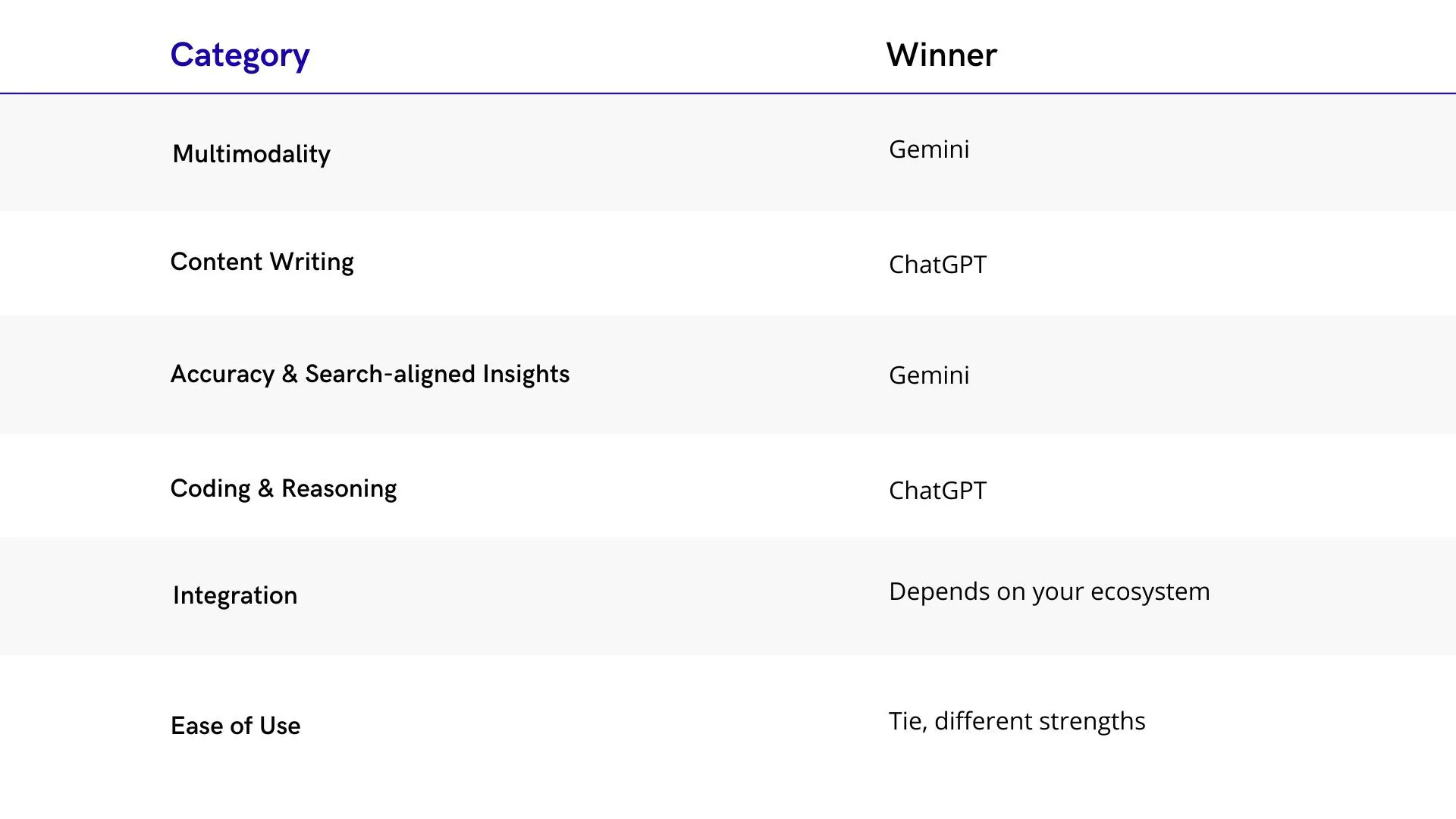
In short:
- If your business relies on Google Workspace, values up-to-date search insights, and uses varied media types, Gemini may be your best fit.
- If your team needs natural language generation, strong creativity, or complex problem-solving, ChatGPT is likely the better option.
How Saigon Digital Recommends Using Them Together
Rather than choosing between Google Gemini and ChatGPT, we often find that businesses achieve the best results by combining both. Each model offers unique strengths, and when used strategically, they complement one another extremely well.
Below is a step-by-step approach that we at Saigon Digital recommend to help teams maximise efficiency, accuracy, and creativity across their SEO and content workflows.
1. Use Google Gemini to Analyse Data, SERPs, and Competitor Content
Start your workflow by using Gemini to gather insights. Since the model aligns closely with Google's understanding of search behaviour, it excels at extracting actionable information from search results, analytics dashboards, and visual data.
How to use Gemini effectively at this stage:
- Upload screenshots or charts from GA4 or Search Console and ask Gemini to summarise key trends.
Example: “Here is a screenshot of our top pages. What patterns do you see and what actions should we prioritise?”
- Use it to break down SERPs by asking questions such as:
- “What themes do top-ranking pages share for ‘[keyword]’?”
- “What search intent is Google prioritising for this query?”
- Request structured competitor insights, including content gaps or keyword opportunities.
Example_:_ “Compare our article with these competitor URLs and suggest what we should add to improve rankings.”
Why this step matters:
By starting with solid data-driven analysis, you ensure that every piece of content or strategy you create is directly aligned with user needs and Google’s ranking expectations.
2. Use ChatGPT to Produce Quality Content Based on Those Insights
Once Gemini provides the foundation of your research, move to ChatGPT for the content creation phase. ChatGPT’s natural writing style makes it ideal for crafting content that feels engaging, conversational, and user-centred, qualities that Saigon Digital prioritises in all SEO deliverables.
How to use ChatGPT at this stage:
- Provide the insights gathered from Gemini and ask ChatGPT to turn them into a structured outline.
Example_:_ “Using the competitor gaps identified earlier, create a detailed outline for a 1,500-word blog post.”
- Ask it to transform keyword insights into content that flows naturally and maintains a brand-appropriate voice.
Example: “Write an introduction that addresses the search intent we identified.”
- Use it for long-form writing, including blog articles, whitepapers, landing pages, or email sequences.
- Request multiple tone variations when testing what resonates with your audience.
Example_:_ conversational, professional, educational, or persuasive tones.
Additional guidance:
For best results, give ChatGPT clear instructions such as:
- Target audience
- Preferred tone
- SEO requirements (H1, H2s, meta description, FAQs, etc.)
- Any sources or insights gathered from Gemini
This ensures the final content is not only high quality but also strategically aligned.
3. Use Google Gemini Again to Verify Accuracy and Search Alignment
After ChatGPT drafts the content, return to Gemini to ensure the piece is accurate, up-to-date, and aligned with Google’s search expectations. This “review phase” is crucial because it helps prevent factual inconsistencies, outdated references, or keyword misuse, all of which can impact rankings.

How to execute this step:
- Paste the completed content into Gemini and ask it to review for accuracy.
Example_:_ “Please verify whether the statistics and claims in this article are correct based on the latest data.”
- Check alignment with search intent by asking: “Does this article satisfy the intent behind the keyword ‘[keyword]’? What improvements would you recommend?”
- Request on-page SEO enhancements, including:
- Additional semantically related keywords
- Opportunities for clearer subheadings
- More search-friendly structure
- Ask Gemini to compare the draft with top-ranking pages to ensure competitiveness.
Example: “Please compare this content with the top 3 pages ranking for this keyword and suggest improvements.”
Practical example of Gemini's refinement suggestions:
- Recommending a missing definition if competitors include it
- Suggesting more data points or examples to increase helpfulness
- Encouraging clearer structure for mobile readers
- Highlighting weaker sections where competitors offer more value
By running this final quality check with Gemini, you ensure the content is both highly useful to users and well-optimised for search engines.
Ready to Elevate Your Content and SEO Strategy with AI?
The debate of Google Gemini vs ChatGPT doesn’t need to be a battle of which tool replaces the other. Instead, think of them as complementary technologies that, when used wisely, can elevate your digital strategy.
As a forward-thinking SEO agency, Saigon Digital continually tests and optimises these tools to deliver bespoke, user-centric solutions for our clients.
Contact us today if you’d like support integrating AI into your workflow.
Want to be the brand AI engines recommend?
We make businesses visible on Google and inside AI answers, measured in leads, not vanity metrics.