



Artificial intelligence is changing how people discover information online. Instead of clicking through a list of search results, users are increasingly asking AI platforms such as ChatGPT, Google AI Overviews, Gemini, Perplexity, and Microsoft Copilot direct questions and receiving complete answers within seconds.
For businesses, this shift introduces an important question:
Is your content being used by AI engines, and if so, how can you track it?
This is where AI citation tracking becomes essential.
In this guide, we'll explain what AI citation tracking is, why it matters, how AI engines select sources, how to monitor AI references, and what businesses can do to increase their visibility in the age of AI search.
What is AI Citation Tracking?
AI citation tracking is the process of identifying, monitoring, and analysing when AI-powered search engines or generative AI platforms reference your website, brand, research, or content when answering users' questions.
Unlike traditional search rankings, AI citation tracking measures your presence inside AI-generated responses rather than your position on a search engine results page.
For example, if someone asks:
- "What are the best CRM systems for small businesses?"
- "How do restaurants improve local SEO?"
- "What is the difference between GEO and SEO?"
An AI engine may generate a summary while citing information from trusted websites.
If your company is one of those cited sources, your content has become part of the AI-generated answer.
That is exactly what AI citation tracking aims to measure.
Why AI Citation Tracking Matters
Search behaviour is changing rapidly.
Users increasingly expect AI to provide direct answers instead of browsing through multiple websites.
As AI-generated search experiences become more common, brands need to understand whether they are:
- Being referenced frequently
- Being referenced accurately
- Being referenced ahead of competitors
- Missing opportunities entirely
AI citations are becoming an important indicator of digital authority.
If AI consistently selects your content, it signals that your website is viewed as trustworthy, relevant, and authoritative.
This can influence:
- Brand awareness
- Industry credibility
- Customer trust
- Future website traffic
- Lead generation
- Competitive positioning
Rather than asking, "What keyword do we rank for?", businesses should increasingly ask:
"When AI answers questions about our industry, are we part of the conversation?"
How AI Engines Choose Which Content to Reference
Although every AI platform has its own underlying technology, most follow similar principles when deciding which sources to use when generating answers. Unlike traditional search engines, which primarily rank individual webpages, AI models aim to produce the most accurate and trustworthy response by synthesising information from multiple sources.
Rather than relying on a single ranking factor, AI engines evaluate a combination of signals that indicate whether a piece of content is authoritative, reliable, easy to understand, and relevant to the user's question.
1. Authority
One of the strongest signals AI engines look for is authority. Simply put, AI platforms want to reference sources that have demonstrated expertise and credibility within a particular subject area.
Authority is not determined solely by the size of your business or the age of your website. Instead, AI systems assess whether your content consistently demonstrates genuine knowledge and whether your brand is recognised by other trusted sources online.
For example, when answering a medical question, an AI engine is far more likely to reference information from recognised health organisations or reputable hospitals than an unknown personal blog. Likewise, when responding to a question about digital marketing, it may favour agencies, established industry publications, or organisations with a proven track record of expertise.
Authority can be strengthened through several factors, including:
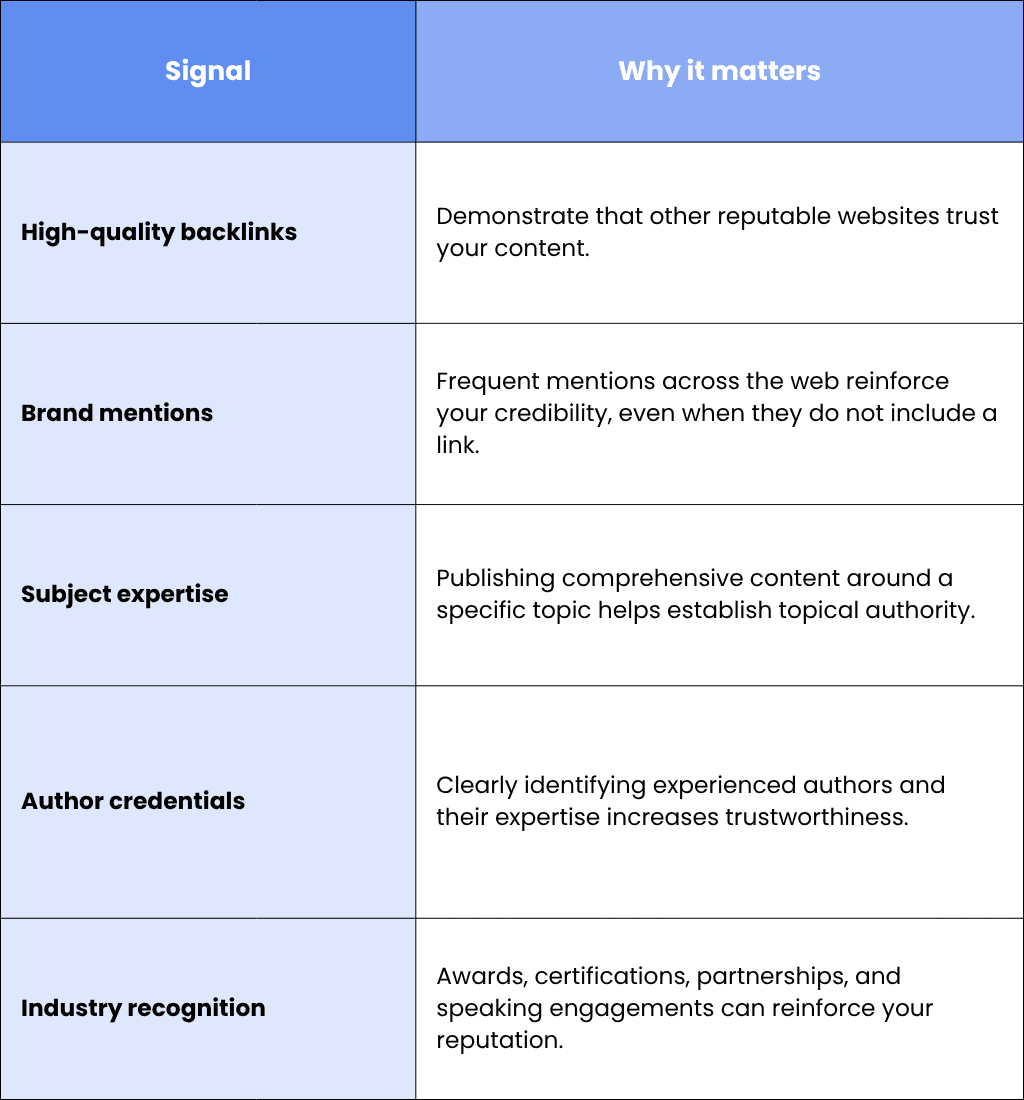
For businesses, this means that building authority is no longer just about improving search rankings. Every authoritative article, media mention, or expert contribution can increase the likelihood that AI engines recognise your brand as a reliable source of information.
2. Content Quality
Even highly authoritative websites are unlikely to be cited if their content does not directly answer users' questions.
AI systems are designed to identify content that is comprehensive, well-structured, and genuinely helpful. They favour pages that explain concepts clearly, answer related questions, and provide sufficient context rather than simply targeting keywords.
For example, consider a user asking: "How does local SEO help restaurants attract more customers?"
An AI engine is more likely to reference an article that explains:
- what local SEO is
- why it matters for restaurants
- how Google Business Profile contributes
- practical optimisation tips
- common mistakes to avoid
- measurable business outcomes
than a short blog post that only defines local SEO in a few paragraphs.
In practice, high-quality content often includes:
- Clear definitions for important concepts.
- Logical headings that guide readers through the topic.
- Practical examples and real-world applications.
- Supporting statistics or research where appropriate.
- Step-by-step explanations for complex processes.
- Internal links that connect related topics.
Quality also extends beyond the information itself. Good formatting improves readability for both people and AI systems. Short paragraphs, descriptive headings, tables, diagrams, and well-organised lists all make it easier for AI models to understand the relationships between different pieces of information.
Instead of asking, "How many words should this article contain?", businesses should ask, "Does this page fully answer every reasonable question a reader might have?" That mindset is far more aligned with how modern AI engines evaluate content.
3. Freshness
Some information remains accurate for years, while other topics can become outdated within weeks. AI engines therefore consider freshness when deciding which sources to reference, particularly for subjects that evolve quickly.
Topics where freshness is especially important include:
- SEO and digital marketing
- AI technologies
- Industry regulations
- Product features
- Software updates
- Market trends
- Economic data
For example, an article discussing Google's ranking systems from 2022 may no longer reflect current best practices. If a newer, more comprehensive guide is available, AI engines are more likely to reference the updated version.
Keeping content fresh does not necessarily mean rewriting every page from scratch. Instead, businesses should review their highest-value content regularly and update information where needed.
Useful updates may include:
- Replacing outdated statistics with newer research.
- Adding recent case studies or examples.
- Removing obsolete recommendations.
- Updating screenshots or interface changes.
- Expanding sections to address emerging trends.
A useful rule of thumb is to review evergreen content at least once or twice a year, while pages covering fast-moving industries may require quarterly updates. Consistently maintaining content demonstrates that your website remains an active and trustworthy source of information.
4. Structured Data
While readers focus on the visible content of a webpage, search engines and AI systems also rely on information that exists behind the scenes. One of the most important of these signals is structured data, commonly implemented using Schema.org markup.
Structured data helps machines understand what each piece of information represents rather than simply reading it as plain text.
For example, instead of seeing a block of text containing your business name, address, and opening hours, structured data explicitly labels each element, making it much easier for search engines and AI systems to interpret.
Some of the most valuable schema types for businesses include:
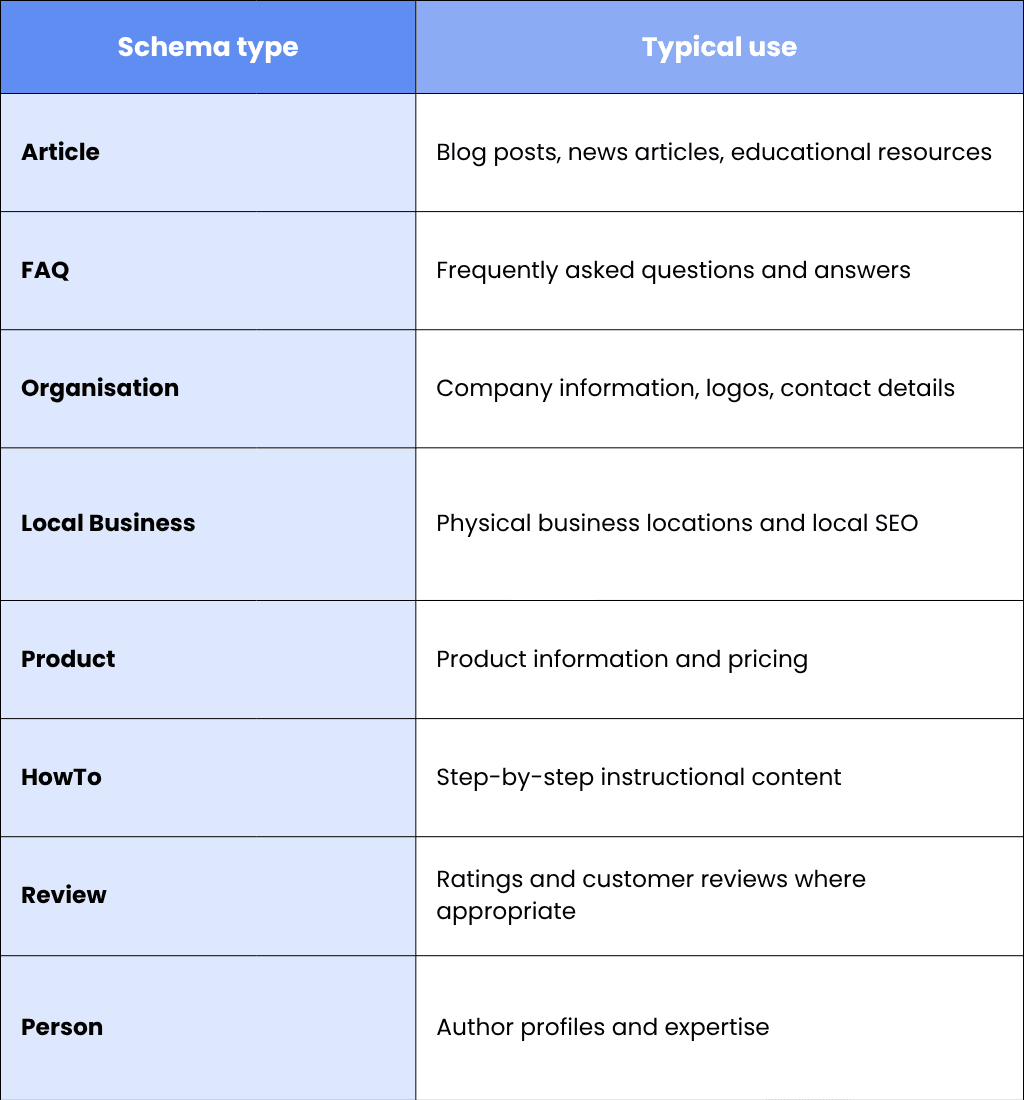
Although schema markup does not directly guarantee AI citations, it provides additional context that helps search engines understand your content more accurately. When combined with strong writing and topical authority, structured data contributes to a website that is easier for both search engines and AI models to interpret confidently.
5. Consistency Across the Web
AI engines rarely rely on a single webpage when generating an answer. Instead, they compare information from numerous trusted sources to identify patterns and determine which facts are most reliable.
As a result, consistency has become increasingly important.
Imagine that your website states your company was founded in 2018, while another directory lists 2020 and a third source lists 2019. These inconsistencies can reduce confidence in the information available about your business.
The same principle applies to your services, contact details, product descriptions, and company positioning.
To strengthen consistency, businesses should ensure that key information remains aligned across:
- Their website
- Google Business Profile
- Social media profiles
- Industry directories
- News articles
- Press releases
- Professional associations
- Knowledge Graph entries
Consistency also applies to your content strategy. If your business regularly publishes quality articles about a particular subject, AI engines begin to associate your brand with that area of expertise.
For example, a hospitality technology company that consistently publishes in-depth resources on hotel marketing, booking systems, guest experience, and AI automation is more likely to be recognised as an authority in hospitality than a company that publishes unrelated content across dozens of topics.
Ultimately, AI systems reward clarity and confidence. When multiple trusted sources consistently reinforce the same information about your business, it becomes much easier for AI engines to recognise your brand as a credible source worth referencing.
Which AI Platforms Provide Citations?
Not all AI platforms reference content in the same way. Some AI engines display citations prominently alongside every response, while others only include sources under certain conditions or depending on the type of query being asked.
For businesses investing in SEO, content marketing, and Generative Engine Optimisation (GEO), understanding these differences is important. After all, if a platform regularly cites external websites, it creates opportunities for your content to gain visibility, attract referral traffic, and strengthen brand recognition even if users never perform a traditional Google search.
It is also worth noting that AI platforms are evolving rapidly. Features, citation formats, and source selection methods continue to change as providers refine their models and improve the user experience. As a result, businesses should monitor multiple AI engines rather than focusing on just one.
The table below provides a high-level overview of how some of today's leading AI platforms handle citations.
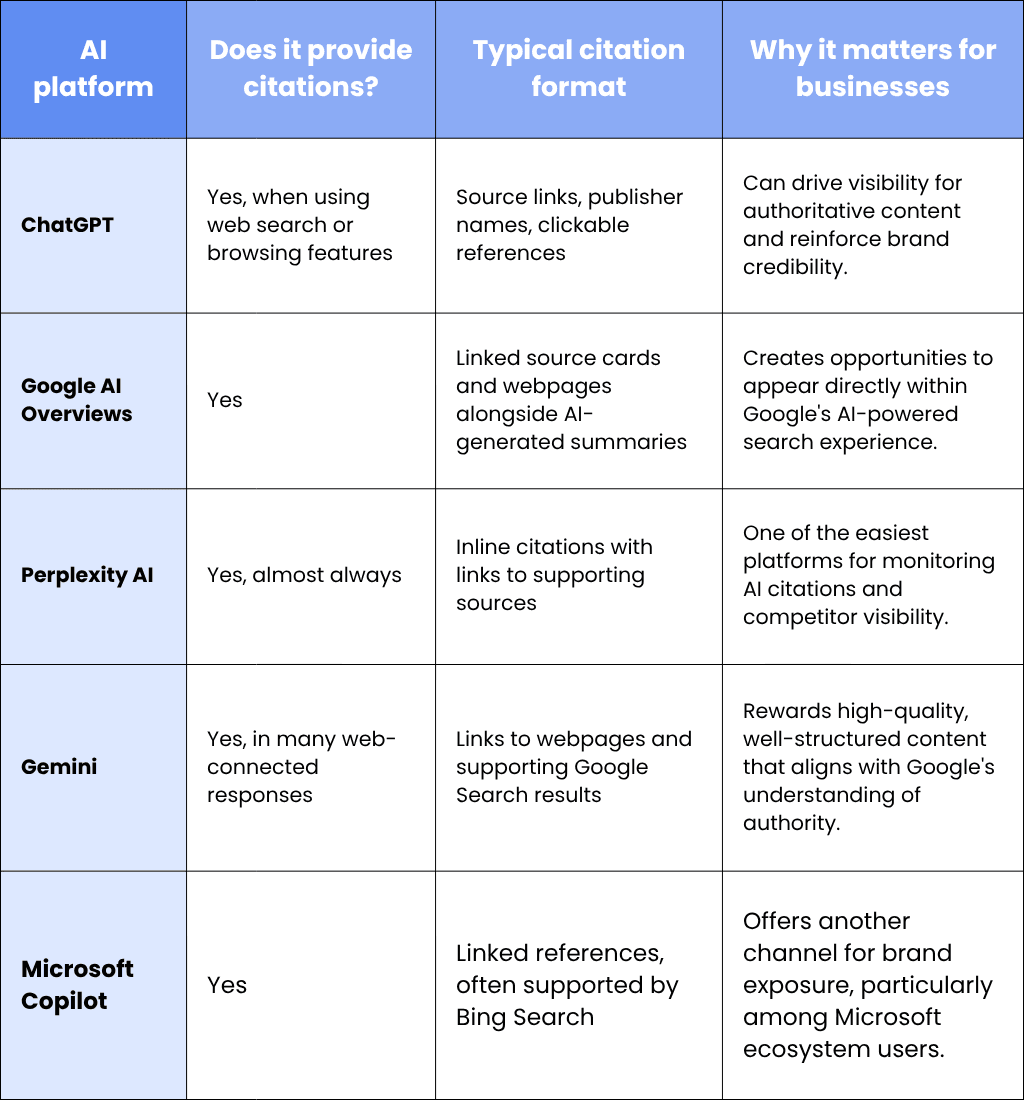
Let's look at how each platform approaches citations in more detail.
1. ChatGPT
When ChatGPT uses its web search capabilities, it frequently includes references to the websites that informed its response. Depending on the question, users may see publisher names, clickable links, or source cards that provide additional context.
For businesses, this means that your content has the potential to appear not only as a traditional search result but also as a trusted source within an AI-generated answer.
For example, if someone asks: "What is Generative Engine Optimisation?"
ChatGPT may summarise the concept using information from several authoritative websites before linking to those sources for users who want to learn more.
This makes it worthwhile to periodically test questions related to your products, services, and industry. Ask ChatGPT the same types of questions your prospective customers might ask and observe:
- Whether your website is referenced.
- Which competitors are cited.
- Which pages are being used.
- Whether the information presented about your business is accurate.
These observations can help identify opportunities to strengthen your content or improve how your expertise is represented online.
2. Google AI Overviews
Google AI Overviews represent one of the biggest changes to traditional search in recent years. Instead of displaying only a list of blue links, Google now generates AI-powered summaries for many informational searches and includes links to supporting sources within the overview.
This means businesses now have two opportunities to gain visibility in Google Search:
- Ranking organically in the search results.
- Being selected as a cited source within the AI Overview itself.
In some cases, a webpage that is not ranked first organically may still be cited within an AI Overview if it provides particularly relevant or authoritative information for the question being asked.
For businesses, this reinforces the importance of creating content that is not only optimised for rankings but also written in a way that clearly answers users' questions. Comprehensive guides, well-structured explanations, original research, and expert insights are all more likely to be considered useful source material for AI-generated summaries.
3. Perplexity AI
Among today's AI search platforms, Perplexity AI is widely regarded as one of the most transparent when it comes to citations.
Almost every response includes clearly visible references to the sources used, allowing users to verify information or explore topics in greater depth. This transparency also makes Perplexity one of the easiest platforms for businesses to monitor as part of an AI citation tracking strategy.
For example, if you ask Perplexity: "What are the latest trends in local SEO for restaurants?"
it will typically generate a summary supported by multiple cited sources, often pulling information from industry publications, agency blogs, research reports, and authoritative websites.
This provides valuable competitive intelligence. Businesses can quickly identify:
- Which websites dominate AI-generated answers.
- Which competitors are consistently referenced.
- What types of content are being cited most frequently.
- Which topics present opportunities to create stronger resources.
Because citations are so visible, many SEO professionals now use Perplexity as a practical way to benchmark how well their content performs in AI-driven search.
4. Gemini
Google Gemini combines the capabilities of Google's large language models with information retrieved from Google's search ecosystem. When responding to web-based queries, Gemini frequently includes links to supporting webpages, particularly when users request factual or up-to-date information.
Although Gemini shares Google's emphasis on quality and relevance, it is not simply selecting the highest-ranking webpage for every answer. Instead, it evaluates a range of trusted sources to generate balanced, context-rich responses.
As a result, businesses should focus on creating content that demonstrates expertise, covers topics comprehensively, and aligns with Google's broader understanding of quality. Pages that include clear structure, accurate information, and strong topical authority are generally better positioned to be recognised by Gemini.
Since Gemini continues to evolve alongside Google's AI initiatives, businesses should regularly monitor how their content appears across both Gemini and Google AI Overviews to identify new optimisation opportunities.
5. Microsoft Copilot
Microsoft Copilot integrates generative AI with Bing Search to provide conversational answers that are often supported by linked references. Similar to other AI-powered search experiences, Copilot aims to provide users with concise answers while allowing them to explore the original sources if they require additional detail.
Although Bing has a smaller market share than Google, Microsoft Copilot reaches users across a wide ecosystem, including Windows devices, Microsoft Edge, Microsoft 365 applications, and enterprise environments. For many organisations, particularly those operating in business-to-business (B2B) sectors, this audience can represent a valuable source of visibility.
Businesses should therefore avoid focusing exclusively on Google's ecosystem. Optimising for broader AI discoverability means ensuring that content is accessible, authoritative, and technically sound regardless of which search engine or AI platform is selecting it.
How to Perform AI Citation Tracking
Unlike traditional SEO, where businesses can monitor keyword rankings and organic traffic using well-established tools, AI citation tracking is still an emerging practice. There is currently no single platform that can tell you every time an AI engine references your website. Instead, businesses need to combine several methods to build a clearer picture of their visibility across AI-powered search experiences.
The good news is that AI citation tracking does not necessarily require expensive software. By combining manual testing, website analytics, brand monitoring, and competitor analysis, businesses can begin identifying where they are being referenced, which content AI platforms trust most, and where opportunities for improvement exist.
Below are some of the most effective ways to monitor AI citations today.
1. Search Your Key Topics Manually
One of the simplest and most effective ways to begin AI citation tracking is to ask AI platforms the same questions your customers are likely to ask.
Think beyond your products or services and consider the broader problems your audience is trying to solve. For example, a restaurant software provider might test queries such as:
- Best restaurant booking systems
- How can restaurants improve local SEO?
- Restaurant marketing ideas for small businesses
- How to reduce no-shows in restaurants
- AI tools for hospitality businesses
Likewise, an education provider might search:
- Best online learning platforms
- How to improve student engagement
- Digital marketing for universities
- AI tools for education
Run the same queries across multiple AI platforms, including ChatGPT, Google AI Overviews, Perplexity, Gemini, and Microsoft Copilot. Since each platform uses its own methods for selecting sources, the results may differ considerably.
As you review each response, record observations such as:
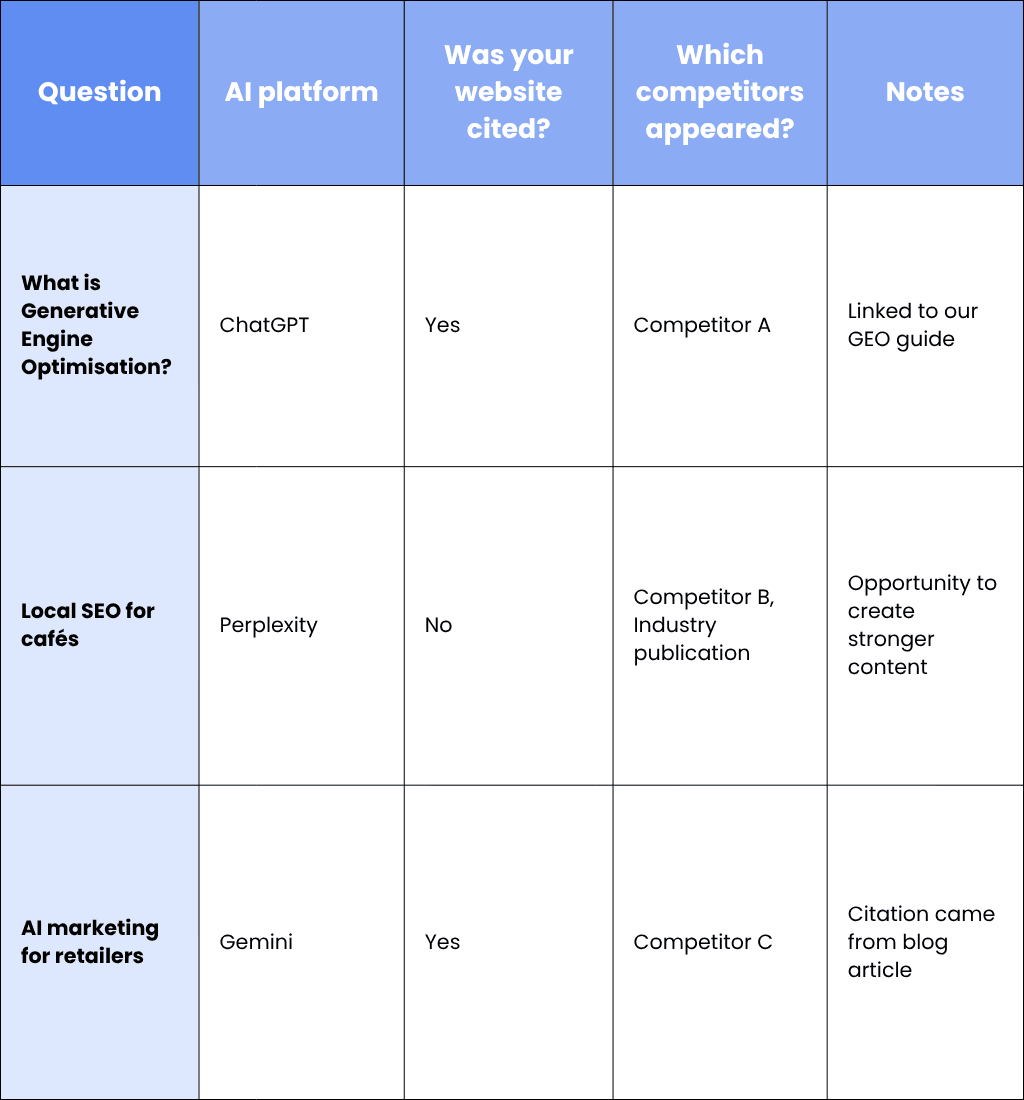
Maintaining a simple spreadsheet like this allows you to identify patterns over time. You may discover that certain topics consistently generate citations, while others reveal significant content gaps.
It is also helpful to repeat the same searches monthly or quarterly. AI-generated answers evolve as models improve, new content is published, and your own website gains authority.
2. Monitor Branded Queries
In addition to topic-based searches, businesses should regularly test searches related to their own brand.
Ask AI platforms questions such as:
- What does [Your Company] do?
- Is [Your Company] a good SEO agency?
- What services does [Your Company] offer?
- Who are the leading digital agencies in Vietnam?
- Tell me about [Your Product].
These searches help you understand how AI currently perceives and describes your business.
When reviewing the responses, pay attention to several factors:
- Is your company description accurate?
- Are your services up to date?
- Does the AI correctly identify your areas of expertise?
- Are outdated products or services still being mentioned?
- Are your competitors being recommended instead?
For example, imagine your agency recently launched Generative Engine Optimisation (GEO) services, but AI platforms continue describing your business solely as a traditional SEO agency. This may indicate that your website and supporting content have not yet established sufficient authority around your new service offering.
Regular branded searches therefore serve two purposes:
- They help you identify whether your business is being referenced.
- They reveal how AI engines understand and position your brand.
Both insights are valuable when refining your content strategy.
3. Track Referral Traffic
Although many AI-generated answers are designed to provide immediate information, users often click through to cited sources when they want additional detail or wish to verify the information presented.
These visits can generate referral traffic to your website.
Using platforms such as Google Analytics 4 (GA4), businesses should monitor whether visitors are arriving from AI-powered platforms where possible. While referral reporting is still developing, identifying trends early can provide valuable insights into how AI search contributes to your overall marketing performance.
Rather than looking only at traffic volume, consider evaluating:
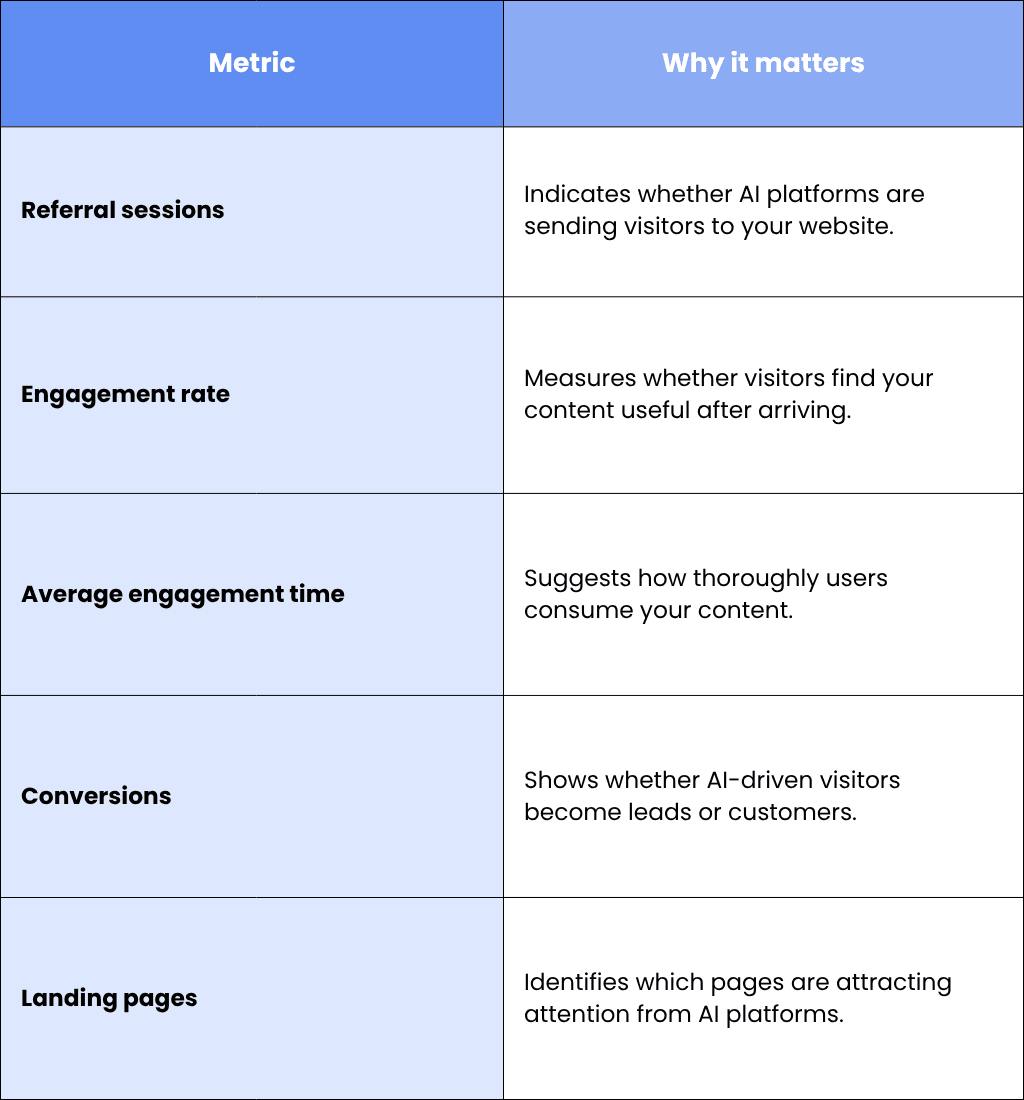
For example, you may discover that a comprehensive guide published six months ago consistently attracts visitors from AI-generated search experiences, while newer articles receive little attention. This insight can help shape future content investment.
As AI-powered search continues to mature, referral traffic from these platforms is likely to become an increasingly valuable performance metric alongside traditional organic traffic.
4. Monitor Brand Mentions
AI models frequently draw upon information that is consistently discussed and reinforced across the wider web. Consequently, your website is only one part of your overall digital authority.
Monitoring brand mentions allows businesses to understand where they are being discussed and whether those discussions contribute positively to their online reputation.
Useful places to monitor include:
- Industry news websites
- Trade publications
- Professional blogs
- Business directories
- Podcasts
- Research reports
- Online communities
- Social media discussions
Not every mention needs to include a backlink. Even unlinked mentions can strengthen your brand's presence across the digital ecosystem and reinforce signals of credibility.
For example, if multiple respected hospitality publications regularly reference your research on hotel marketing trends, AI engines may increasingly associate your brand with expertise in hospitality marketing.
Businesses should also monitor whether brand mentions are:
- Accurate
- Consistent
- Up to date
- Relevant to their core expertise
The more consistently your expertise is recognised across trusted sources, the stronger your overall authority is likely to become.
5. Compare Against Competitors
AI citation tracking becomes significantly more valuable when viewed in context. Knowing that your website is occasionally cited is useful, but understanding why competitors are cited more frequently often reveals the greatest opportunities for improvement.
Select several of your main competitors and compare how AI platforms reference each business across the same set of industry questions.
Questions to investigate include:
- Which competitors appear most frequently?
- Which content formats are being cited?
- Are AI engines favouring blog posts, research reports, guides, or product pages?
- Which topics consistently trigger competitor citations?
- Which publishers are repeatedly referenced?
For example, you may notice that one competitor is frequently cited for educational guides, while another dominates AI responses related to technical implementation.
This analysis often uncovers gaps such as:
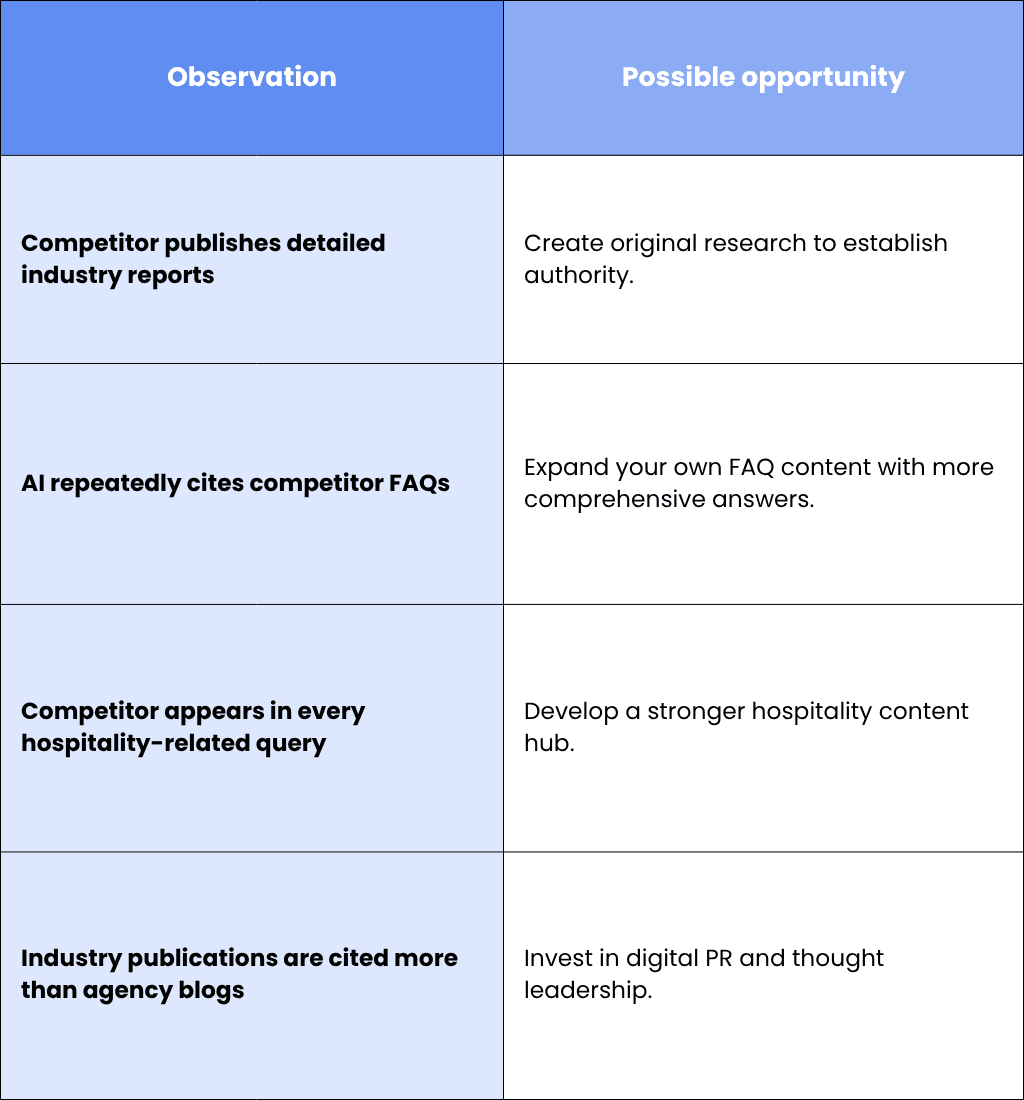
Rather than viewing competitor citations as a disadvantage, treat them as valuable market intelligence. They provide direct evidence of the type of content AI platforms currently trust and help inform your future content strategy.
What Metrics Should Businesses Monitor?
Monitoring AI citations is only valuable if you know what the data is telling you. While traditional SEO focuses on metrics such as keyword rankings, impressions, and organic traffic, AI citation tracking introduces a different set of performance indicators that reflect how AI platforms perceive your brand and content.
Rather than asking a single question such as "Is our website being cited?", businesses should evaluate a range of metrics that together paint a more complete picture of their authority, visibility, and competitiveness within AI-powered search.
Some metrics measure how often your content appears, while others reveal why AI engines trust your content, which topics generate visibility, and how your performance compares with competitors.
The table below summarises the key metrics every business should monitor as part of an AI citation tracking strategy.
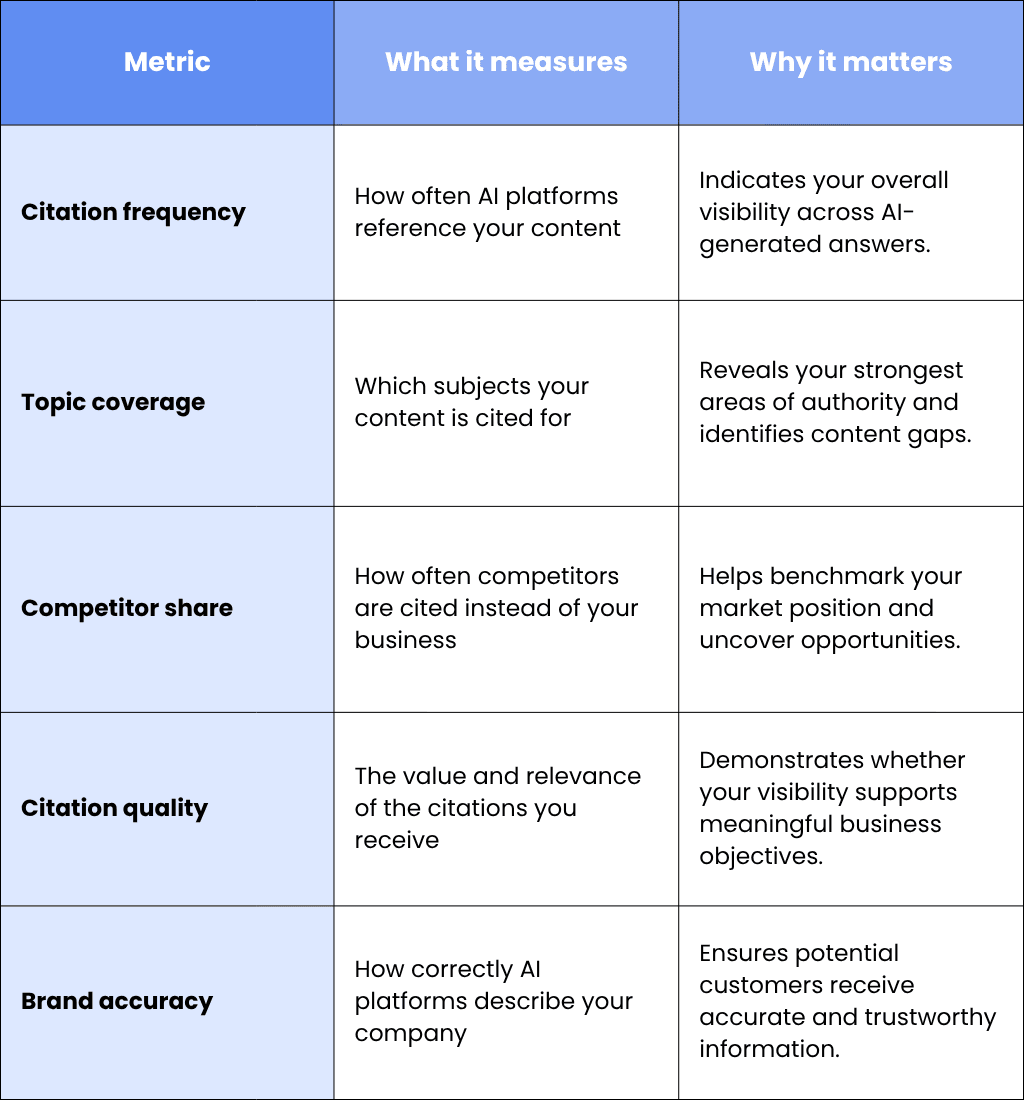
Let's explore each metric in more detail.
1. Citation Frequency
The most obvious metric to monitor is citation frequency, that is, how often AI platforms reference your website or content when responding to users' questions.
At first glance, this may seem similar to tracking search rankings. However, citation frequency measures something quite different. Instead of indicating where your webpage appears in search results, it reflects how frequently AI systems consider your content trustworthy enough to include in their generated answers.
For example, suppose you regularly test 100 industry-related prompts across several AI platforms.
Your findings might look something like this:
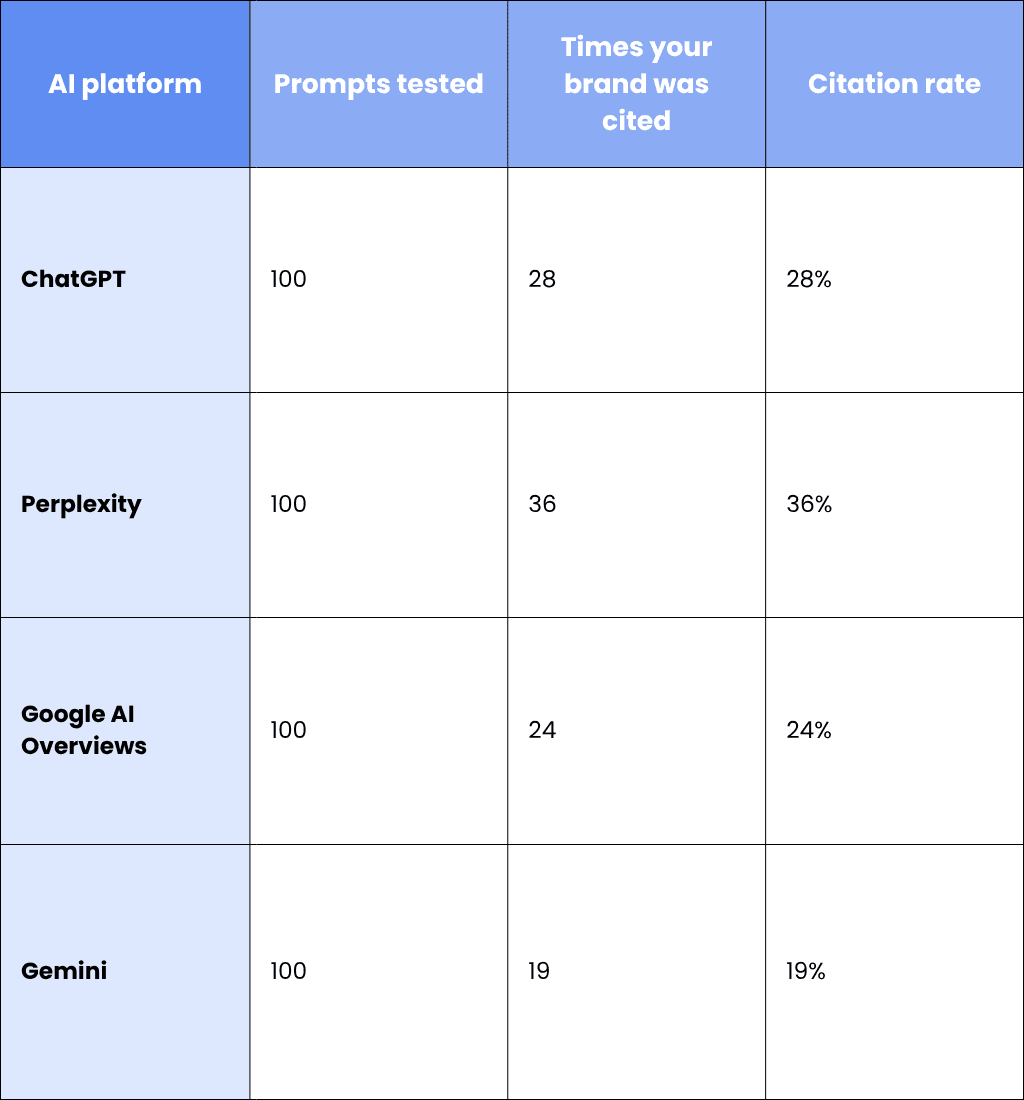
Although these figures are illustrative, they demonstrate an important principle: the goal is not necessarily to achieve a perfect citation rate. Instead, businesses should establish a baseline and monitor whether their visibility improves over time.
If your citation frequency increases after publishing new resources, strengthening topical authority, or improving technical SEO, it suggests that AI platforms are placing greater trust in your content.
Rather than focusing on isolated results, monitor citation frequency consistently over several months to identify meaningful trends.
2. Topic Coverage
Being cited frequently is valuable, but understanding what you are being cited for is often even more informative.
Topic coverage measures the subjects, industries, products, or services that AI platforms most strongly associate with your business.
For example, an SEO agency may discover that AI frequently references its content when users ask about:
- Technical SEO
- Local SEO
- Website performance
However, the same agency may rarely appear for:
- Generative Engine Optimisation (GEO)
- AI marketing
- Answer Engine Optimisation (AEO)
This insight highlights where the business already has authority and where additional content may be required.
One practical way to evaluate topic coverage is to group your AI citations into categories.
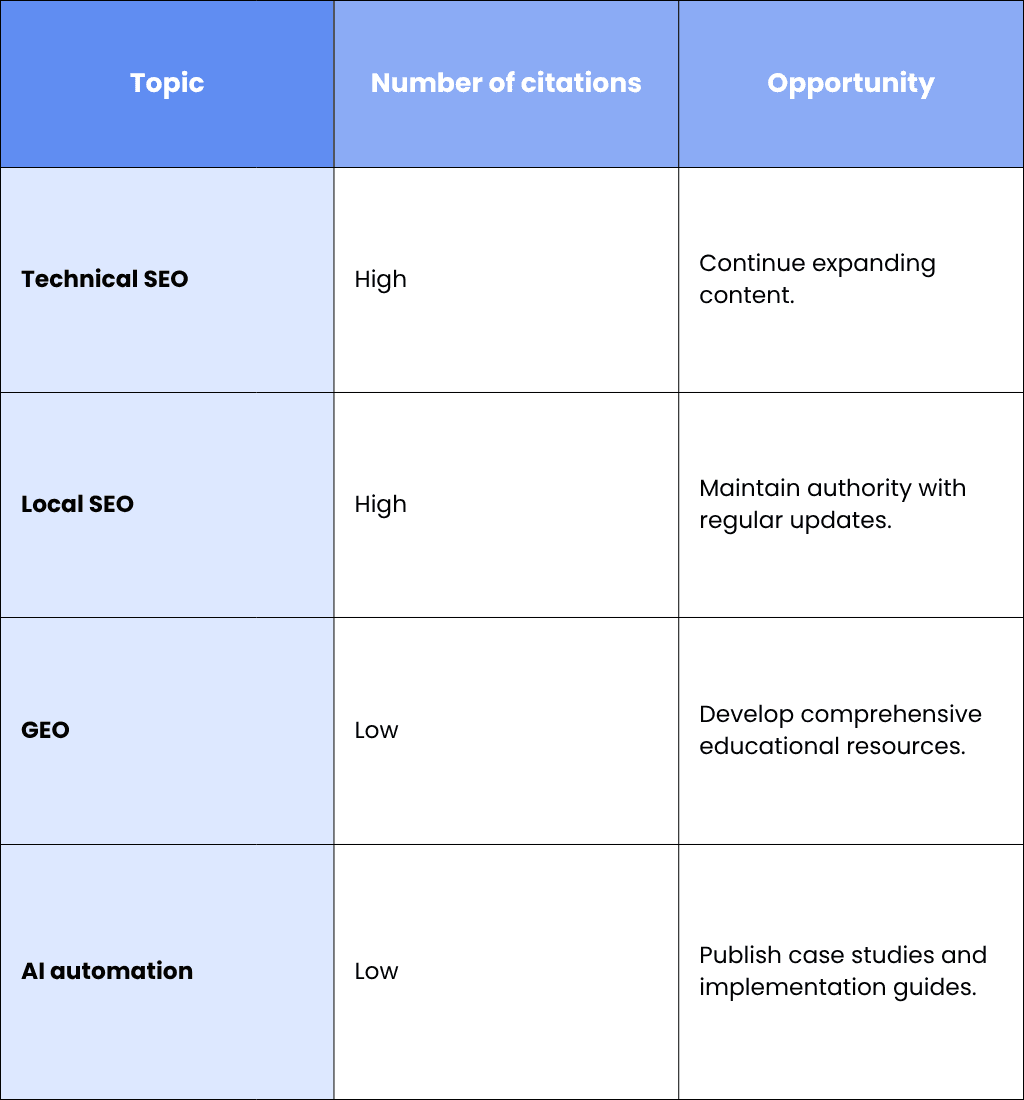
Looking at topic coverage in this way helps businesses make more strategic content decisions. Instead of creating articles based solely on keyword volume, they can invest in topics where increasing authority is likely to improve both AI visibility and business outcomes.
3. Competitor Share
AI citation tracking becomes much more valuable when viewed alongside competitor performance.
Competitor share measures how often AI platforms recommend or reference competing businesses instead of your own when answering relevant questions.
Imagine a potential customer asks: "Who are the best SEO agencies for hospitality businesses?"
If AI platforms consistently recommend your competitors while overlooking your business, this suggests that competitors have stronger authority, more comprehensive content, or broader recognition within that niche.
Comparing citation share helps answer questions such as:
- Which competitors dominate AI-generated answers?
- Which industries or topics do they own?
- Which types of content are consistently referenced?
- Where are opportunities to differentiate?
For example:
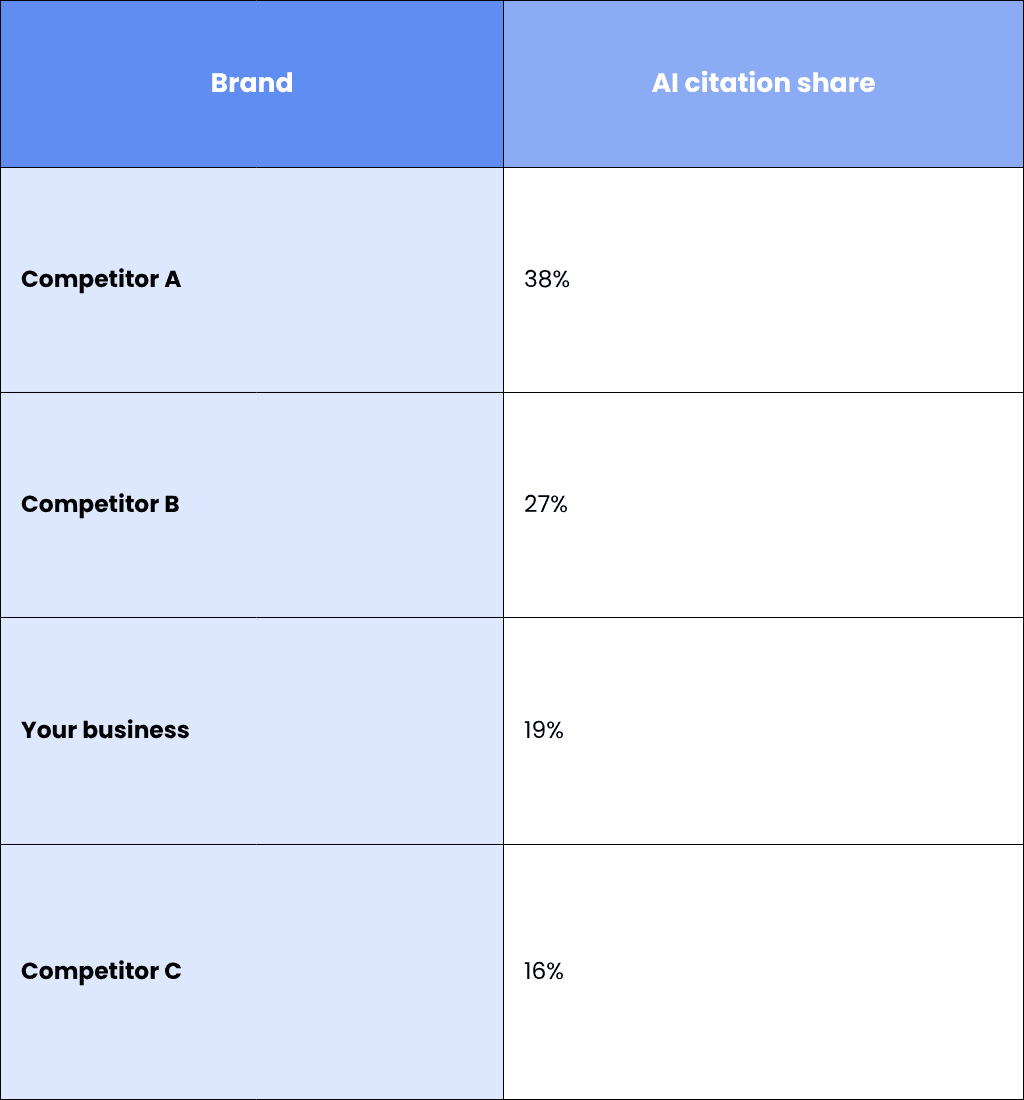
Although these percentages are hypothetical, they illustrate how benchmarking provides context. A citation rate of 19% may seem reasonable until you discover that one competitor appears in nearly twice as many AI-generated responses.
Understanding competitor share allows businesses to prioritise content investment where it is likely to have the greatest impact.
4. Citation Quality
Not every citation contributes equally to your marketing goals.
Being referenced in response to a high-intent commercial query is generally far more valuable than appearing in a broad informational discussion.
For example, consider the difference between these two questions: "What is SEO?"
and "Which SEO agency should a retail business choose?"
Both may generate citations, but the second query is much closer to a purchasing decision and therefore has greater commercial value.
When evaluating citation quality, consider factors such as:
- Is the question informational, commercial, or transactional?
- Does the citation position your business as an expert?
- Is your content the primary reference or just one of many?
- Does the citation encourage users to explore your website?
Rather than aiming for the highest possible number of citations, businesses should prioritise earning citations that align with their target audience and business objectives.
For many organisations, fewer high-quality citations on commercially relevant topics can generate greater value than hundreds of references on unrelated subjects.
5. Brand Accuracy
One of the most overlooked aspects of AI citation tracking is brand accuracy.
Even when AI platforms reference your business, the information they provide may not always be complete or entirely accurate. Because AI models synthesise information from multiple sources, inconsistencies across the web can sometimes result in outdated or misleading descriptions.
Businesses should regularly review how AI platforms describe:
- Company overview
- Core services
- Products
- Industry expertise
- Business locations
- Leadership
- Awards and certifications
For example, if your company has expanded from offering traditional SEO into AI consulting and workflow automation, but AI platforms still describe you solely as an SEO agency, this indicates that your broader expertise has not yet been fully recognised.
Improving brand accuracy often involves strengthening consistency across your digital presence by:
- Updating your website content.
- Refreshing service pages.
- Publishing new educational resources.
- Maintaining accurate business profiles.
- Implementing structured data.
- Earning mentions from authoritative third-party publications.
Accurate AI-generated descriptions not only improve visibility but also help build trust with prospective customers who increasingly rely on AI platforms to research businesses before making purchasing decisions.
Looking Beyond Individual Metrics
While each metric provides valuable insights on its own, the greatest value comes from analysing them together.
For example:
- A high citation frequency combined with narrow topic coverage may indicate that your authority is concentrated in only a few areas.
- Strong topic coverage but low citation quality could suggest that your content performs well for informational searches but not for commercially valuable queries.
- High citation frequency alongside poor brand accuracy may mean that AI platforms recognise your business but do not yet understand your full range of expertise.
By viewing these metrics collectively, businesses can develop a more balanced understanding of how AI platforms perceive their brand and where improvements will have the greatest impact.
A Practical AI Citation Tracking Dashboard
As AI search continues to evolve, businesses should consider reviewing these metrics on a monthly or quarterly basis as part of their wider SEO and content strategy.
A simple dashboard might include:
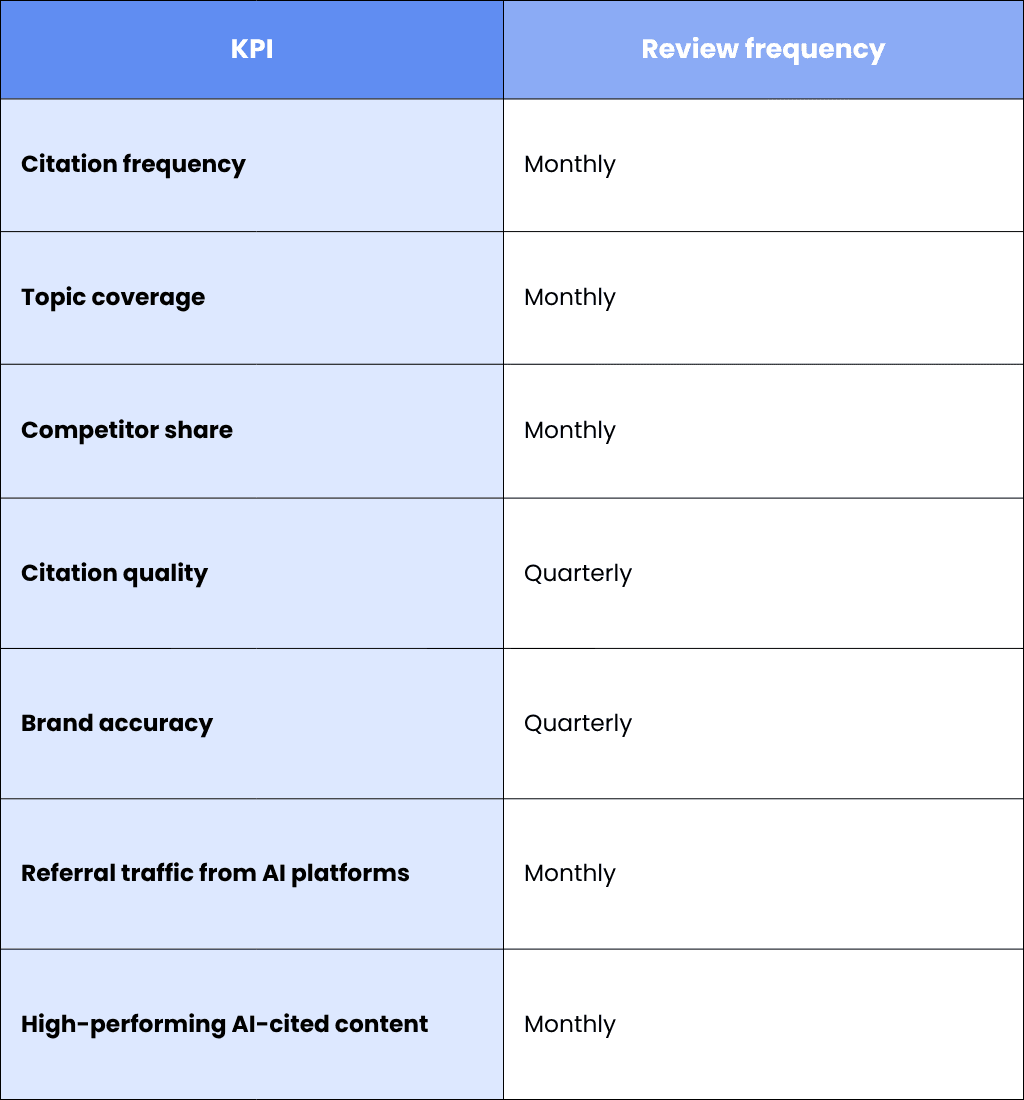
Tracking these indicators consistently allows businesses to move beyond anecdotal observations and make evidence-based decisions about where to invest in content, technical SEO, and Generative Engine Optimisation (GEO).
Ultimately, AI citation tracking is not just about measuring visibility. It is about understanding how AI platforms perceive your expertise, identifying opportunities to strengthen your authority, and ensuring your business remains visible as AI-powered search continues to reshape how customers discover and evaluate brands.
Common Challenges with AI Citation Tracking
Although AI citation tracking is becoming an increasingly valuable way to measure brand visibility, it is still a relatively new discipline. Unlike traditional SEO, which benefits from decades of established metrics, tools, and reporting standards, AI-powered search is evolving rapidly. As a result, businesses should recognise that tracking AI citations requires a degree of flexibility and ongoing experimentation.
This does not mean AI citation tracking is unreliable. Rather, it means organisations should avoid treating AI citations as fixed or absolute measurements. Instead, they should focus on identifying broader patterns, monitoring changes over time, and combining multiple sources of data to gain a more complete understanding of their performance.
Below are some of the most common challenges businesses may encounter.
1. AI Answers Change Frequently
One of the defining characteristics of AI-generated search is that responses are dynamic rather than static.
In traditional search engines, a webpage may remain in the same ranking position for days or even weeks. AI-generated responses, however, can change from one search to the next as models incorporate new information, refine their reasoning, or adjust the sources they use.
Several factors can influence the answer a user receives, including:
- The wording of the question.
- Follow-up prompts within the same conversation.
- Geographic location.
- Language preferences.
- Personalisation features.
- Updates to the AI model.
- Newly published online content.
For example, compare these two prompts:
"What is the best SEO strategy for restaurants?"
"How can a small café improve its online visibility?"
Although both questions address similar topics, an AI platform may generate different responses and reference entirely different websites because each prompt emphasises different aspects of the subject.
For businesses, this means that a single search provides only a snapshot of AI visibility. To identify meaningful trends, it is better to test a consistent set of prompts over time rather than relying on one-off observations.
2. Some AI Engines Do Not Always Reveal Their Sources
Another challenge is that not every AI-generated answer includes visible citations.
Some platforms clearly display supporting links for most responses, while others only provide references under specific circumstances. In certain cases, an AI engine may generate a response without identifying the websites that influenced the answer at all.
This creates an important limitation for businesses attempting to measure their visibility.
For example:
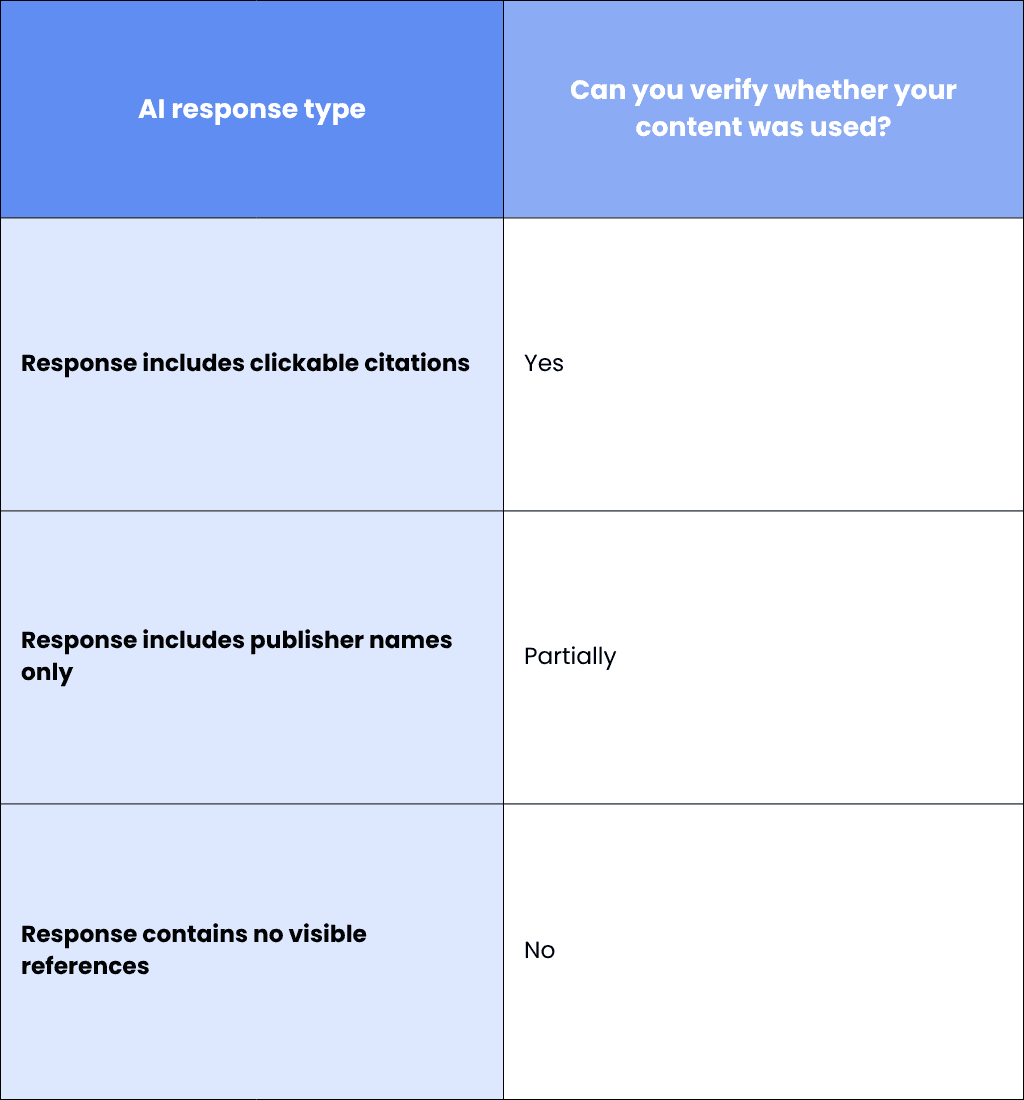
It is therefore possible that your content has contributed to an AI-generated answer without your business receiving any visible attribution.
For this reason, businesses should avoid using citation counts alone as the sole measure of success. Instead, combine citation tracking with broader indicators such as referral traffic, brand mentions, search visibility, and content performance to gain a more balanced view of your digital presence.
3. Limited Analytics
One of the biggest differences between traditional SEO and AI search is the availability of performance data.
Today, marketers can access detailed reports for conventional search through platforms such as Google Search Console and Google Analytics. These tools provide information about impressions, clicks, rankings, traffic, and user behaviour.
Equivalent reporting for AI-powered search is still developing.
At present, businesses may find it difficult to answer questions such as:
- How many times was our content used in AI-generated responses?
- Which prompts generated those citations?
- Which AI platform produced the citation?
- How often do users click through from AI-generated answers?
- Which content performs best across different AI engines?
Although some referral traffic can be identified and manual testing provides useful insights, comprehensive reporting remains limited.
This means businesses should adopt a broader measurement framework rather than relying on a single metric. Combining website analytics, manual testing, competitor analysis, and content performance reviews will generally produce a more accurate picture than waiting for a perfect reporting solution.
As AI search matures, it is likely that new analytics platforms and reporting features will emerge to help businesses better understand AI-driven visibility.
4. AI Models Use Multiple Sources
Unlike traditional search engines, which typically direct users to a single webpage, AI models often generate answers by combining information from numerous trusted sources.
Rather than copying one article, an AI engine may:
- Retrieve information from several authoritative websites.
- Compare overlapping facts and explanations.
- Identify areas of agreement.
- Generate a concise response based on the combined information.
This means that your content may influence an answer even when your website is not explicitly cited.
For example, imagine three respected agencies publish similar guidance on improving local SEO for restaurants. An AI platform may synthesise the shared recommendations into a single response while citing only one or two of those sources.
Consequently, businesses should avoid assuming that the absence of a citation means their content has no impact. Instead, the focus should remain on consistently publishing authoritative, accurate, and comprehensive information that contributes to the wider knowledge ecosystem.
Over time, as your expertise becomes more widely recognised across the web, the likelihood of receiving explicit citations is also likely to increase.
5. Citation Formats Vary Across Platforms
Another challenge is the lack of standardisation in how AI platforms present references.
Each provider has developed its own approach to displaying sources. Some platforms include clearly visible inline citations, while others provide source cards, expandable links, or references only for certain types of queries.
This variation means that businesses cannot apply exactly the same tracking process across every AI engine.
For example:
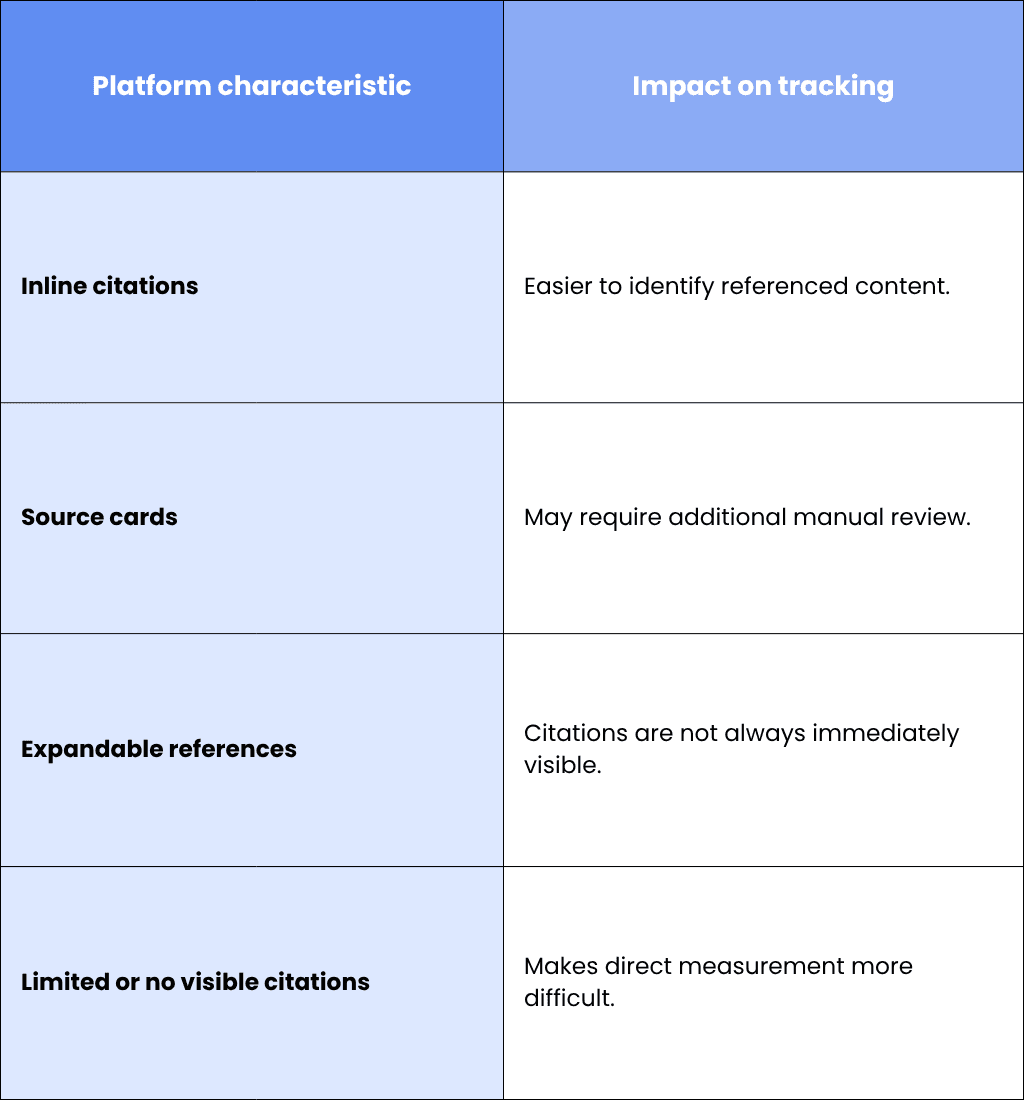
As new AI features continue to roll out, citation formats are likely to evolve further. Businesses should therefore remain adaptable and review multiple platforms rather than relying on a single source of data.
6. AI Search is Evolving Rapidly
Perhaps the greatest challenge of all is the pace of change.
Generative AI is developing far more quickly than traditional search technologies. New models, interface updates, citation methods, and search experiences are introduced regularly, often changing how information is presented to users.
What works well today may need refining six months from now.
For businesses, this means AI citation tracking should be viewed as an ongoing process rather than a one-time project.
Successful organisations are increasingly adopting an iterative approach by:
- Monitoring changes across multiple AI platforms.
- Reviewing their highest-value content regularly.
- Updating information to maintain accuracy.
- Expanding topical authority over time.
- Testing new optimisation techniques as AI search evolves.
Rather than chasing every new trend, businesses should focus on building lasting foundations: creating authoritative content, maintaining technical excellence, and consistently demonstrating expertise within their industry.
These principles are unlikely to change, even as AI platforms continue to evolve.
How to Improve Your Chances of Being Cited by AI
While businesses cannot directly control whether an AI platform cites their content, they can significantly influence the signals that AI systems use when selecting trustworthy sources.
Below are some of the most effective strategies for improving your chances of being cited by AI.
1. Publish Expert-Level Content
The foundation of AI visibility is exceptional content.
AI platforms do not simply look for webpages that contain relevant keywords. They seek content that demonstrates a deep understanding of a topic and provides users with clear, accurate, and comprehensive answers.
Instead of publishing articles that briefly introduce a subject, aim to create resources that become definitive references within your industry.
For example, compare these two approaches:
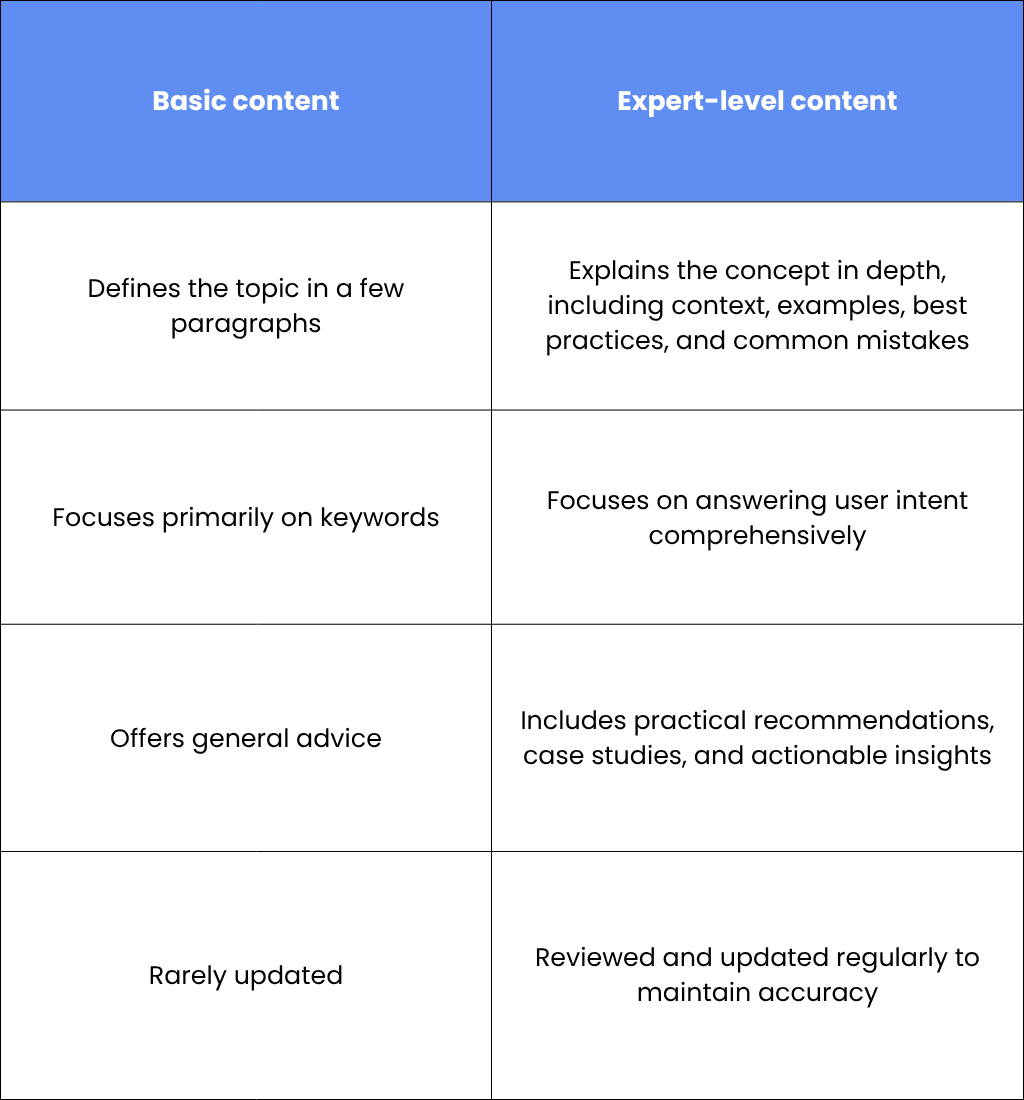
AI engines are more likely to reference content that answers not only the user's initial question but also the related questions they are likely to ask next.
To strengthen the depth of your content, consider including:
- Clear definitions of key concepts.
- Step-by-step explanations.
- Real-world examples.
- Case studies or practical applications.
- Supporting statistics and reputable sources.
- Frequently asked questions.
- Common misconceptions and how to avoid them.
For example, if you are writing about local SEO for restaurants, don't stop at explaining what local SEO is. Also discuss Google Business Profile optimisation, online reviews, local citations, structured data, location pages, and how success can be measured. Covering the topic holistically increases the likelihood that AI systems will identify your content as a valuable source.
2. Build Topical Authority
Publishing one excellent article is unlikely to establish your business as an authority. Instead, AI engines increasingly assess topical authority—the depth and breadth of expertise your website demonstrates across an entire subject.
Think of your website as a knowledge hub rather than a collection of individual blog posts.
For example, instead of publishing a single article on SEO, a digital agency could build a complete content ecosystem covering:
- Technical SEO
- Local SEO
- Enterprise SEO
- E-commerce SEO
- International SEO
- Generative Engine Optimisation (GEO)
- Answer Engine Optimisation (AEO)
- AI citation tracking
- Schema markup
- Website performance
- Content strategy
Each article should link naturally to related resources, helping both users and AI systems understand the relationships between different topics.
A useful way to visualise topical authority is through a pillar-and-cluster model.
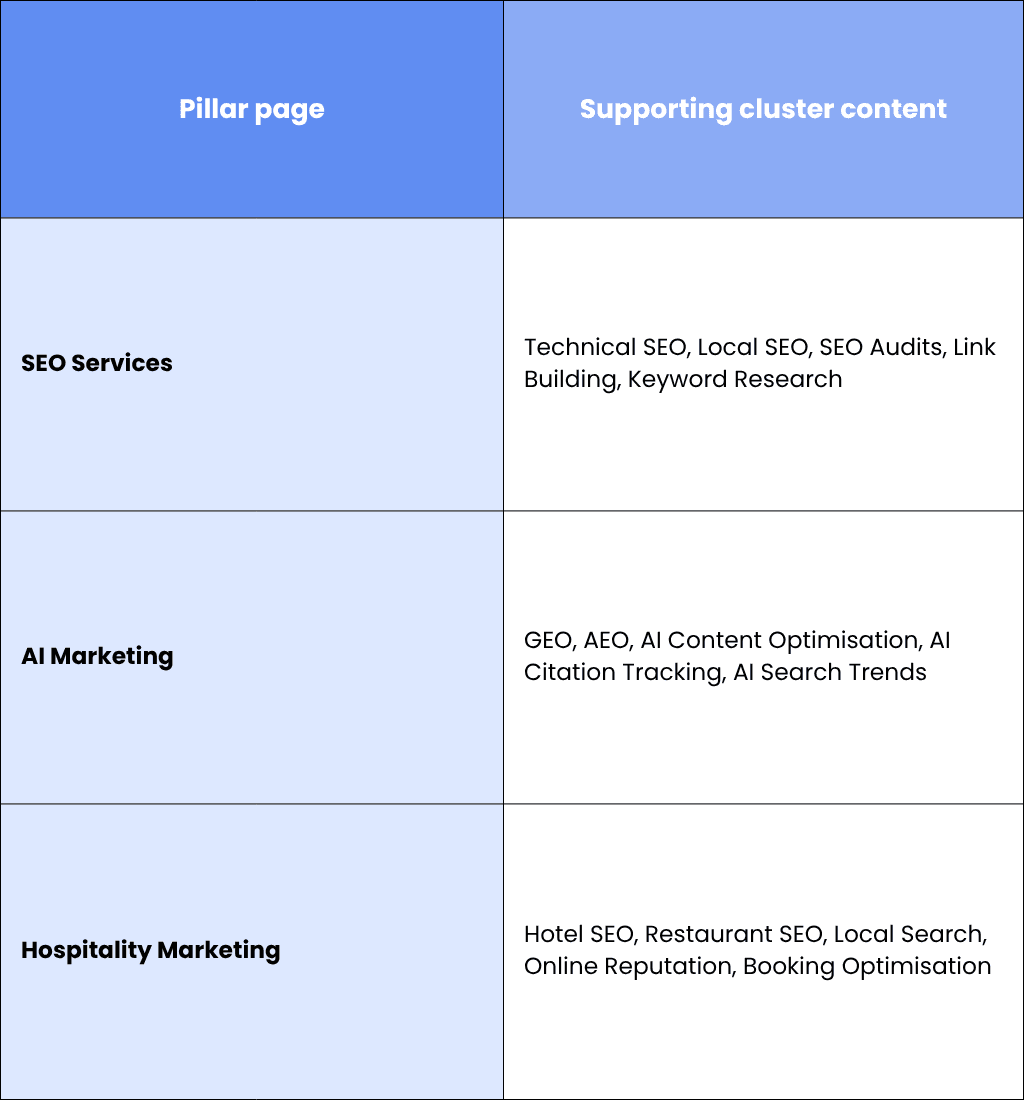
This interconnected structure signals that your business possesses comprehensive expertise rather than isolated knowledge.
Over time, consistently publishing authoritative content across a subject area makes it more likely that AI platforms will associate your brand with that topic.
3. Optimise for AI Readability
Even the most informative content may be overlooked if it is difficult for AI systems to interpret.
AI models process large volumes of information and naturally favour content that is logically organised, easy to follow, and structured in a way that clearly communicates relationships between ideas.
Fortunately, improving AI readability also improves the experience for human readers.
Some practical ways to enhance readability include:
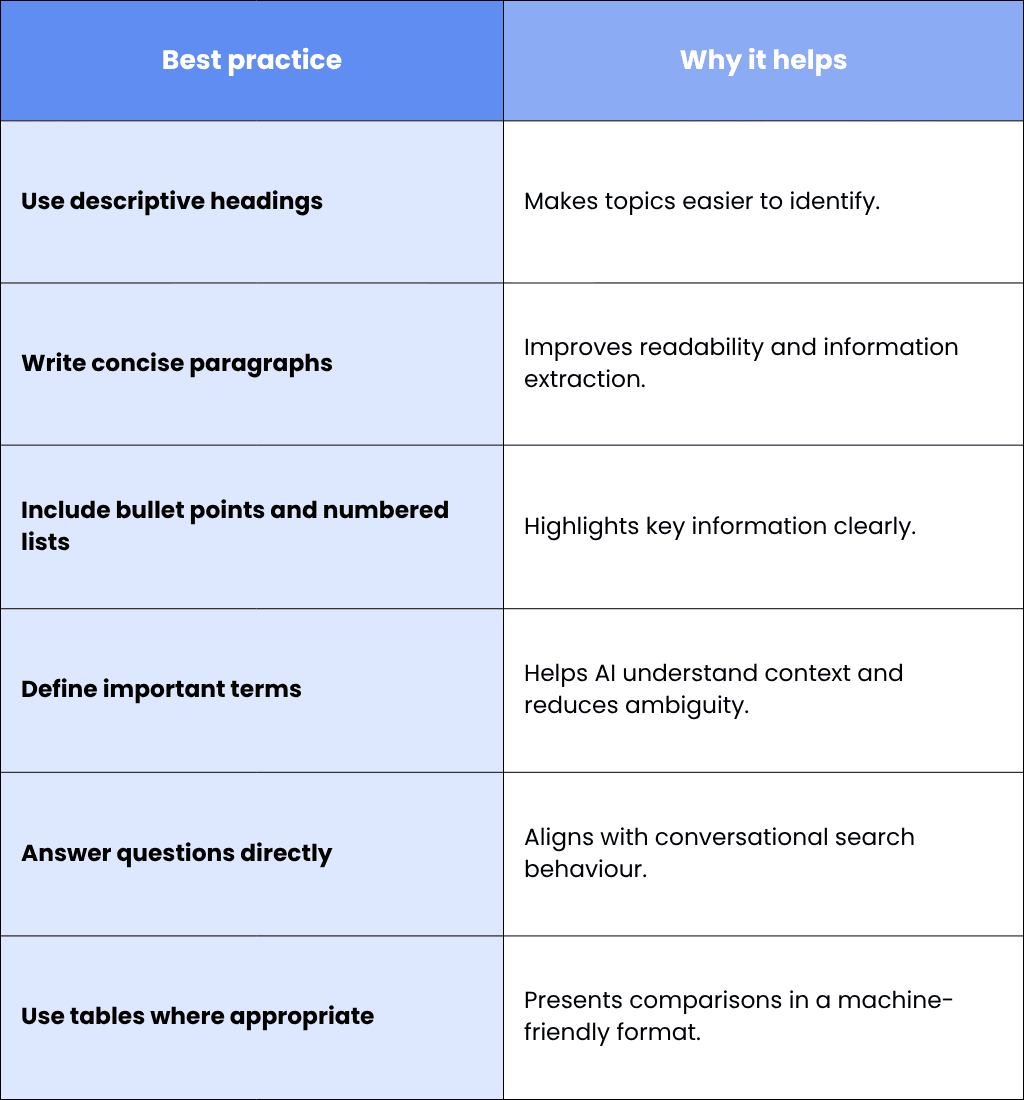
For example, instead of writing several long paragraphs explaining the differences between SEO and GEO, a simple comparison table allows both readers and AI systems to identify the distinctions more efficiently.
Businesses should also consider incorporating question-based headings such as:
- What is AI citation tracking?
- Why does AI citation tracking matter?
- How can businesses monitor AI citations?
These mirror the way users naturally interact with AI platforms and help your content align more closely with conversational search intent.
4. Add Structured Data
Although structured data is invisible to most website visitors, it provides valuable context that helps search engines and AI systems understand your content more accurately.
Schema markup labels different elements of a webpage so that machines can recognise exactly what they represent.
For example, instead of simply reading text that includes your company's name, address, and telephone number, structured data explicitly identifies each item as business information.
Some of the most valuable schema types include:
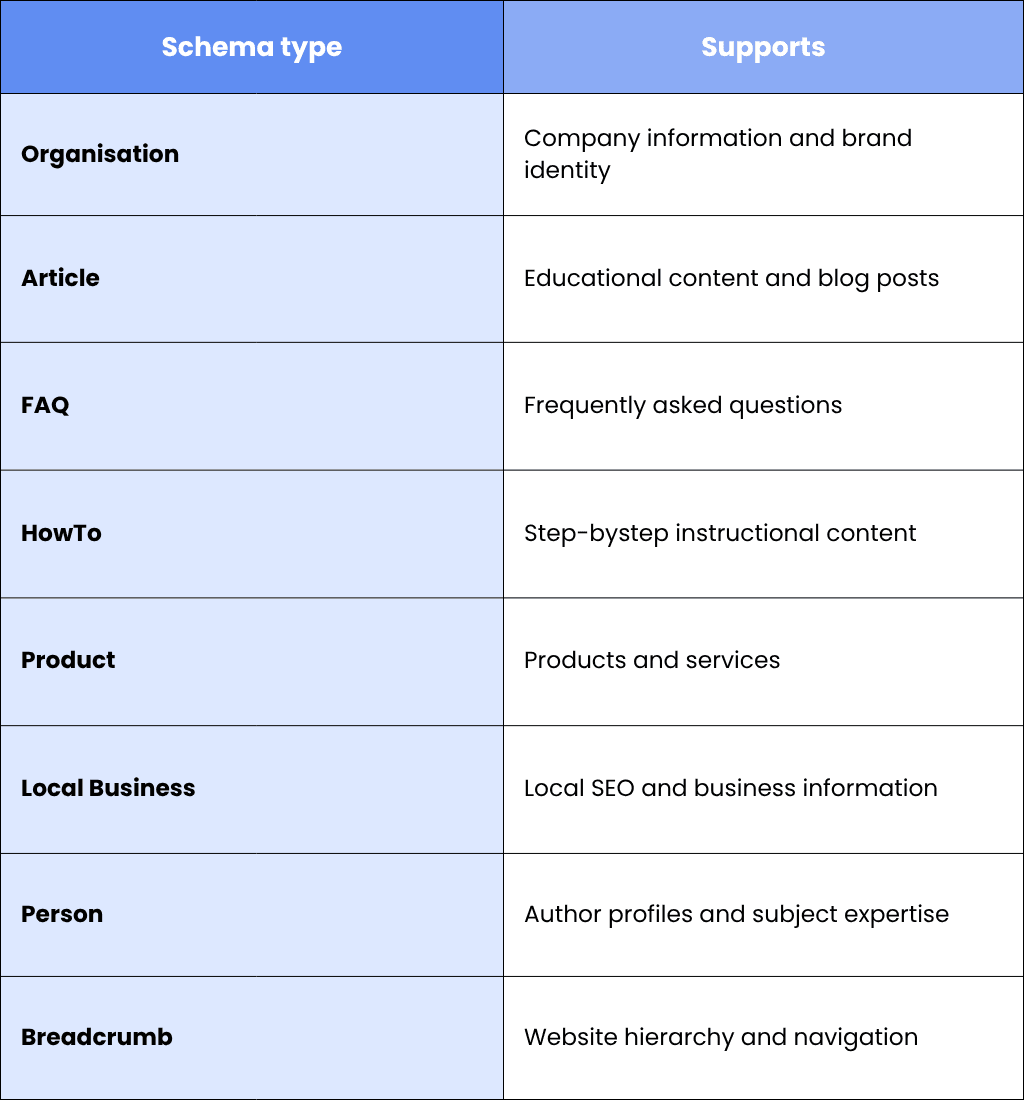
Structured data alone will not guarantee AI citations, but it improves machine understanding and contributes to a stronger technical SEO foundation.
When combined with high-quality content and topical authority, schema markup makes it easier for AI systems to interpret the relationships between your content, your organisation, and your areas of expertise.
5. Keep Information Current
AI engines aim to provide users with accurate and reliable information. Consequently, outdated content is less likely to be selected when more recent and comprehensive resources are available.
This is particularly important for industries that change frequently, including:
- SEO and digital marketing
- Artificial intelligence
- Technology
- Finance
- Healthcare
- Legal and regulatory topics
Rather than constantly publishing new articles, businesses should also invest time in refreshing their existing content.
Regular updates may include:
- Replacing outdated statistics.
- Adding new industry examples.
- Updating screenshots.
- Expanding sections with emerging trends.
- Revising recommendations based on current best practice.
- Improving internal linking.
A practical approach is to create a content maintenance schedule.
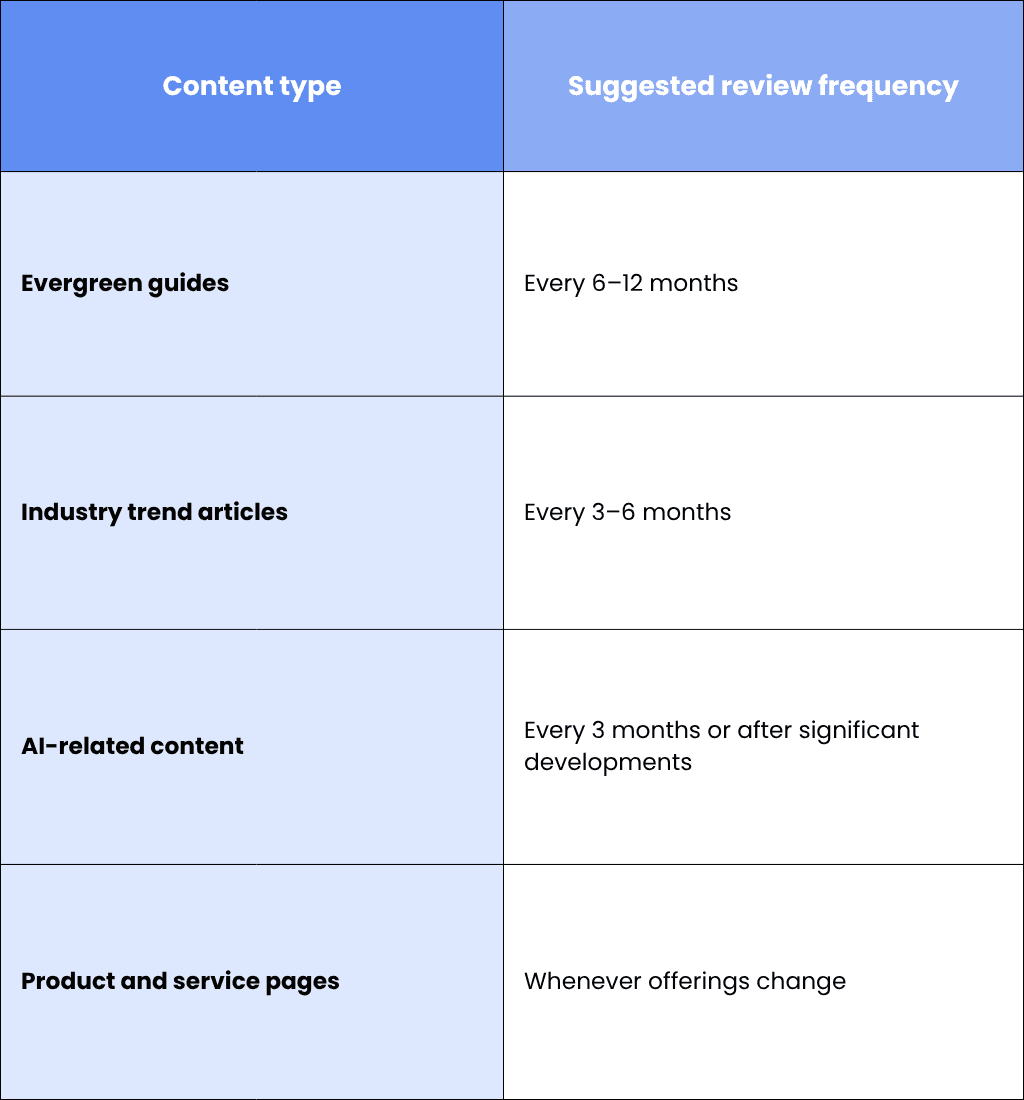
Keeping content current signals that your website remains an active and trustworthy source of information, increasing its long-term value for both users and AI systems.
6. Earn Authoritative Backlinks and Mentions
Authority extends beyond your own website.
AI platforms often evaluate how your business is recognised across the wider web. High-quality backlinks and brand mentions act as signals that other trusted organisations consider your content valuable.
However, quality is far more important than quantity.
A handful of mentions from respected industry publications often provides more value than hundreds of links from low-quality websites.
Effective ways to earn authoritative mentions include:
- Publishing original research.
- Sharing proprietary data and industry insights.
- Contributing expert commentary to journalists.
- Writing guest articles for respected publications.
- Speaking at industry events.
- Collaborating with professional associations.
- Producing unique case studies.
For example, if multiple hospitality publications cite your annual report on hotel marketing trends, AI platforms are more likely to recognise your business as an authority within that sector.
This broader digital footprint reinforces the trust signals generated by your website and strengthens your overall likelihood of being cited.
7. Strengthen Your Brand's Digital Footprint
AI engines do not evaluate websites in isolation. They build an understanding of organisations by connecting information from multiple sources across the web.
For this reason, businesses should ensure that their brand is consistently represented wherever it appears online.
This includes maintaining accurate and up-to-date information across:
- Company website
- Google Business Profile
- LinkedIn and other professional social platforms
- Industry directories
- Press releases
- Knowledge panels
- Partner websites
- Media coverage
Consistency in your company name, services, expertise, and messaging helps AI systems build confidence in your brand.
It also reduces the likelihood of outdated or conflicting information appearing in AI-generated responses.
8. Demonstrate Real-World Expertise
As AI platforms continue to evolve, they are becoming increasingly effective at distinguishing genuinely helpful content from material created solely to target search rankings.
Businesses should therefore look beyond publishing generic articles and instead showcase their real-world experience.
Some effective ways to demonstrate expertise include:
- Publishing original case studies.
- Sharing lessons learned from client projects.
- Including quotes from subject matter experts.
- Explaining practical implementation challenges.
- Providing before-and-after results where appropriate.
- Offering unique insights that cannot easily be found elsewhere.
For example, rather than writing a generic article about restaurant SEO, an agency could share how it helped a hospitality client improve local visibility, increase bookings, or grow organic traffic. These practical insights provide originality that AI systems may view as more valuable than recycled information.
In other words, AI engines increasingly reward content that reflects authentic expertise rather than simply repeating widely available advice.
9. Focus on Helping Users First
Perhaps the most important principle of all is to create content with people, not algorithms, as the primary audience.
Whether a user finds your content through Google Search, ChatGPT, Gemini, Perplexity, or another AI platform, the ultimate goal remains the same: helping them solve a problem or make a more informed decision.
Before publishing any piece of content, ask questions such as:
- Does this answer the user's question completely?
- Is the information accurate and up to date?
- Have we included practical examples?
- Is the content easy to understand?
- Does it offer insights that readers cannot easily find elsewhere?
When businesses consistently prioritise usefulness, clarity, and expertise, they naturally produce the kind of content that both search engines and AI platforms are more likely to trust.
How Saigon Digital Helps Businesses Succeed in AI-Powered Search
The future of search extends beyond traditional rankings. Businesses need strategies that improve visibility across both search engines and AI-powered platforms.
At Saigon Digital, we combine technical SEO expertise with forward-thinking AI optimisation to help ambitious brands remain discoverable as search evolves.
Our SEO Services focus on delivering measurable business outcomes through:
- Site Optimisation & Technical Performance
- Content & Authority Building
- Local & Global Search Strategy
For organisations preparing for the next generation of search, our Generative Engine Optimisation (GEO) services help your content become a trusted source for AI platforms such as ChatGPT, Gemini, Perplexity, and Google AI. These services include:
- AI Readability Optimisation
- Generative Engine Optimisation (GEO)
- Answer Engine Optimisation (AEO)
- Knowledge Graph & Schema Setup
- AI Content Audit & Reformatting
- AI Performance Dashboard
We also provide AI Workflow Automation Services that help businesses streamline operations, reduce manual work, and improve productivity through AI-driven intelligence, custom AI agents, and automation solutions tailored to your organisation.
Future-proof your brand for AI-powered search
As AI continues to transform how people search for information, visibility is no longer measured by rankings alone. Businesses that invest in authoritative content, technical SEO, and Generative Engine Optimisation today will be better positioned to earn trust from search engines as well as AI platforms shaping tomorrow's customer journeys.
Ready to future-proof your digital presence? Get in touch with Saigon Digital to discover how our SEO and AI solutions can help your business become a trusted source in the age of AI search.
Frequently Asked Questions (FAQs)
1. What is the difference between AI citation tracking and traditional SEO tracking?
Traditional SEO tracking focuses on metrics such as keyword rankings, organic traffic, click-through rates, and conversions from search engines. AI citation tracking, on the other hand, measures whether AI-powered platforms such as ChatGPT, Google AI Overviews, Gemini, Perplexity, and Microsoft Copilot reference your content when generating answers. While both are important, AI citation tracking provides insight into your brand's visibility within AI-generated search experiences rather than traditional search engine results pages.
2. Can I optimise my website specifically for AI citations?
There is no guaranteed way to make AI platforms cite your content. However, you can significantly improve your chances by publishing high-quality, authoritative content that directly answers users' questions, demonstrating expertise within your industry, implementing structured data, maintaining accurate and up-to-date information, and building a strong online reputation. These practices align with both modern SEO and Generative Engine Optimisation (GEO) best practices.
3. How often should I perform AI citation tracking?
Most businesses should review their AI visibility on a monthly or quarterly basis. Regularly testing the same industry-related prompts across multiple AI platforms allows you to identify trends, monitor changes in how your brand is referenced, compare your performance against competitors, and evaluate the impact of new content or SEO initiatives over time.
4. Which industries benefit most from AI citation tracking?
Any organisation that relies on online visibility can benefit from AI citation tracking. This includes businesses in retail, hospitality, F&B, education, healthcare, professional services, finance, technology, and e-commerce. As more consumers use AI platforms to research products, services, and providers, becoming a trusted source within AI-generated answers can help strengthen brand awareness, credibility, and lead generation.
5. Is AI citation tracking replacing SEO?
No. AI citation tracking is not replacing SEO—it is becoming an important extension of it. Traditional SEO remains essential for improving search visibility, website performance, and organic traffic. However, as AI-powered search continues to grow, businesses should expand their strategy to include Generative Engine Optimisation (GEO), Answer Engine Optimisation (AEO), and AI citation tracking to maximise their visibility across both search engines and AI platforms.