



Search is changing rapidly. Traditional search engines are no longer the only way people discover information online. AI-powered platforms such as ChatGPT, Gemini, Perplexity and Google's AI Overviews increasingly generate direct answers instead of simply displaying a list of web pages.
For businesses, this shift presents both opportunities and challenges. Creating high-quality content remains essential, but content alone is no longer enough. AI systems need to understand how your website is organised, how topics relate to one another, and which pages demonstrate the greatest authority.
This is where site architecture for AI becomes a competitive advantage.
In this guide, we'll explore what site architecture for AI means, why internal linking matters more than ever, and how businesses can structure their websites to improve both traditional SEO and AI search visibility.
What Is Site Architecture for AI?
Site architecture refers to the way pages are organised, connected and presented throughout a website.
Traditionally, good website architecture focused on helping users navigate efficiently while enabling search engines to crawl every important page. Those objectives remain important, but AI-powered search introduces an additional requirement: Your website should clearly communicate relationships between topics, entities and expertise.
Instead of simply indexing keywords, modern AI systems attempt to understand:
- What your business specialises in
- Which topics your website covers comprehensively
- Which pages are foundational resources
- How supporting content expands upon key subjects
- Whether information appears trustworthy and consistent
In other words, site architecture for AI is about creating a website that machines can interpret almost as easily as human readers.
Rather than viewing your website as hundreds of disconnected pages, AI should recognise it as a structured knowledge resource.
Why AI Search Relies on Website Structure
Understanding what site architecture for AI means is only the first step. The next question is: why does it matter so much? The answer lies in the way modern AI-powered search systems process and retrieve information.
Unlike traditional search engines that primarily index pages based on keywords and links, large language models (LLMs) aim to understand the relationships between topics, concepts and entities. When AI platforms such as ChatGPT, Gemini or Perplexity generate responses, they don't simply identify pages that contain relevant keywords. Instead, they look for signals that indicate a website has comprehensive knowledge of a subject.
This is where your website structure becomes particularly important.
When AI systems access content through search engines, retrieval systems or live web integrations, they evaluate patterns across your website rather than viewing each page in isolation. These patterns help them determine how your content fits together and whether your website demonstrates genuine expertise.
Some of the key signals they analyse include:
- Content hierarchy
- Topic relationships
- Internal linking
- Semantic relevance
- Consistent terminology
- Page authority
- Structured data
A poorly organised website forces AI systems to infer these relationships on their own, increasing the likelihood that important context is overlooked. By contrast, a well-organised website makes those relationships explicit, allowing AI to interpret your expertise with greater confidence.
Ultimately, the easier it is for AI to understand how your content connects, the more likely it is that your website will be recognised as a trustworthy source for AI-generated answers.
Why Internal Linking Matters More Than Ever
If website structure provides the overall framework, internal linking is what brings that framework to life.
Think of your site architecture as a map of your knowledge. While the hierarchy shows where each page belongs, internal links explain how those pages relate to one another. They guide both users and AI systems through your content, helping them understand not only what each page is about, but also why it matters within the broader context of your website.
For years, internal linking has been recognised as an important SEO practice because it helps search engines discover pages and distribute authority across a website. However, in the age of AI search, its role extends far beyond simply passing link equity.
Internal links provide valuable context.
Rather than treating every article as a standalone resource, AI systems use internal links to identify connections between related topics. These links help reinforce your areas of expertise and demonstrate that your website covers a subject in depth.
Consider a hospitality business as an example.
Instead of publishing isolated articles about:
- Hotel marketing
- Local SEO
- Google Business Profile
- Booking engines
- Guest experience
these articles should be strategically connected.
For example:
- Hotel marketing links to local SEO.
- Local SEO links to Google Business Profile optimisation.
- Google Business Profile links to reputation management.
- Reputation management links back to customer experience.
Together, these links form a semantic network that illustrates how each topic contributes to a broader area of expertise. Instead of seeing five separate articles, AI systems recognise a cohesive body of knowledge focused on hospitality marketing.
Without these internal connections, those relationships become far less obvious, making it harder for AI to understand the full depth of your expertise.
How AI Understands Topic Clusters
As internal links begin connecting related pages, they naturally create something even more valuable: topic clusters.
Topic clusters are one of the most effective ways to implement site architecture for AI because they organise content around a central subject while clearly demonstrating topical depth. Rather than publishing articles whenever inspiration strikes, businesses intentionally develop groups of related content that work together to build authority.
A typical topic cluster consists of:
- One comprehensive pillar page
- Multiple supporting articles
- Strategic internal links connecting them
For example, an education provider might create the following cluster.
Pillar page
The Complete Guide to Student Recruitment
Supporting articles:
- SEO for universities
- AI in education marketing
- International student marketing
- Open day promotion
- Content marketing for higher education
- PPC campaigns for education
Each supporting article links back to the main pillar page while also linking to other relevant supporting resources. This creates a tightly connected network that reinforces the relationship between every piece of content.
From an AI perspective, this structure makes your expertise much easier to interpret. Rather than encountering individual pages with limited context, AI systems can recognise that your website covers the topic comprehensively and that each article contributes to a larger body of knowledge.
As a result, websites built around well-connected topic clusters are generally better positioned to demonstrate authority, making them more likely to be surfaced in both traditional search results and AI-generated responses.
The Difference Between Traditional SEO Architecture and AI-First Architecture
As topic clusters demonstrate, organising your website around connected areas of expertise has become increasingly valuable in the era of AI search. However, this doesn't mean businesses should abandon traditional SEO principles altogether.
Instead, it reflects an important shift in how search engines and AI systems interpret websites. While many of the fundamentals remain the same, the emphasis has evolved. Traditional SEO largely focused on helping search engines discover, crawl and rank individual pages. AI-powered search, on the other hand, places greater importance on understanding how those pages relate to one another and how they collectively demonstrate expertise.
In other words, the objective is no longer just to optimise individual pieces of content. It is to build a website that functions as a well-organised knowledge resource, where every page contributes to a broader understanding of your business and its areas of authority.
The comparison below highlights the key differences.
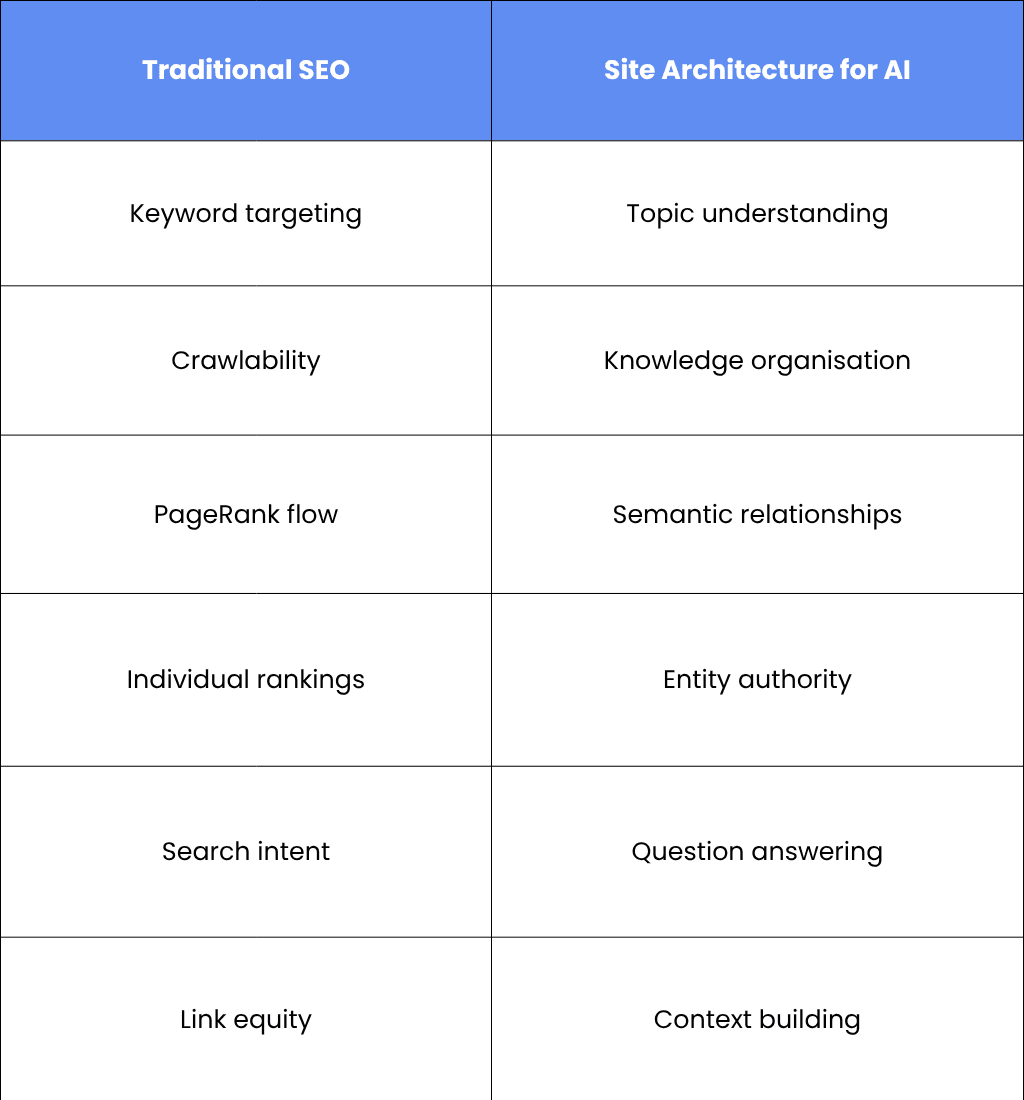
Although these differences are significant, AI-first architecture is not a replacement for traditional SEO. Strong technical foundations, crawlability and user experience remain essential for achieving sustainable search visibility.
Rather, businesses should view AI-first architecture as the next evolution of SEO. By combining proven optimisation practices with logical site structures, meaningful internal linking and well-developed topic clusters, organisations can create websites that perform effectively in both traditional search engines and AI-powered search experiences.
Best Practices for Site Architecture for AI
Now that we've explored how AI interprets website structure and internal links, the next step is putting these principles into practice. While every website is different, the following best practices provide a strong foundation for creating a site architecture that is easy for both users and AI systems to understand.
Rather than viewing these recommendations as isolated tasks, think of them as complementary elements of a connected ecosystem. Together, they help communicate your expertise more clearly, strengthen topical authority and improve your chances of being discovered in both traditional search results and AI-generated answers.
1. Build Clear Content Hierarchies
Every effective website starts with a logical hierarchy. Just as a well-organised library groups books into categories and subjects, your website should organise information into clearly defined sections that guide both visitors and search engines.
A clear hierarchy enables AI systems to recognise which topics are broad, which pages provide detailed information, and how each piece of content relates to the rest of your website.
For example, a digital marketing agency might structure its content like this:
Home
│
├── Services
│ ├── SEO Services
│ │ ├── Technical SEO
│ │ ├── Local SEO
│ │ ├── Enterprise SEO
│ │ └── Generative Engine Optimisation
│ │
│ └── AI Workflow Automation
│
└── Resources
├── SEO Guides
├── AI Marketing
└── Case Studies
This hierarchy immediately tells AI that:
- SEO Services is a core business offering.
- Technical SEO is a specialised area within SEO.
- Generative Engine Optimisation is another related service.
- Educational resources support the company's expertise.
When planning your architecture, aim to keep important pages within three clicks of the homepage whenever possible. This improves accessibility for users while signalling that these pages play a central role within your website.
A simple hierarchy often performs better than one that contains excessive categories or deeply nested pages. If users struggle to navigate your website, AI systems may also find it more difficult to understand its structure.
2. Create Comprehensive Pillar Pages
Once your overall hierarchy is established, the next step is developing pillar pages for your most important topics.
A pillar page serves as the central resource for a broad subject. Instead of answering one specific question, it provides a comprehensive overview while introducing related subtopics that are explored in greater depth elsewhere on your website.
For example, a pillar page about Local SEO could introduce topics such as:
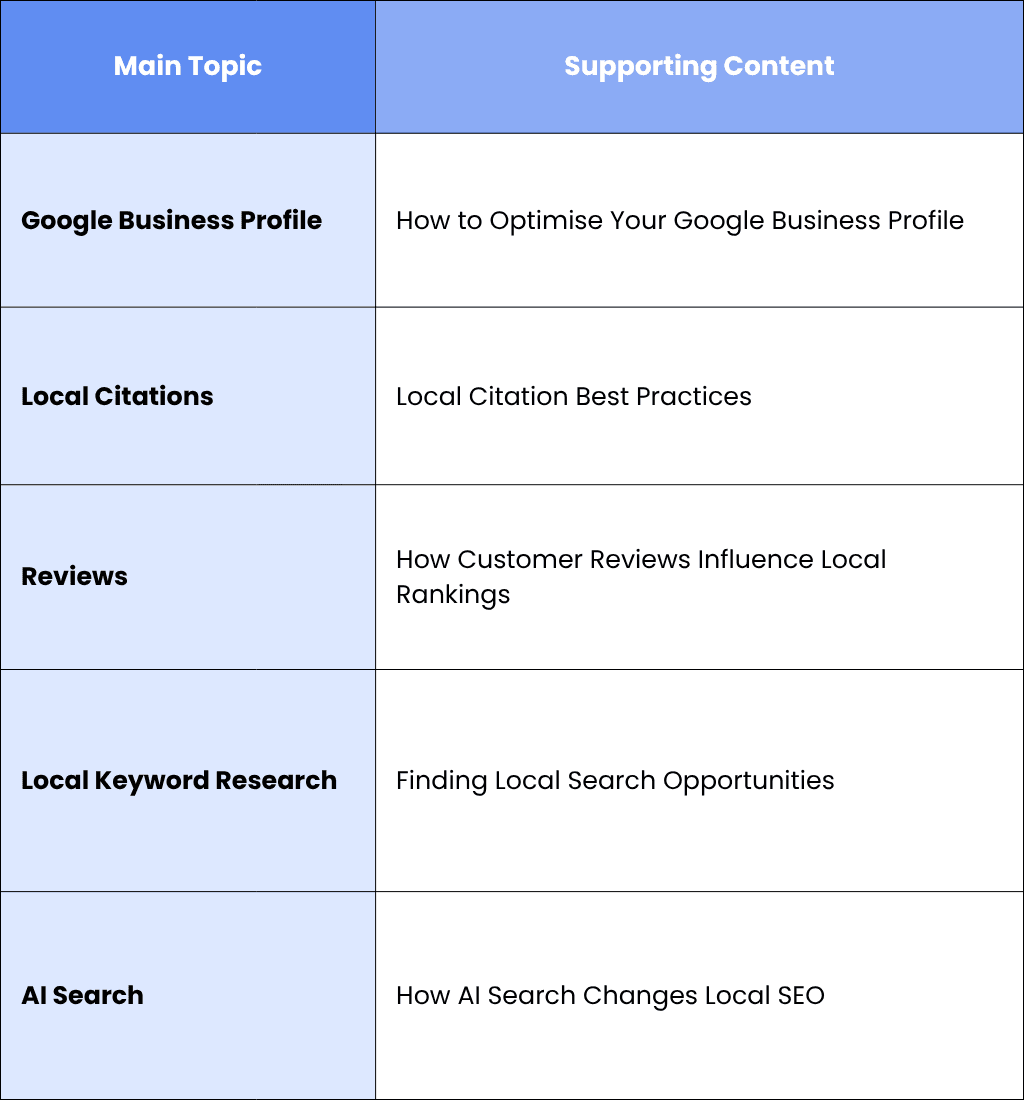
Each supporting article should link back to the pillar page, while the pillar page links naturally to each supporting resource.
This creates several benefits:
- Users can explore a topic without needing to search elsewhere.
- Search engines better understand topical relationships.
- AI systems recognise your website as a comprehensive knowledge source.
Rather than publishing dozens of unrelated articles, pillar pages help organise your content into meaningful subject areas that demonstrate expertise over time.
3. Build Supporting Content Around Every Core Topic
Publishing content consistently is important, but publishing strategically is even more valuable.
One common mistake businesses make is creating articles based solely on trending keywords or one-off ideas. While these pieces may attract occasional traffic, they often fail to strengthen the overall authority of the website because they exist in isolation.
Instead, every core service or business topic should be supported by a collection of related articles.
For example, consider a hospitality business.
Instead of publishing random articles such as:
- Summer travel tips
- Hotel photography
- Booking software
- Local attractions
a more strategic content cluster might look like this:
Core Topic: Hotel SEO
↓
- Local SEO for Hotels
- Google Business Profile Optimisation
- Hotel Website Technical SEO
- Hotel Review Management
- Voice Search for Hotels
- AI Search Optimisation for Hospitality
Notice how every supporting article contributes to the same overarching topic.
Over time, this approach creates stronger topical authority than publishing the same number of unrelated articles.
Before creating new content, ask yourself:
Does this article strengthen one of our existing topic clusters, or does it create another isolated page?
If the answer is the latter, consider how it can be integrated into an existing content ecosystem.
4. Use Descriptive and Contextual Anchor Text
Internal links are only as useful as the information they communicate.
When readers encounter vague anchor text such as:
- Click here
- Learn more
- Read this article
they have little indication of what to expect after clicking. The same applies to AI systems, which rely on anchor text to understand the relationship between linked pages.
Instead, use descriptive anchors that clearly communicate the destination.
For example:
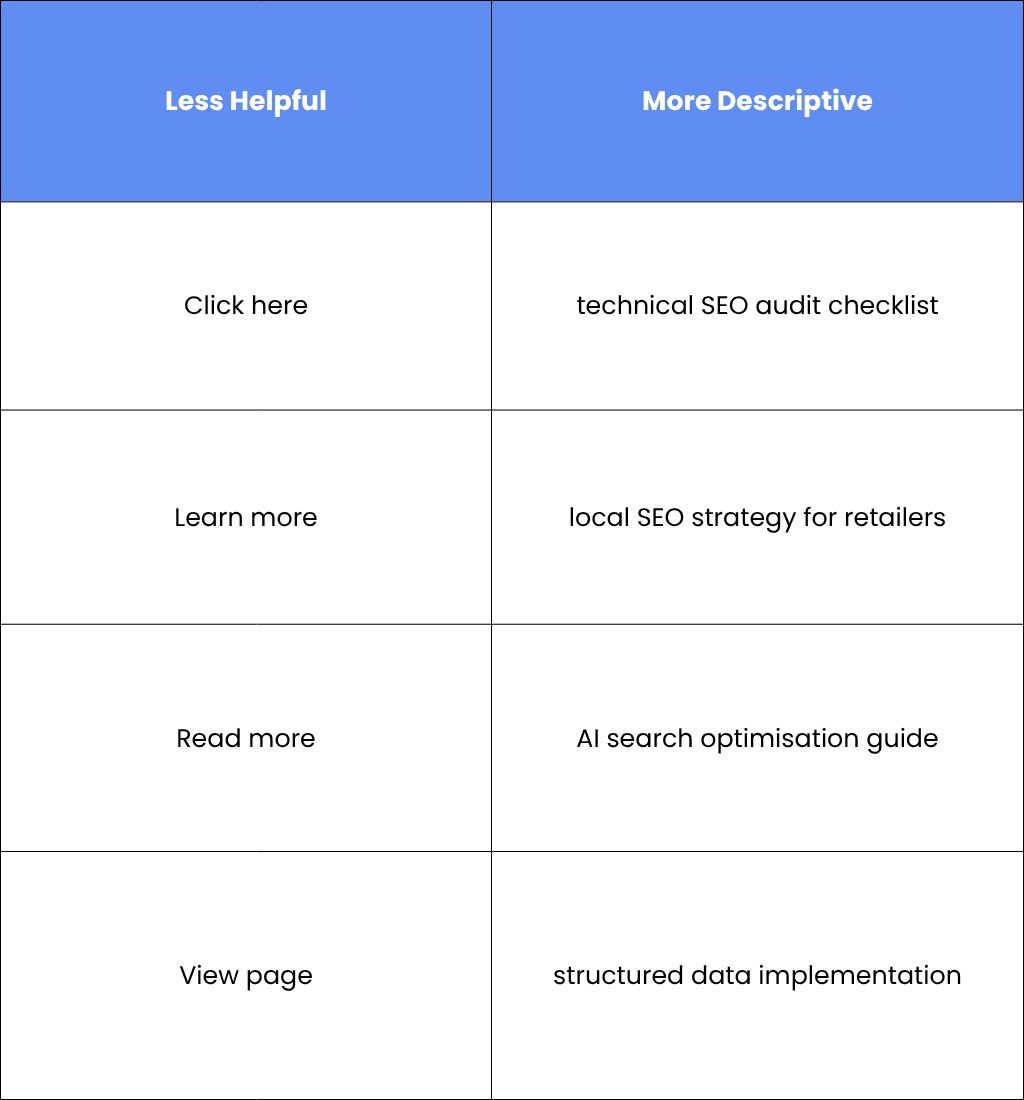
Descriptive anchor text offers several advantages:
- It improves accessibility and usability.
- It reinforces topical relevance.
- It helps AI understand semantic relationships between pages.
That said, avoid forcing exact-match keywords into every link. Repeating identical anchor text excessively can make content feel unnatural. Instead, vary your wording while keeping the meaning clear and relevant.
5. Connect Related Articles Strategically
Many websites rely solely on navigation menus or category pages to connect their content. While these are important, they don't fully demonstrate the relationships between individual topics.
Instead, create meaningful links wherever two pieces of content naturally complement one another.
For example:
Technical SEO
│
├── Internal Linking
│ │
│ ├── Site Architecture
│ │
│ └── Crawl Budget
│
└── Structured Data
This interconnected structure helps AI understand that these topics belong to the same area of expertise rather than existing independently.
As a general guideline, each article should include several contextual internal links, such as:
- Links to broader pillar pages.
- Links to closely related supporting articles.
- Links to relevant service pages where appropriate.
- Links to practical resources or case studies.
Rather than inserting links simply for SEO purposes, focus on improving the reader's journey. If a related article helps answer the reader's next question, it is probably worth linking.
6. Keep Important Pages Close to the Homepage
Not every page on your website carries the same level of importance.
Service pages, cornerstone guides and high-value resources should be easy for both users and search engines to find. If these pages are buried several layers deep within your navigation, they may receive less attention and fewer internal links, reducing their overall visibility.
A useful rule of thumb is:
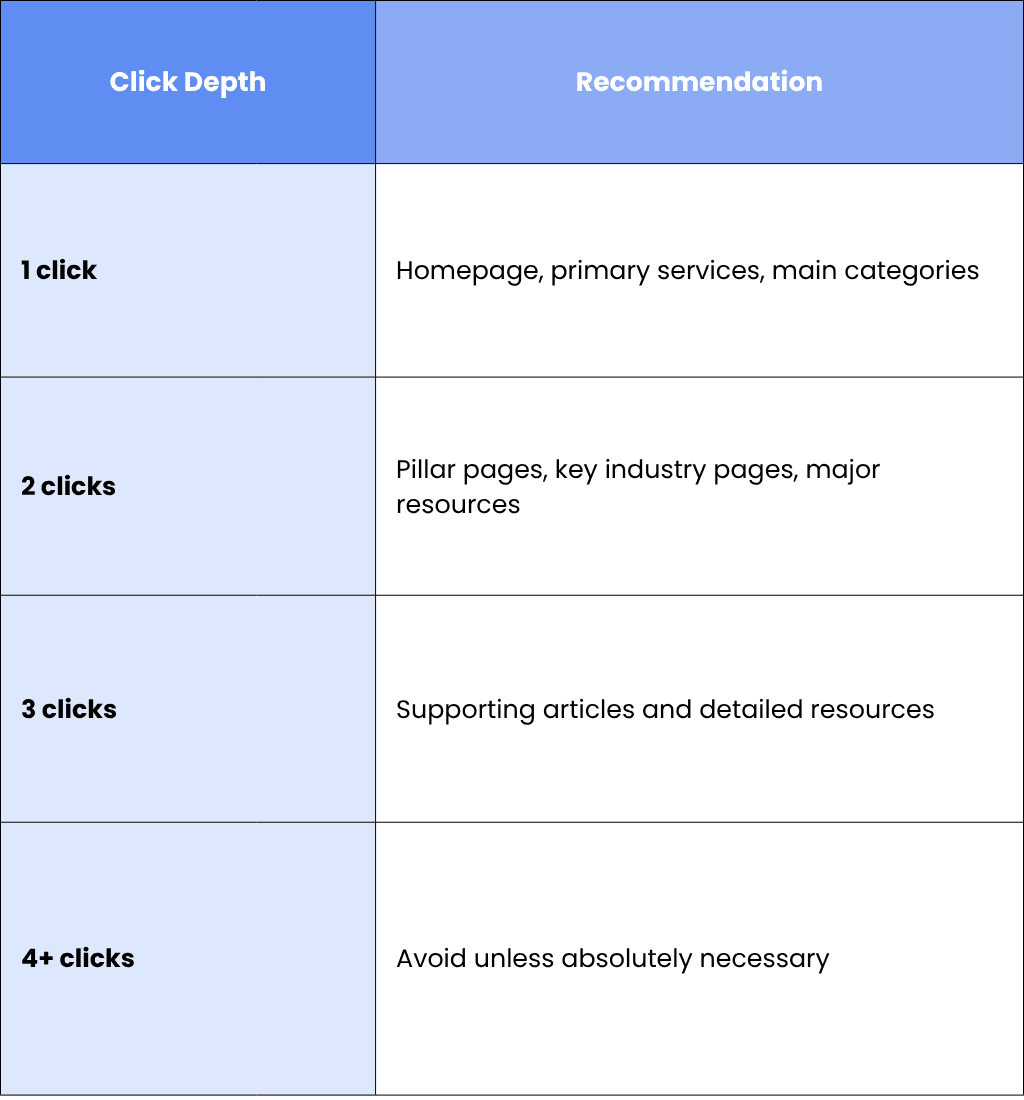
While there is no universal rule, reducing unnecessary click depth generally improves crawl efficiency, user experience and content discoverability.
When reviewing your website, ask yourself:
Could a potential customer find our most important service page within a few clicks?
If not, your architecture may benefit from simplification.
7. Use Consistent Terminology Across Your Website
Consistency plays a significant role in helping AI understand your expertise.
Imagine one page refers to your service as Generative Engine Optimisation, another calls it AI SEO, while a third describes it as LLM optimisation without explaining the relationship between these terms.
Although human readers may infer that these phrases refer to similar concepts, AI systems benefit from greater consistency.
This doesn't mean you should avoid synonyms altogether. Instead:
- Choose one primary term.
- Use it consistently throughout your core pages.
- Introduce alternative terminology naturally where appropriate.
- Clearly explain when different terms describe related concepts.
Doing so reinforces your topical focus while reducing ambiguity across your website.
8. Eliminate Orphan Pages
Finally, ensure that every important page forms part of your website's broader knowledge network.
An orphan page is a page that receives little or no internal links from elsewhere on the website.
Even excellent content can struggle to perform if it exists in isolation because:
- Users are less likely to discover it.
- Search engines may crawl it less frequently.
- AI systems have limited context for understanding its relevance.
A simple internal linking audit can often reveal these missed opportunities.
Whenever you publish a new article, ask yourself:
- Which existing pages should link to this content?
- Which pages should this article link back to?
- Which topic cluster does it belong to?
If you cannot answer these questions, the page probably needs stronger integration into your overall site architecture.
Ultimately, every page should contribute to a connected network of knowledge rather than functioning as a standalone asset. This is one of the defining characteristics of effective site architecture for AI, and it helps ensure your expertise is communicated clearly to both human visitors and AI-powered search systems.
Common Internal Linking Mistakes That Hurt AI Visibility
Even businesses that invest in high-quality content can struggle to improve their AI search visibility if their internal linking strategy is overlooked. In many cases, the issue isn't the content itself, but rather how that content is connected across the website.
As we've seen throughout this guide, AI systems rely on relationships between pages to understand topical authority. When those relationships are weak, inconsistent or missing altogether, your website becomes more difficult for both search engines and AI platforms to interpret.
The following are some of the most common internal linking mistakes, along with practical ways to avoid them.
1. Publishing Isolated Content
One of the most frequent mistakes is treating every blog post as an independent piece of content.
Many businesses publish articles around trending topics or seasonal campaigns without considering how they fit into the rest of the website. As a result, these pages often receive few internal links and contribute little to the site's overall topical authority.
For example, imagine a retail business publishes articles on:
- Holiday gift ideas
- Sustainable packaging
- Customer loyalty programmes
- AI shopping assistants
Each article may be informative, but if they are never linked together or connected to broader resources such as an eCommerce SEO guide or retail marketing hub, AI systems may struggle to understand how they contribute to the company's expertise.
Before publishing new content, ask yourself:
- Which existing pillar page should this article support?
- Which related articles should link to it?
- Which pages should it reference in return?
Thinking about these relationships before publication often leads to a much stronger site architecture over time.
2. Linking Everything Back to the Homepage
Another common habit is directing the majority of internal links to the homepage.
While the homepage is undoubtedly important, it rarely provides the most detailed answer to a user's question. Excessively linking back to it can also prevent authority from flowing to deeper, high-value pages that demonstrate your expertise.
Instead, distribute internal links strategically across your website.
For example, links should point towards:
- Core service pages
- Comprehensive pillar pages
- Industry-specific landing pages
- Supporting educational resources
- Relevant case studies
This creates multiple entry points into your content and helps AI understand which pages serve as authoritative resources within each topic area.
A useful way to think about it is this:
The homepage introduces your business. Your service pages and knowledge hubs demonstrate your expertise.
3. Using Generic or Repetitive Anchor Text
Anchor text provides valuable context about the destination page. However, many websites either use vague wording or repeat the same keyword every time they create a link.
Descriptive anchor text makes it easier for users to understand where a link leads while also helping AI interpret the relationship between pages.
At the same time, avoid using identical anchor text for every link. For example, repeatedly linking with the phrase "SEO services" throughout your website can appear unnatural.
Instead, vary your language while maintaining relevance.
Examples might include:
- technical SEO services
- enterprise SEO solutions
- local SEO strategy
- SEO consultancy
- SEO optimisation services
This creates a more natural reading experience and provides richer contextual signals.
4. Creating Large Volumes of Shallow Content
Publishing more content does not automatically improve visibility.
Some businesses focus heavily on producing short articles targeting individual keywords, hoping to increase organic traffic through sheer volume. Unfortunately, this often results in dozens—or even hundreds—of pages that offer limited depth and overlap significantly in subject matter.
For example, instead of publishing separate 300-word articles covering every small variation of a topic, it is usually more effective to create:
- one comprehensive pillar page,
- several detailed supporting guides, and
- meaningful internal links connecting them.
This approach provides greater value for readers while giving AI systems stronger evidence that your website demonstrates genuine expertise.
As a general principle, depth and context are often more valuable than quantity alone.
5. Relying Solely on Navigation Menus
Website menus are essential for usability, but they should not be your only internal linking strategy.
Navigation menus typically highlight your main categories and services, yet they cannot explain the relationships between individual topics in the way contextual links can.
For example, an article about Technical SEO might naturally reference:
- site architecture,
- crawl budget,
- XML sitemaps,
- structured data, and
- Core Web Vitals.
Embedding links within the content itself helps readers explore these related subjects while also reinforcing topical connections for AI systems.
Whenever you mention a concept that you explain elsewhere on your website, consider whether a contextual internal link would genuinely help the reader. If the answer is yes, adding that link strengthens both the user experience and your site's semantic structure.
6. Ignoring Older Content
Internal linking shouldn't stop once an article has been published.
As your website grows, older pages can gradually become disconnected from newer content, reducing their visibility and limiting the flow of contextual signals across your website.
For example, imagine you publish a new guide on Generative Engine Optimisation (GEO). Rather than waiting for readers to discover it organically, revisit existing articles covering related subjects such as:
- Technical SEO
- Content Strategy
- Structured Data
- AI Marketing
- Answer Engine Optimisation
Adding relevant links from these established pages immediately integrates the new guide into your existing content ecosystem.
Many businesses focus exclusively on linking from new articles to old ones. However, updating older content to reference newer resources is equally important and helps maintain a healthy, interconnected website.
7. Leaving Orphan Pages Unconnected
One of the most damaging structural issues is the presence of orphan pages—pages that receive few or no internal links from the rest of the website.
Without internal links:
- Users are unlikely to discover the page naturally.
- Search engines may crawl it less frequently.
- AI systems receive little context about its importance or relationship to other topics.
Fortunately, orphan pages are relatively easy to identify through a site audit.
Whenever you discover one, ask yourself:
- Which topic cluster should this page belong to?
- Which pillar page should link to it?
- Which supporting articles should reference it?
- Does it deserve to exist, or should it be consolidated with another page?
In many cases, simply integrating an orphan page into an existing topic cluster can significantly improve its visibility and usefulness.
8. Focusing on Links Instead of User Journeys
Perhaps the biggest mistake of all is treating internal linking as a technical SEO exercise rather than part of the overall user experience.
Every internal link should have a purpose. Ideally, it answers the reader's next question or helps them continue their journey through your content.
For example, if someone is reading about site architecture for AI, they may naturally want to learn about:
- structured data,
- topic clusters,
- Generative Engine Optimisation,
- technical SEO audits, or
- AI search visibility.
Providing these next steps creates a smoother reading experience while simultaneously strengthening the semantic relationships across your website.
Ultimately, the best internal linking strategies are those that feel completely natural. When links are added to genuinely help readers discover relevant information, they also provide the contextual signals that search engines and AI systems increasingly rely on to understand your website's expertise.
How Site Architecture Supports E-E-A-T
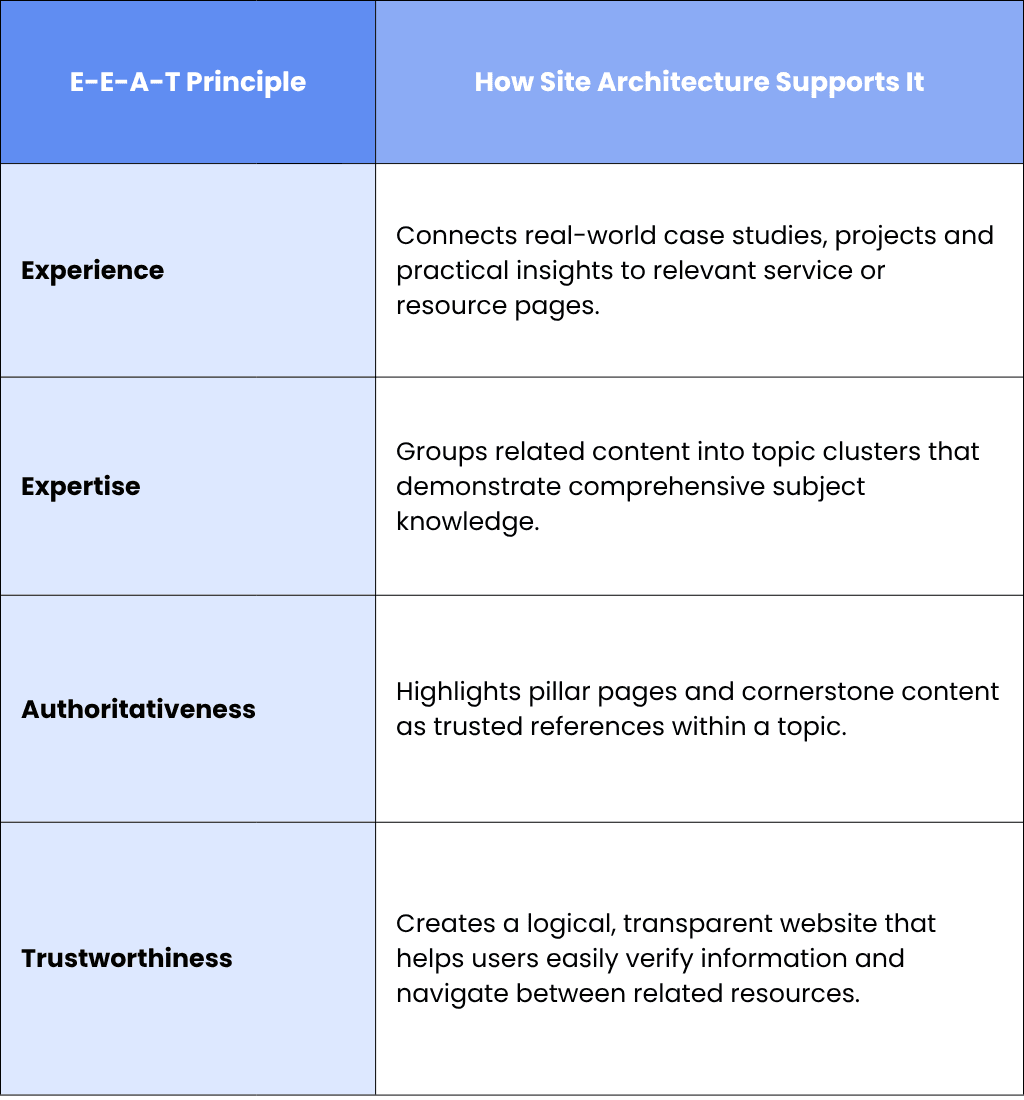
By this point, it should be clear that effective site architecture for AI goes far beyond organising pages neatly. A well-structured website also strengthens one of the most important concepts in modern search: E-E-A-T, which stands for Experience, Expertise, Authoritativeness and Trustworthiness.
Although E-E-A-T is commonly associated with Google's Search Quality Evaluator Guidelines, its underlying principles are equally relevant in the age of AI-powered search. Large language models aim to provide users with accurate, reliable and well-supported information. As a result, they naturally favour websites that consistently demonstrate these qualities.
While no single ranking factor determines E-E-A-T, your website architecture can reinforce each element in meaningful ways.
Site Architecture and Structured Data
While internal linking explains how pages relate to one another, structured data provides another layer of meaning by explicitly describing what each page contains.
Rather than relying solely on AI systems to interpret your content, structured data communicates important information in a standardised format that search engines can understand more easily.
In other words:
- Internal links explain relationships.
- Structured data explains entities.
These two elements work best when implemented together.
For example, imagine a service page for Technical SEO.
Without structured data, AI can still infer that the page describes a service based on its content and internal links.
With structured data, however, you explicitly identify:
- Your organisation
- The service being offered
- The author
- Frequently asked questions
- Breadcrumb navigation
- Related articles
This additional context reduces ambiguity and strengthens your semantic signals.
The table below illustrates how different schema types complement your website architecture.
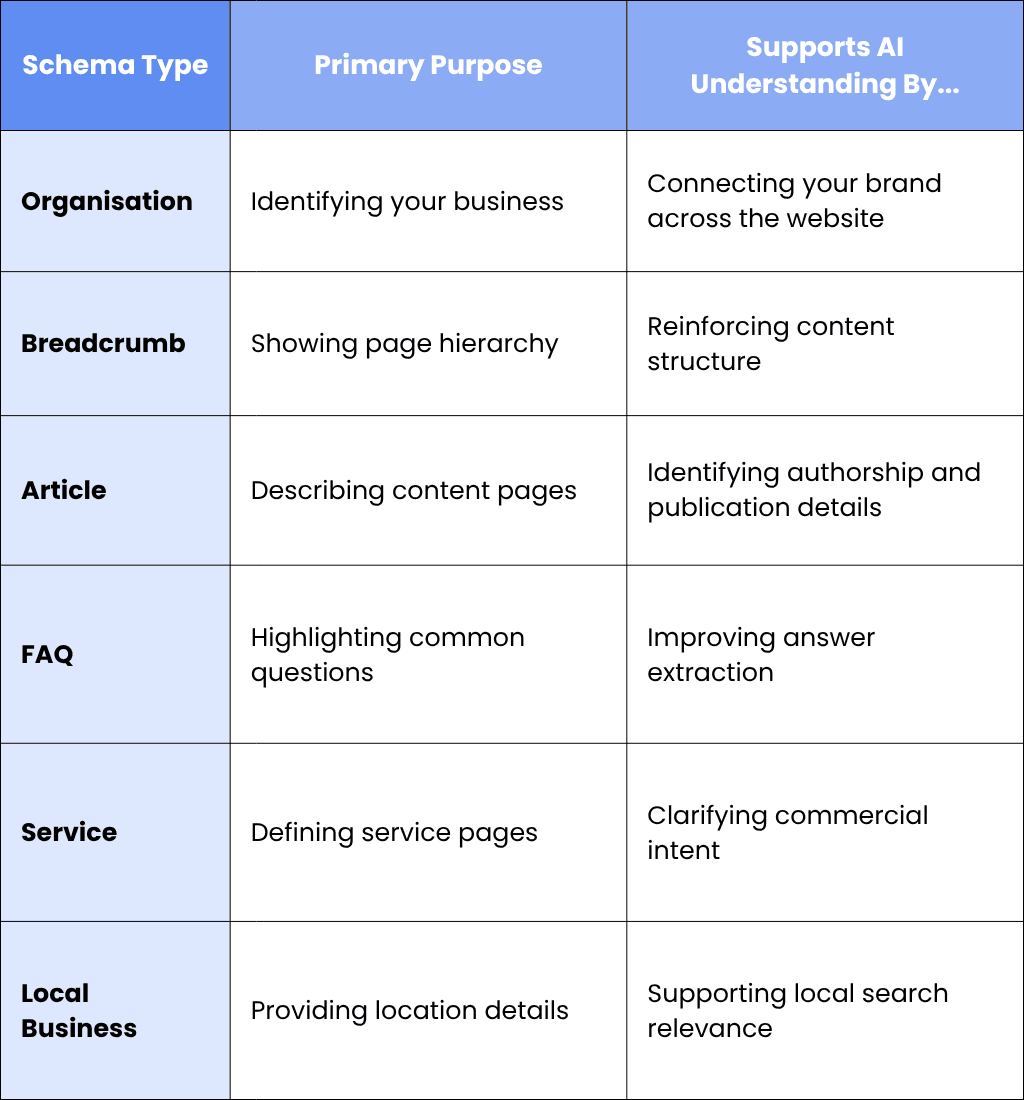
For the strongest results, think of internal linking and structured data as complementary rather than separate optimisation techniques.
Internal links create the pathways between pages, while schema provides clear signposts that help AI interpret those pathways accurately.
Why This Matters Across Different Industries
The principles of site architecture for AI apply to virtually every industry. However, the way they are implemented should reflect the unique needs of each business and its customers.
Rather than following a one-size-fits-all approach, organisations should structure their websites around the questions their audiences are most likely to ask and the topics they want to be recognised for.
Here are a few examples.
1. Food & Beverage
Restaurants, cafés and food brands often focus heavily on menus and promotional content, overlooking the educational resources that can strengthen topical authority.
A more comprehensive content ecosystem might connect:
- Menu pages
- Location pages
- Catering services
- Seasonal promotions
- Dietary information
- Sustainability initiatives
- Recipe or cooking guides
- Local dining recommendations
This structure helps AI understand both your commercial offerings and your broader expertise within the food and beverage industry.
2. Retail
Retail businesses frequently publish hundreds or even thousands of product pages.
While product categories are essential, supporting content can significantly improve the overall structure of the website.
For example, product pages can link naturally to:
- Buying guides
- Product comparisons
- Care and maintenance advice
- Frequently asked questions
- Style inspiration
- Customer case studies
This creates stronger semantic relationships while also helping customers make more informed purchasing decisions.
3. Education
Prospective students rarely search for courses alone.
Instead, they often look for information about admissions, student life, career opportunities, campus facilities and financial support.
Educational institutions can strengthen their website architecture by connecting:
- Course pages
- Faculty information
- Student success stories
- Admission guides
- Scholarship resources
- Career outcomes
- Frequently asked questions
Together, these pages create a richer information network that demonstrates expertise while improving the user experience.
4. Hospitality
Hotels, resorts and travel businesses typically produce content covering destinations, accommodation and guest services.
Rather than treating these pages separately, connect them strategically.
For example:
Accommodation → Local Attractions → Dining → Travel Tips → Seasonal Events → Special Packages
This journey mirrors how travellers naturally plan their trips, making the website easier for both visitors and AI systems to navigate.
Regardless of industry, the principle remains the same: organise your website around meaningful relationships rather than isolated pages. Doing so helps establish topical authority, improves discoverability and creates a better overall experience for users.
How to Audit Your Existing Site Architecture
Understanding best practices is valuable, but the next step is evaluating how your own website performs against them.
A site architecture audit doesn't necessarily require complex software. In many cases, simply reviewing your website from the perspective of both a user and an AI system can uncover significant opportunities for improvement.
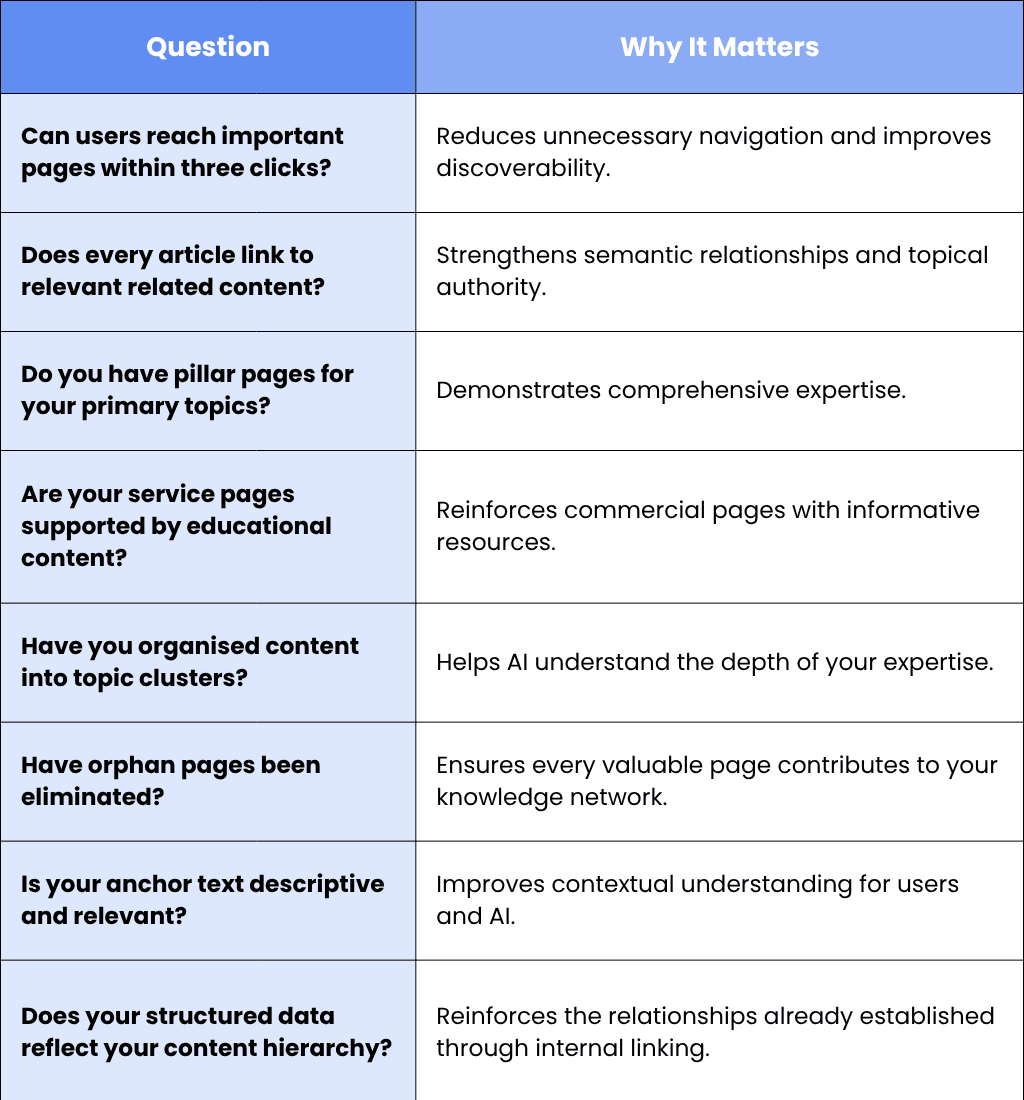
Once you've completed this review, it can be helpful to categorise your findings according to priority.
High Priority
Address these issues first because they have the greatest impact on your site's overall architecture.
- Orphan pages
- Missing internal links
- Poor navigation
- Broken topic clusters
Medium Priority
These improvements strengthen your existing structure over time.
- Updating anchor text
- Expanding pillar pages
- Improving click depth
- Adding supporting content
Long-Term Optimisation
As your website grows, continue refining your architecture by:
- Updating older articles with new internal links.
- Consolidating overlapping content.
- Expanding topic clusters.
- Reviewing structured data.
- Monitoring how AI search surfaces your content.
Remember that site architecture is not a one-time project. Every new page, service and blog article becomes part of your website's broader knowledge ecosystem.
Regular audits help ensure that ecosystem remains organised, connected and easy for both users and AI systems to understand.
How Saigon Digital Can Help Your Business
Building an AI-ready website requires more than publishing content. It demands a strategic approach to website structure, technical SEO and content organisation.
At Saigon Digital, we help ambitious brands create digital experiences that are designed for today's search engines and tomorrow's AI-powered discovery platforms.
Our services include:
- SEO Services: We improve technical performance, optimise websites for search visibility, build content authority and develop local and global search strategies that drive measurable business outcomes.
- Generative Engine Optimisation (GEO): We help brands become discoverable, trusted and cited by AI platforms such as ChatGPT, Gemini, Perplexity and Google AI through AI readability optimisation, Answer Engine Optimisation (AEO), knowledge graph and schema implementation, AI content audits and performance monitoring.
- AI Workflow Automation Services: We design AI-powered workflows, custom AI agents and automation solutions that improve operational efficiency and help businesses scale more effectively.
Whether you're looking to strengthen your SEO foundations, prepare your website for AI search or automate key marketing processes, our team combines strategy, creativity and technical expertise to deliver solutions tailored to your business goals.
Future-Proof Your Website for AI Search
As AI-powered search continues to reshape how people discover information online, a well-structured website is no longer just a technical advantage, it is a business advantage. By investing in strong site architecture, strategic internal linking and a connected content ecosystem, you can improve your visibility across both traditional search engines and emerging AI platforms.
If you're ready to build a website that is designed for the future of search, Saigon Digital is here to help.
Let's build a website that both your customers and AI can trust. Get in touch with us today!
Frequently Asked Questions
1. What is site architecture for AI?
Site architecture for AI refers to the way a website is organised so that AI-powered search platforms, such as ChatGPT, Gemini and Perplexity, can easily understand the relationships between pages, topics and entities. It involves creating logical content hierarchies, building topic clusters, implementing strategic internal linking and using structured data to provide clear contextual signals. A well-planned site architecture helps AI recognise your expertise, making your content more likely to appear in AI-generated answers.
2. How does internal linking improve AI search visibility?
Internal linking helps AI systems understand how different pages on your website relate to one another. By connecting pillar pages with supporting articles and relevant service pages, you create a semantic network that demonstrates topical authority. Effective internal linking also improves content discoverability, distributes page authority and provides users with a more intuitive navigation experience.
3. Is site architecture for AI different from traditional SEO?
The foundations are similar, but the focus has evolved. Traditional SEO primarily aims to improve crawlability, keyword relevance and rankings for individual pages. Site architecture for AI places greater emphasis on organising content into connected topic clusters, demonstrating expertise and helping AI understand the context and relationships between your pages. The strongest websites combine both traditional SEO best practices and AI-first optimisation strategies.
4. How can I tell if my website is ready for AI search?
A good starting point is to review your website's structure and ask whether it clearly demonstrates your expertise. Important pages should be easy to find, content should be organised into logical topic clusters, every valuable page should have relevant internal links, and descriptive anchor text should be used throughout the site. Adding structured data and regularly auditing your content architecture can also help ensure your website is well prepared for AI-powered search.
5. Which businesses benefit most from improving their site architecture for AI?
Businesses across virtually every industry can benefit from improving their site architecture for AI, particularly those that rely on organic search to attract customers. This includes organisations in F&B, retail, education, hospitality, professional services and eCommerce. Any business that publishes informative content, offers multiple products or services, or wants to increase its visibility in both traditional search engines and AI-powered search platforms can gain long-term value from a well-structured website.