



AI visibility metrics measure how often, how prominently and how accurately your brand appears inside answers generated by systems such as ChatGPT, Google AI Overviews, Gemini, Copilot and Perplexity. They replace rankings and clicks with citations, mentions, share of voice and sentiment, because the moment an engine answers inside its own interface, the metrics that defined SEO for twenty years go blind.
Most guides to this topic list metric names without telling you how to calculate them, what a good number looks like, or how many samples you need before the number means anything. This one gives a formula and a benchmark for each of the ten metrics worth tracking, sets out the sampling discipline that makes them trustworthy, and finishes with the metrics you will see recommended that cannot actually be measured.
Key Takeaways
- There is no industry-standard formula. Semrush, Profound and HubSpot's AEO Grader all calculate visibility differently, so a number is only comparable against itself over time.
- Mentions and citations are different metrics. A brand can be named without being linked, and the gap between the two is one of the most useful diagnostics you have.
- Sampling discipline matters more than the metric. AI answers vary run to run, so a single pass over a prompt set produces noise, not data.
- Four metrics carry most of the value. Visibility score, citation rate, share of voice and sentiment. The rest are supporting detail.
- Visibility decays. Industry analysis puts monthly decline at 40% to 60% of brands, so trend matters far more than any snapshot.
- Some widely recommended metrics are unmeasurable. If a metric has no denominator, it is a marketing claim rather than a measurement.
What Are AI Visibility Metrics?
AI visibility metrics are performance indicators that measure how prominently and accurately your brand appears within AI-generated answers.
Unlike traditional SEO metrics, which focus on rankings, impressions and clicks, they evaluate your presence inside generative summaries, conversational responses and knowledge graphs.
These metrics help answer critical questions such as:
- Is your brand being cited in AI-generated answers?
- Are you included in generative search summaries?
- How does your AI share of voice compare to competitors?
- Is AI-driven exposure influencing traffic and conversions?
As search evolves from link-based discovery to AI-powered interpretation, visibility is no longer just about position, it is about presence within the answer itself.
Before You Measure Anything: Prompt Sets and Sampling
This is the step most guides skip, and skipping it makes every metric below meaningless.
1. Build a Fixed Prompt Set
Your prompt set is the denominator for almost everything that follows, so it has to stay fixed. Twenty to fifty prompts is a workable range for most businesses. Build it from four groups:
- Category prompts. "Best offshore SEO agencies for B2B SaaS."
- Problem prompts. "How do I reduce the cost of my in-house SEO team?"
- Comparison prompts. "X versus Y for e-commerce SEO."
- Brand prompts. "What does [your brand] do?" These test accuracy rather than presence.
Weight the set towards commercial intent. Being cited for a definition is pleasant; being cited for "best supplier for X" is revenue.
2. Run Each Prompt Multiple Times
AI answers are probabilistic, not deterministic. Ask the same question twice and you can get different brands named. Analysis of ChatGPT shopping results found the overwhelming majority of product titles appeared in fewer than a third of runs of the identical prompt, and Profound's own methodology used ten or more runs per prompt before treating a rate as stable.
The practical minimum: three runs per prompt per platform if you are doing this manually, more if you can automate it. A single run tells you what happened once, not what happens.
3. Fix Your Competitive Set and Your Platforms
Decide which competitors count and which platforms you track before you start, and do not change either mid-quarter. Share of voice is meaningless if the denominator moves. Three platforms is usually enough: ChatGPT for reach, Perplexity for citation density, and Google AI Overviews for proximity to existing search behaviour.
4. Record Four Things Per Answer
- Were you mentioned by name?
- Were you cited with a link?
- How were you described, in the answer's own words?
- Which competitors appeared, and in what order?
Everything in the next section is derived from those four fields. Our guide to how to track AI visibility covers the operational setup in more detail.
The 10 AI Visibility Metrics Worth Tracking
Four core metrics answer whether you are visible. Four supporting metrics explain why. Two outcome metrics connect the work to revenue.
Core Metrics
1. Visibility Score (Share of Model)
What it measures: the percentage of your tracked prompts where your brand appears at all. This is the primary KPI and the closest equivalent to impressions.
Formula: (answers mentioning your brand ÷ total answers in the prompt set) × 100
Example: across 40 prompts run three times each on three platforms, you have 360 answers. Your brand appears in 54. Visibility score is 15%.
How to improve it: this metric responds to breadth of coverage. If you are absent from whole clusters of prompts, the gap is usually content that does not exist rather than content that ranks poorly.
2. Citation Rate
What it measures: of the answers that mention you, how many actually link to you. This is the single most diagnostic metric on the list, because the gap between mention and citation tells you whether the problem is awareness or extractability.
Formula: (answers citing your domain ÷ answers mentioning your brand) × 100
Example: one published audit found a brand mentioned in 40 ChatGPT answers but linked in only nine, a citation rate of 22.5%. High mentions with low citations means models know who you are but are not reaching for your pages as sources.
How to improve it: answer-first structure, question-based headings, tables, and crawler access. Content that is easy to lift gets cited; content that is only easy to remember gets mentioned.
3. AI Share of Voice
In traditional SEO, share of voice measures how visible your brand is across search results compared to competitors. In AI answers only a small group of brands typically shape the narrative, which makes the same metric far more concentrated and far more decisive.
Formula: (your brand mentions ÷ total brand mentions across all competitors in the prompt set) × 100
Track the citation-based variant separately: (your citations ÷ all citations in the prompt set) × 100. They move independently and mean different things.
A caution on this number. Share of voice quoted without a denominator is a marketing claim. "12% share of voice" means nothing unless you know the prompt set, the competitive set and the number of runs behind it. Always report all three alongside the figure.
How to improve it: comparison and alternative content, third-party roundups and review platform presence. Share of voice is won off your own domain more often than on it. Our guide to benchmarking your AI visibility against competitors covers the competitive side.
4. Sentiment and Accuracy
AI systems do more than retrieve information. They interpret tone, context and reputation, drawing on reviews, press coverage and third-party commentary. How your brand is described across the web directly influences how AI presents you.
What to measure: two things, separately.
- Sentiment. Classify each brand mention as positive, neutral or negative. Formula: (positive mentions ÷ total mentions) × 100.
- Positioning accuracy. Does the description match what you actually do? Score each mention as accurate, partially accurate or wrong. This is the metric that catches the problem where an agency positioned as an AI-driven growth partner is consistently described as a small regional marketing firm.
How to improve it: accuracy problems are entity problems. Standardise your description everywhere it appears, correct outdated third-party profiles, and make sure your About page states plainly what you do and for whom. Sentiment problems are reputation problems, and they respond to review generation and editorial coverage rather than to on-site work.
Supporting Metrics
5. Prompt Coverage
What it measures: the share of your commercially important prompts where you appear, as distinct from all prompts. It is visibility score filtered to the questions that actually precede a purchase.
Formula: (buyer-intent prompts mentioning your brand ÷ total buyer-intent prompts) × 100
Track this separately from overall visibility score. A brand can look healthy on the headline number while being absent from every prompt that leads to revenue.
6. Answer Position
What it measures: where you appear within an answer. Being named first in a list of three carries far more weight than being named fifth in a list of six.
Method: record your ordinal position in each answer that names you, then take the mean. Falling average position with steady visibility score usually means competitors are strengthening faster than you are.
7. Source Mix
What it measures: where the citations in your category actually come from. Not a metric about you, but about your market, and one of the highest-value things you can record.
Method: log every cited domain across your prompt set and group them: your own site, competitor sites, review platforms, editorial publications, forums, reference sources. The distribution tells you where to invest. If 60% of citations in your category come from three review platforms, no amount of blog publishing will fix your share of voice.
8. Visibility Stability
What it measures: how consistently you appear across repeated runs of the same prompt. A brand that appears in one run out of three is in a very different position from one that appears in three out of three, even though both register as "visible".
Formula: (runs mentioning your brand ÷ total runs of that prompt) × 100
This matters because visibility decays. Industry analysis puts monthly decline at between 40% and 60% of brands, and research into AI search found that only around 30% of brands stayed visible from one answer to the next. Stability is the early warning signal that a headline visibility score will not hold.
Outcome Metrics
9. AI Referral Traffic
As AI interfaces reshape the search journey, users may discover your brand through a generated summary, a conversational assistant or a recommendation long before they visit your website.
How to instrument it in GA4: create a channel group or segment filtering session source for the AI referrers, including chatgpt.com, perplexity.ai, gemini.google.com, copilot.microsoft.com and claude.ai. Watch the trend across quarters rather than month to month, since volumes are small enough for a single week to distort them.
A caveat worth stating in every report. Most AI answers contain no clickable link at all, so referral traffic understates AI influence substantially. Treat it as a floor, not a measure.
10. AI-Influenced Conversions
What it measures: what the traffic is worth, which is the number that gets budget approved.
Method: compare conversion rate, session duration and lead quality for AI-referred sessions against organic search. Add a "how did you hear about us" field to your enquiry form, because self-reported attribution catches the journeys analytics cannot see.
Two supporting signals worth watching alongside it: growth in branded search volume, which often follows AI exposure by several weeks, and a shift in query patterns towards longer, more conversational phrasing. Semrush's analysis put AI-referred conversion rates at several times traditional organic, and our own May 2026 SEO update found AI-referred traffic converting 42% better than standard search traffic across the accounts we manage.
AI Visibility Benchmarks for 2026
Benchmarks in this field should be treated as directional rather than authoritative, for a reason worth stating clearly: as of mid-2026 there is no single industry-standard formula. Semrush, Profound and HubSpot's AEO Grader each weight mentions and aggregate across prompts differently, so the same brand can score very differently on two platforms. Your own number over time is the only fully reliable comparison.
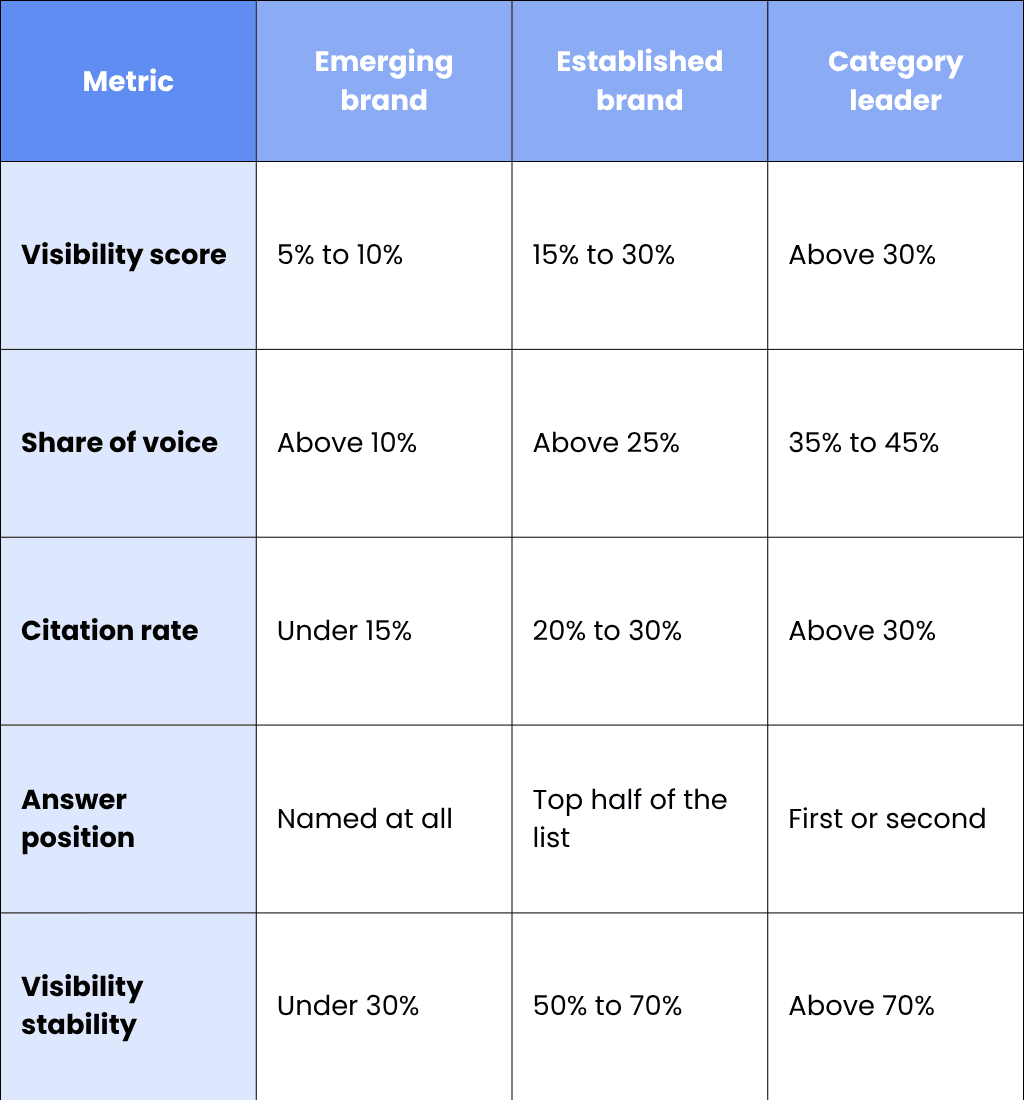
Sector context matters too. In B2B SaaS, where AI-assisted vendor research is furthest advanced, the gap between top and bottom performers is unusually wide, with leading brands earning many times the citations of their category median. In less mature categories, a visibility score in single figures may still make you the most visible brand in your market.
Tools for Tracking AI Visibility Metrics
Traditional SEO platforms cannot see inside AI answers, so a separate category of tool has emerged. Broadly there are three tiers:
- Entry level. Tools such as Otterly and ZipTie track a prompt set across the main platforms at a price accessible to small teams. Good enough to establish a baseline.
- Suite add-ons. Semrush's AI toolkit and Ahrefs Brand Radar add AI visibility reporting to platforms you may already pay for, which is usually the path of least resistance.
- Enterprise. Profound, Scrunch and similar platforms offer deeper prompt intelligence and source analysis at a corresponding cost.
Run manual checks alongside whichever tool you choose. Most trackers query APIs rather than the consumer applications your customers actually use, and the two do not always agree. A monthly manual pass over your top ten prompts keeps the dashboard honest.
Our guide to AI citation tracking covers tool selection in more depth.
A Monthly AI Visibility Report Template
Six lines is enough for a board-level report. Anything longer stops being read.
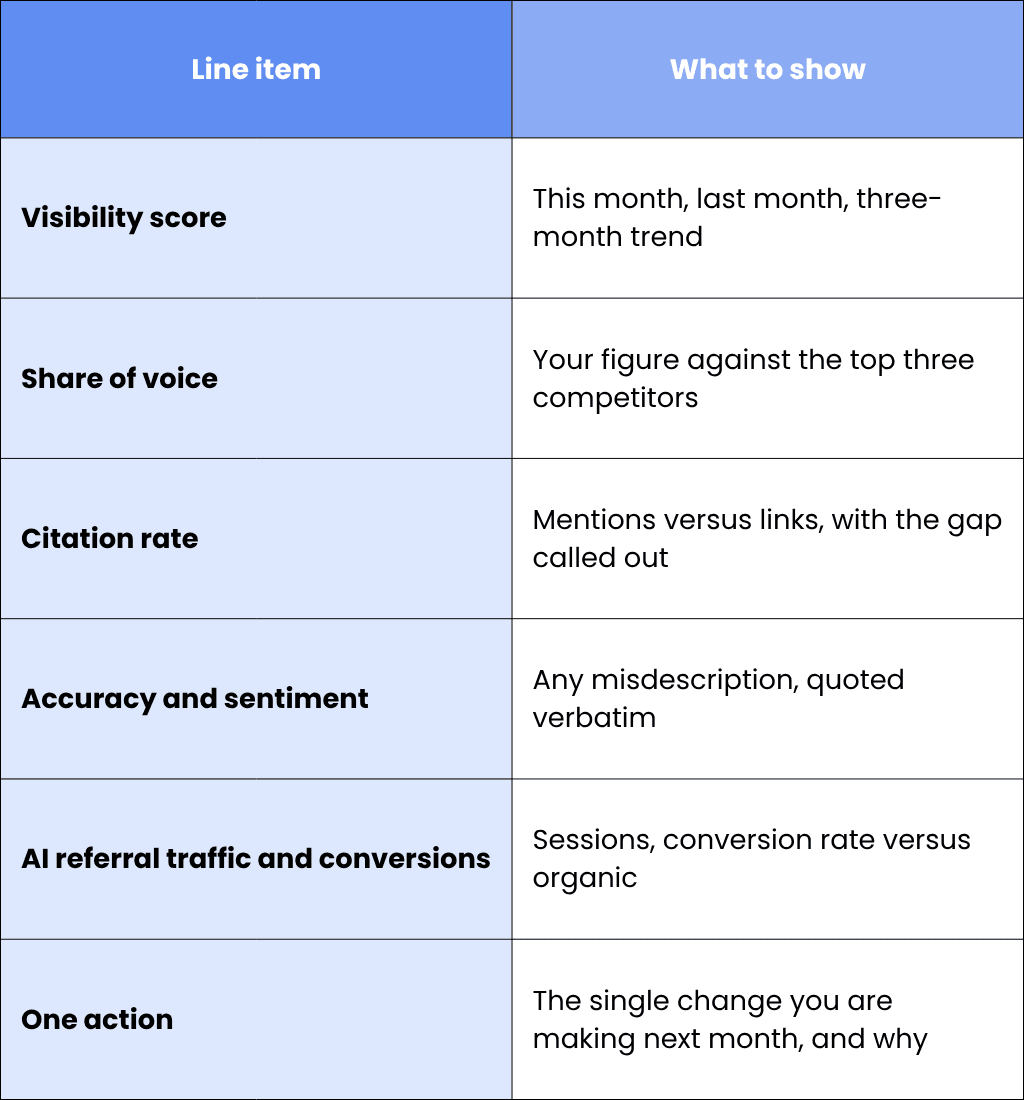
Always state the methodology under the table: number of prompts, number of runs, platforms tracked and competitive set. A visibility figure without those four things cannot be interpreted or defended.
Metrics You Will See Recommended That You Cannot Measure
Several metrics circulate widely in this field that sound rigorous and cannot actually be calculated. Knowing which is worth as much as knowing the real ones.
- Entity authority score. No public system exposes a number for this. Entity strength is real and worth working on, but it is a diagnostic you assess qualitatively, not a metric you compute.
- Predictive visibility. Appearance in autocomplete and recommendation modules is not exposed by any platform in a form you can count reliably.
- Training data inclusion. Whether your content is in a model's training set is not published and cannot be inferred from output.
- Any single "AI visibility score" out of 100. These are proprietary composites. Useful for tracking your own trend within one tool, meaningless when compared across tools or quoted as an absolute.
Diagnostics, Not Metrics
Three things are worth checking regularly but should not sit in a metrics table, because they are pass or fail rather than measured:
- Crawler access. Can GPTBot, PerplexityBot, ClaudeBot and Google-Extended reach your pages, at robots.txt, CDN and firewall level? This is the most common single cause of zero visibility.
- Entity consistency. Is your business described identically across your site, structured data, directories and social profiles?
- Knowledge panel presence. Does a branded search return a complete, accurate panel? Our guide to schema markup for AI search covers the structured data side.
Preparing for the Future of AI Visibility
In 2026, AI visibility metrics will define digital competitiveness. Rankings alone will not guarantee growth. Brands must measure how AI systems interpret, reference, and recommend them.
At Saigon Digital, we believe the future of digital growth is proactive, intelligent, and data-led. We design forward-thinking SEO and AI strategies that help brands:
- Build entity authority
- Increase generative inclusion
- Strengthen AI share of voice
- Turn visibility into measurable business growth
AI is not replacing SEO, it is redefining it. The brands that succeed will be those that adapt early, measure precisely, and optimise strategically.
Get in touch with us today to boost your brand’s AI visibility!
Frequently Asked Questions
1. What are AI visibility metrics?
AI visibility metrics measure how often, how prominently and how accurately your brand appears inside AI-generated answers on platforms such as ChatGPT, Google AI Overviews, Gemini and Perplexity. The core four are visibility score, citation rate, share of voice and sentiment.
2. How do you calculate AI share of voice?
Divide your brand mentions by the total brand mentions across all competitors in your prompt set, then multiply by 100. Report the prompt set size, the competitive set and the number of runs alongside the figure, because the number is meaningless without its denominator.
3. What is the difference between a mention and a citation?
A mention is your brand named in the answer text. A citation is a linked source attached to it. Track them separately: high mentions with low citations means models know your brand but are not using your pages as sources, which is a content structure problem rather than an authority problem.
4. How many prompts do I need to track?
Twenty to fifty prompts covers most businesses, weighted towards commercial intent. What matters more than the count is that the set stays fixed and that each prompt is run several times per measurement cycle.
5. How often should I measure AI visibility?
Monthly is the useful minimum. Weekly is worthwhile if you are running an active optimisation programme. Anything more frequent produces noise, because normal run-to-run variance will swamp any real change.
6. What is a good AI visibility score?
For an established brand, appearing in 15% to 30% of tracked prompts is a reasonable target; emerging brands typically start in the 5% to 10% range. Treat these as directional, since no standard formula exists and your own trend is the more reliable measure.
7. Can I track AI visibility in Google Search Console?
No. Search Console reports impressions and clicks from Google Search, which does not capture whether your brand was named inside an AI answer, and captures nothing at all from ChatGPT, Perplexity or Claude. You need either a dedicated tool or a manual prompt-testing process.
8. Why does my AI visibility fluctuate so much?
Two reasons. AI answers are probabilistic, so identical prompts produce different results across runs. And visibility genuinely decays, with industry analysis putting monthly decline at 40% to 60% of brands. Running multiple passes per prompt separates the noise from the real movement.