



Artificial Intelligence (AI) has evolved rapidly over the past few years, transforming how businesses create content, analyse data, automate workflows, and interact with customers. Among the many innovations driving this transformation, Retrieval-Augmented Generation (RAG) has emerged as one of the most important developments in modern AI systems.
As organisations across industries such as hospitality, education, retail, and food and beverage (F&B) explore AI adoption, many business leaders are asking the same question: what is RAG in generative AI, and why does it matter?
In this beginner's guide, we will explain what RAG in generative AI is, how it works, its benefits and challenges, real-world applications, and why it is becoming a critical technology for businesses looking to build trustworthy AI solutions.
What Is RAG in Generative AI?
RAG (Retrieval-Augmented Generation) is an AI framework that combines a large language model (LLM) with an external knowledge retrieval system.
Instead of relying solely on the information stored within its training data, a RAG system retrieves relevant information from external sources before generating a response. This allows the AI to access more current, specific, and accurate information when answering questions or completing tasks.
In simple terms:
- Traditional AI models answer based only on what they learned during training.
- RAG systems first search for relevant information.
- The retrieved information is then used to help generate a more informed response.
This approach significantly improves accuracy and reduces the risk of AI "hallucinations", where a model confidently provides incorrect information.
When people ask, "what is RAG in generative AI?", the simplest answer is:
RAG is a method that allows AI models to retrieve relevant information from external sources before generating responses, making outputs more accurate, contextual, and reliable.
Why Was RAG Developed?
To understand the importance of RAG, it helps to look at the limitations of traditional generative AI models.
Large language models such as GPT, Claude, Gemini, and Llama are trained on enormous datasets. However, they face several challenges:
1. Knowledge Cut-Off Dates
AI models only know information that existed during their training period.
For example, if a model was trained before a recent industry development, regulation, or company update, it may not have access to that information.
2. Hallucinations
Generative AI can sometimes create information that sounds convincing but is actually incorrect.
This is particularly problematic for businesses that require factual accuracy.
3. Lack of Business-Specific Knowledge
Most AI models do not automatically know:
- Internal company policies
- Product catalogues
- Customer documentation
- Private databases
- Industry-specific resources
4. Compliance and Trust Concerns
Businesses need reliable answers, especially in sectors such as education, healthcare, finance, hospitality, and retail.
Relying solely on a model's training data may not provide the level of trustworthiness required.
RAG was developed to address these limitations by giving AI access to external sources of information at the time of the request.
How Does RAG Work?
Although the technology behind RAG can be sophisticated, the basic process is relatively straightforward.
The process typically follows five key steps.
Step 1: A User Submits a Question
The process begins when a user asks a question or enters a request into the AI system.
For example, a hotel manager may ask:
"What sustainability certifications are currently recognised by international travellers?"
Similarly, a retail business owner might ask:
"What are our latest return policy guidelines for online purchases?"
At this stage, the system first analyses the user's intent and identifies the key concepts within the query. Instead of simply looking for exact keywords, modern RAG systems use natural language understanding to interpret the meaning behind the question.
This initial understanding is important because it helps ensure that the system retrieves information that is genuinely relevant to what the user is trying to achieve.
Step 2: The Retrieval System Searches for Relevant Information
Once the query has been understood, the retrieval component begins searching connected knowledge sources for useful information.
Depending on how the system is configured, these sources may include:
- Internal company documents
- Product databases
- Knowledge bases
- Websites
- Research papers
- Customer support documentation
- Training materials
- Frequently asked questions (FAQs)
Unlike a traditional search engine that often relies heavily on keyword matching, many modern RAG systems use semantic search technology. This means the system attempts to understand the meaning and context of the user's query rather than focusing only on specific words.
As a result, the retrieval process can identify information that is conceptually relevant, even when the wording differs from the original question.
Step 3: The Most Relevant Content Is Retrieved
After searching the available knowledge sources, the system identifies and selects the pieces of information that are most relevant to the user's query.
This step is particularly important because not every document or piece of content will be equally useful. The retrieval system evaluates potential sources and ranks them based on relevance, ensuring that the most valuable information is passed to the language model.
For example, if a customer asks about a company's latest shipping policy, the system may prioritise the newest policy document over older versions.
Rather than sending an entire database to the AI model, the system typically extracts only the most relevant sections or passages. This helps keep responses focused, efficient, and accurate.
Step 4: The AI Generates a Response Using the Retrieved Information
Once the relevant information has been gathered, it is provided to the large language model along with the user's original question.
At this point, the AI combines two sources of knowledge:
- Its existing training and language capabilities
- The newly retrieved information from trusted sources
Because the model has access to relevant supporting information, it can generate a response that is grounded in factual content rather than relying entirely on its memory.
This is one of the key advantages of RAG. Instead of attempting to "guess" an answer based solely on training data, the AI can reference current and relevant information during the response-generation process.
Consequently, responses are often more accurate, more detailed, and better aligned with the user's needs.
Step 5: The User Receives a More Accurate and Contextual Response
Finally, the completed response is delivered to the user.
Because the answer has been informed by retrieved information, it is typically more reliable than a response generated solely from the language model's training data.
For businesses, this can significantly improve the quality of AI-powered interactions. Customers receive more accurate support, employees gain faster access to information, and decision-makers can obtain insights based on trusted organisational knowledge.
In many advanced RAG systems, the AI can also provide citations or references to the source material used in generating the response. This additional transparency helps build trust and allows users to verify information when necessary.
Key Components of a RAG System
A Retrieval-Augmented Generation system generally consists of three major components:
1. Knowledge Source
The knowledge source is the foundation of any RAG system. It contains the information that the AI can access when responding to user queries.
Unlike traditional language models, which rely solely on information learned during training, a RAG system can retrieve information from external repositories whenever a user asks a question. This means the quality, accuracy, and organisation of the knowledge source play a critical role in determining the quality of the final response.
Knowledge sources can take many forms, including:
- Internal company documentation
- Product catalogues
- Training manuals
- Customer support articles
- Standard operating procedures (SOPs)
- Research reports
- Websites and web pages
- Frequently asked questions (FAQs)
- Databases and data warehouses
For example, a hotel group could use its operational manuals, room policies, and guest service documentation as knowledge sources. Similarly, a retail company could connect product information, inventory data, and customer service guidelines to its RAG system.
The more comprehensive and well-maintained the knowledge source is, the more useful and reliable the AI's responses will be. Conversely, outdated or poorly organised information can lead to inaccurate answers, regardless of how advanced the AI model may be.
This is why successful RAG implementations often begin with a strong focus on data quality and knowledge management.
2. Retrieval Engine
Once a user submits a query, the retrieval engine becomes responsible for finding the most relevant information from the available knowledge sources.
In many ways, the retrieval engine is the "intelligence layer" that connects users' questions with the information they need. Rather than searching for exact keyword matches alone, modern retrieval systems aim to understand the meaning and context behind a query.
For example, a user might ask:
"What should I do if a guest requests a late check-out?"
Even if the exact phrase "late check-out request" does not appear in a document, a sophisticated retrieval engine can identify related content discussing guest departure policies and retrieve it for the AI model.
To achieve this, many RAG systems use advanced technologies such as:
- Semantic search
- Vector databases
- Embeddings
- Similarity matching algorithms
These technologies help the system identify content based on meaning rather than simple keyword matching.
The retrieval engine also performs another important task: ranking results according to relevance. When multiple documents contain potentially useful information, the engine prioritises the most relevant content and sends it to the language model.
This process helps ensure that the AI receives the best available information while reducing the risk of irrelevant or misleading content influencing the final response.
In short, even the most comprehensive knowledge base would be difficult to use effectively without a retrieval engine capable of finding the right information quickly and accurately.
3. Large Language Model (LLM)
The final component of the system is the large language model, often referred to as the LLM.
This is the part of the RAG system responsible for generating natural, human-like responses. Popular examples of LLMs include models such as GPT, Gemini, Claude, and Llama.
However, in a RAG architecture, the language model does not work alone. Instead, it receives the user's question alongside the information retrieved from the knowledge source.
The model then analyses the retrieved content and uses its language capabilities to generate a response that is coherent, relevant, and easy to understand.
This is an important distinction because the language model is not simply copying information from documents. Rather, it is interpreting the information, organising it logically, and presenting it in a conversational format that is useful for the user.
For example, if a customer asks about return policies, the retrieved documents may contain multiple sections covering eligibility, timelines, and refund procedures. The language model can synthesise this information into a single, concise answer that directly addresses the customer's question.
As a result, users receive responses that are both informative and easy to consume.
The language model essentially acts as the bridge between raw information and human communication.
How These Components Work Together
While each component plays a distinct role, the true power of RAG comes from how these elements work together as a unified system.
The process typically unfolds as follows:
- A user asks a question.
- The retrieval engine searches the knowledge source.
- Relevant information is identified and retrieved.
- The language model analyses the retrieved content.
- A clear and contextual response is generated.
If any one of these components is weak, the overall performance of the system can suffer. For example:
- A poor knowledge source may provide inaccurate information.
- An ineffective retrieval engine may fail to find the most relevant content.
- A weak language model may struggle to communicate information clearly.
On the other hand, when all three components are properly implemented and maintained, organisations can create AI systems that are significantly more accurate, trustworthy, and useful than traditional standalone language models.
RAG vs Traditional Generative AI
One of the easiest ways to understand what RAG in generative AI means is by comparing it with a standard language model.
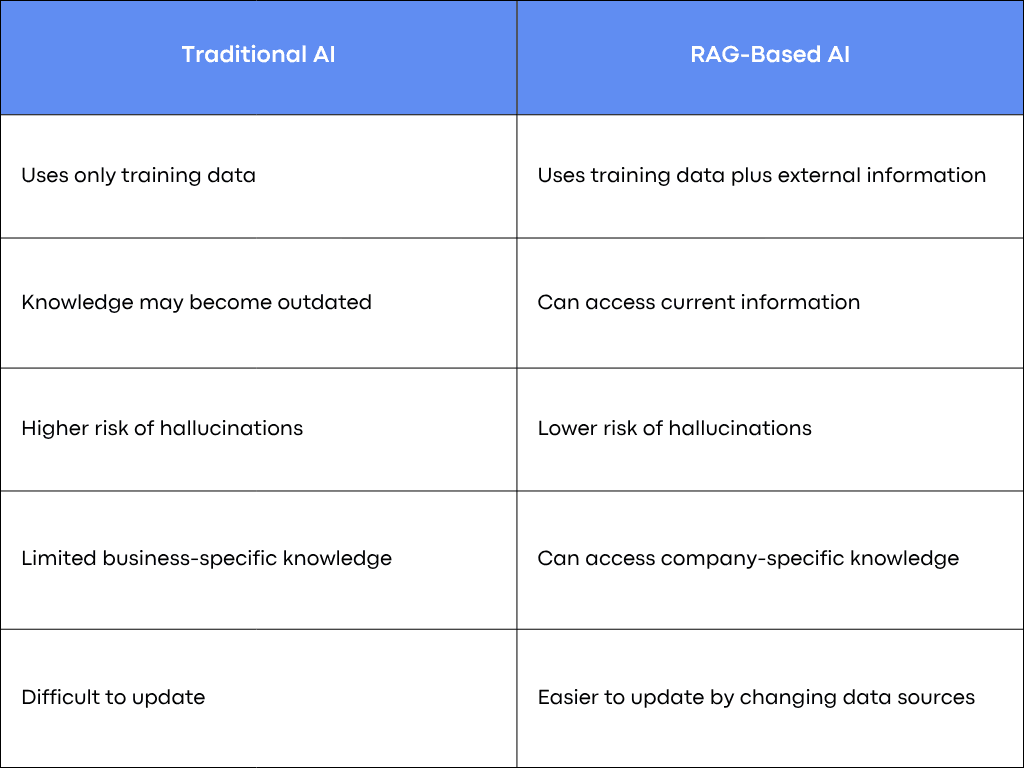
This is why many organisations are moving towards RAG-based solutions rather than relying solely on general-purpose AI models.
What Is an Example of a RAG Solution?
One of the most common questions people ask after learning about Retrieval-Augmented Generation is:
"Is ChatGPT a RAG system?"
The answer is both yes and no.
To understand why, it is important to distinguish between a large language model (LLM) and a RAG solution.
A large language model such as ChatGPT, Gemini, Claude, or Llama is the AI model responsible for understanding language and generating responses. A RAG solution, on the other hand, is a system that combines a language model with a retrieval mechanism that can access external information sources.
In other words, RAG is not a specific AI product. Rather, it is an architecture that can be built using various AI models.
ChatGPT and RAG
By itself, ChatGPT is a large language model that generates responses based on its training and any information available within the conversation.
However, when ChatGPT is connected to external knowledge sources, documents, databases, websites, or enterprise systems, it can become part of a RAG solution.
For example, a company might build an internal AI assistant powered by ChatGPT and connect it to:
- Employee handbooks
- Internal policies
- Product documentation
- Customer support resources
- Company databases
When an employee asks a question, the system retrieves relevant information from these sources before ChatGPT generates an answer.
In this scenario, the overall solution is a RAG system, while ChatGPT serves as the language model component.
Gemini and RAG
The same principle applies to Gemini.
Gemini itself is a large language model developed by Google. However, organisations can build RAG applications using Gemini as the underlying AI model while connecting it to proprietary knowledge bases and business data.
For instance, an educational institution could use Gemini alongside its course materials, student resources, and academic documentation. When students ask questions, the system retrieves relevant information before generating a response.
Again, the RAG system consists of both the retrieval layer and the language model working together.
Real-World Examples of RAG
One of the best ways to understand the value of Retrieval-Augmented Generation is to see how it is used in real-world business environments.
Below are some of the most common real-world applications of RAG.
1. Customer Support
Customer service is one of the most popular use cases for RAG because customers expect fast and accurate answers to their questions.
Traditionally, support agents needed to manually search through documentation, policies, and knowledge bases to find information. While AI chatbots have helped automate some of these interactions, standard chatbots often struggle when information changes or when they need access to company-specific knowledge.
This is where RAG can make a significant difference.
For example, a customer might ask:
"How do I return a product that I purchased online?"
Rather than relying on generic training data, a RAG-powered assistant can retrieve the latest return policy directly from the company's documentation. It can then generate a response that accurately reflects current procedures, eligibility requirements, and timelines.
Similarly, customers may ask questions about:
- Shipping policies
- Warranty coverage
- Refund processes
- Product specifications
- Membership programmes
Because the information comes directly from approved business resources, customers receive more reliable answers while support teams reduce their workload.
Consequently, businesses can improve customer satisfaction while operating more efficiently.
2. Hospitality
The hospitality industry depends heavily on delivering accurate information and exceptional guest experiences. From hotels and resorts to restaurants and travel providers, staff frequently answer questions about services, policies, and local recommendations.
A RAG-powered AI assistant can help streamline these interactions.
For instance, a hotel guest may ask:
"Do you offer airport transfers, and what are the current charges?"
Instead of providing a generic response, the system can retrieve information directly from the hotel's latest service documentation and generate an accurate answer.
Likewise, guests may have questions about:
- Check-in and check-out policies
- Room availability
- Dining options
- Loyalty programmes
- Spa and recreational services
- Local attractions
By retrieving information from operational systems and internal knowledge bases, the AI can provide consistent and up-to-date responses around the clock.
As a result, hospitality businesses can improve guest experiences while reducing the burden on front desk and customer service teams.
3. Education
Educational institutions generate enormous amounts of information, including course materials, student handbooks, academic policies, research resources, and administrative documentation.
Finding the right information can often be time-consuming for both students and staff.
With RAG, educational organisations can create intelligent assistants that retrieve information from approved academic sources and provide clear, contextual answers.
For example, a student might ask:
"What are the requirements for submitting my final project?"
The AI can retrieve the relevant guidelines from course documentation and present them in a concise and easy-to-understand format.
Educational applications may include:
- Student support assistants
- Course information portals
- Academic research tools
- Administrative support systems
- Staff knowledge assistants
Importantly, because the system references official institutional resources, students are more likely to receive accurate and trustworthy information.
This can improve the overall learning experience while reducing repetitive administrative enquiries.
4. Retail
Retail businesses operate in fast-moving environments where information changes frequently. Product inventories, pricing, promotions, shipping policies, and customer service guidelines are constantly evolving.
Traditional AI systems may struggle to keep pace with these changes, especially when they rely on static training data.
A RAG-powered solution can overcome this challenge by retrieving information directly from current business systems.
For example, a customer may ask:
"Is this product currently in stock, and how long will delivery take?"
The system can retrieve the latest inventory and fulfilment information before generating a response.
Retail organisations can also use RAG for:
- Product recommendations
- Customer support automation
- Inventory enquiries
- Returns and exchanges
- Personalised shopping assistance
- Employee training and support
Because the AI is connected to live business information, customers receive more relevant answers and employees can make faster, better-informed decisions.
This can lead to improved customer experiences, increased efficiency, and stronger sales performance.
5. Internal Knowledge Management
While many discussions around AI focus on customer-facing applications, some of the most valuable RAG implementations are designed for internal use.
Large organisations often store thousands of documents across multiple systems. Employees may spend considerable time searching for policies, procedures, reports, or operational information.
A RAG-powered knowledge assistant can transform how teams access information.
For example, an employee might ask:
"What is the process for approving a new supplier?"
Instead of manually searching through internal documentation, the AI can retrieve the relevant procedure and provide a clear summary.
Internal knowledge management systems can support a wide range of business functions, including:
- Human resources
- Finance
- Operations
- Sales
- Marketing
- Compliance
- Procurement
This reduces the time employees spend searching for information and allows them to focus on higher-value work.
For growing organisations, the productivity gains can be substantial.
6. E-Commerce Product Discovery
Another increasingly common application of RAG is helping customers discover products more effectively.
Traditional website search functions often rely on exact keywords, which can make it difficult for shoppers to find what they need.
RAG-powered assistants can interpret customer intent and retrieve relevant product information before generating personalised recommendations.
For example, a shopper may ask:
"I'm looking for a lightweight suitcase suitable for a two-week international trip."
Rather than displaying a list of keyword matches, the system can retrieve relevant product details and recommend options that align with the customer's needs.
This creates a more conversational shopping experience and can help improve conversion rates.
7. Corporate Training and Employee Onboarding
Many organisations struggle to provide new employees with quick access to training materials and institutional knowledge.
A RAG-powered onboarding assistant can help employees learn more efficiently by retrieving information from training documents, internal guides, and company resources.
For example, a new employee might ask:
"How do I submit an expense claim?"
The system can retrieve the relevant procedure and explain the process step by step.
This not only accelerates onboarding but also reduces the number of repetitive questions directed towards managers and support teams.
As organisations grow, this type of AI-powered knowledge support becomes increasingly valuable.
What Businesses Should Know Before Implementing RAG
While Retrieval-Augmented Generation offers significant benefits, implementing a successful RAG solution requires more than simply connecting an AI model to a collection of documents. Businesses should take a strategic approach to ensure the technology delivers meaningful and measurable outcomes.
Before investing in a RAG system, consider the following key factors.
1. Define Clear Objectives
The first step is to identify exactly what business problem you are trying to solve.
Although RAG can support a wide range of use cases, the most successful implementations begin with a clear objective rather than adopting AI for its own sake. By defining your goals early, you can ensure the solution is designed around real business needs.
For example, your organisation may want to:
- Improve customer support response times
- Reduce repetitive employee enquiries
- Provide faster access to internal knowledge
- Enhance product recommendations
- Support sales or service teams with accurate information
Once clear objectives have been established, it becomes much easier to measure success and evaluate the return on investment of the project.
2. Organise Your Data
A RAG system is only as effective as the information it can access.
For this reason, businesses should assess the quality of their existing knowledge sources before implementation. If documentation is outdated, inconsistent, or difficult to locate, the AI may struggle to provide accurate responses.
Where possible, ensure that your information is:
- Accurate
- Up to date
- Well organised
- Clearly structured
- Regularly maintained
Investing time in data preparation often delivers significant long-term benefits, as high-quality information forms the foundation of an effective RAG system.
3. Focus on User Experience
Even the most advanced AI solution will have limited value if users find it difficult to use.
Therefore, businesses should consider how employees, customers, or stakeholders will interact with the system on a day-to-day basis. The experience should feel intuitive, efficient, and aligned with user expectations.
This may involve:
- Designing clear conversation flows
- Providing easy access to information
- Ensuring responses are concise and relevant
- Creating a seamless experience across digital channels
By prioritising usability alongside technical performance, organisations can encourage adoption and maximise the value of their AI investment.
4. Measure Results
Like any business initiative, a RAG implementation should be monitored and evaluated over time.
Establishing key performance indicators (KPIs) from the outset allows organisations to assess whether the system is delivering the intended outcomes. It also helps identify opportunities for ongoing improvement.
Common metrics may include:
- Response accuracy
- Customer satisfaction scores
- Employee productivity gains
- Reduced support workload
- Faster information retrieval
- Cost savings through automation
Regular measurement ensures the system continues to evolve alongside business needs while demonstrating tangible value to stakeholders.
How Saigon Digital Helps Businesses Prepare for the AI Era
As AI continues to reshape how customers discover information and interact with brands, businesses need more than technology, they need a strategic partner that understands digital growth.
At Saigon Digital, we help ambitious brands design, build, and scale digital experiences that drive measurable business results.
Our services include:
SEO Services
We help businesses improve visibility, attract qualified traffic, and generate sustainable growth through:
- Site optimisation and technical performance improvements
- Content and authority building
- Local and global search strategies
Generative Engine Optimisation (GEO)
As AI-powered search experiences become more common, brands need to ensure they are discoverable by platforms such as ChatGPT, Gemini, Perplexity, and Google AI.
Our GEO services include:
- AI Readability Optimisation
- Generative Engine Optimisation (GEO)
- Answer Engine Optimisation (AEO)
- Knowledge Graph and Schema implementation
- AI content audits and restructuring
- AI performance reporting and monitoring
AI Workflow Automation Services
We help organisations streamline operations through:
- AI-driven intelligence
- Pre-built automation frameworks
- Custom AI agents
- Workflow automation solutions
Whether your goal is improving search visibility, preparing your content for AI discovery, or implementing intelligent automation, Saigon Digital provides bespoke, user-centric solutions designed for long-term growth.
The Next Step Towards Smarter AI Adoption
Understanding what is RAG in generative AI is increasingly important for businesses looking to adopt AI responsibly and effectively.
For businesses exploring AI, SEO, Generative Engine Optimisation, or workflow automation, now is the ideal time to build a strategy that aligns technology with measurable business outcomes.
Let’s build your next digital success story together. Get in touch with Saigon Digital today to start turning search intent into measurable results.
Frequently Asked Questions About RAG
1. What is RAG in generative AI?
RAG stands for Retrieval-Augmented Generation. It is a framework that allows AI systems to retrieve relevant information from external sources before generating responses.
2. Why is RAG important?
RAG improves accuracy, reduces hallucinations, provides access to current information, and enables AI systems to use business-specific knowledge.
3. Does ChatGPT use RAG?
Modern AI systems can use RAG techniques when connected to external information sources. The underlying implementation depends on how the AI application is designed.
4. Is RAG better than fine-tuning?
They serve different purposes.
Fine-tuning changes the model itself, while RAG gives the model access to external information. In many business scenarios, RAG is more flexible and easier to maintain.
5. Which industries benefit from RAG?
Virtually any industry can benefit, including:
- Retail
- Hospitality
- Education
- F&B
- Healthcare
- Financial services
- Professional services