



The way people discover information online is changing.
For years, businesses have focused on helping search engines such as Google find, understand, and rank their websites. That remains essential. However, the rise of generative AI is introducing a new layer to digital discovery. People can now ask AI-powered platforms questions in natural language and receive direct answers, summaries, recommendations, and links to relevant sources.
This shift has led to a growing question among businesses on how Google and other AI search engines get their answers and what businesses should do so their services show up on these AI platforms.
The answer is AI crawlers.
In this guide, we will explain what an AI crawler is, how AI crawling works, how it differs from traditional search engine crawling, and what businesses can do today to prepare for an increasingly AI-driven search landscape.
Key Takeaways
- AI crawlers are automated programmes that discover and process web content for AI-related services, including AI-powered search and information retrieval.
- Crawling does not guarantee AI visibility. Your content must also be relevant, useful, accessible, accurate, and trustworthy to have the potential to be retrieved or cited.
- AI crawlers do not replace traditional search crawlers. Both play different roles, but strong SEO fundamentals remain important across the evolving search landscape.
- Make your website easy to understand. Clear site architecture, accessible content, logical internal linking, structured data, and consistent information can help search and AI systems interpret your business.
- Prepare for AI-driven search by strengthening your digital foundations. Focus on technical SEO, high-quality content, expertise, authority, and a clear understanding of your customers' questions and search intent.
What Is an AI Crawler?
At its simplest, an AI crawler is a bot or automated programme that accesses websites and gathers information that an AI-powered system may use for discovery, retrieval, indexing, or other purposes.
To understand this, it helps to think about how the web works.
The internet contains billions of pages. No person could manually read and organise them all. Search engines and other digital services therefore use automated crawlers to visit websites, follow links, discover pages, and collect information.
Traditional search engines have used web crawlers for decades.
Google, for example, uses automated crawlers to discover pages that can potentially be added to its search index. When a user performs a search, Google's systems can then retrieve relevant information from that index and determine which results to show.
AI-powered search introduces additional ways for information to be discovered and retrieved.
An AI system may need to identify relevant sources for a user's question, retrieve information from the web, process that information, and generate a response. In this context, an AI crawler can be part of the infrastructure that helps an AI-powered service discover and access web content.
For example, OpenAI identifies OAI-SearchBot as a crawler used to help surface websites in ChatGPT search. Perplexity similarly operates PerplexityBot, which is described as a crawler designed to surface and link websites in Perplexity search results.
How Does an AI Crawler Work?
Although the exact technology differs between platforms, most AI crawling and retrieval systems follow a similar process. First, a crawler discovers a page. Then, it attempts to access and process the content before the wider system determines whether that information is useful for search, retrieval, or other AI-powered experiences.
A simple way to understand the process is:
Discover → Access → Process → Retrieve → Select → Present
The important thing to remember is that crawling is only the beginning. A page can be successfully crawled without necessarily appearing in an AI-generated answer. Several other factors, including relevance, content quality, accessibility, and the purpose of the AI system, can influence what happens next.
The AI Crawling Process at a Glance
The entire process can be summarised as follows:
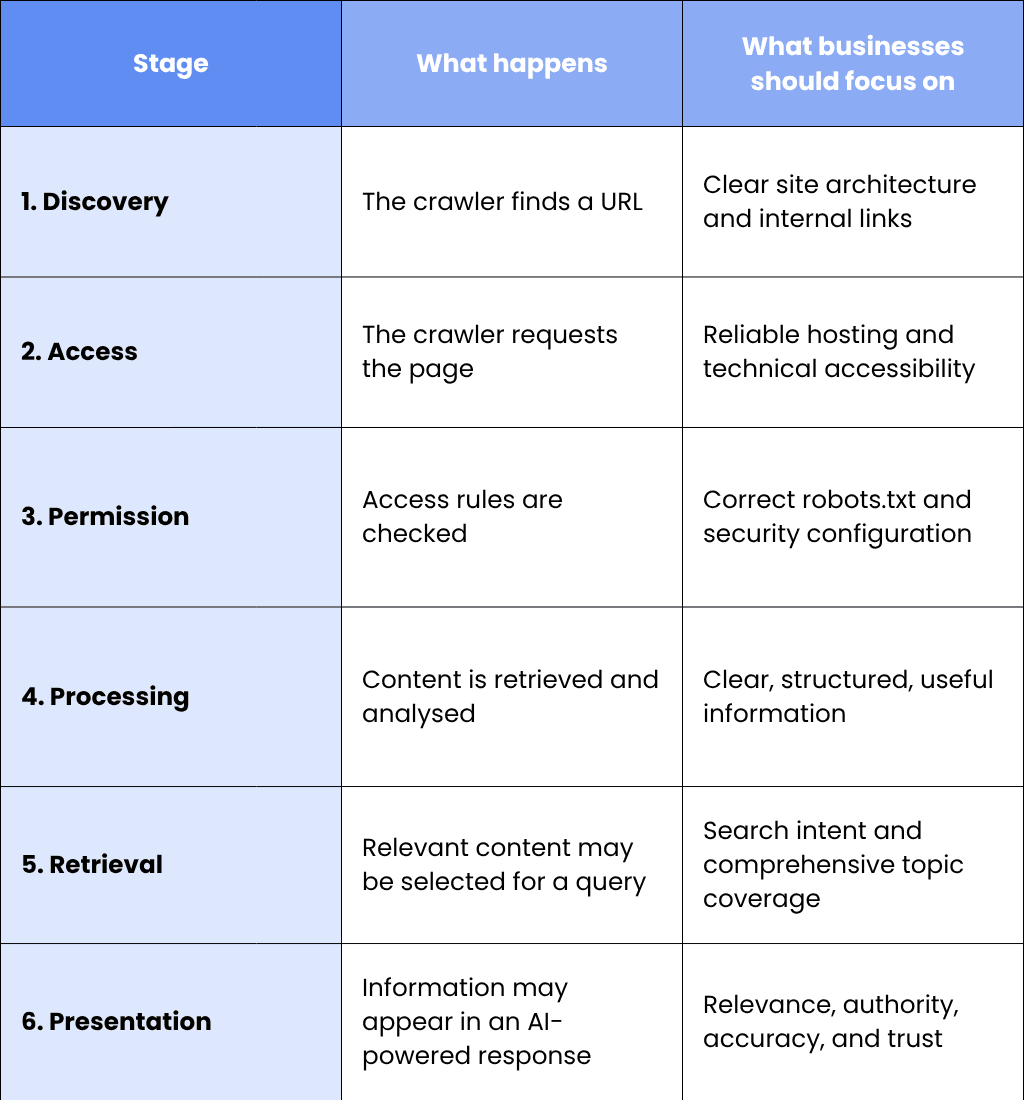
Let's look at each stage in more detail.
1. The Crawler Discovers a Website or Page
Before an AI crawler can read a webpage, it first needs to know that the page exists. This process is known as discovery.
A crawler may discover URLs through several sources, including:
- Internal links from other pages on the same website
- External links from other websites
- XML sitemaps
- Previously discovered URLs
- Search indexes or other databases
- Other discovery mechanisms used by the platform
This is why website architecture matters. When important pages are connected through clear internal links, automated systems have more opportunities to discover them and understand how they relate to the rest of the website.
For example, imagine a hotel website with the following structure:
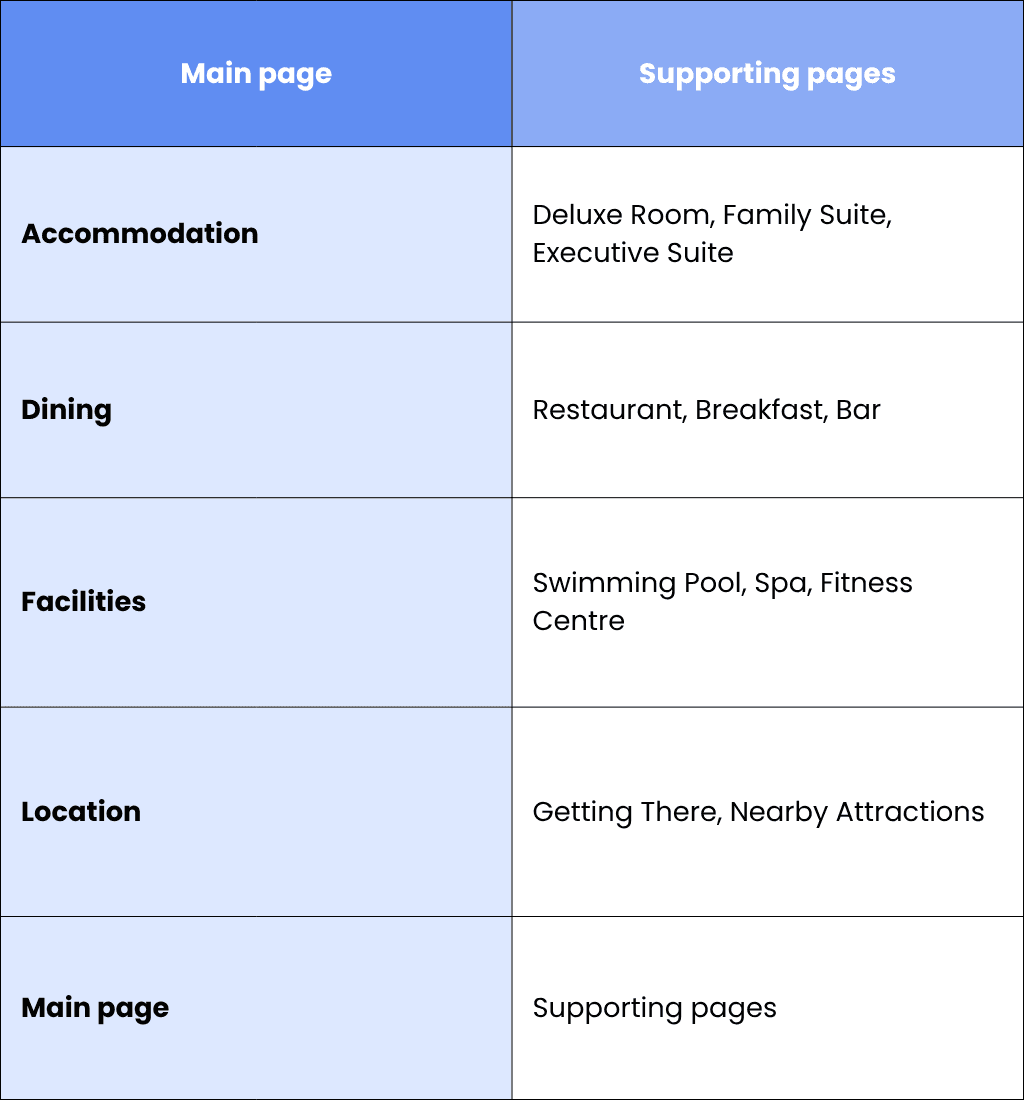
A visitor can easily move between related pages. At the same time, crawlers can follow these connections to discover more of the site's content.
By contrast, if a hotel's page about its family suites is not linked from the main accommodation section, the page may be much harder to discover. Therefore, a good internal linking structure is not simply an SEO technique; it also creates a clearer map of your business for both people and automated systems.
Practical takeaway: Make your most important pages easy to discover. If a page matters to your customers or generates revenue, it should generally be connected to relevant parts of your website rather than left isolated.
2. The Crawler Requests the Page
Once a crawler discovers a URL, it attempts to access the page by sending a request to the website's server. The server then responds by either providing the requested content or returning a response that prevents the crawler from accessing it.
Several technical factors can affect this process, including:
- Server availability
- HTTP status codes
- Robots.txt rules
- Firewalls and security systems
- Bot protection
- Rate limiting
- Authentication requirements
- Geographic restrictions
- JavaScript rendering requirements
For example, suppose a retail company has a product page that works perfectly when a customer visits it in a browser. However, the site's security system mistakenly identifies an automated crawler as suspicious and blocks its request. In that situation, the page may be available to humans but inaccessible to the crawler.
Similarly, a page that returns a 404 Not Found error cannot be processed as a normal content page. A 500 server error may indicate a temporary or ongoing technical problem that also prevents successful access.
This is why technical SEO matters when preparing a website for AI-driven search. A well-written article cannot contribute to visibility if the systems that need to access it cannot reach it reliably.
Practical takeaway: Regularly check your website's technical health. A useful page should be accessible not only to users but also to legitimate search and AI-related crawlers that you want to reach it.
3. The Crawler Checks Access Rules
After reaching a website, a crawler may encounter rules that determine which parts of the site it can access.
One of the main mechanisms involved is the robots.txt file. This file allows website owners to provide instructions to automated crawlers about which areas they should or should not access.
For example, a website might have sections containing:
- Public marketing content
- Customer account areas
- Internal search results
- Temporary development pages
- Administrative sections
A business may choose to restrict crawler access to some of these areas while keeping its public content accessible.
However, robots.txt needs to be handled carefully. It is not a universal privacy mechanism, nor does it guarantee that a URL will never appear in search results. If the goal is to prevent a page from being indexed, website owners may need to use other mechanisms, such as noindex, or protect the content with authentication.
It is also important to remember that different platforms may operate different crawlers. Therefore, a website owner should understand which crawlers are relevant to their objectives before changing access rules.
For example, a company may want to make its public service pages available to search and AI-powered discovery systems while restricting access to private or low-value sections of the website.
The decision should therefore be strategic rather than automatic.
Ask yourself: Which parts of our website do we want search engines and AI platforms to discover, and which parts should remain restricted?
Practical takeaway: Review your robots.txt file and other access controls regularly. Make sure they support your business objectives rather than unintentionally blocking valuable content.
4. The Crawler Retrieves and Processes Content
If the crawler is allowed to access the page, it can retrieve the content and pass it through the platform's processing systems.
At this stage, the system may analyse various elements of the webpage, including:
- Main body content
- Page titles
- Headings
- Links
- Metadata
- Structured data
- Images and associated information
- Other publicly accessible page elements
The exact process varies between platforms. Some systems may use this information to maintain a search index, while others may retrieve content in response to a specific user question.
This is where content clarity becomes increasingly important.
Consider two versions of a hotel page.
Version A: "Experience an unforgettable stay at our luxury hotel, where comfort meets excellence."
Version B: "Our hotel is located in central Hanoi, 10 minutes from Hoan Kiem Lake. Guests can choose from 120 rooms, including family rooms and suites. Facilities include an outdoor swimming pool, fitness centre, and all-day dining restaurant."
Both pages may sound professional. However, Version B communicates significantly more concrete information. It tells users and automated systems exactly what the business offers, where it is located, and which facilities are available.
Therefore, businesses should avoid relying exclusively on vague marketing language. Instead, combine persuasive messaging with clear, factual information.
Practical takeaway: Write content that is easy to interpret. Clearly state what you offer, who you serve, where you operate, and why customers should choose you.
5. Relevant Information May Be Retrieved for a Query
After content has been discovered and processed, an AI-powered search system may retrieve relevant information when a user asks a question.
This is where AI-driven search can differ from a traditional keyword search experience.
For example, a traveller might search:
"What are the best family-friendly hotels near the beach in Da Nang with breakfast and a swimming pool?"
The question contains several requirements:
- Business type: Hotels
- Audience: Families
- Location: Da Nang
- Proximity: Near the beach
- Facility: Swimming pool
- Service: Breakfast
A business that clearly communicates all six points on its website gives search and AI systems more information to work with.
For example, a hotel could have dedicated pages or clearly structured sections covering:
- Family room options
- Distance from the beach
- Breakfast service
- Swimming pool facilities
- Location information
- Nearby attractions
The same principle applies across industries.
A retailer should explain product features and use cases. An education provider should clearly describe courses, entry requirements, and outcomes. An F&B business should communicate its cuisine, location, dietary options, opening hours, and dining experience.
In other words, AI-driven search increasingly rewards businesses that answer the questions customers actually ask.
Practical takeaway: Think beyond individual keywords. Identify the questions, needs, and decision-making factors behind those searches, then make sure your website addresses them clearly.
6. The System Selects and Presents Relevant Information
The final stage is where the information retrieved by an AI-powered system may contribute to the answer shown to a user.
Depending on the platform, the system may:
- Generate a direct answer
- Summarise information from multiple sources
- Provide links to supporting webpages
- Cite sources
- Recommend businesses or products
- Ask follow-up questions
- Combine information from different parts of the web
For example, a user asking for a restaurant recommendation might receive an answer that summarises several options and links to their websites. A student researching university courses might receive a comparison of different programmes based on information gathered from multiple sources.
However, being crawled does not guarantee that a business will be selected.
A simplified example illustrates why:
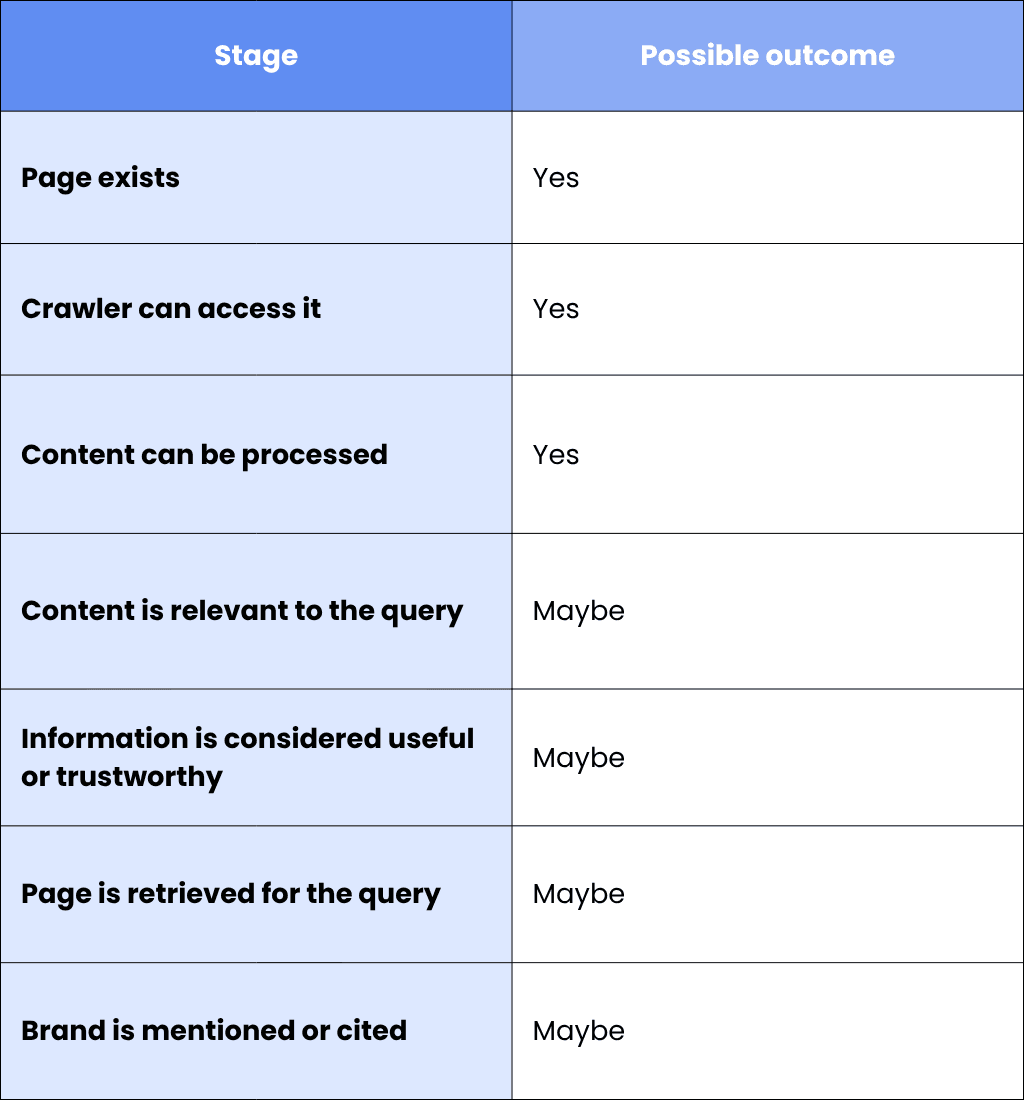
Therefore, businesses should think beyond "Can AI crawl my website?"
The more valuable question is: "Does my website provide clear, useful, trustworthy information that could help answer my customers' questions?"
This shift in thinking is important because it moves the focus from technical accessibility alone towards a more complete approach that combines technical SEO, content quality, authority, user experience, and brand visibility.
Practical takeaway: Treat crawlability as the foundation, not the final objective. Your ultimate goal should be to build a digital presence that search engines and AI systems can access, understand, and confidently associate with the topics relevant to your business.
The key takeaway is that AI crawling is a process, not a ranking factor or visibility guarantee. A business needs to succeed at multiple stages to maximise its chances of being discovered and represented in AI-driven search.
For this reason, companies preparing for the future of search should take a holistic approach. Technical SEO ensures that crawlers can access important content. Content strategy ensures that the information is useful and relevant. Meanwhile, authority, structured data, and consistent business information help search and AI systems build a clearer understanding of the brand.
Together, these elements create a stronger foundation for visibility as search continues to evolve.
AI Crawlers vs Traditional Search Engine Crawlers: What's the Difference?
The terms "AI crawler" and "search engine crawler" can sometimes sound interchangeable. There is considerable overlap, but the broader systems they support may work differently.
A traditional search engine crawler generally helps discover and process pages that can be included in a search engine's index.
An AI-related crawler may support:
- AI-powered search
- Retrieval of relevant web sources
- Search result generation
- Content discovery
- Other AI-related services
The most important distinction is therefore not necessarily the crawler itself, but what the crawler supports and how the resulting information is used.
Consider the following simplified comparison:
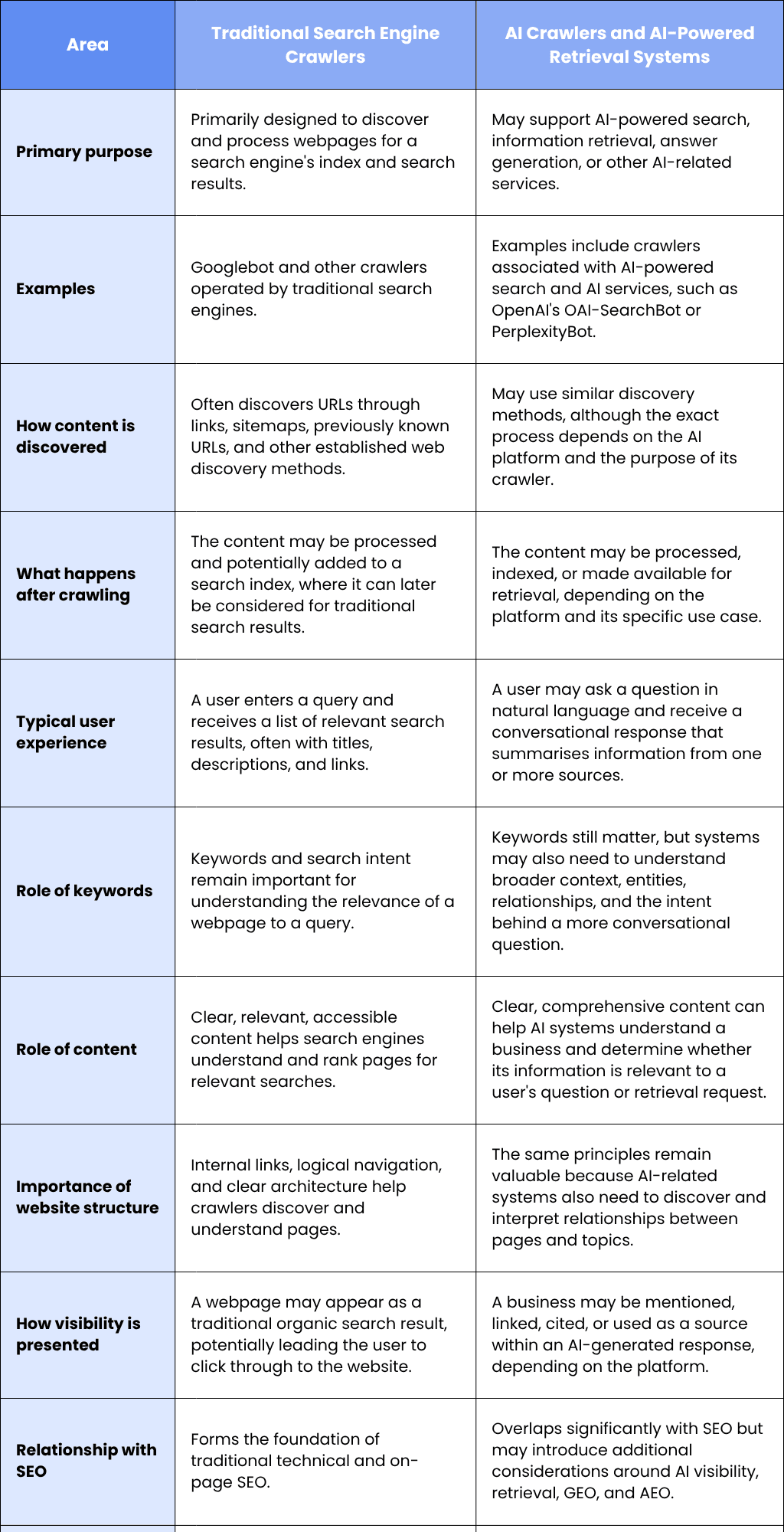
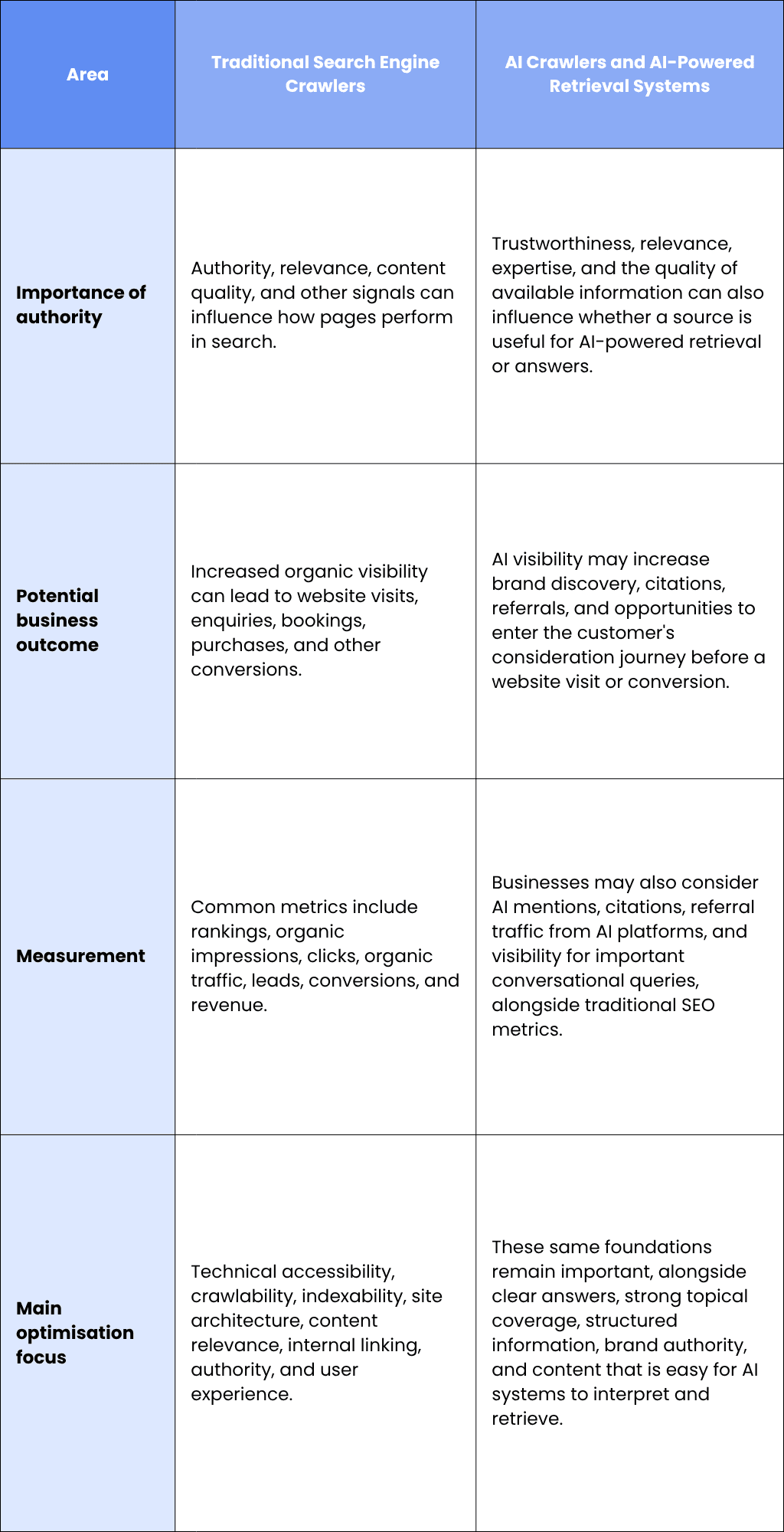
The two experiences are not completely separate.
In fact, Google's own documentation emphasises that traditional SEO fundamentals remain relevant to AI features such as AI Overviews and AI Mode. Pages need to meet the technical requirements for Google Search and be eligible to appear in search before they can be used as supporting links in these AI experiences.
This leads to an important conclusion: AI search does not make SEO obsolete. It makes strong SEO foundations even more important.
Does an AI Crawler Read Every Website?
No.
Just because a website exists online does not mean every crawler will automatically access every page.
A crawler may be unable to access a page because:
- The page is blocked by robots.txt
- The server returns an error
- The page requires authentication
- A firewall blocks the crawler
- Bot protection prevents access
- The page is not discoverable through useful links
- The content is dynamically loaded in a way that creates accessibility challenges
- The crawler simply has not discovered or requested the page
Even when a crawler can access a page, that does not guarantee that the content will be indexed, retrieved, cited, or displayed in an AI-generated answer.
This distinction is critical.
Crawlability is not the same as visibility.
A crawler being able to access your website is only one part of the process.
A useful way to think about the journey is:
Crawl → Process → Index or retrieve → Evaluate relevance → Select → Display
Different platforms may use different processes, but the principle remains: getting crawled is an opportunity, not a guarantee of visibility.
Google explicitly notes that meeting technical requirements and following best practices does not guarantee that a page will be crawled, indexed, or served in search.
What Makes a Website Easier for AI Systems to Understand?
There is no single "AI optimisation" technique that guarantees your business will appear in AI-generated answers. Instead, businesses should focus on making their websites technically accessible, logically structured, factually clear, and genuinely useful.
The clearer that information is, the easier it becomes for search engines, AI systems, and, most importantly, your customers to understand what your business does.
A useful framework is:
Accessible → Structured → Clear → Helpful → Trustworthy → Consistent
Let's look at the key factors in more detail.
1. Create Clear Website Architecture
A well-organised website gives both users and automated systems a logical path through your content.
Website architecture refers to how your pages are organised and connected. Ideally, visitors should be able to move from broad topics to more specific information without getting lost.
For example, consider the website of an education provider:
Home → Courses → Business Courses → MBA → Course Details
Or a retail website:
Home → Women's Clothing → Dresses → Evening Dresses → Product Page
Or a hotel:
Home → Accommodation → Rooms → Deluxe Ocean View Room
This structure creates context.
When a page is linked to other relevant pages, it becomes easier to understand how that page fits into the wider topic. For example, a hotel room page linked from an accommodation hub clearly belongs to the hotel's accommodation offering. If the same page also links to breakfast, facilities, and location information, it creates additional context around the customer experience.
This is where internal linking becomes particularly valuable.
Rather than treating internal links as a way to simply move visitors from one page to another, businesses can use them to build meaningful relationships between topics.
For example:
Hotel in Hanoi → Rooms → Family Rooms → Family Activities in Hanoi
The relationship between these pages helps communicate a broader story about the business and its audience.
A useful rule is the three-click principle: while there is no universal requirement that every page must be reachable within exactly three clicks, important content should generally be easy for users and crawlers to reach.
Practical takeaway: Review your website as if you were seeing it for the first time. Can a visitor quickly understand what you offer? Can they easily find your most important products, services, and information? If not, AI systems may also have difficulty understanding the relationships between your pages.
2. Make Important Content Accessible
Before an AI system can understand your content, it needs to be able to access it.
This sounds obvious, but many websites contain valuable information that is difficult for automated systems to retrieve.
For example, important information might be:
- Hidden behind a login
- Blocked by robots.txt
- Loaded in a way that creates rendering issues
- Available only through an interactive tool
- Buried deep within the website
- Inaccessible because of server errors
- Blocked by security or bot protection systems
Imagine a hotel that has a detailed page explaining its family facilities, but the information is only available after a visitor interacts with a complex booking widget.
A human user may eventually find the information. However, if the information is not available in an accessible format, it may be harder for automated systems to retrieve and interpret.
This is why important information should generally be available in clear, crawlable content.
For example, instead of relying only on: "We offer excellent facilities for families."
A hotel could clearly state: "Our family facilities include connecting rooms, a children's swimming pool, babysitting services, and a dedicated children's menu."
The second version provides significantly more information.
It tells users exactly what is available, while also making the business's offering more explicit to search and AI systems.
Practical takeaway: Identify the pages and information that directly support your business goals. Then, check whether users and legitimate crawlers can access that information without unnecessary technical barriers.
3. Write for Questions, Not Just Keywords
Traditional SEO often starts with keyword research. This remains important, but AI-driven search encourages businesses to think more deeply about search intent.
A keyword tells you what someone types.
A question tells you what someone wants to know.
For example, someone searching for: "best hotel Hanoi"
may actually be asking: "Which area of Hanoi is best for my trip, and which hotel is suitable for my needs?"
Similarly, someone searching for: "English course Vietnam"
may really want to know: "Which English course is best for improving my business communication skills?"
The difference matters.
Instead of creating content that repeatedly uses the same keyword, businesses can create useful resources that answer the questions behind that keyword.
For example, a hotel might publish content covering:
- Which areas of Hanoi are best for first-time visitors?
- What should families look for when choosing a Hanoi hotel?
- How far is the hotel from major attractions?
- Does the hotel provide airport transfers?
- Which room types are suitable for families?
A retailer might answer:
- Which product is best for beginners?
- What is the difference between Product A and Product B?
- What should customers consider before buying?
- How should the product be used?
- Which features matter most for a particular use case?
This approach creates content that is useful beyond a single search query.
It also gives AI systems more context to work with when interpreting questions.
Practical takeaway: For every important product, service, or topic, ask yourself: What questions would a potential customer ask before choosing us?
Then, make sure your website provides clear answers.
4. Demonstrate Expertise and Trust
AI systems need to process enormous amounts of information. As a result, businesses should not assume that simply publishing content will make their brand a credible source.
The quality and credibility of the information matter.
This is particularly important for industries where inaccurate information can have significant consequences, such as education, healthcare, finance, professional services, and other specialist sectors.
Businesses can strengthen trust by demonstrating:
- Relevant expertise
- First-hand experience
- Accurate and up-to-date information
- Transparent authorship
- Clear business credentials
- Reliable sources
- Evidence to support important claims
- Genuine customer experiences
- Consistent brand information
For example, compare these two statements from an education provider.
Statement A: "We are one of the leading education providers in the region."
Statement B: "Our business programme is delivered by lecturers with experience in finance, marketing, and entrepreneurship. The programme includes practical case studies, group projects, and industry-led workshops."
The second statement provides more meaningful information.
It explains why the organisation may be qualified and what the learner can expect.
Similarly, a hotel could provide specific information about its facilities rather than relying entirely on phrases such as "world-class service". A retailer could explain how products are tested or sourced rather than simply calling them "high quality".
Practical takeaway: Ask whether your website demonstrates expertise or simply claims it. Wherever possible, support important claims with specific information, evidence, experience, or credible sources.
5. Use Structured Data Appropriately
Structured data for AI crawlers provides additional information about the meaning and context of a webpage in a way that makes it easier for AI crawlers to discover.
It uses a standardised format that can help search engines understand entities and information represented on a page.
Depending on the business, structured data may describe:
- Organisations
- Local businesses
- Products
- Restaurants
- Hotels
- Articles
- Events
- Courses
- Reviews
- Other supported entities
For example, a restaurant website might provide structured information about its business name, location, opening hours, and cuisine type.
A retail website might provide information about a product's name, brand, price, availability, and other relevant attributes.
An education provider might use appropriate structured data to help describe courses and educational offerings where supported.
However, structured data should not be viewed as a shortcut to AI visibility.
It does not automatically make a page rank higher, nor does it guarantee that an AI system will cite or recommend a business.
Instead, think of structured data as additional context.
Practical takeaway: Use structured data where it is relevant and supported. Most importantly, make sure the information is accurate, up to date, and consistent with what users can actually see on the page.
6. Keep Information Consistent Across the Web
AI systems do not necessarily rely on your website alone when understanding a business.
They may encounter information about your brand across multiple sources, including:
- Your official website
- Google Business Profile
- Business directories
- Review platforms
- Industry publications
- Social media
- Partner websites
- Digital PR coverage
- Other authoritative sources
This means consistency matters.
Imagine that a restaurant's website lists its opening hours as: Monday–Sunday: 10:00–22:00
But its Google Business Profile says: Monday–Sunday: 11:00–23:00
Meanwhile, a directory lists: Monday–Sunday: 09:00–21:00
This creates uncertainty.
A potential customer may not know which information is correct. Similarly, inconsistent information across the web can make it more difficult to establish a clear understanding of the business.
This is especially important for businesses that rely heavily on local or location-based discovery.
For example, restaurants, hotels, retail stores, schools, and physical service providers should regularly review their:
- Business name
- Address
- Phone number
- Opening hours
- Website URL
- Services
- Product information
- Facilities
- Course details
- Pricing information where appropriate
The objective is not to make every platform identical. Instead, the goal is to ensure that the core facts about your business remain accurate and consistent.
Practical takeaway: Treat your business information as an ecosystem rather than a collection of separate listings. Regularly audit important details across your website and relevant third-party platforms.
7. Build Content Around Topics and Entities
AI-powered systems are designed to understand relationships between concepts, not just isolated words.
Therefore, businesses should consider the broader topics and entities associated with their brand.
For example, a hotel is not simply a "hotel".
It may also be associated with:
- A specific city
- A neighbourhood
- Room types
- Restaurants
- Facilities
- Tourist attractions
- Business travel
- Family travel
- Events
- Airport transfers
Similarly, a university may be associated with:
- Specific courses
- Academic departments
- Qualifications
- Locations
- Faculty members
- Research areas
- Student services
The more clearly these relationships are explained, the easier it becomes to understand the wider context of the organisation.
A useful entity-first content strategy might therefore include a central topic supported by related resources.
For example: Main topic: Choosing a Hotel in Hanoi
Supporting content:
- Best areas to stay in Hanoi
- Hanoi hotels for families
- Hanoi hotels for business travellers
- Things to do near Hoan Kiem Lake
- Hanoi airport transfer guide
- Best time to visit Hanoi
This creates a network of related information rather than a collection of disconnected blog posts.
Practical takeaway: Think in terms of topics and relationships. Build content that demonstrates depth around the subjects your business wants to be associated with.
A Simple Framework for AI-Friendly Website Content
The factors above can be summarised into a simple framework:
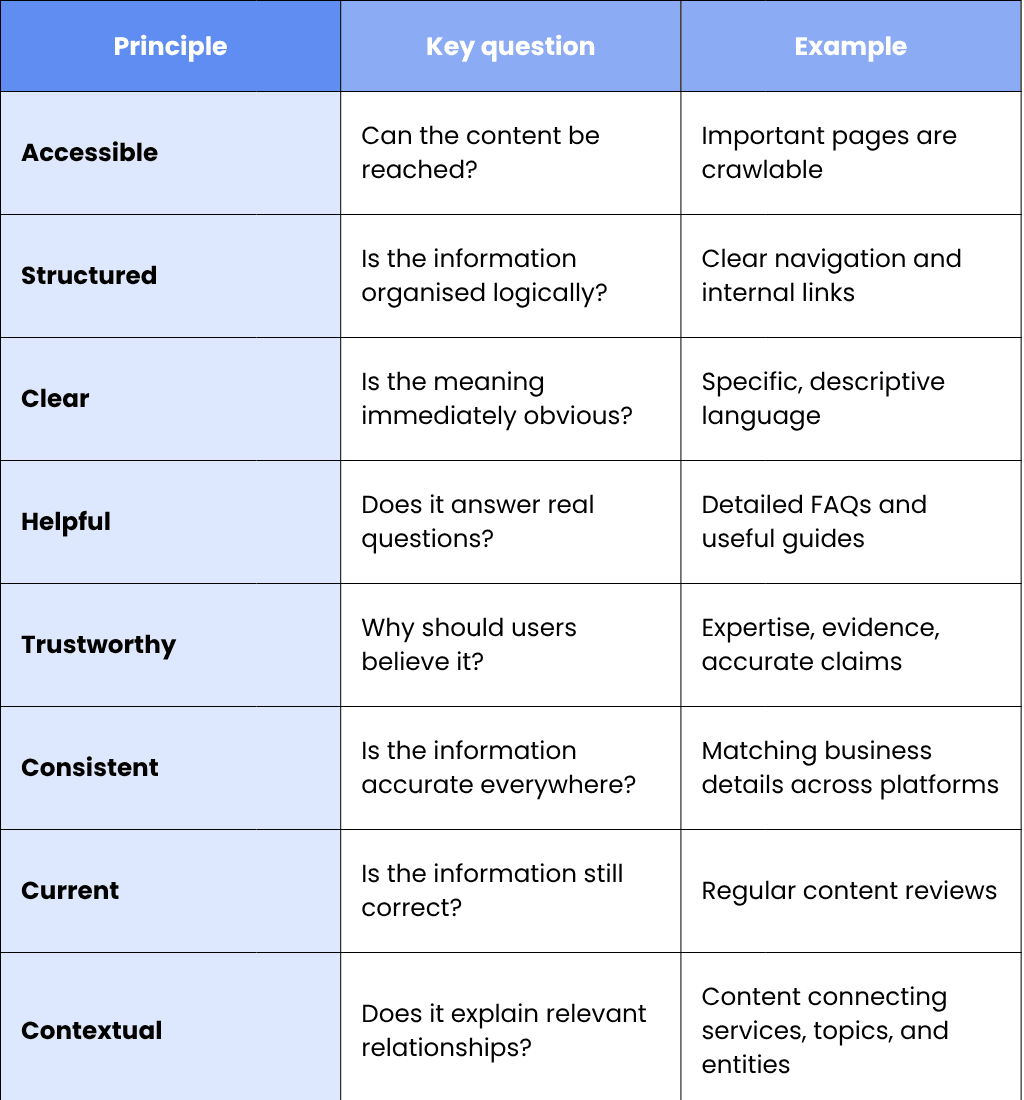
The stronger your website performs across these areas, the clearer your digital presence becomes.
However, it is important to keep expectations realistic. There is no checklist that guarantees inclusion in an AI-generated response. AI platforms use different technologies, datasets, retrieval methods, and ranking or selection systems.
Instead, the objective should be to create a website that is easy to access, easy to understand, useful to customers, and credible within its industry.
That is valuable regardless of how search technology evolves.
What Is the Role of Robots.txt in AI Crawling?
Robots.txt is one of the most frequently discussed topics when businesses talk about AI crawlers.
At a basic level, robots.txt provides instructions that automated crawlers can follow when accessing a website.
For example, a website might use rules to tell a particular crawler that it should not access certain paths.
However, businesses should avoid treating robots.txt as a simple "AI on/off switch".
Different crawlers may have different purposes. A company might want to allow search discovery while restricting other types of access, depending on the platform's controls and the company's content strategy.
It is therefore important to identify:
- Which crawlers are accessing your website
- What each crawler is designed to do
- Which content you want each service to access
- Whether your robots.txt rules reflect those decisions
- Whether other technical systems are blocking legitimate crawlers
Google, OpenAI, and Perplexity all provide their own documentation about crawler behaviour and access controls. Perplexity, for example, states that PerplexityBot follows robots.txt directives and is used to surface and link websites in Perplexity search. OpenAI similarly states that OAI-SearchBot access can help public websites be discovered and surfaced in ChatGPT search.
Because these policies can evolve, businesses should regularly review the official documentation for the platforms that matter to their audiences.
Should You Allow AI Crawlers to Access Your Website?
There is no universal answer.
The right decision depends on your business goals, content strategy, legal considerations, and the specific crawler involved.
If your goal is to increase your visibility across AI-powered search experiences, you may want relevant search crawlers to access your public content.
If you have content that you do not want certain services to access, you may choose to restrict specific crawlers or implement appropriate access controls.
The important thing is to make this a deliberate business decision rather than an accidental technical configuration.
For many companies, the question should be:
Which AI and search experiences do we want to be visible in, and what information should those platforms be able to discover?
This is a more strategic question than simply asking whether to "allow AI crawlers".
Common Misconceptions About AI Crawlers
As AI-driven search becomes more common, businesses are naturally trying to understand how AI systems discover, process, and use online information. However, several misconceptions have emerged around AI crawlers and AI search visibility.
Here are five common myths worth clearing up.
AI Crawler Myths vs Reality at a Glance
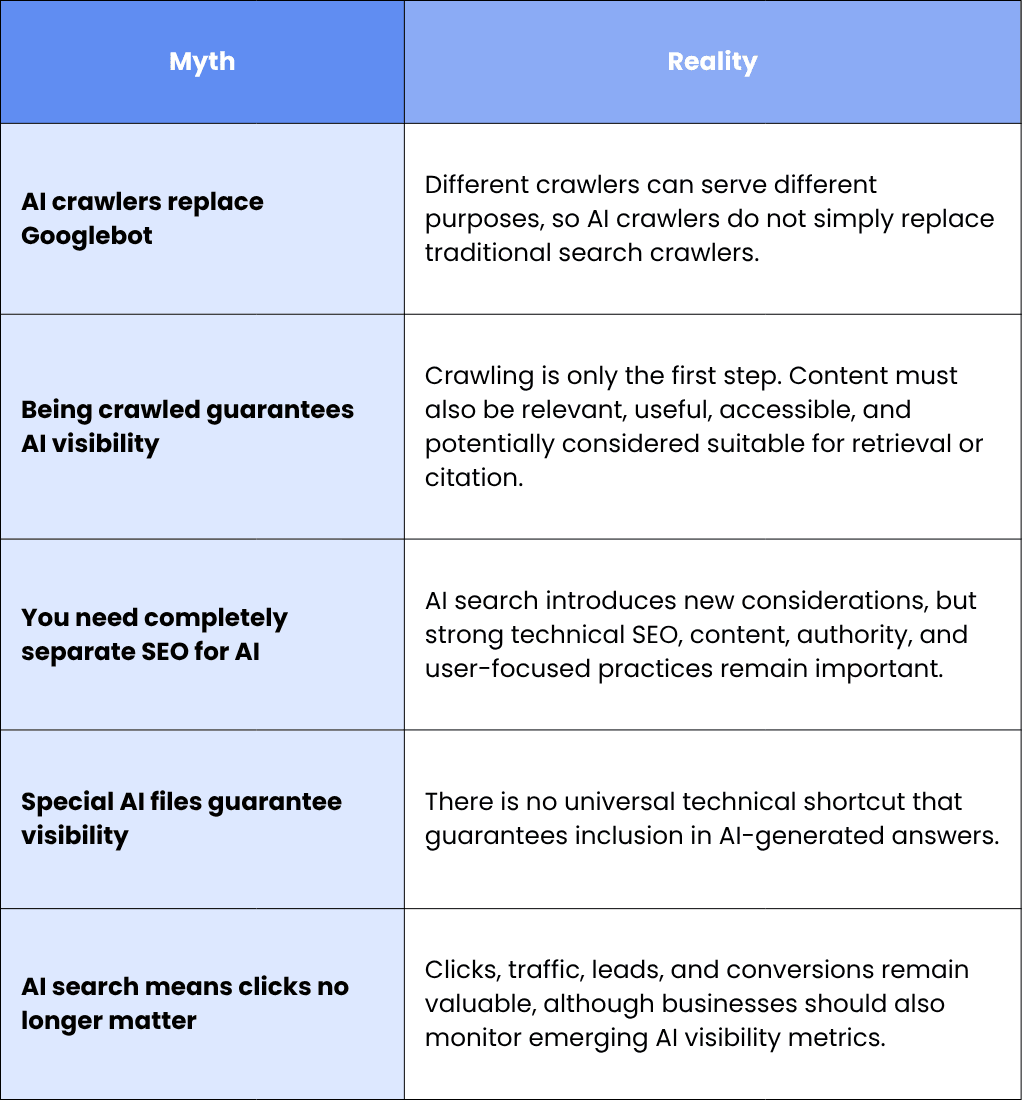
Myth 1: AI Crawlers Replace Googlebot
Not necessarily.
AI crawlers and traditional search engine crawlers can serve different purposes, even though there may be some overlap in how they discover and process web content.
Traditional search crawlers, such as Googlebot, help search engines discover and process webpages for search results. Meanwhile, AI-related crawlers may support AI-powered search, information retrieval, or other AI services.
For businesses, this means that making your website accessible to one crawler does not automatically guarantee visibility across every search engine or AI platform.
The takeaway: Think of AI search as an additional layer of digital discovery rather than a complete replacement for traditional search. A strong SEO foundation remains important while businesses adapt to new AI-powered search experiences.
Myth 2: If an AI Crawler Visits My Website, I Will Appear in AI Answers
Crawling does not guarantee visibility.
An AI crawler accessing your website is only one step in a much larger process. Even when a page is successfully crawled, the system may still decide that the content is not sufficiently relevant, useful, or appropriate for a particular question.
A simplified process might look like this:
Crawled → Processed → Considered relevant → Retrieved → Potentially cited
For example, imagine a hotel has a page about its swimming pool. An AI crawler may successfully access the page, but that does not mean the hotel will automatically appear when someone asks for "the best family-friendly hotels in Hanoi". The system may consider many other factors, including the relevance of the hotel to the specific query and the information available from other sources.
The takeaway: Treat crawlability as the foundation of AI visibility, not a guarantee of it. Your content still needs to be useful, relevant, clear, and trustworthy.
Myth 3: You Need Completely Separate SEO for AI
Not exactly.
The rise of AI-powered search has introduced concepts such as Generative Engine Optimisation (GEO) and Answer Engine Optimisation (AEO). These approaches focus on helping businesses become more visible in AI-generated answers and conversational search experiences.
However, this does not mean businesses should abandon traditional SEO or build an entirely separate strategy.
Many established SEO principles remain highly relevant. Websites still need to be technically accessible, easy to navigate, well structured, and supported by useful content. Businesses also need to demonstrate expertise, maintain accurate information, and build authority within their industries.
The difference is that businesses may now need to consider a wider range of digital discovery experiences beyond traditional search rankings.
The takeaway: AI search does not make SEO obsolete. Instead, it expands the scope of search visibility. Strong technical SEO and content foundations can support a broader strategy that also considers GEO, AEO, and AI-powered discovery.
Myth 4: Adding Special AI Files Guarantees Visibility
There is no universal technical shortcut to AI visibility.
As interest in AI search has grown, some businesses have started looking for special files, tags, or technical solutions that promise to make their content more visible to AI systems.
However, there is no single file or piece of markup that guarantees inclusion in AI-generated answers.
Technical improvements can help search and AI systems access or understand your content, but they cannot replace the fundamentals of good digital marketing.
Businesses still need to invest in:
- Strong technical SEO
- Useful, people-first content
- Clear website architecture
- Relevant and accurate information
- Industry expertise
- Brand authority
- A positive user experience
For example, adding structured data to a poorly written or technically inaccessible website will not suddenly make the business a trusted source for AI-generated answers.
The takeaway: Be cautious of anyone promising a simple technical fix or guaranteed AI visibility. AI search optimisation works best as part of a broader SEO and digital strategy.
Myth 5: AI Search Means Clicks No Longer Matter
Clicks still matter, but the customer journey is changing.
AI-powered search can provide users with direct answers, summaries, and recommendations without requiring them to visit multiple websites. This has understandably raised concerns about whether website traffic will become less important.
However, users still need to visit websites when they want to take meaningful action.
For example, a customer may use AI search to discover a hotel but then visit the hotel's website to:
- Compare room types
- Check availability
- View photos
- Make a booking
Similarly, someone researching an education provider may discover a course through an AI-generated answer but still visit the institution's website to review entry requirements, fees, and application details.
Therefore, businesses should continue to monitor traditional SEO metrics such as:
- Organic traffic
- Leads and enquiries
- Conversion rates
- Bookings
- Revenue
At the same time, businesses may also need to consider newer indicators of AI visibility, such as brand mentions, AI citations, and referral traffic from AI platforms.
The goal is not to choose between rankings and AI visibility. Instead, businesses should understand how different discovery channels contribute to the wider customer journey.
The takeaway: Website traffic and conversions remain valuable. However, businesses should broaden their measurement framework to understand how customers discover and interact with their brand across both traditional search and AI-powered experiences.
Ultimately, the best way to approach AI crawlers is to avoid looking for shortcuts.
AI Crawlers and the Future of SEO
The rise of AI crawlers does not signal the end of SEO.
It signals an expansion of the search landscape.
For years, SEO focused heavily on helping websites appear in lists of search results. Today, businesses increasingly need to think about how their information is discovered and represented across multiple digital experiences.
The future may involve a combination of:
- Traditional search results
- AI Overviews
- AI-powered search engines
- Conversational assistants
- Answer engines
- Voice interfaces
- Recommendation systems
- Other AI-driven discovery experiences
The underlying challenge remains familiar: Make your business easy to find, easy to understand, and worth trusting.
Strong technical SEO helps search and AI systems access your website.
High-quality content helps them understand your expertise.
Clear information architecture helps establish relationships between topics.
Structured data can provide additional context where appropriate.
Authority and reputation help reinforce trust.
Together, these elements create a stronger foundation for digital visibility.
How Saigon Digital Can Help Your Business Prepare for AI-Driven Search
At Saigon Digital, we help ambitious brands solve these challenges with forward-thinking, user-centric, and bespoke digital solutions. Our approach brings together strategy, creativity, data, SEO, web, and AI to help businesses build measurable growth.
SEO Services
Our SEO services focus on more than rankings. We help businesses build search visibility that supports meaningful outcomes, from qualified traffic and leads to long-term growth.
Our capabilities include:
- Site Optimisation & Technical Performance
- Content & Authority Building
- Local & Global Search Strategy
Whether you operate in F&B, retail, education, hospitality, or another competitive sector, we can help strengthen the foundations that make your business easier to discover and understand.
Generative Engine Optimisation
As search becomes more conversational, we help brands prepare for AI-powered discovery across platforms such as ChatGPT, Gemini, Perplexity, and Google AI experiences.
Our Generative Engine Optimisation (GEO) and AI visibility services include:
- AI Readability Optimisation
- Generative Engine Optimisation (GEO)
- Answer Engine Optimisation (AEO)
- Knowledge Graph & Schema Setup
- AI Content Audit & Reformatting
- AI Performance Dashboard
The objective is to help your brand become a clear, credible, and useful source that AI-powered systems can discover, understand, and potentially reference when people search for information relevant to your business.
AI Workflow Automation Services
Preparing for an AI-driven future is not only about search visibility.
AI can also transform the way teams work.
Saigon Digital helps ambitious brands automate workflows, streamline operations, and build AI-powered processes that improve productivity and reduce repetitive manual work.
Our capabilities include:
- AI-driven intelligence
- Pre-built automation templates
- Custom AI Agents
By combining SEO, AI visibility, digital strategy, and workflow automation, we help businesses take a more complete approach to digital growth.
Ready to Prepare Your Business for AI-Driven Search?
AI crawlers are becoming part of a wider search ecosystem that is changing how people discover brands, products, and services.
At Saigon Digital, we help ambitious brands navigate this evolving landscape through SEO, Generative Engine Optimisation, Answer Engine Optimisation, and AI-powered solutions.
Ready to make your business easier to find, understand, and trust?
Get in touch with Saigon Digital and start building your AI-ready digital strategy today.
Frequently Asked Questions About AI Crawlers
1. What is an AI crawler?
An AI crawler is an automated programme that accesses and processes publicly available web content for an AI-related service or system. Depending on the platform, it may help discover webpages, support AI-powered search, retrieve relevant information, or contribute to other AI services. However, being crawled does not guarantee that a website will appear in an AI-generated answer.
2. How is an AI crawler different from a traditional search engine crawler?
The main difference is the purpose of the systems they support. Traditional search engine crawlers primarily help search engines discover and process webpages for search indexes and search results. AI-related crawlers may support AI-powered search, information retrieval, or answer generation. However, there is significant overlap, and both rely on many of the same fundamentals, including accessible websites, clear content, and logical site architecture.
3. Can I block AI crawlers from accessing my website?
Yes, website owners can use mechanisms such as robots.txt to provide instructions to certain crawlers. However, robots.txt should not be treated as a complete privacy or security solution. If you need to protect confidential information, use appropriate access controls such as authentication. Before blocking a crawler, consider how doing so may affect your visibility across the AI or search platform associated with it.
4. Does being crawled by an AI crawler guarantee AI search visibility?
No. Crawling is only the first step. A page may be accessible to a crawler but still not appear in an AI-generated answer. Relevance, content quality, authority, accuracy, and the specific retrieval and selection processes used by each platform can all influence visibility. Businesses should therefore focus on creating useful, trustworthy content while maintaining strong technical SEO foundations.
5. How can businesses prepare for AI-driven search?
Businesses can start by strengthening the fundamentals of their digital presence. This includes improving technical SEO, making important content accessible, creating clear website architecture, answering genuine customer questions, demonstrating expertise, using structured data appropriately, and keeping business information accurate and consistent. Businesses can then build on these foundations with strategies such as Generative Engine Optimisation (GEO) and Answer Engine Optimisation (AEO) to support visibility across evolving AI-powered search experiences.