



AI is changing how people discover brands. More customers now ask tools like ChatGPT for recommendations, explanations, and shortlists before they ever open a browser. That shift raises a simple, high-impact question for marketing leaders: how to appear in ChatGPT answers.
At Saigon Digital, we spend our days helping ambitious brands turn AI visibility into measurable growth. Search engines still matter, but AI assistants increasingly sit at the top of the discovery journey. The good news? The work you do to build authority, clarity, and trust online is the same work that helps AI systems recognise and reference your brand.
This guide explains, in practical terms, how to improve your chances of appearing in ChatGPT answers.
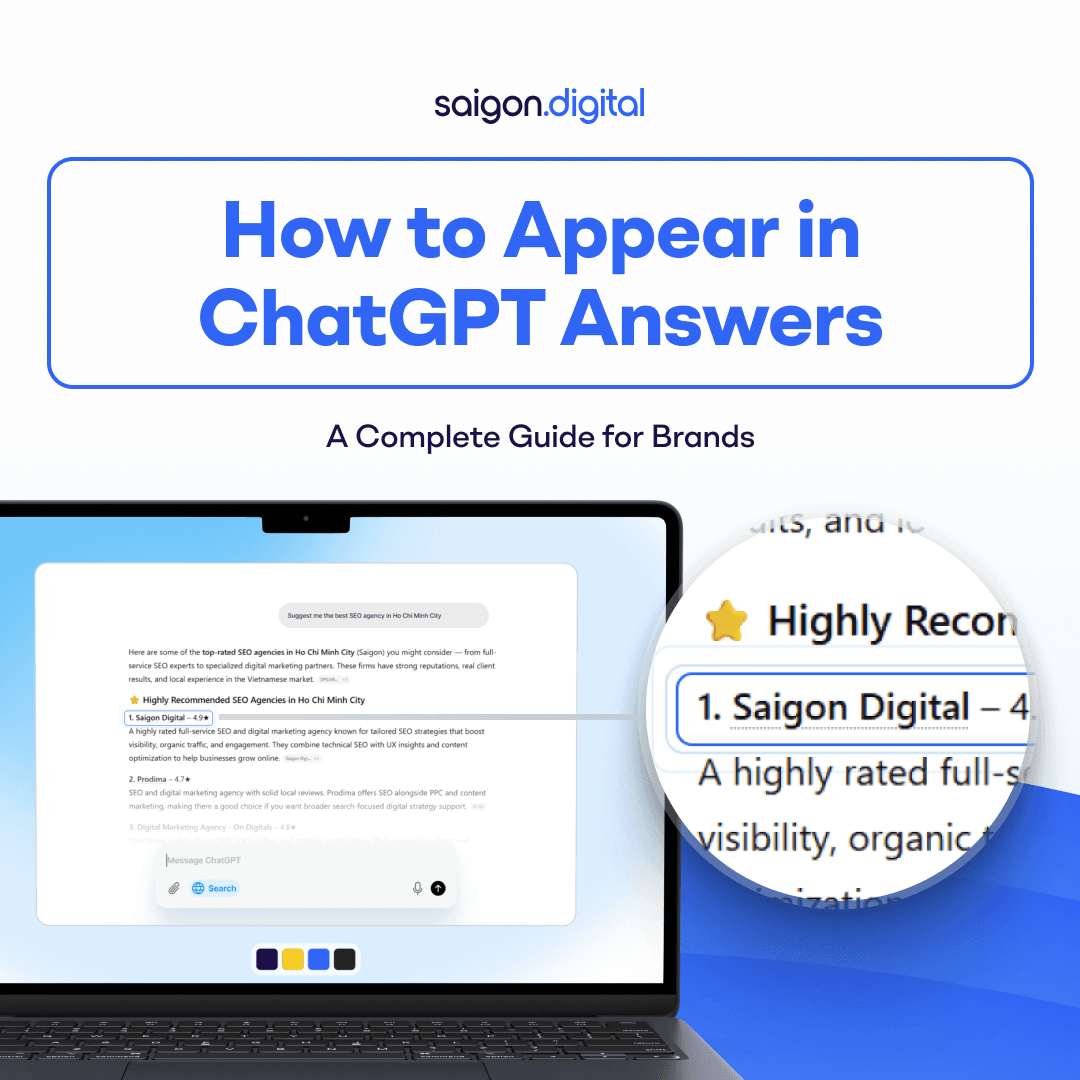
Key Takeaways
- ChatGPT answers come from two different places. Its training data and its live retrieval layer. You need a different tactic for each.
- Technical access comes first. If OpenAI cannot crawl or render your pages, nothing else you do will matter.
- Bing matters more than Google here. ChatGPT's live search leans heavily on Bing's index rather than Google's.
- Third-party sources do most of the work. Wikipedia, Reddit, review platforms and industry directories are cited far more often than brand blogs.
- Freshness is a ranking signal in everything but name. Recently published and visibly updated pages are cited disproportionately often.
- You cannot buy your way into organic answers. OpenAI has begun testing advertising, but paid placement is separate from the answer itself.
- Measure it or you are guessing. Build a fixed prompt set, run it monthly and track mention rate rather than rankings.
The Short Answer
To appear in ChatGPT answers, you need to do four things: let OpenAI crawl and render your site, make your brand recognisable as a consistent entity across the wider web, publish content that answers questions directly enough to be extracted, and earn mentions on the third-party sources ChatGPT already trusts. There is no submission form and no organic ranking algorithm to reverse engineer.
That matters more each quarter. ChatGPT reached 900 million weekly active users in February 2026 according to OpenAI figures reported by Reuters, and its app passed one billion monthly active users in June 2026. A growing share of buyers now form a shortlist inside an AI assistant before they ever open a search engine.
This guide covers exactly how to appear in ChatGPT answers, including why your brand may currently be invisible, what to fix first, and how to tell whether any of it is working.
How ChatGPT Chooses What to Say
ChatGPT builds answers from two separate systems. Most brands optimise for one and ignore the other, which is the single most common reason their efforts stall.
Route one: what the model already knows
The model was trained on a large mixture of licensed data, publicly available web content and material created by human trainers. When you ask a general question, it often answers from these learned patterns without going anywhere. You cannot edit this. You can only influence the next training cycle by being widely and consistently described across the public web.
Route two: live retrieval
When a question is recent, specific or commercial, ChatGPT searches the web in real time and cites sources. This is the route you can influence quickly. OpenAI documents two separate crawlers for this: OAI-SearchBot, which surfaces sites in ChatGPT search, and GPTBot, which collects content for model training. The two are controlled independently in robots.txt, so you can allow one and block the other.
The same split applies to other assistants, though the weightings differ. If you are building a cross-platform programme, our guide on how to appear in Perplexity AI answers covers a platform that is far more citation-transparent, and Google Gemini vs ChatGPT explains where the two diverge.
Why Your Brand Is Not Showing Up in ChatGPT Responses
If customers ask about your industry and your brand never comes up, the cause is almost always one of the following. Work through them in order, because the first three block everything below them.
- AI crawlers are blocked. Many sites disallow GPTBot and OAI-SearchBot by default, or their CDN and firewall rules treat AI bots as scrapers and block them before robots.txt is ever read.
- Your content only exists after JavaScript runs. OpenAI’s crawlers are widely reported not to execute JavaScript, so client-side rendered copy is effectively invisible to them.
- You are not in Bing. Seer Interactive found that 87 per cent of SearchGPT citations matched Bing’s top results, against 56 per cent for Google. Strong Google rankings are not a substitute.
- Your brand is described differently in every place it appears. Inconsistent naming, categories and service descriptions make it hard for a model to resolve you as a single entity.
- Nobody independent has connected your brand to the topic. If only your own website says you do a thing, that claim carries very little weight.
- Your pages bury the answer. Long preambles, vague headings and no summaries make content expensive to extract and easy to skip.
- Your content is old. SE Ranking’s analysis of 129,000 domains found that 95 per cent of ChatGPT citations came from content published within the previous ten months.
Ranking on Google is not the safety net people assume. Moz analysis across 40,000 keywords found that 88 per cent of Google AI Mode citations did not come from the organic top ten, and ChatGPT diverges from Google further still. If you want a structured way to find the gaps, see our guide on how to improve AI search visibility.
How to Appear in ChatGPT Answers
Step 1: Make Sure ChatGPT Can Read Your Site
This is unglamorous and it is where most of the quick wins are.
Allow the right crawlers
- Explicitly allow OAI-SearchBot so your pages can appear in ChatGPT search results.
- Decide separately on GPTBot, which governs training use. Allowing it helps long-term brand recognition. Blocking it protects proprietary content.
- Check your CDN, WAF and bot-protection settings. These often block AI user agents at network level regardless of what your robots.txt says.
- Also consider ClaudeBot, PerplexityBot and Google-Extended while you are in there.
Serve your content in the HTML
View the page source rather than the rendered page. If your headings, body copy and tables are present in the raw HTML, AI crawlers can read them. If the source is mostly a JavaScript bundle, they cannot. Server-side rendering or pre-rendering is the reliable fix.
Get indexed in Bing
Verify your site in Bing Webmaster Tools, submit your sitemap and consider IndexNow so new and updated pages reach Bing in hours rather than days. This is the highest-leverage technical task on the list and most teams have never done it.
Tidy the discovery layer
- Keep XML sitemaps accurate and free of redirects, noindex pages and 404s.
- Resolve duplicate URL variants so a single canonical version accumulates all the signals.
- Consider an llms.txt file to point AI systems at your most useful documentation and guides.
Step 2: Build the Entity Signals ChatGPT Trusts
AI systems treat your brand as an entity, not a website. An entity becomes trustworthy when many independent sources describe it the same way.
Be specific about what you do
Vague positioning is a visibility problem, not just a branding one. Compare these two descriptions:
- "We deliver innovative digital solutions for modern businesses."
- "We are an SEO and AI search agency helping international brands grow organic revenue through data-led strategies."
The second tells a model who you help, what you solve and which category you belong in. Every core service should have its own page with a descriptive headline, a plain statement of who it is for, and concrete examples.
Say the same thing everywhere
Your website, LinkedIn, business profiles, directory listings and partner pages should agree on your company name, category, services and one-line description. They do not need identical copy. They do need a consistent core claim. Contradictions between sources are one of the fastest ways to get filtered out of an answer.
Win the sources ChatGPT actually cites
This is the part most brands skip. Ahrefs analysed ChatGPT’s 1,000 most-cited pages and found roughly 30 per cent were Wikipedia, around 24 per cent were brand homepages and about 7 per cent were app store listings. Your blog is competing for a much smaller slice than you think.
Practical priorities, in rough order of return:
- Review platforms. G2, Capterra, Clutch and TrustRadius for B2B and SaaS. Google Business Profile, Yelp and sector platforms for consumer and hospitality brands.
- Reddit and community discussion. Genuine participation where your category is debated, not drive-by promotion.
- Niche directories. Industry association and marketplace listings confirm category membership, which general directories do not.
- Third-party listicles and comparisons. Being included in someone else’s "best tools for X" article repeats the brand-to-category association on a domain that is not yours.
- Wikipedia and Wikidata, where genuinely notable. Do not attempt this without meeting the notability bar. Failed attempts damage more than they help.
Step 3: Write Content ChatGPT Can Extract
Lead with the answer
Put a direct, self-contained answer in the first forty to sixty words of the page and of each major section. Then expand. A model that has to read 600 words of preamble before finding a usable statement will usually pick a different source.
Structure for chunking
- Use descriptive H2 and H3 headings phrased the way people ask questions.
- Keep paragraphs to one idea. Short paragraphs survive summarisation better.
- Use comparison tables for anything with two or more options.
- Add a short summary or key takeaways block near the top.
- Keep terminology consistent. Switching between synonyms weakens the association.
Mark it up properly
Structured data will not force an AI citation, but it removes ambiguity about what a page represents and who published it. Start with Organisation, Article or BlogPosting, Service and FAQ where it genuinely fits the visible content. Our guide to schema markup for AI search covers implementation in detail.
Keep it visibly fresh
Freshness is unusually powerful here. In SE Ranking’s dataset, pages showing a visible "last updated" date received roughly 1.8 times more citations than pages without one. Set a review cycle of six to twelve months for cornerstone pages, update the statistics and examples, and display the date.
Step 4: Earn Authority Off Your Own Site
Mentions on credible third-party sites are the closest thing to a ranking signal in AI answers.
- Digital PR and expert commentary. Being quoted in industry publications puts your brand next to your topic on a domain with independent authority.
- Original data. Surveys, benchmarks and anonymised client results give other people a reason to cite you. This is the single most repeatable way to earn citations.
- Backlinks still count. A Semrush study with Kevin Indig across 1,000 domains found that domains with stronger backlink authority were mentioned more often in AI answers, and that nofollow links performed almost identically to follow links.
- Podcasts and webinars with published notes. The transcript and show notes are the asset, not the recording.
Quality beats volume. A handful of relevant, respected placements will do more than dozens of low-value ones.
Step 5: Measure Whether Any of It Is Working
AI answers are not stable. The same prompt can return different brands minutes apart, so single checks tell you nothing. Measure across repeated runs instead.
1. Build a fixed prompt set. Twenty to forty prompts a real buyer would type, covering category, comparison, problem and "best X for Y" questions.
2. Run them on a schedule. Monthly at minimum, on a consistent account setting, and log the results.
3. Track mention rate and share of voice. What percentage of runs mention you, and how do you compare to named competitors.
4. Track citation rate separately. Being mentioned and being linked are different outcomes with different value.
5. Segment AI referrals in GA4. Filter session source for chatgpt.com, perplexity.ai, gemini.google.com and copilot.microsoft.com.
6. Watch sentiment and context. Being described inaccurately is worse than not being mentioned.
For the full method, including tooling options, see AI citation tracking. Smaller teams working without enterprise budgets may find our roundup of AI SEO tools for small business more practical.
How to Make Blog Posts Appear in ChatGPT Answers
Individual articles need a slightly different checklist from the site as a whole. Before publishing, confirm each of these:
- The title matches how someone would actually phrase the question.
- The opening paragraph answers it in two or three sentences with no preamble.
- Each H2 is a question or a clear, specific claim rather than a label like "Our Approach".
- There is at least one table, list or comparison that can be lifted whole.
- Claims are attributed to named sources with dates.
- A named author with relevant credentials is attached, not just a company byline.
- Article or BlogPosting schema is present and matches the visible content.
- The published and updated dates are visible on the page.
- The article links to and from the related pages in its cluster.
Depth still matters, but padding does not. Write to the length the question deserves and cut everything that does not add information.
How to Appear in ChatGPT Answers in Regulated and High-Trust Sectors
Financial services, healthcare and education face a higher evidentiary bar, because assistants are tuned to be cautious with advice that carries real consequences. If you are asking how to get a bank, clinic or school featured in ChatGPT answers, the fundamentals are the same but the weighting shifts.
- Regulatory and licensing detail matters. Publish registration numbers, regulatory bodies, licences and jurisdictions in plain, crawlable text.
- Named, credentialed authors are close to mandatory. Anonymous content in these categories is heavily discounted.
- Institutional and third-party validation carries the most weight. Regulator registers, industry bodies, ratings agencies and established review platforms outrank owned content.
- Accuracy and dating are non-negotiable. Rates, fees, eligibility criteria and course details must show when they were last verified.
- Local entity signals still apply. Branch, campus and clinic pages with complete, consistent details reinforce that the organisation is real and operating.
Retail and e-commerce brands face a different set of constraints again, which we cover in AI search visibility for e-commerce.
The Bigger Picture: Visibility, Not Vanity
Learning how to appear in ChatGPT answers is not about chasing the next shiny object. It is about doing what strong brands have always done:
- Communicate clearly
- Prove expertise
- Earn trust
- Show up consistently where your audience looks for answers
At Saigon Digital, we help brands design, build, and scale digital experiences that do exactly that, combining strategy, creativity, data, and now AI-powered marketing into one growth engine.
Get in touch with us today!
Frequently Asked Questions
1. Can you pay to appear in ChatGPT answers?
Not in the organic answer itself. OpenAI began testing advertising formats in 2026, but that is a separate paid placement rather than a way to insert your brand into a generated recommendation. Organic inclusion is still earned through crawlability, entity signals and third-party validation.
2. How long does it take to appear in ChatGPT answers?
Retrieval-driven visibility can shift within weeks once technical blockers are removed and content is restructured. Recognition that comes from training data typically takes far longer, because it depends on your brand being widely described across the web before the next training cycle.
3. Why is my brand not showing up in ChatGPT responses when customers ask about our industry?
Usually because AI crawlers are blocked, your content is not in Bing’s index, your positioning is inconsistent across sources, or no independent site connects your brand to that topic. Work through the diagnostic list earlier in this guide in order.
4. Does ranking on Google mean I will appear in ChatGPT?
No. Independent studies consistently find low overlap between Google’s top results and ChatGPT’s citations. Bing visibility is the closer proxy for ChatGPT specifically.
5. What is the best strategy to appear in ChatGPT answers?
Fix technical access first, because nothing else works without it. Then restructure your most commercially important pages to answer questions directly. Then invest in third-party mentions on review platforms, industry publications and communities. Measure with a fixed prompt set throughout.
6. Should I block GPTBot?
It depends on what you are protecting. Blocking GPTBot keeps your content out of training data but does not stop you appearing in ChatGPT search, provided OAI-SearchBot is allowed. Publishers protecting paid content often block it. Most brands seeking visibility allow both.
7. Is schema markup required to appear in ChatGPT answers?
It is not required, and evidence on its direct effect is mixed. It is still worth implementing because it clarifies entities, authorship and content type across every surface, including traditional search and Google AI Overviews.
8. Do I need an agency for this?
Not necessarily, but the work spans technical SEO, content, digital PR and measurement, which is more disciplines than most in-house marketing teams hold at once. The decision usually comes down to whether you can staff all four consistently.