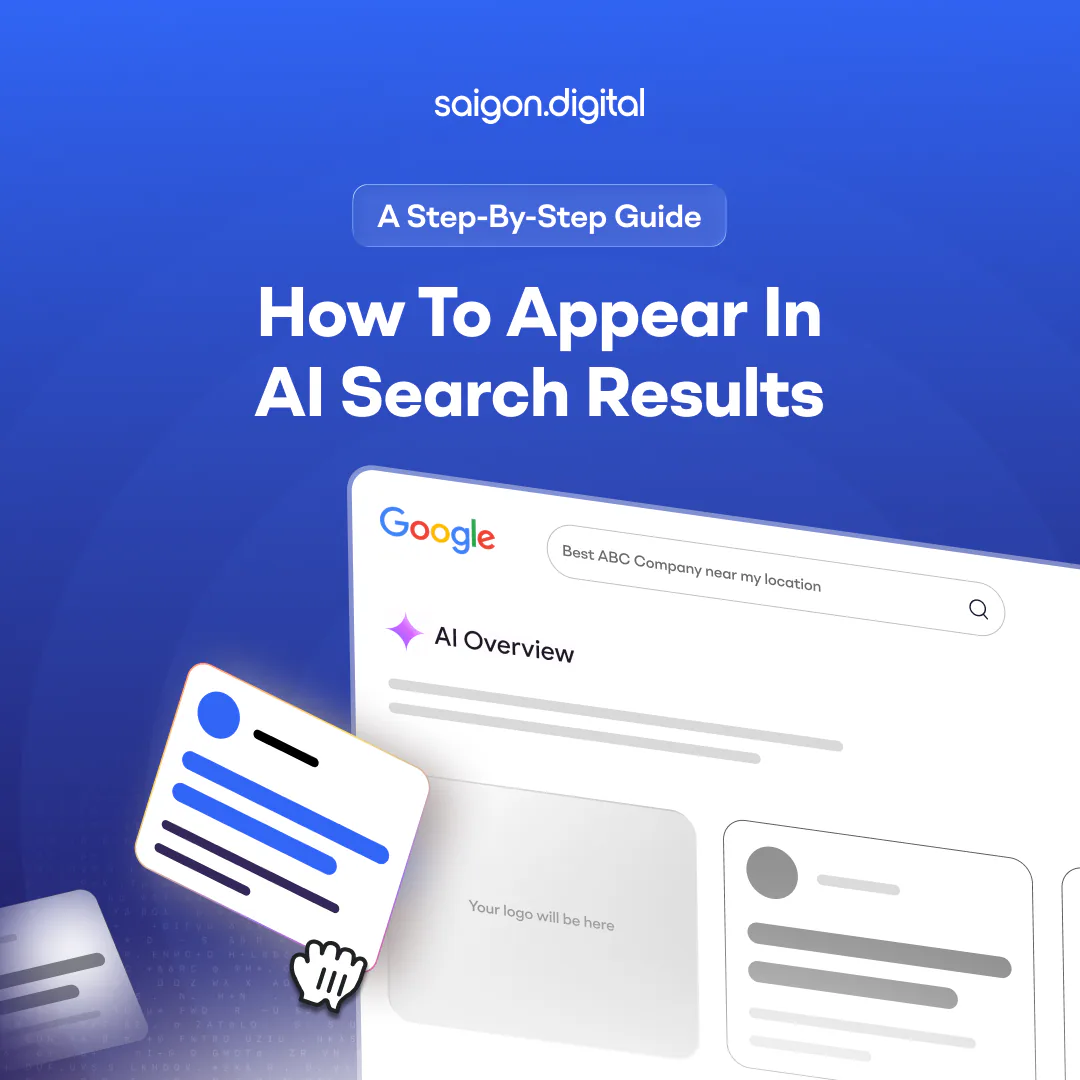
Search is changing. More people now ask questions in AI tools, voice assistants, and AI-powered search experiences instead of typing a few keywords into a traditional search box. For ambitious brands, this shift brings a new challenge and a new opportunity: learning how to appear in AI search results.
At Saigon Digital, we help businesses turn strategy, creativity, and data into measurable growth. That means staying ahead of changes in how people discover information online. In this guide, we will walk you through exactly how to appear in AI search results, step by step, using practical, proven approaches you can apply today.
Whether you manage a growing brand or a well-established business, this guide will help you build visibility in the next generation of search.
Why AI Search Is Different from Traditional Search
Traditional SEO focuses on ranking web pages for specific keywords. AI search, on the other hand, often works by:
- Understanding user intent in full questions
- Summarising answers from multiple sources
- Recommending brands, tools, or services directly
- Citing trusted sources rather than listing ten blue links
For example, instead of searching “best SEO agency in Ho Chi Minh City”, a user might ask an AI tool: “Which agency can help me grow organic traffic and build a high-performance website?”
The AI will not just look for keywords. It will look for clear expertise, trusted content, and well-structured information. That is why learning how to appear in AI search results starts with getting the fundamentals right and then going a step further.
Step 1: Build a Clear Topical Focus
If you want to understand how to appear in AI search results, the first and most important step is to build a clear topical focus. AI systems are designed to recognise patterns of expertise. In other words, they look for websites that consistently and credibly cover a specific set of subjects, rather than sites that touch on everything in a shallow way. The clearer your focus, the easier it becomes for AI to understand what your business stands for and when it should recommend you.
A strong topical focus starts with three simple but powerful questions.
1. What Problems Do We Solve Best?
Begin by identifying the real problems your business is best equipped to solve. This is not about listing every service you offer. Instead, it is about understanding where your expertise genuinely delivers the most value.
For example, rather than saying “we do digital marketing”, a more focused answer might be:
- “We help businesses grow organic traffic through SEO”
- “We design and build high-performance websites”
- “We use data and AI to improve marketing efficiency and results”
Once you are clear on these core problems, you can create content that directly addresses them. This helps AI systems connect your website with specific user needs.
A practical way to approach this is to:
- List your main services
- Write down the problems each service solves
- Highlight the areas where you have the strongest results or most experience
From there, prioritise those areas in your content strategy. The more consistently you publish useful, in-depth content around these problems, the stronger your topical authority becomes.
2. What Topics Do We Want to Be Known For?
Next, you should decide what you want your brand to be associated with in the long term. This step is about positioning as much as it is about SEO.
Think in terms of themes rather than individual articles. For instance, at Saigon Digital, these themes might include:
- SEO and organic growth
- High-performance web design and development
- AI-powered marketing and automation
- Digital strategy and scalable growth
Each of these topics can then be supported by a group of related articles, guides, and case studies. Over time, this creates a clear signal to AI systems that your website is a reliable source in these areas.
To make this actionable:
- Choose 3 to 5 core topics that match your expertise and business goals
- Create a content hub or category for each topic
- Plan supporting articles that explore each topic from different angles
For example, if one of your topics is SEO, you might publish content about technical SEO, content strategy, AI and search, performance optimisation, and measurement. Together, these pieces form a coherent, credible body of knowledge rather than a collection of disconnected posts.
3. What Questions Do Our Ideal Clients Actually Ask?
Finally, shift your focus from what you want to say to what your audience actually wants to know. AI search is heavily driven by natural language questions, so your content should reflect the way real people think and search.
Start by collecting questions from:
- Sales and support conversations
- Client meetings and proposals
- Search queries in your analytics tools
- Common industry discussions
These questions might sound like:
- “How can we improve our website’s performance?”
- “What does AI mean for our SEO strategy?”
- “How do we appear in AI search results?”
- “What should we prioritise to grow organic traffic?”
Once you have these questions, turn them into clear, helpful content. Each important question can become:
- A dedicated article
- A section within a longer guide
- A frequently asked questions (FAQ) resource
Make sure each answer is direct, practical, and easy to understand. This not only helps your readers, but also makes it easier for AI systems to extract, summarise, and reference your content.
Step 2: Write for Real Questions, Not Just Keywords
Once you have established a clear topical focus, the next step in learning how to appear in AI search results is to change the way you think about content creation. Traditionally, SEO has revolved around targeting specific keywords. While keywords still matter, AI search places far greater emphasis on real questions, real intent, and real answers.
In practice, this means shifting from writing content purely for search engines to writing content that genuinely helps people who are looking for solutions.
1. Move From Short Keywords to Full Questions
People no longer search in short, fragmented phrases as often as they used to. Instead, they speak or type full questions into AI tools and search assistants. For example, instead of searching for:
- “AI SEO strategy”
- “SEO for AI search”
They are far more likely to ask:
- “How can my business appear in AI search results?”
- “What should I change on my website for AI-driven search?”
- “Does AI search replace traditional SEO?”
Your content should mirror this behaviour. Start by identifying the full questions your audience is asking, then build pages and articles that answer them clearly and directly.
A simple way to do this is to:
- Review customer emails, sales calls, and support queries
- Look at the “People also ask” style questions in search results
- Use your analytics data to see what queries already bring visitors to your site
- Ask your team which questions come up most often in conversations with clients
Each of these questions is an opportunity to create content that aligns perfectly with how AI systems understand user intent.
2. Structure Your Content Around Clear Answers
AI systems work best with content that is well organised and easy to interpret. This means your pages should not hide the answer in the middle of a long, unfocused article. Instead, they should lead with clarity and then build depth.
A strong structure usually looks like this:
- State the question clearly in a heading
- Provide a direct, helpful answer in the opening paragraph
- Expand on that answer with explanations, steps, and examples
- Add supporting details, such as best practices or common mistakes to avoid
For example, if your page targets the question “How do we appear in AI search results?”, start by explaining the core idea in simple terms. Then, guide the reader through the practical steps they can take, using clear subheadings and logical sections.
This approach helps human readers understand your message quickly and also makes it easier for AI systems to summarise or reference your content.
3. Match Your Language to How People Actually Speak
Another important part of writing for real questions is using natural, human language. AI search is designed to understand everyday speech, not just technical jargon or keyword-stuffed phrases.
This does not mean your content should be vague or simplistic. It means your writing should be:
- Clear and precise
- Free from unnecessary buzzwords
- Focused on explaining ideas in plain English
- Written as if you are answering a real person, not a machine
For instance, instead of repeatedly forcing the phrase “how to appear in AI search results” into every sentence, use natural variations such as:
- “showing up in AI-driven search”
- “being recommended by AI tools”
- “improving AI visibility in AI search experiences”
This makes your content more pleasant to read and more aligned with how AI systems interpret meaning and context.
4. Create Content that Solves the Whole Problem, Not Just Part of It
When someone asks a question, they are rarely looking for a partial answer. They want guidance they can actually use. That is why AI systems tend to favour content that covers a topic thoroughly and thoughtfully.
Before you publish a piece of content, ask yourself:
- Does this fully answer the main question?
- Does it address the follow-up questions a reader might have?
- Does it provide practical next steps or examples?
For example, an article about how to appear in AI search results should not only explain what AI search is. It should also cover content strategy, technical foundations, authority building, and ongoing optimisation. By doing so, you increase the chances that your content will be seen as a reliable, complete resource worth referencing.
Step 3: Make Your Content Easy to Understand and Use
Even the most insightful content will struggle to perform if people find it difficult to read, navigate, or interpret. That is why the next step in learning how to appear in AI search results is to focus on clarity and usability. Simply put, your content should be easy to understand, easy to scan, and easy to act on.
AI-driven search experiences are designed to extract meaning quickly. They favour content that is clearly structured, logically organised, and written in a straightforward way. At the same time, your human readers benefit from exactly the same approach.
1. Start With a Clear and Logical Structure
Good structure is the foundation of usable content. Before you even start writing, think about the journey you want the reader to take from the first line to the last.
A strong structure usually includes:
- A clear introduction that explains what the page is about and why it matters
- Well-defined sections with descriptive headings
- A logical flow from basic concepts to more detailed guidance
- A conclusion or summary that reinforces the key points or next steps
For example, a guide on how to appear in AI search results might begin with a short explanation of AI search, move into strategy and content principles, and then finish with practical actions. This kind of progression makes your content easier to follow and easier for AI systems to understand and summarise.
2. Use Headings and Subheadings to Guide the Reader
Headings are not just a design choice. They play a crucial role in helping both users and AI systems understand what each section of your content is about.
Each heading should:
- Clearly describe the topic of the section
- Use simple, specific language
- Reflect the questions or problems your audience cares about
For instance, a heading like “How to structure content for AI search” is far more helpful than something vague like “Content considerations”. Clear headings allow readers to scan the page quickly and jump to the sections that matter most to them, while also giving AI systems clear signals about the structure and meaning of your content.
3. Keep Paragraphs Focused and Easy to Read
Long, dense blocks of text can be intimidating and difficult to process. Instead, aim for short, focused paragraphs that each communicate one main idea.
As a general rule:
- Introduce the point in the first sentence
- Explain or expand on it in the next few sentences
- Then move smoothly to the next idea using a natural transition
This approach improves readability and keeps readers engaged. It also makes it easier for AI systems to identify key points and extract useful information from your content.
4. Use Bullet Points and Lists Where They Add Clarity
Not everything needs to be written in paragraphs. Bullet points and numbered lists are especially useful when you want to:
- Summarise key ideas
- Present steps in a process
- Highlight benefits or requirements
- Make complex information easier to scan
For example, instead of describing a multi-step process in a long paragraph, you can break it down into a short list of clear actions. This helps readers understand what they need to do at a glance and makes your content more practical and usable.
However, use lists thoughtfully. They should support your explanation, not replace it. A short introductory sentence before a list and a brief explanation after it often make the content flow more naturally.
5. Write in Clear, Plain English Without Oversimplifying
Clarity does not mean removing depth or expertise. It means expressing complex ideas in a way that is easy to understand and apply.
To do this:
- Prefer simple words over unnecessary jargon
- Explain technical terms when you first introduce them
- Use active voice to keep sentences direct and engaging
- Avoid long, complicated sentences where a shorter one would do
For example, if you are explaining structured data, start by describing what it does in practical terms and why it matters to a business, before moving into more technical detail. This keeps both beginners and more experienced readers engaged, while also making your content easier for AI systems to interpret.
Step 4: Demonstrate Real Expertise and Experience
As AI search becomes more sophisticated, it places increasing importance on trust, credibility, and real-world expertise. This means that if you want to understand how to appear in AI search results, it is no longer enough to simply publish well-written content. You must also clearly demonstrate that your business has genuine experience and authority in the topics you cover.
In practical terms, AI systems are looking for signals that show your content is created by people who know what they are talking about and who have applied that knowledge in real situations. At the same time, human readers want reassurance that they can rely on your advice.
1. Show Who is Behind The Content
One of the simplest ways to build credibility is to be transparent about who is creating your content and why they are qualified to do so.
You can do this by:
- Adding author profiles with relevant experience and roles
- Including short introductions that explain your team’s expertise
- Linking to your company’s “About” or “Our Approach” pages
- Mentioning relevant experience, certifications, or areas of specialism
For example, instead of presenting advice as anonymous information, you might explain that it comes from a team that designs high-performance websites, delivers SEO strategies, and builds AI-powered marketing solutions for growing brands. This context helps both users and AI systems understand that your guidance is grounded in real practice, not just theory.
2. Use Real Examples, Case Studies, and Practical Insights
Nothing demonstrates experience better than showing how your ideas work in the real world. Where possible, support your advice with examples drawn from your own work or from realistic business scenarios.
This could include:
- Short case studies that explain a challenge, an approach, and a result
- Practical examples of how a strategy was applied
- Before-and-after comparisons
- Common problems you see and how you typically solve them
For instance, if you explain how better site structure improves visibility in AI search, briefly describe how you helped a client reorganise their content and what changed as a result. Even simple, anonymised examples can make your advice more credible and more useful.
3. Explain Your Thinking, Not Just Your Conclusions
Expertise is not only about what you recommend, but also about how you arrive at those recommendations. Taking the time to explain your reasoning helps readers understand the logic behind your advice and shows AI systems that your content is thoughtful and well-founded.
You can do this by:
- Outlining the problem before presenting the solution
- Explaining why one approach works better than another
- Highlighting trade-offs or limitations where they exist
- Connecting your advice to broader strategy or business goals
For example, instead of simply saying “you should focus on topical authority”, explain why AI systems value consistent subject coverage and how this influences their recommendations. This depth of explanation signals real understanding rather than surface-level knowledge.
4. Keep Your Content Accurate and Up to Date
Credibility depends on relevance. Outdated advice, old statistics, or references to tools and practices that are no longer used can quickly undermine trust.
To avoid this:
- Regularly review and update your key pages
- Refresh examples and data points where necessary
- Adjust your recommendations as technology and best practices evolve
- Clearly reflect current realities in SEO, AI, and digital marketing
This ongoing maintenance shows that your expertise is active and current, not something that was written once and forgotten. AI systems, in particular, are more likely to trust and reference content that appears well maintained and aligned with present-day practices.
Step 5: Optimise Your Website’s Technical Foundations
Even the strongest content and clearest strategy will fall short if your website’s technical foundations are weak. That is why a critical part of learning how to appear in AI search results is making sure your site is easy to crawl, easy to understand, and easy to trust. In many ways, technical optimisation is about removing friction, for both users and intelligent systems.
AI-driven search experiences rely on clean, well-structured websites to interpret content accurately. If your pages are slow, confusing, or difficult to access, you reduce the chances of your content being discovered, understood, or recommended.
1. Make Sure Your Website is Fast and Reliable
Speed is not just a user experience issue. It is also a strong quality signal. Slow-loading pages frustrate visitors and make it harder for AI systems to efficiently process your site.
To improve performance:
- Optimise images and media files
- Reduce unnecessary scripts and plugins
- Use efficient hosting and caching solutions
- Regularly test page speed on both mobile and desktop
A fast, stable website signals professionalism and quality. More importantly, it ensures that both users and automated systems can access your content without barriers.
2. Design For Mobile First
Most people now browse and search on mobile devices, and AI-driven search experiences reflect this reality. Your website should not just “work” on mobile, it should be designed with mobile users in mind from the start.
Check that:
- Text is easy to read without zooming
- Buttons and links are easy to tap
- Navigation is clear and simple
- Key content loads quickly on smaller screens
If your site is difficult to use on a phone, you are not only losing potential customers, but also sending negative signals about overall quality and usability.
3. Create a Clean and Logical Site Structure
A well-organised website helps AI systems understand how your content fits together and which pages are most important. It also helps users find what they are looking for more quickly.
A strong site structure usually means:
- Clear categories and sections
- Logical URL paths
- Simple, consistent navigation
- Important pages no more than a few clicks from the homepage
For example, if you offer SEO, web development, and AI marketing services, each of these should have its own clear section, supported by related guides and resources. This creates a clear hierarchy that both users and AI systems can follow.
4. Implement Structured Data Where it Adds Value
Structured data helps machines understand what your content is about, not just what it says. While it is not a magic solution, it can make a real difference in how your pages are interpreted and presented.
You might use structured data to clarify:
- Your organisation and business details
- Your services and offerings
- Articles, guides, and authors
- FAQs or key informational sections
Think of structured data as adding labels to your content. It gives AI systems extra context and reduces the risk of misunderstanding or misclassification.
Step 6: Create Content That Deserves to Be Cited
In many AI-driven search experiences, visibility does not come from ranking in a list of links alone. Instead, it comes from being referenced, quoted, or used as a source within an AI-generated answer. That is why a crucial part of learning how to appear in AI search results is creating content that genuinely deserves to be cited.
Put simply, your goal is to move beyond “good enough” content and start producing resources that are clearly more useful, more reliable, and more complete than the average page on the same topic.
1. Understand What “Citable” Content Looks Like
Citable content shares a few important qualities. It is:
- Accurate and up to date
- Clearly structured and easy to extract information from
- Focused on answering real questions thoroughly
- Written with authority and practical insight
- Useful even when read in small sections or summaries
AI systems are far more likely to reference content that provides clear, dependable answers rather than vague opinions or surface-level overviews. This means every important page on your site should aim to be a strong, trustworthy reference point for a specific topic.
2. Go Deeper Than The Average Article
One of the most effective ways to make your content citation-worthy is to go further than what is already available. Many articles repeat the same basic ideas without adding much value. Your content should aim to do the opposite.
Before publishing, ask yourself:
- Does this explain the topic more clearly than most other pages?
- Does it cover the key aspects in enough depth?
- Does it answer follow-up questions a reader is likely to have?
- Does it include practical guidance, not just theory?
For example, instead of writing a short overview of how to appear in AI search results, create a detailed guide that covers strategy, content, technical foundations, and ongoing optimisation. This kind of comprehensive resource is far more likely to be used and referenced by AI systems.
3. Use Evidence, Examples, And Clear Reasoning
Content that deserves to be cited should not rely on vague statements or unsupported claims. Wherever possible, strengthen your points with:
- Real-world examples
- Short case studies or scenarios
- Clear explanations of cause and effect
- Practical experiences from your work
For instance, if you explain that clear site structure helps AI understand your content, briefly describe how reorganising a website improved discoverability or usability. Even simple examples add weight to your argument and make your content more credible and useful.
4. Make Key Information Easy To Find And Extract
AI systems often look for clear, well-presented answers they can summarise or reference. This means presentation matters just as much as substance.
You can improve this by:
- Using descriptive headings and subheadings
- Opening sections with clear, direct answers
- Breaking complex ideas into steps or lists
- Summarising key points where appropriate
For example, if a section explains a process, consider presenting it as a short step-by-step list with a brief explanation for each step. This makes your content easier for readers to use and easier for AI systems to interpret accurately.
5. Keep Your Most Important Content Updated And Accurate
Citable content must remain trustworthy over time. If key pages become outdated, they quickly lose their value as reference material.
Build a habit of:
- Reviewing your core guides regularly
- Updating examples, tools, and recommendations
- Refreshing statistics or industry references
- Improving clarity as your thinking evolves
This ongoing care signals that your content is actively maintained and reliable, qualities that both users and AI systems look for when deciding what to trust and reference.
Step 7: Build Your Brand Beyond Your Website
If you want to strengthen your chances of appearing in AI-driven search experiences, it is important to think beyond your own website. While high-quality on-site content is essential, AI systems also look at the wider digital landscape to understand which brands are trusted, recognised, and influential within their fields. In other words, your visibility is shaped not only by what you publish, but also by where and how your brand appears elsewhere online.
Building your brand beyond your website helps create a broader picture of authority and credibility. The more consistently your expertise shows up in relevant, reputable places, the easier it becomes for AI systems to recognise your business as a reliable source.
1. Focus On Being Present Where Your Audience Already Is
The first step is to identify the platforms, publications, and communities your ideal clients already use. These might include:
- Industry blogs and news sites
- Professional networks and business communities
- Podcasts, webinars, and online events
- Trusted directories or review platforms
Rather than trying to be everywhere at once, focus on a small number of channels that are genuinely relevant to your audience. Being visible in the right places is far more valuable than being visible in many places that do not matter to your market.
For example, if your audience includes marketing leaders and business owners, contributing insights to respected marketing publications or speaking at digital events will carry far more weight than posting occasionally on unrelated platforms.
2. Contribute Value, Not Just Promotion
Building your brand externally is not about repeating sales messages. It is about sharing useful knowledge, practical insights, and thoughtful perspectives that reflect your expertise.
You can do this by:
- Writing guest articles that solve real problems
- Offering expert commentary on industry trends
- Sharing original research or data-driven insights
- Taking part in discussions where your experience adds clarity
When your contributions are genuinely helpful, they naturally build trust and recognition. Over time, this positions your brand as a credible voice in your field rather than just another company promoting its services.
3. Create Consistent Brand Signals Across The Web
Consistency plays a key role in how both people and AI systems understand your brand. Your messaging, positioning, and core areas of expertise should be clear and aligned wherever your business appears.
To achieve this:
- Use a consistent company description and positioning
- Clearly communicate your main services and strengths
- Keep branding and tone aligned across platforms
- Ensure business profiles and listings are accurate and up to date
For Saigon Digital, this means consistently reinforcing your focus on strategy, creativity, data, SEO, high-performance websites, and AI-powered marketing. Repeating these themes across credible platforms helps strengthen the overall picture of what your brand stands for.
4. Earn Mentions And References From Trusted Sources
Mentions and references from reputable websites, publications, and organisations act as strong signals of authority. They show that others in your industry recognise your expertise and value your perspective.
You can encourage this by:
- Building relationships with industry publishers and partners
- Sharing insights that journalists or editors may want to reference
- Collaborating on research, events, or content projects
- Producing original resources that others naturally want to link to or cite
These external signals help AI systems see your brand as part of a wider, trusted network rather than an isolated voice.
5. Connect External Activity Back To Your Core Content
While your brand should grow beyond your website, your website should remain the central hub of your expertise. Wherever possible, your external activity should link back to your most important resources, guides, and service pages.
This creates:
- A clear trail of credibility and context
- Stronger signals about which topics matter most to your brand
- Better journeys for users who want to learn more
- A more connected and coherent digital presence
For example, a guest article about AI in SEO might link back to your in-depth guide on how to appear in AI search results, reinforcing your authority on the topic.
Build Your Visibility In The Age Of AI Search
Ready to make your brand more visible in AI-driven search?
At Saigon Digital, we help ambitious businesses turn strategy, creativity, and data into measurable growth, from SEO and high-performance websites to AI-powered marketing solutions. If you want a clear, practical plan for how to appear in AI search results, our team is here to help.
Get in touch with Saigon Digital today to discuss how we can build your visibility, strengthen your authority, and prepare your digital presence for the future of search.
Want to be the brand AI engines recommend?
We make businesses visible on Google and inside AI answers, measured in leads, not vanity metrics.