



Search is changing faster than ever.
For decades, traditional search engines have helped users find information by ranking web pages and presenting lists of links. Today, a new generation of AI search engines is transforming how people discover and consume information online.
Tools such as ChatGPT, Google AI Overviews, Perplexity, Gemini, and Microsoft Copilot are reshaping user expectations and redefining the search experience.
For businesses, understanding how AI search engines work is becoming increasingly important. The rise of AI-driven search affects everything, from visibility, content strategy, SEO performance, customer discovery, and ultimately, to revenue generation.
In this guide, we explain how AI search engines work, explore the concepts of Retrieval-Augmented Generation (RAG), retrieval systems, and AI summarisation, and discuss what these developments mean for organisations looking to remain competitive in an AI-first search landscape.
The Evolution of Search
To understand how AI search engines work, it helps to first understand how traditional search engines operate.
Traditional search engines such as Google follow a relatively straightforward process:
- Crawl web pages across the internet
- Index content within massive databases
- Rank pages according to relevance and authority
- Present users with a list of search results
When a user searches for "best hotel management software" or "restaurant marketing strategies", the search engine identifies relevant pages and ranks them based on hundreds of signals, including:
- Content relevance
- Backlink authority
- Technical performance
- User experience
- Search intent alignment
The user must then click through various pages to find the information they need.
AI search engines introduce a fundamentally different experience. Instead of simply presenting links, they attempt to answer the question directly. For example, now when users type in a query in the search box, AI search engines such as Google AI Overviews will answer the question directly by pulling information from various sources, mostly content from multiple websites.
This shift moves search from: Finding information to Delivering information
That distinction is at the heart of understanding how AI search engines work.
What Is an AI Search Engine?
An AI search engine combines traditional search technology with large language models (LLMs) and advanced retrieval systems.
Rather than acting solely as an index of websites, AI search engines can:
- Understand natural language queries
- Interpret context and intent
- Retrieve relevant information
- Summarise multiple sources
- Generate conversational responses
- Provide follow-up answers
Examples include:
- ChatGPT Search
- Perplexity AI
- Google AI Overviews
- Gemini
- Microsoft Copilot
These platforms use a combination of language models and information retrieval systems to generate responses that feel more like a conversation than a traditional search experience.
To understand how AI search engines work, we need to explore the three core components behind them:
- Retrieval
- Retrieval-Augmented Generation (RAG)
- Summarisation
How AI Search Engines Work: The High-Level Process
Most AI search engines follow a workflow similar to this:
Step 1: User Enters a Query
The user submits a question in natural language.
For example:
- "What are the best SEO strategies for hospitality businesses?"
- "How can a retail brand improve local search visibility?"
- "What are the benefits of AI workflow automation?"
Unlike traditional keyword-based search, AI systems are designed to understand conversational language and complex questions.
Step 2: Query Understanding
The AI model analyses:
- User search intent
- Context
- Entities
- Relationships
- Ambiguities
Rather than matching keywords alone, the system attempts to understand what the user is actually trying to achieve.
For example, someone searching for:
"How can my restaurant get more customers from Google?"
may actually be seeking information about:
- Local SEO
- Google Business Profile optimisation
- Review management
- Content marketing
The AI interprets the broader meaning behind the question.
Step 3: Information Retrieval
Once the intent is understood, the system retrieves relevant information.
This stage is known as retrieval.
Retrieval involves searching:
- Web pages
- Knowledge databases
- Internal indexes
- Trusted content repositories
- Structured data sources
The objective is to gather the most relevant information available before generating a response.
This retrieval stage is one of the most important aspects of how AI search engines work.
Step 4: Response Generation
The language model processes the retrieved information and generates an answer.
Instead of displaying ten blue links, it creates:
- Summaries
- Explanations
- Recommendations
- Comparisons
- Step-by-step guidance
The result feels conversational and tailored to the user's query.
Step 5: Source Attribution
Many modern AI search engines also provide citations or links to the original sources used in the response.
This helps users verify information and explore topics further.
What Is Retrieval in AI Search?
Retrieval is the process of finding relevant information before generating a response.
Think of retrieval as the research stage.
When a user asks a question, the AI does not necessarily rely solely on what it learned during training. Instead, it searches for relevant information that can help answer the query accurately.
This process improves:
- Accuracy
- Relevance
- Freshness
- Trustworthiness
Without retrieval, an AI model may generate responses based solely on historical training data.
With retrieval, it can incorporate more current and authoritative information.
Why Retrieval Matters
Businesses often assume AI models know everything.
In reality, language models have limitations:
- Knowledge may be outdated
- Facts can change
- New products emerge
- Industry regulations evolve
Retrieval helps bridge these gaps by bringing in fresh information from external sources.
This is particularly important for industries such as:
- Hospitality
- Retail
- Education
- Healthcare
- Finance
where information changes regularly.
What Is RAG (Retrieval-Augmented Generation)?
One of the most important concepts when learning how AI search engines work is Retrieval-Augmented Generation, commonly known as RAG.
RAG combines two powerful technologies:
Retrieval
Finding relevant information.
Generation
Using an AI model to create a human-like response.
Together, these processes create more accurate and useful answers.
How RAG Works
Imagine a hotel owner asks: "What are the latest SEO trends for hotels in 2026?"
Without RAG: The AI relies solely on training data.
With RAG:
The system first retrieves current information from trusted sources and then generates a response using that information.
The workflow typically looks like this:
- User submits query
- Retrieval system searches relevant sources
- Most relevant content is selected
- Information is passed to the language model
- AI generates a response based on retrieved content
This approach dramatically improves answer quality.
What Is AI Summarisation?
Once information has been retrieved, the next step is summarisation.
Summarisation is the process of condensing large amounts of information into concise, understandable answers.
This capability is central to how AI search engines work.
Rather than forcing users to read multiple articles, reports, and web pages, AI systems can synthesise information into a single response.
Types of AI Summarisation
There are two main types of AI summarisation that you’ll see in search engines:
1. Extractive Summarisation
The system identifies and selects key sentences directly from source content then presents it to users.
Think of it as highlighting the most important passages.
2. Abstractive Summarisation
The AI rewrites information in its own words while preserving the original meaning.
This creates more natural and conversational responses.
Modern AI search engines primarily use abstractive summarisation because it delivers a smoother user experience.
How Retrieval, RAG and Summarisation Work Together
While retrieval, RAG, and summarisation are often discussed separately, they are most powerful when working together. In fact, these three components form the foundation of most modern AI search engines.
A useful way to think about it is as a three-step process:
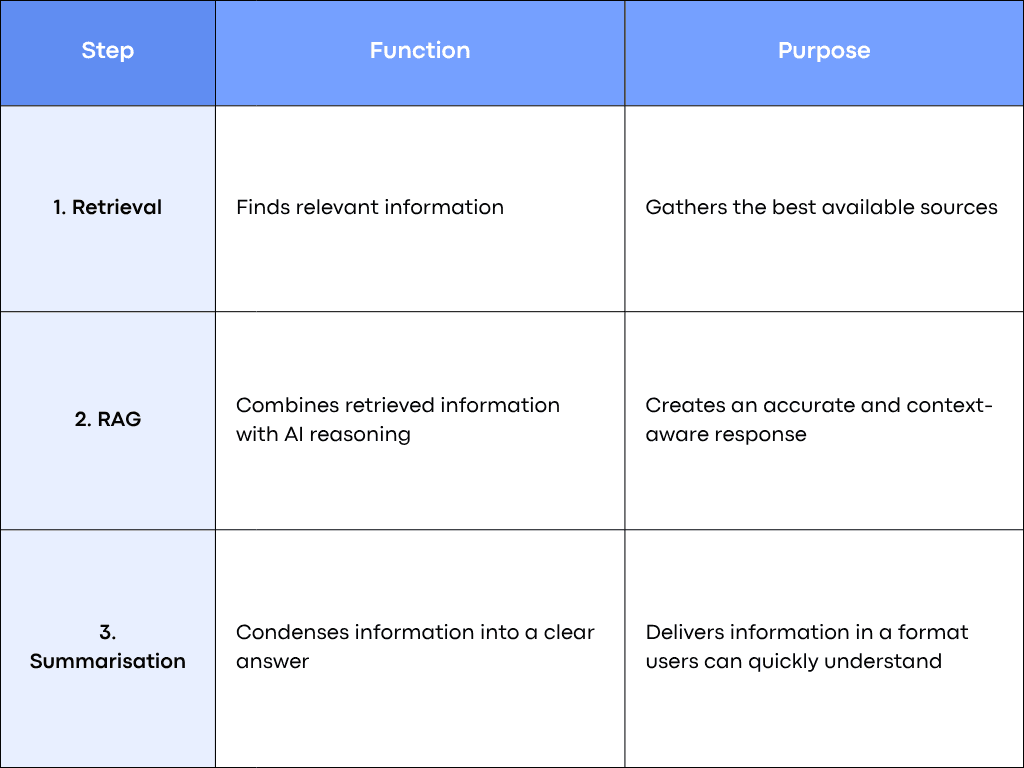
In simple terms:
- Retrieval finds the information.
- RAG processes the information.
- Summarisation delivers the information.
Together, these technologies enable AI search engines to provide direct, useful answers rather than simply presenting a list of webpages.
A Practical Example
Imagine a hospitality business owner asks: "What are the best SEO strategies for hotels in 2026?"
The AI search engine might follow a process like this:
Step 1: Retrieval
First, the system searches trusted sources across the web and retrieves relevant information.
For example, it may identify:
- Industry SEO reports
- Hotel marketing studies
- Search trend data
- Expert articles
- Recent Google updates
At this stage, the AI is gathering information, not generating an answer.
Step 2: Retrieval-Augmented Generation (RAG)
Next, the retrieved information is passed to the language model.
The model evaluates the material, identifies recurring themes, and determines which information is most relevant to the user's question.
For example, it may recognise that several authoritative sources highlight:
- Local SEO optimisation
- High-quality destination content
- Review management
- Structured data implementation
- Mobile-first website performance
Using these insights, the AI constructs a response grounded in the retrieved information rather than relying solely on its training data.
Step 3: Summarisation
Finally, the AI condenses the information into a concise and readable answer.
Instead of presenting dozens of articles, it might generate:
"The most effective SEO strategies for hotels in 2026 include strengthening local SEO, improving website speed, implementing structured data, creating destination-focused content, and actively managing online reviews."
The user receives a clear answer within seconds, while the AI has effectively processed information from multiple sources behind the scenes.
What This Means for Businesses
For businesses, this process highlights why content quality, authority, and structure are becoming increasingly important.
AI search engines can only retrieve and summarise information that they can understand and trust. Consequently, brands that publish clear, well-structured, and authoritative content are more likely to be referenced within AI-generated answers.
As AI search adoption grows, success will depend not only on ranking in search results but also on becoming a source that AI systems choose to retrieve, interpret, and cite.
How AI Search Changes SEO
Traditional SEO focused heavily on rankings and clicks. However, AI-powered search introduces new priorities that change how brands earn visibility online. Instead of simply competing for positions on a search results page, businesses must also consider how their content is interpreted, summarised, and referenced by AI systems.
1. Visibility Beyond Rankings
In traditional search, success was often measured by where a page ranked and how many clicks it received. Most pages would want their content to rank within the first 5 positions on the search results page.
However, AI search engines can now surface information directly within generated answers, meaning your content may influence a response even if users never visit your website.
As a result, brands need to think beyond rankings alone. Being cited, referenced, or used as a source by AI platforms can increase brand awareness, authority, and trust, even when the user remains within the AI interface.
2. Authority Becomes More Important
As AI search engines aim to provide reliable answers, they tend to favour sources that demonstrate expertise, credibility, and trustworthiness. Consequently, brands with a strong reputation and a proven track record are more likely to be referenced within AI-generated responses.
This means businesses should focus not only on publishing content regularly but also on building genuine authority through expert insights, original research, industry experience, and trustworthy information.
3. Structured Information Matters
AI systems need to quickly understand and interpret content before they can retrieve and summarise it. Therefore, well-structured content gives your information a significant advantage.
Clear headings, logical page organisation, FAQ sections, schema markup, and concise explanations make it easier for AI search engines to identify key information. In turn, this increases the likelihood that your content will be selected and incorporated into generated answers.
4. Entity-Based Search Expands
While keywords remain important, AI search engines increasingly rely on entities to understand relationships between people, brands, products, services, and topics. Rather than focusing solely on matching words, AI systems attempt to understand what those words represent.
For businesses, this means building clear associations around your brand and areas of expertise. By consistently publishing content related to your products, services, locations, and industry specialisations, you help AI systems better understand where your brand fits within the wider digital landscape.
How Businesses Can Optimise for AI Search
As AI search continues to evolve, organisations should adapt their content strategies accordingly. While many traditional SEO principles still apply, AI-powered search places greater emphasis on content quality, clarity, authority, and usefulness. By understanding what AI systems look for when retrieving and generating answers, businesses can improve their chances of being discovered and referenced.
1. Create Expert-Led Content
AI search engines aim to provide users with trustworthy and accurate information. Therefore, content that demonstrates genuine expertise is more likely to be viewed as a reliable source.
Rather than publishing generic articles, businesses should focus on sharing industry knowledge, practical insights, and real-world experience. This not only helps build credibility with readers but also strengthens the signals that AI systems use to assess authority and trustworthiness.
2. Answer Real Questions
Many AI searches are phrased as direct questions rather than traditional keyword searches. As a result, businesses should create content that addresses the specific queries, challenges, and concerns their target audience is likely to have.
By focusing on user intent and providing clear, helpful answers, organisations can make their content more relevant to both users and AI systems. Over time, this can increase the likelihood of being included in AI-generated responses.
3. Improve Content Structure
Even the most valuable content can be difficult for AI systems to interpret if it is poorly organised. Therefore, content should be structured in a way that makes key information easy to identify and understand.
Using clear headings, logical formatting, bullet points, FAQs, and summary sections helps both readers and AI search engines navigate the content more effectively. In turn, this can improve retrieval accuracy and increase the chances of your content being referenced.
4. Build Topical Authority
AI search engines increasingly evaluate how comprehensively a brand covers a particular subject. Consequently, publishing a single article on a topic is often less effective than developing a broader collection of related content.
By creating topic clusters and addressing subjects from multiple angles, businesses can demonstrate deeper expertise within their niche. This helps establish authority and signals to AI systems that your website is a valuable source of information on that topic.
5. Implement Structured Data
Structured data helps search engines understand the meaning and context of content on a webpage. While users may never see it directly, schema markup provides valuable signals that can improve how information is interpreted and categorised.
As AI search becomes more sophisticated, structured data can play an important role in helping platforms identify key details about your business, services, products, and content. This additional context can improve visibility across both traditional and AI-driven search experiences.
6. Maintain High Content Quality
Ultimately, content quality remains one of the most important factors in search visibility. Regardless of how advanced AI systems become, they are still designed to prioritise information that is accurate, relevant, useful, and trustworthy.
For this reason, businesses should focus on creating content that genuinely helps their audience rather than producing content solely for search engines. High-quality content is more likely to earn trust, attract engagement, and be referenced by AI platforms when generating responses.
Preparing Your Business for the Future of Search with Saigon Digital
As AI-powered search continues to transform how customers discover information online, businesses need strategies that go beyond traditional SEO.
At Saigon Digital, we help ambitious brands improve visibility across both search engines and AI-powered platforms while streamlining operations through intelligent automation.
Here’s how Saigon Digital helps businesses grow:
SEO Services
We help businesses improve their organic visibility and turn search traffic into measurable business outcomes by:
- Optimising website performance and technical SEO foundations
- Identifying high-value search opportunities and target keywords
- Creating content strategies that attract qualified audiences
- Building topical authority and brand trust online
- Improving local and international search visibility
- Monitoring performance and continuously refining SEO efforts
Generative Engine Optimisation (GEO)
We help brands become more discoverable across AI-powered search platforms such as ChatGPT, Gemini, Perplexity, and Google AI by:
- Optimising content for AI readability and retrieval
- Structuring information to improve AI-generated citations
- Implementing schema markup and knowledge graph strategies
- Identifying opportunities to increase AI search visibility
- Auditing and refining content for Answer Engine Optimisation (AEO)
- Tracking AI search performance and brand presence
AI Workflow Automation
We help organisations improve efficiency and scale operations through practical AI solutions by:
- Automating repetitive and time-consuming processes
- Building custom AI agents tailored to business needs
- Streamlining workflows across teams and departments
- Integrating AI tools into existing systems and operations
- Improving productivity through intelligent automation
- Helping teams focus on higher-value strategic work
Take the Next Step Towards AI-Ready Search Visibility
AI search combines advanced retrieval systems, Retrieval-Augmented Generation (RAG), and sophisticated summarisation techniques to deliver direct answers rather than simple lists of links.
For brands across hospitality, retail, education, F&B, and other competitive sectors, this shift presents both challenges and opportunities. Businesses that create authoritative, structured, and genuinely useful content are more likely to be discovered, referenced, and trusted by both users and AI systems.
At Saigon Digital, we help ambitious brands stay ahead of these changes.
The future of search is already here. Businesses that understand how AI search engines work today will be better positioned to capture visibility, authority, and growth tomorrow.
Ready to strengthen your visibility in the age of AI search?