



An AI visibility report answers one question in plain terms: when buyers ask an AI assistant for a supplier in your category, does your brand get named, and is that improving?
Most guides on this topic explain the theory and stop. This one gives you the artefact. Below you will find the seven-step process for producing an AI brand visibility report, a section-by-section template you can copy, worked examples with real numbers, the six metrics that belong in it, and a one-page executive summary format for the people who will only read the first paragraph.
Artificial intelligence is no longer a future-facing concept. It is already shaping how people search, discover and choose brands. From conversational search engines to AI-powered assistants, customers are increasingly receiving curated answers rather than traditional lists of links.
Key Takeaways
- Lead with Visibility Score, not traffic. Most AI answers contain no clickable link, so referral traffic understates the channel badly. Visibility Score is the percentage of tracked prompts where your brand appears.
- Fifteen to twenty-five prompts is the working range. Fewer and the sample is noise. More and the report becomes unrepeatable by hand.
- Keep the prompt set frozen. Changing prompts between cycles means you are measuring the prompts, not the progress.
- Segment by platform. A blended visibility number hides the gaps that matter. Brands are routinely strong in one engine and invisible in another.
- Monthly is the right default cadence for most brands, with weekly during an active campaign and quarterly for stable, low-competition categories.
What Is an AI Visibility Report?
An AI visibility report is a structured analysis of how your brand performs across AI-driven search environments and generative platforms.
Unlike traditional SEO reporting, which focuses on rankings and traffic, an AI visibility report evaluates:
- Whether AI tools mention your brand
- How your brand is described
- Which competitors are surfaced instead of you
- The sources AI systems rely on when generating answers
- The sentiment and positioning of your brand within AI responses
It bridges the gap between search engine optimisation and AI-powered discovery.
As AI-powered tools such as conversational assistants and generative search experiences increasingly influence customer journeys, brands must understand how they are represented, not just whether they rank.
Why Your Brand Needs an AI Visibility Report
AI systems are rapidly becoming gatekeepers of information. Instead of clicking through multiple websites, users now rely on summarised answers.
If your brand is:
- Not cited
- Incorrectly described
- Positioned below competitors
- Associated with outdated messaging
…then your digital visibility is already under pressure.
An AI visibility report enables you to:
- Identify missed visibility opportunities
- Uncover content gaps
- Protect brand positioning
- Inform SEO and content strategy
- Align your AI strategy with business goals
For forward-thinking brands, this is no longer optional. It is a strategic requirement.
How to Build an AI Visibility Report in 7 Steps
Step 1: Define the Scope and Objectives
Before you gather data or test prompts, define exactly what your AI visibility report is designed to measure. Connect the report to a commercial objective by asking: what business decision will this report support?
Clarify the core objective. Decide whether you are assessing:
- Brand awareness: how often AI mentions your brand in relevant conversations
- Category authority: whether your brand is positioned as a leader in your niche
- Product or service discoverability: whether your core offerings surface when users search for solutions
- Reputation and sentiment: whether your brand is described positively, neutrally or critically
- Competitive share of voice: how your visibility compares to direct competitors
Define geographic and market scope. AI responses vary by geography and language. A brand may appear prominently in UK-focused prompts yet remain invisible globally. If your growth strategy targets expansion, the report must reflect that.
Identify priority service lines. Not all services are commercially equal. Focus prompt testing on your highest-margin and highest-growth offerings rather than spreading effort evenly.
Select competitors deliberately. Segment into direct competitors, aspirational competitors and emerging disruptors. Three named competitors is usually the right number for a readable report.
Step 2: Identify Relevant AI Platforms
AI-powered discovery does not happen in one place. Rather than analysing every AI tool available, focus on the platforms that genuinely influence your audience's decision-making.
- Conversational assistants: where buyers ask for recommendations and comparisons
- AI-enhanced search: Google AI Overviews, AI Mode, answer boxes and knowledge panels
- Vertical and industry tools: SaaS marketplaces, procurement platforms and review aggregators that shape shortlists in your sector
Practical guidance: three to five platforms is the right scope. Document why you included each one, and test in clean or incognito sessions to reduce personalisation effects.
Step 3: Develop Structured Prompt Sets
AI systems respond differently depending on wording, intent and context. Without structured prompt sets, your report will produce inconsistent and unreliable insights.
Brand-focused prompts assess how AI interprets your business when asked directly:
- "What is [Your Brand] known for?"
- "Is [Your Brand] a reputable agency?"
- "Who are the competitors of [Your Brand]?"
Solution and intent-based prompts reflect how buyers search before they know your name. This category is the most commercially significant:
- "Best SEO agency in Ho Chi Minh City"
- "Top AI marketing agencies"
- "Which AI SEO agency should I hire?"
Comparative prompts reveal how AI positions you against alternatives:
- "[Your Brand] vs [Competitor Name]"
- "Best alternative to [Competitor Name]"
Two rules that determine whether the report is usable. First, keep the set between 15 and 25 prompts. Second, freeze it. Once the prompt set changes, you are no longer measuring progress against a baseline, and every trend line in the report becomes meaningless.
Step 4: Analyse Brand Representation
At this stage your focus shifts from visibility to representation. It is no longer enough to ask whether your brand appears. You must evaluate how it appears.
Evaluate messaging accuracy. Does the AI describe your core services correctly? Is outdated information appearing? Are you categorised in the right niche? If your agency has repositioned around AI-powered SEO yet responses still describe you as a "web development agency", that is an alignment gap, not an AI error. It usually means your digital footprint still reflects older messaging.
Assess authority and tone. Compare these two descriptions:
- "A leading AI marketing agency specialising in technical SEO."
- "A digital agency offering various marketing services."
Both may be technically correct, yet the first conveys authority while the second sounds generic. Record the adjectives used, whether credentials are referenced, and the depth of explanation compared with competitors.
Analyse differentiation. If your unique selling points are unclear or inconsistently communicated online, AI responses will flatten your positioning. Check whether you are described as a specialist or a generalist, and whether competitors receive sharper framing for capabilities you also offer.
Patterns matter far more than individual responses. One odd answer is noise. The same outdated description appearing across three platforms is a finding, and it usually traces back to your own site, your directory listings or your backlink profile.
Step 5: Track Source Attribution
If brand representation reveals the outcome, source attribution reveals the cause. Document every citation appearing in AI responses and record which domains appear most frequently.
Categorise sources into:
- Owned media: your website, blog and resources
- Earned media: press coverage, interviews, guest contributions
- Shared media: social and syndicated mentions
- Review platforms: directories and testimonials
Then check your third-party profiles for the details that quietly undermine credibility: duplicate or inconsistent business descriptions, old service offerings still listed, incomplete profile data and incorrect geographic categorisation.
This section usually produces the most actionable finding in the entire report. If competitors are cited through industry publications and review platforms while your own blog is never referenced, the gap is not content quality. It is third-party validation, and the fix is digital PR rather than more publishing. Our guide to AI citation tracking covers how to monitor this continuously.
Step 6: Benchmark Against Competitors
Visibility in AI environments is inherently relative. If competitors are positioned more prominently or more consistently, your absence becomes more pronounced.
Measure share of visibility across prompt categories rather than analysing isolated mentions. A simple comparison table is enough:
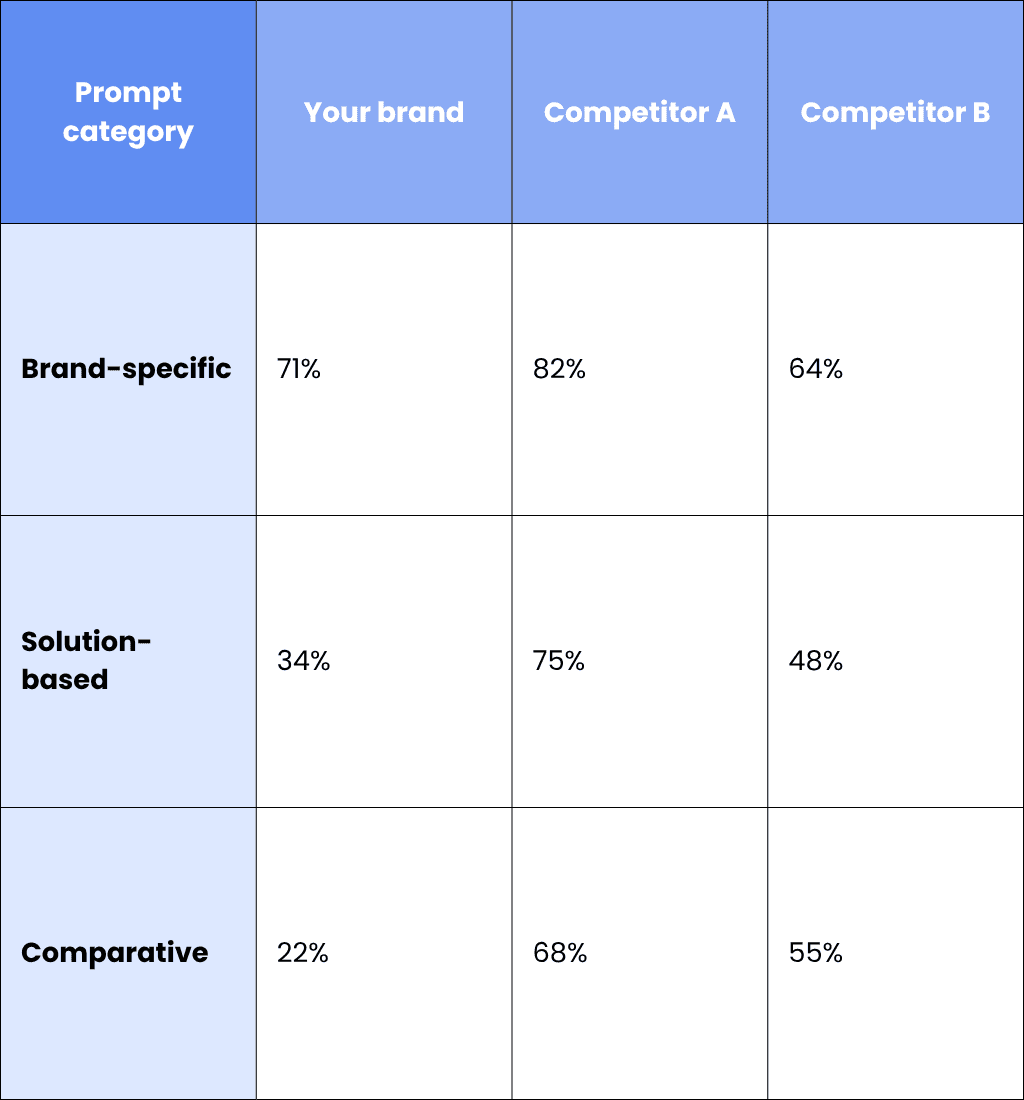
The pattern in that table is extremely common and worth recognising. Strong brand-query visibility with weak solution-query visibility means people who already know you find you, and people who do not, never will. That is an authority problem, not an awareness problem, and it changes what you should spend money on.
Compare authority language. If Competitor B is consistently described as "a leading consultancy with enterprise clients" while you are "a digital agency", that difference shapes perception regardless of mention counts.
Identify emerging threats. Benchmarking often surfaces brands you had not considered, including smaller players gaining ground through thought leadership or strong review signals. Our guide to benchmarking AI visibility against competitors covers the full method.
Step 7: Translate Insights into Action and Establish Monitoring
Prioritise by commercial impact. Not all findings deserve immediate attention. Rank gaps by whether they affect revenue, positioning or credibility, then categorise as high impact and urgent, high impact and non-urgent, or long-term optimisation.
Build the action plan as a table, not prose. Every row needs a gap, an action, an owner, a timeline and a success metric:
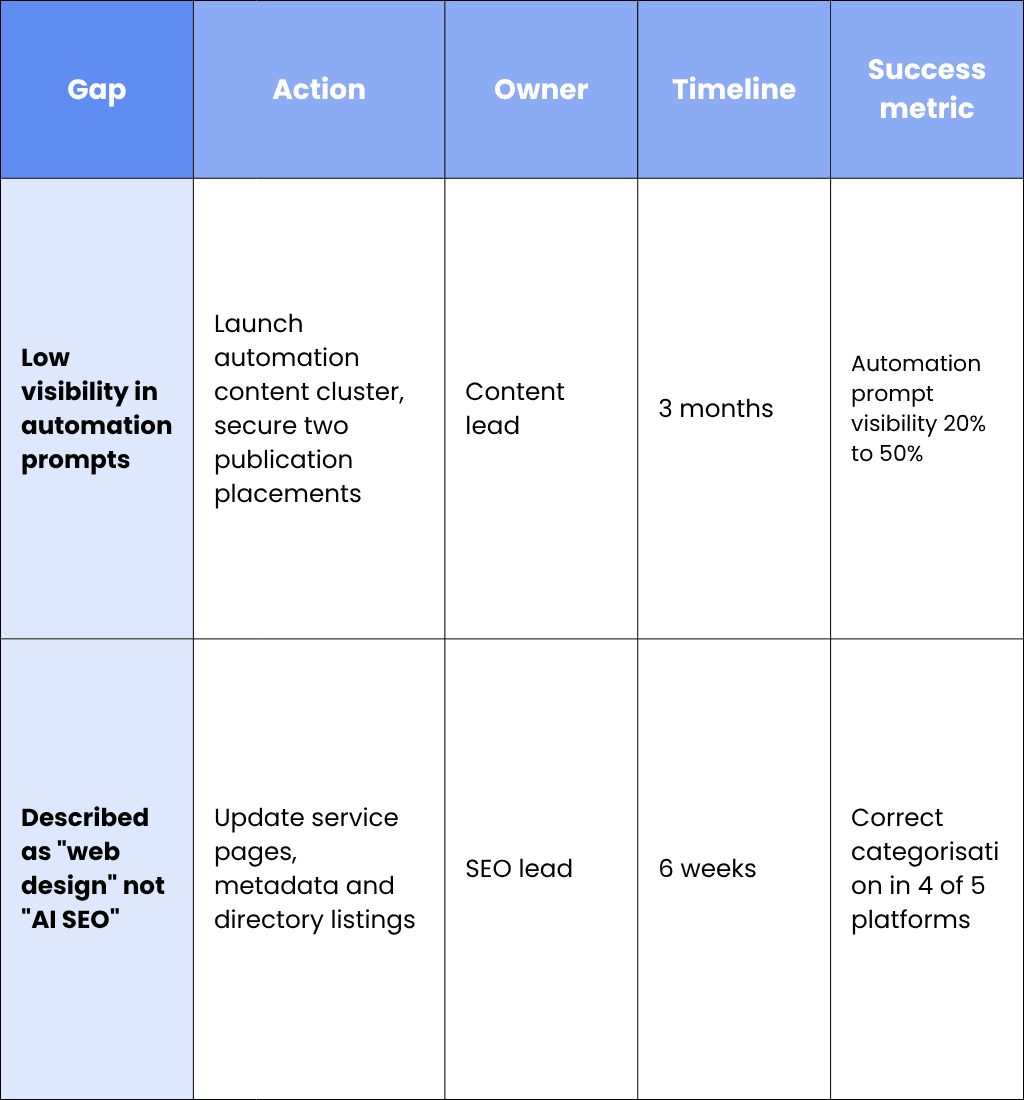
t a review cadence and hold it. Re-run the identical prompt set, compare scores, and document new citation sources. Consistency is what turns anecdote into performance tracking.
Which cadence is right?
- Weekly: during an active campaign or repositioning. Enough signal to course-correct, high manual effort without tooling.
- Monthly: the right default for most brands. Aligns with existing marketing reporting cycles.
- Quarterly: suitable for stable, low-competition categories, but slow enough that you will discover problems late.
Integrate with wider reporting. Align AI visibility data with organic performance, backlink growth, content production and digital PR activity so you can attribute movement to specific investment. Our overview of essential marketing metrics covers how this fits the broader picture.
Tools for Producing an AI Visibility Report
You can produce a credible first report with nothing but a spreadsheet and two hours. Automation becomes worthwhile once the prompt set or the reporting frequency grows.
- Manual, free. A spreadsheet with one row per prompt per platform, plus Google Search Console's generative AI performance reports for AI Overviews and AI Mode impressions. Workable up to around 25 prompts across three platforms.
- Entry-level monitoring. Dedicated platforms starting around $29 per month automate prompt running and citation extraction across the major engines.
- Mid-market analytics. Roughly $80 to $300 per month adds sentiment scoring, share of voice and exportable reporting.
- Enterprise. Source-level citation intelligence and governance, typically sold through a demo process.
We compare the specific options in our guides to AI visibility tools and Google AI Overview tracking tools. A word of caution that applies to all of them: automation removes the manual effort but not the judgement. The tool tells you your score moved. It cannot tell you why.
The Future of Brand Visibility Is AI-Driven
Search behaviour is evolving. AI systems increasingly summarise, recommend, and prioritise information on behalf of users.
Brands that understand how they appear in AI-generated responses gain a strategic advantage. They influence perception at the very moment decisions are being shaped.
An effective AI visibility report enables you to:
- Strengthen authority
- Improve discoverability
- Protect brand positioning
- Align digital strategy with AI evolution
At Saigon Digital, we believe the future of digital growth lies in combining technical precision with strategic foresight.
Contact us today and let us boost your brand’s AI presence!
AI Visibility Report FAQs
1. What is an AI visibility report?
An AI visibility report is a structured, repeatable analysis of how often your brand appears in AI-generated answers, how it is described, which competitors appear instead, and which sources those answers cite. It measures inclusion inside the answer rather than rankings or clicks.
2. What should an AI brand visibility report include?
Nine sections: an executive summary under 100 words, a metrics scorecard, a platform-by-platform breakdown, competitive share of voice, representation analysis with direct excerpts, source attribution, prioritised gaps, an action plan with owners and timelines, and a methodology appendix.
3. How do you calculate an AI visibility score?
Divide the number of prompts where your brand appears by the total number of prompts tested, then express it as a percentage. Calculate it separately for each platform and for each prompt category, because a single blended figure conceals the gaps that matter most.
4. How often should you produce an AI visibility report?
Monthly suits most brands and aligns with existing marketing reporting. Move to weekly during an active campaign or repositioning, and quarterly only in stable, low-competition categories where slower detection is acceptable.
5. How many prompts should you test?
Between 15 and 25, split across brand-specific, solution-based and comparative categories. Fewer produces a sample too small to trust. More becomes impractical to run manually and tempts teams to skip cycles.
6. Can you build an AI visibility report for free?
Yes. A spreadsheet, a frozen prompt set and clean browser sessions will produce a credible first report in around two hours, supplemented by Google Search Console's generative AI performance reports for AI Overviews and AI Mode impressions. Paid tooling saves time rather than unlocking insight you could not otherwise reach.
7. Why do AI answers differ each time I run the same prompt?
Generative models produce variable output by design, and results also shift with location, device, account history and model updates. This is why the report must document its methodology and why patterns across multiple runs matter far more than any single response.
8. How is an AI visibility report different from an SEO report?
An SEO report measures position and traffic for pages. An AI visibility report measures whether your brand is named inside an answer, how it is characterised, and who is named alongside you. The two are complementary, and strong rankings do not guarantee strong AI visibility, particularly in ChatGPT.