



Search has entered a new era.
For years, businesses optimised websites primarily for traditional search engines, focusing on rankings, keywords, backlinks, and technical SEO. While these fundamentals remain essential, AI-powered search experiences are rapidly changing how users discover information. Platforms such as ChatGPT, Gemini, Perplexity, and Google's AI-powered search features increasingly rely on structured, machine-readable information to understand websites, identify trustworthy sources, and generate accurate responses.
This shift means businesses need to think beyond simply implementing basic Schema.org markup. The organisations that stand out in AI-generated answers will be those that make their content exceptionally easy for AI systems to interpret, connect and trust.
This is where advanced structured data strategies become a competitive advantage.
In this guide, we'll explore what advanced structured data means, why it matters for AI crawlers, and how businesses can build a future-ready website that supports both traditional SEO and emerging Generative Engine Optimisation (GEO).
Why Structured Data Matters More Than Ever
Traditional search engines primarily ranked pages based on hundreds of signals including content relevance, links, page experience and authority.
AI systems operate differently.
Rather than simply matching keywords, they attempt to understand:
- entities
- relationships
- facts
- context
- expertise
- trustworthiness
- topical authority
Structured data provides many of these signals in a format machines can interpret with high confidence.
Instead of asking AI to infer information from paragraphs of text, structured data explicitly tells it:
- who your company is
- what products or services you offer
- where you operate
- who created the content
- how different pages relate to one another
- which facts should be considered authoritative
The result is greater clarity for AI crawlers and fewer opportunities for misunderstanding.
Beyond Schema.org: What Does "Advanced" Actually Mean?
Many organisations believe they have completed structured data implementation after adding Organisation, LocalBusiness or Article schema.
In reality, this is only the beginning.
Basic Schema typically answers:
- What is this page?
- Who owns it?
- What is the business called?
Advanced structured data strategies answer much bigger questions:
- How does every page connect?
- Which entities are most important?
- What relationships exist across the website?
- Which facts should AI trust?
- How does this organisation fit into its wider industry?
Rather than treating schema as isolated snippets of code, advanced implementations create an interconnected knowledge ecosystem.
This helps AI understand your entire digital presence rather than individual webpages.
AI Crawlers Rely on Entities, Not Just Keywords
One of the biggest changes in AI search is the move towards entity-based understanding.
An entity can be:
- a company
- a product
- a location
- a service
- a person
- an educational institution
- a restaurant
- a hotel
- a brand
AI systems build enormous knowledge graphs consisting of millions of interconnected entities.
When your website clearly defines these entities through structured data, AI can place your organisation into its broader understanding of the web.
For example, a hospitality business isn't simply targeting "hotel in Ho Chi Minh City."
Instead, AI may understand:
- the hotel brand
- room types
- amenities
- location
- nearby attractions
- awards
- sustainability initiatives
- reviews
- booking policies
- partnerships
Each becomes part of a connected knowledge graph.
Advanced Structured Data Strategies for AI Crawlers
Once you've established a solid Schema.org foundation, the next step is to adopt more sophisticated approaches that help AI systems understand your website at a deeper level. Rather than viewing structured data as a collection of individual code snippets, think of it as a framework that explains your business, content and expertise in a way that machines can interpret with confidence.
The following advanced structured data strategies can help improve how AI crawlers understand your website, connect information across pages and determine whether your content is suitable to surface in AI-generated responses.
1. Build Entity Relationships Across Your Entire Website
One of the most effective advanced structured data strategies is to stop thinking of webpages as isolated assets. Instead, consider your website as a connected network of entities that work together to tell the complete story of your business.
For example, your homepage shouldn't simply identify your organisation. It should also establish relationships with your services, locations, key personnel and supporting content. Likewise, blog articles should identify their authors, while case studies should reference the services delivered and industries served.
This interconnected structure enables AI crawlers to understand not only what each page is about but also how every page contributes to your overall expertise.
A simplified relationship might look like this:
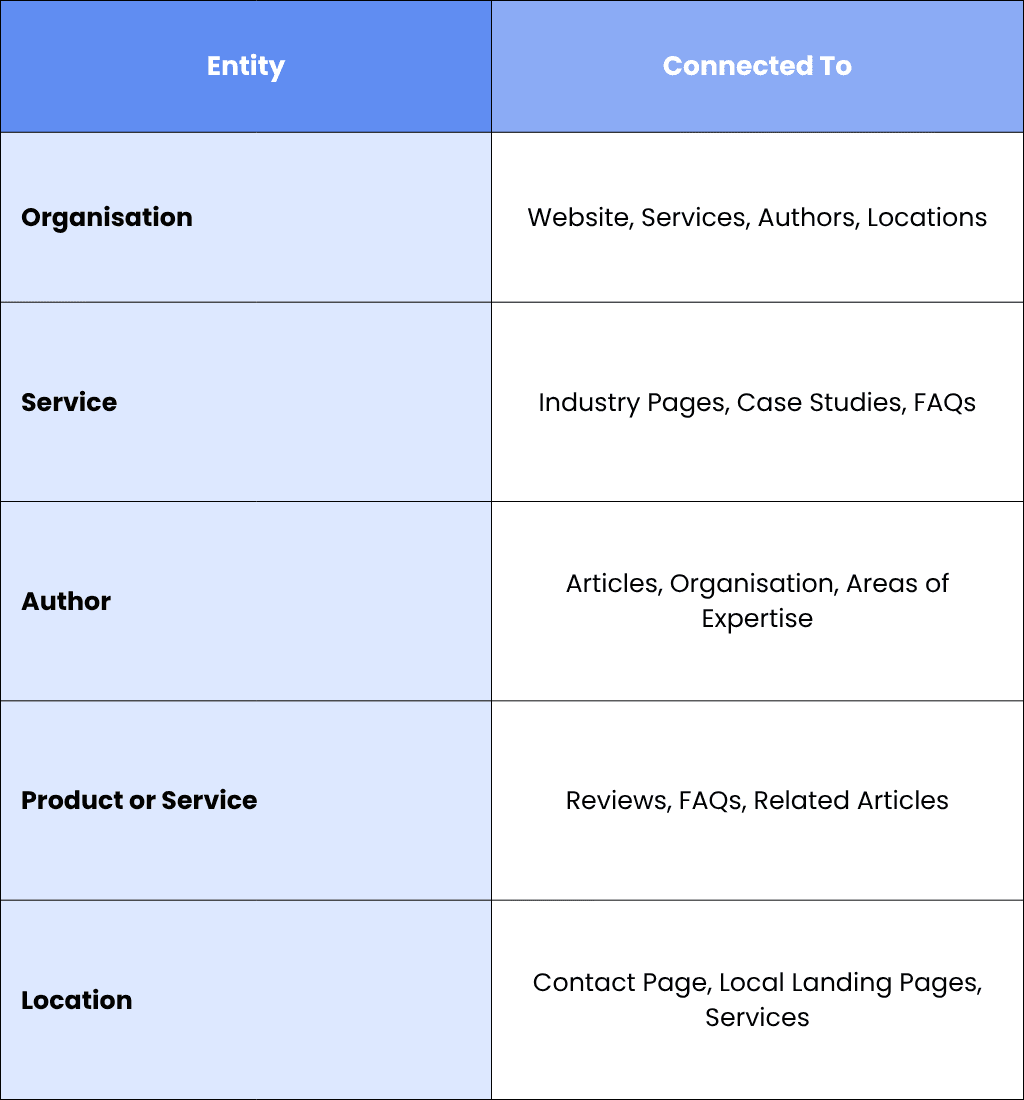
By consistently linking these entities throughout your website, you create a coherent information architecture that AI systems can follow with ease. This also reduces ambiguity, making it easier for AI to reference your organisation accurately.
2. Use Persistent Identifiers Wherever Possible
AI systems often encounter multiple businesses with similar names, making it difficult to determine which organisation a webpage refers to. Persistent identifiers solve this problem by providing unique references that consistently identify your business across the web.
Instead of relying solely on your company name, connect your structured data to authoritative identifiers wherever possible.
These may include:
- your official website
- your Google Business Profile
- recognised social media profiles
- Wikidata identifiers
- industry association memberships
- recognised business directories
Imagine two restaurants called "The Garden". Without additional context, AI may struggle to distinguish between them. However, when both restaurants include unique identifiers such as their official website, verified business profile and location information, AI can confidently identify the correct entity.
The more consistently these identifiers appear across your digital presence, the stronger your entity becomes within AI knowledge systems.
3. Strengthen Your Knowledge Graph
Knowledge Graph optimisation goes beyond adding structured data to individual pages. Instead, it focuses on building a complete digital representation of your organisation.
Every important aspect of your business should be connected, including:
- your company
- your founders or leadership team
- your products and services
- your locations
- your areas of expertise
- your client industries
- your published content
Rather than asking AI to piece together this information from dozens of webpages, you are proactively helping it understand the bigger picture.
For example, an SEO agency serving hospitality businesses could connect:
Organisation → SEO Services → Hospitality SEO → Hotel Case Study → Industry Insights → Author Expertise
This chain of relationships provides AI with significantly more context than standalone webpages.
As your Knowledge Graph grows, your business becomes easier for AI systems to recognise as an authoritative source within your niche.
4. Mark Up Expertise, Not Just Content
Many organisations implement Article schema but overlook the people behind the content. However, AI systems increasingly evaluate who created information, particularly for topics where expertise matters.
Whenever appropriate, include structured data for:
- authors
- reviewers
- editors
- contributors
- organisations
- professional roles
- qualifications
- relevant experience
For example, instead of simply publishing an article under "Marketing Team", identify the individual author, describe their role within your company and connect them back to your organisation.
This approach strengthens signals related to Experience, Expertise, Authoritativeness and Trustworthiness (E-E-A-T). It also helps AI determine whether your content comes from credible subject matter experts rather than anonymous publishers.
As AI-generated search continues to evolve, transparent authorship is likely to become increasingly valuable.
5. Connect Services with Industries and Customer Problems
Many businesses describe their services without providing enough context about who those services are intended for. As a result, AI may understand what you do but not when to recommend you.
Instead, establish structured relationships between your services, industries and customer challenges.
For example:
This additional context helps AI answer highly specific user queries.
For instance, if someone asks an AI assistant:
"Which agency specialises in SEO for hospitality businesses?"
a website that clearly connects its SEO services with the hospitality industry is far more likely to be recommended than one that simply lists "SEO Services".
6. Use Semantic HTML Alongside Structured Data
Structured data should complement your website's visible content, not replace it.
AI crawlers still rely heavily on semantic HTML to understand page hierarchy and meaning. If your content lacks logical structure, even well-written schema may have limited impact.
A well-organised page should include:
- one clear H1 heading
- descriptive H2 and H3 subheadings
- concise paragraphs
- numbered steps where appropriate
- bullet lists for complex information
- descriptive image alt text
- accessible tables
- meaningful internal links
Consider the following comparison:
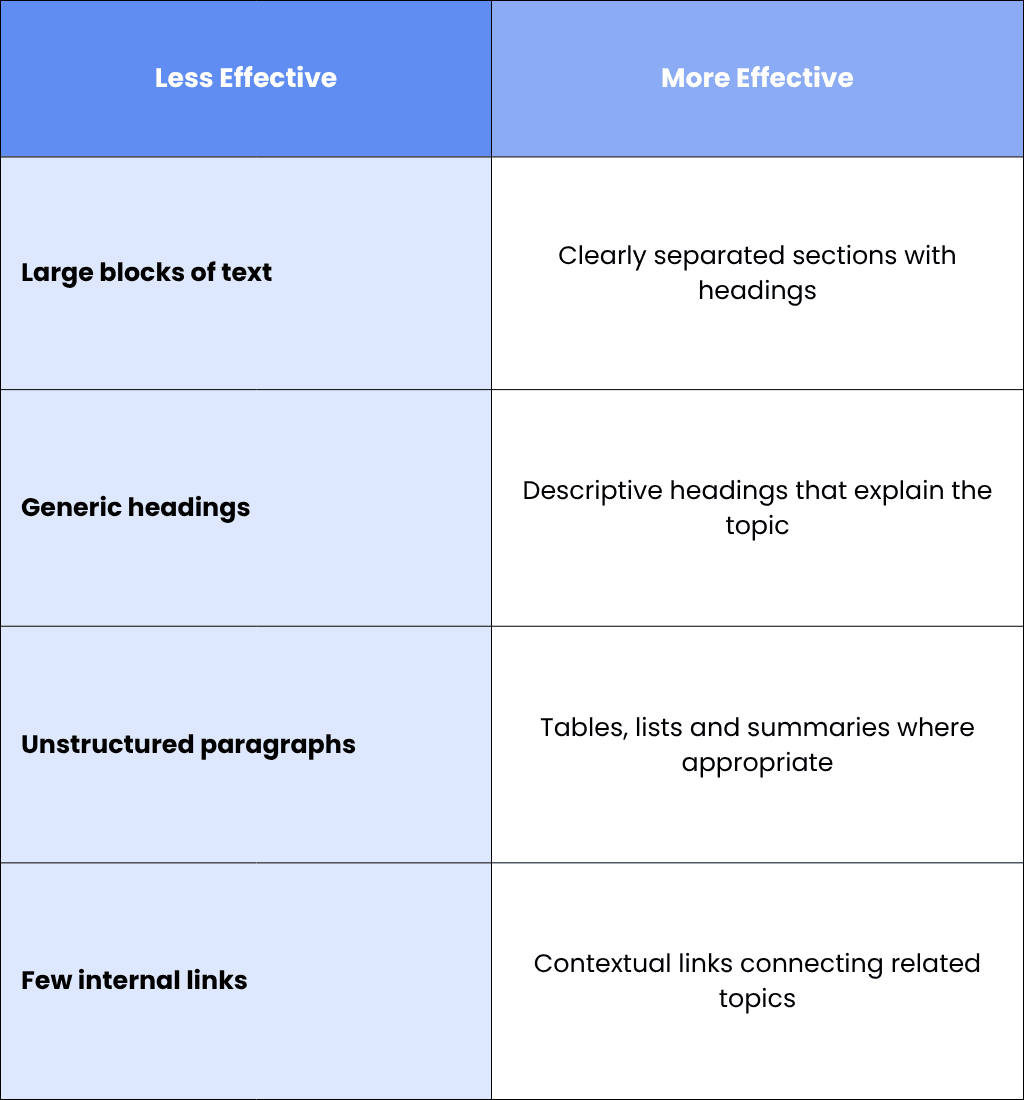
When both semantic HTML and structured data reinforce the same information, AI systems can interpret your content with greater confidence.
7. Add Structured Data to Supporting Content
Many organisations restrict structured data implementation to service pages or product pages. However, supporting content often contains the detailed information that AI systems use when generating responses.
Consider implementing structured data across content such as:
- comprehensive guides
- FAQs
- case studies
- research reports
- webinars
- videos
- white papers
- events
- downloadable resources
For example, a detailed guide explaining local SEO best practices may become the source AI references when answering user questions, even if the service page itself is not cited.
The broader your structured content ecosystem becomes, the more opportunities AI has to discover, interpret and reference your expertise.
8. Build Topic Clusters with Structured Relationships
Rather than publishing disconnected articles, organise your content into topic clusters centred around your core expertise.
Each cluster should consist of:
- one comprehensive pillar page
- multiple supporting articles
- internal links connecting related topics
- structured data reinforcing these relationships
For example, an education provider might develop a topic cluster like this:
International Education
│
├── Student Recruitment
├── Admissions Process
├── Visa Guidance
├── Online Learning
├── Scholarships
└── Student Success Stories
This structure helps AI understand that your organisation has broad and in-depth expertise within a particular subject area.
The stronger the relationships between these pages, the easier it becomes for AI to recognise your topical authority.
9. Create FAQs That Answer Real Questions
FAQs remain valuable, but only when they genuinely help users.
Rather than writing questions purely to target keywords, identify the questions your customers repeatedly ask during consultations, sales conversations or customer support interactions.
High-value FAQs often cover topics such as:
- implementation timelines
- pricing considerations
- common misconceptions
- eligibility requirements
- comparisons between solutions
- expected outcomes
- ongoing maintenance
Each answer should be concise, factual and easy to understand.
Remember that AI assistants frequently extract short answers from FAQ sections. Therefore, every response should stand on its own without requiring additional explanation.
10. Keep Structured Data Synchronised with Website Content
Structured data should never become outdated.
Whenever information changes on your website, update your structured data at the same time.
This includes changes to:
- services
- product information
- pricing
- contact details
- business locations
- leadership team
- operating hours
- certifications
- awards
Imagine that your structured data still lists an old office address while your contact page displays a new one. AI systems may struggle to determine which information is accurate, reducing confidence in your website.
Establishing a routine audit, perhaps every quarter or alongside major website updates, can help ensure your structured data remains aligned with your visible content.
11. Make Business Information Machine Readable
Important business information should never be hidden inside lengthy paragraphs.
Instead, present key facts clearly and consistently across your website.
This might include:
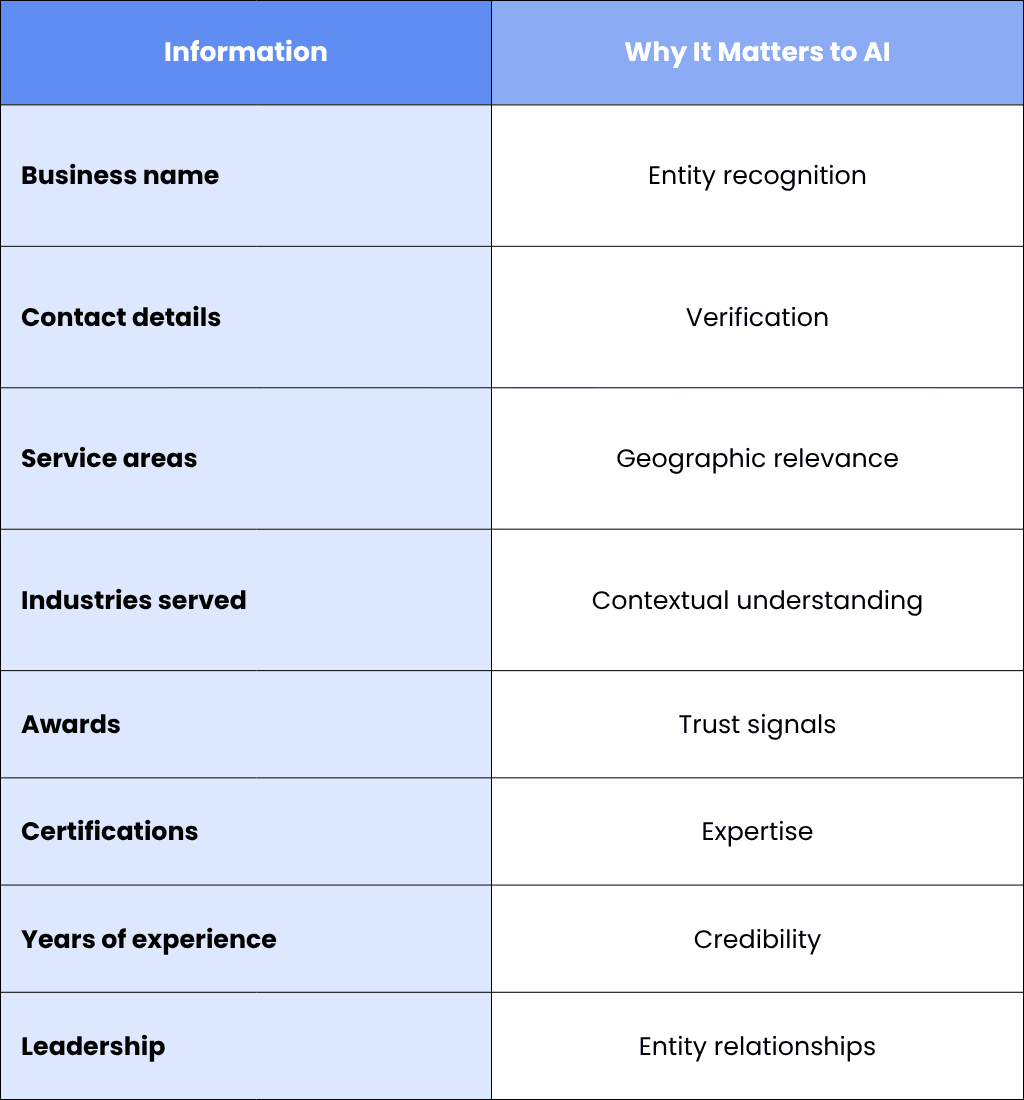
The easier your website makes these details to identify, the easier it becomes for AI systems to retrieve accurate information when generating responses.
12. Optimise for AI Retrieval, Not Only Search Engine Indexing
Traditional SEO focused on ensuring webpages could be crawled, indexed and ranked.
AI optimisation introduces an additional objective: retrieval.
When an AI assistant answers a question, it needs to locate information quickly, understand it confidently and determine whether it is trustworthy enough to reference.
Before publishing a page, ask yourself:
- Can AI immediately identify the main topic?
- Is the primary answer obvious within the first few paragraphs?
- Are the author and organisation clearly identified?
- Is supporting evidence easy to locate?
- Are related resources connected through internal links and structured data?
If the answer to these questions is "yes", your content is significantly more likely to be retrieved and cited in AI-generated responses.
Ultimately, the goal is not simply to help AI crawl your website, it is to help AI understand, trust and confidently recommend your business when users seek reliable information.
Monitor How AI Platforms Reference Your Brand
As AI-powered search continues to evolve, measuring success requires more than tracking keyword rankings or organic traffic. Increasingly, businesses also need to understand how AI platforms perceive, interpret and reference their brand.
Unlike traditional search engines, AI assistants do not always present a list of webpages for users to choose from. Instead, they often generate direct answers by synthesising information from multiple trusted sources. This means your website may influence an AI-generated response even if users never visit your page directly.
For this reason, monitoring your brand's visibility across AI platforms should become a regular part of your SEO and Generative Engine Optimisation (GEO) strategy.
Rather than asking, "Where does my website rank?", businesses should begin asking:
- Does AI mention our brand when discussing our area of expertise?
- Does AI accurately describe our products or services?
- Is our company recommended for relevant industry-specific queries?
- Does AI correctly identify our experience, locations and specialisations?
- Are competitors being referenced more frequently than we are?
These questions provide valuable insights into how AI systems understand your business and where opportunities for improvement may exist.
What Should You Monitor?
A comprehensive monitoring process should examine both the accuracy and visibility of your brand across multiple AI platforms.
Key areas to review include:
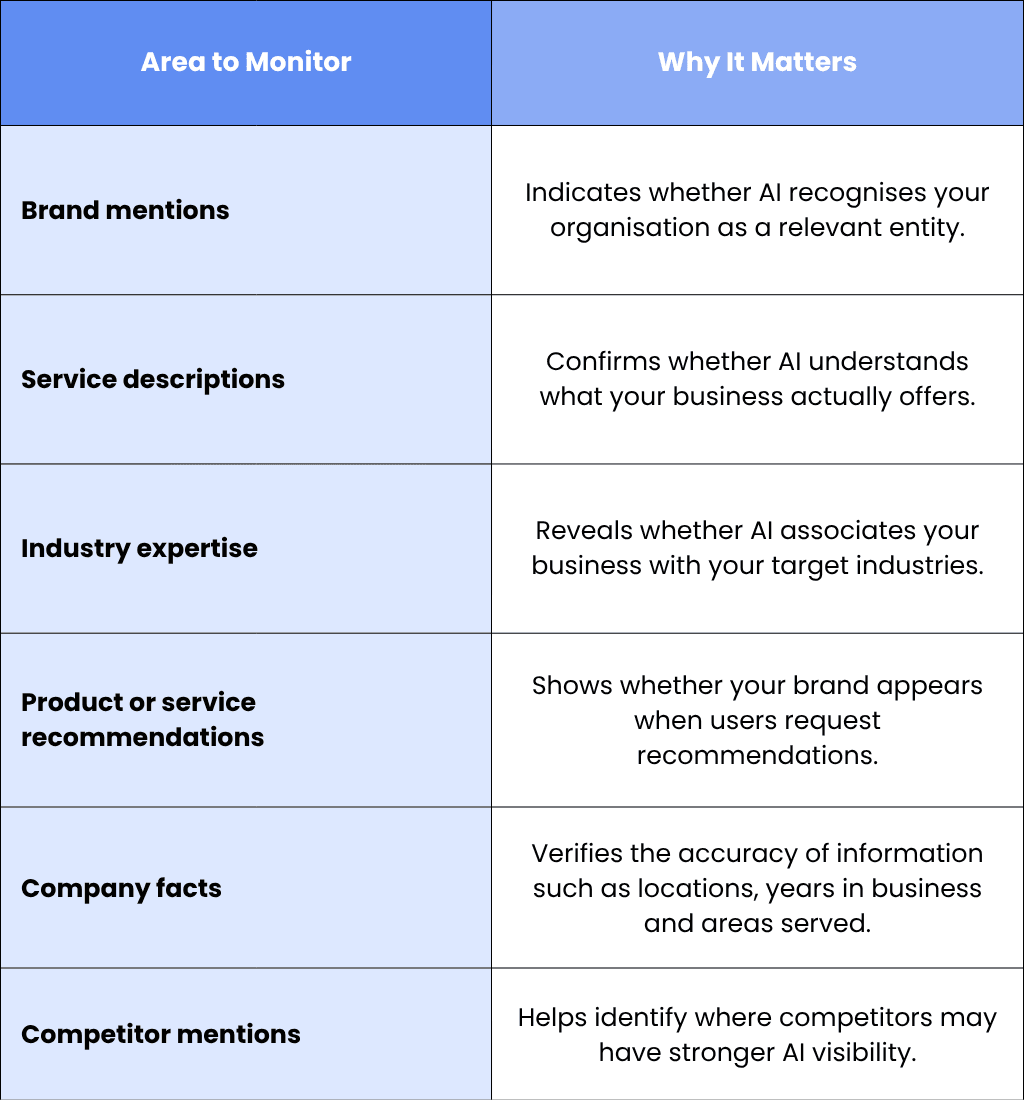
Monitoring these areas allows you to identify gaps before they affect customer perception or lead generation.
Test AI Platforms Using Real Customer Questions
One of the simplest ways to evaluate your AI visibility is to ask the same questions your potential customers are likely to ask.
For example, rather than using broad prompts, test queries that reflect genuine buying intent.
Examples include:
- Which SEO agencies specialise in hospitality businesses?
- Who provides Generative Engine Optimisation services?
- What are the best SEO agencies for retailers?
- How can restaurants improve their visibility in AI search?
- Which agencies offer both SEO and AI automation services?
As you review the responses, consider:
- Is your business mentioned?
- Are your services accurately described?
- Are your strengths clearly recognised?
- Which competitors appear instead?
- Does AI provide outdated or incorrect information?
Documenting these responses over time allows you to identify trends and measure the impact of your optimisation efforts.
Track Brand Consistency Across AI Platforms
Different AI platforms may interpret your business differently because they rely on different data sources, retrieval methods and ranking systems.
For example, one platform may accurately describe your services, while another may omit important information or confuse your business with another organisation.
Where possible, compare how your brand appears across multiple AI assistants, including:
- ChatGPT
- Gemini
- Perplexity
- Google AI-powered search experiences
- Microsoft Copilot
If you notice inconsistencies, investigate whether your website, structured data, business profiles or third-party references require updating.
Maintaining consistent information across your digital ecosystem makes it easier for AI systems to develop a reliable understanding of your organisation.
Monitor Which Content AI Prefers to Reference
Not every page on your website contributes equally to AI-generated responses.
In many cases, AI assistants favour content that is:
- comprehensive
- well structured
- factually accurate
- clearly organised
- regularly updated
- supported by authoritative sources
You may discover that your educational guides are referenced far more frequently than your service pages, or that your FAQs are regularly used to answer customer questions.
Understanding these patterns enables you to produce more of the content that AI systems find valuable.
Over time, this insight can shape your editorial strategy and improve your overall visibility across AI-driven search experiences.
Compare Your AI Visibility with Your Competitors
Competitive analysis has always been an important part of SEO, and it is becoming equally valuable in the world of AI search.
Periodically test the same prompts using both your brand and your competitors.
Consider questions such as:
- Which companies are consistently recommended?
- What expertise does AI associate with each business?
- Which services receive the greatest visibility?
- What types of content appear to influence AI recommendations?
This exercise often reveals opportunities to strengthen your own content, improve structured data implementation or expand topical coverage.
Rather than copying competitors, focus on identifying gaps where your organisation can provide more comprehensive, trustworthy and clearly structured information.
Build an AI Visibility Dashboard
As AI search matures, businesses should consider tracking AI performance alongside traditional SEO metrics.
An AI visibility dashboard might include measures such as:
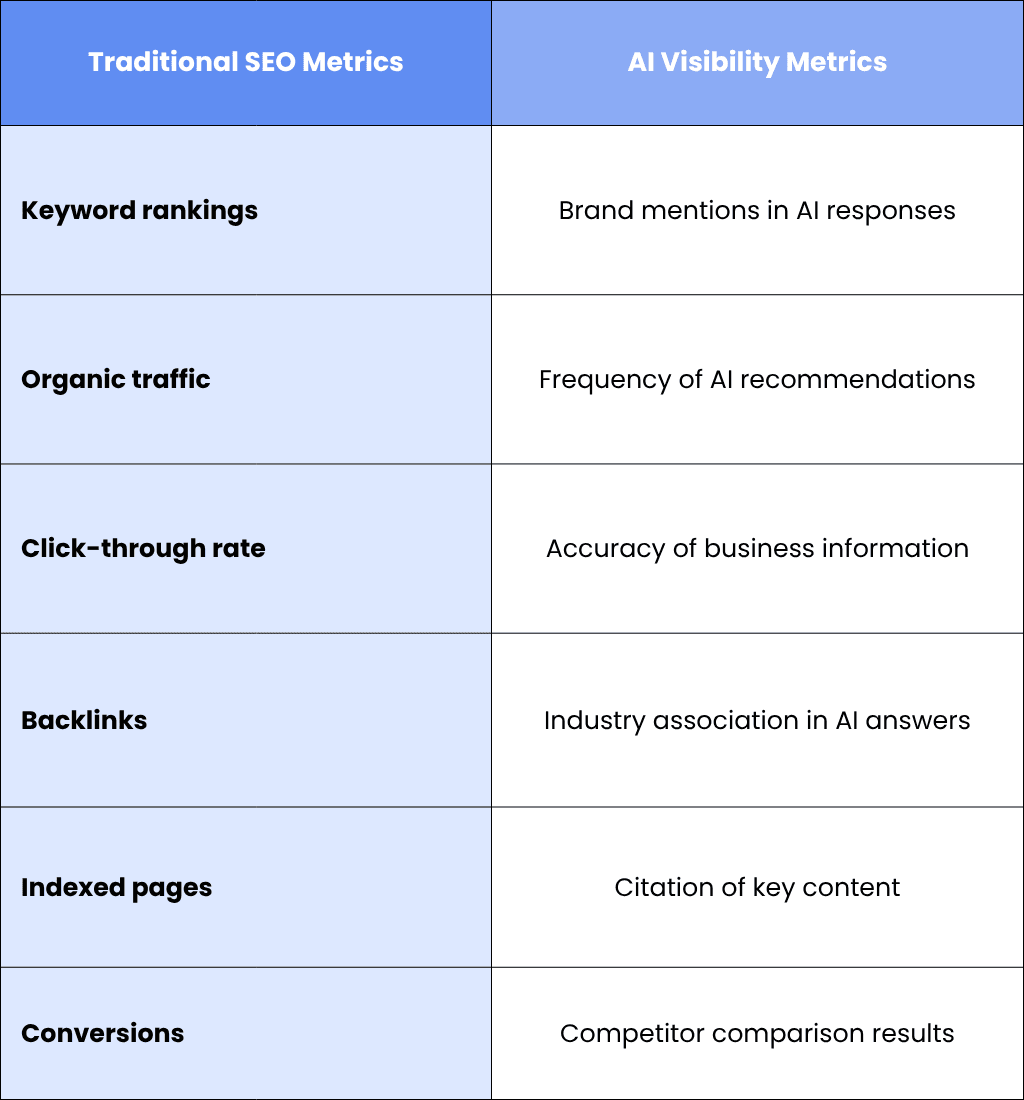
Although many of these metrics are still evolving, establishing a baseline today makes it easier to measure future progress as AI search becomes increasingly influential.
Treat AI Monitoring as an Ongoing Process
AI systems evolve continuously. Their retrieval methods, knowledge sources and response generation models are updated far more frequently than many traditional search algorithms.
As a result, monitoring your AI visibility should not be treated as a one-off exercise.
Instead, incorporate it into your regular SEO and GEO reviews by:
- testing representative customer prompts every month
- checking whether your brand is accurately represented
- validating structured data after major website updates
- reviewing new content for AI readability
- monitoring competitor visibility
- identifying new opportunities to strengthen your Knowledge Graph
Regular monitoring enables you to respond proactively as AI search continues to develop, rather than reacting after your visibility has declined.
Ultimately, businesses that consistently measure and improve how AI systems understand their brand will be better positioned to earn recommendations, citations and trust in the next generation of search.
The Future of Structured Data in AI Search
AI search is evolving rapidly.
Future systems will continue moving beyond keywords towards contextual understanding, trusted entities and interconnected knowledge.
Businesses that invest in advanced structured data today position themselves for greater visibility across both traditional search engines and AI-powered discovery platforms.
The goal is no longer simply appearing in search results.
It is becoming a trusted source that AI systems confidently reference, recommend and cite.
As AI continues reshaping digital discovery, structured data will become less about technical compliance and more about communicating your business in a language machines truly understand.
How Saigon Digital Helps Businesses Prepare for AI-First Search
Building an AI-ready website requires more than adding a few Schema.org tags. It demands a strategic approach that combines technical SEO, content architecture, entity optimisation and AI-focused visibility.
At Saigon Digital, we help ambitious brands solve digital challenges with forward-thinking, user-centric and bespoke solutions that drive measurable business growth.
Our capabilities include:
- SEO Services: We improve technical performance, strengthen site architecture, build authoritative content and develop local and global search strategies that generate sustainable business results.
- Generative Engine Optimisation (GEO): We optimise your content for AI-powered platforms including ChatGPT, Gemini, Perplexity and Google AI. Our services include AI Readability Optimisation, Answer Engine Optimisation (AEO), Knowledge Graph and Schema implementation, AI content audits, and AI performance reporting.
- AI Workflow Automation Services: We design AI-powered workflows, intelligent automation and custom AI agents that help businesses improve efficiency while scaling operations.
As search continues to evolve, businesses need partners who understand both established SEO best practices and the emerging requirements of AI-driven discovery. By combining technical expertise, data-driven strategy and innovative AI solutions, Saigon Digital helps brands build digital experiences that remain visible, trusted and competitive in the years ahead.
Future-Proof Your Search Visibility with Saigon Digital
AI-powered search is reshaping how customers discover, evaluate and trust businesses online. While implementing advanced structured data strategies is an important step, long-term success requires a holistic approach that combines technical SEO, high-quality content, entity optimisation and Generative Engine Optimisation (GEO).
At Saigon Digital, we help ambitious brands build websites that perform not only in traditional search engines but also across AI-driven platforms such as ChatGPT, Gemini and Perplexity.
Get in touch with Saigon Digital today to build a search strategy that's ready for the future.
Frequently Asked Questions
1. What are advanced structured data strategies?
Advanced structured data strategies go beyond implementing basic Schema.org markup on individual pages. They focus on creating meaningful relationships between entities such as your organisation, services, authors, products and locations, helping AI crawlers understand your website as a connected ecosystem. By providing clear, machine-readable context, these strategies improve how AI systems interpret, trust and retrieve your content in both traditional and AI-powered search experiences.
2. Is Schema.org still important for AI crawlers?
Yes. Schema.org remains the foundation of structured data and continues to play an important role in helping search engines and AI platforms understand webpage content. However, AI crawlers increasingly rely on additional signals such as entity relationships, Knowledge Graphs, semantic HTML, content quality and topical authority. Businesses should therefore view Schema.org as the starting point rather than the complete solution.
3. How do advanced structured data strategies improve AI search visibility?
Advanced structured data strategies help AI systems identify key facts about your business, connect related information across your website and better understand your expertise. When combined with high-quality content and strong technical SEO, they make it easier for AI platforms to retrieve, reference and recommend your content when answering users' questions.
4. Which types of businesses benefit most from advanced structured data?
Businesses across virtually every industry can benefit from advanced structured data, particularly those that rely on organic visibility to attract customers. This includes organisations in sectors such as hospitality, retail, F&B, education, healthcare, professional services and eCommerce. Any business looking to strengthen its presence in both traditional search engines and AI-powered search experiences can gain value from implementing a well-planned structured data strategy.
5. How can Saigon Digital help businesses optimise for AI crawlers?
Saigon Digital helps businesses prepare for the future of search through a combination of technical SEO, structured data implementation, Knowledge Graph optimisation and Generative Engine Optimisation (GEO). By aligning your website with the way modern AI platforms discover, interpret and reference information, we help improve your visibility across search engines as well as AI-powered platforms such as ChatGPT, Gemini and Perplexity.