



Artificial intelligence has transformed the way businesses create content. From drafting blog posts and product descriptions to generating FAQs and social media captions, AI tools have become an everyday part of modern marketing.
However, one question continues to concern business owners, marketers, and SEO professionals alike: Will AI generated content hurt your rankings?
The short answer is no, not simply because it is AI-generated.
In this guide, we explore what Google actually says about AI-generated content, how AI search engines evaluate information, and how businesses can safely use AI while protecting and improving their search visibility.
Key Takeaways
- AI-generated content does not automatically hurt your rankings. Google evaluates content based on its quality, usefulness, and relevance—not whether it was created by AI.
- People-first content remains the priority. Content that demonstrates Experience, Expertise, Authoritativeness, and Trustworthiness (E-E-A-T) is more likely to perform well in search.
- AI is most effective as an assistant, not a replacement. Combine AI with human expertise, fact-checking, and original insights to create content that stands out.
- AI search engines reward credible, well-structured content. Platforms like ChatGPT, Gemini, Perplexity, and Google AI favour content that is clear, accurate, and genuinely helpful.
- The future of SEO goes beyond Google rankings. Businesses should optimise for both traditional search engines and AI-powered search experiences through a combination of SEO, Generative Engine Optimisation (GEO), and Answer Engine Optimisation (AEO).
Google's Position on AI-Generated Content
When ChatGPT became widely adopted, many businesses feared Google would begin penalising websites using AI.
That never happened.
Instead, Google clarified that quality, not production method, is what matters.
Google's guidance consistently focuses on creating content that is:
- Helpful
- Reliable
- Accurate
- Original
- Written for people first
- Demonstrates genuine expertise
In other words, Google does not ask: "Was this written by AI?"
It asks: "Does this page genuinely help users?"
If the answer is yes, AI-assisted content can perform just as well as human-written content.
If the answer is no, rankings will suffer, regardless of whether the content came from ChatGPT, Gemini, Claude, or a human copywriter.
This is an important mindset shift for businesses. AI itself is not the problem. Poor-quality content is.
So, Will AI Generated Content Hurt Your Rankings?
The answer is: Only if the content is poor.
AI-generated content can negatively affect rankings when it contains:
- Generic information
- Factual inaccuracies
- Thin content
- Duplicate ideas
- Keyword stuffing
- No original insights
- No evidence of experience
- Poor user experience
Many AI-generated articles sound polished while saying very little. They often repeat information already available across hundreds of websites.
Google has become increasingly effective at identifying pages that offer little additional value.
Simply publishing dozens of AI-generated articles is therefore unlikely to improve rankings.
Instead, businesses should ask: "Does this page help users more than competing pages?"
That is the question Google's algorithms increasingly reward.
Google's Helpful Content Principles Still Apply
Whether content is written by AI, a human, or a combination of both, Google's expectations remain the same. The search engine's goal is to surface content that genuinely helps users solve a problem or make a decision. In other words, AI does not change the quality standards your content needs to meet.
Google summarises these standards through its E-E-A-T framework, which stands for Experience, Expertise, Authoritativeness, and Trustworthiness. Rather than being a direct ranking factor, E-E-A-T is a framework Google uses to evaluate whether content is likely to be useful and reliable.
Let's look at what each element means in practice.
Experience
Experience refers to whether the content reflects first-hand, real-world knowledge of the topic. Readers, and search engines, are more likely to trust advice from someone who has actually done the work rather than simply summarised information from other websites.
For businesses, this means enriching AI-assisted content with insights that only your team can provide. For example:
- Share lessons learned from client projects or campaigns.
- Include real examples, case studies, or before-and-after results.
- Explain challenges you've encountered and how they were solved.
- Add original photographs, screenshots, or demonstrations where appropriate.
For instance, a hospitality business writing about improving hotel occupancy could discuss how adjusting seasonal pricing or introducing local experience packages affected booking rates. These practical insights add value that generic AI-generated content cannot easily replicate.
Expertise
Expertise is about demonstrating that the information is accurate, well-informed, and relevant. While AI can produce fluent writing, it can also generate outdated or incorrect information. This makes human review an essential part of the content creation process.
Before publishing, ensure that your content has been reviewed by someone with subject knowledge who can:
- Verify facts, statistics, and industry terminology.
- Remove inaccuracies or unsupported claims.
- Update recommendations to reflect current best practices.
- Add professional insights that improve the overall quality of the article.
For example, an education provider writing about student recruitment should reference current admission processes and evolving digital marketing trends rather than relying solely on AI-generated suggestions.
Authoritativeness
Authoritativeness reflects your reputation within your industry. Google considers whether your website and brand are recognised as credible sources of information, particularly when compared with competing websites.
Building authority takes time, but consistent effort can significantly strengthen your visibility in both traditional search and AI-powered search experiences.
Some effective ways to build authority include:
- Publishing original research or industry insights.
- Earning backlinks from reputable and relevant websites.
- Creating comprehensive content that covers a topic in depth.
- Maintaining consistent branding and business information across digital channels.
- Demonstrating thought leadership through expert articles, webinars, or speaking engagements.
Over time, these signals help search engines associate your business with expertise in your field, making your content more likely to rank—and increasingly, more likely to be referenced by AI-powered search engines.
Trustworthiness
Trustworthiness underpins every piece of content you publish. Even well-written articles can struggle to perform if readers cannot verify the information or feel uncertain about its credibility.
Fortunately, improving trust is often straightforward. Consider the following best practices:
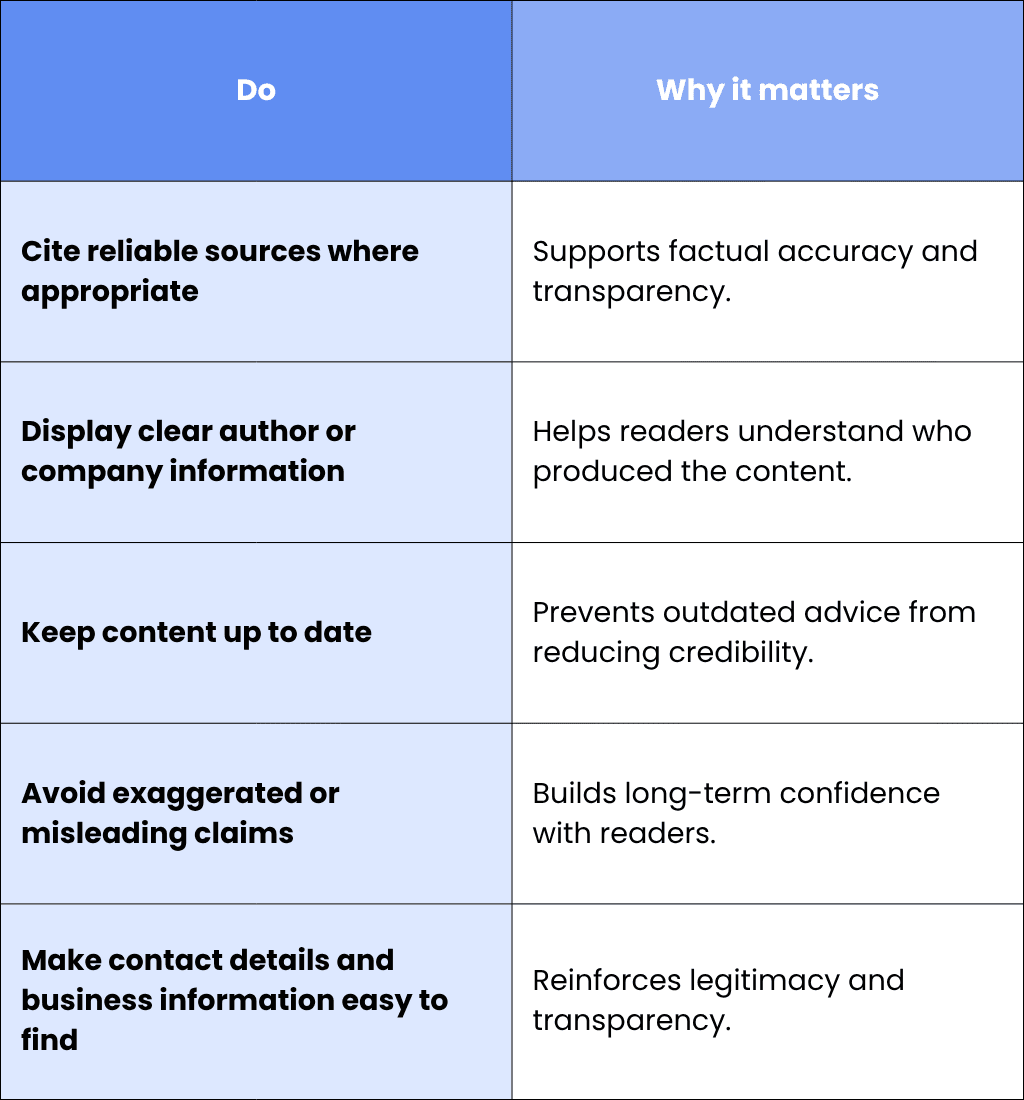
For businesses operating in sectors such as healthcare, finance, or education—where inaccurate information can have serious consequences—trustworthiness is especially important. However, these principles benefit every industry, regardless of size or market.
Bringing E-E-A-T together
Rather than treating Experience, Expertise, Authoritativeness, and Trustworthiness as separate checklists, think of them as qualities that work together to strengthen your content.
A practical workflow might look like this:
- Use AI to generate an outline or first draft.
- Add original insights based on your team's real experience.
- Fact-check every claim and update outdated information.
- Include examples, data, or case studies where relevant.
- Review the content to ensure it genuinely answers the user's question better than competing pages.
This balanced approach allows businesses to benefit from AI's efficiency while producing content that aligns with Google's Helpful Content principles—and is more likely to perform well in both traditional search results and AI-powered search experiences.
What AI Search Engines Are Looking For
As AI-powered search continues to grow, businesses need to think beyond traditional Google rankings. More people are now using tools such as ChatGPT, Gemini, Perplexity, and Google's AI Overviews to research products, compare services, and find answers to their questions.
Unlike traditional search engines, which present a list of webpages, these AI platforms generate direct answers by drawing information from multiple trusted sources. This means your content is no longer competing solely for a place on the first page of search results, it is also competing to become one of the sources that AI systems choose to reference.
So, what makes content more likely to be selected?
While each AI platform uses its own technology, they generally favour content that is:
- Clearly structured with logical headings.
- Accurate, factual, and up to date.
- Easy to understand and free from unnecessary jargon.
- Comprehensive enough to answer a topic in depth.
- Supported by credible sources or real-world expertise.
- Consistently maintained and regularly updated.
Notice that none of these characteristics relate to whether the content was written by AI or a human. Instead, they focus on quality, clarity, and credibility.
For example, imagine two articles answering the same question:
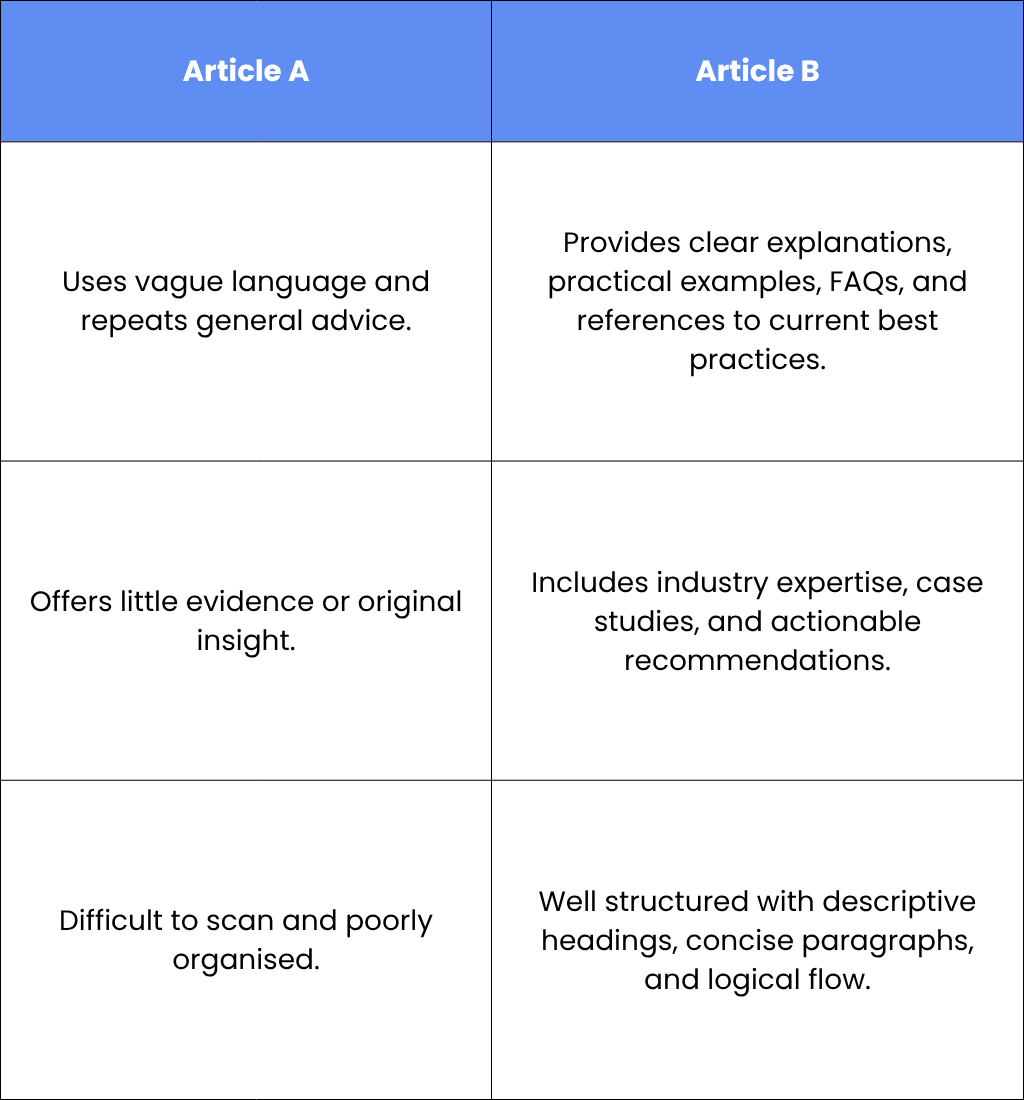
Even if both articles were drafted using AI, Article B is far more likely to earn readers' trust and be recognised by both search engines and AI-powered platforms.
For businesses, the takeaway is simple: don't optimise content for AI tools—optimise it for people. Content that genuinely helps readers is also the type of content AI systems are more likely to surface in their answers.
Why Generic AI Content Struggles
One of the biggest limitations of AI-generated content is that it often sounds convincing without offering anything new. Because AI models are trained on existing information, they naturally produce responses based on patterns that already exist across the web.
As a result, many AI-generated articles end up looking remarkably similar.
Imagine asking several businesses to use AI to write an article on "How to improve restaurant marketing." Chances are, most articles would include nearly identical suggestions such as:
- Use social media.
- Optimise your Google Business Profile.
- Collect more customer reviews.
- Run seasonal promotions.
- Improve your website.
None of these recommendations are incorrect. In fact, they are all worthwhile marketing activities. The problem is that they're also advice readers can find on hundreds of other websites.
Search engines, and increasingly AI search platforms, aim to provide users with the most helpful and informative answers available. If your content simply repeats what's already been published, it offers little reason to rank highly or be cited as a trusted source.
Instead, successful content builds on general advice by adding something uniquely valuable.
For example, rather than simply recommending restaurants collect more reviews, you could explain:
- How one restaurant increased review volume after introducing QR code feedback cards.
- Which review request methods generated the highest response rates.
- Common mistakes that discourage customers from leaving reviews.
- Lessons learned from managing review strategies across multiple locations.
These practical insights demonstrate genuine experience while giving readers information they are unlikely to find elsewhere.
A simple way to think about it is this:
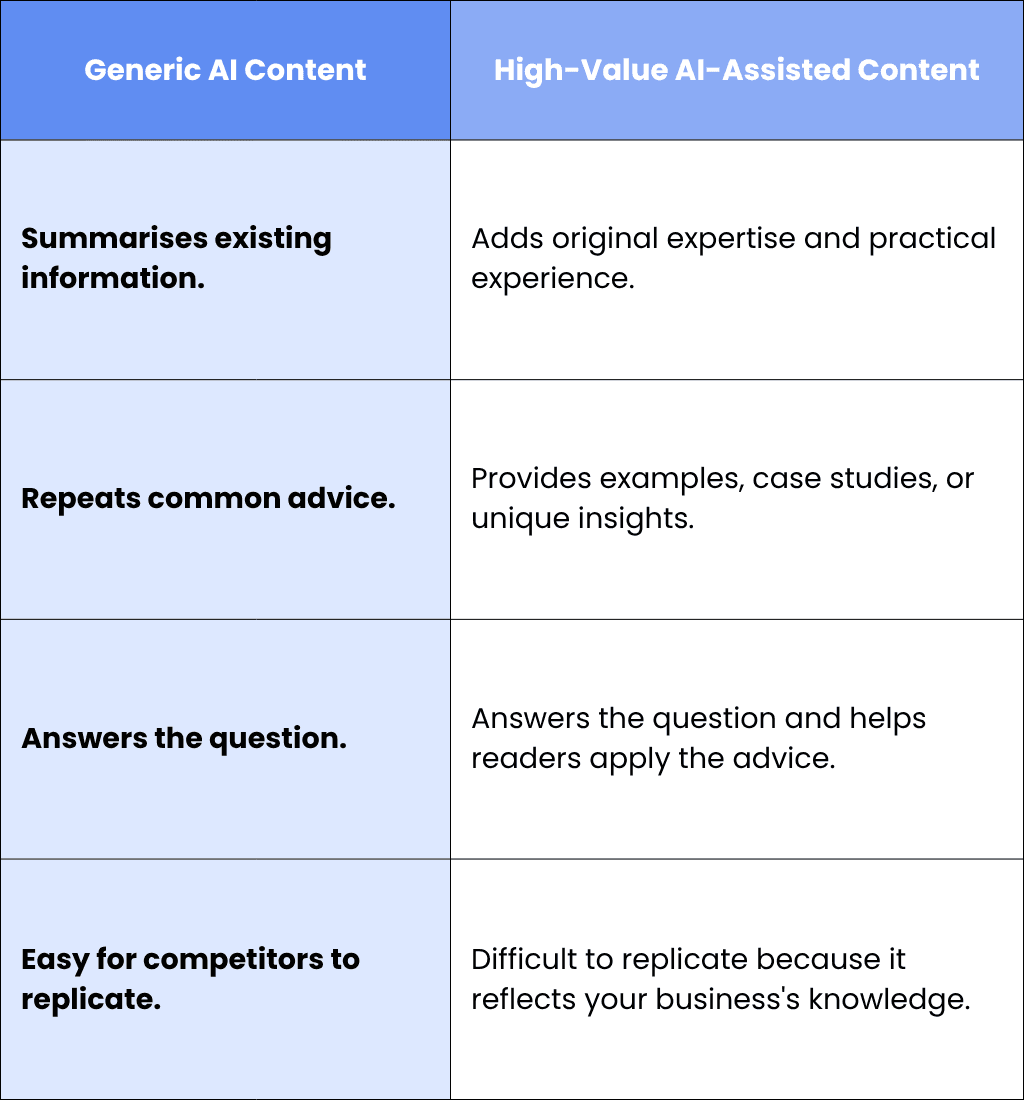
Ultimately, AI should help you create content more efficiently—not create content that looks the same as everyone else's. By combining AI with your team's expertise, customer insights, and real-world experience, you can produce content that is more useful to readers and more valuable to both traditional search engines and AI-powered search experiences.
How to Use AI Safely for SEO
AI can be a valuable addition to your SEO workflow, but like any tool, its effectiveness depends on how you use it. Rather than replacing human expertise, AI should help your team work more efficiently while maintaining the quality standards that both search engines and readers expect.
The safest and most effective approach is to combine AI's speed with human judgement, industry knowledge, and strategic oversight. Below is a practical workflow businesses can follow to create AI-assisted content that supports long-term SEO performance.
1. Start with Audience and Search Intent
Before opening an AI tool, take time to understand who you're writing for and what they want to achieve. AI can generate content quickly, but it cannot replace customer research or a clear content strategy.
Ask yourself:
- What question is the reader trying to answer?
- What problem are they hoping to solve?
- What stage of the buying journey are they in?
- What information would genuinely help them move forward?
For example, someone searching "will AI generated content hurt your rankings" is likely looking for reassurance, evidence, and practical guidance, not just a simple yes-or-no answer. Understanding this intent allows you to create content that fully addresses their concerns.
2. Use AI to Accelerate, Not Replace, Content Creation
Once you've defined your objective, AI can help streamline the drafting process. It works particularly well for repetitive or time-consuming tasks, allowing your team to focus on higher-value work.
Some effective uses of AI include:
- Brainstorming content ideas and angles.
- Creating article outlines.
- Drafting introductions or summaries.
- Generating FAQ sections.
- Suggesting headings and meta descriptions.
- Rewriting content for improved clarity or readability.
However, resist the temptation to publish AI-generated text without review. Think of AI as producing a strong first draft, one that still requires editing, refinement, and professional input before it is ready for your audience.
3. Add Your Expertise and Original Insights
This is where your content becomes genuinely valuable.
Search engines increasingly reward pages that offer something beyond information already available elsewhere. By incorporating your own experience and expertise, you transform a generic draft into a resource readers can trust.
Consider adding:
- Real client examples or case studies.
- Insights from your industry experience.
- Original research or internal data.
- Practical tips based on successful campaigns.
- Common mistakes you've observed and how to avoid them.
For example, rather than simply stating that AI content should be edited, explain how your team reviews AI-assisted articles, what quality checks you perform, or how this process has improved content performance for clients. These details are unique to your business and cannot be replicated by AI alone.
4. Verify Every Fact Before Publishing
Although AI is excellent at generating natural-sounding text, it is not always accurate. It can misinterpret information, cite outdated guidance, or even produce convincing but entirely incorrect statements.
Before publishing, review your content carefully to verify:
- Statistics and research findings.
- Dates and industry developments.
- Product or service information.
- Legal or regulatory guidance.
- Technical recommendations.
- External references and citations.
A few extra minutes spent fact-checking can prevent costly mistakes while strengthening your content's credibility and trustworthiness.
5. Optimise for People First, Then Search Engines
Effective SEO is no longer about inserting keywords as many times as possible. Instead, focus on creating content that is easy to read, well organised, and genuinely useful.
When reviewing your article, ask yourself:
- Does the introduction clearly answer the reader's question?
- Are headings descriptive and easy to scan?
- Are paragraphs concise and logically structured?
- Have important concepts been explained clearly?
- Are there opportunities to include FAQs, examples, tables, or visuals?
At the same time, don't overlook core on-page SEO elements. Optimising title tags, meta descriptions, internal links, image alt text, and structured data helps search engines better understand your content while improving the overall user experience.
6. Keep Your Content Accurate and Up to Date
SEO is an ongoing process, not a one-time task. Search behaviour, industry trends, and Google's guidance continue to evolve, meaning even well-performing content will eventually need refreshing.
A regular content review helps ensure your pages remain relevant and competitive. During each review, consider whether you should:
- Update outdated information or statistics.
- Replace broken links.
- Add new examples or case studies.
- Expand sections that no longer answer user questions completely.
- Incorporate recent industry developments or Google's latest recommendations.
As a general guideline, evergreen content should be reviewed at least once or twice a year, while topics involving AI, digital marketing, or search engine updates may require more frequent updates due to the pace of change.
A Simple AI-Assisted SEO Workflow
Rather than viewing AI as a shortcut, think of it as one step within a structured content creation process.
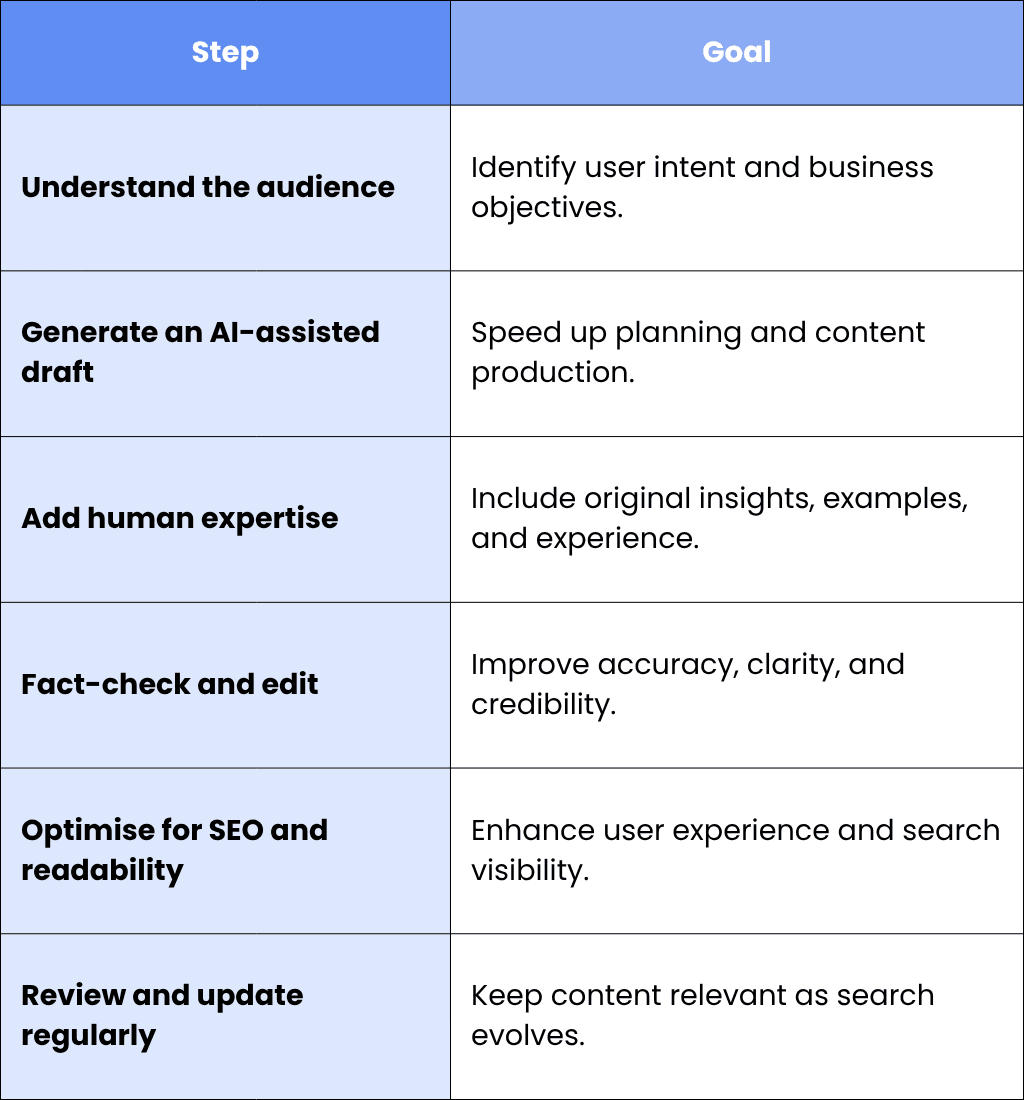
Following this workflow allows businesses to benefit from AI's efficiency without sacrificing the quality signals that Google and AI-powered search engines increasingly prioritise.
Ultimately, AI should make your content creation process smarter, not more automated. When combined with human expertise, thoughtful editing, and a user-first mindset, it becomes a powerful tool for producing content that performs well in search results, earns reader trust, and remains valuable over time.
Beyond SEO: Optimising for AI Discovery
As AI-powered search becomes increasingly common, businesses need to think beyond traditional rankings.
Success now involves ensuring your content can also be understood, trusted, and cited by AI systems.
This includes:
- creating comprehensive topic coverage
- implementing structured data
- improving content clarity
- answering user questions directly
- strengthening brand authority across the web
- maintaining consistent business information
This emerging discipline is often referred to as Generative Engine Optimisation (GEO) and Answer Engine Optimisation (AEO).
Rather than focusing solely on ranking webpages, these approaches help brands become trusted sources within AI-generated answers.
For organisations investing in long-term digital growth, combining SEO with GEO creates greater visibility across both traditional search results and AI-powered experiences.
How Saigon Digital Helps Businesses Succeed in Both Search and AI
AI is changing search rapidly, but the fundamentals remain the same: businesses that provide trustworthy, helpful, and user-focused information are best positioned to succeed.
At Saigon Digital, we help ambitious brands turn these principles into measurable business growth through bespoke digital strategies tailored to their goals.
Our SEO services go beyond improving rankings. We combine technical optimisation, content strategy, authority building, and local or international search expertise to attract qualified traffic that converts into real business outcomes.
As search evolves, we also help businesses prepare for the next generation of discovery through Generative Engine Optimisation (GEO) and Answer Engine Optimisation (AEO). Our services are designed to improve AI readability, strengthen knowledge graph signals, implement structured data, optimise existing content for AI platforms, and increase the likelihood of your brand being surfaced by tools such as ChatGPT, Gemini, Perplexity, and Google's AI-powered search experiences.
Beyond search visibility, we support organisations in improving operational efficiency through AI workflow automation. From intelligent automation and custom AI agents to scalable AI-powered processes, we help businesses unlock productivity while maintaining quality and consistency.
Ready to Build Content That Ranks Today and Tomorrow?
AI isn't the future of content creation, it's already here. The real advantage lies in using it strategically. Businesses that combine AI with human expertise, sound SEO practices, and a genuine focus on helping their audience will be best positioned to succeed in both traditional search and AI-powered search experiences.
At Saigon Digital, we help ambitious brands do exactly that.
Ready to future-proof your SEO strategy?
Get in touch with Saigon Digital to discover how our SEO, Generative Engine Optimisation (GEO), and AI solutions can help your business stay visible in the evolving search landscape.
Frequently Asked Questions
1. Will AI generated content hurt your rankings on Google?
No. Google has repeatedly stated that it does not penalise content simply because it is created with AI. Instead, Google's algorithms evaluate whether the content is helpful, accurate, original, and satisfies the user's search intent. AI-generated content can rank well if it meets these quality standards, while low-quality content—whether written by AI or a human—is unlikely to perform well in search results.
2. Can AI-generated content rank on Google?
Yes. AI-generated content can achieve strong rankings when it provides genuine value to readers. The best-performing content is typically AI-assisted rather than AI-only, combining the efficiency of AI with human expertise, fact-checking, original insights, and a clear understanding of the audience's needs. This approach aligns with Google's people-first content principles and E-E-A-T framework.
3. Does Google know if content was written by AI?
Google may use various signals to assess content quality, but it does not rank pages based solely on whether AI was involved in the writing process. Instead of trying to detect AI, businesses should focus on creating trustworthy, well-structured, and informative content that demonstrates real experience and expertise.
4. How can businesses use AI without harming their SEO?
The safest approach is to use AI as a productivity tool rather than a replacement for human expertise. AI can help generate ideas, outlines, and first drafts, while your team should review the content for accuracy, add original insights, optimise it for search intent, and ensure it reflects your brand's expertise. This combination of AI efficiency and human oversight helps create content that performs well in both search engines and AI-powered search platforms.
5. How can I optimise my content for AI search engines like ChatGPT and Google AI?
Optimising for AI-powered search starts with creating content that is clear, trustworthy, and genuinely useful. Use descriptive headings, answer common questions directly, include original insights or case studies, implement structured data where appropriate, and keep your content up to date. As AI search continues to evolve, combining traditional SEO with Generative Engine Optimisation (GEO) and Answer Engine Optimisation (AEO) will help your brand become more discoverable across both search engines and AI-driven experiences.