



Search engine optimisation (SEO) is constantly evolving. As competition for rankings increases, marketers continue to explore different strategies to improve visibility and attract qualified traffic. One approach that often sparks debate is parasite SEO.
So, what is parasite SEO, and is it a strategy your business should use?
In this guide, we'll explain what parasite SEO is, how it works, its benefits and drawbacks, and the best practices businesses should follow. We'll also discuss why sustainable SEO remains the most effective long-term approach for brands looking to build lasting online visibility.
Key Takeaways
- Parasite SEO involves publishing content on high-authority third-party websites to gain search visibility more quickly instead of relying solely on your own website.
- While parasite SEO can accelerate rankings, increase brand exposure, and generate referral traffic, it should complement—not replace—a long-term SEO strategy.
- Parasite SEO differs from backlink building and traditional SEO, although all three can work together as part of a well-rounded digital marketing strategy.
- Sustainable success depends on publishing high-quality, user-focused content on reputable platforms while avoiding manipulative or spammy tactics.
- As AI-powered search continues to evolve, businesses should prioritise building authority across both owned and trusted third-party channels to maximise long-term visibility.
What Is Parasite SEO?
Parasite SEO is an SEO strategy where content is published on a high-authority third-party website to rank for competitive keywords instead of publishing the content on your own domain.
Rather than relying on your website's domain authority, parasite SEO leverages the trust, authority, and strong backlink profile of an established platform. Because these websites already perform well in search engines, content published on them often has a better chance of ranking quickly.
For example, a business might publish an article on:
- Medium
- LinkedIn Articles
- Quora
- Industry news websites
- Business directories
- Guest posting websites
Instead of waiting months for a new page on a company website to gain authority, marketers attempt to benefit from the existing credibility of these platforms.
In simple terms, parasite SEO allows you to "borrow" another website's authority to improve search visibility.
How Does Parasite SEO Work?
Search engines evaluate many signals when ranking content, including:
- Domain authority and trust
- Content quality
- Topical relevance
- User engagement
- Backlinks
- Technical performance
Large, established websites already possess strong authority in many of these areas. When you publish content on one of these domains, Google may consider that content more trustworthy than similar content published on a brand new website.
A typical parasite SEO process looks like this:
- Identify keywords with commercial or informational intent.
- Choose a high-authority platform that allows content publishing, such as Medium, LinkedIn, Quora, etc.
- Create valuable, optimised content.
- Publish the content under the third-party domain.
- Include natural links on the content to direct readers to your website where appropriate, such as linking your website main page or contact page within the content.
- Promote the content to increase visibility and engagement.
The strategy aims to accelerate rankings by reducing the need to build authority from scratch.
Parasite SEO vs Backlinks: What's the Difference?
One of the most common misconceptions is that parasite SEO and backlink building are the same strategy. While the two are related and often work together, they have different objectives and should not be used interchangeably.
What Are Backlinks?
A backlink is simply a hyperlink from one website to another. When another reputable website links to your content, search engines may interpret that link as a signal of trust and authority.
For example, if an established hospitality publication links to your hotel's destination guide, that backlink may help improve your website's authority and organic rankings over time.
Backlinks are one of many ranking signals Google considers, alongside factors such as content quality, user experience, technical SEO, and topical relevance.
How Parasite SEO Is Different
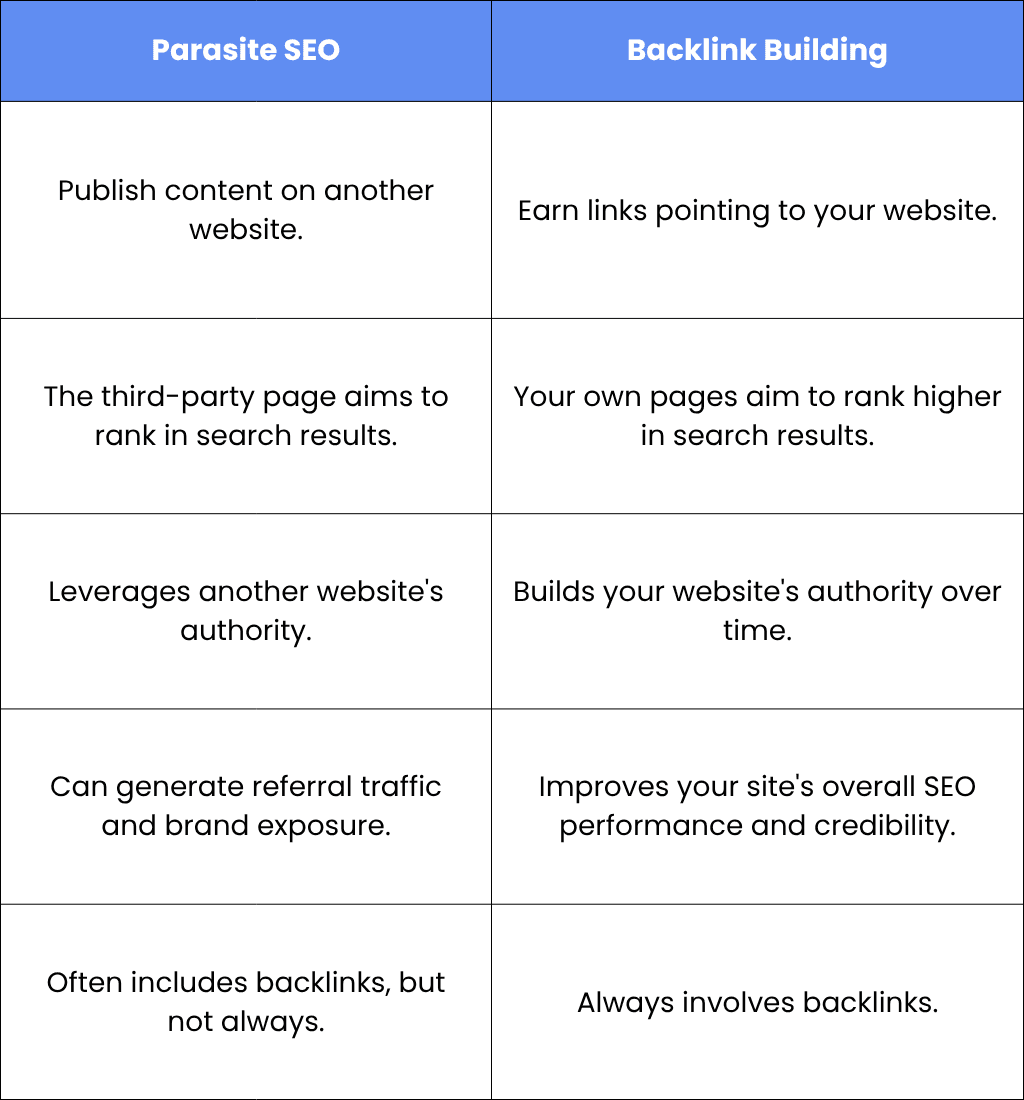
Parasite SEO focuses on publishing content directly on a third-party website, rather than publishing content on your own website and earning links to it.
In other words:
- With traditional SEO, your goal is to make your own website rank in search results.
- With parasite SEO, your goal is to make the third-party page rank in search results by leveraging the authority of that website.
Although parasite SEO articles often include links back to your website, those backlinks are usually a secondary benefit rather than the primary objective.
A Simple Comparison
Can Parasite SEO Help You Build Backlinks?
Yes, but only when approached strategically.
Many businesses use parasite SEO as part of a broader content marketing strategy. For example, an education provider might publish an expert article on a respected education publication discussing how parents can evaluate international schools. Within the article, the publisher may naturally link to an in-depth admissions guide hosted on the company's own website.
In this scenario, the business gains several benefits simultaneously:
- Increased visibility through the publication's existing audience.
- Referral traffic from interested readers.
- A high-quality backlink to its own website.
- Greater brand credibility through association with a trusted publication.
However, these outcomes depend on the editorial policies of the publishing platform. Some websites add nofollow or sponsored attributes to external links, while others may limit the number of links authors can include. As a result, businesses should never pursue parasite SEO solely for backlinks.
Which Strategy Should Businesses Prioritise?
For most businesses, the answer is both, but with different objectives.
Backlink building remains a cornerstone of sustainable SEO because it strengthens the authority of your own website over the long term. Meanwhile, parasite SEO can complement your strategy by helping you reach new audiences, build thought leadership, and gain visibility more quickly through trusted third-party platforms.
Rather than viewing parasite SEO and backlink building as competing tactics, think of them as complementary components of a well-rounded SEO strategy. When combined with high-quality website content, technical SEO, and digital PR, they can work together to improve both immediate visibility and long-term organic growth.
Parasite SEO vs Traditional SEO: Which Strategy Is Better?
Now that we've explored how parasite SEO differs from backlink building, another important question naturally follows: how does parasite SEO compare with traditional SEO?
The answer is that they are not competing strategies. Instead, they serve different purposes and often work best when used together.
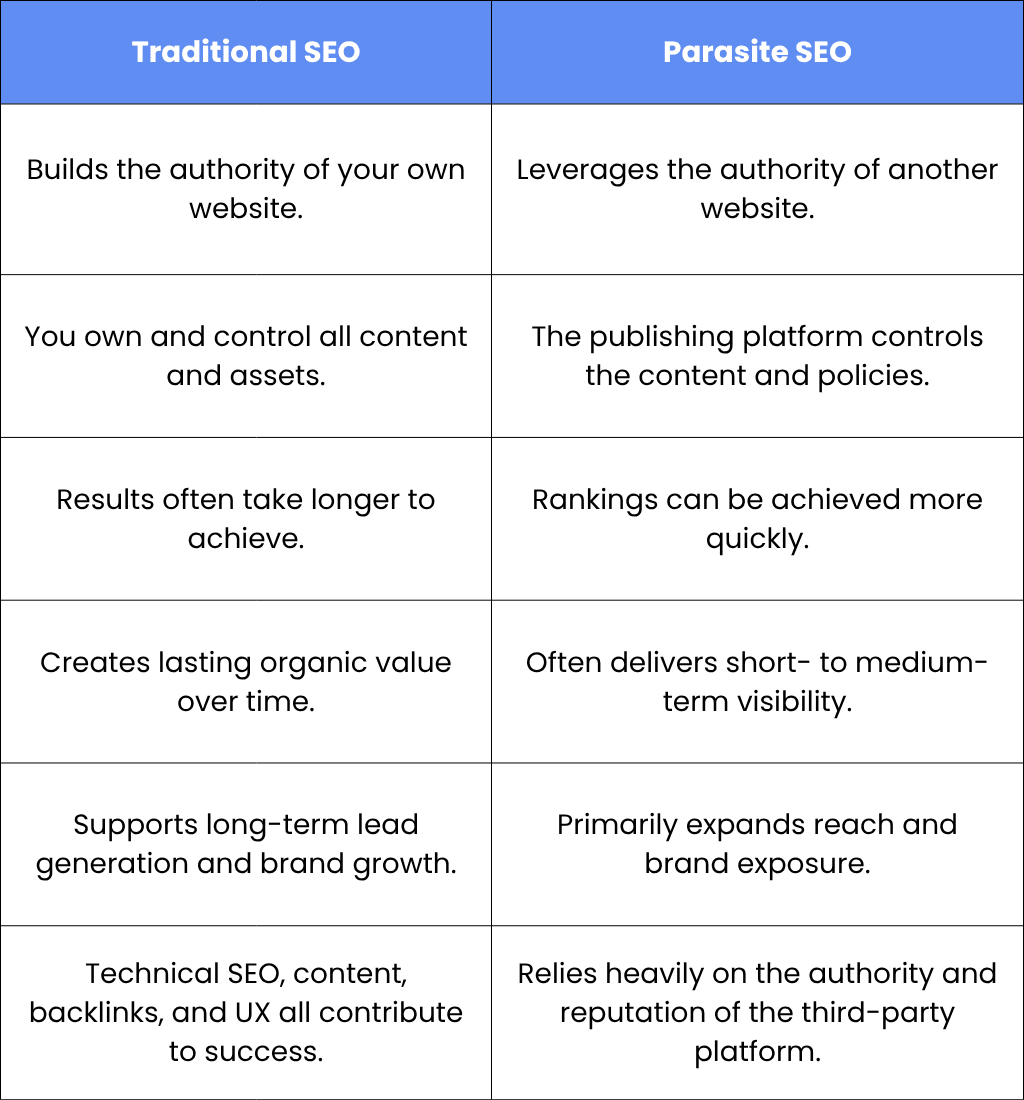
Traditional SEO focuses on improving the visibility of your own website. Every piece of content, technical improvement, backlink, and user experience enhancement contributes to increasing your site's authority over time. While this approach usually requires patience, it creates a valuable long-term asset that your business fully owns and controls.
Parasite SEO, on the other hand, takes advantage of an established website's authority to achieve visibility more quickly. Instead of waiting for your own pages to gain trust, you publish content on platforms that already perform well in search results.
Think of it this way:
- Traditional SEO is like buying and developing your own property. It requires time and investment, but the value belongs entirely to you.
- Parasite SEO is like renting space in a busy shopping centre. You benefit from the location and foot traffic, but you do not own the property and must operate within the landlord's rules.
Both approaches can generate business value, but their long-term benefits differ significantly.
A Side-by-Side Comparison
When Traditional SEO Makes the Most Sense
For most established businesses, traditional SEO should remain the foundation of their digital marketing strategy.
Investing in your own website allows you to build a sustainable source of organic traffic that continues generating value long after individual marketing campaigns have ended.
For example:
- An F&B brand can create recipe guides, menu pages, and location-specific content that attracts customers searching throughout the year.
- A retailer can develop comprehensive buying guides that rank for high-intent product searches.
- An education provider can publish detailed resources that answer common questions from prospective students and parents.
- A hotel or resort can build destination guides that consistently attract travellers planning future holidays.
Every high-quality page published on your own website strengthens your overall topical authority and increases your ability to compete for valuable keywords.
When Parasite SEO Can Add Value
Although traditional SEO offers stronger long-term returns, parasite SEO can still play a valuable supporting role.
Businesses may consider parasite SEO when they want to:
- Launch a new product or service quickly.
- Reach audiences that already trust a particular publication.
- Build thought leadership within their industry.
- Increase brand awareness in competitive markets.
- Test new content ideas before investing in a full content campaign.
For example, a hospitality company launching a new luxury resort could publish expert travel content on a respected tourism website while simultaneously building comprehensive destination pages on its own website. The third-party publication provides immediate visibility, while the company's website continues developing long-term authority.
The Most Effective Approach: Combine Both Strategies
Rather than choosing one strategy over the other, successful businesses often combine traditional SEO with carefully selected parasite SEO opportunities.
A balanced strategy might look like this:
- Build authoritative content on your own website.
- Optimise technical SEO and user experience.
- Earn high-quality backlinks through digital PR and outreach.
- Publish expert articles on trusted third-party websites to expand your reach.
- Use those publications to introduce new audiences to your brand and direct interested readers back to your website.
In this way, parasite SEO becomes a complementary tactic rather than a substitute for sustainable SEO.
For businesses seeking long-term growth, your website should always remain the centre of your digital presence. Third-party platforms can amplify your visibility, but lasting authority is built by consistently investing in content, technical excellence, and exceptional user experiences on channels you own.
Why Is It Called "Parasite" SEO?
The name comes from the idea that one website is "feeding" off another website's authority.
While the term may sound negative, not all forms of parasite SEO are unethical.
For example:
- Publishing expert articles on reputable industry publications
- Writing thought leadership pieces on LinkedIn
- Contributing valuable answers on Quora
- Creating helpful resources on trusted community websites
These are legitimate marketing activities.
The strategy becomes problematic when marketers exploit low-quality websites, spam publishing platforms, or create content solely to manipulate search rankings without providing genuine value.
Parasite SEO Examples
Understanding the theory behind parasite SEO is one thing, but seeing it applied in real-world scenarios makes the concept much easier to grasp.
The following examples illustrate how businesses can use parasite SEO ethically to expand their reach, as well as practices that should be avoided.
Example 1: Publishing Expert Content on an Industry Website
Imagine a restaurant group wants to attract businesses looking for catering services.
Instead of relying solely on its own website, the company publishes an in-depth article on a respected F&B publication titled "How to Choose the Right Corporate Catering Partner". The article shares practical advice, discusses common mistakes, and naturally links to the company's catering services page for readers who want more information.
This is an example of ethical parasite SEO because the content:
- Provides genuine value to readers.
- Appears on a relevant, trusted publication.
- Positions the business as an industry expert.
- Generates referral traffic alongside potential SEO benefits.
Example 2: Building Thought Leadership on LinkedIn
A digital marketing agency publishes a series of educational LinkedIn Articles explaining changes in Google's search algorithms and the rise of AI-powered search.
Because LinkedIn has a highly authoritative domain and a large professional audience, these articles may rank for relevant informational searches while introducing new audiences to the agency's expertise.
Rather than directly selling services, the content builds credibility and encourages readers to visit the company's website to learn more.
Example 3: Contributing Guest Articles to Industry Publications
An education provider partners with a respected education website to publish a detailed guide on selecting the right international school.
The publication reaches thousands of parents researching schooling options, while the article links to additional resources on the provider's website.
In this case, parasite SEO helps the organisation:
- Reach a highly relevant audience.
- Strengthen brand credibility.
- Generate qualified referral traffic.
- Earn a valuable editorial backlink.
Example 4: Using Community Platforms to Answer Questions
A hospitality business regularly answers travel-related questions on platforms such as Reddit or Quora, providing genuinely helpful recommendations rather than promotional responses.
Where appropriate, the business links to comprehensive travel guides or destination resources on its own website to help readers find more detailed information.
This approach focuses on helping users first, making any links feel natural and relevant.
An Example of Poor Parasite SEO
Not every parasite SEO strategy follows best practices.
For example, a business might publish dozens of low-quality, AI-generated articles across unrelated websites while repeatedly inserting commercial keywords and links back to its website. The content offers little value to readers and exists primarily to manipulate search rankings.
This type of approach is unlikely to deliver sustainable results. Search engines have become increasingly effective at identifying low-value content, and publishing on irrelevant or spammy websites can damage both your visibility and your brand's reputation.
What Can We Learn from These Examples?
The common thread across successful parasite SEO campaigns is that they prioritise people over algorithms.
Whether you're publishing on an industry publication, contributing guest articles, or sharing expertise on professional platforms, your content should always aim to educate, inform, or solve a problem for the reader.
In contrast, strategies that focus solely on exploiting another website's authority without delivering meaningful value are becoming increasingly risky as search engines and AI-powered search platforms continue to reward helpful, trustworthy content.
Benefits of Parasite SEO
When used responsibly, parasite SEO offers several advantages.
1. Faster Search Rankings
One of the biggest advantages is speed.
Established websites already have strong authority, allowing new content to rank much faster than pages on newer domains.
For businesses launching new products or entering competitive markets, this can help generate visibility more quickly.
2. Increased Brand Exposure
Publishing on respected platforms can introduce your business to audiences who may never have discovered your website.
For example, a hospitality business sharing travel insights on an established tourism publication can reach highly relevant readers while strengthening brand awareness.
3. Access to Competitive Keywords
Some keywords are extremely difficult to rank for using a relatively new website.
Parasite SEO may allow businesses to gain visibility for competitive search terms that would otherwise require significant time and investment.
4. Referral Traffic
High-authority websites often have substantial readership beyond search engines.
If your content resonates with readers, you can generate referral traffic directly from the platform itself.
5. Thought Leadership
Publishing insightful, original content on reputable websites helps position your business as an industry expert.
For businesses in education, retail, hospitality, or professional services, this can strengthen trust and credibility with prospective customers.
Risks of Parasite SEO
Although parasite SEO can deliver short-term gains, businesses should also understand its limitations.
1. Limited Control
When you publish content on any established platform, that content now belongs to said publishing platform. This means the website owner, at any point in time, may:
- Remove your article
- Change their policies
- Add nofollow attributes to links
- Restrict edits
- Delete your account
As a result, you never fully own the asset.
2. Platform Dependency
If most of your visibility comes from third-party websites, your marketing becomes dependent on external platforms.
A change in their rules or algorithms can significantly reduce your visibility overnight.
3. Google Algorithm Updates
Google continues to improve its ability to identify content created primarily to manipulate rankings.
Recent updates have specifically targeted low-value content published on authoritative websites simply to exploit their authority.
Websites engaging in large-scale manipulative parasite SEO may experience reduced visibility.
4. Reputation Risks
Publishing on irrelevant or low-quality websites can damage your brand's credibility.
Customers increasingly expect trustworthy, authoritative information. Poor placement can undermine confidence rather than build it.
5. Lower Long-Term Value
Every article published on someone else's website contributes to their authority—not yours.
While you may gain temporary visibility, your own website misses opportunities to build topical authority, backlinks, and long-term organic growth.
Is Parasite SEO Against Google's Guidelines?
Not necessarily.
Google does not prohibit publishing content on third-party websites.
However, Google discourages content created primarily to manipulate search rankings rather than help users.
The distinction lies in intent and quality.
Generally acceptable examples include:
- Expert guest articles
- Industry publications
- Original research
- Educational resources
- Genuine thought leadership
Problematic examples include:
- Thin affiliate pages
- Mass-produced AI-generated articles with little human oversight
- Keyword-stuffed content
- Paid placements solely intended to pass ranking signals
- Duplicate or low-value articles
The safest approach is to create content that genuinely benefits readers regardless of where it is published.
Best Practices for Parasite SEO
Parasite SEO can be an effective supporting strategy when used responsibly. However, success depends far less on the platform you choose than on the quality, relevance, and purpose of the content you publish. The following best practices will help you maximise the benefits of parasite SEO while minimising potential risks.
1. Focus on Quality Content
High-authority websites may help your content rank faster, but they cannot compensate for poor-quality content. Search engines continue to prioritise pages that demonstrate expertise, satisfy user intent, and provide genuine value. Therefore, your first priority should always be creating content that readers find useful—not content written solely to rank.
Before publishing, ask yourself whether the article:
- Answers a specific question thoroughly.
- Offers original insights, data, or practical advice.
- Demonstrates subject matter expertise.
- Is well organised with clear headings and logical structure.
- Is easy to read on both desktop and mobile devices.
For example, imagine an education company wants to reach parents searching for "how to choose an international school". Rather than publishing a generic 500-word article filled with keywords, they could create a comprehensive guide covering curriculum options, tuition fees, accreditation, admission timelines, and common mistakes families make. This type of resource is far more likely to earn engagement, shares, and long-term visibility.
Where appropriate, strengthen your content by including:
- Statistics or industry research.
- Real-world examples or case studies.
- Step-by-step instructions.
- Expert opinions.
- Frequently asked questions.
- Relevant visuals, charts, or infographics.
The more helpful your content is, the more likely it is to perform well—regardless of where it is published.
2. Choose Reputable Platforms
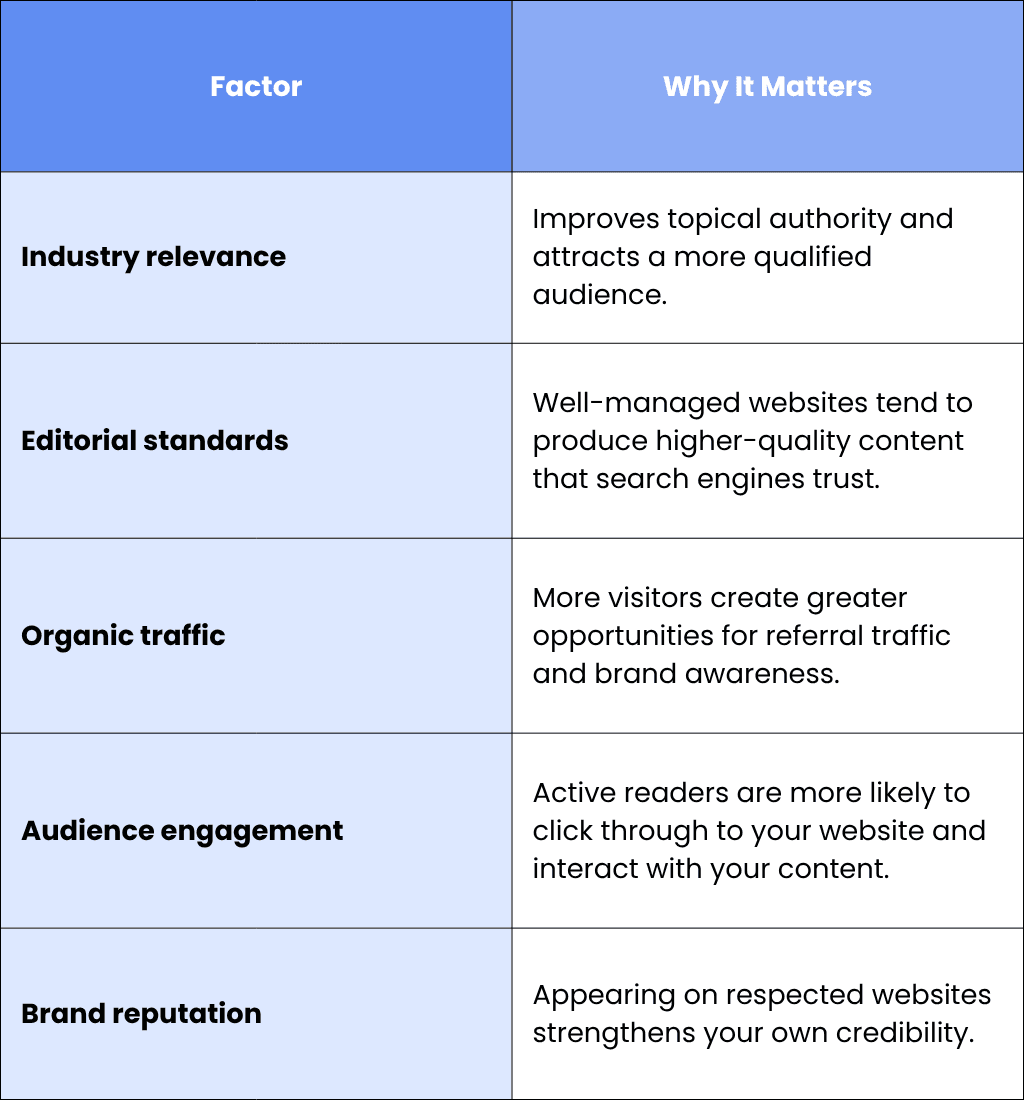
Not every high-authority website is the right place for your content. Relevance matters just as much as authority.
Publishing an article on a website that aligns with your industry helps search engines better understand the relationship between your content and your area of expertise. It also increases the likelihood that readers will genuinely be interested in your products or services.
When evaluating potential publishing platforms, consider factors such as:
For example:
- A hospitality business may benefit from contributing articles to reputable travel publications.
- A restaurant group might publish thought leadership on respected F&B industry websites.
- An education provider could contribute expert advice to education-focused publications or parent resources.
On the other hand, publishing on unrelated websites simply because they have high domain authority often provides limited value and may even appear manipulative.
As a general rule, choose platforms where your ideal customers already spend their time.
3. Avoid Spam Tactics
One of the biggest mistakes businesses make is treating parasite SEO as a shortcut rather than part of a broader content strategy.
Google's algorithms have become increasingly effective at identifying content created purely to manipulate search rankings. As a result, spammy parasite SEO tactics that may have worked years ago are now far less effective—and can even harm your online reputation.
Avoid practices such as:
- Publishing identical or slightly rewritten articles across multiple websites.
- Stuffing keywords unnaturally into every heading and paragraph.
- Purchasing low-quality sponsored placements solely for SEO purposes.
- Producing large volumes of AI-generated content without human editing or fact-checking.
- Adding excessive backlinks that provide little value to readers.
For example, if the phrase "what is parasite SEO" appears unnaturally in every sentence, the article becomes difficult to read and may signal keyword manipulation. Instead, use your primary keyword naturally alongside related terms such as:
- third-party publishing
- domain authority
- guest posting
- SEO strategy
- organic visibility
- content marketing
This creates a more natural reading experience while helping search engines understand the broader topic.
Ultimately, if a tactic prioritises search engines over people, it is probably not a sustainable strategy.
4. Support Your Own Website
Parasite SEO should enhance your digital marketing strategy—not replace your own website.
Think of your website as your digital headquarters. While third-party platforms can introduce new audiences to your brand, your website is where prospective customers learn more about your business, explore your services, and ultimately convert.
For that reason, continue investing in your own digital assets by focusing on:
- Technical SEO improvements.
- High-quality, original website content.
- Internal linking.
- Product and service pages.
- Helpful resource hubs.
- Case studies and success stories.
- Digital PR and backlink acquisition.
- Local SEO, if relevant to your business.
For example, a retail company could publish an industry trends article on a respected business publication while linking readers to a detailed buying guide hosted on its own website. In this scenario, the third-party platform generates awareness, while the company's website provides the in-depth information needed to build trust and encourage conversions.
Over time, every high-quality page you publish on your own website contributes to stronger topical authority, making it easier to rank organically without relying on external platforms.
5. Monitor Performance
Publishing content is only the beginning. To understand whether your parasite SEO efforts are delivering real business value, you should regularly monitor performance and refine your strategy based on the results.
Rather than focusing solely on rankings, track metrics that reflect meaningful business outcomes.
These may include:
- Organic keyword rankings.
- Referral traffic from publishing platforms.
- Time spent on page.
- Click-through rate (CTR).
- Conversion rate.
- Lead enquiries or sales generated.
- Brand mentions.
- Backlinks earned naturally.
For example, consider two published articles:
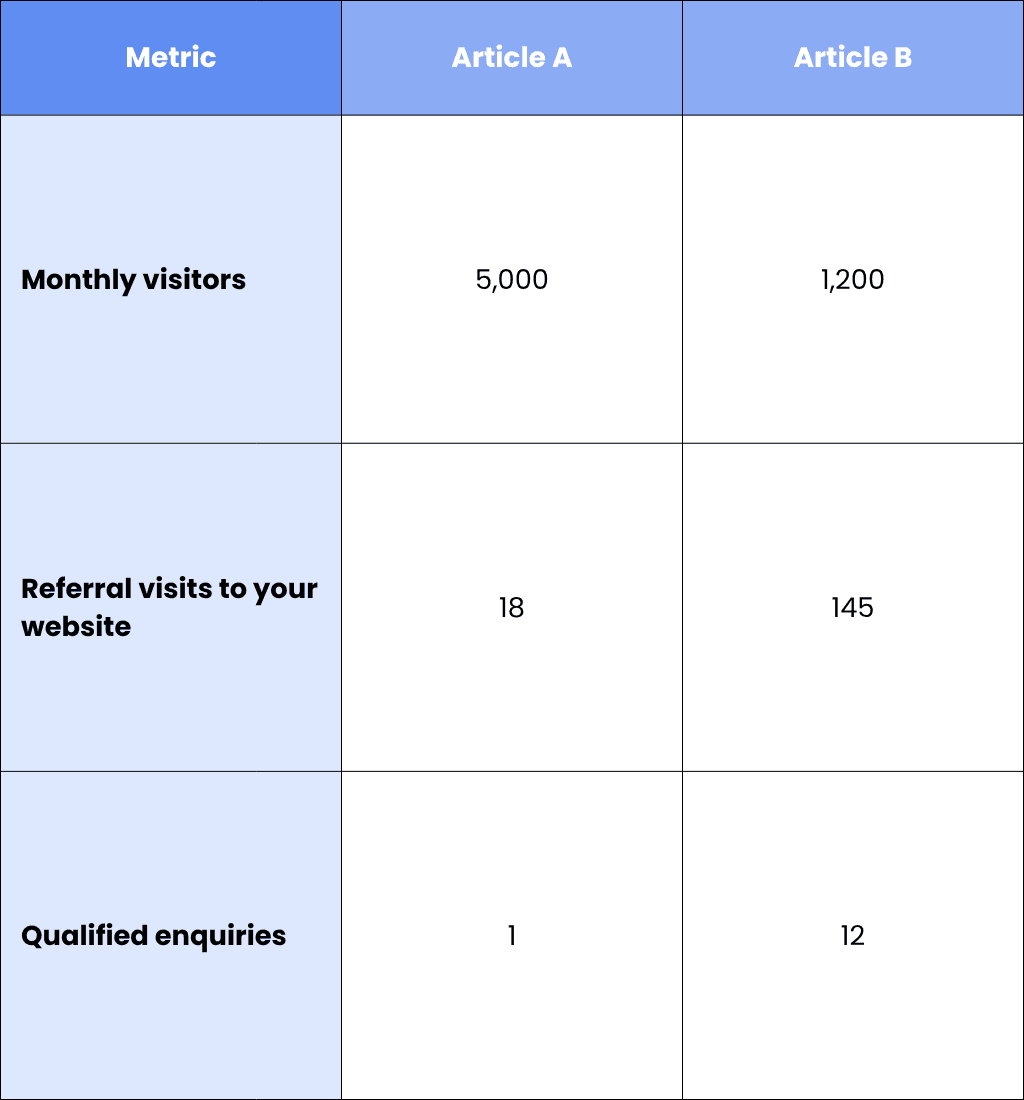
Although Article A attracts significantly more traffic, Article B generates substantially more qualified leads. In this case, the smaller but more targeted audience delivers greater business value. This highlights why businesses should measure success by outcomes rather than traffic alone.
Regular performance reviews also help you identify:
- Which publishing platforms attract the highest-quality visitors.
- Which content topics resonate most with your audience.
- Which calls to action generate the strongest engagement.
- Where future content investments should be prioritised.
Over time, these insights enable you to build a more effective parasite SEO strategy that supports broader marketing objectives instead of simply chasing rankings.
Should Your Business Use Parasite SEO?
The answer depends on your objectives.
Parasite SEO can be effective for:
- Increasing short-term visibility
- Supporting product launches
- Building brand awareness
- Reaching new audiences
- Establishing thought leadership
However, businesses should avoid relying on parasite SEO as their primary growth strategy.
Companies in industries such as F&B, retail, education, hospitality, healthcare, and professional services benefit most from building their own digital assets through sustainable SEO.
A well-optimised website becomes a long-term business asset that continues generating leads, enquiries, and organic traffic for years.
Parasite SEO in the Age of AI Search
The search landscape is changing rapidly.
AI search engines such as ChatGPT, Google AI Overviews, Gemini, and Perplexity increasingly generate answers by referencing trustworthy, authoritative content rather than simply displaying a list of links.
This shift means that visibility is no longer measured solely by traditional search rankings.
Businesses should focus on creating content that is:
- Factually accurate
- Well-structured
- Clearly sourced
- Easy for AI systems to understand
- Demonstrably authoritative
Publishing valuable content on respected third-party websites may increase your brand's visibility across AI-powered search experiences. However, it should form part of a broader strategy that also strengthens your own website's authority.
As AI search continues to evolve, businesses that invest in trusted, user-first content across both owned and earned channels will be best positioned for long-term success.
Build Sustainable Search Growth with Saigon Digital
At Saigon Digital, we believe that lasting SEO success comes from creating exceptional digital experiences, not chasing short-term ranking tactics.
Our SEO specialists develop tailored strategies that help ambitious brands improve visibility, attract qualified traffic, and convert more customers through sustainable organic growth.
Our SEO services include:
- Site optimisation and technical SEO
- Content strategy and authority building
- Local and international SEO
- Digital PR and link acquisition
- SEO performance reporting and analytics
As search continues to evolve beyond traditional search engines, we also help businesses prepare for AI-powered discovery through our Generative Engine Optimisation (GEO) services.
Our GEO specialists optimise your content so it can be discovered, understood, and cited by platforms such as ChatGPT, Gemini, Perplexity, and Google AI. From structured data implementation to AI content optimisation and Answer Engine Optimisation (AEO), we help brands remain visible wherever customers search for information.
Beyond SEO, Saigon Digital also delivers AI Workflow Automation solutions that streamline repetitive tasks, improve operational efficiency, and help businesses scale with intelligent automation.
Whether you're looking to improve search rankings, increase AI visibility, or automate business processes, our team combines strategy, creativity, and data to deliver measurable business growth.
Build a Smarter, Sustainable SEO Strategy
Parasite SEO can be a valuable addition to your digital marketing toolkit when used strategically and ethically. However, the most successful businesses don't rely on quick wins alone, they invest in building lasting authority through high-quality content, technical excellence, and user-focused SEO.
At Saigon Digital, we help ambitious brands create sustainable search strategies that drive measurable business growth.
Ready to build an SEO strategy that's designed for long-term success?
Get in touch with Saigon Digital to discover how we can help your business grow with confidence!
Frequently Asked Questions About Parasite SEO
1. Is parasite SEO suitable for small businesses?
Yes, parasite SEO can be useful for small businesses, particularly those looking to increase brand awareness or gain visibility for competitive keywords more quickly. However, it should complement—not replace—a long-term SEO strategy. Investing in your own website, creating valuable content, and building topical authority will provide more sustainable results over time.
2. Does Google penalise parasite SEO?
Not necessarily. Google does not penalise businesses simply for publishing content on third-party websites. However, it does discourage content created solely to manipulate search rankings. Low-quality, spammy, or AI-generated content with little value to users may perform poorly or be affected by future algorithm updates. The safest approach is to publish original, helpful content that genuinely serves your audience.
3. What types of websites are best for parasite SEO?
The best platforms are those that are reputable, relevant to your industry, and have an engaged audience. Rather than choosing a website based solely on its domain authority, prioritise platforms where your target customers are likely to discover and trust your content. Industry publications, respected news websites, professional communities, and authoritative blogs often provide the greatest long-term value.
4. How long does it take to see results from parasite SEO?
Results vary depending on the competitiveness of your target keywords, the authority of the publishing platform, and the quality of your content. In some cases, articles published on highly authoritative websites may begin ranking within days or weeks. However, visibility is never guaranteed, and ongoing optimisation and promotion are often needed to maximise performance.
5. Should parasite SEO be part of my overall SEO strategy?
For many businesses, yes—but only as one component of a broader SEO strategy. Parasite SEO can help you expand your reach, build thought leadership, and generate referral traffic, while traditional SEO strengthens the authority of your own website. Combining both approaches with technical SEO, high-quality content, digital PR, and Generative Engine Optimisation (GEO) creates a more resilient strategy that supports long-term business growth.