



Artificial intelligence has transformed the way businesses discover, organise, and use information. However, one of the biggest challenges AI systems face is understanding the relationships between pieces of information rather than simply processing isolated data points.
This is where knowledge graphs play a critical role.
If you have been researching AI technologies, search engines, or modern SEO strategies, you may have encountered the term "knowledge graph". Understanding what a knowledge graph is in AI can help businesses make better decisions about data management, AI implementation, search visibility, and digital growth.
In this comprehensive guide, we will explain what a knowledge graph in AI is, how it works, why it matters, and how organisations can leverage it to improve customer experiences, business intelligence, and online visibility.
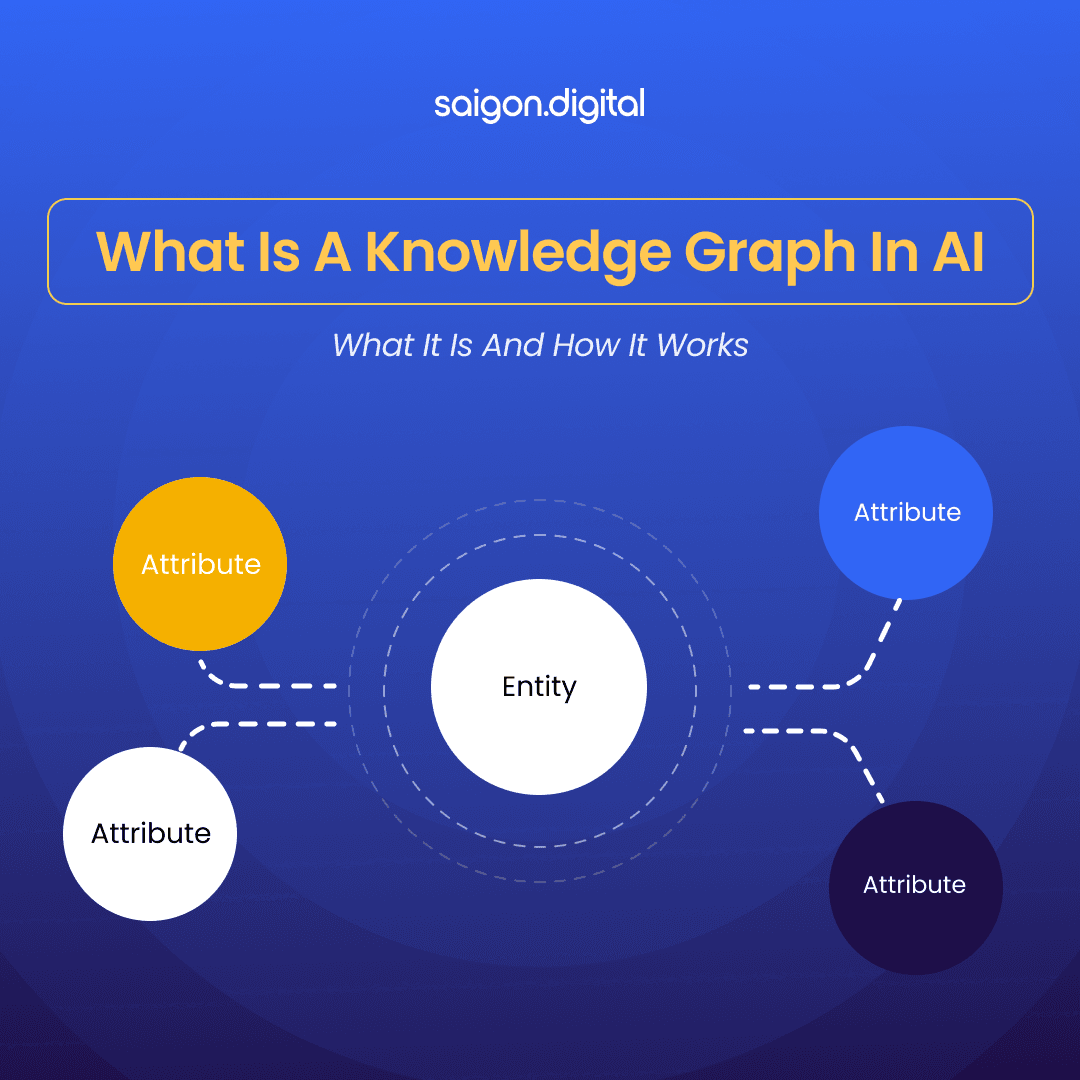
What Is a Knowledge Graph in AI?
A knowledge graph in AI is a structured representation of information that connects entities, concepts, and facts through meaningful relationships.
Rather than storing information as isolated records, a knowledge graph organises data into a network of interconnected nodes and relationships that allow AI systems to understand context and meaning.
For example, instead of simply storing information such as:
- London is a city
- The United Kingdom is a country
- Buckingham Palace is located in London
A knowledge graph connects these facts together, allowing an AI system to understand that:
- London is the capital of the United Kingdom
- Buckingham Palace is located in London
- Buckingham Palace is associated with the British monarchy
This interconnected structure enables AI to reason about information in a way that more closely resembles human understanding.
In simple terms, if traditional databases answer the question "What information do we have?", knowledge graphs help answer "How is this information connected?"
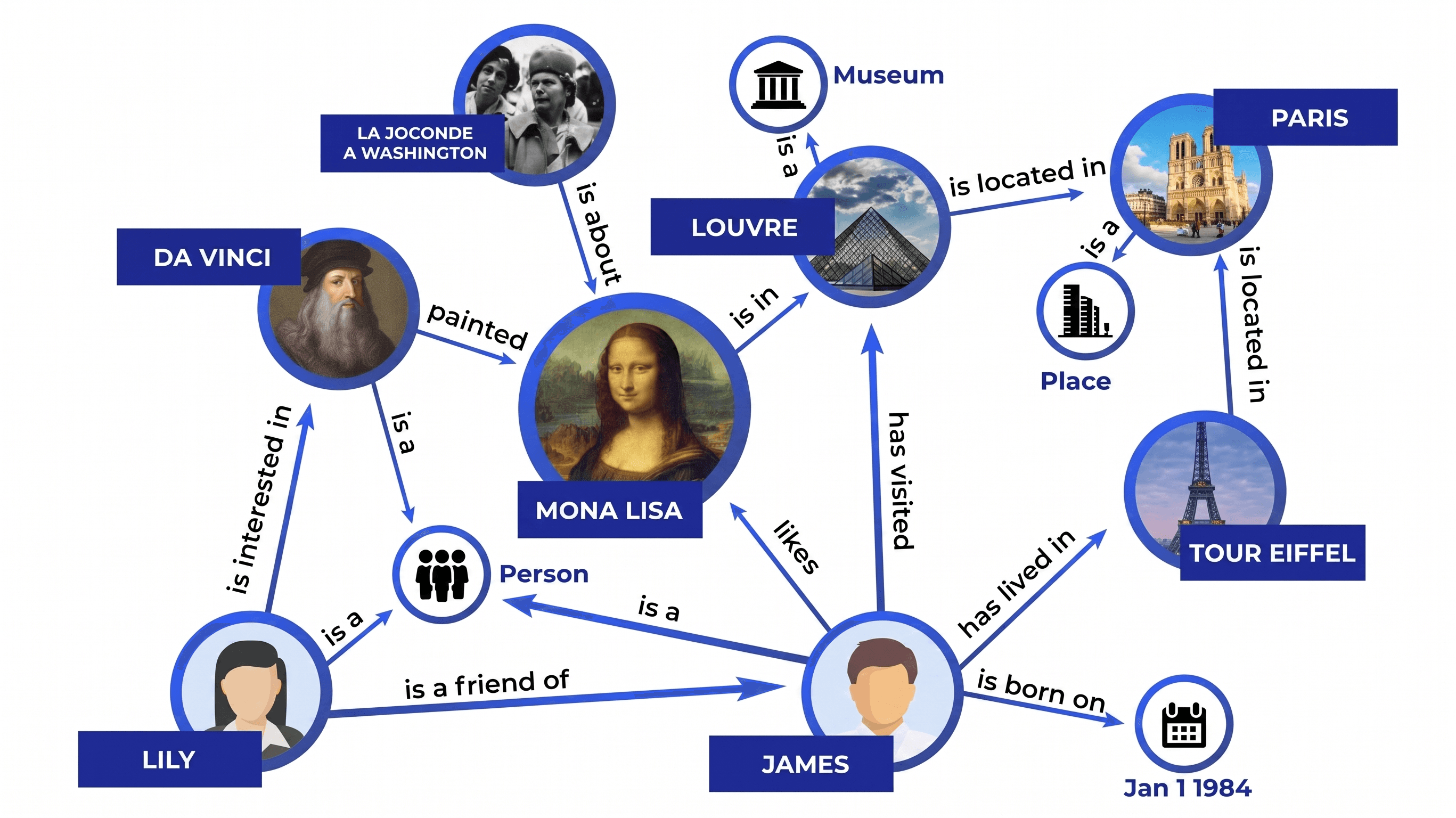
Understanding the Core Components of a Knowledge Graph
To understand how a knowledge graph works, it is useful to understand its three fundamental building blocks.
1. Entities
Entities are the objects, people, places, products, organisations, or concepts represented within the graph.
Examples include:
- A restaurant
- A customer
- A hotel
- A product
- A university
- A city
Each entity becomes a node within the graph.
2. Relationships
Relationships define how entities connect to one another.
Examples include:
- Customer purchased Product
- Hotel located in City
- Student enrolled in University
- Restaurant owned by Company
Relationships form the links between nodes.
3. Attributes
Attributes provide additional details about entities.
For example, a restaurant entity may contain:
- Name
- Address
- Cuisine type
- Opening hours
- Review rating
Together, entities, relationships, and attributes create a rich knowledge network that AI systems can interpret and analyse.
How Does a Knowledge Graph Work?
A knowledge graph works by gathering information from multiple sources and organising it into a structured network of connected entities and relationships. Rather than viewing data as isolated records, it creates a map of how different pieces of information relate to one another. This allows AI systems to understand context, identify patterns, and deliver more accurate insights.
The process typically involves five key stages:
1. Data Collection
First, information is gathered from various internal and external sources, including:
- Databases
- Websites
- CRM systems
- ERP platforms
- Customer support records
- Public datasets
By bringing data together from different locations, organisations can create a more complete view of their business, customers, and operations.
2. Entity Recognition
Next, AI identifies and categorises important entities within the data. These entities may include people, organisations, products, locations, services, or concepts.
For example, in the sentence:
"Saigon Digital provides SEO services in Vietnam."
The AI would recognise:
- Saigon Digital as an organisation
- SEO services as a service
- Vietnam as a location
This step helps transform unstructured information into data that AI can understand and organise.
3. Relationship Extraction
Once entities have been identified, the system determines how they connect to one another.
Using the same example, AI may establish relationships such as:
- Saigon Digital provides SEO services
- Saigon Digital operates in Vietnam
These connections are what give a knowledge graph its intelligence, enabling AI to understand context rather than simply storing facts.
4. Graph Construction
The identified entities and relationships are then organised into a graph structure.
Each entity becomes a node, while the relationships between them become links. As more data is added, the graph grows into an interconnected knowledge network that reflects how information relates across the real world.
This structure allows AI systems to quickly discover connections that may not be obvious in traditional databases.
5. Continuous Updates and Learning
Finally, modern knowledge graphs are continuously updated as new information becomes available.
For example, if a business launches a new product, opens a new location, or updates its services, the graph can incorporate these changes and create new relationships. As a result, the knowledge graph remains accurate, relevant, and useful over time.
Why Are Knowledge Graphs Important in AI?
Knowledge graphs have become increasingly important because they help overcome one of AI's biggest limitations: understanding context.
Traditional AI systems often struggle with ambiguity and disconnected information.
Knowledge graphs provide contextual understanding by showing how concepts relate to one another.
Key benefits include:
1. Improved Search Accuracy
Knowledge graphs help search engines understand user intent.
Rather than matching keywords alone, search systems can interpret the meaning behind queries.
For example, if someone searches:
"Best family-friendly hotel near London attractions"
A search engine using knowledge graph data can understand:
- Family-friendly is a hotel characteristic
- London attractions are points of interest
- Proximity is important
This results in more relevant search results.
2. Better AI Decision-Making
AI systems can use relationship-based information to make more informed recommendations and predictions.
Examples include:
- Product recommendations
- Fraud detection
- Healthcare diagnostics
- Customer support automation
3. Enhanced Data Integration
Many businesses operate with data scattered across multiple systems.
Knowledge graphs connect information from different sources into a unified view.
This creates a more complete understanding of customers, products, operations, and performance.
4. Explainable AI
One of the growing concerns surrounding AI is transparency.
Knowledge graphs provide traceable relationships that help explain how an AI system reached a conclusion.
This is particularly valuable in industries where accountability matters, such as healthcare, finance, and education.
Knowledge Graphs and Search Engines
One of the most well-known applications of knowledge graphs is within search engines.
Google introduced its Knowledge Graph in 2012 to improve search understanding and deliver richer search results.
When users search for a business, person, landmark, brand, or topic, Google often displays a knowledge panel containing:
- Business information
- Contact details
- Reviews
- Images
- Related entities
- Frequently asked questions
This information is powered by Google's understanding of entity relationships.
Instead of viewing a webpage as isolated content, search engines increasingly view the web as a network of interconnected entities.
This shift has significantly influenced modern SEO strategies.
The Relationship Between Knowledge Graphs and SEO
Knowledge graphs have become an increasingly important part of modern SEO because search engines no longer rely solely on keywords to understand content.
Instead, they aim to understand the entities behind a search query and the relationships between those entities. In other words, search engines want to know not just what words appear on a page, but what those words actually represent and how they connect to the wider web of information.
As a result, businesses that help search engines understand their brand, products, services, locations, and expertise are often better positioned to improve their visibility in search results.
From Keywords to Entities
Traditional SEO focused heavily on keywords and keyword matching. While keywords remain important, search engines have become far more sophisticated.
Today, Google and other search platforms use knowledge graphs to understand:
- Who a business is
- What products or services it offers
- Where it operates
- Which topics it is associated with
- How it relates to other entities across the web
For example, when Google understands that a restaurant is connected to a specific cuisine, location, menu items, and customer reviews, it can deliver more relevant results to users searching for dining options.
This shift towards entity-based understanding means businesses must focus on building clear and consistent digital signals rather than simply targeting keywords.
Entity-Based SEO
Entity-based SEO is the practice of helping search engines recognise and understand your business as a distinct entity within their knowledge graph.
This involves creating clear connections between your brand and relevant topics, services, products, locations, and industry expertise.
For example, a hospitality business may be connected to:
- Hotels and accommodation
- Travel destinations
- Local attractions
- Guest reviews
- Tourism organisations
Similarly, an education provider may be connected to:
- Courses and programmes
- Subject areas
- Academic qualifications
- Industry partnerships
- Learning resources
The stronger and more consistent these connections become, the easier it is for search engines and AI systems to understand your business and present it to the right audience.
Structured Data and Schema Markup
One of the most effective ways to support knowledge graph visibility is through structured data.
Structured data, often implemented through schema markup, provides search engines with machine-readable information about your website and business.
For example, schema can help identify:
- Organisations
- Products
- Services
- Locations
- Events
- Reviews
- Frequently asked questions
By adding this layer of context, businesses make it easier for search engines to accurately interpret their content and establish relationships between entities.
Think of schema markup as a way of speaking directly to search engines in a language they can clearly understand.
Why Knowledge Graphs Matter for AI Search
The rise of AI-powered search has made knowledge graphs even more important.
AI search engines such as ChatGPT, Gemini, Perplexity, and Google's AI-powered search experiences increasingly rely on trusted entities and structured information when generating responses.
Rather than simply retrieving webpages, these systems attempt to understand concepts, relationships, and sources before producing an answer.
As a result, businesses that have strong entity signals, structured content, and a well-defined digital presence are more likely to be recognised as authoritative sources within AI-generated responses.
This is one reason why strategies such as Answer Engine Optimisation (AEO), Generative Engine Optimisation (GEO), schema implementation, and knowledge graph development are becoming essential components of modern digital marketing.
What This Means for Businesses
For businesses across industries such as retail, hospitality, education, and F&B, the future of SEO is increasingly centred on trust, authority, and entity recognition.
While keywords still play a role, search engines and AI platforms are becoming more focused on understanding:
- Who you are
- What you offer
- Why you are credible
- How you relate to other recognised entities
Businesses that invest in entity-based SEO, structured data, and knowledge graph optimisation can build stronger visibility across both traditional search engines and emerging AI-powered discovery platforms.
In short, knowledge graphs are helping shape the next generation of search, making them an increasingly valuable consideration for any organisation looking to strengthen its long-term digital presence.
Real-World Examples of Knowledge Graphs
Knowledge graphs are not just theoretical AI concepts. In fact, they are already being used across a wide range of industries to connect information, improve decision-making, and deliver better user experiences.
By understanding the relationships between people, products, services, and other data points, organisations can uncover insights that would be difficult to identify using traditional databases alone.
Here are some common real-world applications of knowledge graphs.
Retail: Delivering Smarter Product Recommendations
Retailers often manage vast amounts of information, including products, brands, customer preferences, purchase histories, and inventory data.
A knowledge graph helps connect these data points, enabling AI systems to better understand customer behaviour and product relationships.
For example, if a customer frequently purchases running apparel, the system can identify related products such as running shoes, fitness trackers, or sports accessories and recommend them accordingly.
As a result, retailers can improve:
- Product recommendations
- Personalised shopping experiences
- Cross-selling and upselling opportunities
- Customer retention
This allows businesses to create more relevant shopping journeys while increasing revenue opportunities.
Hospitality: Enhancing Travel and Booking Experiences
In the hospitality industry, knowledge graphs can connect information about hotels, destinations, amenities, attractions, customer reviews, and travel preferences.
Rather than treating each piece of information separately, AI can understand how they relate to one another.
For example, a traveller searching for a family-friendly hotel near popular attractions may receive more accurate recommendations because the system understands the relationships between:
- Hotels
- Local landmarks
- Transport options
- Guest reviews
- Family-oriented amenities
This helps hospitality brands deliver more personalised experiences and improve customer satisfaction throughout the booking journey.
Education: Creating Connected Learning Experiences
Educational institutions generate large amounts of information related to students, courses, instructors, research projects, and learning resources.
Knowledge graphs can organise these relationships into a unified knowledge network.
For instance, an AI-powered learning platform could recommend relevant courses, reading materials, or certifications based on a student's academic history and interests.
This can help institutions:
- Improve knowledge discovery
- Personalise learning pathways
- Connect related educational resources
- Support student success
As AI adoption grows in education, knowledge graphs are becoming an important foundation for intelligent learning systems.
Food and Beverage: Understanding Customers and Operations
For restaurants, cafés, franchises, and food service brands, knowledge graphs can connect information across menus, ingredients, suppliers, customer preferences, and business locations.
For example, an AI-powered system may identify that customers who regularly order plant-based menu items are also more likely to engage with sustainability-focused promotions.
By understanding these relationships, F&B businesses can improve:
- Menu recommendations
- Customer personalisation
- Inventory management
- Supplier coordination
- Marketing effectiveness
This enables brands to make more informed decisions while creating better customer experiences.
Search Engines: Understanding the World Beyond Keywords
Perhaps the most widely recognised example of a knowledge graph is Google's Knowledge Graph.
When users search for a business, person, location, product, or topic, Google often displays a knowledge panel containing relevant information gathered from multiple trusted sources.
This is possible because Google's knowledge graph understands relationships between entities rather than relying solely on keyword matching.
For example, when someone searches for a restaurant, Google can understand connections between:
- The business
- Its location
- Opening hours
- Reviews
- Cuisine type
- Nearby attractions
This helps search engines provide richer, more accurate search experiences for users.
Enterprise AI: Connecting Information Across the Business
Many organisations store information across multiple systems, including CRMs, ERPs, analytics platforms, customer service tools, and internal databases.
Knowledge graphs can unify these disconnected data sources into a single connected framework.
For example, a company could link:
- Customer records
- Sales data
- Marketing campaigns
- Support interactions
- Product usage data
This gives decision-makers a more complete view of their operations and enables AI systems to uncover patterns that may otherwise remain hidden.
As a result, businesses can improve forecasting, customer insights, operational efficiency, and strategic decision-making.
What These Examples Have in Common
Although these use cases span different industries, they all rely on the same principle: understanding relationships.
Rather than viewing information as isolated records, knowledge graphs reveal how people, products, services, locations, and concepts connect to one another. This deeper understanding enables AI systems to provide more relevant recommendations, more accurate search results, and more valuable business insights.
As AI continues to evolve, organisations that can effectively organise and connect their data will be better positioned to unlock the full value of intelligent technologies.
How Saigon Digital Helps Businesses Leverage Knowledge Graphs and AI
At Saigon Digital, we believe the future of digital growth lies at the intersection of SEO, AI, data, and user experience.
As search engines and AI platforms increasingly rely on entities and structured knowledge, businesses need strategies that go beyond traditional SEO.
Our team helps organisations improve their digital visibility through:
SEO Services
We help businesses increase search visibility, traffic, and conversions through:
- Site optimisation and technical performance improvements
- Content strategy and authority building
- Local and global SEO campaigns
- Entity-focused SEO strategies
Generative Engine Optimisation (GEO)
As AI search platforms reshape how customers discover information, our GEO services help businesses become trusted sources for AI-generated answers.
Our solutions include:
- AI Readability Optimisation
- Generative Engine Optimisation (GEO)
- Answer Engine Optimisation (AEO)
- Knowledge Graph and Schema Setup
- AI Content Audits and Reformatting
- AI Performance Dashboards
AI Workflow Automation Services
We help ambitious brands streamline operations through:
- AI-driven intelligence solutions
- Custom AI agents
- Workflow automation
- Productivity-enhancing AI systems
By combining SEO expertise with AI innovation, we help organisations build stronger digital foundations for long-term growth.
Preparing Your Business for the Future of AI Search
Understanding what a knowledge graph in AI is has become increasingly important for businesses navigating the modern digital landscape.
For organisations across retail, hospitality, education, F&B, and other sectors, knowledge graphs offer opportunities to improve customer experiences, enhance operational efficiency, and strengthen online visibility.
Let’s build your next digital success story together. Get in touch with Saigon Digital today to start turning search intent into measurable results.
Frequently Asked Questions
1. What is a knowledge graph in AI?
A knowledge graph in AI is a structured network of entities, concepts, and relationships that helps artificial intelligence systems understand how different pieces of information connect. Rather than treating data as isolated records, a knowledge graph organises information into an interconnected framework, allowing AI to better understand context, meaning, and relationships.
2. How does a knowledge graph improve AI performance?
Knowledge graphs improve AI performance by providing context and structured relationships between data points. This enables AI systems to deliver more accurate search results, recommendations, insights, and responses. By understanding how information is connected, AI can make better decisions and provide more relevant outputs.
3. What is the difference between a knowledge graph and a traditional database?
A traditional database stores information in tables, rows, and columns, focusing on individual records. A knowledge graph, on the other hand, focuses on the relationships between entities. This allows AI systems to explore connections, uncover patterns, and understand context more effectively than conventional databases.
4. Why are knowledge graphs important for SEO?
Knowledge graphs help search engines understand businesses, products, services, and topics as entities rather than just keywords. By improving entity recognition and contextual understanding, knowledge graphs can support stronger search visibility, enhanced search features, and greater opportunities to appear in AI-generated responses and knowledge panels.
5. Can businesses use knowledge graphs to improve their digital presence?
Yes. Businesses can use knowledge graphs to strengthen their digital presence by implementing structured data, building clear entity relationships, and creating authoritative content. These efforts help search engines and AI platforms better understand the business, which can improve visibility across traditional search results as well as emerging AI-powered search experiences.