



As search evolves beyond traditional rankings, businesses face a new challenge: creating content that not only performs well in search engines but also gets surfaced and cited by AI platforms such as ChatGPT, Google AI Overviews, Gemini, and Perplexity.
One question increasingly asked by marketing leaders is this: in the debate of long form vs short form content, which format is more likely to be cited by AI?
This guide explores the differences between long-form and short-form content, how AI systems evaluate information, and how businesses can develop a content strategy designed for both human audiences and generative search experiences.
Understanding Long-Form vs Short-Form Content
Before examining which type of content receives more AI citations, it is important to define each format.
What is Long-Form Content?
Long-form content typically exceeds 1,200 words and explores a topic in depth. It often includes:
- Comprehensive explanations
- Supporting evidence and examples
- Structured headings and subheadings
- Frequently asked questions
- Original insights or expert commentary
- Actionable recommendations
Examples of long-form content include:
- Ultimate guides
- Industry reports
- Educational resources
- Detailed case studies
- Comprehensive service pages
For instance, a hospitality brand may publish a complete guide to increasing direct hotel bookings through SEO, while an education provider might create an extensive resource on choosing the right international curriculum.
What is Short-Form Content?
Short-form content is designed to communicate information quickly and concisely. It generally ranges from a few hundred words to around 1,000 words.
Examples include:
- News updates
- Brief blog posts
- Product announcements
- Quick tips articles
- Social media content
- Simple FAQs
Short-form content excels when addressing straightforward questions or delivering timely information.
How AI Systems Evaluate Content
AI platforms do not necessarily favour content solely because it is longer.
Rather, they tend to prioritise content that demonstrates several characteristics.
1. Clarity
AI models seek information that is easy to interpret. Therefore, content that uses logical heading structures, concise explanations, and straightforward language is often easier for these systems to process. In addition, clearly defining key concepts reduces ambiguity, helping AI understand exactly what the content is communicating.
2. Topical depth
Comprehensive coverage of a subject can increase the likelihood that an AI system identifies the content as a valuable source. Rather than addressing a topic superficially, in-depth content explores related questions, practical considerations, and supporting context. As a result, this breadth of information often signals expertise and enhances the overall usefulness of the content.

3. Accuracy
Content supported by credible evidence, practical experience, and factual consistency tends to perform better. Moreover, regularly reviewing and updating information helps ensure that advice, statistics, and recommendations remain relevant over time. Since AI systems aim to provide trustworthy responses, accuracy remains a critical factor in determining which sources are referenced.
4. Authority
Established brands, recognised experts, and websites with strong reputations are often viewed more favourably. However, authority is not built overnight. It develops through the consistent publication of high-quality content, the demonstration of genuine expertise, and the accumulation of signals that indicate trustworthiness within a particular industry.
5. Answer-focused formatting
Content that directly addresses common questions in a structured format aligns well with how AI generates responses. For example, using descriptive subheadings, concise introductory answers, and clearly organised sections makes it easier for AI systems to identify key takeaways. Consequently, well-formatted content may have a greater chance of being surfaced when users seek specific information.
Long-Form vs Short-Form Content: Which Gets Cited by AI More?
In most cases, long-form content is more likely to be cited by AI systems.
However, this advantage stems from the qualities often associated with long-form content rather than word count itself.
Long-form content often performs strongly in AI-driven search environments because it provides the depth and context that AI systems need to generate accurate responses. Rather than relying on isolated pieces of information, AI models look for sources that thoroughly explain a topic and address related questions. As a result, comprehensive resources frequently offer more opportunities for citation.
However, businesses should remember that length alone does not create value. The goal should be to cover a topic as extensively as necessary while ensuring that every section serves a clear purpose for the reader.
Comprehensive Topic Coverage
One of the greatest strengths of long-form content is its ability to address multiple aspects of a subject within a single resource. Since AI platforms often synthesise information from several sources to answer user queries, content that provides broad yet relevant coverage can become particularly valuable.
For example, consider a hospitality business creating an article on "How hotels can improve direct bookings through SEO". A short article may discuss keywords and meta descriptions. In contrast, a long-form guide could explore:
- Local SEO strategies for hotels
- Technical website optimisation
- Review management techniques
- Content marketing opportunities
- Structured data implementation
- Mobile user experience considerations
- Tracking and measuring performance
Because the article answers numerous related questions, it provides AI systems with several potential points of reference.
Practical tip: When planning long-form content, identify the primary question first. Then, map out the secondary questions that users are likely to ask afterwards. Addressing these naturally within the article can strengthen its usefulness and citation potential.
Stronger Semantic Relationships
Longer content often introduces related concepts, terminology, and examples that help establish clear connections between ideas. Consequently, AI models gain a richer understanding of the subject matter and the context surrounding it.
For instance, an article targeting "restaurant SEO" may also discuss:
- Local search optimisation
- Google Business Profile management
- Customer reviews
- Menu schema markup
- Online reservations
- Mobile search behaviour
These related terms reinforce the article's topical relevance. Rather than appearing as a standalone piece focused narrowly on one phrase, the content demonstrates a broader understanding of the subject.
From a practical perspective, businesses should avoid forcing keywords into an article. Instead, focus on answering questions comprehensively and using the natural language that customers and stakeholders already use when discussing the topic.
Ask yourself:
- What related concepts should readers understand?
- What terminology is commonly used within the industry?
- What follow-up questions might arise?
Addressing these areas can improve both user experience and AI interpretability.
Greater Demonstration of Expertise
AI systems increasingly favour content that reflects genuine expertise and practical experience. While anyone can summarise publicly available information, businesses that share original insights often provide greater value.
For example, an education provider writing about student recruitment trends could strengthen its content by including:
- Observations gathered from working with prospective families
- Lessons learned from previous campaigns
- Common mistakes schools should avoid
- Recommendations based on industry experience
Similarly, a retail business discussing seasonal marketing strategies could incorporate examples drawn from actual promotional periods and customer behaviours.
These additions help transform an article from a generic overview into a resource grounded in experience.
Ways to demonstrate expertise include:
- Sharing real-world examples
- Incorporating case studies
- Providing step-by-step recommendations
- Highlighting industry-specific considerations
- Offering informed opinions supported by evidence
Ultimately, expertise builds trust. The more useful and experience-driven the content becomes, the stronger its potential as a source for AI-generated responses.
Increased Citation Opportunities
Long-form content naturally contains more individual elements that AI systems may reference when generating answers. This does not mean adding unnecessary information. Rather, it involves structuring the content so that valuable insights are easy to identify.
Within a single article, AI may draw from:
- Definitions and explanations
- Practical frameworks
- Step-by-step processes
- Statistics and research findings
- Industry examples
- Frequently asked questions
- Best practice recommendations
Consider an article containing ten well-developed sections, each answering a distinct question related to the overall topic. In simple terms, this creates significantly more citation opportunities than an article that addresses only one narrow point.
For example:
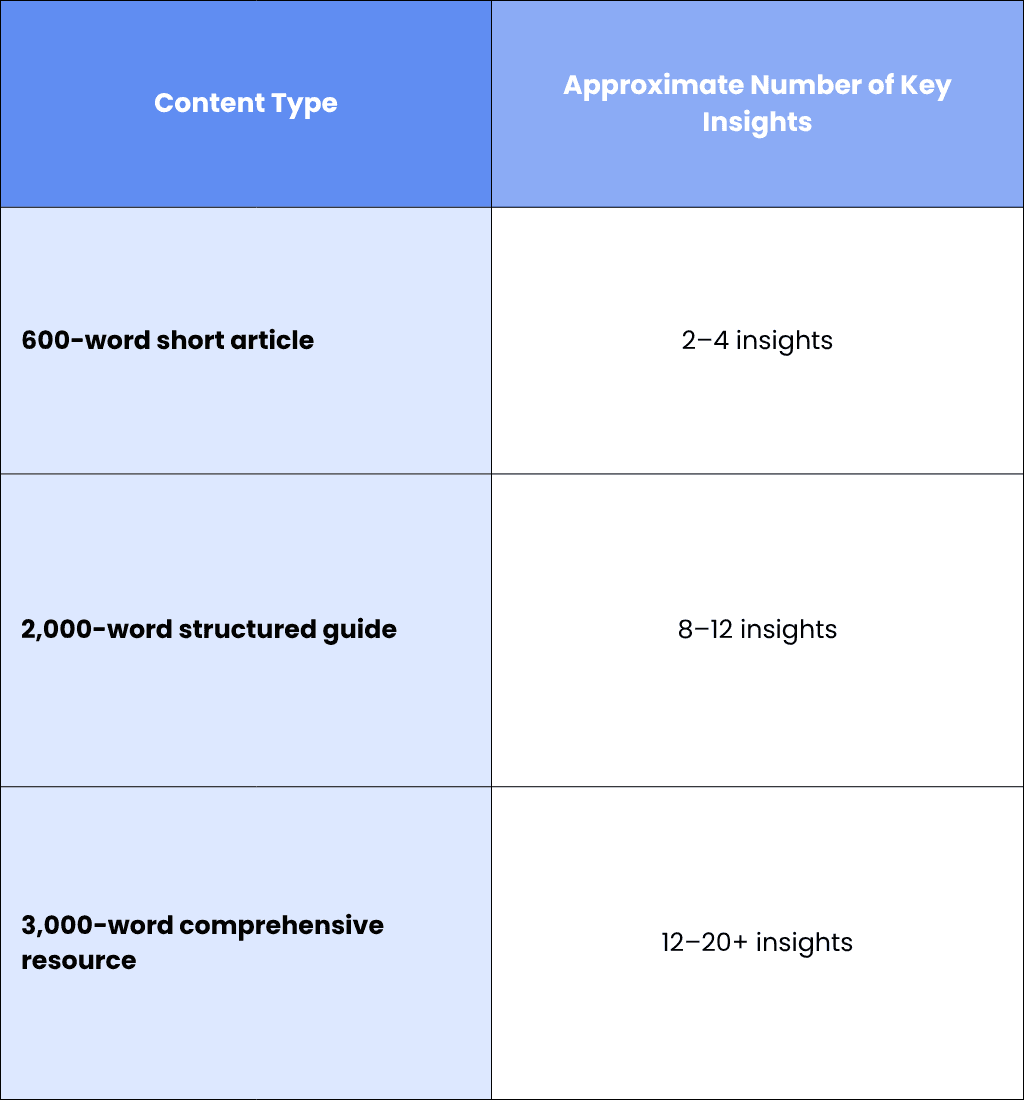
Although these figures are illustrative rather than definitive, they highlight an important principle: well-structured depth increases the number of opportunities for your content to contribute meaningfully to AI-generated answers.
To maximise citation potential:
- Use descriptive headings and subheadings.
- Answer one major question per section.
- Include concise summary statements.
- Present actionable recommendations clearly.
- Break complex topics into digestible segments.
In doing so, businesses create content that is not only easier for readers to navigate but also easier for AI systems to interpret and reference.
What Businesses Should Take Away
When considering long form vs short form content, organisations should avoid viewing the decision as an either-or choice. Instead, they should evaluate the intent behind the content and the role it plays within a broader strategy.
Long-form content is particularly effective when the objective is to:
- Establish topical authority
- Educate audiences on complex subjects
- Address multiple related questions
- Demonstrate expertise and experience
- Increase opportunities for AI citations
At the same time, businesses should ensure that every section contributes genuine value. Expanding word count without improving usefulness may weaken both engagement and clarity.
The Advantages of Short-Form Content
Although long-form content generally enjoys an advantage, short-form content still plays an important role.
Short-form content performs well when:
Answering simple questions
If a user asks a highly specific query, concise content may provide the most relevant response.
Covering time-sensitive topics
News updates, seasonal promotions, and industry developments often require shorter formats.
Supporting content ecosystems
Short-form pieces can complement larger cornerstone resources.
For example, a retailer might create:
- A long-form guide on omnichannel retail marketing
- Short articles addressing specific tactics within that broader strategy
Improving engagement
Not every audience member seeks an in-depth resource.
Some users prefer quick answers and practical tips.
Does Word Count Alone Influence AI Citations?
No.
Word count should never be treated as the primary objective.
An 800-word article that thoroughly answers a focused question may outperform a 3,000-word article filled with repetition and unnecessary detail.
Businesses should avoid creating longer content solely to meet arbitrary targets.
Instead, ask:
- Have we answered the user's questions comprehensively?
- Does this content provide unique value?
- Is the structure easy to navigate?
- Can AI systems easily identify key insights?
Quality remains more important than quantity.
What Businesses Should Consider When Creating AI-Friendly Content
As AI-powered search experiences continue to evolve, businesses need to rethink how they plan, structure, and maintain their content. Traditional SEO fundamentals remain important; however, organisations must also consider how AI systems interpret, synthesise, and surface information.
The following considerations can help businesses create content that resonates with both human readers and AI platforms.
Prioritise Topical Authority
Rather than producing isolated articles that compete for attention independently, businesses should focus on building clusters of interconnected content around strategic themes. Over time, this approach demonstrates depth of expertise and helps establish the brand as a credible source within its industry.
For example, an education provider may develop content covering:
- International school admissions processes
- Student recruitment strategies
- Parent decision-making behaviours
- Local SEO for educational institutions
- Frequently asked questions from prospective families
Similarly, an F&B business could create a collection of resources addressing restaurant SEO, online reputation management, local search optimisation, and customer retention strategies.
When these pieces link naturally to one another, they form a broader body of knowledge that reinforces topical relevance.
To strengthen topical authority:
- Identify the core subjects most relevant to your services and audience.
- Develop pillar content that provides comprehensive coverage of those subjects.
- Create supporting articles that explore subtopics in greater detail.
- Review existing content regularly to identify gaps or opportunities for expansion.
The objective is not to publish more content for the sake of volume. Instead, businesses should aim to become recognised sources of expertise within clearly defined areas.
Use Clear Heading Structures
Well-structured content improves readability for users while also making it easier for AI systems to understand how information is organised. Clear headings provide context, indicate topic transitions, and highlight the relationship between ideas.
For example, compare these two approaches:
Less effective:
- Tips
- More ideas
- Final thoughts
More effective:
- How Restaurants Can Improve Local SEO Visibility
- Common Mistakes Retailers Make with Product Content
- Steps Schools Can Take to Increase Enrolment Enquiries
The second approach immediately communicates the purpose of each section.
In addition, logical heading structures encourage readers to scan the page efficiently. Since many users do not read articles from beginning to end, descriptive subheadings help them locate the information most relevant to their needs.
Best practices include:
- Using headings that accurately reflect the content beneath them.
- Breaking lengthy sections into smaller, digestible segments.
- Maintaining a logical hierarchy throughout the article.
- Avoiding vague or overly creative headings that sacrifice clarity.
Ultimately, if readers can navigate your content easily, AI systems are more likely to interpret it effectively as well.
Include Direct Answers
AI-generated responses are designed to answer user questions efficiently. Consequently, content that addresses key questions clearly and early within a section may be easier for AI platforms to reference.
A practical approach is to begin each subsection with a concise answer before expanding on the supporting details.
For instance:
Question: How often should businesses update their content?
Direct answer: Businesses should review and update high-value content regularly to ensure accuracy, relevance, and alignment with changing user needs.
The article can then elaborate on why updates matter and how organisations can implement a review process.
This structure benefits readers too. Decision-makers often seek immediate clarity before investing time in deeper explanations.
When creating content, ask:
- What question is this section answering?
- Is the answer stated clearly near the beginning?
- Have I supported the answer with relevant context or examples?
Balancing brevity with depth allows businesses to satisfy both quick information needs and more detailed research intent.
Demonstrate Experience
As AI systems increasingly emphasise trustworthiness and expertise, businesses should look for opportunities to incorporate real-world experience into their content. Generic advice is widely available online; however, practical insights can differentiate one source from another.
For example, a hospitality business discussing direct booking strategies might share observations about seasonal fluctuations in customer behaviour. Likewise, a retailer could explain lessons learned from previous promotional campaigns.
Examples of experience-driven content include:
- Case studies highlighting measurable outcomes.
- Industry observations derived from client work.
- Practical recommendations based on implementation experience.
- Common pitfalls businesses should avoid.
- Step-by-step processes refined through real-world application.
This does not mean revealing confidential information. Rather, it involves demonstrating an understanding of the challenges, nuances, and realities within a particular sector.
For readers, this type of content feels more credible and actionable. For AI systems, it may provide stronger signals that the material reflects genuine expertise rather than recycled information.
Keep Content Current
Even the most comprehensive article can lose value if the information becomes outdated. Search behaviours evolve, technologies advance, and industry best practices change over time. Consequently, maintaining content should be viewed as an ongoing responsibility rather than a one-time task.
For example:
- Retail trends shift as consumer expectations change.
- Educational institutions adapt recruitment strategies annually.
- Hospitality businesses respond to seasonal patterns and market conditions.
- Search engines and AI platforms regularly update how they evaluate content.
Regular reviews help ensure that existing resources continue to serve users effectively.
Businesses should consider updating:
- Statistics and research findings.
- References to tools or technologies.
- Industry examples and case studies.
- Recommendations that no longer reflect current best practices.
- Internal links to newer or more relevant resources.
A simple content maintenance framework could involve:
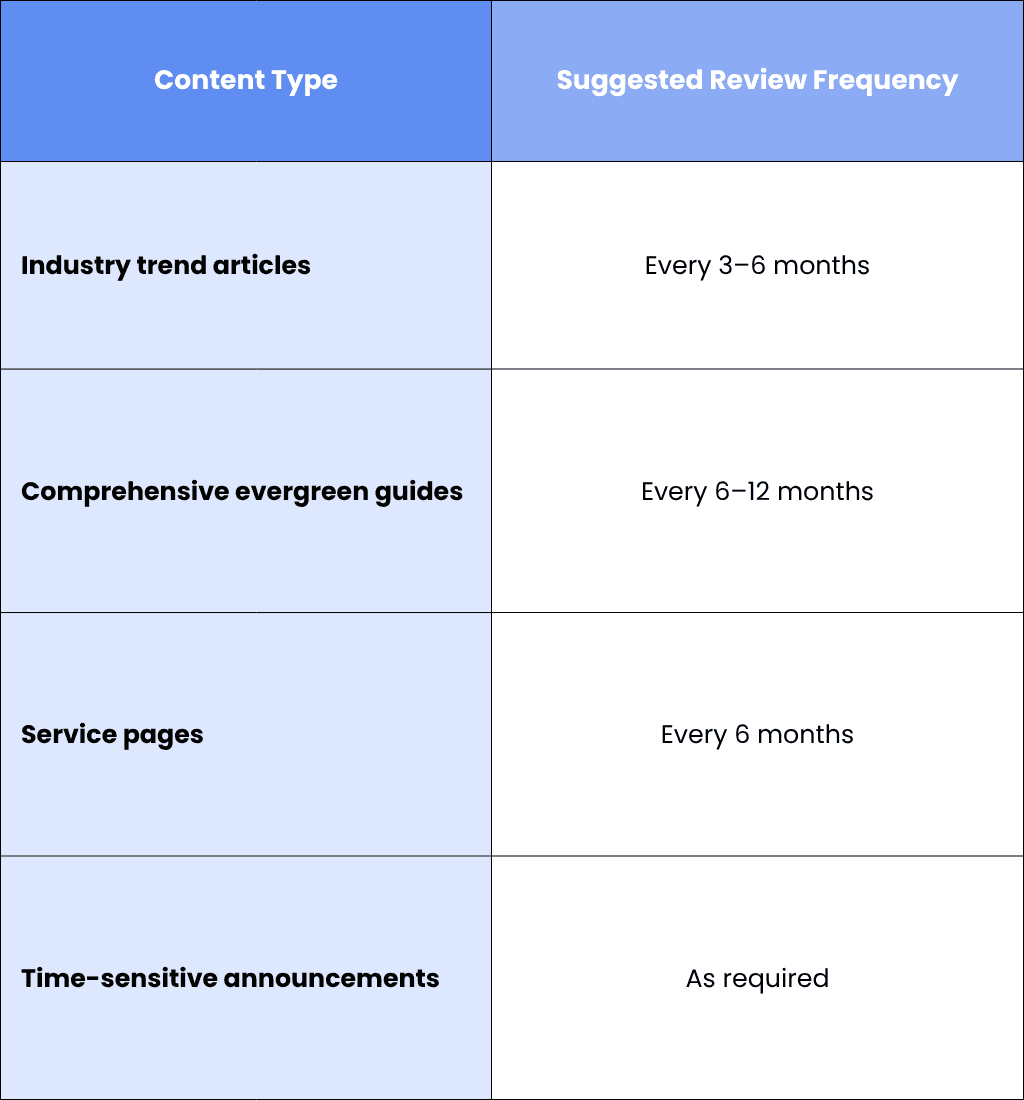
By keeping information accurate and relevant, businesses improve the user experience while strengthening the long-term value of their content assets.
Content Recommendations by Industry
While the principles of AI-friendly content apply broadly across sectors, the way businesses implement those principles should reflect the needs, behaviours, and search intent of their audiences. Different industries face distinct challenges, and therefore require tailored content strategies.
The following recommendations illustrate how organisations in key sectors can balance long-form and short-form content to improve both traditional search visibility and their potential to be referenced by AI platforms.
F&B Businesses
For restaurants, cafés, food brands, and other F&B businesses, visibility often depends on capturing local demand while building trust with potential customers. Consumers typically move quickly from discovery to decision-making, making both comprehensive resources and timely updates valuable.
Long-form content can help establish expertise and answer broader questions related to the business. For example, a restaurant group may publish guides covering topics such as sustainable sourcing practices, catering considerations for corporate events, or insights into regional cuisines.
Meanwhile, short-form content can support day-to-day engagement by promoting seasonal offerings, limited-time menus, or upcoming events.
Recommended long-form content:
- Guides to planning corporate catering events
- Articles exploring food trends and customer preferences
- Educational content about ingredient sourcing or dietary options
- Local SEO resources for multi-location restaurant brands
Recommended short-form content:
- Seasonal menu announcements
- Event promotions
- Chef highlights and behind-the-scenes updates
- Quick dining tips or FAQs
Practical insight: F&B businesses often benefit from combining informative content with strong local signals. Including location-specific information, customer questions, and operational details can improve relevance for both search engines and AI systems.
Retail Companies
Retail consumers frequently conduct extensive research before making purchasing decisions. As a result, retailers have an opportunity to support customers throughout the buying journey by providing content that educates, compares, and guides.
Long-form resources are particularly effective during the consideration stage. Comprehensive buying guides, trend analyses, and educational articles can help consumers evaluate their options with confidence.
Short-form content, on the other hand, can address immediate needs and support conversion-focused objectives.
Recommended long-form content:
- Product buying guides
- Trend reports and seasonal forecasts
- Comparison articles explaining key differences between options
- Educational resources related to product usage and maintenance
Recommended short-form content:
- Product launch announcements
- Promotional campaign updates
- Quick styling or usage tips
- Frequently asked product questions
For example: A home furnishings retailer might publish a detailed guide on selecting furniture for small spaces, while also creating shorter articles introducing new collections or seasonal promotions.
This combination allows retailers to capture both high-intent research traffic and audiences seeking immediate information.
Education Providers
Educational institutions often support prospective students and families through complex decision-making processes. Questions around admissions, programmes, costs, outcomes, and learning environments require clear, trustworthy information.
Long-form content can position educational organisations as authoritative sources while addressing the concerns of prospective students in depth.
At the same time, shorter content formats can help answer specific questions and communicate important updates efficiently.
Recommended long-form content:
- Admissions and enrolment guides
- Programme comparison resources
- Articles addressing common parent concerns
- Insights into educational trends and student outcomes
Recommended short-form content:
- Application deadline reminders
- Scholarship announcements
- Event and open day updates
- Concise answers to frequently asked questions
Practical insight: Education-related decisions often involve multiple stakeholders, including students, parents, and guardians. Therefore, content should anticipate the different questions each audience may ask throughout the decision-making journey.
By addressing these concerns proactively, institutions can build trust while increasing the likelihood of their content being referenced within AI-generated responses.
Hospitality Businesses
Hospitality brands operate within highly competitive environments where trust, experience, and convenience significantly influence booking decisions. Travellers frequently seek detailed information before committing, making comprehensive content an effective tool for attracting and reassuring potential guests.
Long-form content can showcase expertise, highlight local knowledge, and support travel planning. Short-form content can maintain engagement by promoting timely opportunities and experiences.
Recommended long-form content:
- Destination guides featuring local attractions and recommendations
- Resources explaining how to maximise loyalty programme benefits
- Articles offering travel planning advice
- Guides to hosting meetings, conferences, or special events
Recommended short-form content:
- Seasonal package announcements
- Event promotions
- Property updates and new service offerings
- Travel tips related to upcoming holidays or local events
For example: A hotel in Ho Chi Minh City could publish an in-depth guide to exploring the city's cultural districts while also sharing shorter updates about festive dining experiences or limited-time accommodation packages.
This balanced approach allows hospitality businesses to support both early-stage research and last-minute decision-making.
Finding the Right Balance
Although each industry has unique requirements, one principle remains consistent: businesses should align content formats with audience intent.
As a general guideline:
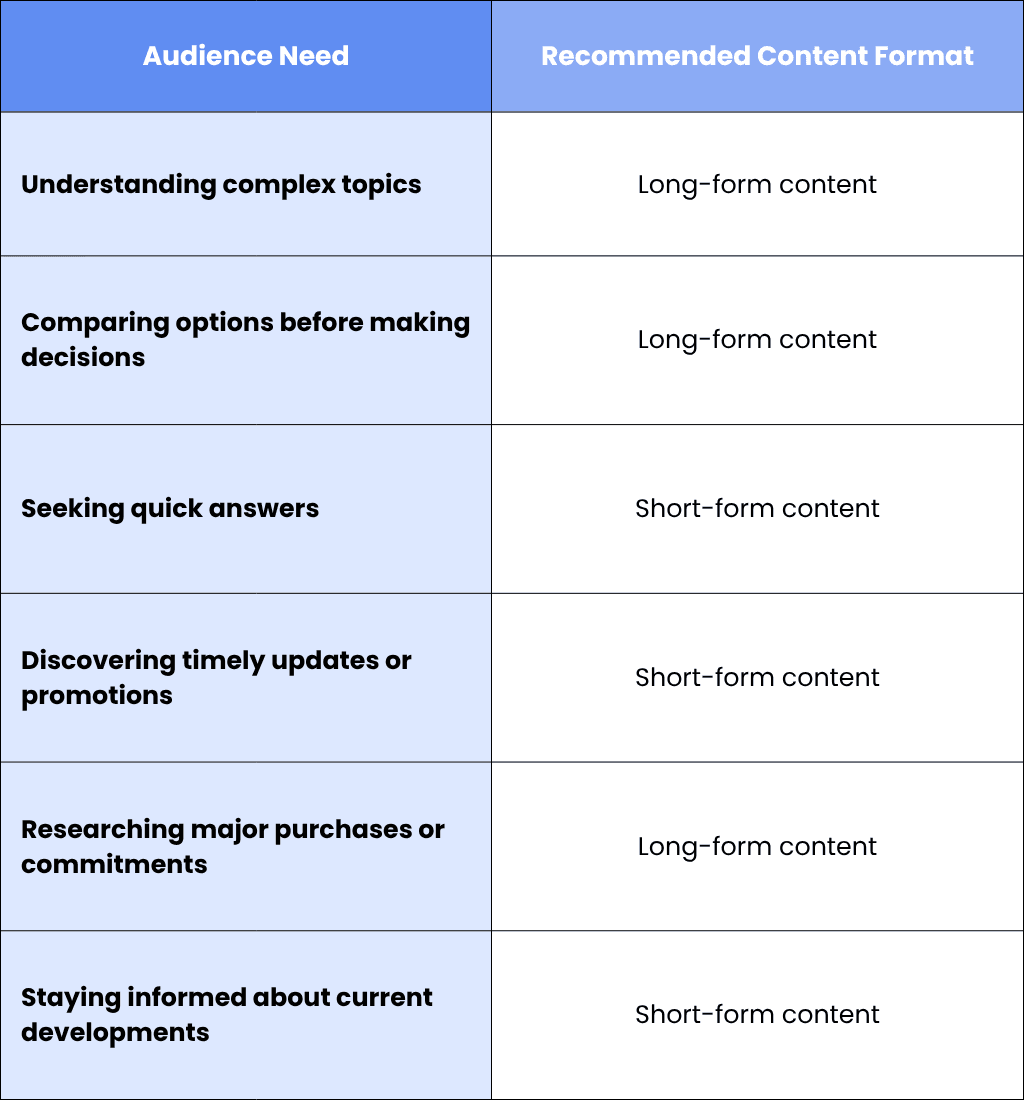
Rather than treating long form vs short form content as competing approaches, businesses should recognise that each serves a distinct purpose within a broader content ecosystem.
Long-form content often establishes authority and provides the depth that AI systems value when generating responses. Conversely, short-form content supports agility, relevance, and ongoing audience engagement.
Build Content That Performs in Search and AI with Saigon Digital
At Saigon Digital, we help ambitious brands navigate the changing landscape of digital discovery.
Our team combines strategy, creativity, and data to deliver measurable business growth through bespoke solutions tailored to your goals.
Our services include:
SEO Services
We make search engines perform for your business by focusing on outcomes that matter.
Our capabilities include:
- Site optimisation and technical performance
- Content and authority building
- Local and global search strategy
Generative Engine Optimisation (GEO)
As AI reshapes how people find information, brands need to become trusted sources within generative experiences.
Our GEO services help businesses get discovered, quoted, and trusted by platforms such as ChatGPT, Gemini, Perplexity, and Google AI.
These services include:
- AI readability optimisation
- Generative Engine Optimisation (GEO)
- Answer Engine Optimisation (AEO)
- Knowledge graph and schema setup
- AI content audit and reformatting
- AI performance dashboards
AI Workflow Automation Services
We also help organisations streamline operations through intelligent automation solutions designed to improve efficiency and support growth.
Our services include:
- AI-driven intelligence
- Pre-built automation templates
- Custom AI agents
The future of digital growth is already here. By combining high-performance SEO strategies with AI-powered innovation, Saigon Digital equips businesses with the visibility, agility, and expertise needed to lead in an increasingly competitive marketplace.
Need Help Creating Content That Performs in Search and AI?
As search behaviour evolves, businesses need more than content that simply ranks. They need content that informs, builds trust, and positions their brand as a credible source across both traditional search engines and emerging AI platforms.
At Saigon Digital, we help ambitious brands turn strategy, creativity, and data into measurable business outcomes. From technical SEO and content development to Generative Engine Optimisation (GEO) and AI-powered marketing solutions, our team works alongside you to solve complex digital challenges with forward-thinking, user-centric approaches.
Get in touch with our team today to discuss how we can help your business get discovered, quoted, and trusted in the evolving search landscape.
Frequently Asked Questions About Long-Form vs Short-Form Content
1. Is long-form content always better than short-form content for SEO and AI visibility?
No. In the discussion of long form vs short form content, neither format is inherently superior in every situation. Long-form content often performs well because it provides comprehensive information, demonstrates expertise, and addresses multiple related questions. However, short-form content can be highly effective when users need quick answers, timely updates, or concise guidance. The most successful content strategies typically incorporate both formats to meet different user intents.
2. Why is long-form content more likely to be cited by AI platforms?
Long-form content generally offers greater topical depth and context, which can increase the number of opportunities for AI systems to reference it. For example, a detailed guide may include definitions, examples, practical recommendations, and answers to several related questions within one resource. That said, AI platforms prioritise usefulness and clarity over word count alone, so quality should always take precedence over length.
3. How long should long-form content be?
There is no universal word count that guarantees success. Instead, businesses should focus on covering a topic thoroughly without adding unnecessary information. In many cases, long-form articles range from 1,200 to 3,000 words or more, depending on the complexity of the subject matter. The key consideration is whether the content fully addresses the audience's questions and provides genuine value.
4. Should businesses stop creating short-form content in the age of AI search?
Not at all. Short-form content continues to play an important role within a broader content strategy. It is particularly useful for sharing company updates, answering straightforward questions, promoting events, or highlighting seasonal campaigns. Rather than choosing between long form vs short form content, businesses should understand how each format supports different stages of the customer journey.
5. How can businesses optimise their content for both search engines and AI platforms?
Businesses should focus on creating content that is clear, accurate, and user-centric. Some best practices include:
- Building topical authority through interconnected content.
- Using descriptive headings and logical structures.
- Providing direct answers to common questions.
- Demonstrating real-world expertise through examples and insights.
- Reviewing and updating content regularly to maintain accuracy.
- Implementing structured data where appropriate.
By combining these practices with a balanced content strategy, businesses can improve their chances of being discovered through both traditional search results and AI-generated experiences.