



As search behaviour evolves, businesses face a new challenge: ensuring their content remains visible not only in traditional search engine results but also within AI-generated answers.
From Google's AI Overviews to platforms such as ChatGPT, Gemini, and Perplexity, users increasingly expect direct, conversational responses to their questions. In this environment, well-structured FAQ content has become more than a helpful website feature. It is now a strategic asset for search visibility.
For businesses operating in competitive industries such as F&B, retail, education, hospitality, and professional services, understanding how to structure FAQ content can improve discoverability, strengthen authority, and increase the likelihood of being referenced by AI-powered search experiences.
This guide explores practical strategies for creating FAQ content that serves both human readers and emerging AI search systems.
Why FAQ Content Matters in the Age of AI Search
Traditionally, FAQ sections helped businesses address common customer concerns, reduce support enquiries, and improve user experience.
Today, they serve an additional purpose.
AI search systems rely heavily on clear and well-organised information when generating responses. FAQ content naturally aligns with this requirement because it presents information in a question-and-answer format that mirrors how people interact with AI assistants.
When structured effectively, FAQ pages can help businesses:
- Increase visibility in AI-generated search experiences
- Enhance traditional SEO performance
- Capture long-tail search queries
- Demonstrate topical expertise
- Improve customer experience by addressing concerns proactively
- Support Answer Engine Optimisation (AEO) and Generative Engine Optimisation (GEO) initiatives
For organisations seeking sustainable digital growth, learning how to structure FAQ content has become an essential component of modern content strategy.
Understanding How AI Search Uses FAQ Content
Unlike traditional search engines that primarily rank webpages, AI-powered systems synthesise information from multiple sources to provide direct answers.
These systems favour content that is:
- Easy to interpret
- Factually accurate
- Clearly organised
- Written in natural language
- Supported by authoritative signals
- Contextually relevant to user intent
FAQ content often satisfies these requirements exceptionally well.
For example, a hospitality business may publish an FAQ addressing cancellation policies, check-in times, and amenities. If those answers are concise, accurate, and properly structured, AI systems may identify them as reliable sources when responding to user queries.
This shift highlights why businesses must move beyond simply adding generic FAQ sections and instead focus on how to structure FAQ content strategically.
Start with Real Customer Questions
The foundation of effective FAQ content lies in understanding what your customers genuinely want to know.
To build a strong FAQ strategy, collect insights from multiple customer touchpoints and prioritise the questions that appear most frequently or influence purchasing decisions.
Customer Service Teams
Your customer service team is often the richest source of FAQ ideas. They interact with customers daily and have first-hand knowledge of common concerns, misconceptions, and pain points.
Review support tickets, call logs, and email enquiries to identify patterns. If the same question is being asked repeatedly, it deserves a place within your FAQ content.
Look for questions such as:
- "What does this package include?"
- "How long will my order take to arrive?"
- "Can I change my booking after confirmation?"
- "Do you offer support after purchase?"
Practical tip: If customer service receives the same question multiple times each week, consider it a high-priority FAQ. Addressing these queries proactively can reduce support workload while improving customer confidence.
Sales Enquiries
Questions raised during the sales process often reveal information gaps that may prevent prospects from converting.
Sales teams regularly encounter objections and requests for clarification before customers commit to a purchase. By transforming these discussions into FAQ content, businesses can help potential buyers make informed decisions more quickly.
Common examples include:
- "What makes your service different from competitors?"
- "What pricing options are available?"
- "Is there a minimum contract period?"
- "Can this solution be customised to our needs?"
For B2B organisations, these FAQs can be particularly valuable because they address the considerations stakeholders evaluate before approving investments.
Website Chat Transcripts
Live chat tools and AI chatbots capture authentic language directly from website visitors. Unlike internally generated questions, chat transcripts often reflect how people naturally phrase their queries.
Review transcripts regularly to identify recurring themes and conversational wording that can strengthen your FAQ strategy.
For example, instead of creating a question titled:
"Shipping Information"
consider using:
"How long does delivery take within Vietnam?"
This conversational approach aligns more closely with both voice search behaviour and AI-generated search experiences.
Search Query Data
Your website analytics and search performance tools can provide valuable insights into what users are already looking for.
Platforms such as Google Search Console can reveal the exact queries that lead visitors to your website. Pay particular attention to long-tail questions, as these often indicate strong intent.
For example:
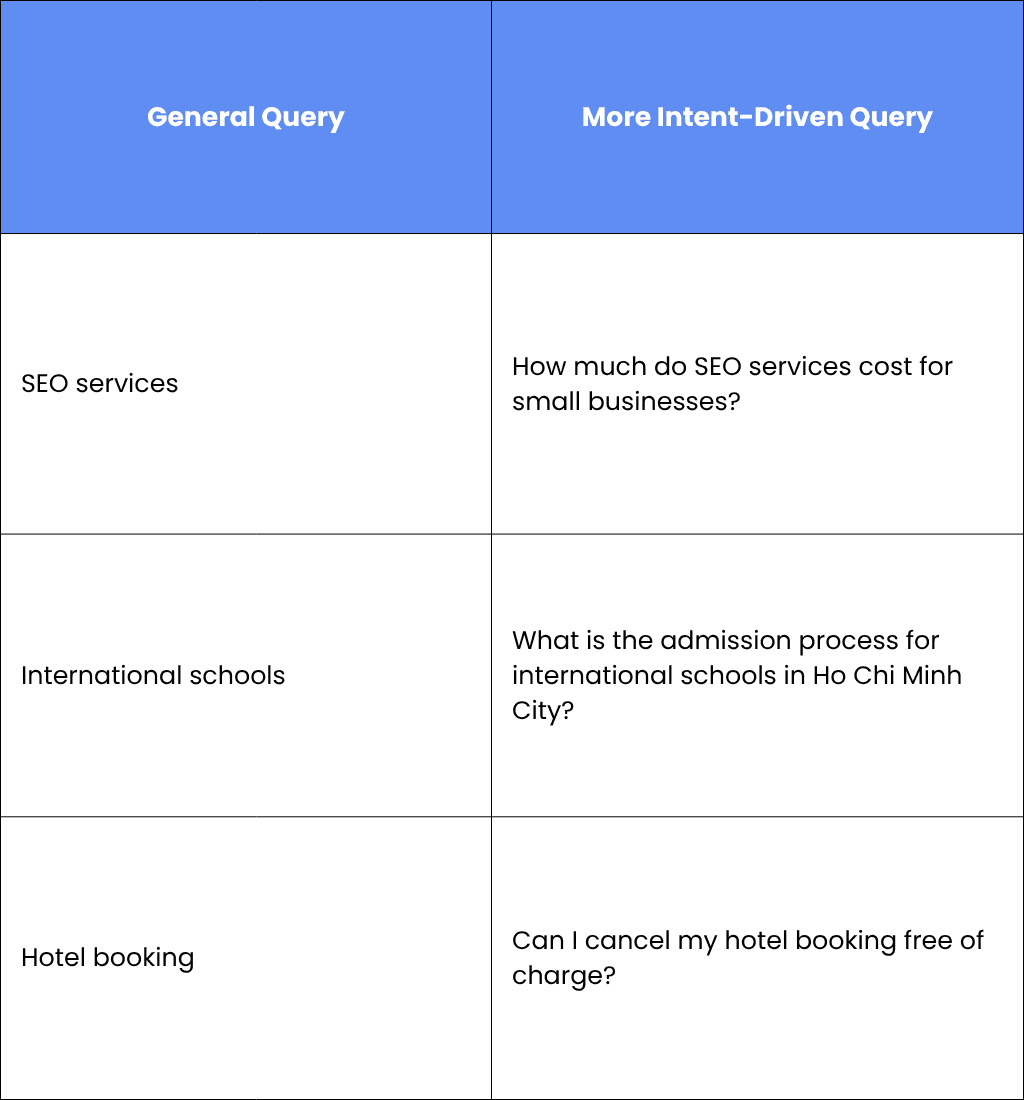
The more closely your FAQs align with actual search behaviour, the more useful they become for both users and AI systems.
Online Reviews
Customer reviews can uncover concerns that businesses may not recognise internally. Positive reviews highlight strengths worth reinforcing, while negative reviews often expose areas where clearer communication is needed.
Analyse reviews across platforms such as Google, TripAdvisor, Facebook, or industry-specific directories.
Pay attention to comments about:
- Product quality
- Delivery experiences
- Booking processes
- Customer support responsiveness
- Pricing transparency
For instance, if multiple reviewers mention confusion around cancellation policies, developing a dedicated FAQ can help set clearer expectations for future customers.
Social Media Conversations
Social media channels offer another window into customer interests and emerging trends.
Unlike formal enquiries, social media interactions are often spontaneous. Customers may ask questions in comments, direct messages, or community groups before they even visit your website.
Monitor for questions such as:
- "Do you have vegetarian options?"
- "When will this product be back in stock?"
- "Is this course suitable for beginners?"
- "Are pets allowed at your property?"
In addition to informing FAQ content, these conversations can help businesses respond proactively to changing customer expectations.
Internal Site Search Reports
If your website includes a search function, review the terms visitors enter. Internal search data provides direct insight into the information users expect to find but may struggle to locate.
For example, frequent searches for terms such as:
- "Returns policy"
- "Tuition fees"
- "Parking availability"
- "Opening hours"
may indicate that these topics deserve greater prominence within your FAQ section.
This process not only strengthens your content strategy but can also improve website usability.
Prioritise Questions Strategically
Once you have gathered questions from multiple sources, organise them based on impact.
Consider prioritising questions that:
- Influence purchase decisions
- Reduce support enquiries
- Address high-volume search intent
- Clarify policies and processes
- Resolve common objections
A simple scoring system can help.
For example, rate each question from 1 to 5 based on:
- Frequency of enquiries
- Importance to customers
- Commercial relevance
Questions receiving the highest combined scores should appear first in your FAQ strategy.
Industry Examples
Different industries naturally generate different types of customer questions. Tailoring your FAQs accordingly makes them significantly more useful.
F&B Businesses
Customers often seek practical information before visiting or placing orders.
Examples include:
- Do you cater for dietary requirements such as vegetarian or gluten-free diets?
- Can customers reserve tables online?
- Do you provide catering services for events?
- What are your delivery areas and operating hours?
Addressing these questions upfront helps improve convenience and reduce uncertainty.
Educational Institutions
Prospective students and parents frequently require detailed guidance before making decisions.
Common questions include:
- What courses or programmes are available?
- What are the admission requirements?
- Are scholarships or financial aid options offered?
- What documents are required during the application process?
Providing clear answers can support trust throughout a lengthy decision-making journey.
Retail Brands
Retail FAQs should focus on minimising friction during the purchasing process.
Examples include:
- What is your returns and exchange policy?
- How long does delivery typically take?
- Do you offer international shipping?
- How can customers track their orders?
Transparent information can improve conversion rates while reducing post-purchase enquiries.
Group Questions by Topic
Once you have identified the questions your customers are asking, the next step is to organise them into logical categories. This structure makes it easier for users to find relevant information quickly while helping search engines and AI systems understand the relationships between different topics on your website.
Rather than presenting visitors with one long, overwhelming list of questions, group related FAQs under clear headings. This improves readability, strengthens topical relevance, and creates a more intuitive browsing experience.
Why Topic Grouping Matters
People rarely arrive at your website looking for all the answers. More often, they are trying to solve a specific problem or complete a particular task.
For example, someone who is ready to purchase may have questions about payment options, whereas an existing customer may be looking for information about returns or support.
By clustering related questions together, you can:
- Help visitors find answers faster
- Reduce frustration caused by information overload
- Improve website navigation and user experience
- Strengthen topical authority for search engines
- Provide clearer context for AI-powered search systems
In other words, thoughtful organisation benefits both human readers and machines interpreting your content.
Think in Terms of Customer Intent
When deciding how to group FAQs, consider the underlying intent behind each question. Ask yourself: What is the customer trying to accomplish?
Common intent categories include:
- Learning about products or services
- Making a purchase decision
- Completing a transaction
- Understanding policies
- Accessing support after purchase
Organising content around these intentions creates a more user-centric FAQ experience.
Product Information
Questions related to products or services should be grouped together to help potential customers evaluate whether your offering meets their needs.
This section often supports visitors during the consideration stage of the buying journey.
Examples include:
- What features does this product include?
- Is this service suitable for small businesses?
- Which package would you recommend for beginners?
- Are there customisation options available?
Best practice: Start with broad questions before moving into more detailed enquiries. This mirrors the way customers naturally gather information.
Orders and Payments
Purchasing-related concerns frequently influence conversion decisions. If users cannot quickly find answers about payment methods or ordering processes, they may abandon their purchase altogether.
Bringing these questions together creates a smoother path to conversion.
Examples include:
- Which payment methods do you accept?
- Can I amend my order after it has been placed?
- Will I receive an order confirmation email?
- Is instalment payment available?
Practical tip: Review your checkout abandonment data. Questions arising during the purchasing process should be prioritised within this category.
Shipping and Delivery
For many businesses, especially in retail and F&B, delivery information plays a critical role in customer satisfaction.
A dedicated section allows visitors to access logistics-related details without searching through unrelated content.
Examples include:
- How long does delivery take?
- Which locations do you deliver to?
- How can I track my order?
- What happens if my delivery is delayed?
Providing clear expectations upfront can reduce customer enquiries and improve trust.
Policies and Procedures
Policies often contain essential information, yet they are frequently buried within lengthy legal documents. Incorporating key policy questions into your FAQ section makes this information more accessible.
Examples include:
- What is your refund policy?
- How do exchanges work?
- Can I cancel my booking?
- How is customer data protected?
Best practice: Use plain English where possible. While legal accuracy remains important, customers should not need specialist knowledge to understand your policies.
Support and Troubleshooting
Existing customers may return to your website seeking assistance after making a purchase. Grouping support-related questions separately allows them to resolve issues more efficiently.
Examples include:
- How do I contact customer support?
- What should I do if my order arrives damaged?
- How can I reset my account password?
- Where can I access user guides or tutorials?
This approach empowers customers to find solutions independently while reducing pressure on support teams.
Local Services and Location Information
Businesses with physical locations or geographically specific services should dedicate space to answering practical location-based questions.
This is particularly relevant for hospitality, education, healthcare, and local service providers.
Examples include:
- What are your opening hours?
- Is parking available on-site?
- Which areas do you serve?
- How can I get to your location?
Providing these details clearly improves convenience and supports local search visibility.
Tailor Categories to Your Industry
Although many FAQ categories are universal, each industry has its own priorities. Adapt your structure to reflect the information customers value most.
F&B Businesses
Customers often seek operational and service-related information.
Consider categories such as:
- Menu and dietary requirements
- Reservations and bookings
- Delivery services
- Catering and private events
Retail Businesses
Retail FAQs typically revolve around the buying and fulfilment process.
Common categories include:
- Product information
- Orders and payments
- Shipping and delivery
- Returns and exchanges
Educational Institutions
Prospective students and parents often require detailed guidance.
Useful categories may include:
- Courses and programmes
- Admissions and applications
- Tuition fees and scholarships
- Student support services
Hospitality Brands
Guests frequently look for practical information before booking or arriving.
Potential categories include:
- Accommodation information
- Reservations and cancellations
- Facilities and amenities
- Transportation and accessibility
Limit Category Size Where Possible
While comprehensive information is valuable, excessively large sections can overwhelm readers.
As a general guideline:
- Aim for 5–10 related questions per category.
- If a section grows significantly larger, consider dividing it into smaller subcategories.
- Prioritise the most important questions near the top of each section.
This approach keeps your FAQ content easy to navigate and encourages visitors to continue exploring.
Use Clear and Descriptive Headings
Category titles should immediately communicate what users can expect to find within them.
Avoid vague headings such as:
- General Information
- Other Questions
- Miscellaneous
Instead, opt for straightforward labels such as:
- Shipping and Delivery
- Admissions and Applications
- Returns and Refunds
- Reservations and Bookings
Clear headings improve usability while helping search engines and AI systems interpret the structure of your content more effectively.
Provide Direct Answers First
One of the most important principles in how to structure FAQ content is answering questions immediately.
Avoid lengthy introductions or unnecessary context before addressing the user's query.
For example:
Less effective: "At our company, we understand that delivery expectations vary depending on numerous factors. We continuously work with logistics partners to provide efficient service."
More effective: "Standard delivery typically takes between three and five working days within Vietnam."
After providing the direct answer, businesses can expand with additional context where appropriate.
This format improves readability and increases the likelihood that AI systems extract the correct information.
Incorporate Relevant Keywords Naturally
Keyword optimisation still matters.
However, modern search systems prioritise helpfulness over repetition.
The focused keyword should appear naturally within the article rather than being forced into every section.
Similarly, individual FAQs should incorporate relevant phrases users genuinely search for.
For example:
Instead of: "What is your return process?"
Consider: "How do I return an item purchased online?"
The second example aligns more closely with actual search behaviour.
Natural language optimisation benefits both traditional search engines and AI-powered answer systems.
Implement FAQ Schema Markup
Creating well-written FAQ content is only part of the equation. To help search engines interpret your content more effectively, businesses should also consider implementing FAQ schema markup.
What Is FAQ Schema Markup?
FAQ schema is a type of structured data based on the Schema.org vocabulary. It is added to a webpage's code to indicate that the page contains a list of questions and answers.
In simple terms, it acts as a translator between your content and search engines.
Without schema markup, search engines must infer the structure of your page. With schema markup, you provide that information directly.
For example, search engines can clearly recognise:
- This sentence is a question.
- This paragraph is the answer.
- These questions belong to an FAQ section.
The result is improved clarity, which may support stronger content understanding.
Example of FAQ Schema Markup
Below is a simple example of FAQ schema markup using JSON-LD, which is the format most commonly recommended for structured data implementation.
Suppose an educational institution has the following FAQ section on its admissions page:
Question: What documents are required for admission?
Answer: Applicants typically need to submit academic transcripts, identification documents, completed application forms, and any programme-specific requirements outlined by the institution.
The corresponding FAQ schema markup would look like this:
<script type="application/ld+json">
{
"@context": "https://schema.org",
"@type": "FAQPage",
"mainEntity": [
{
"@type": "Question",
"name": "What documents are required for admission?",
"acceptedAnswer": {
"@type": "Answer",
"text": "Applicants typically need to submit academic transcripts, identification documents, completed application forms, and any programme-specific requirements outlined by the institution."
}
}
]
}
</script>
Understanding the key elements
- @context specifies the vocabulary being used, which in this case is Schema.org.
- @type: "FAQPage" tells search engines that the page contains FAQ content.
- mainEntity lists the individual questions included on the page.
- Question identifies the FAQ question itself.
- name contains the exact wording of the visible question.
- acceptedAnswer specifies the corresponding answer.
- text contains the answer exactly as it appears on the webpage.
Why FAQ Schema Matters for AI Search Visibility
AI-powered search experiences rely on extracting and synthesising information from trusted sources. The easier it is for systems to interpret your content, the greater the likelihood that your information will be considered during this process.
FAQ schema contributes by providing:
- Clear content relationships: It explicitly links questions with their answers.
- Improved machine readability: Structured information is easier to process.
- Enhanced semantic understanding: Search engines gain a stronger understanding of the topics covered.
- Additional context signals: Schema complements your existing on-page content.
Although schema alone will not improve rankings, it supports broader efforts in SEO, Answer Engine Optimisation (AEO), and Generative Engine Optimisation (GEO).
Focus on Content Quality First
Before implementing FAQ schema, ensure that the underlying content is genuinely useful.
Schema cannot compensate for poor-quality FAQs.
Ask yourself:
- Does this question address a real customer concern?
- Is the answer accurate and complete?
- Is the language easy to understand?
- Does the information align with the rest of the website?
Only apply FAQ schema to content that provides authentic value to users.
Ensure Questions Match Visible Content
One of the most important implementation principles is consistency.
The questions and answers included within your structured data should exactly match the content displayed on the page itself.
For example, if your webpage states:
Question: How long does delivery take?
Answer: Standard delivery takes three to five working days.
Your FAQ schema should reflect the same wording and information.
Avoid:
- Adding hidden questions that users cannot see.
- Including promotional messaging disguised as FAQs.
- Marking up content that differs from what appears on the page.
Transparency supports trust and compliance with search guidelines.
Prioritise High-Value FAQ Pages
Not every page requires FAQ schema.
Instead, focus implementation efforts on pages that address meaningful customer questions or support important business objectives.
Common candidates include:
- Service pages
- Product pages
- Admissions pages
- Booking information pages
- Returns and refund pages
- Location-specific landing pages
For example, a hospitality business might add FAQ schema to pages covering cancellation policies and amenities, while an educational institution could implement it on admissions-related pages.
Prioritising strategically helps maximise the impact of your optimisation efforts.
Work with Technical Teams Carefully
Implementing schema often involves collaboration between content, SEO, and development teams.
To streamline the process:
- Finalise the FAQ content.
- Confirm that the information is accurate.
- Determine which pages warrant schema implementation.
- Add the appropriate structured data.
- Test the implementation before publishing.
Cross-functional collaboration ensures that both the technical and content aspects align effectively.
Maintain and Update Your Schema
FAQ content should evolve alongside your business, and your structured data should evolve with it.
Whenever you update an FAQ section, review the associated schema to ensure consistency.
Regular checks are especially important when changes occur to:
- Pricing structures
- Delivery timelines
- Booking policies
- Product specifications
- Admissions requirements
- Service availability
Outdated schema can create confusion for both users and search systems.
As a best practice, incorporate schema reviews into your routine content maintenance schedule.
Partner with Saigon Digital to Strengthen Your Search Visibility
At Saigon Digital, we help ambitious brands navigate the changing landscape of search and digital growth.
Our approach combines strategy, creativity, and data to deliver measurable outcomes that extend beyond rankings alone.
Our SEO services include:
- Site optimisation and technical performance improvements
- Content development and authority building
- Local and global search strategies designed for sustainable growth
As AI reshapes how users discover information, we also support businesses through specialised Generative Engine Optimisation (GEO) services, helping brands become trusted sources for platforms such as ChatGPT, Gemini, Perplexity, and Google AI.
Our GEO capabilities include:
- AI readability optimisation
- Generative Engine Optimisation (GEO)
- Answer Engine Optimisation (AEO)
- Knowledge graph and schema implementation
- AI content audits and reformatting
- AI performance dashboards
Beyond visibility, Saigon Digital enables organisations to improve efficiency through AI workflow automation services, including custom AI agents, intelligent automation solutions, and scalable productivity systems.
The future of digital growth is here. Businesses that embrace forward-thinking, user-centric strategies today will be better positioned to lead tomorrow.
Future-Proof Your Search Strategy in the Era of AI
As search continues to evolve, businesses must adapt the way they create and structure content. From traditional SEO to AI-powered search experiences, the brands that provide clear, helpful, and well-organised information will be best positioned to earn visibility and trust.
If you're exploring how to structure FAQ content more effectively, or looking to strengthen your broader search strategy, Saigon Digital can help.
Get in touch with Saigon Digital today and receive a consultation!
Frequently Asked Questions About Structuring FAQ Content for AI Search Visibility
1. Why is FAQ content important for AI search visibility?
FAQ content presents information in a clear question-and-answer format, which closely aligns with how people interact with AI-powered search platforms such as ChatGPT, Gemini, Perplexity, and Google AI. Well-structured FAQs can help AI systems interpret your content more effectively, increasing the likelihood that your brand is referenced when users seek relevant information.
2. How should I structure FAQ content for SEO and AI search?
When considering how to structure FAQ content, start by identifying genuine customer questions and organising them into logical categories. Use conversational language, provide direct answers upfront, and maintain a clear hierarchy with descriptive headings. Additionally, implementing FAQ schema markup can help search engines better understand the relationship between your questions and answers.
3. How many questions should an FAQ section include?
There is no fixed number of questions that every FAQ page should contain. Instead, focus on relevance and usefulness. As a general guideline, aim for 5 to 10 high-value questions per topic category. Prioritise questions that address common customer concerns, influence purchasing decisions, or frequently appear in support enquiries and search queries.
4. Does FAQ schema markup improve search rankings?
FAQ schema markup does not directly improve rankings. However, it provides structured signals that help search engines interpret your content more accurately. When combined with high-quality answers, strong technical SEO, and a user-focused content strategy, schema markup can support broader efforts in SEO, Answer Engine Optimisation (AEO), and Generative Engine Optimisation (GEO).
5. How often should businesses update their FAQ content?
FAQ content should be reviewed regularly to ensure that information remains accurate and relevant. Businesses should update their FAQs whenever there are changes to policies, pricing, products, services, admissions processes, or operating procedures. As a best practice, conduct a comprehensive FAQ review at least every three to six months, while also monitoring customer feedback and emerging search trends for new opportunities to address user needs.