



As AI changes the way people discover information, businesses are facing a new question alongside the traditional SEO debate: should they manage Generative Engine Optimisation (GEO) internally, or work with a specialist agency?
This guide explores the differences between a GEO agency vs in-house in detail and explains how to make the right decision for your business.
Key Takeaways
- GEO and SEO work together: GEO extends traditional SEO into AI-powered search and discovery, so strong technical, content and authority foundations still matter.
- There is no one-size-fits-all model: The choice between a GEO agency, an in-house team or a hybrid approach depends on your business goals, resources, expertise and growth plans.
- In-house offers control and business knowledge: Internal teams have a deep understanding of the brand, customers and operations, but require investment in talent, tools and ongoing training.
- Agencies provide specialist expertise and flexibility: A GEO agency can give businesses faster access to specialised skills, technology and experience without building a large internal team.
- A hybrid approach can be highly effective: Internal teams can provide industry knowledge and strategic direction while agencies contribute specialist SEO, GEO, technical and content expertise.
- Industry needs vary: F&B, retail, education and hospitality businesses face different search and AI visibility challenges, so their GEO strategies should reflect their customer journeys and business models.
- Focus on business outcomes: GEO should be measured through meaningful indicators such as visibility, relevant citations, qualified traffic, leads, bookings, enquiries and revenue rather than citations alone.
What Is GEO and Why Does It Matter?
Generative Engine Optimisation, commonly known as GEO, focuses on improving how a brand, organisation or website appears within AI-generated answers and other generative search experiences.
Traditional SEO generally focuses on helping search engines discover, understand and rank web pages for relevant searches. GEO takes this challenge further by considering how AI systems discover information, select sources, interpret content and use those sources when generating an answer.
GEO is not simply “SEO for ChatGPT”. There is no universal GEO score that guarantees a brand will be cited across every AI platform. AI systems can produce different answers for similar questions, use different information sources and change their behaviour as their underlying systems evolve.
Instead, businesses should think about GEO as a broader visibility discipline that includes:
- Making important information easy for AI systems to understand and retrieve
- Building strong topical authority and credible sources
- Structuring content around real user questions and needs
- Strengthening technical SEO and website accessibility
- Improving structured data and entity understanding
- Building a consistent brand presence across relevant sources
- Monitoring how AI platforms represent, reference and recommend the brand
- Testing and refining content based on observed performance
Google's current guidance reinforces an important principle: websites should continue to follow sound SEO fundamentals when preparing for generative AI features in Search.
In other words, GEO should not replace SEO.
It should sit alongside it.
>>> Read more: SEO vs GEO vs AEO: What’s the Difference in 2026?
GEO Agency vs In-House: What Is the Difference?
At a high level, the choice comes down to building capability internally or accessing specialist capability externally.
An in-house GEO team becomes part of your organisation. Your employees develop a deep understanding of your products, customers, systems, content and business objectives.
A GEO agency, by contrast, brings external specialists into the equation. The agency typically provides strategic planning, technical expertise, research, content optimisation, experimentation and performance monitoring across multiple clients and industries.
Neither model is automatically better.
The right question is: Which approach gives your business the right combination of expertise, speed, control, cost efficiency and long-term capability?
That answer can differ significantly between a growing restaurant group and an international hotel brand, or between a private education provider and a multi-location retailer.
GEO Agency vs In-House: A Complete Comparison
The simplest way to approach the decision is to compare the two models across the areas that matter most.
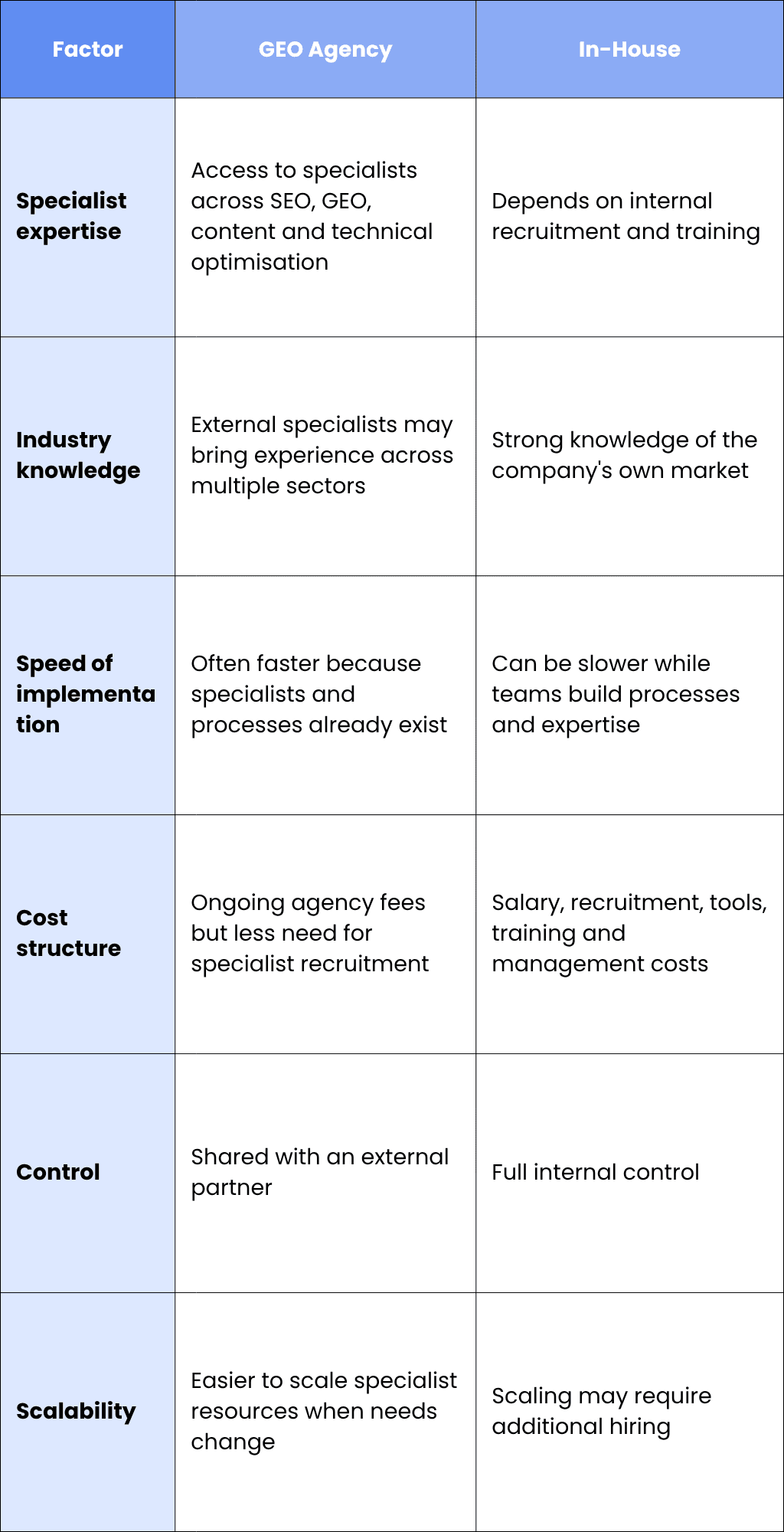
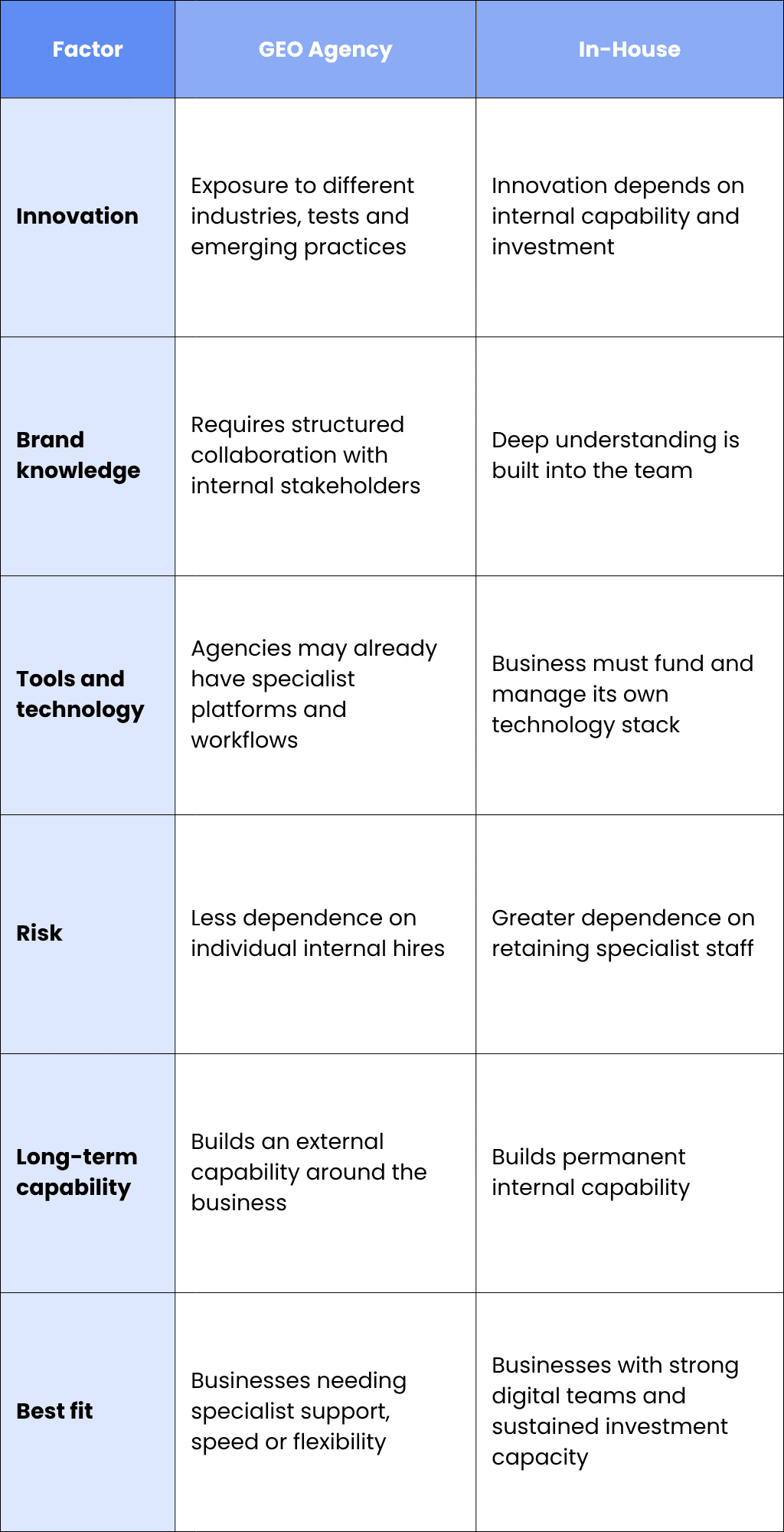
The table gives a useful overview, but the real decision requires a closer look at each factor.
1. Expertise: Who Actually Understands GEO?
One of the biggest challenges with GEO is that it sits across several disciplines.
It involves SEO, entity-first content strategy, technical optimisation, information architecture, brand authority, structured data, digital PR, analytics and AI-specific experimentation.
That creates a challenge for businesses building a GEO capability from scratch.
Recruiting one person who understands every aspect of this work can be difficult. More often, businesses need several specialists across different areas.
An in-house team might eventually include:
- SEO specialists
- Content strategists and writers
- Technical SEO professionals
- Digital PR or authority-building specialists
- Data and analytics professionals
- Developers
- AI or automation specialists
For larger organisations, this can be worthwhile.
For smaller businesses, however, building that team may require a significant investment in recruitment, salaries, software, training and management.
A specialist GEO agency can give businesses access to a broader combination of skills without requiring every capability to sit on the payroll.
This can be particularly valuable for companies that already have strong marketing teams but lack dedicated GEO expertise.
The Advantage of an In-House Team
An internal team develops intimate knowledge of the company.
They understand the brand's positioning, products, customers, internal processes and commercial goals. That context can make it easier to identify useful content opportunities and respond quickly to changes within the organisation.
For example, an education company launching a new course can immediately connect its SEO and GEO strategy with admissions, student concerns, course content and internal subject experts.
That institutional knowledge has real value.
The Advantage of an Agency
An agency can provide exposure to a much broader range of challenges.
Instead of learning only from one website, specialist teams often work across multiple clients, sectors and technical environments. This can expose them to different search behaviours, content structures, technical problems and optimisation opportunities.
For businesses entering GEO for the first time, that outside perspective can shorten the learning curve.
2. Cost: Is In-House GEO Actually Cheaper?
It is easy to assume that an in-house team costs less because there is no agency retainer. However, the real cost of GEO includes much more than salaries. Businesses also need to account for recruitment, benefits, specialist software, training, management time and the cost of maintaining multiple skill sets.
For example, imagine a business needs one SEO specialist, one content specialist and part-time technical support to establish a basic GEO capability:
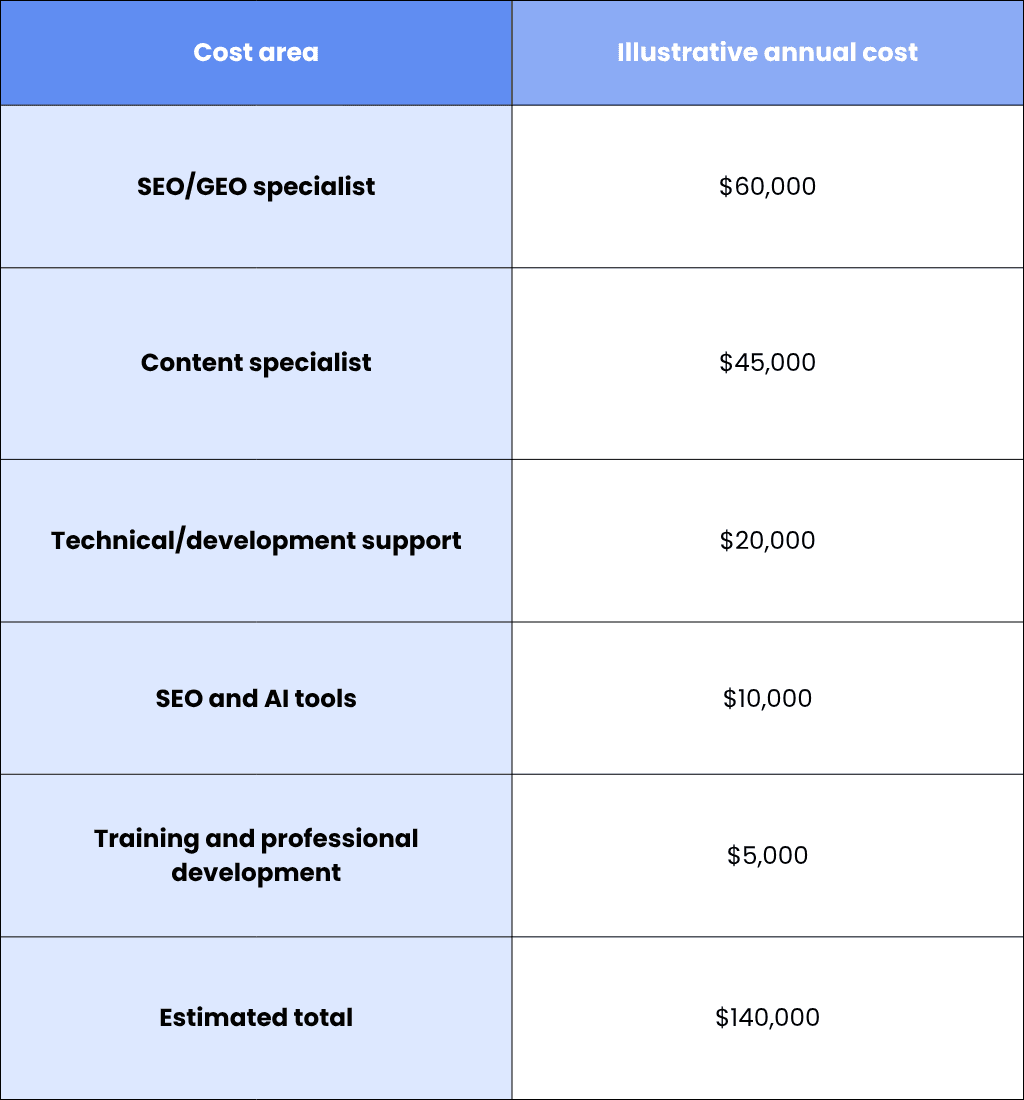
These figures are illustrative rather than a market benchmark, but they show why the comparison should not simply be agency fee vs salary.
An agency may provide access to several specialists through one engagement, which can reduce the need for permanent headcount. This can be particularly useful for businesses that are still testing GEO, have limited internal resources or need specialist expertise for specific projects rather than every day.
At the same time, in-house can become more cost-effective for larger businesses with substantial and continuous GEO requirements. Therefore, the better question is not “Which option is cheaper?” but “Which model gives us the capabilities we need at an appropriate total cost?”
3. Speed: How Quickly Can You Adapt?
Speed matters because GEO sits within a rapidly changing search environment. Businesses need to monitor how AI-powered search experiences evolve, test what works and update their strategy rather than treating GEO as a one-off optimisation project.
An agency can often move faster at the beginning because it already has specialists, processes, tools and reporting frameworks in place. Instead of spending months hiring and training, a business can begin with an existing team and focus immediately on priorities such as technical improvements, content optimisation, structured data for AI search and AI visibility monitoring.
For example, a hotel group launching a new property may need its website, location pages, destination content and structured information optimised before launch. An agency with an established SEO and GEO workflow can often bring these resources together quickly, whereas an internal team may first need to determine who owns each task.
However, speed does not always favour agencies. Once an experienced in-house team has established its processes, it can respond extremely quickly because it works directly with product, marketing, development and leadership teams.
The key difference is often the starting point: agencies can provide immediate specialist capacity, while in-house teams can become faster once the capability is fully established.
4. Control: Does Your Business Need Everything In-House?
Control is one of the strongest arguments for building GEO capability internally. An in-house team has direct access to company data, internal stakeholders, product teams and decision-makers, which can make it easier to manage priorities and protect brand consistency.
This can be particularly important for businesses with sensitive information or complex approval processes. For example, an education provider may need its content to reflect precise course requirements, accreditation details and admissions policies. Having specialists inside the organisation can make those checks easier.
However, working with an agency does not necessarily mean giving up control. A well-managed agency relationship should keep strategic ownership with the business while the agency provides specialist execution and advice.
A practical division could look like this:
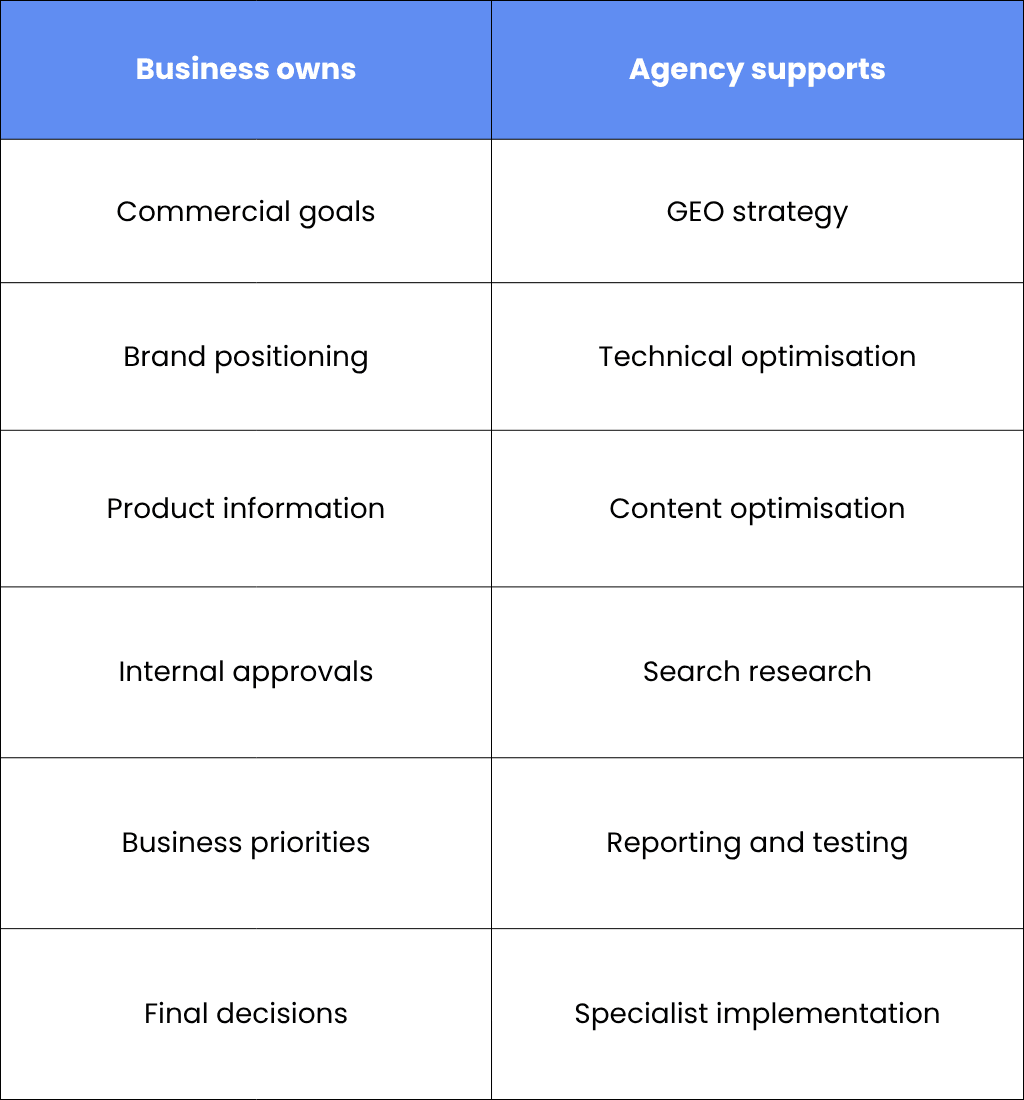
This approach gives the business control over what it wants to achieve while the agency helps determine how to achieve it efficiently.
5. Industry Knowledge: In-House Has a Natural Advantage
In-house teams naturally understand the business in a way an external partner cannot replicate immediately. They know the products, customers, operational constraints, competitive environment and internal terminology. That context can be particularly valuable when GEO depends on detailed, specialist information.
For example, a restaurant group knows which dishes are most popular, which locations cater to families and which venues suit corporate events. A retailer understands its product range and seasonal priorities. An education provider knows which questions prospective students ask before applying.
However, industry knowledge alone does not guarantee strong GEO performance. The challenge is turning that knowledge into information that search engines and AI systems can easily understand, retrieve and connect with relevant user questions.
This is where an agency can complement the internal team.
A useful model is simple:
Internal team = subject-matter expertiseAgency = search, GEO and technical expertise
Rather than asking an agency to replace internal knowledge, businesses can use it to structure and optimise that knowledge more effectively.
6. Scale: What Happens When Your Requirements Grow?
GEO requirements can become significantly more complex as a business grows. A company with one website and one market may manage its needs with a small internal team, but expansion can quickly introduce additional technical, content and localisation requirements.
For instance, a hospitality group that grows from one property to 15 properties may suddenly need location-specific content, local search optimisation, international SEO, multilingual content, technical support, AI visibility tracking and more.
An agency can usually scale resources around these changing requirements without requiring the client to hire every specialist permanently. In-house teams can also scale, but expansion normally means additional recruitment, onboarding and management.
A simple example illustrates the difference:
Business needs today: 1 SEO specialist + occasional technical support
Business needs after expansion: 1 SEO lead + 2 content specialists + technical SEO + developer support + analytics + GEO specialist
With an in-house model, the business may need to create several new roles. With an agency, it may be possible to expand the scope of an existing partnership.
Therefore, businesses should consider not only their current requirements but also their expected growth over the next two to three years.
7. Innovation: Who Is Testing What Comes Next?
GEO is still developing, which means businesses need to test rather than assume that one optimisation method will work indefinitely. What performs well today may need to change as AI platforms, search interfaces and user behaviour evolve.
This creates an interesting advantage for agencies because specialist teams typically work across multiple clients and projects. They can see different technical challenges, content approaches and search behaviours rather than learning from one website alone.
For example, an agency working with F&B, retail and hospitality businesses may identify a content or structured-data opportunity from one sector that can inspire a useful test in another.
In-house teams have a different advantage: they can experiment deeply within the context of their own business. They can work closely with product, sales and customer-service teams and quickly connect GEO insights with real customer questions.
The strongest approach is therefore not simply “agency = innovation” or “in-house = innovation”.
It is continuous testing + strong business context + reliable measurement.
Businesses should look for a partner or internal team that can answer three practical questions:
- What are we testing?
- Why are we testing it?
- What business outcome will tell us whether it worked?
That mindset is more valuable than following GEO trends for their own sake.
GEO Agency vs In-House for Different Types of Businesses
The right GEO model can look very different depending on the industry, business size and customer journey.
Rather than choosing between an agency and an in-house team based only on company size, businesses should consider how complex their search presence is, how much specialist expertise they need and how closely GEO connects to revenue.
F&B Businesses
For restaurants, cafés and F&B groups, discovery is often highly local and intent-driven. Customers may ask where to eat, which restaurant is suitable for a particular occasion, what dishes are available or which venue is near a specific location. As a result, GEO needs to work alongside local SEO, accurate business information, reviews, menus and location-specific content.
For a small independent restaurant, hiring a dedicated GEO specialist may not be practical. A better option could be an internal marketing manager supported by an agency that handles technical SEO, local search, content and AI visibility. This gives the business specialist support without adding another full-time role.
Larger F&B groups have more complex requirements. A brand operating 20 locations, for example, may need location pages, structured data, menu information, reputation management, content production and consistent brand signals across multiple markets. In this case, an internal team can provide valuable operational and brand knowledge, while an agency adds specialist SEO and GEO expertise.
A practical model for F&B:
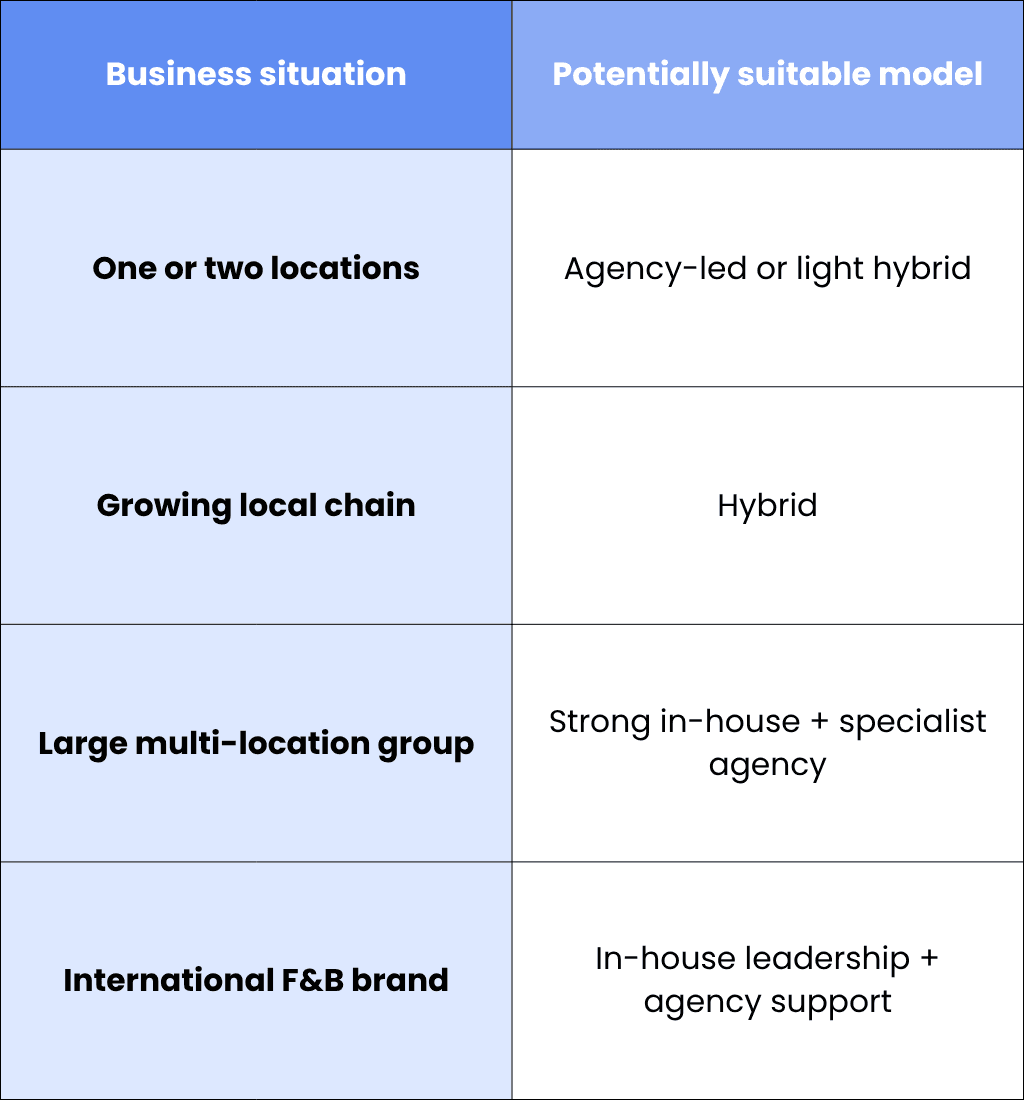
The key is to make the business easy to understand and discover when customers use both traditional search and AI-powered recommendations.
Retail Businesses
Retail businesses often face a more technical GEO challenge because they may have hundreds or thousands of products, categories and brand pages. Visibility depends not only on content but also on website architecture, product information, internal linking, structured data, technical performance and product availability.
For example, an electronics retailer may need to appear when customers ask questions such as which laptop is suitable for students or how two products compare. A fashion retailer may need useful content around categories, styles, occasions and product attributes. In both cases, simply publishing more content will not necessarily improve visibility if the underlying product information is unclear or poorly structured.
Large retailers can benefit significantly from an in-house SEO capability because search is closely connected to ecommerce, merchandising, product and technology teams. However, external specialists can provide valuable support when the business needs technical audits, large-scale content optimisation, structured data implementation or emerging GEO expertise.
For retailers, consider this balance:
- In-house: product knowledge, merchandising priorities, customer data and commercial decisions
- Agency: technical SEO, GEO strategy, content systems, authority building and specialist analysis
- Shared: website improvements, content priorities, measurement and experimentation
For smaller retailers, outsourcing more of the specialist work may be more efficient. For larger ecommerce organisations, a hybrid model can provide both internal ownership and access to specialist expertise.
>>> Read more: AI Search Visibility for E-Commerce: How to Get Your Products Cited
Education Businesses
Education is a particularly important area for GEO because prospective students and parents often conduct extensive research before making a decision. They may ask AI platforms about courses, qualifications, institutions, entry requirements, career pathways, fees, locations and the differences between educational options.
This makes accuracy, expertise and trust especially important.
An education provider's internal team has a major advantage because academics, admissions teams and subject specialists possess information that an external agency cannot generate on its own. Their expertise can help answer the detailed questions prospective students actually have.
However, that expertise needs to be presented in a way that users and search systems can understand easily. An agency can support this process by identifying search opportunities, structuring content, improving technical foundations, strengthening authority and evaluating how the organisation appears across search and AI experiences.
For example, a university may have an excellent computer science programme but limited visibility for questions around career outcomes or course comparisons. An internal subject expert can provide the authoritative information, while a specialist team can help turn that knowledge into useful, discoverable content.
Education businesses often benefit from a hybrid approach:
Subject experts provide the knowledge.Digital specialists make that knowledge discoverable and understandable.
This combination can be particularly effective where trust and accuracy directly influence enrolment decisions.
Hospitality Businesses
Hospitality brands operate in a highly competitive discovery environment, where customers may research destinations, hotels, restaurants, facilities, experiences and local attractions before making a booking. Importantly, this research can happen across many stages of the customer journey, from broad destination questions to highly specific booking-related searches.
For example, a traveller might begin with “Where should I stay in Bangkok for a family holiday?” and later ask more specific questions about hotel facilities, nearby attractions, airport access or restaurants. This creates opportunities for hotels and hospitality brands to provide useful information throughout the journey rather than focusing only on transactional booking pages.
An individual hotel can often benefit from external specialist support because its internal marketing team may already be managing campaigns, partnerships, social media, bookings and guest communications. An agency can provide additional capacity for technical SEO, local visibility, content strategy and GEO monitoring.
Larger hotel groups may need more sophisticated coordination. Multiple properties, destinations, languages and websites can create a complex search environment, making a hybrid model particularly attractive.
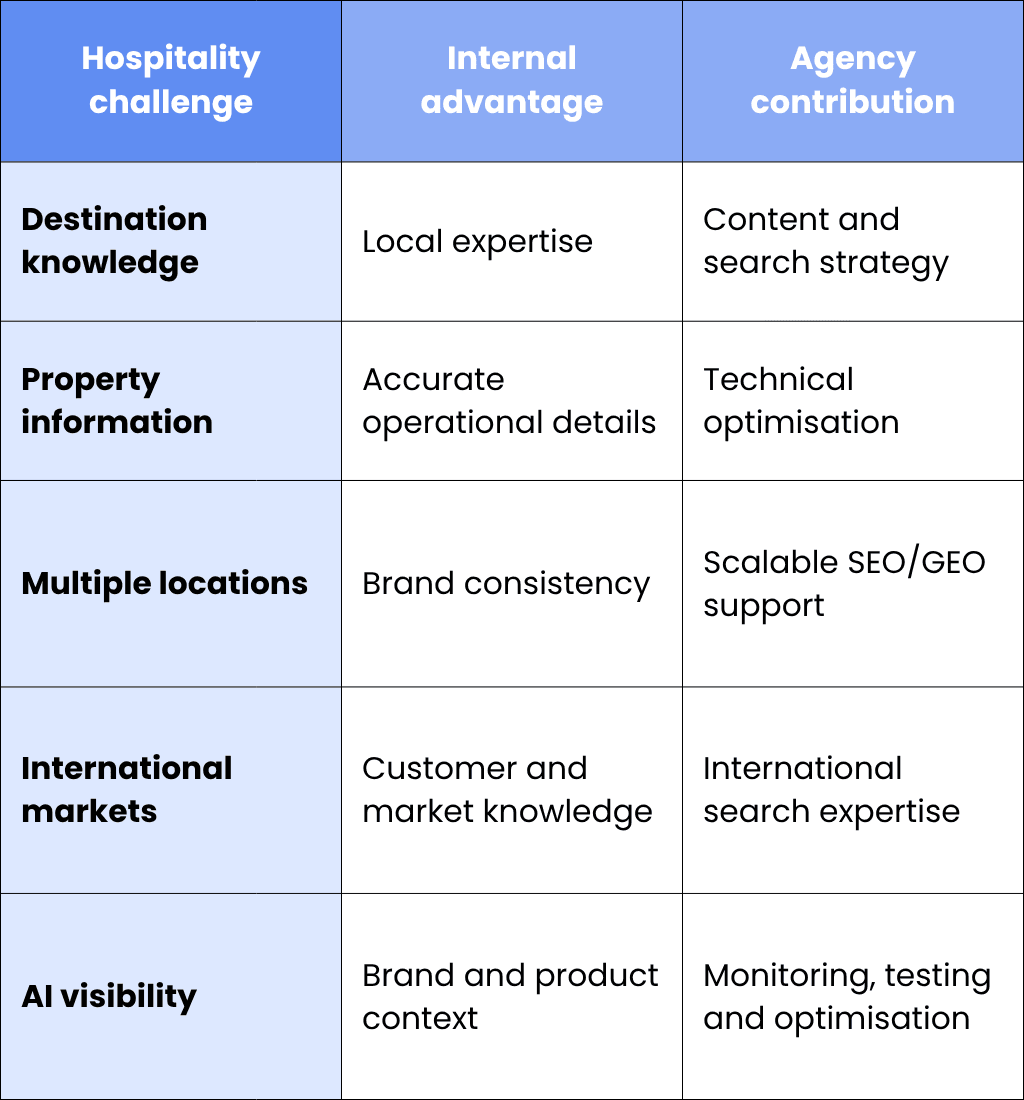
Ultimately, hospitality businesses should focus on becoming a useful source of information throughout the customer's planning journey. The objective is not simply to appear when someone searches for a hotel, but to become a credible source that helps travellers make decisions.
When Should You Choose an In-House GEO Team?
Building GEO capability internally may make sense when several of the following are true.
You Already Have a Strong Digital Team
If your business already employs SEO, content, development, analytics and digital marketing specialists, adding GEO capabilities may be a natural next step.
The foundational knowledge already exists.
GEO is Strategically Important to Your Business
If organic search and AI discovery generate a significant proportion of your leads, bookings or revenue, investing in permanent capability may make commercial sense.
You Need Deep Internal Knowledge
Businesses with highly specialised products or complex regulatory requirements may benefit from having GEO expertise embedded directly within the organisation.
You Can Sustain the Investment
GEO is not simply a campaign.
It requires ongoing monitoring, research, content development, technical improvements and experimentation.
The business needs enough resources to support this over time.
You Want to Develop Long-Term Internal Capability
Some organisations deliberately build internal expertise because they see search and AI visibility as a permanent strategic function.
That can be a strong investment when the organisation has the scale to support it.
When Should You Work With a GEO Agency?
A GEO agency may be the better choice when your business needs specialist expertise without building a large internal team.
You Are New to GEO
Starting from scratch can involve a steep learning curve.
An experienced specialist can help establish a practical strategy, identify priorities and avoid unnecessary experimentation.
Your Internal Team is Already Stretched
Marketing teams often have more priorities than resources.
Adding GEO to an already overloaded SEO or content team may reduce effectiveness elsewhere.
External support can provide additional capacity without requiring permanent recruitment.
You Need Specialist Technical Expertise
Some GEO and SEO projects require close collaboration between content, developers, technical SEO specialists and data teams.
An agency can bring these capabilities together.
You Operate Across Several Markets
International and multi-location brands often have complex search requirements.
An agency can provide additional strategic and operational support as the programme expands.
You Need to Move Quickly
When AI search represents a new commercial opportunity, speed can matter.
Working with specialists can help businesses start testing and learning sooner.
The Third Option: GEO Agency + In-House
The agency-versus-in-house debate assumes that businesses must choose one.
They do not.
In many cases, a hybrid model can be the strongest option.
The internal team retains ownership of:
- Brand strategy
- Business priorities
- Customer knowledge
- Product knowledge
- Internal stakeholders
- Commercial objectives
The agency supports:
- GEO strategy
- Technical SEO
- AI search research
- Content optimisation
- Authority building
- Structured data
- Measurement
- Testing
- Specialist implementation
This creates a useful division of responsibilities.
The business does not have to outsource its knowledge.
The agency does not have to replace the internal team.
Instead, both sides contribute what they do best.
For many mid-sized and growing businesses, this can offer a strong balance between control and specialist expertise.
So, Which Is Right: GEO Agency vs In-House?
There is no universal winner.
Choose in-house when your business already has strong digital capabilities, can invest in specialist talent and sees SEO and GEO as a core long-term function.
Choose an agency when you need specialist knowledge, faster implementation, flexible resources or access to expertise that would be expensive to build internally.
Choose a hybrid model when you want to retain strategic control and deep business knowledge while bringing in external specialists for the areas where your internal team needs additional capability.
For many growing companies, the hybrid approach can offer the best balance.
Your internal team understands the business.
Your agency understands the search and AI environment.
Together, they can build a strategy around both.
Why Saigon Digital Can Help
At Saigon Digital, we believe digital growth should be built around the needs of the business, not around isolated marketing tactics.
Our approach connects SEO, AI-powered discovery, content, technology and measurable business outcomes.
As an SEO agency focused on solving digital challenges with forward-thinking, user-centric and bespoke solutions, we help ambitious brands build the visibility and digital foundations they need to grow.
SEO Services
Our SEO services go beyond chasing rankings.
We focus on driving qualified traffic, leads and measurable outcomes through:
- Site Optimisation & Technical Performance
- Content & Authority Building
- Local & Global Search Strategy
This gives businesses a strong SEO foundation that supports both traditional search visibility and the evolving requirements of AI-powered search.
Generative Engine Optimisation
AI platforms such as ChatGPT, Gemini and Google's AI search experiences are changing how people discover information.
Our Generative Engine Optimisation service helps brands improve how their information can be discovered, understood and trusted within these emerging environments.
Our GEO offering includes:
- AI Readability Optimisation
- Generative Engine Optimisation (GEO)
- Answer Engine Optimisation (AEO)
- Knowledge Graph & Schema Setup
- AI Content Audit & Reformatting
- AI Performance Dashboard
The goal is not simply to make content visible.
It is to help your business become a credible source of information that AI systems can understand and users can trust.
AI Workflow Automation Services
Visibility is only one part of digital growth.
We also help ambitious businesses use AI to streamline internal processes, reduce repetitive work and improve productivity through:
- AI-driven intelligence
- Pre-built automation templates
- Custom AI Agents
For businesses exploring the next stage of digital transformation, this creates an opportunity to connect search, content and AI with broader business operations.
Ready to Build Your GEO Strategy?
Whether you build your GEO capabilities in-house, work with an agency or combine both, the priority is the same: make your brand easier to discover, understand and trust across search and AI-powered experiences.
For businesses in F&B, retail, education, hospitality and beyond, Saigon Digital brings SEO and Generative Engine Optimisation together to turn digital visibility into measurable growth.
Ready to strengthen your search and AI visibility?
Talk to Saigon Digital today and start building a smarter digital growth strategy.
Frequently Asked Questions About GEO Agency vs In-House
1. Is GEO the same as SEO?
No. GEO focuses on visibility within generative and AI-powered search experiences, while SEO focuses more broadly on improving a website's discoverability, relevance and performance in search engines. However, the two disciplines overlap significantly, and Google states that established SEO best practices remain relevant to AI search features.
2. Can an SEO agency also handle GEO?
Yes, provided the agency has the appropriate expertise. Because technical SEO, content, authority, structured information and AI visibility are closely connected, an SEO agency with genuine GEO capabilities can often support both areas as part of a broader search strategy.
3. Is in-house GEO better for large companies?
Not necessarily. Large organisations may have the resources to build sophisticated internal teams, but they can still benefit from agencies for specialist skills, independent strategy, experimentation or additional capacity.
4. How much does GEO cost?
There is no single standard cost because GEO requirements vary significantly. A small business may need strategic guidance and targeted optimisation, while a large organisation may require technical SEO, content production, authority building, AI monitoring, analytics and ongoing experimentation.
The most useful way to evaluate cost is against the scope of work, internal capability and expected commercial outcomes rather than comparing a simple agency fee with an employee salary.
5. Can a GEO agency guarantee AI citations?
No responsible provider should guarantee permanent citations or recommendations from a specific AI platform. Generative search systems are dynamic, and research into GEO continues to identify variability in how systems retrieve, select and use sources.
6. Does every business need GEO?
Not every business needs a large dedicated GEO programme today. However, businesses that depend heavily on online discovery should at least understand how AI search is changing customer behaviour and consider whether their existing SEO and content strategy is ready for that shift.
7. Should we start with SEO or GEO?
In most cases, start with strong SEO and build GEO capabilities alongside it. A technically sound website, useful content, clear information architecture and credible authority remain important foundations for visibility across search environments.