



As search evolves, businesses can no longer rely solely on traditional keyword optimisation to improve visibility online. Search engines and AI-powered answer platforms have become increasingly sophisticated in understanding the relationships between concepts, brands, places, products, and people. In this new environment, organisations need a more strategic approach to content creation.
This is where an entity-first content strategy becomes essential.
In this guide, we explore what an entity-first content strategy is, why it matters in the age of AI search, and how businesses can implement it effectively.
What Is an Entity-First Content Strategy?
An entity-first content strategy is a method of planning, creating, and structuring content around entities and their relationships rather than focusing exclusively on keywords.
In search, an entity refers to something that is distinct, identifiable, and understandable by machines. Examples include:
- A business or organisation
- A product or service
- A location
- An industry concept
- A person
- An event
- A brand
For example, a hospitality business is not simply targeting keywords such as "luxury hotel in Ho Chi Minh City". Instead, it is building content that establishes relationships between its hotel brand, accommodation offerings, nearby attractions, customer experiences, dining concepts, and broader hospitality expertise.
This approach aligns more closely with how modern search engines interpret information.
Why Traditional Keyword Strategies Are No Longer Enough
Keywords remain important. However, relying exclusively on keyword density or targeting isolated search phrases is increasingly ineffective.
Search engines have evolved from matching strings of text to understanding meaning.
Platforms such as Google use advanced natural language processing and knowledge graphs to identify:
- What a page is about
- Which entities are discussed
- How those entities relate to one another
- Whether the source demonstrates expertise and trustworthiness
Similarly, AI search engines such as ChatGPT, Gemini, and Perplexity synthesise information from multiple sources to generate answers. They favour content that is:
- Well-structured
- Contextually rich
- Consistent across multiple touchpoints
- Demonstrably authoritative
Businesses that fail to build semantic depth around their expertise risk becoming invisible within these new search environments.
The Connection Between Entities and Topical Authority
Topical authority refers to the level of expertise and comprehensiveness a website demonstrates within a specific subject area.
Search engines increasingly reward websites that cover a topic extensively rather than superficially because it shows that the business truly understands the niche they’re operating in.
An entity-first content strategy supports topical authority by helping businesses:
- Address all relevant subtopics within a subject area
- Establish relationships between concepts
- Provide context that enhances understanding
- Demonstrate expertise consistently over time
For example, an education provider specialising in international schools could build authority around entities such as:
- International curricula
- Student wellbeing
- Language programmes
- University preparation
- Admissions processes
- Teacher qualifications
- Parent resources
Each piece of content reinforces the broader entity ecosystem, strengthening the institution's perceived expertise.
Why Entity-First Content Matters for AI Search
AI-powered search experiences are fundamentally changing how people discover information online.
Instead of clicking through multiple search results to compare different sources, users are increasingly receiving direct answers generated by AI search engines such as ChatGPT, Gemini, Perplexity, and Google's AI experiences. As a result, businesses need to think beyond traditional rankings and consider how their content is interpreted, trusted, and referenced by these systems.
This shift presents both opportunities and challenges. While it may reduce the visibility of websites that rely solely on conventional SEO tactics, it also creates an opportunity for organisations that consistently demonstrate expertise and authority within their field.
To succeed in this environment, businesses must optimise not only for search engines but also for AI systems that prioritise clarity, context, and credibility. In practice, this means creating content that exhibits the following characteristics:
1. Clear Subject Matter Expertise
AI search platforms aim to provide users with accurate and reliable information. Consequently, they are more likely to surface content from sources that demonstrate genuine expertise rather than offering broad, surface-level commentary.
For businesses, this means going beyond introductory content and sharing insights that reflect real-world experience, industry knowledge, and practical value. For example, a hospitality brand might publish detailed guidance on guest experience trends, while an education provider could explore curriculum developments and student support strategies.
Furthermore, consistently producing high-quality content within your area of expertise helps reinforce your authority over time. The more evidence search systems have that your organisation understands a particular subject, the more likely they are to associate your brand with that topic.
2. Strong Contextual Relationships
In an entity-first content strategy, individual pieces of content should not exist in isolation. Instead, they should work together to build a broader understanding of the topics your business specialises in.
AI systems assess how concepts, services, and topics relate to one another. Therefore, establishing clear contextual relationships through supporting articles, topic clusters, and strategic internal linking can strengthen your overall authority.
For instance, a retail brand discussing customer loyalty programmes could also connect that topic to content about omnichannel experiences, personalisation strategies, and consumer behaviour trends. By doing so, the business demonstrates a more comprehensive understanding of the retail landscape rather than expertise in only a single area.
As a result, both users and AI systems gain a clearer picture of your brand's depth of knowledge.
3. Consistency Across Channels
Trust is built through consistency, and AI search is no exception.
Search engines and AI platforms often evaluate information from multiple sources to determine whether a business is credible. If your organisation presents conflicting information across its website, business profiles, social channels, and external mentions, it may weaken the confidence these systems have in your brand.
Therefore, businesses should ensure that key details remain aligned across all digital touchpoints. This includes maintaining consistency in areas such as:
- Business names and descriptions
- Products and service offerings
- Contact information and locations
- Brand messaging and positioning
- Leadership and organisational information
In addition, regular reviews of external listings and directory profiles can help identify outdated or inaccurate information before it affects your online visibility.
4. Structured Data Signals
While high-quality content is essential, businesses should also help search systems understand that content more efficiently.
Structured data, often implemented through schema markup, provides explicit signals about the entities featured on a webpage and the relationships between them. In other words, it translates information into a format that machines can interpret with greater accuracy.
For example, schema can clarify whether a page refers to an organisation, an event, a product, a local business, or an educational institution. It can also highlight important details such as reviews, opening hours, frequently asked questions, or authorship information.
Although structured data does not guarantee improved rankings or AI citations, it supports discoverability by reducing ambiguity and strengthening entity recognition. Consequently, it forms an important component of an effective entity-first content strategy.
How to Develop an Entity-First Content Strategy
While the concept of an entity-first approach may sound complex, implementing it can be surprisingly practical. The key is to move away from thinking in terms of isolated keywords and begin viewing your content as part of a connected ecosystem of knowledge.
The following framework can help businesses develop an entity first content strategy that supports both topical authority and visibility across traditional and AI-powered search experiences.
1. Identify Your Core Business Entities
The first step is to define the entities that sit at the centre of your organisation's expertise. These are the subjects, products, services, locations, and concepts that your business wants to be known for.
Rather than starting with keyword tools, begin by asking a more strategic question: "If our ideal customer described our business in five years' time, what topics would we want them to associate us with?"
Your answers will reveal the entities that should shape your content strategy.
For many businesses, core entities may include:
- Products and services
- Industry specialisations
- Geographic locations served
- Brand values and differentiators
- Customer challenges you solve
- Subject matter experts within the organisation
- Proprietary methodologies or frameworks
For example:
Hospitality business
Core entities could include:
- Luxury accommodation
- Sustainable tourism
- Family-friendly experiences
- Destination expertise
- Corporate event hosting
Education provider
Core entities could include:
- International curricula
- Student wellbeing
- University preparation
- Language learning
- Early childhood development
Retail brand
Core entities could include:
- Omnichannel shopping
- Customer loyalty programmes
- Ethical sourcing
- Personalised experiences
- Product expertise
At this stage, avoid creating an exhaustive list. Instead, prioritise the entities most closely aligned with your commercial objectives and areas of genuine expertise.
A useful exercise is to limit yourself to five to ten primary entities. These will form the foundation of your broader content ecosystem.
2. Map Supporting Topics and Relationships
Once your core entities have been identified, the next step is to uncover the topics connected to them.
This process involves thinking beyond what your business offers and considering what your audience needs to know throughout their decision-making journey.
Ask questions such as:
- What questions do prospective customers frequently ask?
- What misconceptions exist within our industry?
- What information helps customers make informed decisions?
- Which topics naturally relate to our products or services?
- What concerns arise before, during, and after purchase?
The objective is to identify the relationships between entities.
For example, if one of your core entities is sustainable sourcing within the F&B industry, related topics might include:
- Supplier transparency
- Seasonal ingredients
- Food traceability
- Ethical procurement practices
- Environmental certifications
- Consumer demand for sustainability
Together, these supporting topics create a more complete picture of your expertise.
One practical approach is to create a simple entity map.
For example:
Core Entity: Sustainable Sourcing
↓
Supporting Topics:
- Ingredient traceability
- Local supplier partnerships
- Food waste reduction
- Consumer education
- Sustainable menu development
↓
Customer Outcomes:
- Increased trust
- Improved brand reputation
- Better purchasing confidence
This exercise helps ensure that future content serves a strategic purpose rather than being produced reactively.
3. Build Content Clusters Around Entity Themes
With your entities and supporting topics defined, you can begin creating structured content clusters.
A content cluster consists of a comprehensive pillar page supported by several related pieces of content. Together, they demonstrate breadth and depth of expertise.
This approach is particularly valuable because AI systems increasingly favour sources that provide comprehensive coverage of a topic.
A simplified structure might look like this:
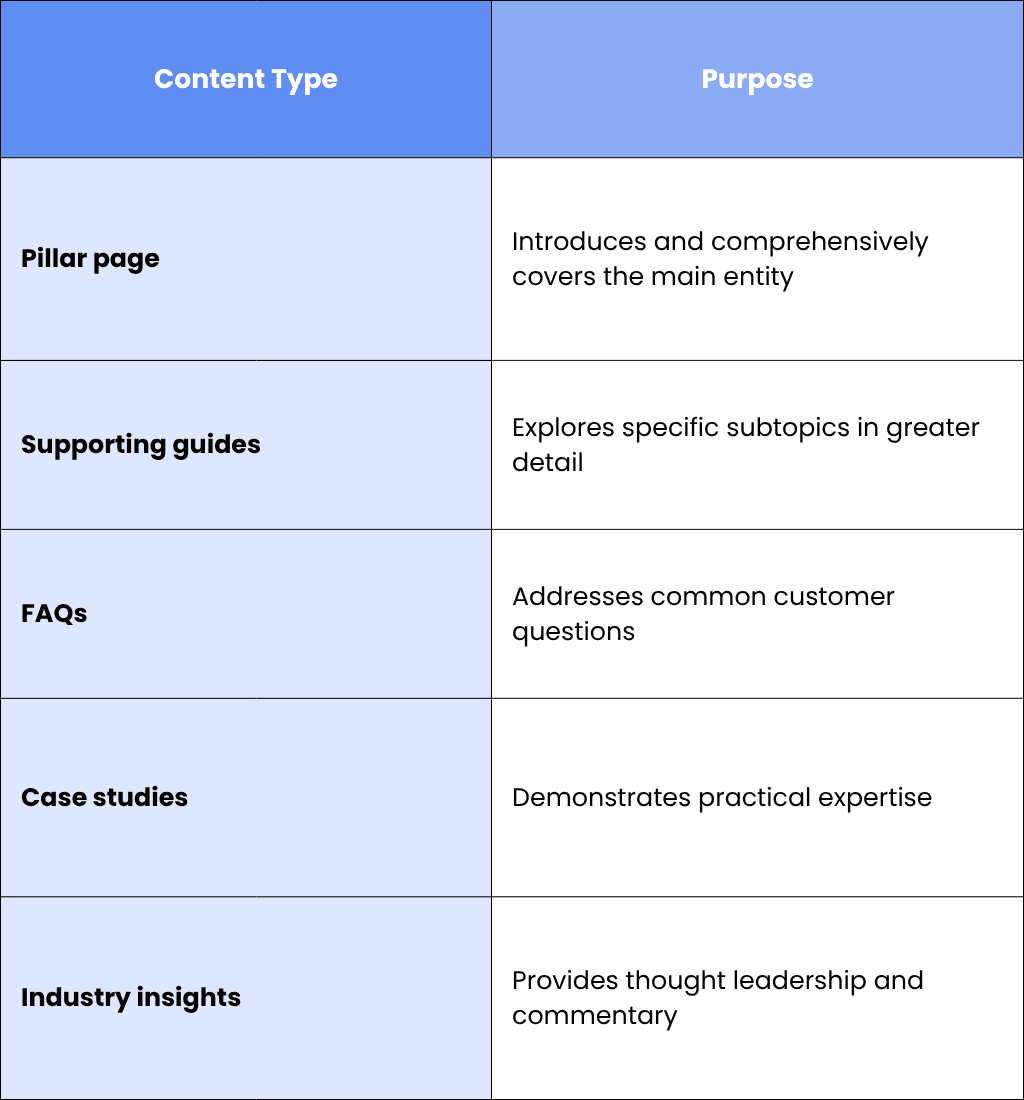
For example, an education institution targeting the entity student wellbeing could develop the following cluster:
Pillar Content
- The Complete Guide to Supporting Student Wellbeing
Supporting Articles
- Signs of Emotional Stress in Students
- How Schools Can Foster Resilience
- The Role of Parent-School Communication
- Effective Wellbeing Programmes in Education
- Measuring Student Engagement and Belonging
Through this structure, each supporting article strengthens the authority of the pillar page, while the pillar page provides context for the broader topic.
Rather than publishing twenty unrelated articles, businesses create a cohesive body of knowledge that search engines and AI systems can interpret more effectively.
4. Use Internal Linking Strategically
Internal linking is often overlooked, yet it plays a critical role in an entity-first content strategy.
Every internal link acts as a signal that helps search engines understand how topics relate to one another. Consequently, strategic linking reinforces topical authority and improves content discoverability.
However, effective internal linking requires intentionality.
When reviewing content, consider:
- Does this page support a broader entity theme?
- Are there relevant pillar pages that should receive additional authority?
- Would readers benefit from exploring a related topic next?
For example, an article discussing hotel sustainability initiatives could naturally link to content covering:
- Sustainable tourism trends
- Eco-conscious guest expectations
- Local community partnerships
- Green hospitality certifications
The relationship between these topics provides valuable contextual signals.
As a general guideline:
- Pillar pages should link to supporting content.
- Supporting content should link back to pillar pages.
- Related supporting articles should cross-link where relevant.
The goal is to create a network of interconnected knowledge rather than isolated content silos.
5. Implement Structured Data
Creating excellent content is important. Equally important is ensuring that search systems can accurately interpret what that content represents.
Structured data helps achieve this by providing machine-readable context.
Schema markup can clarify:
- Who created the content
- Which organisation published it
- What products or services are being discussed
- Whether a page answers frequently asked questions
- When events take place
- Where a business operates
For businesses adopting an entity-first approach, structured data strengthens entity recognition and reduces ambiguity.
Depending on your industry, relevant schema types may include:
Hospitality
- Hotel
- LocalBusiness
- Review
- Event
Education
- EducationalOrganisation
- Course
- FAQPage
- Article
Retail
- Product
- Offer
- Review
- Organisation
F&B
- Restaurant
- Menu
- LocalBusiness
- Event
Although schema implementation often requires technical expertise, even basic organisational markup can provide meaningful benefits.
Importantly, structured data should support genuine content rather than attempt to manipulate search visibility.
6. Maintain Consistency Across Digital Properties
Entity recognition depends heavily on consistency.
Search engines and AI systems evaluate information from numerous sources to determine whether they refer to the same entity. When details conflict, confidence in that entity may weaken.
Therefore, businesses should regularly audit their digital presence.
Areas to review include:
- Website copy
- Google Business Profile information
- Social media accounts
- Online directories
- Press releases
- Partner websites
- Industry association listings
Pay particular attention to consistency in:
- Business names
- Addresses and contact details
- Service descriptions
- Brand positioning statements
- Leadership information
For example, if a hospitality business describes itself as a "luxury boutique hotel" on its website but appears as a "budget accommodation provider" elsewhere, this inconsistency can create confusion.
Likewise, if an education provider lists different programme offerings across multiple channels, prospective students and search systems may struggle to understand the institution's true expertise.
A quarterly review process can help minimise discrepancies.
Bringing It All Together
An entity first content strategy is not about abandoning keywords altogether. Rather, it involves placing those keywords within a broader framework of meaning and expertise.
In practice, the process often looks like this:
- Identify the entities your business wants to own.
- Understand the questions and topics connected to those entities.
- Organise content into structured clusters.
- Strengthen relationships through internal linking.
- Support machine understanding with structured data.
- Reinforce trust through consistency across all channels.
Over time, these efforts accumulate.
Instead of becoming known for a handful of individual search terms, your organisation begins to establish itself as a recognised authority within its field. As search increasingly shifts towards AI-generated answers and entity understanding, this deeper level of credibility may become one of the most valuable assets in your digital strategy.
Entity-First Content Examples Across Industries
While the principles behind an entity first content strategy remain consistent across sectors, the entities themselves will vary depending on each organisation's goals, customers, and expertise. Understanding how this approach translates into real-world applications can help businesses identify opportunities within their own industries.
The examples below illustrate how organisations can move beyond isolated keywords and instead build interconnected content ecosystems that strengthen topical authority over time.
Food and Beverage: Building Authority Around Dining Experiences and Consumer Trust
For businesses operating in the food and beverage sector, customers increasingly seek transparency, authenticity, and expertise before making purchasing decisions. Consequently, F&B brands have an opportunity to establish authority by educating audiences on topics that extend beyond individual menu items.
Rather than creating standalone content targeting phrases such as "best brunch restaurant" or "healthy café near me", businesses can organise their content around broader entities that reflect their unique value proposition.
Example core entity: Sustainable Dining
Supporting entities and topics could include:
- Ingredient sourcing practices
- Partnerships with local suppliers
- Seasonal menu planning
- Food waste reduction initiatives
- Nutritional considerations
- Ethical seafood or meat procurement
- Sustainability certifications
This could translate into a content ecosystem such as:
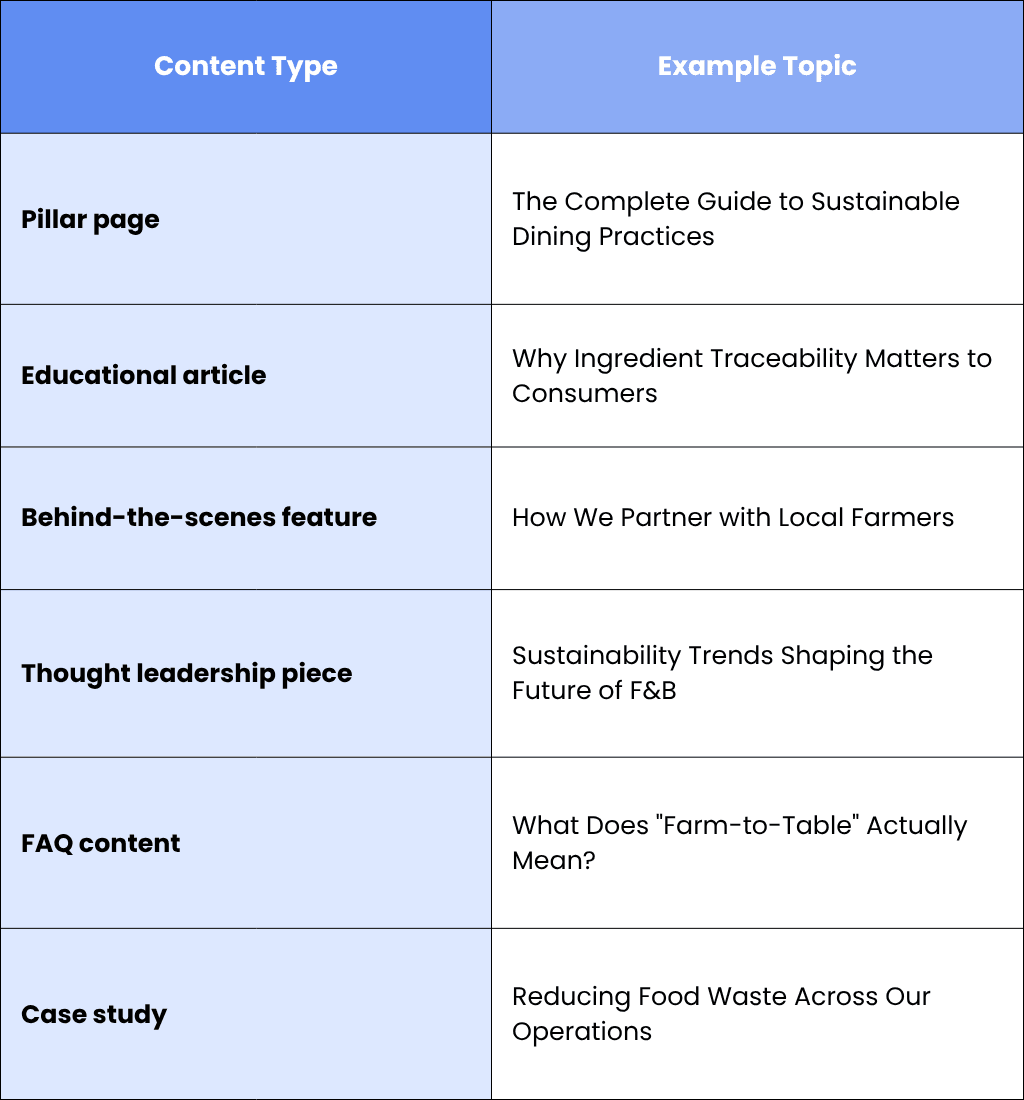
This approach allows restaurants, hospitality groups, and food brands to position themselves as trusted voices within the wider conversation around responsible dining.
Hospitality: Becoming the Go-To Source for Destination Expertise
Travellers rarely make decisions based solely on accommodation features. Instead, they seek guidance on destinations, experiences, convenience, and value.
As a result, hospitality brands can benefit significantly from building content around entities that reflect the complete guest journey.
Example core entity: Family-Friendly Hospitality Experiences
Supporting entities and topics may include:
- Child-friendly facilities
- Local attractions for families
- Family travel planning advice
- Seasonal events and activities
- Dining options suitable for children
- Safety and accessibility considerations
An example content cluster might include:
Pillar Page
- The Ultimate Guide to Family-Friendly Travel in Ho Chi Minh City
Supporting Content
- Top Attractions for Families Visiting the City
- What Parents Should Look for in Family Accommodation
- Planning Stress-Free School Holiday Getaways
- Child-Friendly Dining Recommendations
- Activities Suitable for Different Age Groups
This strategy enables hotels and resorts to compete not only for accommodation-related searches but also for broader informational queries that influence booking decisions earlier in the customer journey.
Over time, the business becomes recognised not simply as a hotel provider but as a trusted authority on family travel experiences.
Education: Demonstrating Expertise Beyond Programme Promotion
Educational institutions often focus heavily on promoting courses and enrolment opportunities. However, prospective students and parents typically require much more information before making decisions.
An entity-first approach allows educational organisations to address these broader informational needs while showcasing their expertise.
Example core entity: Student Wellbeing
Supporting entities and topics could include:
- Emotional resilience
- Mental health support
- Parent-school communication
- Inclusive learning environments
- Student engagement strategies
- Academic stress management
- Social development initiatives
A potential content structure may look like this:
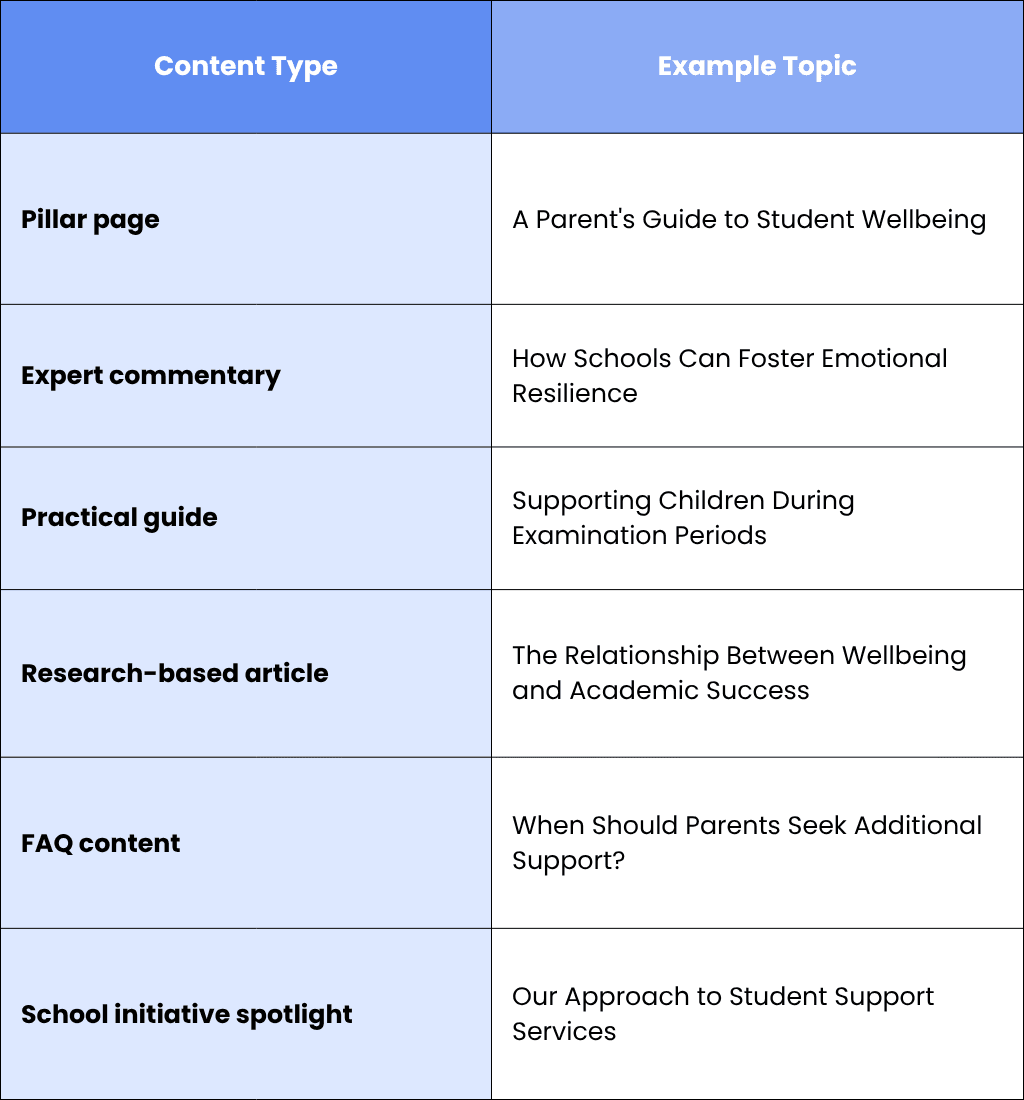
Through this content ecosystem, institutions demonstrate a commitment to student development rather than focusing exclusively on admissions messaging.
As a result, they strengthen trust among prospective families while building authority around educational outcomes that matter most to their audience.
Retail: Establishing Leadership Across the Customer Experience
Modern retail extends far beyond transactions. Consumers increasingly value convenience, transparency, personalisation, and brand values.
Retailers that adopt an entity-first mindset can create content addressing these wider expectations while differentiating themselves from competitors.
Example core entity: Omnichannel Shopping Experience
Supporting entities and topics may include:
- Click-and-collect services
- Mobile commerce trends
- Customer loyalty programmes
- Personalised recommendations
- Inventory visibility
- Flexible fulfilment options
- Digital customer service innovations
An entity-driven content cluster could include:
Pillar Content
- Understanding the Future of Omnichannel Retail
Supporting Content
- How Click-and-Collect Benefits Modern Consumers
- The Growing Importance of Mobile Shopping
- Building Effective Customer Loyalty Strategies
- Balancing Online Convenience with In-Store Experiences
- Emerging Technologies Transforming Retail
By addressing the evolving retail landscape comprehensively, businesses strengthen their position as knowledgeable partners rather than simply product providers.
This can be particularly valuable for retailers seeking to build long-term customer relationships in highly competitive markets.
A Practical Framework for Any Industry
Regardless of sector, the process of applying an entity-first approach follows a similar structure.
Businesses can use the following framework:
Step 1: Identify the Primary Entity
Ask:
"What topic do we genuinely want to become known for?"
Examples:
- Sustainable dining
- Student wellbeing
- Luxury travel experiences
- Omnichannel retail
Step 2: Identify Related Entities
Consider:
- Which concepts naturally connect to this topic?
- What supporting knowledge would customers expect from an expert source?
- What questions arise throughout the customer journey?
Step 3: Develop Supporting Content
Create a mix of formats, including:
- Comprehensive pillar pages
- Educational guides
- FAQs
- Industry commentary
- Case studies
- Practical checklists
- Expert interviews
Step 4: Connect the Ecosystem
Finally, reinforce relationships through:
- Internal linking strategies
- Consistent terminology
- Structured data implementation
- Regular content updates
Over time, these interconnected signals help search engines and AI systems understand the depth of your expertise.
The Key Insight: Authority Is Built Through Breadth and Depth
One of the most important lessons businesses can take from these examples is that topical authority rarely comes from publishing a single high-performing article.
Instead, authority develops gradually through the consistent publication of relevant, interconnected content.
A useful way to think about this is through the following comparison:
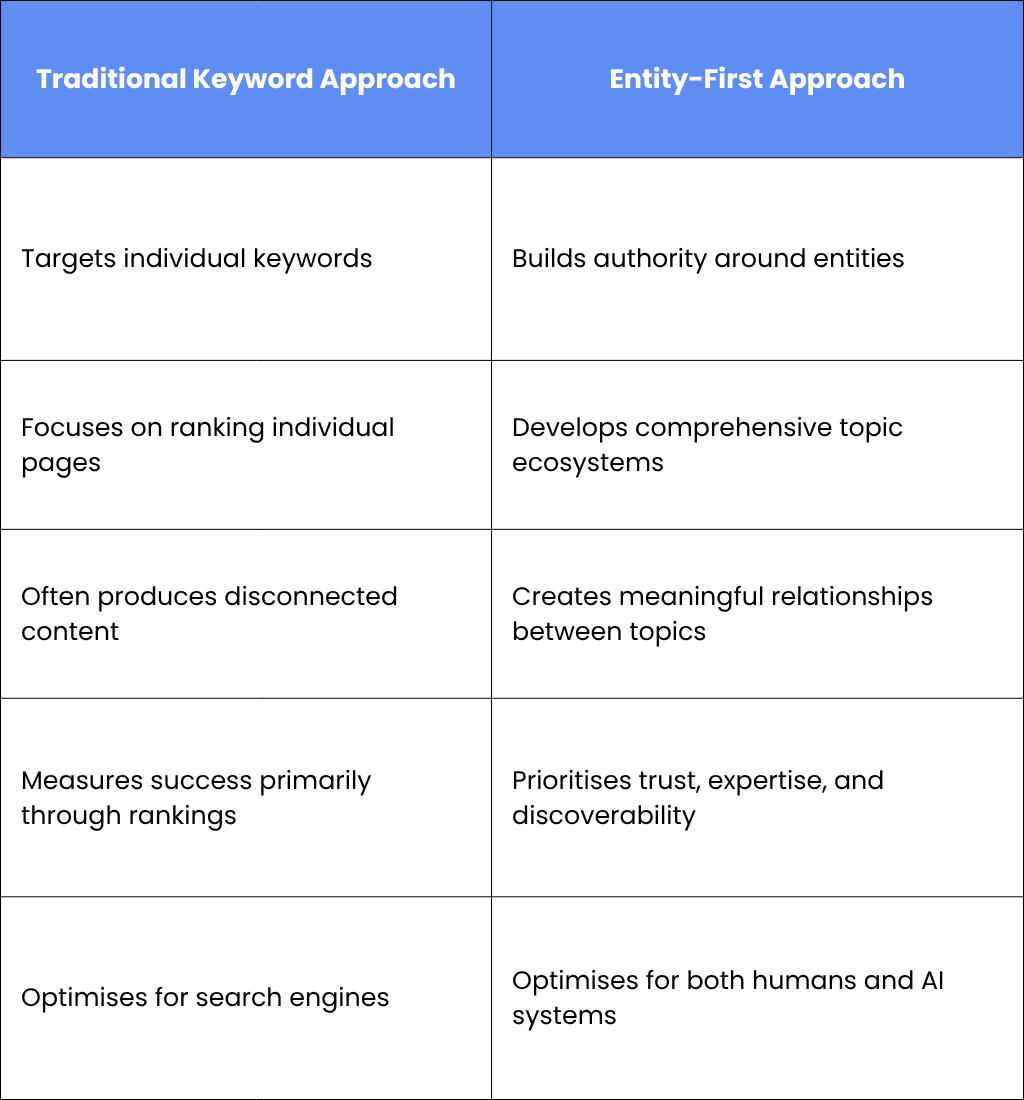
As AI search continues to evolve, businesses that demonstrate both breadth of coverage and depth of expertise will be better positioned to earn visibility and trust.
Measuring Success
Implementing an entity first content strategy is a long-term investment. Unlike traditional SEO campaigns that often focus heavily on individual keyword rankings, an entity-based approach aims to strengthen your overall authority within a subject area. Consequently, measuring success requires a broader set of performance indicators.
While rankings and traffic still matter, they represent only part of the picture. Businesses should also evaluate whether their content ecosystem is improving visibility, reinforcing expertise, and contributing to meaningful commercial outcomes.
The following metrics can help organisations assess the effectiveness of their entity-first efforts.
1. Growth in Non-Branded Organic Visibility
One of the clearest signs that your topical authority is improving is an increase in non-branded organic traffic.
Non-branded searches occur when users discover your content without explicitly searching for your company name. These searches indicate that search engines recognise your website as a valuable resource for broader industry topics.
For example:
- Branded search: "Saigon Digital SEO services"
- Non-branded search: "how to improve AI search visibility"
If an entity-first strategy is working effectively, you should begin attracting visitors through informational and commercial-intent searches related to your core entities.
What to monitor:
- Growth in non-branded impressions
- Growth in non-branded clicks
- New topic areas generating traffic
- Increases in search visibility across supporting content
Why it matters:
It demonstrates that your organisation is becoming discoverable beyond existing brand awareness and expanding its reach within strategically important topics.
2. Improvements in Topical Coverage
Entity-first content is designed to build comprehensive expertise. Therefore, businesses should regularly assess how thoroughly they cover their chosen entities.
Rather than asking, "Do we rank for this keyword?", consider:
"Have we addressed the questions, concerns, and subtopics our audience expects an authority to cover?"
A practical way to evaluate this is through a topical coverage audit.
Example:
Core Entity: Student Wellbeing
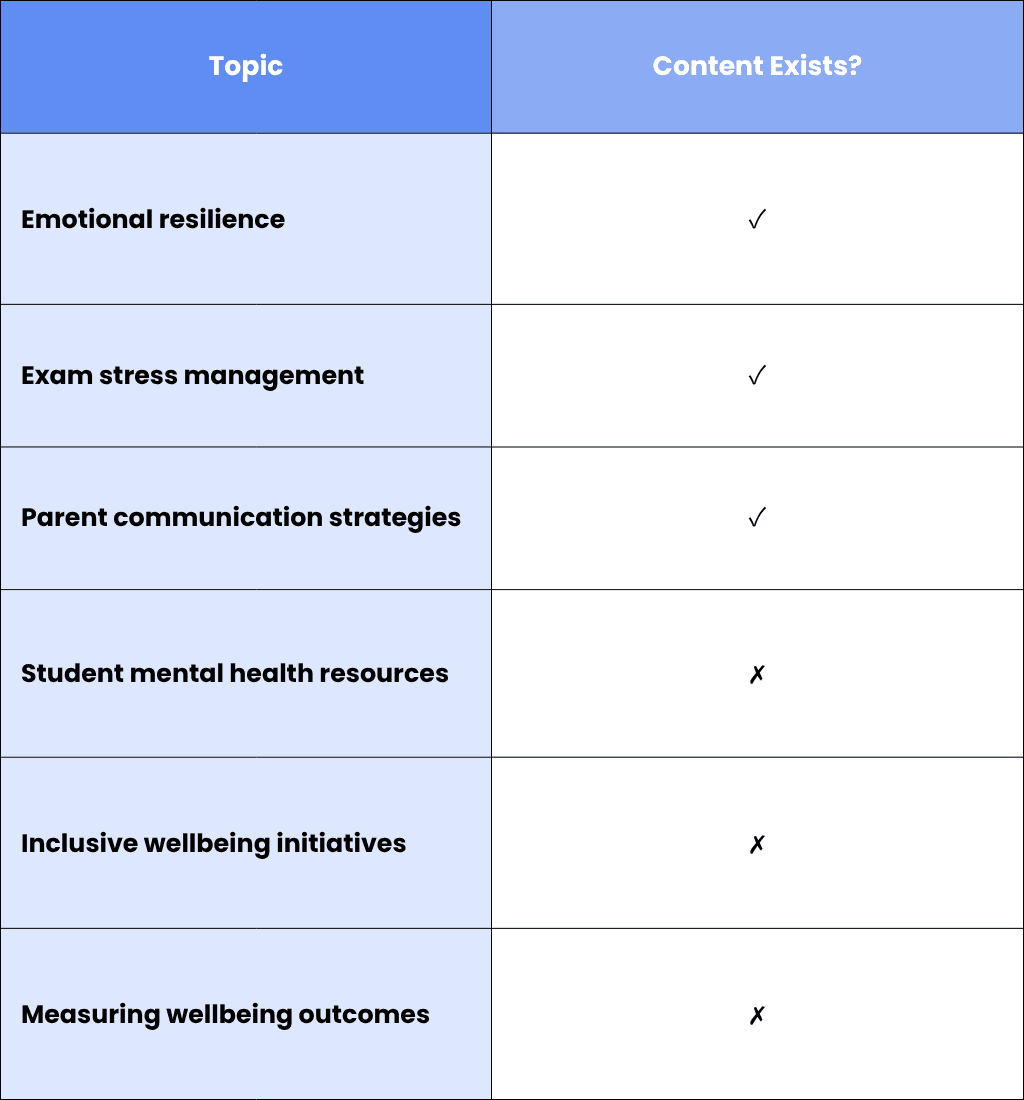
In this example, gaps clearly emerge despite existing content efforts.
What to monitor:
- Number of supporting entities covered
- Identification of content gaps
- Depth of coverage across customer journeys
- Updates made to existing resources
Why it matters:
Comprehensive coverage strengthens topical authority and increases the likelihood that AI systems recognise your brand as a trusted source.
3. Increased Engagement with Supporting Content
Entity-first strategies encourage users to explore interconnected content rather than consuming a single page and leaving.
As internal relationships between articles strengthen, audience engagement often improves as well.
For example, a visitor arriving via a guide on sustainable sourcing may continue reading related articles about ethical procurement, supplier transparency, or consumer trends.
This behaviour signals that users find the content ecosystem valuable.
What to monitor:
- Average engagement time
- Pages viewed per session
- Scroll depth
- Return visitor rates
- Navigation paths between related content
Questions to ask:
- Are visitors exploring multiple resources?
- Which content clusters generate the strongest engagement?
- Where do users exit the journey?
Why it matters:
Strong engagement indicates that your content is genuinely useful and that your entity relationships align with user interests.
4. Enhanced Internal Linking Efficiency
Internal links help search engines understand the relationships between topics. Therefore, evaluating the effectiveness of your internal linking strategy is an important part of measuring success.
Over time, entity-first content ecosystems should become increasingly interconnected.
A useful exercise is to assess whether important pages receive sufficient support from related content.
Example:
Pillar Page: The Complete Guide to Sustainable Dining
Supporting pages linking back:
- How Seasonal Menus Reduce Food Waste ✓
- Understanding Ethical Ingredient Sourcing ✓
- Consumer Demand for Sustainable Dining ✓
- Local Supplier Partnerships in Hospitality ✗
The missing connection highlights an opportunity to strengthen contextual signals.
What to monitor:
- Number of internal links pointing to pillar content
- Internal link distribution across topic clusters
- Orphaned pages lacking strategic connections
- Opportunities to improve contextual linking
Why it matters:
Efficient internal linking reinforces entity relationships and improves both discoverability and user navigation.
5. Appearance Within AI-Generated Answers
As AI search adoption grows, businesses should begin monitoring whether their content is being surfaced within generative experiences.
Although measurement in this area continues to evolve, early indicators can provide valuable insights into how well your content supports AI discovery.
Potential signals include:
- Referral traffic from AI platforms
- Brand mentions within AI-generated responses
- Citations from third-party publications influenced by your content
- Increased visibility for informational queries commonly addressed by AI systems
Businesses can also periodically test relevant prompts.
For example:
"What are best practices for sustainable hospitality?"
"How can schools improve student wellbeing?"
If competitors consistently appear while your organisation does not, it may indicate opportunities to improve entity clarity, content depth, or authority signals.
Why it matters:
Visibility within AI-generated experiences represents an emerging frontier of search performance and may increasingly influence brand discovery.
6. Growth in Qualified Leads and Conversions
Ultimately, even the most sophisticated content strategy should contribute to business objectives.
Improved authority and visibility are valuable because they support meaningful outcomes, such as attracting prospective customers who are actively seeking solutions.
For example:
- A hospitality group may generate more event enquiries.
- An education provider may increase admissions enquiries.
- A retail business may improve online sales performance.
- An F&B brand may drive reservations or catering requests.
What to monitor:
- Organic lead volume
- Conversion rates from organic visitors
- Assisted conversions influenced by informational content
- Revenue attributed to organic channels
- Quality of enquiries generated
Questions to ask:
- Are leads becoming more qualified?
- Which content clusters contribute most frequently to conversions?
- How does organic traffic support the broader customer journey?
Why it matters:
Commercial outcomes demonstrate whether authority-building efforts translate into measurable business value.
Creating an Entity-First Performance Dashboard
Because entity-first strategies influence multiple stages of the customer journey, businesses should avoid relying on a single metric.
Instead, consider grouping indicators into a balanced performance dashboard.
Example Dashboard
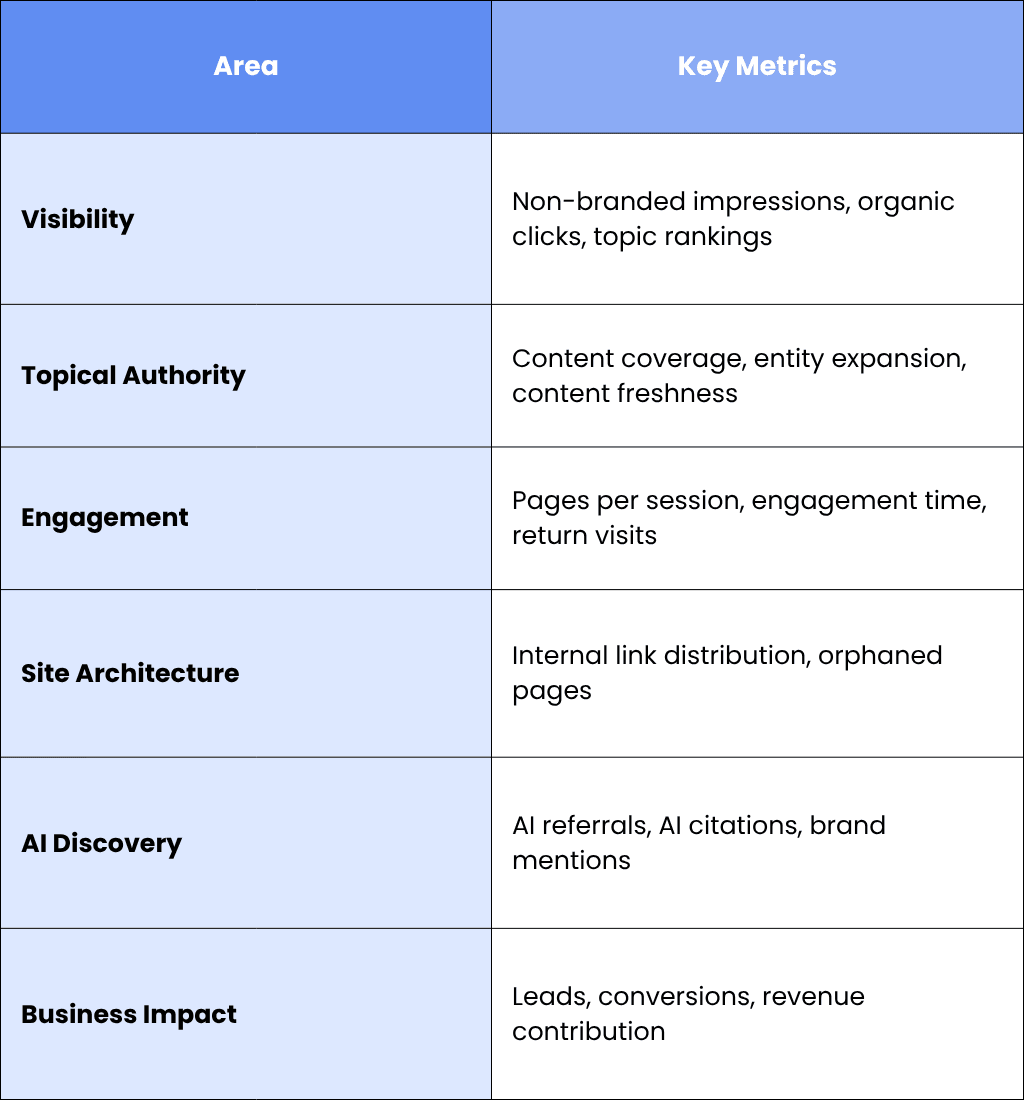
Reviewing these metrics collectively provides a more accurate picture of progress.
A temporary ranking fluctuation may matter less if overall authority, engagement, and lead generation continue to improve.
How Saigon Digital Helps Businesses Build Authority for the Future
At Saigon Digital, we believe that sustainable growth comes from combining strategy, creativity, and data to deliver measurable business outcomes.
As a forward-thinking SEO agency, we help ambitious brands navigate the changing search landscape through tailored solutions designed for long-term success.
Our SEO services support businesses through:
- Site optimisation and technical performance improvements
- Content and authority building initiatives
- Local and global search strategies
As AI reshapes how consumers discover information, our Generative Engine Optimisation (GEO) services help brands become trusted sources across platforms such as ChatGPT, Gemini, Perplexity, and Google AI.
These services include:
- AI readability optimisation
- Generative Engine Optimisation (GEO)
- Answer Engine Optimisation (AEO)
- Knowledge graph and schema implementation
- AI content auditing and reformatting
- AI performance reporting
Beyond search visibility, our AI workflow automation services empower businesses to streamline operations and improve productivity through intelligent solutions, including custom AI agents and automation frameworks.
The future of digital growth belongs to organisations that embrace innovation while remaining focused on user value.
By adopting an entity-first content strategy today, businesses can strengthen their topical authority, improve discoverability across both traditional and AI search environments, and build the trust required to lead tomorrow's digital landscape.
Take the Next Step Towards AI Search Visibility
Building topical authority is no longer about producing the highest number of keyword-targeted articles.
It requires a deliberate strategy that reflects how modern search systems understand information.
If your organisation is ready to move beyond conventional SEO and embrace a more AI-focused approach to search visibility, Saigon Digital is here to help.
Get in touch with our team today for a consultation!
Frequently Asked Questions About Entity-First Content Strategy
1. What is an entity first content strategy?
An entity first content strategy is an approach to content planning that focuses on the people, places, products, services, and concepts that define a business rather than targeting individual keywords in isolation. The goal is to build interconnected content ecosystems that demonstrate expertise around specific subjects. This helps search engines and AI platforms better understand your brand's authority and increases your chances of appearing in both traditional search results and AI-generated answers.
2. How does an entity first content strategy differ from traditional SEO?
Traditional SEO often prioritises ranking individual pages for specific keywords. While keywords remain important, an entity-first approach goes a step further by considering the relationships between topics and how they contribute to broader subject expertise.
For example, instead of publishing separate, disconnected articles targeting different search terms, businesses create comprehensive topic clusters centred around core entities. This allows search engines to recognise the depth and breadth of the organisation's knowledge, helping to strengthen topical authority over time.
3. Why is topical authority important for AI search?
AI-powered platforms such as ChatGPT, Gemini, and Perplexity aim to provide users with accurate and trustworthy information. As a result, they are more likely to reference sources that consistently demonstrate expertise within a particular subject area.
Building topical authority through an entity first content strategy helps establish your organisation as a credible source of information. By covering relevant topics comprehensively and showing clear relationships between them, businesses improve their potential to be discovered, cited, and trusted within AI-driven search experiences.
4. How long does it take to see results from an entity first content strategy?
The timeline varies depending on factors such as your website's existing authority, the competitiveness of your industry, and the consistency of your content efforts. However, businesses should view entity-based SEO as a long-term investment rather than a quick-win tactic.
In many cases, early improvements in engagement and topical coverage may emerge within a few months, while significant gains in authority, organic visibility, and AI discoverability can take six to twelve months or longer. The cumulative impact of consistently publishing high-quality, interconnected content is what ultimately drives sustainable results.
5. Can small and medium-sized businesses benefit from an entity first content strategy?
Absolutely. In fact, small and medium-sized businesses often have an advantage because they can focus on specific areas of expertise and niche audiences.
For example, a boutique hotel can build authority around family-friendly travel experiences within its destination, while an independent education provider can establish expertise in specialised learning approaches. Rather than competing broadly against larger organisations, businesses can use an entity first content strategy to become recognised authorities within the topics most relevant to their customers.
With the right strategy in place, organisations of all sizes can strengthen their visibility, build trust with their audiences, and improve their performance across both traditional and AI-powered search environments.