


An AI paraphrasing tool rewrites text you already have while keeping the original meaning, usually offering modes that shift formality, length or tone. It starts from your writing rather than generating something new from a prompt, which is the main thing separating this category from AI text generators.
This guide compares the ten best AI paraphrasing tools on price, free word limits and output quality. It also covers three questions most roundups avoid: whether paraphrasing beats AI detection, whether it is safe for SEO, and whether a dedicated paraphraser is still worth paying for when a general AI assistant costs the same.
Key Takeaways
- QuillBot is still the category default. Around $8 per month on annual billing, the widest set of rewrite modes, and integrations where you actually write.
- Free tiers are capped by word count, not quality. QuillBot and Scribbr cut off at roughly 125 words per submission; Paraphraser.io allows around 600 with no account.
- General AI assistants now compete directly. ChatGPT and Claude cost about the same as a premium paraphraser, have no word limits, and give better output on long documents.
- Paraphrasing does not reliably defeat AI detection. Standard tools change wording without changing the sentence rhythm detectors actually analyse.
- Paraphrasing is safe for SEO, republishing someone else's article is not. The risk is the use case, not the tool.
- Every tool here needs a human edit. Meaning drifts most on the highest creativity settings, which is exactly where people reach first.
What Are AI Paraphrasing Tools?
AI paraphrasing tools rewrite text while preserving the original meaning. Unlike simple synonym replacers, modern tools understand context, sentence structure, and intent. This makes them useful for:
- Refreshing existing blog content
- Improving clarity and readability
- Avoiding duplication in SEO content
- Adapting tone for different audiences
- Supporting non-native English writers
For example, a paragraph written for a technical whitepaper can be paraphrased into simpler language for a blog or landing page, without rewriting from scratch.
What They Are Not
Three things worth being clear about before you buy one:
- Not a plagiarism solution. Rewording source material reduces surface-level matching, but the ideas are still someone else's. Attribution is a separate obligation that no tool removes.
- Not an AI detection bypass. See the dedicated section below. The marketing on some tools overstates this considerably.
- Not a content generator. If you need something written from nothing, you want an AI text generator instead.
How We Assessed These Tools
We use paraphrasing tools daily across client content work, and the ranking reflects four things rather than feature counts:
- How much editing the output needs before it is publishable, which is the only measure of quality that costs real time.
- Whether meaning survives the rewrite. Independent testing consistently finds that output drifts from intended meaning on high-creativity settings, across every tool in this category.
- Free tier honesty. What you can actually do without paying, stated in words rather than adjectives.
- Where it lives. A tool that requires leaving your document quietly stops being used.
We have no affiliate relationships with any tool listed, and every entry names a limitation.
The 10 Best AI Paraphrasing Tools in 2026
1. QuillBot: Best Overall Paraphrasing Tool
Price: free tier capped at roughly 125 words per submission with no account needed; premium from around $8 per month on annual billing, more monthly.
QuillBot is ideal for SEO writers, in-house content teams and anyone producing frequent written content who needs control over how text is rephrased. It is particularly effective when rewriting sections of long-form articles that must maintain clarity and relevance.
Its strength lies in versatility and user control. It offers several paraphrasing modes, and each adjusts how conservative or expressive the rewrite should be:
- Standard. Keeps meaning tight and structure close to the original.
- Fluency. Focuses on readability and grammatical smoothness.
- Formal and Academic. Raises register for professional or scholarly writing.
- Creative. More inventive phrasing, useful for brainstorming, riskiest for accuracy.
- Expand and Shorten. Length control rather than tone control.
The synonym slider lets you control how aggressively the text is rewritten, preventing unnecessary word swaps that distort meaning.
It is also more than a paraphraser: the dashboard bundles a grammar checker, summariser, translator, plagiarism checker and AI detector, and the browser extension works across Gmail, Google Docs, LinkedIn, Outlook and Notion.
Where it falls short. The free word cap is low enough that two paragraphs will hit it. Its heavy student association also means some universities and employers view its use with suspicion regardless of context.
2. ChatGPT or Claude: Best for Long Documents
Price: capable free tiers; paid plans around $20 per month.
This is the entry most roundups leave out, and in 2026 it belongs near the top. A general AI assistant costs roughly twice a premium paraphraser and removes the constraint that defines the category: there is no word limit, so you can paste an entire article rather than working paragraph by paragraph.
It also gives you instruction control a mode selector cannot. "Rewrite this for a non-technical audience, keep the three statistics exactly as written, and do not use the words leverage or seamless" is not a setting on any dedicated tool.
Where it falls short. There is no one-click rewrite button and no browser extension sitting in your document. You have to write the prompt, which is a real friction cost if you paraphrase a sentence at a time rather than a document at a time.
3. Wordtune: Best for Sentence-Level Tone Control
Price: free tier of roughly ten rewrites per day; paid from around $7 to $14 per month depending on plan and billing.
Wordtune excels for teams where tone and user experience matter most: UX writers, copywriters, product teams and email marketers. It is less about large content volumes and more about how the content feels to the reader.
Its strength is tone-based rewriting and sentence-by-sentence control. Instead of bulk rewriting, it lets you refine individual sentences for formality, casualness, brevity or clarity, which makes it particularly useful for:
- Interface copy
- CTAs and headlines
- Customer communications
- Brand messaging
It is also a strong option for non-native English speakers, because the sentence-level focus makes it easy to see exactly what changed and why.
Where it falls short. The sentence-level design that makes it good is also what makes it slow. Rewriting a 2,000-word article one sentence at a time is not a workflow.
4. Grammarly: Best If You Already Pay for It
Price: roughly $30 per month billed monthly, closer to $12 on annual billing.
Grammarly is most effective for professionals and corporate teams where clarity, tone accuracy and error-free communication matter more than creative rephrasing. It suits business reports, proposals, executive communications and client deliverables.
While it is best known for grammar checking, its rewrite suggestions understand context and detect tone, and it provides tone indicators, readability scores and contextual phrasing guidance.
Where it falls short. Rewriting is the weakest feature in an otherwise strong product. Reviewers regularly report that its paraphrasing reads unnaturally and occasionally introduces errors, and the floating interface is intrusive. If you are buying a subscription specifically to paraphrase, QuillBot or Wordtune do it better for less. If you already pay for Grammarly, use it and save the second subscription.
5. Jasper AI: Best for Brand Voice at Team Scale
Price: paid only, from roughly $49 per seat per month.
Jasper is best for organisations that need both paraphrasing and content generation in one platform. Its advantage is brand voice training, which embeds tone, style and audience preferences so that paraphrased content stays consistent across multiple contributors. The long-form editor handles larger context rewrites well.
Where it falls short. You are paying six times a dedicated paraphraser. That is justifiable when consistency across a distributed team is the actual problem, and very hard to justify otherwise.
6. Paraphraser.io: Best Free Tier
Price: free tier of roughly 600 words per run with no account and no daily cap; paid plans from around $23 per month.
Paraphraser.io is designed for speed and simplicity. You do not need an account, it handles text quickly, and the free allowance is several times more generous than QuillBot's, which makes it the practical choice if you want to rewrite real paragraphs without paying.
It also supports multiple modes and a wide range of languages, which is unusual at this price.
Where it falls short. Output is noticeably less polished than QuillBot's, and it leans harder on direct synonym substitution. Feed it small batches and read the result carefully.
7. Scribbr: Best Free Academic Option
Price: free paraphraser, no sign-up; other tools sold separately.
Scribbr is the cleanest free option for short passages, and it is the only tool here that frames paraphrasing around citation rather than around avoiding detection. That framing matters: it treats rewording as part of using a source properly, not as a way of hiding that you used one.
Where it falls short. A short per-submission cap, and a narrow feature set if your use case is marketing rather than academic.
8. Wordvice AI: Best for Academic and ESL Writing
Price: from around $10 per month on annual billing.
Wordvice AI offers several academically tuned rewrite modes alongside a plagiarism checker and an MS Word add-in, which makes it the strongest pick for researchers and for writers working in English as a second language who need register control rather than creativity.
Where it falls short. The academic tuning that helps a thesis actively works against you on marketing copy, where the register is wrong.
9. WordAI: Best for Bulk Rewriting
Price: from around $27 per month.
WordAI analyses context before rewriting, which produces more natural output than synonym-first tools, and it offers API access for automated workflows. For agencies rewriting large volumes programmatically, it is the most capable option here.
Where it falls short, and this is important. The use case WordAI is built for, rewriting content at volume with minimal review, is precisely what Google's scaled content abuse policy targets. The tool is not the problem; publishing its output unreviewed is. Treat the API as a drafting step with a human review stage attached, not as a publishing pipeline.
10. Smodin: Best for Multilingual Rewriting
Price: free tier available; low-cost paid tiers.
Smodin's rewriter handles well over a hundred languages, which puts it in a small group of tools that serve non-English content at anything like the same level as English. For businesses producing content across several markets, that breadth is the whole argument.
Where it falls short. Breadth over depth. In any single language, a specialist tool will give you better output.
Free vs Paid: What the Free Tiers Actually Give You
Free paraphrasing tiers are limited by volume rather than by quality. You generally get the same engine with a cap on how much you can feed it.
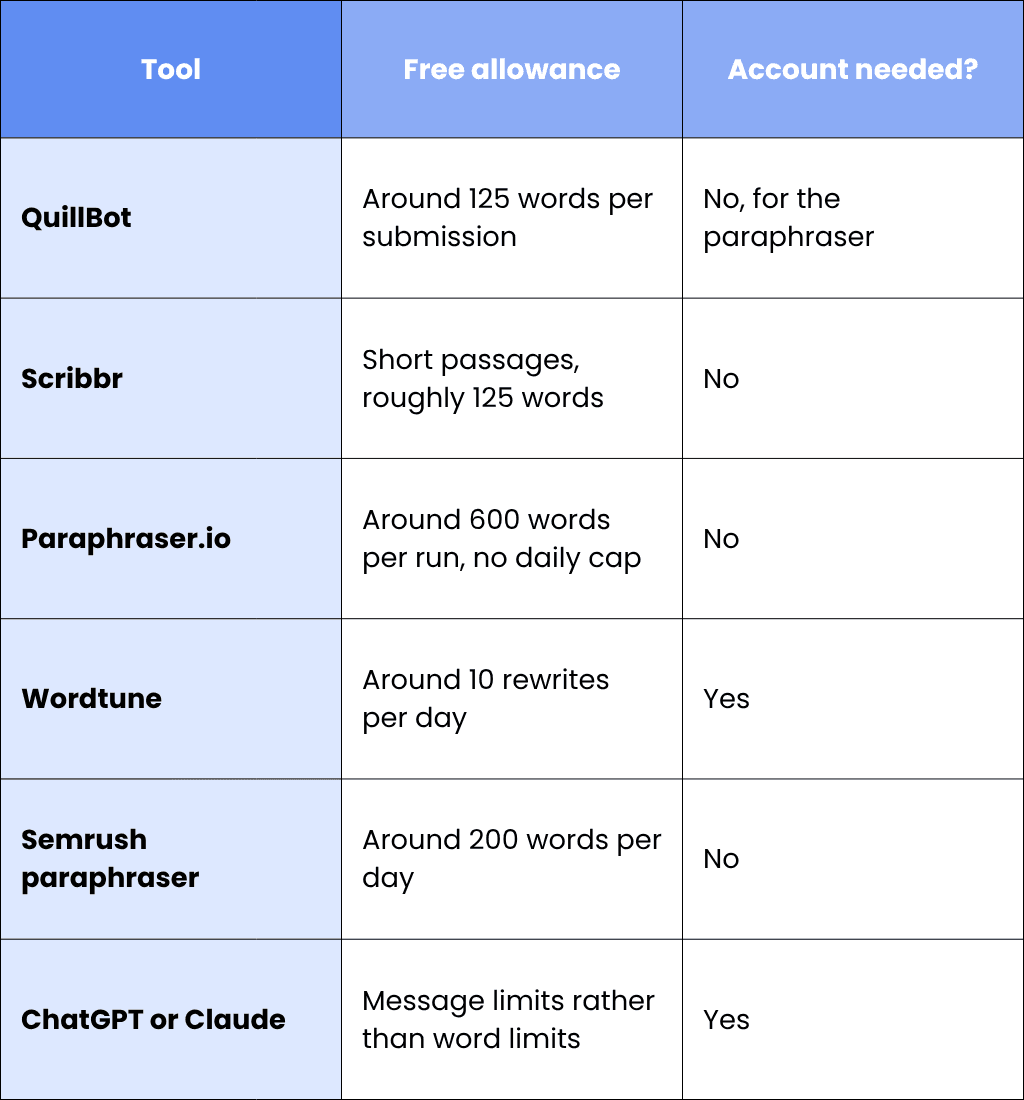
A practical rule. If a 125-word cap is annoying you more than twice a week, the roughly $8 monthly upgrade pays for itself immediately. If it annoys you monthly, use Paraphraser.io and keep your money. And if you are already paying for ChatGPT or Claude, test whether you need a dedicated paraphraser at all before adding a second subscription.
What Different Rewrite Intensities Actually Look Like
Mode names such as Standard, Fluency and Creative are hard to judge in the abstract, so here is the same sentence at three levels of rewrite intensity. These illustrate what each setting does rather than reproducing any particular tool's output.
Original: "Our platform helps businesses reduce operational costs by automating repetitive manual processes across finance and procurement."
- Conservative rewrite. "Our platform helps companies lower operating costs by automating repetitive manual tasks in finance and procurement." Meaning intact, structure intact, low risk. This is the setting to use on anything factual.
- Fluency rewrite. "Our platform cuts operating costs for businesses by taking over the repetitive manual work in finance and procurement." Reads better, slightly more assertive, still accurate.
- Creative rewrite. "We help finance and procurement teams stop wasting hours on manual busywork, and cut costs while we are at it." Much livelier, and note what has quietly changed: "helps businesses reduce" has become "we help teams stop wasting", and the platform has disappeared. On a product page that is a factual drift, not a style choice.
This is the practical case for reading every output rather than accepting it. Creative modes are genuinely useful for headlines, social copy and breaking writer's block. They are the wrong setting for anything a customer might rely on.
Do AI Paraphrasing Tools Beat AI Detection?
Not reliably, and any tool promising otherwise is overselling. Standard paraphrasers such as QuillBot, Grammarly and Wordtune change vocabulary and sentence construction, but AI detectors analyse rhythm and predictability patterns across a whole passage, which word-level substitution does not meaningfully alter.
A separate category of "humaniser" tools markets itself specifically on detection bypass, with claimed success rates in the region of 85% to 90%. Two things are worth knowing before relying on those numbers:
- Detectors are unreliable in both directions. They produce false positives on entirely human writing and miss heavily edited AI writing, so a passing score is not evidence of anything.
- The claimed rates come from the vendors selling the tools. Independent verification is thin, and detection models update continuously.
The more useful question for a business is not whether text passes a detector but whether it is accurate, original and genuinely useful, which is what search engines and readers actually assess. If your concern is that AI-assisted drafts read mechanically, that is an editing problem rather than a detection problem, and our comparison of AI to human text converter tools covers that specific step.
Are AI Paraphrasing Tools Safe for SEO?
Yes for rewriting your own content. No for republishing someone else's. Search engines evaluate content quality rather than production method, so the risk sits in the use case.
Where They Help
- Refreshing and improving pages you already own, which is one of the highest-return SEO activities available
- Resolving internal duplication across similar product or location pages
- Improving readability on content that is accurate but hard to read
- Adapting one piece of research for several audiences
Where They Create Risk
- Rewriting competitors' articles. Paraphrasing changes the words, not the fact that the structure, angle and research are theirs. It also produces content with no original insight, which is exactly what recent core updates have demoted.
- Volume without review. Google's scaled content abuse policy applies to content produced by automation, by humans, or by a combination of the two. Fifty rewritten pages published unreviewed break the same rule whoever produced them.
- Rewriting to dodge a duplicate content problem you should fix properly. If two of your pages compete for the same query, consolidation usually beats rewording. Our guides to duplicate content in SEO and content pruning cover that decision.
The clearest compliance signal remains the same as it has been for years: a named author, a fact check and a genuine review step before anything is published. Our guide to E-E-A-T for AI content covers how to keep authority signals intact when AI is part of the workflow.
Plagiarism and Academic Use
Worth addressing briefly, because a large share of paraphrasing tool users are students and researchers.
Paraphrasing reduces surface-level text matching but does not create original ideas. If the substance came from a source, it still needs a citation, and most institutions treat "I paraphrased it" as an aggravating factor rather than a defence. Several universities also class undeclared paraphrasing tool use as a form of academic misconduct in its own right, independently of plagiarism.
Legitimate academic uses do exist: improving your own writing, adjusting register, and helping non-native English speakers express their own arguments more clearly. Check your institution's policy first, because it varies considerably.
How to Use AI Paraphrasing Tools Effectively
Five habits make most of the difference between usable and unusable output.
- Start with a solid original. If the source text lacks clarity or accuracy, paraphrasing amplifies the weakness rather than fixing it. Confirm facts and structure before rewriting.
- Refine, do not replace. Target the specific sections that need work rather than pasting an entire article and publishing the output.
- Work in small batches. Meaning drifts more the more text you feed in at once, and it drifts fastest on creative settings.
- Protect your keywords and links. Rewriting frequently removes the exact phrase a page ranks for, along with internal link anchors. Check both after every rewrite. Our guide to keyword analysis and selection covers which terms to protect.
- Always read the output against the original. Read it aloud, compare meaning, and leave your genuine insights and examples untouched. Paraphrasing transitional and explanatory sentences improves flow; paraphrasing your expert commentary removes the reason anyone is reading.
Choosing the Right Tool for Your Business
Match the tool to the job rather than to the feature list.
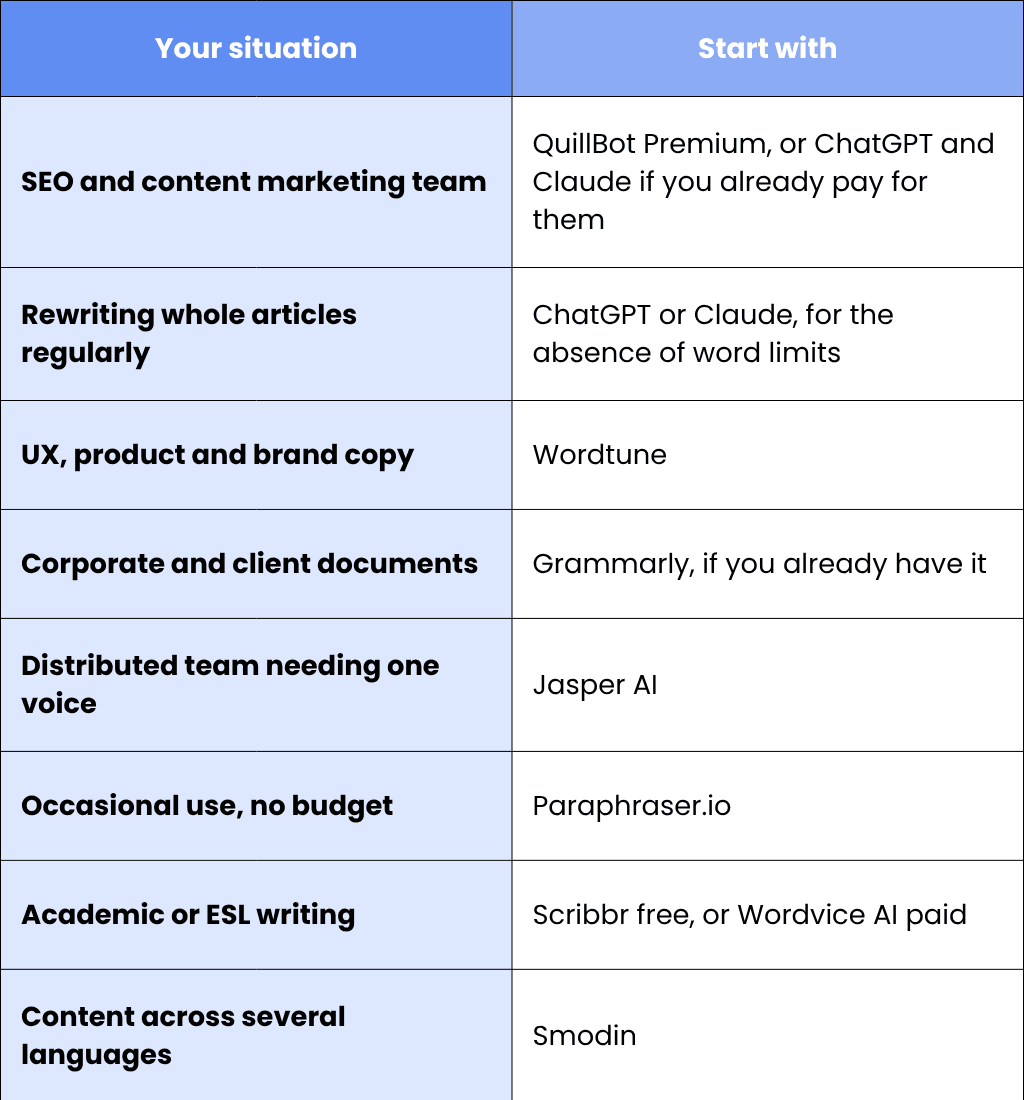
Before committing, answer four questions: how often will we paraphrase, who will use the tool, do we need brand voice control, and how much manual editing are we prepared to do? The last one decides more than the first three.
Make AI Paraphrasing Tools Work Smarter for You
In 2026, AI paraphrasing tools are steadily becoming a part of modern digital workflows. However, technology alone does not drive results. Strategy, creativity, and human judgement remain essential.
At Saigon Digital, we see AI as an enabler. When paired with strong SEO foundations, clear brand messaging, and user-centric thinking, the best AI paraphrasing tools help businesses move faster without compromising quality.
Get in touch with Saigon Digital and start integrating AI in your workflow today!
Frequently Asked Questions
1. What is the best AI paraphrasing tool?
QuillBot is the strongest dedicated paraphraser for most people: the widest set of rewrite modes, integrations where you write, and premium pricing from around $8 per month annually. If you regularly rewrite long documents, a general assistant such as ChatGPT or Claude will serve you better because there is no word limit.
2. Is there a good free AI paraphrasing tool?
Paraphraser.io has the most generous free allowance at roughly 600 words per run with no account. QuillBot and Scribbr are more polished but cap at around 125 words per submission. Scribbr is the better choice for academic passages because it frames rewriting around citation.
3. Can AI paraphrasing tools bypass AI detection?
Not reliably. Standard paraphrasers change wording without altering the sentence rhythm and predictability that detectors analyse. Specialist humanisers claim bypass rates around 85% to 90%, but those figures come from the vendors and detectors change constantly. Detector scores are unreliable in both directions and should not be treated as evidence.
4. Will paraphrased content hurt my SEO?
Not if you are rewriting your own content with human review. Google assesses quality rather than production method. The risk comes from republishing rewritten versions of other people's articles, or from publishing large volumes of rewritten pages without review, which falls under scaled content abuse.
5. Is using a paraphrasing tool plagiarism?
Rewording someone else's ideas without attribution is plagiarism regardless of whether a tool was involved. Paraphrasing reduces text matching, not the obligation to cite. Using one on your own writing is not plagiarism, though some institutions have separate rules about undeclared tool use.
6. Do I still need a paraphrasing tool if I have ChatGPT?
Often not. A dedicated paraphraser wins on speed and convenience: a browser extension, a one-click rewrite, and no prompt to write. A general assistant wins on document length, instruction control and output quality. If you rewrite sentences all day, the extension is worth it. If you rewrite documents, it usually is not.
7. Which paraphrasing mode should I use?
Standard or Fluency for anything factual, including product pages, technical content and anything with numbers in it. Creative modes are useful for headlines, social copy and brainstorming, but they are where meaning drifts, so always compare the output against the original.
8. Are paraphrasing tools safe for confidential material?
Check the data policy before pasting client work, contracts or unpublished plans into any of them. Business plans generally commit to not using your input for training; free consumer tiers often do not.