



If you've spent any time learning about SEO, you've probably come across the term YMYL. It frequently appears in discussions about Google rankings and website trustworthiness. Yet for many businesses, especially those outside the digital marketing industry, it remains an unfamiliar concept.
So, what is YMYL, and why should your business care?
In this beginner's guide, we'll explain what YMYL means, why Google places so much importance on it, how it relates to E-E-A-T, and what your business can do to produce high-quality, trustworthy content.
Key Takeaways
- YMYL (Your Money or Your Life) refers to content that can significantly impact a person's health, finances, safety, legal rights or overall wellbeing.
- Google applies stricter quality standards to YMYL content because inaccurate or misleading information can have serious real-world consequences.
- E-E-A-T (Experience, Expertise, Authoritativeness and Trustworthiness) plays a critical role in how Google evaluates the credibility of YMYL content.
- Businesses can strengthen their YMYL content by demonstrating genuine expertise, maintaining accurate and up-to-date information, improving technical SEO, and building trust with users.
- Creating trustworthy, people-first content not only supports long-term SEO performance but also improves visibility in AI-powered search experiences such as ChatGPT, Google AI, Gemini and Perplexity.
What Is YMYL?
YMYL stands for "Your Money or Your Life."
Google uses this term to describe content that could significantly affect a person's:
- Health
- Financial stability
- Safety
- Happiness
- Wellbeing
- Future opportunities
- Civic participation
Because inaccurate or misleading information in these areas can cause genuine harm, Google applies much stricter quality standards when evaluating YMYL content.
For example, imagine someone searches for:
- "How to treat chest pain"
- "Best investment strategy for retirement"
- "How to apply for a student visa"
- "Signs of food poisoning"
If the information they receive is inaccurate, the consequences could be serious. Google's goal is to ensure users receive reliable, authoritative and trustworthy information for these types of searches.
Why Does Google Care About YMYL?
Google's mission is to organise the world's information and make it useful. That responsibility becomes even more important when the information can directly influence someone's decisions or wellbeing.
Poor advice about choosing a mortgage differs greatly from choosing a restaurant for dinner.
One poor decision may simply lead to disappointment.
The other could lead to financial hardship.
Similarly, incorrect medical advice can place lives at risk.
Because of this, Google wants its search results to prioritise websites that demonstrate genuine expertise and credibility.
Rather than relying on keyword optimisation alone, Google increasingly evaluates whether content appears trustworthy enough to deserve visibility.
Examples of YMYL Topics
Many people assume YMYL only applies to websites in the healthcare or financial sectors. In reality, Google's definition is much broader.
A page may be considered YMYL if its information could influence a person's health, finances, safety, legal rights or other important life decisions. The greater the potential impact, the higher the expectations for content quality, accuracy and trustworthiness.
Below are some of the most common YMYL categories.
Health and Medical Information
Health is one of the clearest examples of YMYL because inaccurate information could directly affect a person's wellbeing or even put lives at risk.
Google expects medical content to be accurate, evidence-based and, where appropriate, created or reviewed by qualified healthcare professionals.
Examples include:
- Medical conditions and symptoms.
- Treatment options and medications.
- Nutrition and dietary advice.
- Mental health information.
- Pregnancy and childcare guidance.
- Fitness advice related to injury prevention or medical conditions.
For instance, an article explaining the symptoms of food poisoning carries far greater responsibility than a blog reviewing the best local restaurants. Because users may rely on this information to make health decisions, Google applies much stricter quality standards.
Financial Information
Financial decisions can have lasting consequences, making finance another major YMYL category.
Whether someone is investing their savings, applying for a mortgage or choosing insurance, inaccurate advice could result in significant financial loss.
Examples include:
- Personal finance guides.
- Investment strategies.
- Retirement planning.
- Tax advice.
- Loans and mortgages.
- Cryptocurrency and digital assets.
- Insurance products.
Businesses publishing financial content should ensure that information is accurate, regularly updated and, where appropriate, produced or reviewed by qualified professionals.
Legal Advice
Legal information often influences important personal or business decisions. Incorrect guidance could lead to legal disputes, financial penalties or missed opportunities.
Examples include:
- Employment law.
- Immigration and visa guidance.
- Divorce and family law.
- Business regulations.
- Intellectual property.
- Consumer rights.
For example, an education provider publishing student visa guidance or a business consultancy explaining employment regulations should ensure the information reflects current legislation and is reviewed regularly.
News and Public Information
News and public affairs can also fall within Google's YMYL framework, particularly when they influence public understanding or civic participation.
Examples include:
- Elections and voting information.
- Government policies.
- Public health announcements.
- Major economic developments.
- Emergency or safety information.
Because these topics can shape public opinion and decision-making, Google places greater emphasis on sourcing, factual accuracy and editorial transparency.
Shopping and eCommerce
Many businesses are surprised to discover that eCommerce websites can also publish YMYL content.
While selling everyday consumer products does not automatically make an entire website YMYL, pages that influence significant purchasing decisions or involve product safety are held to higher standards.
Examples include:
- Electronics and appliances.
- Children's products.
- Medical devices.
- Nutritional supplements.
- Luxury goods.
- High-value purchases.
For example, if an online retailer sells baby products, customers rely on accurate safety information, product specifications and usage instructions before making a purchase. Likewise, businesses selling supplements should ensure product descriptions and health-related claims are factually correct and comply with relevant regulations.
For retail businesses, this means that trustworthy product information can be just as important as pricing or promotions.
Education and Career Information
Education is another area that can fall within YMYL because the information provided may influence a person's future opportunities.
Students and professionals often rely on online guidance when making decisions about their education or careers, so inaccurate information could have long-term consequences.
Examples include:
- University admissions advice.
- Student visa information.
- Scholarship guidance.
- Professional certifications.
- Career planning resources.
- Skills development recommendations.
For education providers, ensuring that course information, entry requirements and application guidance remain accurate and up to date helps build trust with prospective students while supporting Google's quality expectations.
Not Every Page on a Website Is YMYL
An important point to remember is that Google doesn't classify entire websites as YMYL. Instead, it often evaluates individual pages based on the type of information they contain.
For example, a hospitality website may publish:
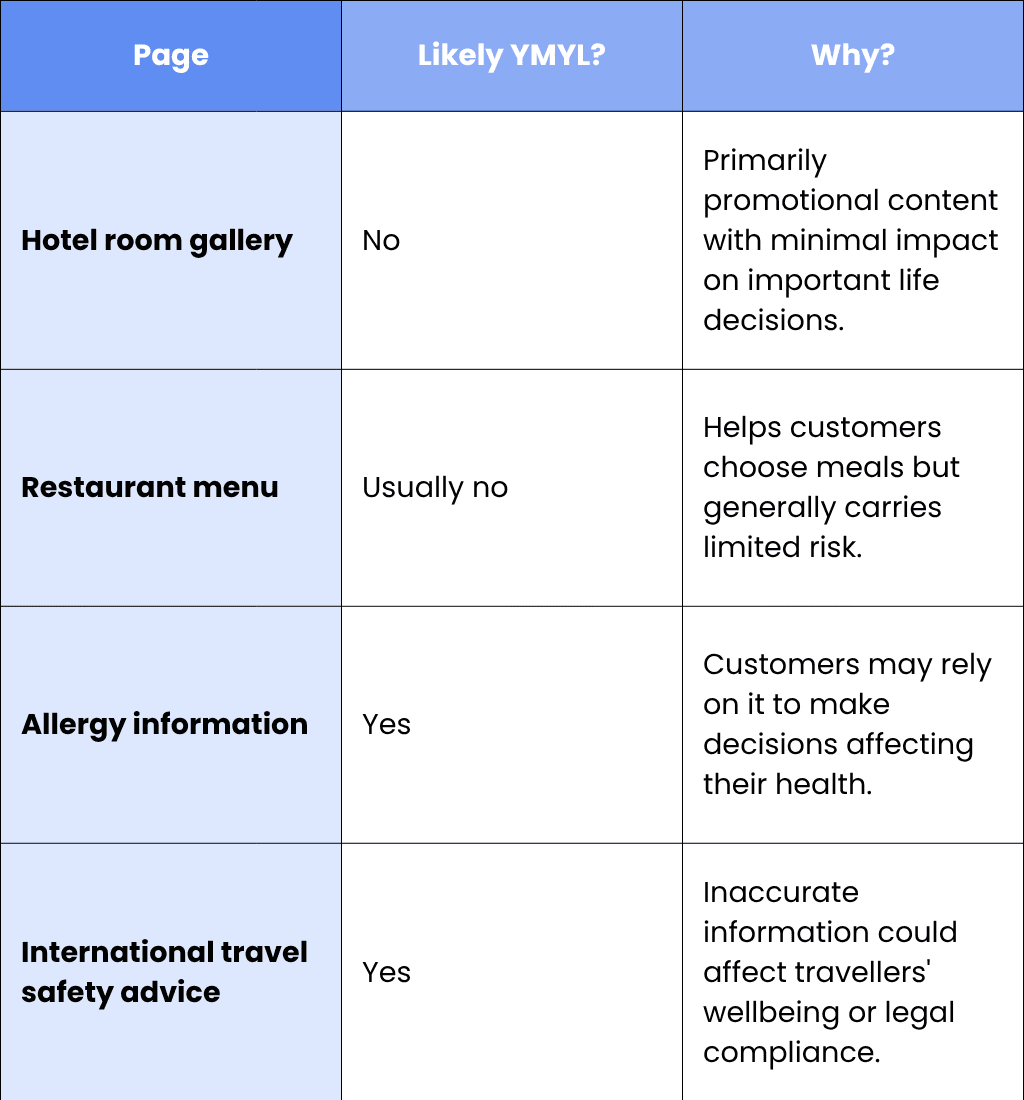
Similarly, a retail website selling home décor products may not publish much YMYL content. However, if it begins offering advice about electrical safety, children's products or nutritional supplements, those pages may be evaluated under stricter quality standards.
The key takeaway is that YMYL depends on the potential impact of the content, not simply the industry your business operates in.
How Does Google Evaluate YMYL Content?
Google does not assign websites a specific "YMYL score". Instead, it uses numerous ranking systems and quality signals to determine whether content is trustworthy enough for topics that could affect a person's health, finances, safety or overall wellbeing.
Below are some of the key factors Google considers.
Demonstrated Expertise
One of Google's primary considerations is whether the content has been created by someone with genuine knowledge or experience in the subject.
The level of expertise expected depends on the topic. For example, a doctor discussing treatment options for diabetes is expected to have recognised medical qualifications, whereas a travel blogger can credibly write about destinations they have personally visited. In both cases, the content demonstrates experience that readers can trust.
Businesses can strengthen expertise by:
- Publishing content written or reviewed by subject matter experts.
- Including author biographies with relevant qualifications or industry experience.
- Sharing original insights, research or real-world case studies.
- Demonstrating first-hand knowledge instead of repeating information from other websites.
Example
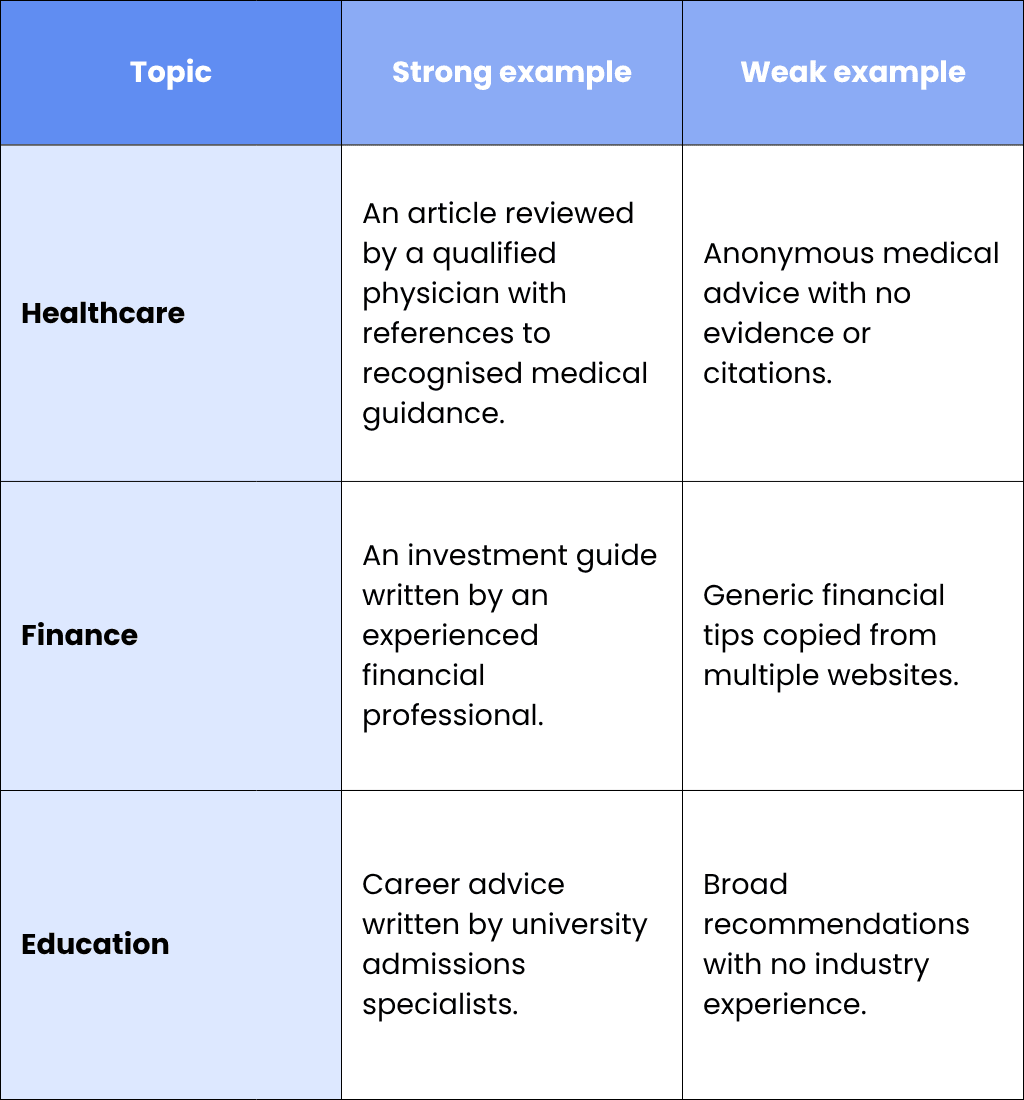
Ultimately, the more confidence Google has in the expertise behind your content, the more likely it is to consider it a reliable resource.
Accuracy
Accurate information is essential for all websites, but it becomes especially important for YMYL topics where incorrect advice may have real-world consequences.
Google looks for content that is factually correct, up to date and consistent with established knowledge. Information that becomes outdated over time should also be reviewed and updated regularly.
To improve accuracy:
- Verify facts before publishing.
- Cite reputable sources where appropriate.
- Update statistics, regulations and industry guidance as they change.
- Avoid exaggerations or unsupported claims.
For example, if a retail business publishes guidance on product safety, customers should be able to rely on that information when making purchasing decisions. Likewise, an education provider should regularly review visa requirements or admissions advice to ensure it reflects the latest regulations.
Accurate content not only supports better SEO but also builds long-term trust with your audience.
Transparency
Google wants users to know who is responsible for the information they are reading. A transparent website provides clear information about the people and organisation behind its content, helping users assess its credibility.
Trust signals may include:
- Detailed "About Us" pages.
- Named authors and editors.
- Contact information.
- Privacy Policy and Terms & Conditions.
- Editorial or content review policies.
- Business registration or professional accreditation where relevant.
Imagine comparing two websites offering the same financial advice. One clearly identifies its authors, explains its editorial process and provides company contact details, while the other offers no indication of who created the content. Most users would naturally trust the first website and Google tends to favour the same level of transparency.
Simply put, transparency reassures both users and search engines that your business stands behind the information it publishes.
Website Reputation
Google also considers how your business is recognised beyond its own website. A positive reputation helps reinforce that your content is trustworthy and authoritative.
Reputation is built over time through consistent quality and positive recognition from other reputable sources.
Some of the signals that contribute to a strong reputation include:
- Positive customer reviews.
- Mentions from respected industry publications.
- High-quality backlinks from authoritative websites.
- Professional certifications or industry memberships.
- Awards and recognition.
- Positive brand sentiment online.
It's important to understand that reputation extends beyond SEO. A business with consistently poor customer reviews or misleading practices may find it more difficult to establish trust, even if its content is technically well optimised.
On the other hand, organisations that consistently deliver value to customers often strengthen both their brand reputation and their search visibility over time.
In short, Google's assessment goes beyond what's written on your website—it also considers how your business is perceived across the wider web.
The Relationship Between YMYL and E-E-A-T
When people first learn what is YMYL, they often come across another important concept: E-E-A-T.
While the two terms are closely related, they are not the same.
Think of it this way:
- YMYL identifies the types of content that require a higher level of accuracy and trust because they can significantly impact a person's life.
- E-E-A-T is the framework Google uses to assess whether that content is credible enough to rank well.
In other words, if your content falls under a YMYL topic, Google places greater emphasis on the E-E-A-T signals your website demonstrates. The more your content reflects genuine experience, expertise, authority and trust, the more confidence Google has in recommending it to users.
Let's explore each element in more detail.
Experience
The first "E" in E-E-A-T stands for Experience, which refers to first-hand or life experience with a topic.
Not every article needs to be written by an academic or certified professional. In many cases, someone who has personally used a product, visited a destination or completed a process can provide valuable insights that readers won't find elsewhere.
For example, a hotel owner writing about improving guest satisfaction can share practical lessons from years of managing accommodation. Similarly, a retailer reviewing products they have personally tested is likely to provide more helpful information than someone simply summarising manufacturer descriptions.
Businesses can demonstrate experience by:
- Sharing real case studies and success stories.
- Including original photos, videos or demonstrations.
- Explaining lessons learned from real projects.
- Discussing practical challenges and solutions based on first-hand knowledge.
The key is authenticity. Google increasingly rewards content that reflects genuine experience rather than information that has simply been rewritten from other websites.
Expertise
Experience alone is not always enough, particularly for YMYL topics involving health, finance or legal matters. This is where Expertise becomes essential.
Expertise refers to the depth of knowledge someone has developed through education, professional qualifications or extensive industry experience.
For example:
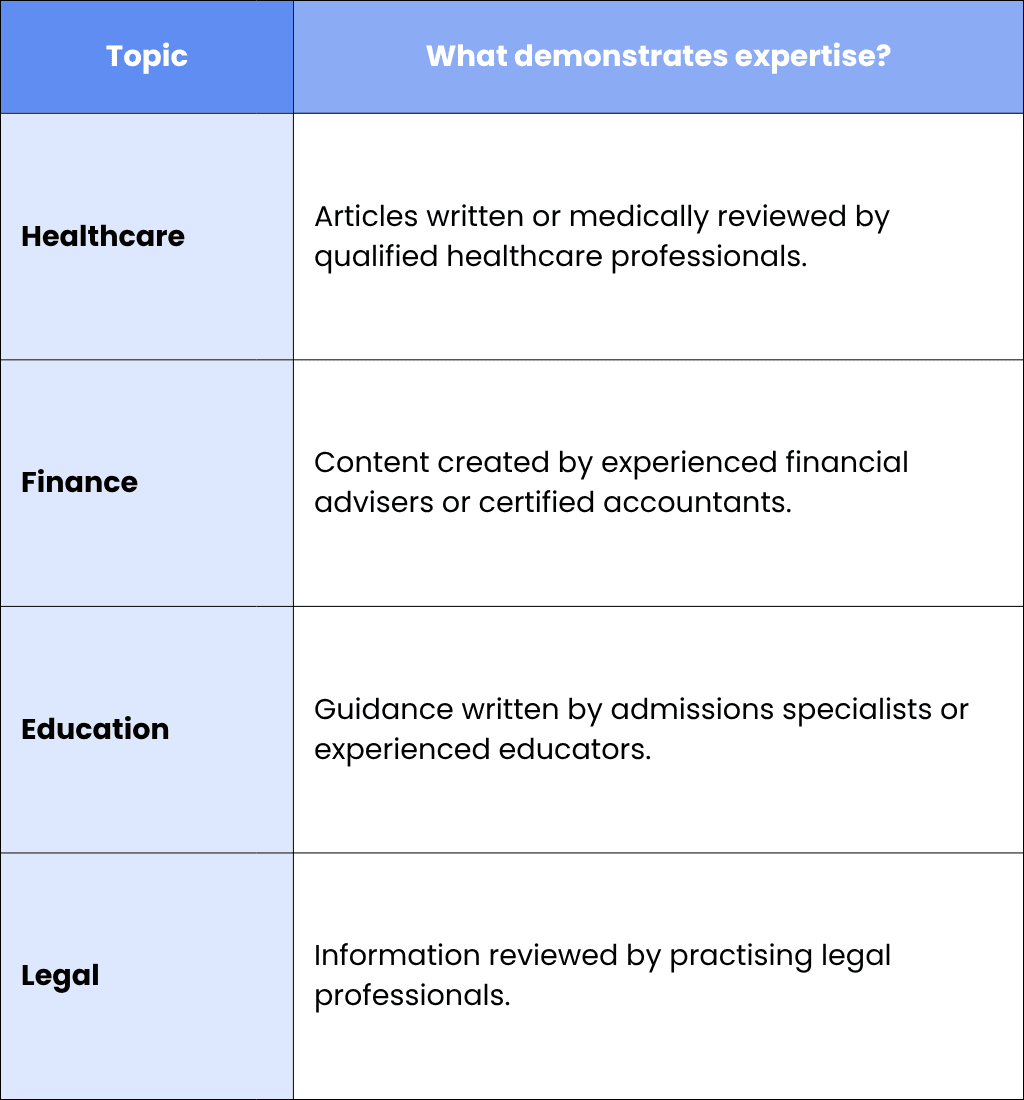
Businesses can strengthen expertise by:
- Publishing content created or reviewed by subject matter experts.
- Highlighting relevant qualifications and certifications.
- Including author biographies that explain industry experience.
- Supporting advice with reputable research where appropriate.
Even if your business does not operate in a highly regulated industry, demonstrating expertise helps both users and search engines understand why your content deserves to be trusted.
Authoritativeness
While expertise focuses on what you know, Authoritativeness reflects how others recognise your knowledge.
Google looks for signals that indicate your business or website is regarded as a reliable source within its industry. In other words, authority is earned through reputation rather than claimed through marketing.
Some common indicators of authority include:
- Mentions from respected industry publications.
- High-quality backlinks from reputable websites.
- Speaking engagements or media appearances.
- Professional memberships and certifications.
- Original research that others reference.
- Positive brand recognition within your industry.
For example, imagine two websites publish similar articles about sustainable hospitality practices. If one is regularly cited by leading tourism organisations and industry publications, Google is more likely to view it as an authoritative source.
Building authority takes time, but consistently publishing valuable content and earning recognition from credible organisations can significantly strengthen your long-term SEO performance.
Trustworthiness
Of all four elements, Trustworthiness is widely regarded as the most important.
A website may demonstrate experience, expertise and authority, but if users cannot trust its information, those strengths quickly lose their value.
Google looks for evidence that users can confidently rely on both the content and the organisation behind it.
Some common trust signals include:
- Accurate and fact-checked information.
- Secure HTTPS encryption.
- Clear contact information and company details.
- Transparent pricing and policies.
- Honest, evidence-based claims.
- Regularly updated content.
- Genuine customer reviews and testimonials.
For example, an online retailer that clearly displays return policies, customer service information and verified product reviews is likely to appear more trustworthy than one that provides little information about the business behind the website.
Trust is also built through consistency. Businesses that regularly publish accurate, helpful content and maintain transparent communication with customers are more likely to earn credibility over time.
Ultimately, trust is the foundation of E-E-A-T. Without it, even expert content may struggle to perform well in search results.
Why E-E-A-T Matters More for YMYL Content
Although Google considers E-E-A-T across all types of content, it applies much stricter scrutiny to YMYL topics because the consequences of inaccurate information can be significant.
The table below illustrates the difference.
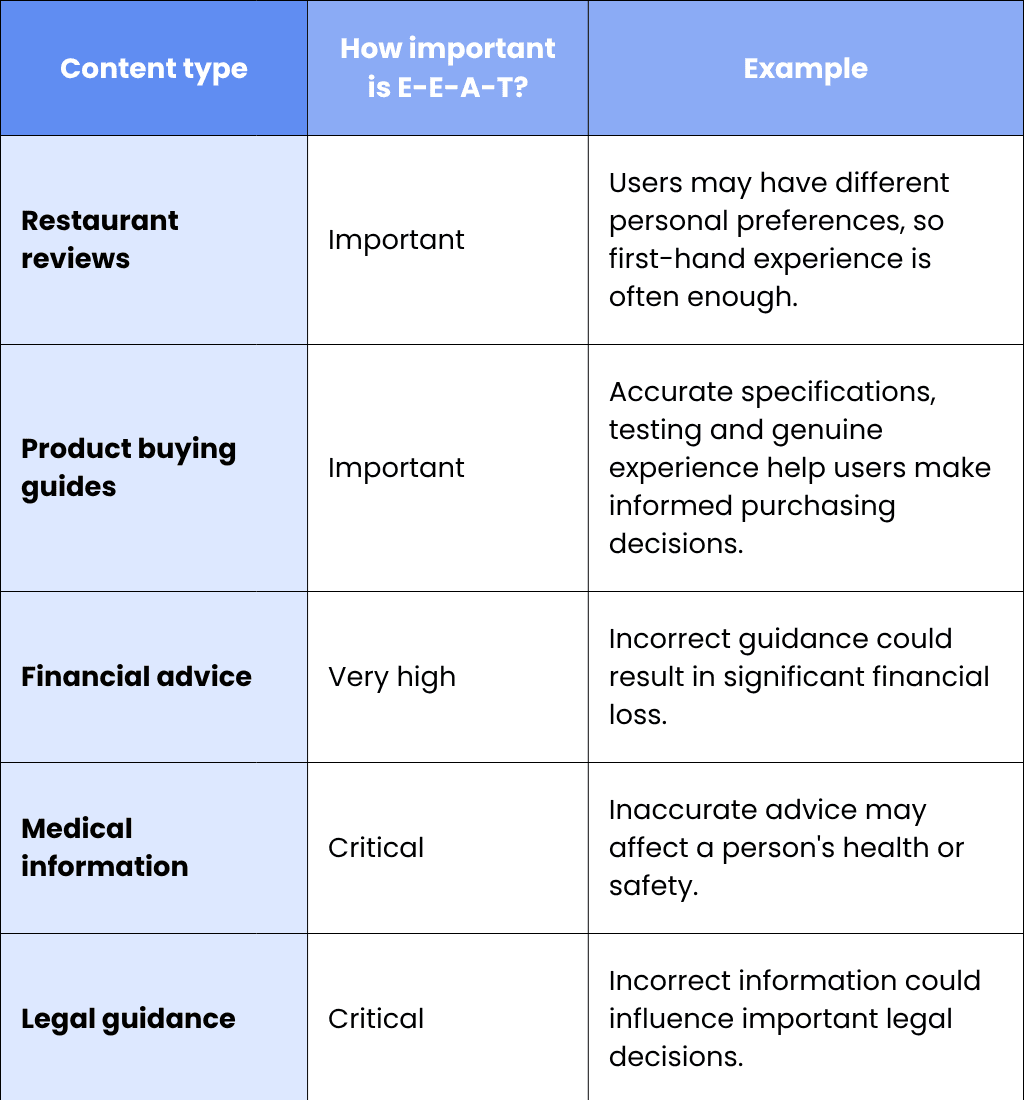
The greater the potential impact on a user's life, the stronger the E-E-A-T signals Google expects to see.
For businesses, the takeaway is simple: if your content helps customers make important decisions, invest in demonstrating genuine experience, showcasing expertise, building authority and earning trust. These principles not only align with Google's quality standards but also create a better experience for the people you're trying to reach.
How Businesses Can Improve Their YMYL Content
Publishing YMYL content isn't about trying to satisfy a checklist of Google ranking factors. Instead, it's about creating information that users can confidently rely on when making important decisions.
The good news is that improving YMYL content often aligns with broader SEO best practices and delivering a better user experience.
Here are several practical ways to improve your YMYL content.
Write for People First
One of Google's core principles is to create people-first content. Rather than writing solely to rank for keywords, businesses should focus on answering real questions and helping users achieve their goals.
Before publishing any page, ask yourself:
- Does this content fully answer the user's question?
- Would someone leave the page feeling more informed?
- Does it provide unique insights or simply repeat what's already available elsewhere?
For example, instead of writing a generic article about "choosing a CRM", explain the factors businesses should consider, compare different approaches and provide practical recommendations based on real-world experience.
When your content genuinely helps readers, it naturally becomes more valuable to both users and search engines.
Demonstrate Real Expertise
YMYL content should clearly show that it has been created by people who understand the subject matter.
This doesn't necessarily mean every article must be written by a certified expert. However, the content should demonstrate genuine knowledge, practical experience and an understanding of the audience's needs.
Businesses can strengthen expertise by:
- Including original insights rather than summarising existing articles.
- Publishing real case studies or project examples.
- Explaining how recommendations work in practice.
- Having technical or specialist content reviewed by qualified professionals where appropriate.
For example, a hospitality business sharing lessons from improving guest satisfaction provides significantly more value than an article that simply lists generic customer service tips.
Original expertise is difficult to replicate, making it one of the strongest long-term advantages in SEO.
Keep Content Accurate and Up to Date
Information naturally becomes outdated over time. Statistics change, regulations evolve, products are updated and industry best practices continue to develop.
For YMYL content, outdated information can reduce trust and, in some cases, lead users to make poor decisions.
As part of your content maintenance process, regularly review pages to update:
- Industry statistics and research.
- Government regulations or compliance requirements.
- Product specifications and pricing.
- Internal links and external references.
- Screenshots, examples and case studies.
Many businesses focus heavily on publishing new content while overlooking existing pages. In reality, refreshing high-performing articles can often deliver greater SEO value than creating new ones from scratch.
A simple content review every six to twelve months can help ensure your information remains relevant and trustworthy.
Strengthen Technical SEO
Even the most informative content may struggle to perform if your website provides a poor user experience.
Google considers technical quality alongside content quality when evaluating websites. A slow, difficult-to-use or insecure website can undermine user trust, particularly for YMYL topics.
Some technical improvements that support trustworthy content include:
- Fast page loading speeds.
- Mobile-friendly design.
- Secure HTTPS encryption.
- Clear site navigation.
- Logical internal linking.
- Structured data (schema markup) where appropriate.
- Accessible page layouts that are easy to read.
Think of technical SEO as the foundation that supports your content. Without a strong technical framework, even excellent information may not achieve its full ranking potential.
Build Brand Authority Beyond Your Website
Google doesn't evaluate your content in isolation. It also looks for evidence that your business is recognised and trusted across the wider web.
Building authority takes time, but consistent effort can significantly improve your online credibility.
Some effective ways to strengthen your brand authority include:
- Earning backlinks from reputable industry websites.
- Publishing original research or market insights.
- Contributing guest articles to respected publications.
- Speaking at conferences or industry events.
- Encouraging genuine customer reviews.
- Maintaining an active and professional online presence.
For example, if your company regularly contributes expert commentary to recognised industry publications, those mentions reinforce your expertise and authority—not only for potential customers but also for search engines.
Authority isn't built overnight. However, every positive mention, quality backlink and satisfied customer contributes to a stronger online reputation over time.
Review AI-Generated Content Carefully
Artificial intelligence has become a valuable tool for improving productivity, but it should support your content strategy rather than replace human expertise.
AI can assist with research, drafting ideas and improving efficiency. However, it may occasionally produce outdated, inaccurate or overly generic information, particularly when covering YMYL topics.
Before publishing AI-assisted content, businesses should:
- Verify factual accuracy.
- Check that statistics and references are current.
- Add original insights and real-world examples.
- Ensure the content reflects your brand's expertise.
- Have specialist topics reviewed by qualified professionals where appropriate.
The goal isn't simply to publish content faster—it's to publish content that readers can trust.
Businesses that combine AI efficiency with human expertise are often best positioned to create high-quality, scalable content that performs well in both traditional search and AI-powered search experiences.
Improving YMYL Content Is an Ongoing Process
There is no single checklist that guarantees success with YMYL content. Instead, businesses should view it as a long-term commitment to producing accurate, transparent and genuinely helpful information.
Over time, consistently applying these principles helps to:
- Build trust with potential customers.
- Strengthen your brand's authority.
- Improve organic search visibility.
- Increase the likelihood of being referenced by AI-powered search platforms.
- Support sustainable, long-term SEO growth.
Ultimately, the businesses that succeed with YMYL are those that prioritise helping people first. By combining valuable expertise with a strong user experience and a commitment to quality, your content will be better positioned to earn both Google's trust and your audience's confidence.
Does YMYL Matter for AI Search?
Absolutely.
As AI-powered search experiences continue to evolve through platforms like ChatGPT, Google AI, Gemini and Perplexity, trust has become even more important.
These systems aim to generate accurate, helpful answers by identifying reliable sources across the web.
Businesses with strong expertise, clear authority and trustworthy content are more likely to be referenced, cited and surfaced within AI-generated responses.
This means that investing in high-quality YMYL content is no longer just about traditional search rankings. It is increasingly about improving your visibility across the broader AI search ecosystem.
As search evolves, organisations that prioritise accuracy, transparency and user value will be better positioned to earn both search engine visibility and customer trust.
Partner with Saigon Digital for Future-Ready SEO
At Saigon Digital, we help ambitious brands solve digital challenges with forward-thinking, user-centric and bespoke solutions. By combining strategy, creativity and data, we design digital experiences that deliver measurable business growth.
Our SEO specialists support businesses through:
- Site Optimisation & Technical Performance to improve website health, speed and search visibility.
- Content & Authority Building that develops high-quality, trustworthy content aligned with Google's quality expectations.
- Local & Global Search Strategy tailored to your market, audience and business objectives.
As AI transforms how people discover information, we also help brands prepare for the future through Generative Engine Optimisation (GEO). Our AI-focused services include AI Readability Optimisation, Answer Engine Optimisation (AEO), Knowledge Graph and Schema implementation, AI Content Audits, and AI Performance Dashboards, helping your business become a trusted source for platforms such as ChatGPT, Gemini, Perplexity and Google AI.
Beyond search, our AI Workflow Automation Services help organisations streamline operations, improve productivity and scale efficiently through intelligent automation, custom AI agents and AI-driven workflows.
Build Trustworthy Content That Performs
Understanding what is YMYL is only the first step. Applying its principles consistently across your website is what helps build trust with both your audience and search engines.
Ready to build content your customers and Google can trust?
Get in touch with Saigon Digital and discover how our bespoke SEO and AI solutions can help your business grow with confidence!
Frequently Asked Questions
1. What is YMYL in SEO?
YMYL stands for "Your Money or Your Life", a term used by Google to describe content that could significantly impact a person's health, finances, safety, legal rights or overall wellbeing. Because inaccurate information in these areas can have serious consequences, Google holds YMYL content to much higher standards of quality, accuracy and trustworthiness than other types of content.
2. Does YMYL only apply to healthcare and finance websites?
No. While healthcare and finance are among the most common YMYL categories, Google's definition extends much further. Legal advice, education, government information, shopping pages for high-value or safety-related products, and even travel guidance can all be considered YMYL if the information influences important decisions that affect users' lives.
3. What is the difference between YMYL and E-E-A-T?
YMYL and E-E-A-T are closely related but serve different purposes.
YMYL identifies content that requires greater scrutiny because it may affect a person's wellbeing or future. E-E-A-T—which stands for Experience, Expertise, Authoritativeness and Trustworthiness—is the framework Google uses to assess whether that content is reliable enough to rank prominently in search results.
In short, YMYL defines which content requires higher standards, while E-E-A-T helps Google evaluate whether those standards have been met.
4. Can AI-generated content rank for YMYL topics?
Yes, but only if it meets Google's quality expectations. Google evaluates content based on its usefulness, accuracy and trustworthiness—not on whether it was created by AI or humans.
Businesses using AI to produce YMYL content should always review and fact-check the output, add original expertise and ensure that important information is accurate and up to date before publishing.
5. How can businesses improve their YMYL content?
The best way to improve YMYL content is to focus on creating genuinely helpful, trustworthy information for your audience. This includes demonstrating real expertise, keeping content accurate and up to date, providing clear author and business information, strengthening your website's technical SEO, and building authority through high-quality content and reputable industry recognition.
By consistently applying these best practices, businesses can improve both user trust and their long-term visibility in traditional search engines and AI-powered search experiences.