



AI conversations have become much more natural in recent years. Instead of asking a single question and starting again from scratch, users can now ask a question, add more detail, correct an earlier point, and continue exploring the same topic without repeating everything.
This is where the concept of multi turn conversation becomes important.
Key Takeaways
- Multi-turn conversation allows AI to use relevant information from earlier messages to understand follow-up questions and maintain a coherent interaction.
- AI context can come from conversation history, system instructions, external business data and persistent memory.
- Context and memory are different: context supports the current interaction, while memory can retain selected information for future conversations.
- Businesses can use multi-turn AI to build customer service assistants, product recommendation tools, booking assistants, AI tutors and lead qualification systems.
- Effective multi-turn AI focuses on relevant context, reliable data and clear business outcomes, rather than simply retaining as much information as possible.
- As AI-driven search and digital experiences grow, businesses should combine strong SEO, AI-ready content and intelligent automation to stay visible and competitive.
What is Multi Turn Conversation?
So, what is multi turn conversation in practical terms?
A multi-turn conversation is an interaction in which the user and AI exchange multiple messages, with each new response informed by relevant information from earlier parts of the conversation.
For example:
User: I’m looking for a laptop for university.
AI: What will you mainly use it for?
User: Mostly writing, research and some video editing.
AI: In that case, I’d prioritise a reliable processor, at least 16GB of RAM and a good-quality display.
User: My budget is around £1,000.
AI: With that budget and your requirements, I’d narrow the options to these categories…
The final answer makes sense because the AI can connect several pieces of information: the user is a university student, needs the laptop for writing and research, sometimes edits video and has a budget of around £1,000.
That is the defining characteristic of a multi-turn interaction: meaning develops across turns.
By contrast, a single-turn conversation might look like this: “Recommend a laptop for university under £1,000.”
The AI can still provide a useful response, but it has less conversational information to work with.
Multi-turn interactions therefore make AI systems feel more intuitive because users can communicate in the same incremental way they would with another person.
How Does AI Remember Context?
The phrase “AI remembers context” can make the technology sound more human than it really is.
A large language model does not automatically remember previous conversations in the same way a person remembers experiences. Instead, the application surrounding the model determines what information is made available when generating a response.
In a typical multi-turn interaction, the system may provide the model with some or all of the relevant conversation history alongside the latest user message. The model then processes that information as context when producing its next response.
For example, imagine a customer says: “I’m planning a three-night stay in Singapore.”
Later, they ask: “Does the hotel have a pool?”
The second question is incomplete on its own. Which hotel? What stay? Why are they asking?
Within the conversation, however, the earlier message supplies useful context.
The AI can interpret the second question in relation to the first and continue the discussion naturally.
Modern AI platforms can manage conversation state in different ways. OpenAI, for example, provides mechanisms for storing and retrieving conversation state across Responses API calls, while other AI platforms provide their own approaches to managing message history and context.
This leads to an important distinction: AI context is not necessarily the same thing as permanent AI memory.
Context Window Vs AI Memory
Although the terms “context” and “memory” are often used interchangeably, they describe different concepts.
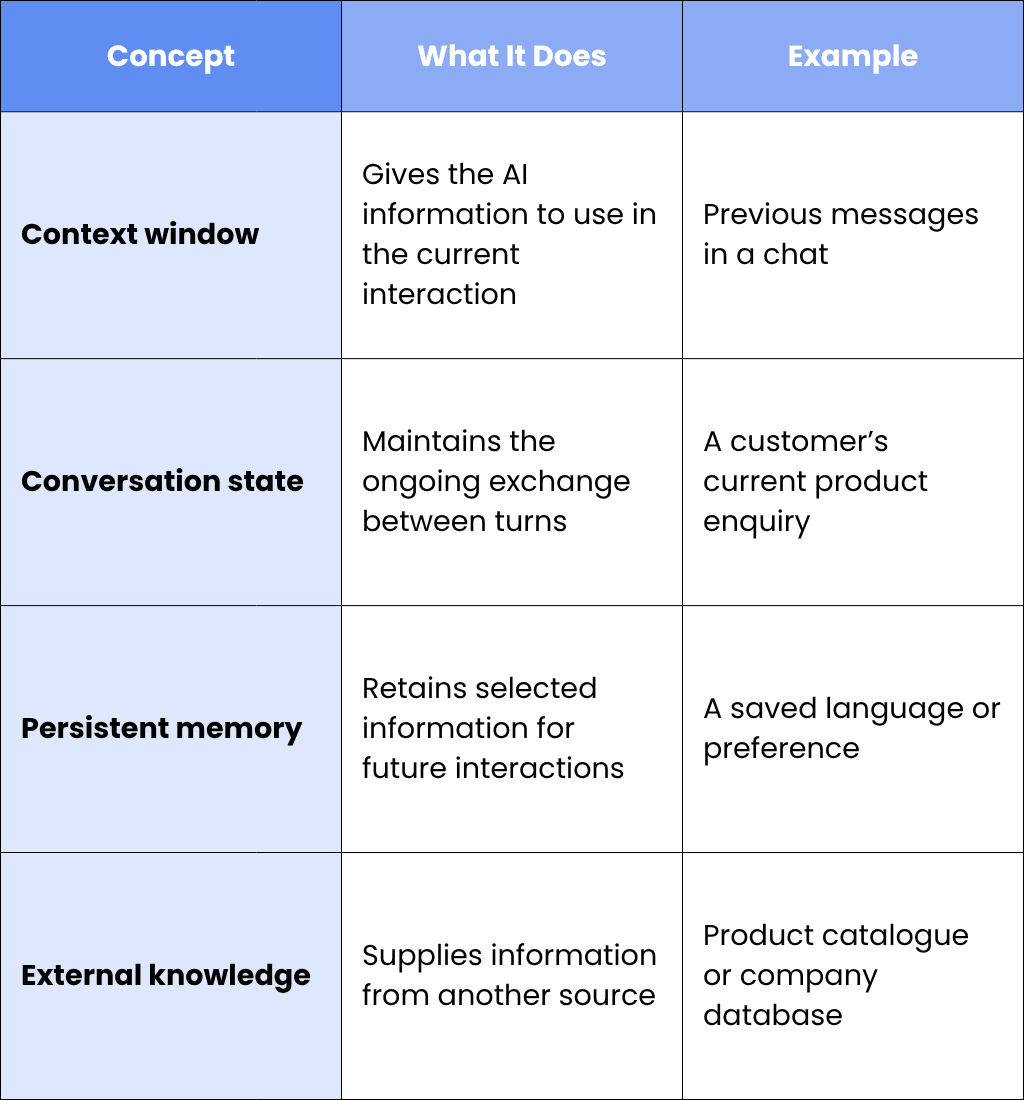
A context window is the information an AI model can consider when generating a particular response. It can include the current message, previous messages, system instructions, retrieved information and other content supplied to the model.
AI memory, on the other hand, generally refers to information that a system can retain and potentially use beyond the immediate interaction.
A simple way to understand the difference is:
Why The Context Window Matters
Every AI model has limits on how much information it can process in a single interaction. As a conversation becomes longer, the application may need to manage the information carefully.
For example, a customer support conversation might begin with a general question about delivery and eventually move into an order-specific issue. Not every earlier message will remain equally useful. A well-designed system therefore needs to prioritise relevant information instead of simply passing every previous message to the model.
Some AI applications may summarise earlier exchanges, retrieve specific information again or remove less important content when conversations become very long.
Memory Does Not Mean Remembering Everything
Persistent memory should also not be confused with a complete record of every previous interaction.
A system may retain selected information because it is useful for future personalisation, while leaving other information available only within the original conversation. What gets stored, for how long and how it can be used depends on the product, architecture and privacy policies involved.
For businesses, this distinction matters because storing more information is not automatically better. Effective AI depends on relevant, reliable and appropriately managed context.
What Information Can AI Use as Context?
AI can use more than just the messages a user sends. Depending on how an AI application is designed, it can combine conversation history, instructions, external business data and stored user information to produce a more relevant response.
Understanding these different sources of context is important because they each serve a different purpose. Together, they help an AI system maintain continuity, interpret user intent and provide answers that are more useful.
1. Previous Conversation Turns
The most straightforward source of context is the conversation itself. An AI system can use earlier messages to understand what the user has already said, what they are trying to achieve and which details are relevant to the current question.
For example, a hotel guest might first ask, “Do you have family rooms?” They could then follow up with, “What about breakfast?” and later ask, “Can I book one for three nights?” The guest does not need to repeat that they are looking for a family room because the earlier conversation provides that context.
In technical terms, the application can provide previous messages as part of the model’s input or maintain them through a conversation-state mechanism. This allows the AI to connect individual messages into one continuous interaction.
Example:
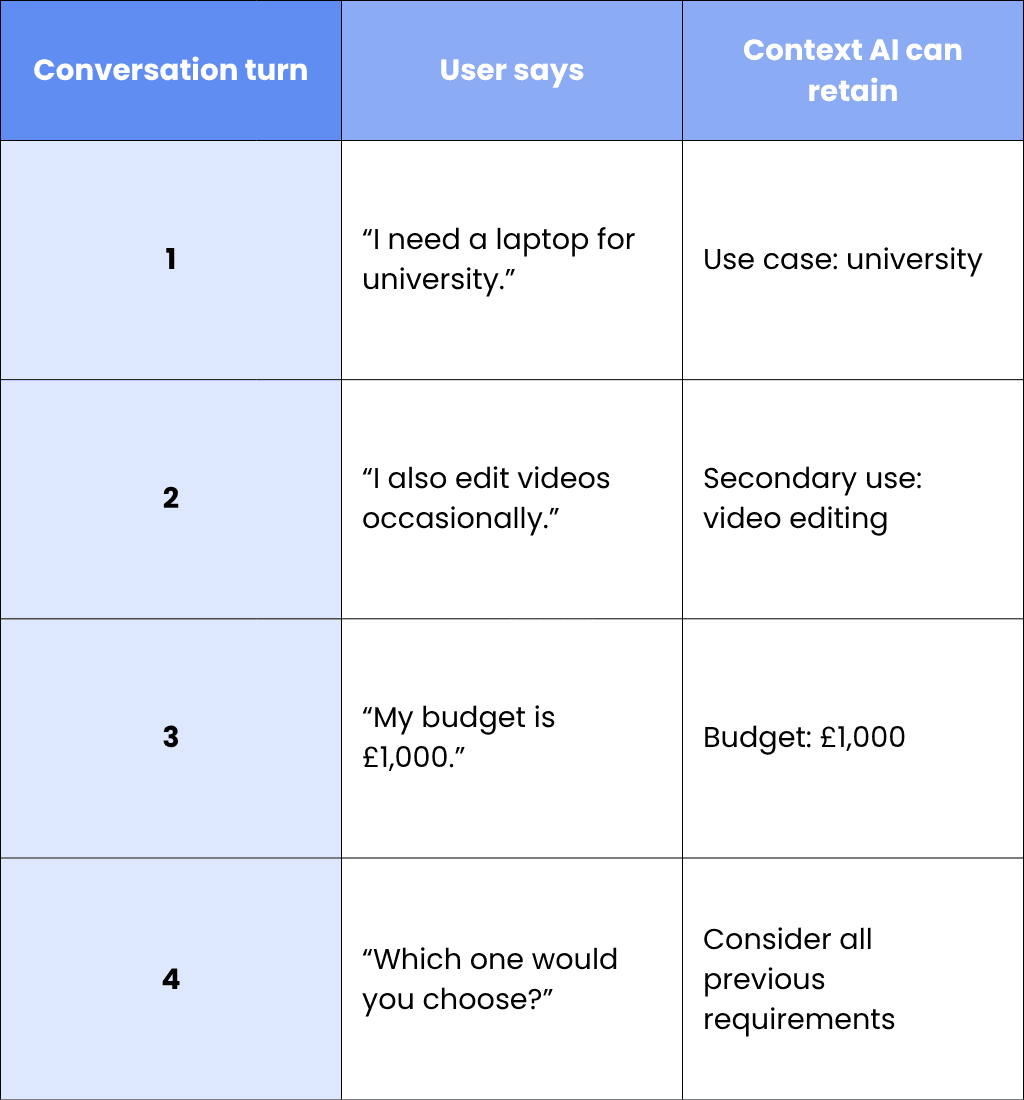
The important point is that each new question can build on the information already established. Consequently, the user can communicate naturally instead of repeating the same requirements in every message.
2. System Instructions
AI can also receive system instructions, which define how it should behave throughout an interaction. These instructions can establish the assistant’s role, tone, response format, business rules or limitations before the user even asks a question.
For instance, an F&B brand could configure an AI assistant to answer as a customer service representative, use polite language, provide information only from approved restaurant data and recommend contacting staff when a request falls outside its capabilities.
This creates a consistent layer of context that remains separate from the customer’s individual questions.
A simple way to think about it is:
System instructions = how the AI should behave
Conversation history = what the user has said
User’s latest message = what the user wants now
When these three elements work together, the AI has a much clearer understanding of both the task and the appropriate way to respond.
3. External Knowledge
Sometimes, the conversation alone is not enough. An AI assistant may need information from a website, database, product catalogue, knowledge base or another business system to answer accurately.
For example, a retail assistant could understand that a customer wants “a black running shoe under £120”, but it still needs access to current product information to determine which products are actually available. Similarly, a hotel chatbot may need live information about room availability, while an education assistant may need access to a school’s course materials and policies.
This is why many business AI systems use retrieval, APIs or other connected data sources. Rather than expecting the AI model to know every business detail, the system retrieves relevant information and supplies it as context.
The process can be simplified as:
User question → Find relevant information → Add information to context → Generate response
This approach is particularly useful because business information changes frequently. Prices, inventory, opening hours, promotions and availability may all change, so connecting AI to reliable sources is generally more practical than relying solely on static model knowledge.
4. Persistent Memory
Some AI systems can also retain selected information across conversations. This is different from ordinary conversation history because the information may remain useful after the original conversation has ended.
For example, an education platform could remember that a learner prefers concise explanations, while a customer assistant might retain a user’s preferred language or previously stated service preferences. In future interactions, the system could use that information to personalise its responses.
However, persistent memory should be designed carefully. Not every piece of information needs to be stored, and businesses need clear rules around privacy, security, retention and user control.
A useful distinction is:
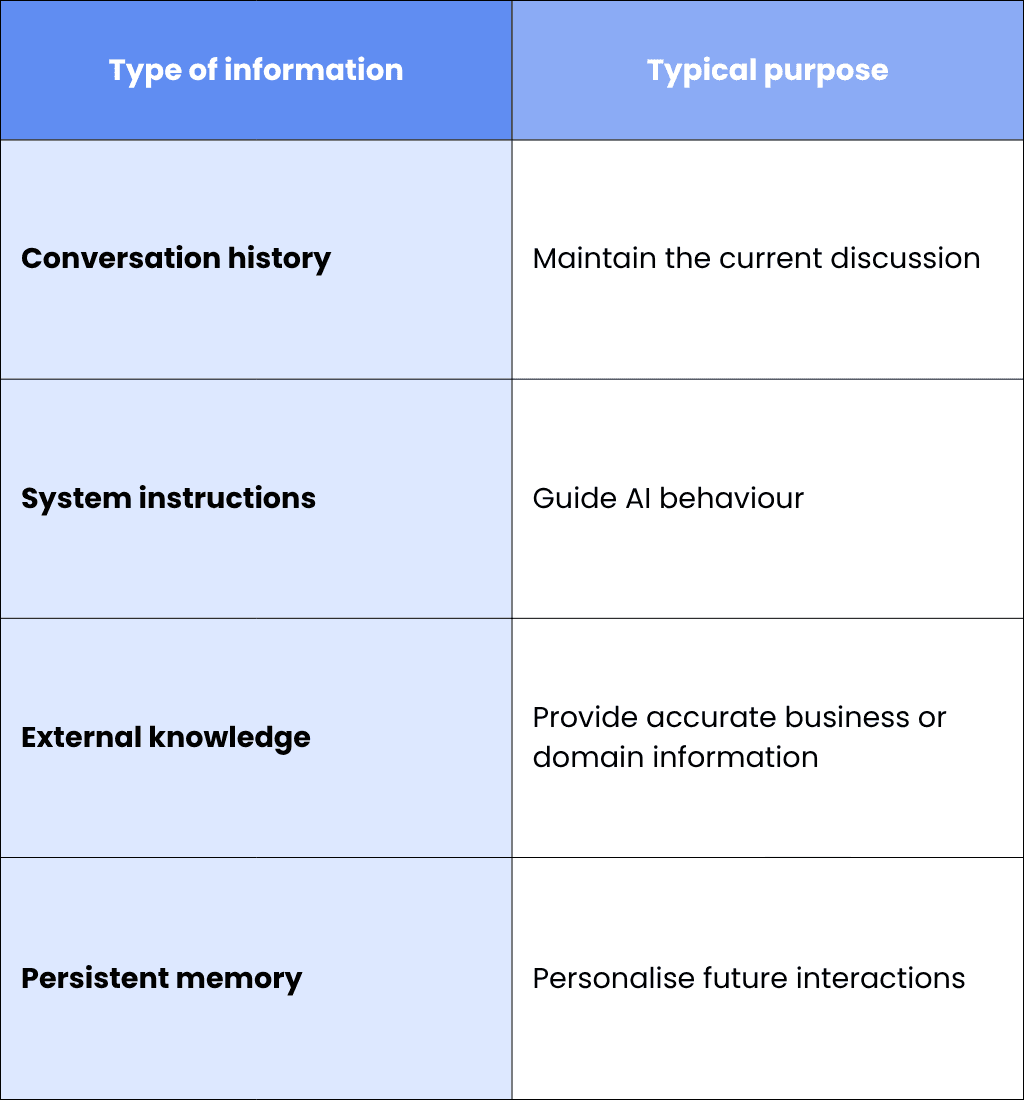
These layers can work together, but they should not be confused. A customer’s previous message, for example, may only need to remain relevant for the current conversation, whereas a saved preference could potentially be useful across multiple sessions.
Why Does Multi-Turn Conversation Matter For Businesses?
The technical ability to maintain context becomes much more valuable when it is connected to a real customer journey.
Customers rarely communicate everything they need in a single, perfectly structured question. Instead, they tend to ask a question, provide more information, change their preferences and ask follow-up questions as they go.
Multi-turn conversation allows businesses to support this natural behaviour.
It Reduces Repetition
Without context, customers may need to repeat information every time they ask a follow-up question.
For example:
“I’m travelling with two children.”“We need a family room.”“Does it include breakfast?”“Can we check in early?”
A context-aware hospitality assistant can understand that these questions relate to the same booking requirements. This creates a smoother experience and reduces unnecessary friction.
It Supports More Complex Customer Journeys
Multi-turn interactions are particularly useful when a decision requires several pieces of information.
A retail assistant could first identify a shopper’s budget, then understand their preferred style, intended use and product requirements before recommending suitable products. Similarly, an education platform could ask a learner a series of questions before deciding which explanation or learning resource would be most useful.
Instead of forcing customers to navigate a rigid sequence of forms, businesses can use conversation to gather information progressively.
It Makes AI More Useful Across Industries
This flexibility can support a wide range of business applications:
- F&B: answering menu questions, understanding dietary requirements and suggesting suitable dishes.
- Retail: comparing products, refining preferences and supporting purchase decisions.
- Education: explaining concepts, asking follow-up questions and adapting learning support.
- Hospitality: handling guest enquiries, recommending services and assisting with bookings.
The common factor is simple: the customer’s needs develop throughout the conversation.
What Are The Benefits Of Multi-Turn AI?
Once AI can maintain relevant context, the conversation becomes more than a series of isolated questions and answers. It can become a guided interaction that helps users reach an outcome more efficiently.
1. More Natural Conversations
Users can communicate in smaller steps rather than preparing one detailed prompt. This feels more natural because the AI can respond to information as it emerges.
2. Better Personalisation
The system can use details provided earlier in the conversation to tailor recommendations and responses.
For example, a retailer does not need to ask a customer’s budget again every time it recommends another product. The AI can use the previously stated budget as part of the current context.
3. Less Friction
Every repeated question adds effort to the customer journey. By carrying relevant information forward, multi-turn AI can reduce repetition and make interactions faster.
4. Better Support For Complex Tasks
Some tasks cannot be completed effectively with a single question.
A customer may need help choosing a product, planning a trip, understanding a policy or resolving an account issue. Multi-turn conversation allows the AI to gather the necessary information progressively instead of requiring the user to provide everything at once.
5. Greater Opportunities For Automation
For businesses, this can also support more advanced workflows. An AI assistant might collect initial information, answer routine questions, retrieve relevant data and then pass a more complete request to a human employee when escalation is necessary.
The result is not simply a better chatbot. It can become a more efficient layer between customers, employees and business systems.
What Happens When AI Loses Context?
Even advanced AI systems can lose or misinterpret context.
This can happen when a conversation becomes very long, when relevant information is no longer included in the active context, or when the system retrieves incomplete or outdated information.
Long interactions can therefore require deliberate context management. Some systems may truncate older messages, while more sophisticated applications can summarise earlier exchanges, retrieve relevant information again or store important details separately. OpenAI and Anthropic both document techniques for managing long-running conversations and context limitations.
There is also a second problem: irrelevant context.
More information is not always better.
If an AI assistant receives a large amount of outdated information alongside a simple customer request, it may have more material to process but less clarity about what actually matters.
Good AI design therefore focuses on relevant context, not simply more context.
What Can Businesses Build With Multi-Turn AI?
The most common applications depend on the customer journey a business wants to improve.
AI Customer Service Assistant
A business can build an AI support assistant that handles an issue over several messages rather than answering each question independently.
For example:
“My order hasn’t arrived.”“When did you place the order?”“Yesterday.”“I see. Do you have your order number?”“Yes, it’s 45821.”“Thank you. I can see that the order is currently out for delivery.”
The AI uses information provided throughout the conversation to understand the problem, collect the necessary details and determine the next step.
AI Product Recommendation Assistant
Retailers can build conversational shopping assistants that help customers find products through a series of questions.
Instead of asking a customer to search through dozens of filters, the AI might ask:
“What are you looking for?”“Running shoes.”“Where will you mainly use them?”“Road running.”“What is your budget?”“Around £120.”
The assistant can then use these details to narrow the available products and explain why particular options may suit the customer.
AI Booking And Enquiry Assistant
Hospitality businesses can use multi-turn AI to guide customers through enquiries about rooms, restaurants, events or activities.
For example, a hotel assistant could establish the guest’s dates, number of guests, room preferences and additional requirements before presenting suitable options. A restaurant could use a similar experience to answer menu questions, understand dietary requirements and help a customer decide what to order.
AI Learning Assistant
Education providers can build AI tutors that ask questions, assess the learner’s responses and adjust the next explanation accordingly.
For example, instead of immediately giving a definition, the AI might ask what the student already understands, identify a knowledge gap and then provide an explanation at an appropriate level. The conversation becomes part of the learning process.
AI Lead Qualification Assistant
Businesses can also use multi-turn AI to qualify enquiries before passing them to a sales team.
The AI could ask about the company’s requirements, budget, timeline and current challenges. Once enough information has been collected, it could summarise the enquiry and route it to the appropriate team.
This can be particularly useful for companies that receive a high volume of enquiries but need to prioritise leads based on specific criteria.
How Businesses Can Design Better Multi-Turn AI Experiences
Once a business has identified the right use case, the next step is to design the conversation carefully.
Start With A Specific Business Problem
Businesses should avoid building an AI assistant simply because AI is available. Instead, start by identifying a process that involves repetitive questions, lengthy forms, complex decisions or unnecessary handovers.
For example, a retailer might discover that customers regularly ask five or six questions before choosing a product. That journey could be a strong candidate for a conversational shopping assistant.
Decide What The AI Needs To Know
Next, identify which information should carry from one turn to the next.
For a hotel booking assistant, this could include:
- Check-in and check-out dates
- Number of guests
- Room preferences
- Special requirements
- Budget
The AI does not need to remember everything the user says. It needs to retain the information that helps it provide the next useful response.
Connect The AI To Business Systems
The conversation itself is only one part of the experience. To provide useful answers, the AI may also need access to reliable business information.
A retail assistant may need product and stock data. A hotel assistant may need room availability and booking information. A customer service assistant may need access to order records.
This is where AI becomes more than a conversational interface: it becomes a layer that connects the customer to the business's information and processes.
Give The Conversation A Clear End Point
A good multi-turn experience should have a purpose.
That might be recommending a product, answering a support issue, qualifying a lead, completing a booking or handing a detailed enquiry to a member of staff.
The objective is therefore not to make conversations longer. It is to use context to make them more efficient and more useful.
Include Human Escalation Where Needed
Finally, businesses should define when the AI should stop and involve a human.
If an enquiry is particularly complex, sensitive or outside the AI's capabilities, the system should provide a straightforward route to human support. Where appropriate, the conversation history can also be passed to the employee so the customer does not have to repeat everything.
Measure The Experience
Finally, businesses should measure whether multi-turn AI is actually improving the customer journey.
Useful metrics may include:
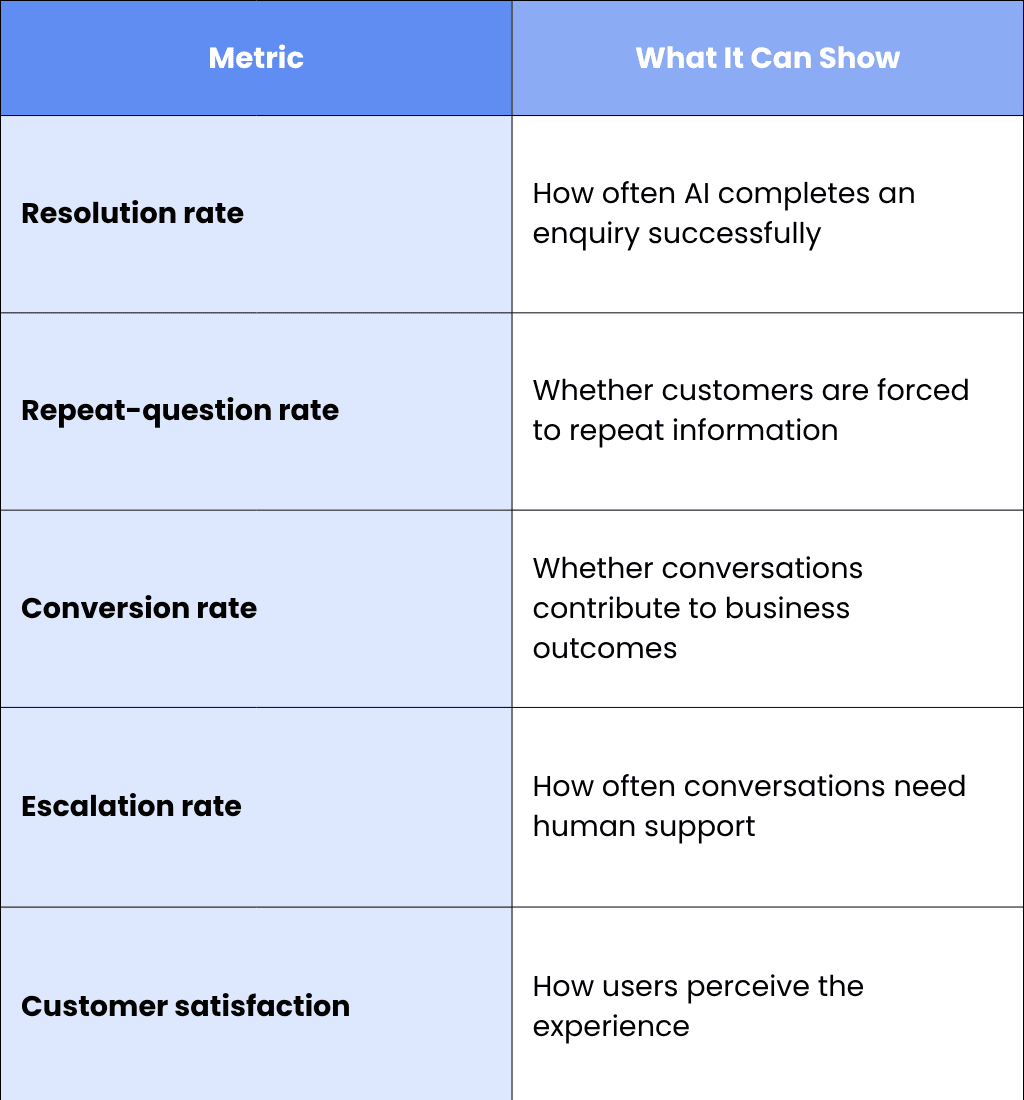
Ultimately, effective multi-turn AI is not about creating the longest possible conversation. It is about creating shorter paths to useful outcomes.
When an AI system understands what has already been said, has access to reliable information and knows what to do next, conversations become more helpful for users and more valuable for businesses.
Multi-Turn Conversation and the Future of Search
Multi-turn interaction also has implications for digital marketing.
Traditional search behaviour often begins with a query and a list of results. Conversational AI introduces another model: users can ask follow-up questions and refine their intent through a dialogue.
For brands, this creates a new challenge.
Being visible online is no longer only about ranking for a single keyword. Businesses increasingly need content that is structured, understandable, authoritative and useful across different stages of an information journey.
This is particularly relevant as AI platforms increasingly provide direct answers rather than simply directing users towards search results.
For organisations investing in digital growth, the opportunity is to make their information easy for both people and AI systems to understand.
That means well-structured content, strong topical coverage, technically sound websites, clear entities and trustworthy information all become increasingly important.
How Saigon Digital Can Help Your Business Prepare for AI-Led Discovery
As AI changes how people search, compare and make decisions, businesses need a digital strategy that connects traditional search visibility with emerging AI experiences.
That is where Saigon Digital can help.
Saigon Digital is an SEO Agency focused on solving digital challenges with forward-thinking, user-centric and bespoke solutions. We turn strategy, creativity and data into measurable business growth, helping ambitious brands improve visibility across web, search and AI-powered experiences.
Our SEO Services are designed to do more than improve rankings. We focus on measurable business outcomes through:
- Site Optimisation & Technical Performance
- Content & Authority Building
- Local & Global Search Strategy
For businesses adapting to AI-driven discovery, our Generative Engine Optimisation (GEO) services help brands become more discoverable, quotable and trustworthy across AI platforms such as ChatGPT, Gemini, Perplexity and Google AI. This includes AI Readability Optimisation, GEO, Answer Engine Optimisation, Knowledge Graph & Schema Setup, AI Content Audit & Reformatting, and AI Performance Dashboards.
We also help organisations identify where AI can create operational value through AI Workflow Automation Services, including AI-driven intelligence, pre-built automation templates and custom AI agents.
Ready To Turn AI Conversations Into Business Growth?
Multi-turn AI can do more than make conversations feel natural. When thoughtfully designed, it can help businesses improve customer experiences, streamline workflows and guide users towards meaningful outcomes.
The opportunity lies in connecting the right AI capabilities with strong data, content and digital foundations. At Saigon Digital, we help ambitious brands turn these opportunities into practical digital solutions.
Ready to build smarter digital experiences? Let’s turn your AI ambitions into measurable growth with Saigon Digital.
Get in touch with Saigon Digital today to start turning search intent into measurable results.
Frequently Asked Questions About Multi-Turn Conversation
1. What Is Multi-Turn Conversation In AI?
Multi-turn conversation is an interaction where AI uses relevant information from earlier messages to respond to later questions. Instead of treating every message separately, the AI can follow the conversation, understand references and build towards an outcome over multiple exchanges.
2. How Does AI Remember Context In A Conversation?
AI can maintain context by using previous conversation messages, system instructions, retrieved information and, in some applications, stored memory. The exact approach depends on how the AI system is built. Importantly, AI does not necessarily remember everything permanently; it uses the information made available to it when generating a response.
3. What Is The Difference Between AI Context And AI Memory?
AI context refers to information available to the model during a particular interaction, such as previous messages or retrieved data. AI memory generally refers to information that a system can retain and potentially use in future interactions. Context helps the AI follow the current conversation, while memory can support longer-term personalisation.
4. What Can Businesses Build With Multi-Turn AI?
Businesses can use multi-turn AI to build customer service assistants, product recommendation tools, booking assistants, AI tutors and lead qualification systems. These applications are particularly useful when customers need to provide information gradually, ask follow-up questions or complete a task across several steps.
5. Why Is Multi-Turn AI Important For Businesses?
Multi-turn AI can reduce repetition, personalise interactions and make complex customer journeys easier to navigate. For businesses in industries such as F&B, retail, education and hospitality, it can help customers find information, make decisions and complete tasks through more natural, conversational digital experiences.