



Search is changing rapidly. Traditional ranking factors still matter, but the rise of AI-powered search experiences has fundamentally shifted how content is discovered, interpreted, and surfaced to users.
Platforms such as ChatGPT, Gemini, Perplexity, and Google's AI-generated search experiences increasingly favour sources that demonstrate expertise across an entire subject area rather than isolated pieces of content targeting individual keywords.
The organisations that succeed in this environment are those that establish clear topical authority.
At the heart of this approach lies the topical authority map.
This guide explores what a topical authority map is, why it matters for modern SEO and Generative Engine Optimisation (GEO), and how businesses can build one that AI search engines trust.
What Is a Topical Authority Map?
A topical authority map is a structured framework that organises all the content your business needs to publish around a specific area of expertise.
Rather than creating content reactively or pursuing disconnected keyword opportunities, a topical authority map outlines:
- The core topics your business should own
- The supporting subtopics related to those themes
- The relationships between different pieces of content
- The internal linking structure that connects them
- The content gaps that need to be addressed
In simple terms, it acts as a blueprint for demonstrating expertise at scale.
Instead of publishing ten unrelated articles, you develop a comprehensive ecosystem of interconnected content that signals authority to both traditional search engines and AI systems.
Why Topical Authority Matters More in the AI Era
Historically, many SEO strategies focused heavily on individual keywords.
While keyword optimisation remains important, AI search engines are increasingly evaluating whether a source demonstrates broad and consistent expertise within a topic area.
Large language models synthesise information from multiple trusted sources. When determining which brands to cite or reference, they often favour organisations that exhibit:
- Depth of knowledge
- Comprehensive topic coverage
- Clear semantic relationships between content
- Consistency in messaging
- Strong evidence of expertise and trustworthiness
This means businesses can no longer rely solely on ranking a handful of commercial pages.
They must build subject matter authority.
A well-developed topical authority map helps achieve exactly that.
How AI Search Engines Interpret Authority
AI systems do not think in keywords alone.
They interpret concepts, entities, relationships, and contextual relevance.
When evaluating whether a website is a reliable source on a topic, several signals become important:
1. Comprehensive Coverage
Does the website address the major questions users have about a topic?
For example, an education provider discussing international student recruitment should also cover:
- Admission processes
- Visa guidance
- Student accommodation considerations
- Career pathways
- Tuition planning
- Country-specific education systems
Breadth and depth matter.
2. Semantic Connections
AI models recognise relationships between subjects.
Content that is strategically interconnected demonstrates a stronger understanding of a domain than isolated pages.
3. Expertise Signals
Search systems increasingly look for evidence that content has been created or reviewed by individuals or organisations with relevant experience.
Examples include:
- Author credentials
- Case studies
- Original insights
- Industry experience
- First-hand examples
4. Consistency Over Time
Authority is earned gradually.
Publishing one comprehensive article rarely establishes expertise. Consistent investment in a topic area reinforces credibility.
How to Build a Topical Authority Map
Building a topical authority map is not simply an exercise in organising keywords. Rather, it is a strategic process that helps businesses identify the subjects they should own, create meaningful connections between related topics, and develop content that demonstrates genuine expertise.
When executed effectively, a topical authority map enables both traditional search engines and AI-powered platforms to understand the depth and breadth of your knowledge.
The following framework provides a practical approach that businesses can use to build a topical authority map that AI search engines trust.
Step 1: Define the Core Topics Your Business Wants to Own
The first step is to determine the primary subject areas that align with your business objectives, products or services, and expertise. In other words, ask yourself: What topics should our brand become known for?
Many organisations make the mistake of pursuing every relevant keyword opportunity they discover. However, true authority is developed through focus. Concentrating on a select group of strategic topics allows you to build comprehensive coverage and stronger associations in the minds of both users and search engines.
To identify your core topics, consider the following questions:
- What products or services generate the greatest business value?
- What questions do prospects frequently ask before making a purchase decision?
- Which topics reflect our unique expertise and experience?
- What challenges do our customers consistently face?
For example, a hospitality group may identify the following pillars:
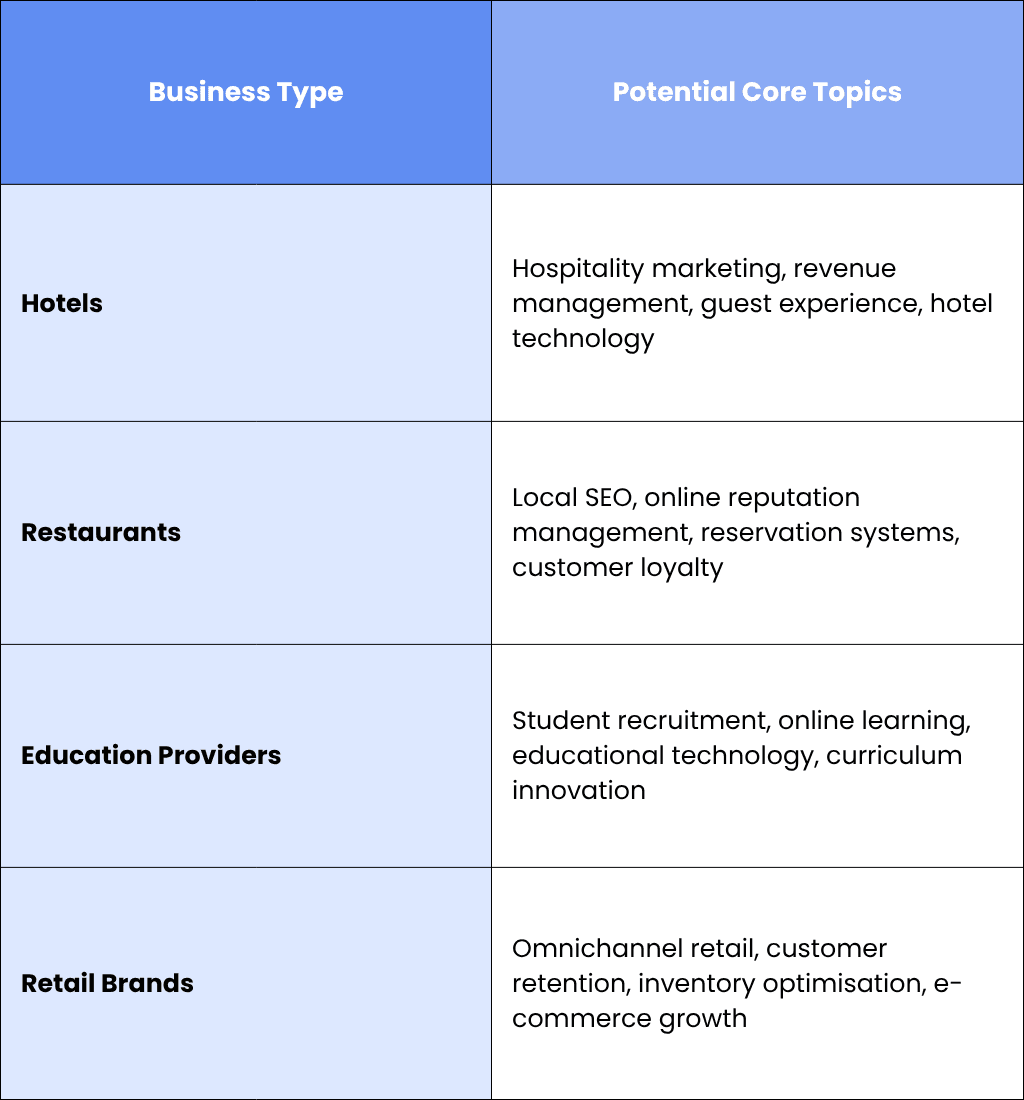
As a general guideline, most businesses benefit from focusing on three to six core topic areas. Too few may limit growth opportunities, whilst too many can dilute authority-building efforts.
Once these pillars are established, they become the foundation of your topical authority map.
Step 2: Conduct Entity and Topic Research Beyond Keywords
After defining your main themes, the next step is to understand the broader ecosystem surrounding those subjects.
Whilst keyword research remains important, AI search engines increasingly interpret information through entities and relationships rather than exact-match phrases alone. Entities refer to identifiable concepts such as brands, products, locations, services, processes, or industry terminology.
For each core topic, identify:
- Related concepts and subtopics
- Frequently asked questions
- Industry-specific terminology
- Problems users are trying to solve
- Trends influencing the sector
- Tools, platforms, or methodologies associated with the topic
For instance, if a restaurant chain wishes to establish authority around restaurant SEO, the surrounding entities may include:
- Google Business Profile
- Local citations
- Online reviews
- Menu optimisation
- Voice search
- Mobile usability
- Reservation platforms
- Food photography
- Schema markup
Mapping these relationships provides a more accurate representation of how search engines understand a topic.
A useful exercise is to ask: "If someone wanted to become an expert in this subject, what would they need to know?"
The answers often reveal valuable content opportunities that traditional keyword research may overlook.
Step 3: Organise Content into Topic Clusters
With your topics identified, you can begin structuring them into topic clusters.
Topic clusters create a logical hierarchy that demonstrates expertise through interconnected content.
Typically, this structure consists of:
Pillar Content
Pillar pages provide broad, comprehensive coverage of a major subject area.
Examples include:
- The Complete Guide to Restaurant SEO
- Hospitality Marketing Strategies for Modern Hotels
- Everything Schools Need to Know About Digital Student Recruitment
These resources serve as central hubs within the topical authority map.
Cluster Content
Cluster articles explore individual aspects of the broader topic in greater detail.
For example, under a pillar focused on restaurant SEO, supporting content may include:
- How to Optimise Your Google Business Profile
- Local SEO Tips for Independent Restaurants
- Managing Online Reviews to Improve Visibility
- Using Structured Data for Restaurant Websites
- Restaurant Website Mistakes That Hurt Search Rankings
A simple visualisation may look like this:
Restaurant SEO (Pillar Page)
→ Google Business Profile Optimisation
→ Local Citation Building
→ Restaurant Review Management
→ Schema Markup for Restaurants
→ Mobile SEO Best Practices
→ Voice Search for Restaurants
This interconnected structure helps search engines recognise subject expertise whilst guiding users through related information naturally.
Step 4: Map Content to Different Stages of Search Intent
Not all users are seeking the same type of information.
Some are learning, others are comparing options, and some are ready to engage a provider. Therefore, a strong topical authority map addresses multiple forms of search intent throughout the customer journey.
Generally, search intent can be divided into three categories.
Informational Intent
Users seeking education and understanding.
Examples include:
- What is local SEO?
- How does AI search work?
- Why are online reviews important for restaurants?
Commercial Investigation Intent
Users evaluating potential solutions.
Examples include:
- SEO agency versus in-house marketing team
- Best SEO strategies for hotels
- How to choose an education marketing agency
Transactional Intent
Users preparing to take action.
Examples include:
- SEO services for hospitality businesses
- Generative Engine Optimisation agency
- Local SEO consultants near me
A practical way to evaluate your authority map is to review whether each core topic includes content addressing all three stages.
For example:
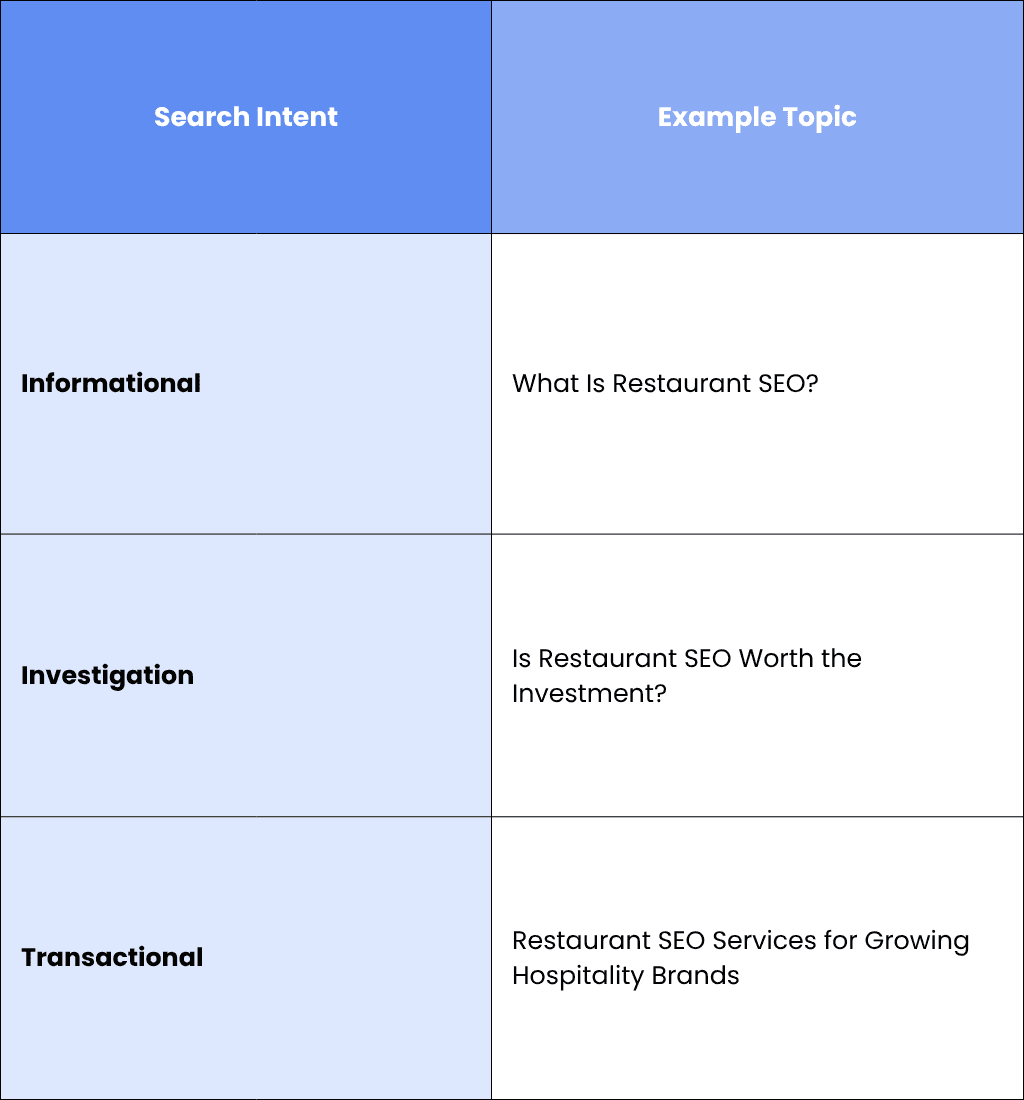
By aligning content with intent, businesses improve their ability to attract, educate, and convert prospective customers.
Step 5: Create Strategic Internal Linking Pathways
Once content is published, internal linking becomes the mechanism that connects your authority map together.
Without these connections, even excellent content may remain isolated.
Internal links help search engines understand:
- Which pages are most important
- How topics relate to one another
- The hierarchy of information across the website
- The broader context surrounding a subject
To strengthen your topical authority map:
- Link cluster articles back to their relevant pillar page.
- Link pillar pages to supporting resources.
- Cross-link related articles where appropriate.
- Update older content with links to newly published material.
- Use descriptive anchor text that reflects the destination topic.
For example, an article discussing online reviews could naturally link to resources covering Google Business Profile optimisation or local SEO strategies.
Over time, these pathways reinforce semantic relationships and improve discoverability across the entire website.
Step 6: Prioritise Depth and Usefulness Over Publishing Volume
Many businesses assume that publishing more content automatically leads to stronger authority.
In reality, quality consistently outperforms quantity.
AI search engines increasingly evaluate whether content genuinely satisfies user needs. As a result, producing large volumes of superficial articles often delivers limited value.
Before publishing, ask whether the content:
- Answers the user's question comprehensively
- Provides actionable recommendations
- Reflects current industry best practices
- Demonstrates practical experience
- Offers insights unavailable elsewhere
For instance, one detailed guide on improving local visibility for restaurants may generate greater long-term value than ten brief articles repeating generic advice.
When resources are limited, investing in fewer but stronger assets is usually the wiser strategy.
Step 7: Strengthen Authority Through Original Experience and Insights
As AI-generated content becomes increasingly widespread, originality has emerged as a significant differentiator.
Businesses possess valuable experiences that competitors cannot easily replicate. Incorporating these insights helps establish credibility and trustworthiness.
Consider including:
- Case studies demonstrating measurable outcomes
- Proprietary research and survey findings
- First-hand observations from client engagements
- Commentary from subject matter experts
- Lessons learned through implementation
- Industry-specific benchmarks
For example, rather than simply advising hotels to improve website speed, a hospitality agency could explain how performance improvements contributed to increases in direct bookings or organic traffic.
These practical examples elevate content from theoretical guidance to evidence-based expertise.
Step 8: Support Your Authority Map with Structured Data
Even the most valuable content benefits from clear technical communication.
Structured data helps search engines interpret information more accurately by defining what various elements on a page represent.
Relevant schema types may include:
- Organisation schema
- Article schema
- Author schema
- FAQ schema
- Review schema
- Service schema
- Event schema
Whilst structured data does not guarantee improved rankings, it strengthens machine readability and contributes to broader knowledge graph understanding.
As AI search experiences continue to evolve, helping systems interpret your expertise accurately becomes increasingly important.
Step 9: Audit, Refine, and Expand Your Authority Map Regularly
A topical authority map should be viewed as a living framework rather than a one-time project.
Industries evolve, customer behaviours shift, and new opportunities emerge. Consequently, regular reviews are essential to maintaining relevance and competitiveness.
Conduct periodic audits to identify:
- Content gaps within existing clusters
- Pages requiring updates due to changing information
- Emerging topics worthy of expansion
- Internal linking opportunities
- Underperforming assets that need improvement
As a practical benchmark, businesses may wish to review their topical authority map every six to twelve months, depending on the pace of change within their industry.
For example, educational institutions adapting to developments in AI-assisted learning may need more frequent updates than organisations operating in relatively stable sectors.
Consistent refinement ensures that your authority continues to grow alongside your market.
Bringing Your Topical Authority Map Together
When viewed collectively, a topical authority map functions much like a blueprint for sustainable search visibility.
The process typically follows this progression:
- Identify your core topics.
- Research related entities and subtopics.
- Organise content into topic clusters.
- Align content with user intent.
- Establish strong internal linking structures.
- Focus on quality and usefulness.
- Incorporate original expertise and experience.
- Enhance clarity through structured data.
- Continuously audit and refine your strategy.
Whilst building a topical authority map requires time and commitment, the long-term benefits can be substantial. Businesses that consistently demonstrate expertise across interconnected topics are more likely to earn trust from both users and AI-powered search systems.
In an increasingly competitive digital landscape, authority is no longer built through isolated keywords or one-off campaigns. Instead, it is established through comprehensive, user-focused knowledge ecosystems that answer questions, solve problems, and deliver genuine value over time.
What Does Success Look Like?
Building a topical authority map requires a long-term commitment. Unlike short-lived tactics designed to generate temporary ranking gains, authority-building compounds over time. As your content ecosystem expands and becomes more interconnected, search engines and AI platforms gain greater confidence in your expertise.
However, organisations often ask an important question: How do we know whether our topical authority strategy is working?
Success is not measured by a single metric. Instead, it becomes visible through a combination of improvements in visibility, engagement, lead quality, and brand perception. The following indicators can help businesses assess whether their topical authority efforts are delivering meaningful results.
Increased Organic Visibility
One of the earliest signs of a successful topical authority strategy is a broader presence across organic search results.
Whilst many businesses initially focus on rankings for a small number of high-priority keywords, topical authority often produces a much wider impact. As search engines recognise your expertise within a subject area, they become more likely to surface your content for a larger variety of related searches.
For example, a hospitality business that publishes a comprehensive cluster around hotel marketing may initially target terms such as:
- Hotel SEO strategies
- Hospitality digital marketing
- Marketing for independent hotels
However, over time, the same content ecosystem may begin ranking for additional searches such as:
- How hotels improve direct bookings
- Guest experience marketing ideas
- Hotel website optimisation tips
- Hospitality marketing trends
This phenomenon is often referred to as keyword expansion, whereby one topic cluster generates visibility across dozens or even hundreds of semantically related searches.
To monitor progress, businesses should track:
- Growth in total organic impressions
- The number of ranking keywords across topic areas
- Improvements in average search positions
- Changes in organic traffic over time
For instance, increasing from 200 ranking keywords to 800 ranking keywords within a year may indicate that search engines are developing stronger associations between your brand and the subject matter you cover.
Importantly, visibility growth should be evaluated within the context of strategic topics rather than vanity metrics alone.
Greater Share of Voice Within Your Industry
Beyond rankings, successful topical authority translates into increased share of voice.
Share of voice refers to the proportion of conversations, searches, and digital visibility your brand commands compared with competitors within a specific topic area.
Consider the example of a retail technology provider specialising in omnichannel commerce. If prospects consistently encounter that company's insights when researching inventory management, customer loyalty, or retail analytics, the organisation effectively occupies more mental and digital space within the industry.
Over time, this increased visibility can strengthen brand recognition and influence purchasing decisions before formal buying processes even begin.
Businesses can evaluate share of voice by asking:
- Are we appearing for the topics most relevant to our expertise?
- Are we gaining visibility across multiple stages of the customer journey?
- Are competitors dominating conversations that we should be leading?
Indicators of growing share of voice may include:
- Increased mentions within industry discussions
- Greater visibility across relevant search themes
- More frequent appearances in AI-generated responses
- Rising brand awareness amongst target audiences
Ultimately, the goal is not merely to participate in industry conversations but to become one of the recognised sources shaping them.
Improved Engagement Metrics
Attracting visitors is only part of the equation. Successful authority-building should also improve how audiences interact with your content.
When users perceive information as relevant, trustworthy, and useful, they tend to engage more deeply.
Positive engagement signals may include:
- Longer average time spent on page
- Increased pages viewed per session
- Higher scroll depth on long-form resources
- More interactions with internal links
- Growth in newsletter subscriptions or resource downloads
For example, imagine a business publishes a comprehensive pillar page supported by five related cluster articles.
Previously, visitors may have viewed one page and exited the website immediately. Following the implementation of a topical authority map, users might explore three or four interconnected resources before leaving.
Whilst engagement metrics do not directly determine rankings, they can reveal whether content effectively addresses user needs.
When analysing performance, businesses should focus on trends rather than isolated fluctuations.
Questions worth considering include:
- Are users consuming multiple pieces of related content?
- Which clusters generate the strongest engagement?
- Where do visitors abandon the journey?
These insights can inform future optimisation efforts and content development priorities.
Higher-Quality Inbound Leads
Increased traffic is valuable only if it contributes to meaningful business outcomes.
One of the most significant advantages of topical authority is its ability to attract visitors with stronger intent and a clearer understanding of their needs.
By educating audiences throughout their decision-making journey, businesses position themselves as trusted advisors long before prospects initiate direct contact.
As a result, inbound enquiries often become more qualified.
Examples of positive indicators include:
- Prospects referencing specific articles during consultations
- Shorter sales cycles due to greater pre-purchase understanding
- Higher conversion rates from organic channels
- Increased enquiries aligned with priority services
Consider an education consultancy that develops authoritative resources addressing international admissions processes.
A prospective student who has already consumed several of these resources may approach the organisation with greater confidence and clearer expectations than someone arriving through a generic advertisement.
This difference can improve both efficiency and conversion outcomes.
Businesses should therefore monitor:
- Organic lead volume
- Lead-to-customer conversion rates
- Revenue generated from organic channels
- Average deal value associated with inbound enquiries
When authority-building efforts are successful, organisations frequently observe not only more leads but better leads.
Stronger Performance in AI-Generated Search Experiences
As AI-powered search platforms continue to evolve, visibility within these environments represents an increasingly important success indicator.
Platforms such as ChatGPT, Gemini, Perplexity, and Google's AI-generated experiences aim to provide users with direct answers supported by trustworthy sources.
Although the mechanisms behind these systems continue to develop, brands demonstrating strong topical authority are often better positioned to influence AI-generated responses.
Indicators of progress may include:
- Increased referral traffic from AI-powered discovery tools
- More frequent citations of your brand or content
- Greater visibility in AI Overviews and answer-based experiences
- Improved performance for conversational search queries
For example, a hospitality consultancy consistently publishing comprehensive resources on hotel marketing may eventually become one of the sources informing AI-generated explanations related to that topic.
Whilst direct attribution remains challenging, organisations should begin monitoring emerging indicators alongside traditional SEO metrics.
The ability to earn trust within AI ecosystems is likely to become an increasingly valuable competitive advantage.
Enhanced Brand Credibility and Trust
Perhaps the most enduring outcome of topical authority is the development of stronger brand credibility.
Repeated exposure to valuable, insightful content reinforces perceptions of expertise. Over time, audiences begin to associate your organisation with reliability and leadership within your field.
This trust can influence purchasing decisions in ways that extend beyond measurable search performance.
For instance, businesses demonstrating consistent expertise may experience:
- Increased invitations to contribute to industry publications
- More opportunities to participate in speaking engagements
- Greater confidence from prospective clients
- Stronger referral activity from existing customers
- Improved stakeholder perceptions internally and externally
Trust is particularly important in sectors such as education, healthcare, hospitality, and professional services, where decision-making often involves significant investment or perceived risk.
Whilst credibility can be difficult to quantify, its effects frequently become visible through stronger relationships and improved business resilience.
Success Is Cumulative, Not Instantaneous
It is important to recognise that topical authority rarely produces overnight transformations.
Unlike paid advertising campaigns that generate immediate exposure, authority-building relies upon consistency and sustained investment.
A typical progression may resemble the following:
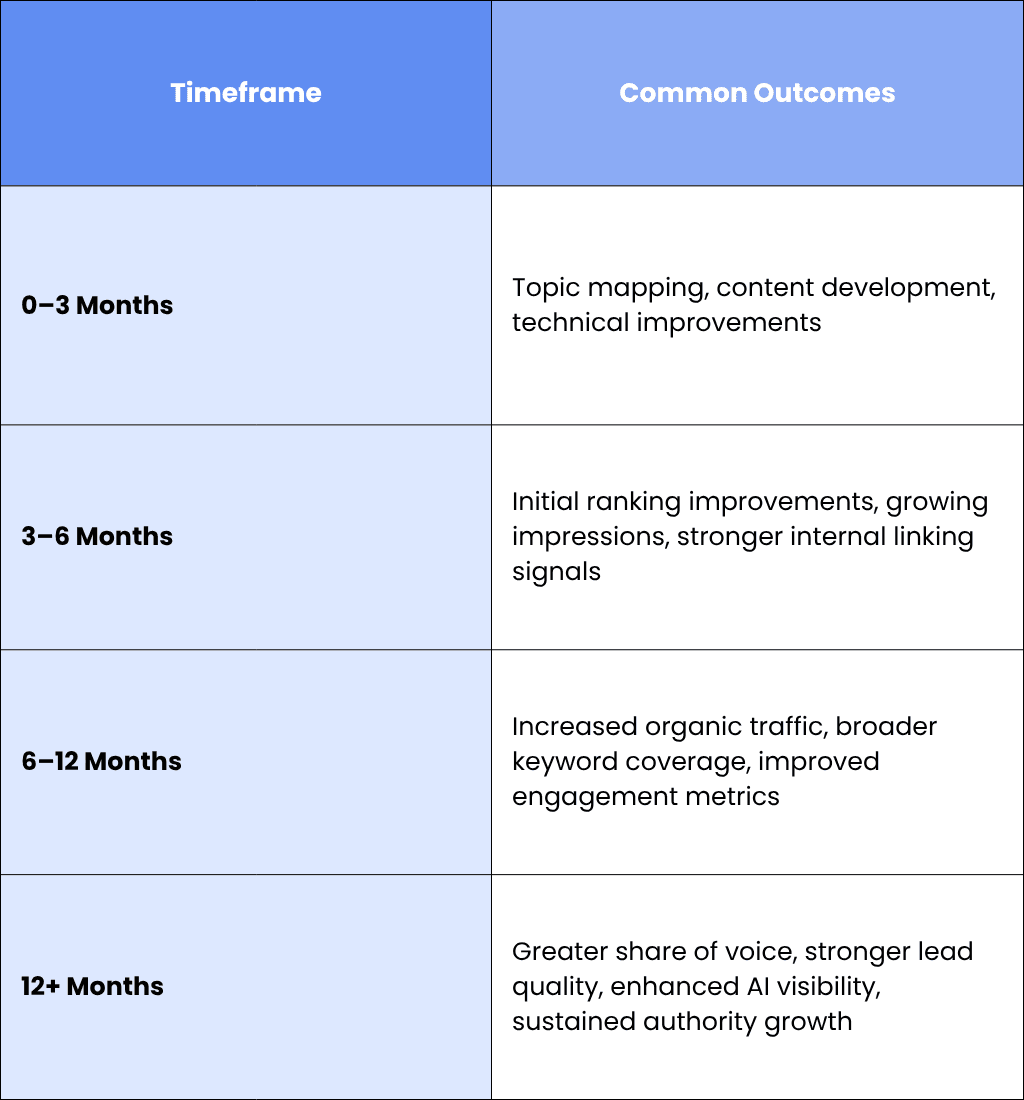
Naturally, timelines vary depending on factors such as competition levels, domain maturity, resource allocation, and industry complexity.
Nevertheless, organisations adopting a strategic, long-term perspective are generally more likely to realise meaningful results.
How Saigon Digital Helps Businesses Build Trusted Authority
Building a topical authority map requires strategic planning, technical expertise, and a deep understanding of how both search engines and AI systems interpret information.
At Saigon Digital, we help ambitious brands design and execute authority-building strategies that drive measurable business outcomes.
Our SEO services extend beyond rankings to focus on sustainable growth through:
- Site optimisation and technical performance improvements
- Content strategy and authority building
- Local and global search strategies tailored to your market
As search evolves, we also support businesses through specialised Generative Engine Optimisation (GEO) services designed to improve visibility across platforms such as ChatGPT, Gemini, Perplexity, and Google's AI experiences.
These services include:
- AI readability optimisation
- Generative Engine Optimisation (GEO)
- Answer Engine Optimisation (AEO)
- Knowledge graph and schema implementation
- AI content auditing and reformatting
- AI performance reporting and dashboards
For organisations looking to streamline operations, our AI Workflow Automation solutions help teams reduce manual processes and unlock new efficiencies through custom AI-powered systems.
At Saigon Digital, we combine strategy, creativity, and data to solve complex digital challenges with forward-thinking, user-centric, and bespoke solutions.
Because sustainable growth is not achieved through shortcuts.
It is built through expertise, trust, and the consistent delivery of value.
Ready to Build Authority That Drives Real Business Growth?
The question is no longer whether businesses should pursue topical authority.
The real question is how quickly they can build it.
For brands ready to lead rather than follow, now is the time to begin.
If your organisation is ready to strengthen its authority, improve its visibility across both search engines and AI platforms, and build a sustainable foundation for long-term growth, Saigon Digital is ready to help you take the next step.
Get in touch with us today!
Frequently Asked Questions About Building a Topical Authority Map
1. What is a topical authority map?
A topical authority map is a strategic framework that organises all the content your business needs to create around a particular area of expertise. It outlines your primary topics, supporting subtopics, content clusters, internal linking opportunities, and user intent considerations.
Rather than publishing isolated articles targeting individual keywords, a topical authority map helps businesses build comprehensive content ecosystems that demonstrate expertise to both traditional search engines and AI-powered platforms. Ultimately, it provides a roadmap for establishing your brand as a trusted source within your industry.
2. Why is a topical authority map important for AI search engines?
AI search engines increasingly prioritise sources that demonstrate depth, consistency, and expertise across a subject area. Instead of evaluating pages solely based on keyword usage, these systems assess how well organisations cover interconnected topics and answer users' questions comprehensively.
A well-structured topical authority map helps AI platforms understand:
- The subjects your business specialises in
- The relationships between your content assets
- The breadth and depth of your expertise
- Whether your website can be considered a trustworthy source of information
As AI-driven search experiences continue to evolve, building topical authority is becoming an essential component of long-term digital visibility.
3. How long does it take to build topical authority?
Building topical authority is an ongoing process rather than a quick-win tactic. Whilst some businesses may begin noticing improvements in organic visibility within a few months, meaningful authority often develops over a longer period.
As a general guide:
- 3–6 months: Initial gains in rankings, impressions, and topic relevance
- 6–12 months: Growth in organic traffic and broader keyword visibility
- 12 months and beyond: Stronger industry authority, improved lead quality, and increased opportunities to appear in AI-generated search experiences
The exact timeline depends on factors such as your industry's competitiveness, the quality of your content, the strength of your website's technical foundations, and the consistency of your publishing efforts.
4. How many topic clusters should a business create?
There is no universal number that applies to every organisation. However, most businesses benefit from starting with three to six core topic areas that closely align with their products, services, and commercial goals.
Each core topic can then expand into multiple supporting clusters over time.
For example, a hospitality business might focus on:
- Hotel SEO
- Hospitality marketing
- Guest experience optimisation
- Revenue management
- Hotel technology trends
The objective is not to cover every possible topic within your industry. Instead, businesses should prioritise the areas where they can offer the greatest value and demonstrate genuine expertise.
5. Should businesses build a topical authority map internally or work with an agency?
The answer depends on your internal capabilities, available resources, and growth objectives.
Some organisations have in-house teams with the expertise to conduct topic research, develop content strategies, implement technical SEO recommendations, and measure performance effectively.
However, many businesses choose to work with specialised agencies to accelerate results and ensure that their strategy aligns with evolving search behaviours.
Partnering with an experienced agency can provide access to:
- Advanced SEO expertise
- Generative Engine Optimisation (GEO) insights
- Technical SEO support
- Scalable content planning processes
- Performance measurement frameworks
- Strategic guidance tailored to your industry
For businesses operating in competitive sectors such as hospitality, retail, education, and F&B, external expertise can help transform a topical authority initiative from a collection of content ideas into a measurable growth strategy.
The most important consideration is ensuring that your topical authority map is developed with a long-term perspective, prioritising usefulness, trust, and business outcomes rather than short-term ranking gains.