



Search visibility can have a direct impact on how customers discover a business. For businesses in competitive industries such as F&B, retail, education and hospitality, appearing in front of the right audience at the right moment can make a meaningful difference to growth.
Yet SEO is not a one-off marketing task. It involves technical website improvements, keyword and audience research, content, authority building, local search, analytics and continuous optimisation. As search continues to evolve, businesses also need to consider how their websites appear in AI-powered search experiences.
This is where SEO outsourcing can make sense.
Instead of building a large in-house SEO team, a business can work with an external agency or specialist team that provides the expertise, processes and resources needed to improve organic search performance.
This guide explains what SEO outsourcing involves, what an SEO agency should actually do, how much control businesses should retain, how to choose an agency, what results to expect and how to build a productive long-term relationship with an external SEO partner.
Key Takeaways
- SEO outsourcing gives businesses access to specialist expertise without the cost of building a full in-house team.
- A comprehensive SEO programme can cover technical SEO, keyword research, content, on-page optimisation, local SEO, authority building and performance reporting.
- The choice between in-house SEO, outsourcing or a hybrid model depends on your business size, resources, goals and level of expertise.
- When choosing an agency, look beyond rankings and price. Prioritise experience, transparency, strategy, communication and measurable business outcomes.
- A clear SEO outsourcing contract should define scope, deliverables, responsibilities, reporting, costs, ownership and termination terms.
- SEO costs vary widely. In Vietnam, outsourcing can offer cost-efficient access to specialist digital expertise, particularly for businesses targeting international markets.
- As search evolves, businesses should consider AI-powered search, GEO and AEO alongside traditional SEO.
- The right SEO partner should focus on turning organic visibility into qualified traffic, leads, bookings and sustainable business growth.
What is SEO Outsourcing?
SEO outsourcing is the practice of hiring an external agency, consultant or specialist team to manage some or all of a company's search engine optimisation activities.
Rather than employing specialists in technical SEO, content, digital PR, analytics and search strategy internally, a company can access those capabilities through an external partner.
The scope can vary considerably.
A small business might outsource a technical SEO audit and receive recommendations for its internal developer to implement. A larger company might outsource its entire SEO programme, including strategy, content production, technical optimisation, authority building, reporting and ongoing experimentation.
In other cases, a company may already have an internal marketing team but lack specialist SEO expertise. It might therefore outsource specific areas while keeping overall marketing strategy and brand management in-house.
A useful way to think about it is: Your business provides the knowledge of your customers, products, services and commercial priorities. Your SEO partner provides specialist search expertise, resources and execution.
The strongest relationships combine both.
Why Are Businesses Outsourcing SEO?
SEO can deliver long-term value, but managing it well requires specialist knowledge, consistent execution and ongoing analysis. For many businesses, especially those in competitive industries such as F&B, retail, education and hospitality, outsourcing SEO provides a practical way to access this expertise without building a large in-house team.
1. Access To Specialist Expertise
SEO brings together several disciplines, including technical optimisation, keyword research, content strategy, analytics, local search and authority building. Therefore, businesses often need more than one skill set to manage SEO effectively.
For example, an education provider may need technical SEO support for its course website, content expertise to target student searches, and local or international SEO to reach students in different markets. Hiring separate specialists for each area can quickly become expensive.
By outsourcing, a business can access a wider range of expertise through one partner. This can be particularly useful for companies that have a marketing team but do not have dedicated SEO specialists.
In practice, an SEO agency may provide:
- Technical SEO specialists
- Content strategists and writers
- SEO analysts
- Local and international SEO expertise
- Digital PR and authority-building specialists
- AI search and optimisation expertise
This gives businesses a broader skill set without requiring them to build an entire SEO department internally.
2. More Efficient Use Of Internal Resources
SEO requires regular research, optimisation, monitoring and reporting. However, marketing teams often already manage campaigns, social media, paid advertising, email marketing, events and other activities. As a result, SEO can become a lower priority even when it represents an important source of potential customers.
Outsourcing can remove much of this operational workload. For instance, rather than asking an internal marketing manager to spend 15–20 hours each month analysing search performance and coordinating technical fixes, an agency can manage these activities while the internal team focuses on broader marketing priorities.
A simple example illustrates the potential efficiency:
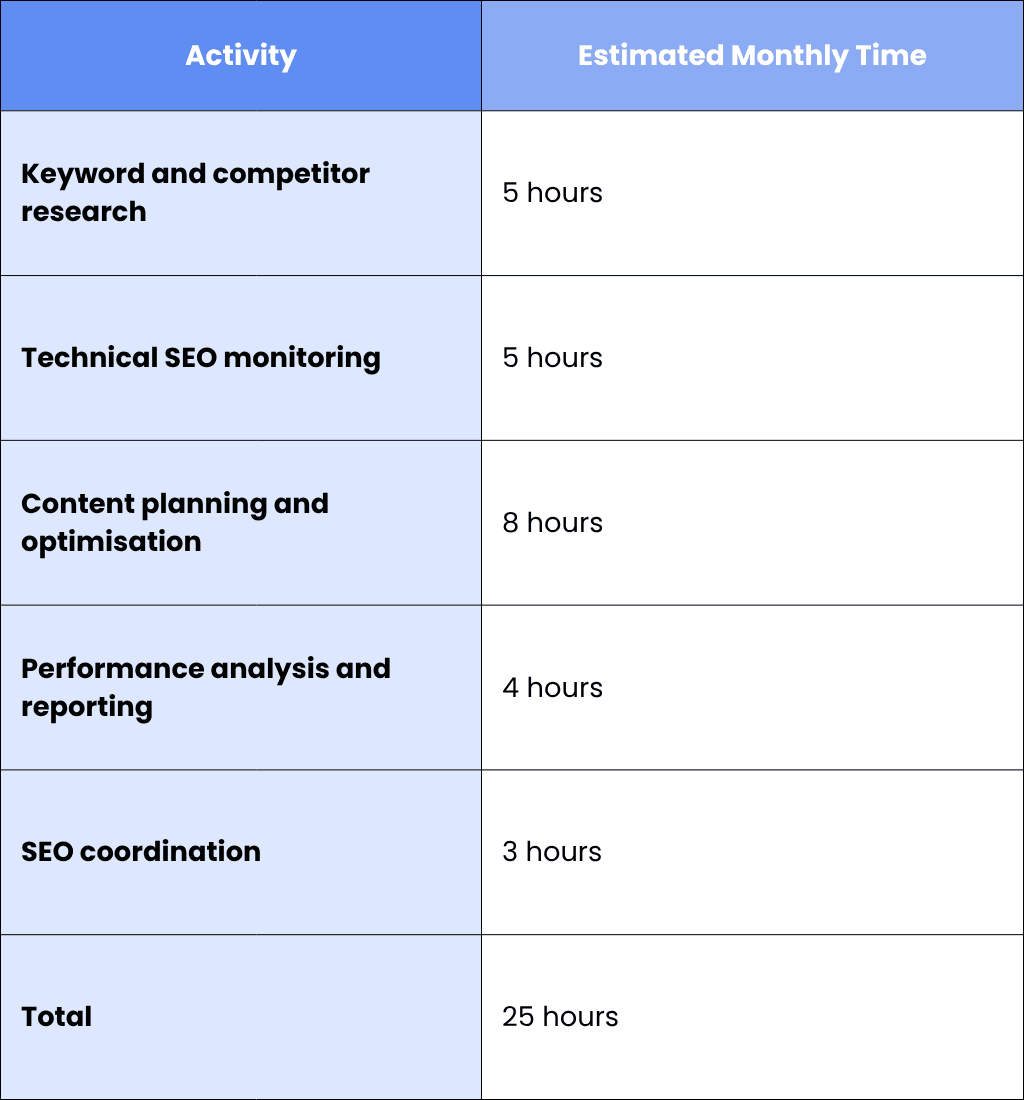
That is roughly 300 hours per year. Therefore, outsourcing can make financial sense when it allows internal employees to spend that time on activities that directly support revenue, customers or business growth.
3. Better Access To Tools And Processes
Professional SEO relies on data. Agencies commonly use specialist tools to analyse search demand, competitors, backlinks, website performance, crawling, indexing and content opportunities.
However, the value of these tools does not simply come from having access to them. More importantly, SEO specialists need to know how to interpret the data and turn it into practical actions.
For example, a technical crawling tool might identify thousands of duplicate URLs on an e-commerce website. An experienced SEO team can determine which duplicates actually matter, identify the cause and recommend the appropriate solution rather than attempting to fix every warning individually.
Similarly, keyword research might reveal 10,000 potential searches. A good agency will help narrow these down to the terms that have the strongest combination of relevance, search intent, competition and commercial value.
In other words, businesses are not just outsourcing access to SEO software. They are outsourcing the expertise needed to turn information into decisions.
4. Scalability
SEO requirements often become more complex as a business grows. A company with 20 website pages may be able to manage basic optimisation internally; however, a retailer with 20,000 product URLs, or a hotel group operating across several countries, faces a very different challenge.
Outsourcing allows SEO resources to scale alongside these changes.
For example:
- F&B: A restaurant group opening 10 new locations may need scalable local SEO and location pages.
- Retail: A growing e-commerce site may need help managing thousands of category and product pages.
- Education: A university or education provider expanding internationally may need multilingual and international SEO.
- Hospitality: A hotel group entering new destinations may need country, city and destination-focused search strategies.
Consequently, outsourcing can give businesses access to additional expertise when demand increases, without requiring them to recruit a new specialist for every new SEO challenge.
5. An Outside Perspective
Internal teams naturally understand their own products, services and brand very well. However, that familiarity can sometimes make it harder to see the website from a customer's perspective.
An external SEO team can provide a fresh view of how customers search, what competitors are doing and where the website may be losing opportunities.
For example, a hotel might describe itself internally as a "luxury urban accommodation provider". However, potential customers may search for terms such as "five-star hotel in Ho Chi Minh City", "hotel near District 1" or "hotel with rooftop pool".
The difference matters because SEO should reflect how customers search, not simply how a business describes itself.
An external agency can therefore challenge assumptions, identify missed opportunities and compare the business objectively against competitors.
At A Glance: The Main Reasons To Outsource SEO
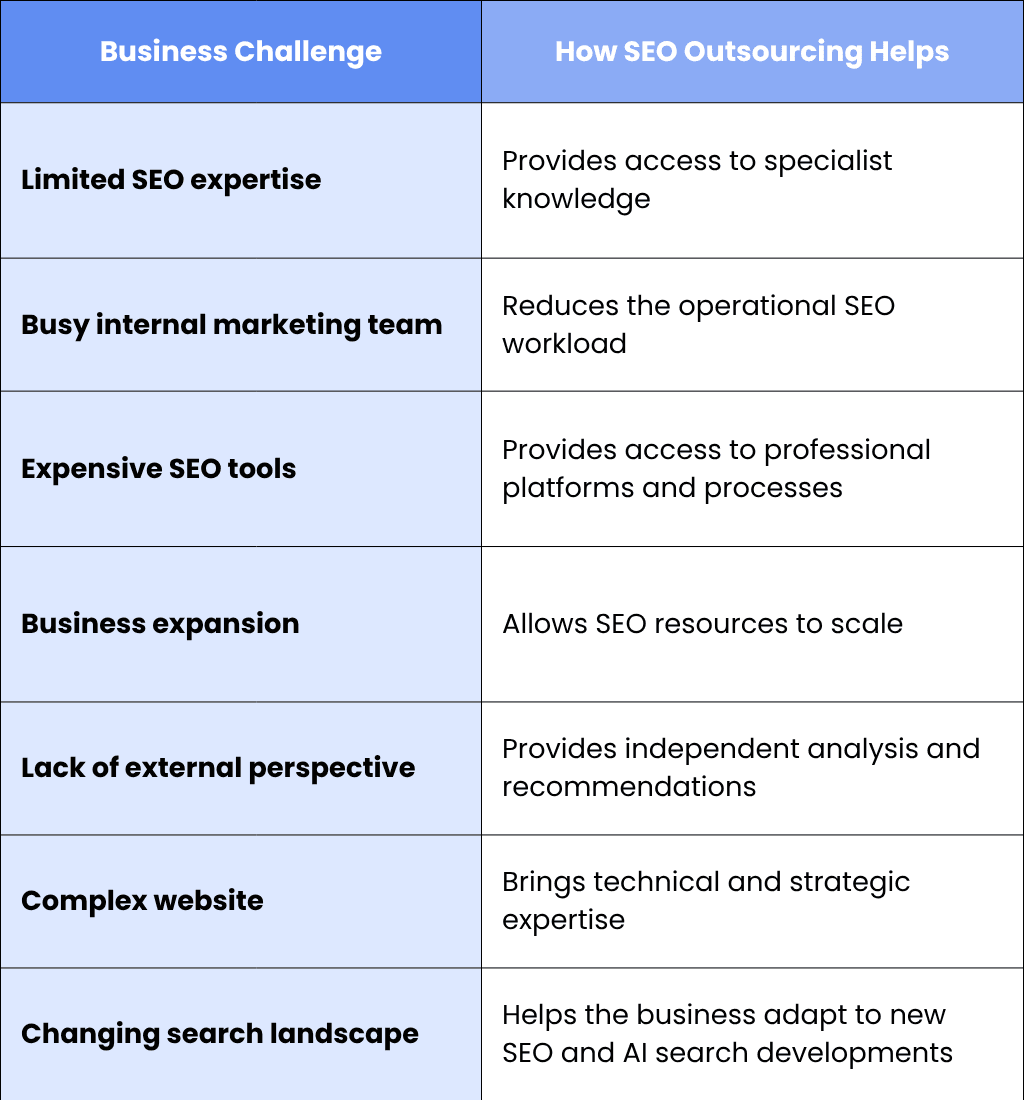
Ultimately, SEO outsourcing works best when a business treats its agency as a strategic partner rather than simply a supplier of monthly tasks. The agency should understand the company's commercial objectives, while the business should provide the industry knowledge, access and internal support needed to turn SEO recommendations into real improvements.
What Does SEO Outsourcing Usually Include?
SEO outsourcing can cover a wide range of activities, depending on the business, website and commercial goals. A small local business may only need technical improvements and local SEO, while a large retailer or hospitality group may require ongoing technical SEO, content, international search and authority building.
A good SEO outsourcing programme should therefore be tailored to the business rather than based on a fixed list of monthly tasks. The following areas are commonly included in a comprehensive SEO service.
1. Technical SEO
Technical SEO focuses on making sure search engines can efficiently access, crawl, understand and index a website. At the same time, it aims to provide visitors with a smooth experience.
An SEO agency may review areas such as:
- Website architecture and navigation
- Crawlability and indexation
- XML sitemaps and robots.txt
- URL structures
- Redirects and canonical tags
- Mobile usability
- Page speed and Core Web Vitals
- Duplicate or thin pages
- Internal linking
- JavaScript rendering
- Structured data and schema
- HTTPS and website security
For example, an e-commerce retailer might have thousands of automatically generated URLs created by product filters. If search engines crawl and index too many unnecessary URLs, the website can become harder to manage and important pages may receive less attention.
A technical SEO team can identify these issues, determine which pages should be accessible to search engines and work with developers to implement the appropriate solution.
The goal is simple: create a technically sound website that search engines can understand and users can navigate easily.
2. Keyword Research And Search Intent
Keyword research helps businesses understand what their potential customers search for. However, effective SEO outsourcing goes beyond finding keywords with high search volume.
The agency should also consider search intent — the reason behind a search.
For example, consider these searches for an education provider:
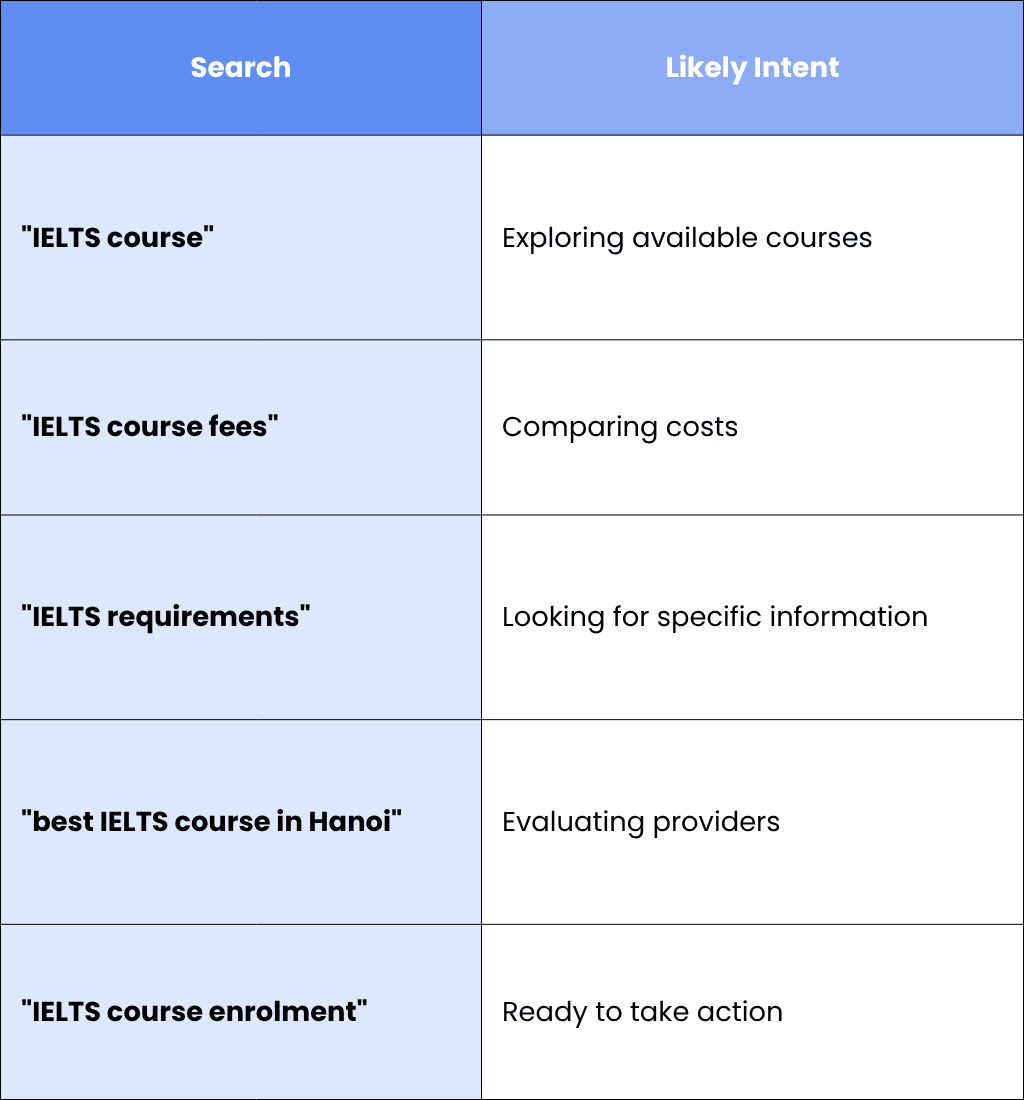
Although these searches relate to the same subject, they represent different stages of the customer journey.
Therefore, an SEO agency should map important keywords to the right pages rather than trying to rank one page for everything. This approach helps ensure that searchers land on content that actually answers their needs.
3. On-Page SEO
On-page SEO involves improving the content and structure of individual website pages so that their purpose is clear to both users and search engines.
This can include:
- Page titles
- Headings and subheadings
- Meta descriptions
- Content structure
- Keyword and topic relevance
- Internal links
- Image optimisation
- Alt text
- URLs
- Calls to action
- Supporting information
For instance, a hotel may have a page titled simply "Rooms". An SEO review might identify an opportunity to make the page more useful by clearly explaining room types, facilities, occupancy, location and booking options while naturally incorporating relevant search topics.
The aim is not to insert keywords wherever possible. Instead, the agency should make the page more useful, clearer and better aligned with what visitors are looking for.
4. Content Strategy And Content Creation
Content is often one of the largest parts of an SEO programme, but effective SEO outsourcing does not mean publishing as many articles as possible.
A good content strategy starts by identifying gaps between what customers want to know and what the website currently provides.
An agency may analyse:
- Customer questions
- Search trends
- Competitor content
- Existing website content
- Product and service information
- Commercial priorities
- Search intent
- Content performance
For example, a retail brand selling running shoes might create useful buying guides covering topics such as choosing running shoes, understanding different shoe types and comparing features. These resources can attract relevant searchers while also supporting important product and category pages.
For F&B businesses, useful content could include dining guides, location-based content or information about specific cuisines and experiences.
For education providers, content might cover course choices, entry requirements, application processes and career pathways.
The emphasis should always remain on usefulness, accuracy and relevance, rather than content volume alone.
5. Internal Linking
Internal linking is sometimes overlooked, yet it plays an important role in helping users and search engines navigate a website.
An SEO agency can identify opportunities to connect related pages strategically.
For example:
Blog article → Category page → Product page
Or:
Destination guide → Hotel location page → Room page → Booking page
This structure helps users move naturally through the website while also helping search engines understand how different pages relate to one another.
A strong internal linking strategy can be particularly valuable for larger websites where important pages may otherwise become difficult to discover.
6. Authority Building And Digital PR
SEO outsourcing may also include activities designed to strengthen a website's authority and reputation.
This can involve:
- Digital PR
- Industry publications
- Expert commentary
- Original research
- Data-led content
- Relevant business partnerships
- Industry resources
- Editorial link opportunities
For example, an education provider could publish original research about student preferences and use the findings to generate coverage from relevant education publications.
Similarly, a hospitality company might produce useful travel research or destination data that journalists and travel websites can reference.
The focus should be on earning relevant recognition, rather than simply collecting as many backlinks as possible. Quantity alone does not tell you whether a link-building campaign is effective.
7. Local SEO
Local SEO is particularly important for businesses that serve customers in specific locations, including restaurants, cafés, hotels, retail stores, schools and education centres.
An outsourced local SEO programme may include:
- Google Business Profile optimisation
- Local keyword research
- Location landing pages
- Local citations
- Review and reputation considerations
- Local content
- Business information consistency
- Local structured data
- Internal linking between location pages
Consider a restaurant group with 15 locations. Instead of creating one generic page listing every restaurant, an SEO agency might develop a clear, useful page for each location, with accurate information about the branch, services, opening details, menu and surrounding area.
This creates a better experience for both customers and search engines.
8. International SEO
Businesses entering new countries often need more than simple translation.
International SEO considers how people in different markets actually search and how websites should communicate with those audiences.
An agency may support:
- International keyword research
- Country and language targeting
- Multilingual content
- Hreflang implementation
- International website architecture
- Local search behaviour
- Regional landing pages
- International authority building
For example, a hotel brand targeting visitors from Vietnam, Singapore and the UK may need different keyword research and content approaches for each market.
Although the underlying service remains the same, customer expectations and search behaviour can vary considerably between markets.
9. SEO Analytics And Performance Reporting
SEO outsourcing should include regular measurement. However, reporting should go beyond showing a list of keyword positions.
A useful SEO report may track:
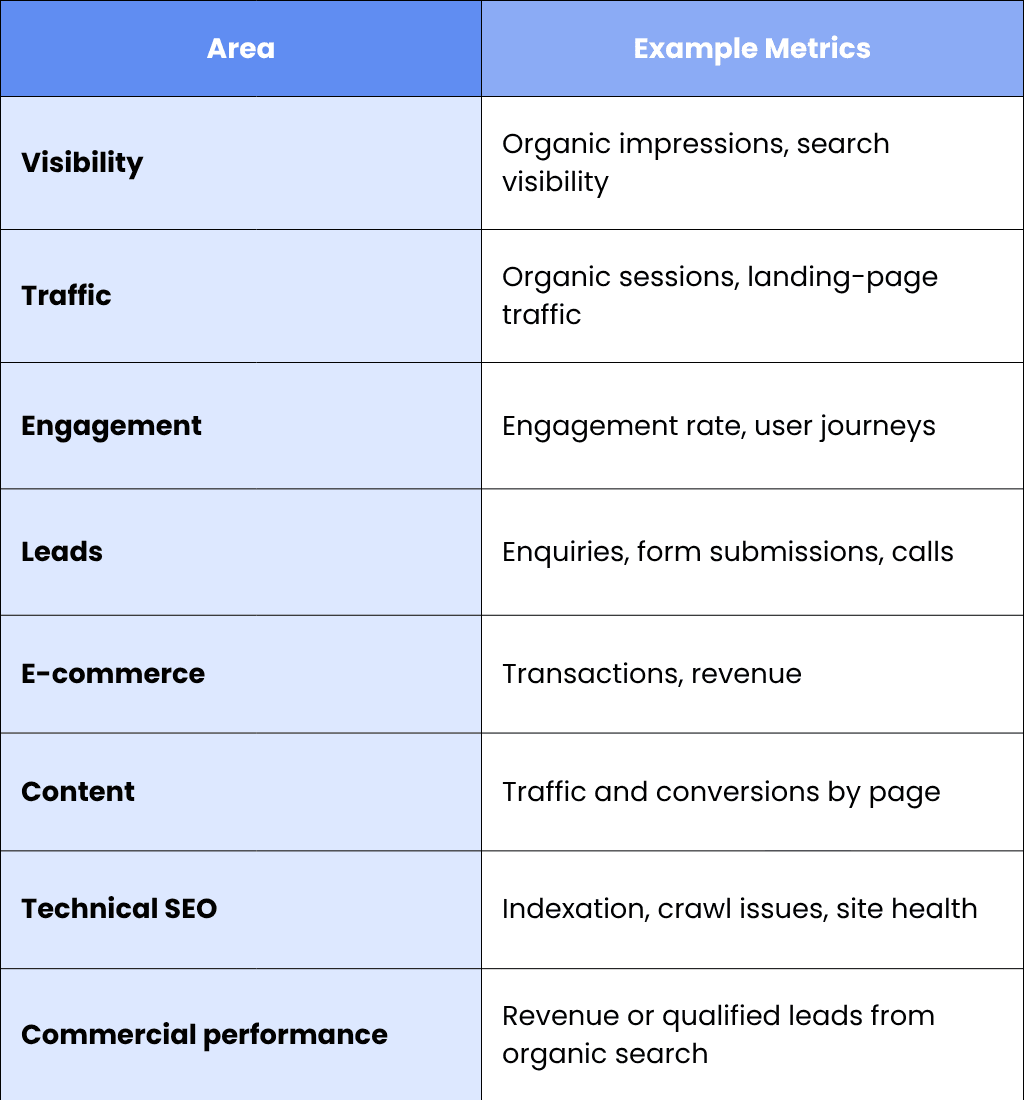
The agency should then explain what the numbers mean.
For example, if organic traffic increases by 30% but enquiries remain unchanged, the conclusion should not simply be "SEO is working". The agency should investigate whether the additional traffic is relevant, whether users are landing on the right pages and whether conversion opportunities need improvement.
In other words, reporting should lead to decisions, not just document activity.
10. SEO Strategy And Ongoing Optimisation
SEO is not a set-and-forget service. Search behaviour, competitors, websites and search engine systems all change over time.
Therefore, an SEO agency should continuously review performance and adjust the strategy.
A typical cycle might look like:
Research → Implement → Measure → Learn → Improve → Repeat
For example, an agency may discover that several category pages are receiving impressions but few clicks. It could then review titles, descriptions, search intent and page content, make improvements and monitor the results.
Similarly, if a particular content topic performs well, the agency may identify related topics and build a broader content cluster around it.
This ongoing process is what allows SEO to become a long-term growth channel rather than a one-off website project.
How These SEO Services Work Together
These activities should not operate independently. The strongest SEO programmes connect them into one strategy.
For example, a retail business might follow this process:
- Technical SEO ensures product and category pages can be crawled and indexed.
- Keyword research identifies valuable searches and customer intent.
- On-page SEO improves important category and product pages.
- Content strategy addresses customer questions and supports commercial pages.
- Internal linking connects informational and transactional content.
- Authority building strengthens the website's credibility.
- Analytics measures traffic, conversions and revenue.
- Ongoing optimisation identifies what to improve next.
This is why businesses should evaluate an SEO outsourcing provider based on its overall approach, rather than simply counting how many tasks it promises to complete each month.
Ultimately, the purpose of SEO outsourcing is not to generate more SEO activity. It is to build a stronger search presence that brings the business relevant visibility, qualified traffic and measurable commercial value.
SEO Outsourcing Vs In-House SEO
When deciding how to manage SEO, businesses often face a straightforward question: should they build an internal SEO team or outsource the work to an external agency?
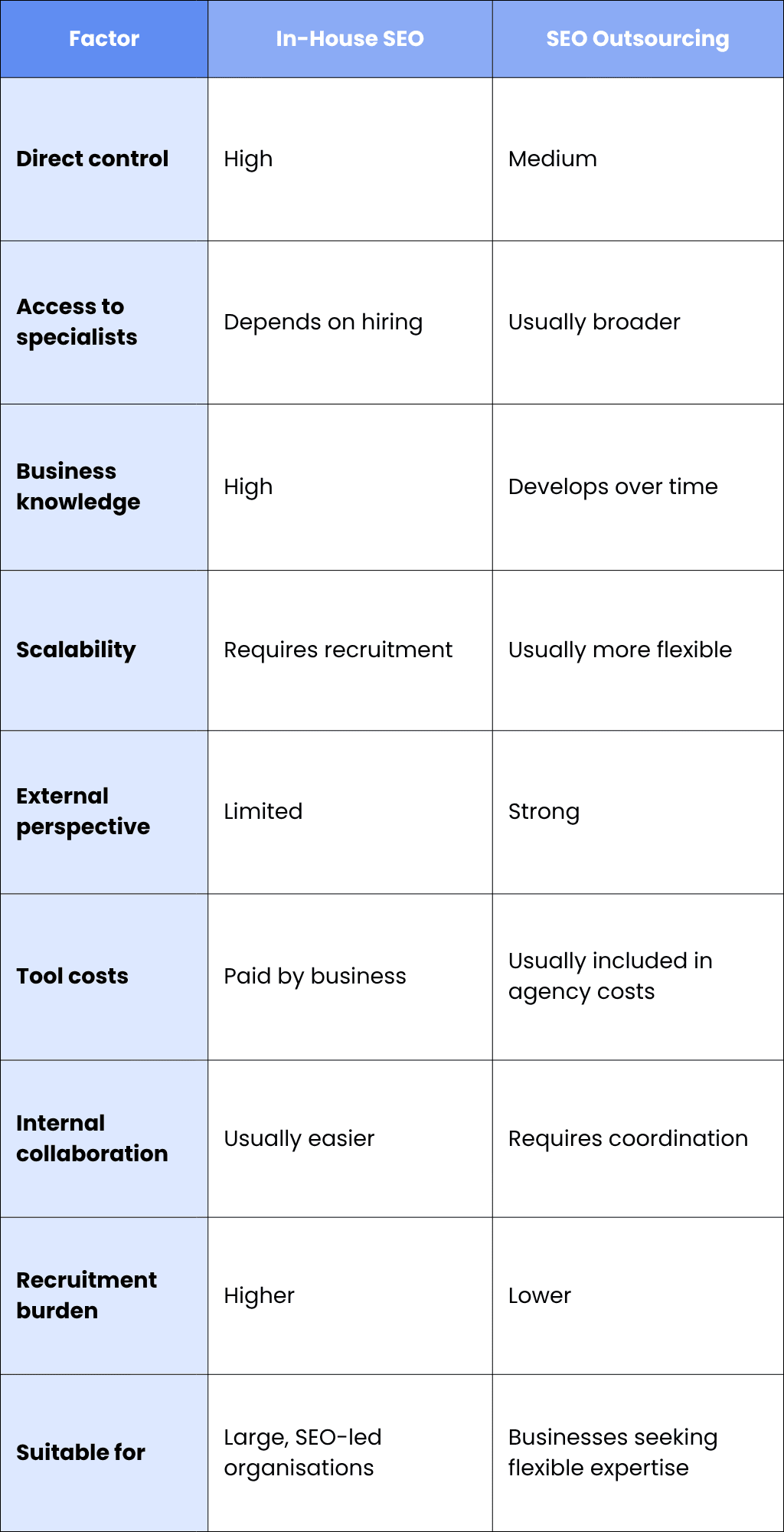
The following comparison can help businesses decide which approach makes the most sense.
SEO Outsourcing Vs In-House SEO: Quick Comparison
In-House SEO: When Does It Make Sense?
Building SEO capabilities internally can work well for businesses where organic search is a major and long-term growth channel.
An in-house team can become deeply familiar with the company's products, customers, brand and internal processes. As a result, SEO decisions can often happen quickly because the specialists are already part of the organisation.
An in-house model may be particularly suitable when:
- SEO contributes significantly to revenue or lead generation.
- The business has a large or continuously changing website.
- The company can afford to hire experienced SEO specialists.
- Marketing, content and development teams already work closely together.
- SEO requires frequent collaboration with internal stakeholders.
- The business wants to develop long-term SEO expertise internally.
For example, a large e-commerce retailer with thousands of products may benefit from having SEO specialists involved in website changes from the beginning. Rather than waiting for an external agency to review every new category or technical development, an internal team can work directly with developers and merchandising teams.
However, building an internal team also requires more than hiring one SEO manager. A mature SEO function may need technical, content, analytical and strategic capabilities.
SEO Outsourcing: When Does It Make Sense?
SEO outsourcing can be a practical option for businesses that need specialist expertise but do not want to build a large internal team.
An external agency can provide access to multiple specialists while allowing the business to maintain a relatively lean marketing structure.
This can work particularly well when:
- The internal marketing team has limited SEO expertise.
- SEO is important but does not justify a full internal department.
- The business needs specialist technical support.
- The company wants to scale SEO quickly.
- The website requires expertise that is difficult to hire internally.
- The business is entering new locations or markets.
- The marketing team needs an independent perspective.
For example, a growing hospitality group might have a marketing manager, social media team and paid media specialist but no technical SEO expertise. Hiring a complete SEO department may not be practical. Instead, outsourcing SEO can provide access to technical, content, local and international search specialists through one partner.
What About Cost?
Cost is often one of the first considerations, but businesses should compare the total cost of capability, rather than simply comparing an agency fee with one employee's salary.
Consider a simplified example:
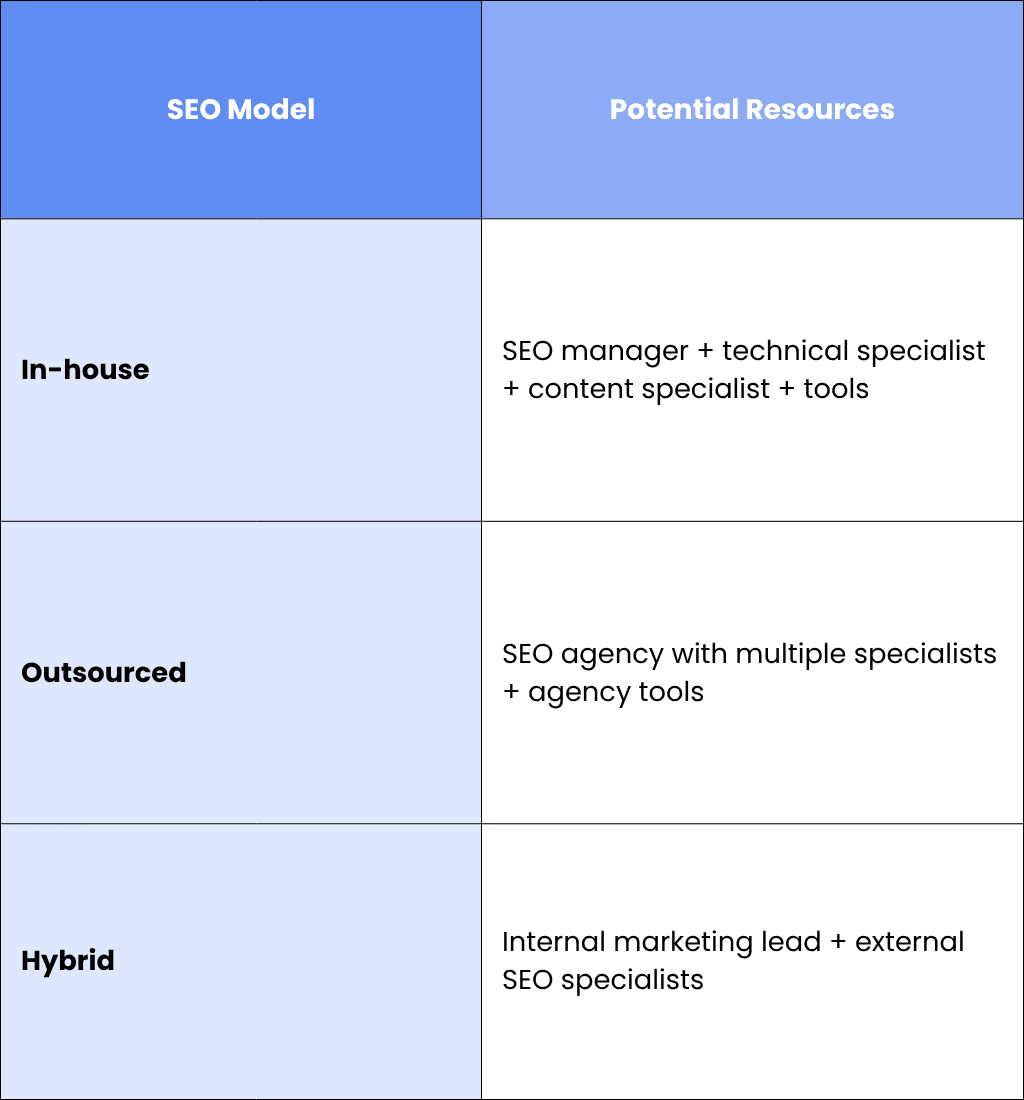
Suppose a business needs three different SEO skill sets. Hiring three specialists means paying not only salaries but also recruitment costs, benefits, training, software and management time.
By comparison, an SEO agency can spread the cost of its specialists and technology across multiple clients.
This does not mean outsourcing is automatically cheaper. A large company with substantial SEO requirements may eventually find an internal team more cost-effective. Therefore, businesses should compare cost against the level of expertise, output and commercial value they actually need.
Control And Flexibility
One advantage of an internal team is direct control. Employees are already inside the organisation, so they can attend meetings, access internal systems and collaborate closely with other departments.
However, an agency can provide greater flexibility when the workload changes.
For example, an international expansion may suddenly require additional keyword research, multilingual SEO and technical support. An agency can potentially allocate additional specialists to the project without the company needing to recruit permanent employees.
Therefore:
In-house = greater direct control
Outsourcing = greater access to flexible external resources
Neither is inherently better. The better option depends on how the business operates.
Expertise And Skills
SEO covers a broad range of disciplines, which can make building an internal team challenging.
A single SEO professional may be highly capable but cannot necessarily specialise deeply in every area, from technical SEO and analytics to content, digital PR and international search.
An agency can bring together multiple specialists.
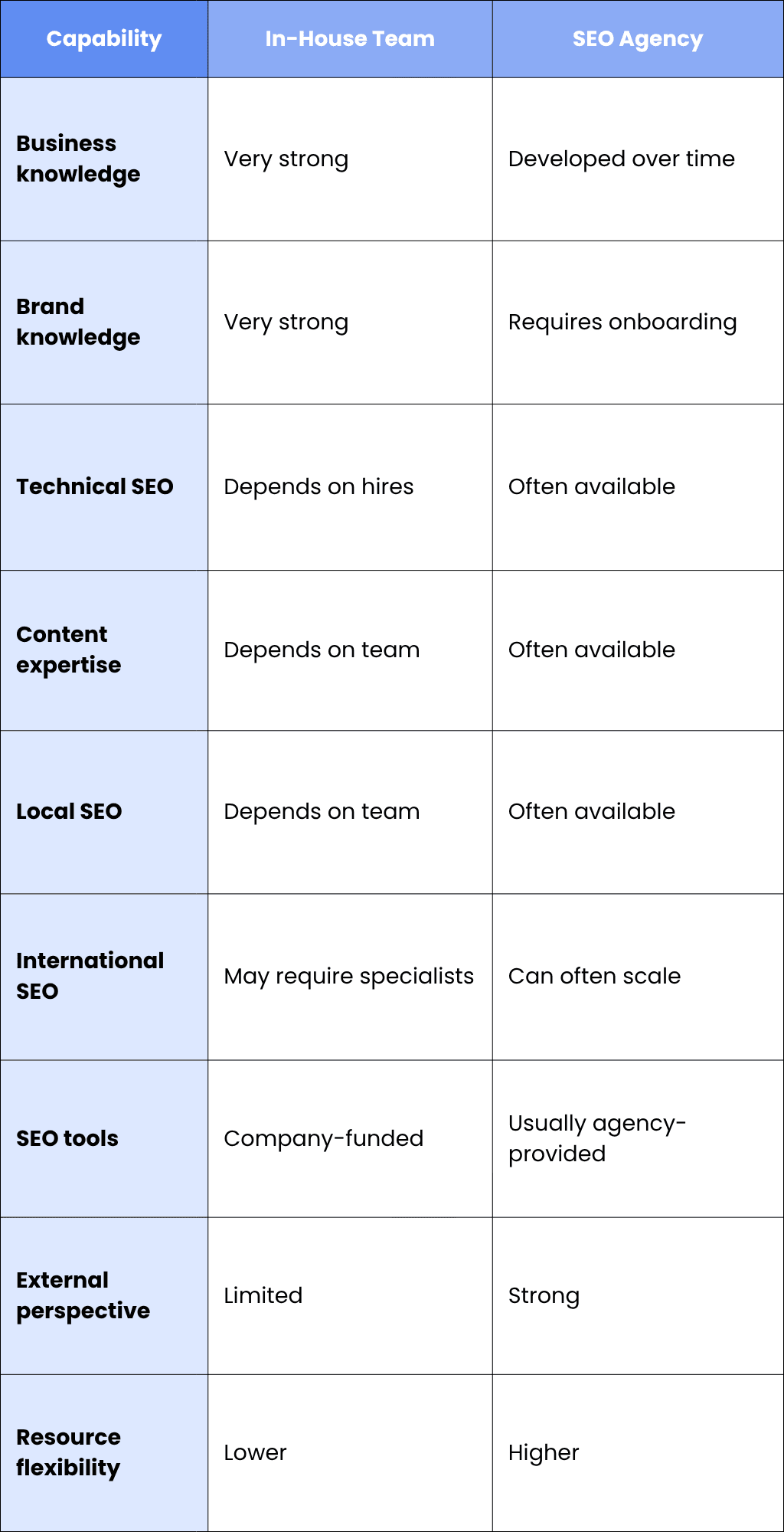
The important consideration is not simply who knows more about SEO. It is whether the business has access to the right skills at the right time.
The Hybrid Model: Often The Best Of Both
Businesses do not have to choose exclusively between in-house SEO and SEO outsourcing.
A hybrid approach can combine an internal team's business knowledge with an agency's specialist expertise.
For example:
Internal team
- Owns brand and marketing strategy
- Provides customer and industry knowledge
- Sets commercial priorities
- Coordinates internal stakeholders
- Approves content and recommendations
External SEO team
- Develops SEO strategy
- Performs technical audits
- Conducts keyword research
- Plans content
- Provides specialist optimisation
- Analyses performance
- Supports authority building
- Identifies new search opportunities
This approach can be particularly effective for medium-sized businesses that have a capable marketing team but do not need, or cannot justify, a full SEO department.
Which Model Is Right For Your Business?
A useful starting point is to ask four questions:
- How important is organic search to our revenue or lead generation?
- What SEO expertise do we already have internally?
- How complex is our website and target market?
- Can we realistically recruit and retain the specialists we need?
If SEO is central to the business and the company has the resources to build a specialist team, in-house SEO may be a strong long-term investment.
If the business needs expertise quickly, has a lean marketing team or faces complex SEO requirements, outsourcing may offer a more practical route.
For many companies, however, the answer will sit somewhere between the two.
A hybrid approach allows the business to keep strategic ownership internally while using an SEO agency for specialist knowledge, execution and additional capacity.
Ultimately, SEO outsourcing and in-house SEO are not competing philosophies. They are different ways of accessing the capabilities needed to grow through organic search. The right choice is the one that gives your business the expertise, resources and flexibility required to achieve its commercial goals.
How To Choose An SEO Outsourcing Agency
A good SEO partner should understand your commercial goals, explain its strategy clearly and show how its work will contribute to measurable business outcomes. The following factors can help you evaluate potential agencies more confidently.
1. Look Beyond Ranking Promises
Be cautious when an agency guarantees a specific Google ranking, particularly if it promises to get your website to number one within a fixed timeframe.
Search engines use complex ranking systems, and no external agency controls them. As a result, reputable SEO providers should avoid making guarantees they cannot realistically keep.
Instead, ask how the agency measures progress across several areas:
- Organic traffic
- Qualified website visits
- Search visibility
- Priority keyword performance
- Leads and enquiries
- E-commerce transactions
- Organic revenue
- Conversion rates
- Technical improvements
For example, ranking number one for "hotel in Hanoi" might sound impressive, but it is less valuable if the traffic does not generate bookings. A slightly lower ranking for a highly relevant, high-intent search may produce considerably more commercial value.
The key question is not "How high can you rank us?" but "How will SEO contribute to our business growth?"
2. Ask How They Define Success
Before discussing tactics, ask the agency what success would look like for your business.
The answer should connect SEO with your actual commercial objectives.
For example:
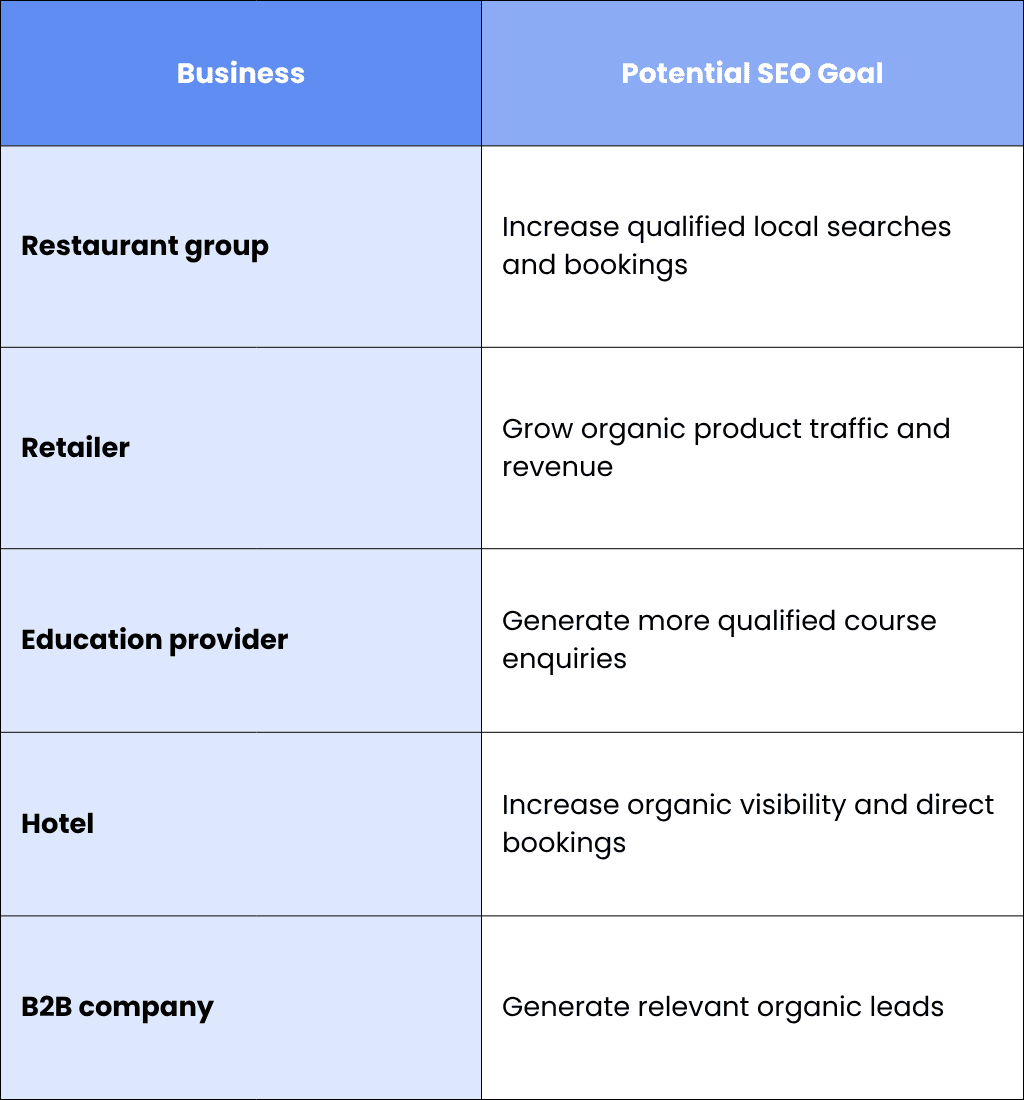
This distinction matters because SEO metrics can look positive without producing meaningful business results.
For instance, imagine organic traffic increases from 50,000 to 65,000 visits per month — a 30% increase — but enquiries remain unchanged. The agency should investigate why.
Perhaps the additional visitors are searching for informational topics rather than commercial services. Alternatively, important landing pages may have weak calls to action.
Therefore, a good agency should connect visibility → traffic → engagement → conversions → business value.
3. Ask What They Will Actually Do
A proposal should explain the work clearly rather than relying on vague phrases such as "SEO management" or "website optimisation".
Ask potential agencies to explain what their engagement will include.
For example:
- Technical SEO audits
- Keyword and competitor research
- On-page optimisation
- Content strategy
- Content creation
- Internal linking
- Local SEO
- Authority building
- Performance analysis
- Conversion analysis
- Monthly reporting
- Ongoing strategy development
You should also ask how these activities will be prioritised.
A strong agency will not simply give you a long list of tasks. It should explain which activities matter most, why they matter and what impact they could have.
4. Examine Their Approach To Content
Content is a major part of modern SEO, but more content does not automatically mean better SEO.
Ask the agency how it decides:
- What topics to cover
- Which pages to create
- Which existing pages to improve
- What search intent to target
- How subject-matter expertise will be incorporated
- How content quality will be reviewed
- How performance will be measured
For example, an education provider might have 100 existing articles but receive little organic traffic from them. Creating another 100 articles may not solve the problem.
A better strategy could involve improving the existing content, consolidating overlapping pages and developing a smaller number of genuinely useful resources around important student questions.
The agency should therefore demonstrate that it understands content quality, relevance and business purpose, rather than simply promising high publishing volumes.
5. Ask About Technical SEO
Technical SEO can become complicated quickly, particularly for e-commerce websites, large corporate sites and businesses operating across multiple markets.
However, a good agency should still be able to explain technical issues in simple language.
Ask:
- What are the biggest technical problems on our website?
- Which issues should we fix first?
- Why do they matter?
- What could happen if we do not fix them?
- Who will implement the changes?
- How will you validate the fixes?
For example, an agency might identify 5,000 duplicate URLs on an e-commerce website. Rather than simply presenting the number as a problem, it should explain why those URLs exist, whether they should be indexed and what solution is appropriate.
Good technical SEO is not about creating complicated reports. It is about identifying the problems that matter and helping the business solve them.
6. Look For Relevant Industry Experience
An agency does not necessarily need to work exclusively within your industry. However, relevant experience can reduce the learning curve and help the agency understand your customers more quickly.
Consider whether the agency understands your:
- Customer journey
- Products and services
- Business model
- Sales cycle
- Locations
- Competitors
- Seasonal demand
- Regulatory environment
- Growth plans
For example, SEO for a restaurant depends heavily on local search behaviour, while SEO for an international education provider may require detailed research into course searches, student journeys and different geographic markets.
Ask potential agencies to explain how their previous experience would influence their approach to your business, rather than simply asking for a list of client logos.
7. Understand Who Will Work On Your Account
The people you meet during the sales process may not be the people who manage your SEO programme.
Therefore, ask:
- Who will be our main point of contact?
- Who develops the strategy?
- Who handles technical SEO?
- Who produces or reviews content?
- How experienced is the account team?
- How often will we speak with them?
This matters because SEO is an ongoing relationship.
A strong strategy can lose momentum if communication becomes inconsistent or if the account changes hands frequently.
8. Review Their Reporting Process
Reporting should help you understand what is happening and what needs to happen next.
A useful monthly report might include:
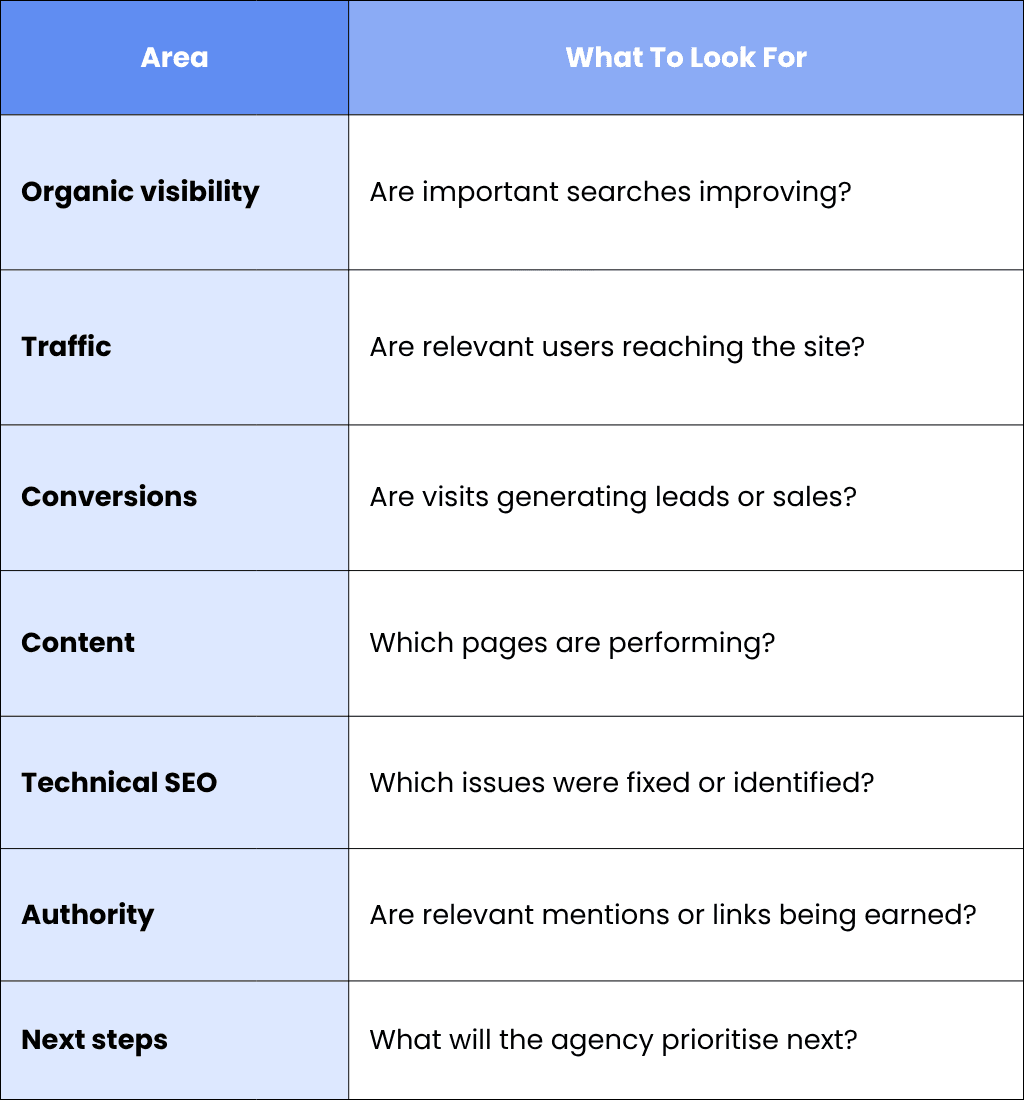
The agency should explain the story behind the numbers.
For example, if traffic falls by 10%, a useful report should explain whether the decline came from seasonality, an algorithm change, technical problems, competitor activity or another factor.
A report should help you make decisions, not simply prove that the agency has been busy.
9. Ask About Communication And Collaboration
SEO rarely happens in isolation.
An agency may need to work with your marketing team, developers, content writers, designers, sales team and senior stakeholders.
Therefore, establish communication expectations before starting.
Consider agreeing on:
- Monthly strategy meetings
- Reporting frequency
- Main points of contact
- Response times
- Approval processes
- Technical implementation responsibilities
- Content review procedures
- Escalation processes
Clear communication can prevent relatively simple SEO recommendations from becoming stuck internally for months.
10. Understand How They Handle AI And Modern Search
Search is evolving, so it is worth asking how the agency approaches AI-powered search experiences.
A capable agency should understand areas such as:
- Generative Engine Optimisation (GEO)
- Answer Engine Optimisation (AEO)
- Structured data
- Knowledge graphs
- AI-readable content
- Search experience changes
However, be cautious of agencies presenting AI SEO as a replacement for traditional SEO.
Strong technical foundations, useful content, clear website structures and genuine authority remain important. AI search optimisation should complement these fundamentals rather than replace them.
Ask the agency a simple question:
"How are you adapting our SEO strategy as people increasingly use AI to discover information?"
The quality of the answer can tell you a lot about whether the agency is thinking beyond traditional keyword rankings.
11. Be Careful With Link-Building Promises
Link building can be valuable, but it is also an area where businesses should ask detailed questions.
Avoid providers that promise thousands of backlinks at unusually low prices or cannot explain where their links will come from.
Instead, ask:
- How do you identify relevant websites?
- How do you earn links?
- What makes a link valuable?
- Do you use digital PR or original research?
- How do you assess link quality?
- How do you avoid manipulative practices?
The objective should be to build genuine authority and relevant recognition, not simply increase a backlink counter.
12. Check Whether They Are Transparent About Challenges
No SEO campaign performs perfectly all the time.
Markets change, competitors improve, search behaviour shifts and websites occasionally experience technical problems.
A trustworthy agency should be willing to explain when something is not working and what it plans to change.
For example, instead of saying:
"The campaign is performing well because we completed all deliverables."
A stronger agency might say:
"Organic traffic increased, but commercial conversions have remained flat. We believe the next priority should be improving the landing pages receiving the most non-converting traffic."
That level of honesty is valuable because it focuses the relationship on problem-solving rather than protecting appearances.
A Simple SEO Agency Evaluation Framework
When comparing agencies, you can score each provider from 1 to 5 across several areas:
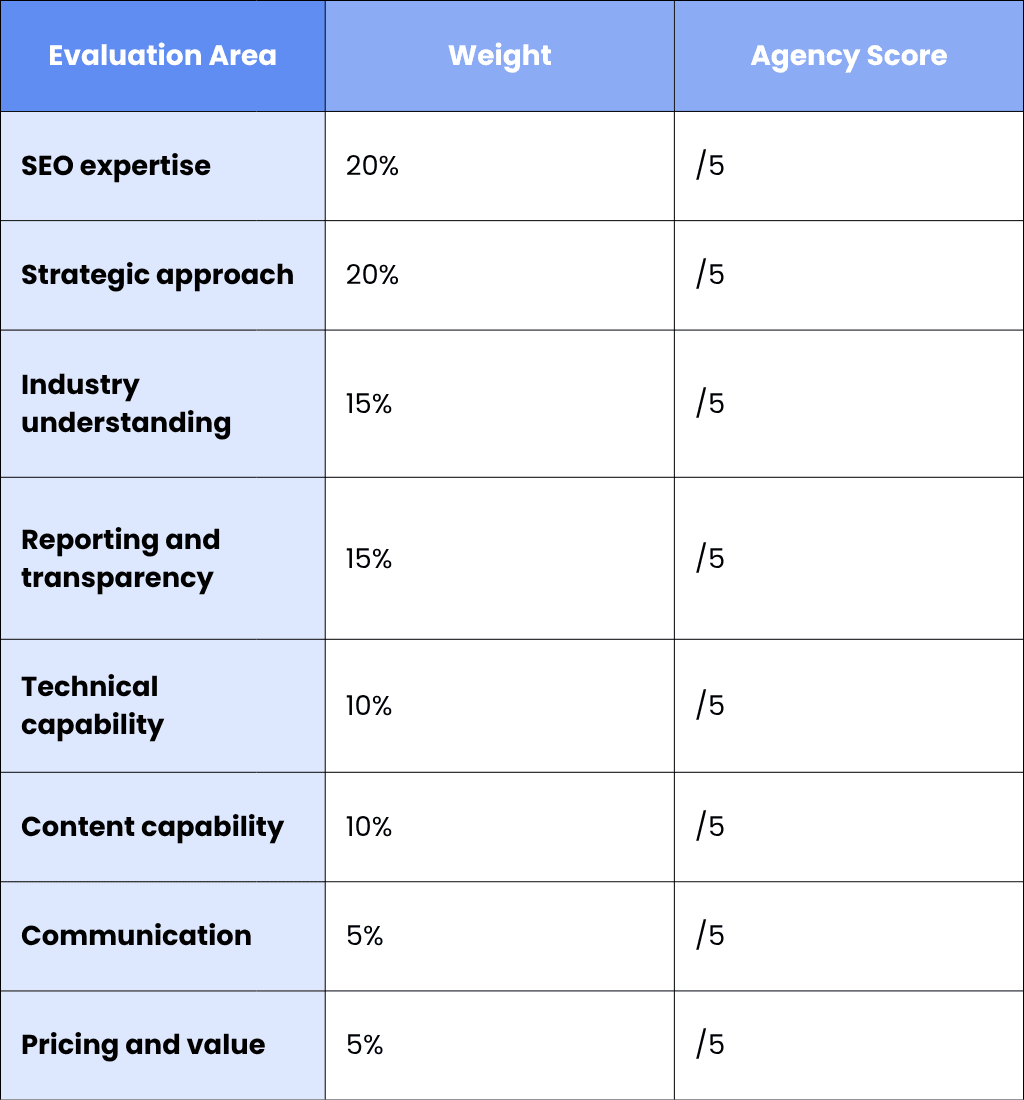
For example, if an agency scores 4/5 for SEO expertise, its weighted contribution would be:
4 ÷ 5 × 20 = 16 points
You can repeat this calculation for each category and compare the final scores.
This approach does not replace judgement, but it helps prevent a decision from being based solely on price or presentation.
What Should An SEO Outsourcing Contract Include?
Once you have selected an SEO outsourcing agency, the contract should make the working relationship clear from the beginning. A good agreement does more than define the monthly fee. It establishes what the agency will do, what the client needs to provide, how performance will be measured and what happens if priorities change.
Because SEO can involve strategy, content, technical development and access to important business data, clarity at this stage can prevent misunderstandings later.
1. Scope Of Work
The contract should clearly explain what SEO services are included.
For example, the scope might cover:
- Technical SEO
- Keyword research
- Competitor analysis
- On-page optimisation
- Content strategy
- Content production
- Internal linking
- Local SEO
- International SEO
- Authority building
- SEO reporting
- AI search optimisation
However, avoid vague descriptions such as "full SEO management" without further explanation.
Instead, the contract should make it clear what the agency is responsible for and what falls outside the agreed scope.
For example, if the agency identifies technical problems but does not implement website changes, the contract should state this clearly.
2. Deliverables
The agreement should explain what the agency will actually deliver.
A monthly SEO programme might include:
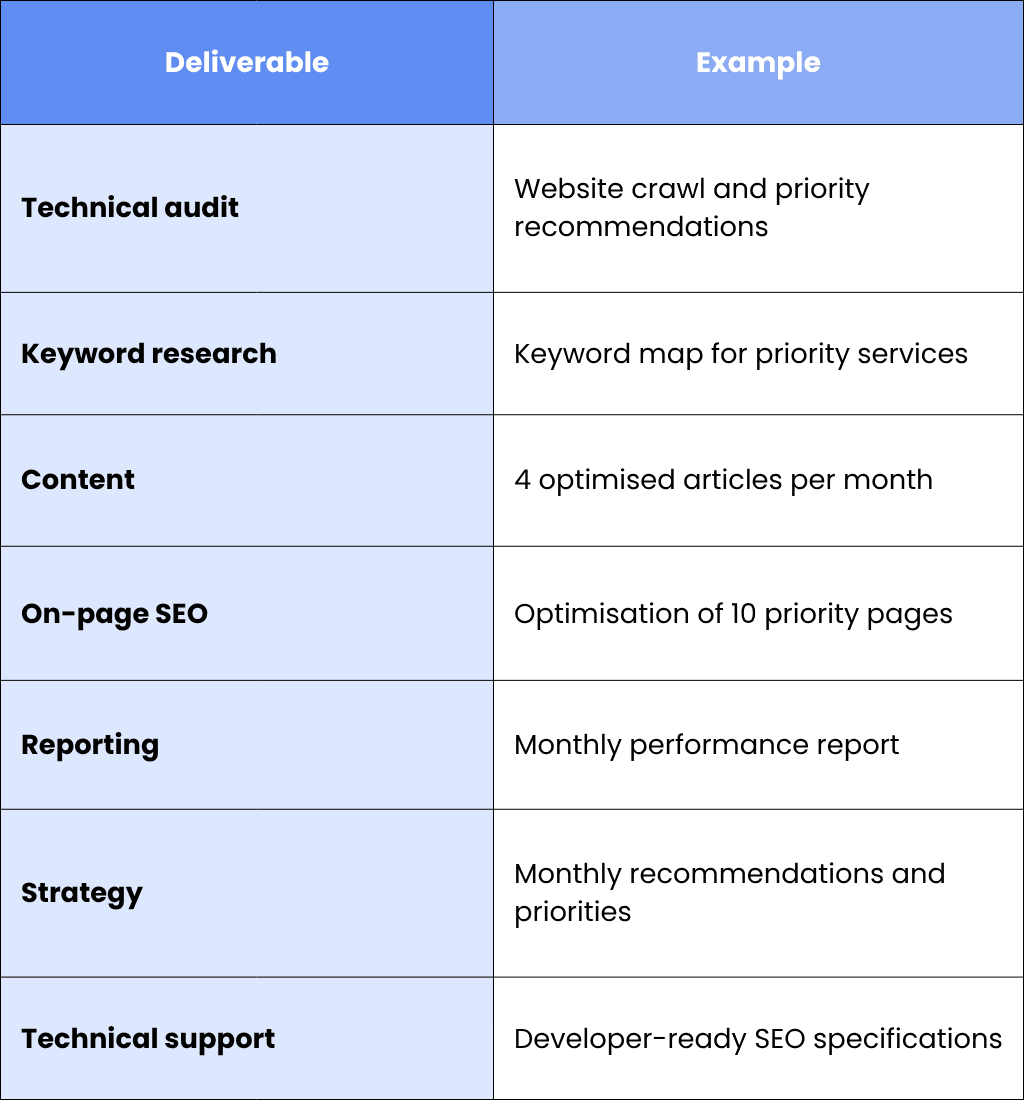
The exact deliverables will vary by business. More importantly, they should reflect the strategy rather than become a checklist that the agency completes regardless of performance.
3. Responsibilities Of Each Party
SEO requires cooperation between the agency and the client.
Therefore, the contract should explain who is responsible for each major activity.
For example:
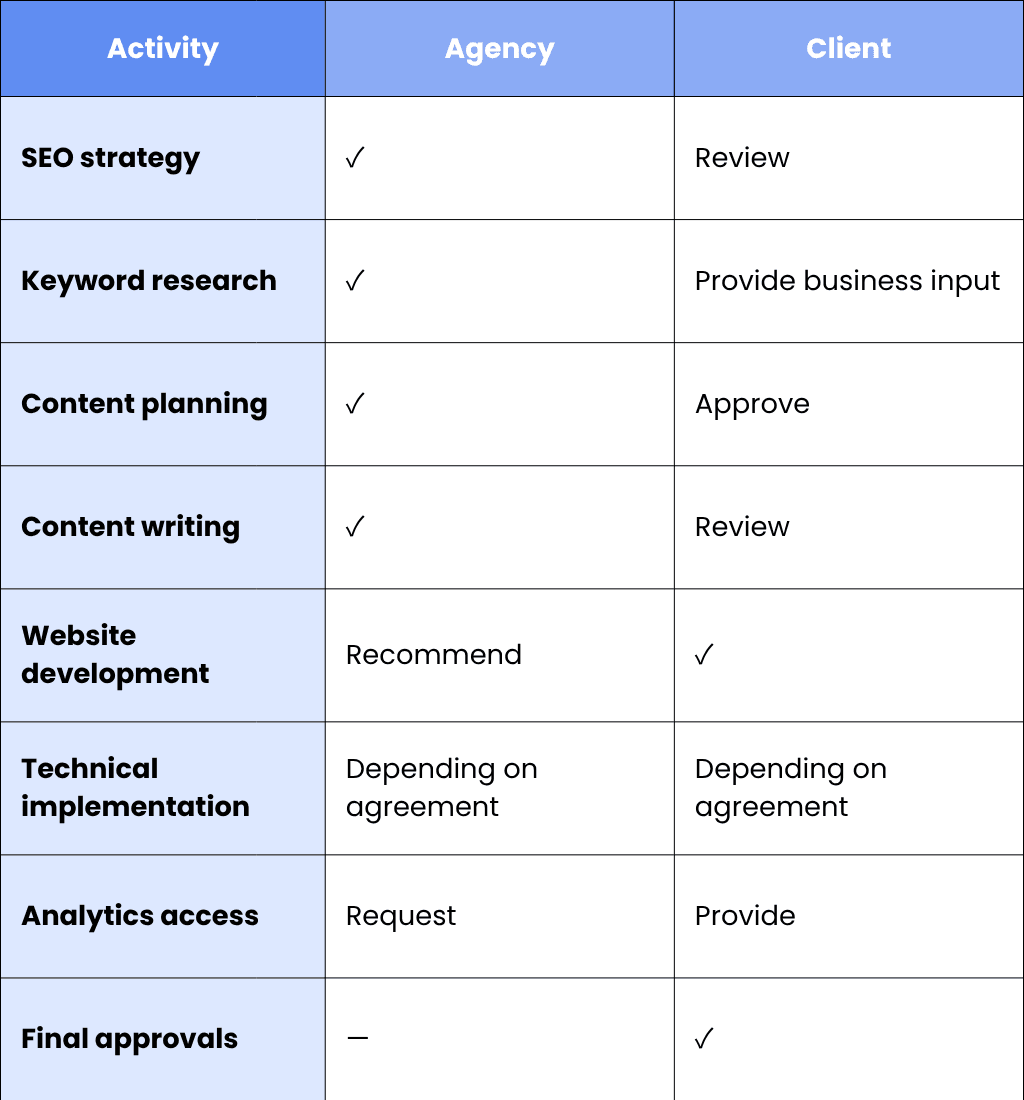
This becomes particularly important for technical SEO.
An agency may identify a website issue, but if the client's developers need to implement the fix, the contract should make that responsibility clear.
4. Access And Permissions
SEO agencies often need access to several systems, such as:
- Google Search Console
- Google Analytics
- CMS
- Google Business Profile
- Tag management systems
- SEO tools
- Website hosting or development environments
The contract should explain what access the agency requires and how that access will be managed.
Businesses should also avoid unnecessarily giving an agency more access than it needs. Where possible, use appropriate user permissions rather than sharing passwords.
This protects both parties and makes it easier to manage access when team members change.
5. Reporting And Performance Measurement
The contract should define how SEO performance will be reported and reviewed.
This could include:
- Monthly reports
- Quarterly strategy reviews
- Organic traffic
- Search visibility
- Priority keyword performance
- Leads
- Enquiries
- Transactions
- Organic revenue
- Technical performance
- Content performance
It is also useful to agree on how data will be interpreted.
For example, if organic traffic increases but qualified leads decline, both parties should understand that traffic growth alone does not necessarily represent success.
The contract should therefore support a business-focused approach to measurement, rather than relying solely on rankings or traffic.
6. Implementation Responsibilities
This is one of the most important areas to clarify.
An agency may identify an SEO issue, but who actually fixes it?
There are several possible arrangements:
Agency identifies → Client implements
or
Agency identifies → Agency implements
or
Agency identifies → Client approves → Agency implements
All three models can work. The important thing is to establish the process before the engagement begins.
For example, if a retailer has a serious technical issue that requires developer support, the agency should know who has authority to make the change and how quickly the client's development team can respond.
7. Content Approval And Publishing
If content forms part of the SEO programme, agree on the approval process.
The contract can specify:
- Who writes the content
- Who reviews it
- Who approves it
- How many revision rounds are included
- Who publishes it
- How quickly the client should provide feedback
This can prevent content from becoming stuck in an approval cycle.
For businesses in industries where accuracy is particularly important, such as education, healthcare or finance, the contract should also establish appropriate subject-matter review processes.
8. Ownership Of Content And Deliverables
The agreement should clarify who owns the work produced during the engagement.
This may include:
- Website content
- Keyword research
- SEO strategy documents
- Technical recommendations
- Reports
- Data
- Creative assets
- Structured data
- Other materials produced for the business
Ownership terms can vary between agencies, so businesses should understand them before signing.
It is also worth clarifying what happens to these assets if the contract ends.
9. Confidentiality And Data Protection
SEO agencies may receive access to sensitive business information, including analytics data, customer insights, commercial plans and website systems.
The contract should therefore address confidentiality and, where relevant, data protection responsibilities.
Businesses should understand:
- What information the agency can access
- How data will be stored
- Who can access it
- Whether third parties will receive it
- How information is handled after the engagement ends
The exact requirements will depend on the business, location and type of information involved, so legal or data protection advice may be appropriate for more complex arrangements.
10. Contract Length And Notice Period
SEO is a long-term activity, so agencies may recommend a minimum engagement period. This can give enough time to research, implement changes, measure results and refine the strategy.
However, businesses should understand the commitment they are making.
The contract should clearly state:
- Start date
- Initial term
- Renewal terms
- Notice period
- Cancellation process
- Any early termination fees
Avoid agreeing to a long commitment simply because an agency claims that "SEO needs time". The agency should be able to explain why the proposed engagement period is appropriate for your website and objectives.
11. Pricing And Payment Terms
The agreement should explain exactly how fees work.
Depending on the arrangement, pricing might include:
- Monthly retainer
- Fixed project fees
- Hourly consulting
- Content production fees
- Technical development costs
- Third-party software costs
- Additional services
For example, an SEO retainer might cover strategy and optimisation, while website development remains a separate cost.
Understanding these boundaries helps prevent unexpected charges later.
12. Use Of AI And Third-Party Tools
As AI becomes increasingly common in SEO workflows, businesses may also want to understand how agencies use AI.
Ask whether AI tools are used for:
- Research
- Content ideation
- Content drafting
- Data analysis
- Reporting
- Automation
- Technical workflows
The contract or supporting policies should make clear how confidential information is handled when third-party AI tools are involved.
Businesses should also establish expectations around content quality, human review and fact-checking. AI can support SEO workflows, but the agency should remain accountable for the quality and accuracy of its work.
13. Performance Expectations And Limitations
A good contract should set expectations without promising outcomes that nobody can guarantee.
For example, the agency can commit to specific activities and reporting standards, but it should not promise that the website will achieve a particular Google ranking by a fixed date.
A sensible agreement might define:
What the agency controls: strategy, research, recommendations, agreed deliverables and reporting.
What neither party fully controls: search engine algorithms, competitor behaviour, market demand and changes in search behaviour.
This distinction creates more realistic expectations and encourages both parties to focus on the areas they can influence.
14. What Happens When The Contract Ends?
Finally, establish the exit process before you need it.
The contract should explain what happens to:
- Website access
- Analytics access
- SEO documents
- Content
- Reports
- Data
- Accounts
- Third-party tools
- Ongoing campaigns
A professional SEO relationship should not make it unnecessarily difficult for a business to transition to another provider or bring SEO in-house.
SEO Outsourcing Contract Checklist
Before signing, make sure the agreement clearly covers:
- Scope of SEO services
- Deliverables
- Responsibilities of both parties
- Access and permissions
- Reporting and KPIs
- Technical implementation
- Content approval
- Ownership of deliverables
- Confidentiality and data protection
- Contract duration
- Notice and cancellation terms
- Pricing and additional costs
- AI and third-party tool usage
- Performance expectations
- Exit and handover process
Ultimately, a good SEO outsourcing contract should make the relationship clear, practical and accountable. It should give the agency enough flexibility to adapt the strategy while ensuring that the client understands what it is paying for and what both parties need to contribute.
Before signing, businesses should also consider having the agreement reviewed by an appropriate legal professional, particularly where significant budgets, intellectual property, sensitive data or long-term commitments are involved.
How Much Does SEO Outsourcing Cost?
There is no standard price for SEO outsourcing because the right investment depends on the size of your website, the competitiveness of your market, your target audience and the amount of work required.
However, having some realistic figures can make it easier to plan a budget.
For businesses considering an offshore SEO agency in Southeast Asia, Vietnam can offer an attractive balance between specialist expertise, service quality and operating costs.
As a general illustration, current published Vietnam SEO pricing places ongoing retainers at around
- VND 5–15 million per month for freelancers (approx. US$200–600/£150–450)
- VND 15–40 million for boutique agencies (approx. US$600–1,400/£450–1,040)
- VND 40–150 million or more for larger agencies and complex enterprise projects. (approx. US$1,400–5,000+/£1,040–3,600)
International-facing SEO programmes can sit higher depending on the target market and scope.
These figures are market illustrations, not fixed industry rates. A business should always compare the scope, expertise and expected outcomes behind a quote rather than choosing an agency based on price alone.
What Determines The Cost Of SEO Outsourcing?
Several factors can influence the cost of an SEO outsourcing programme.
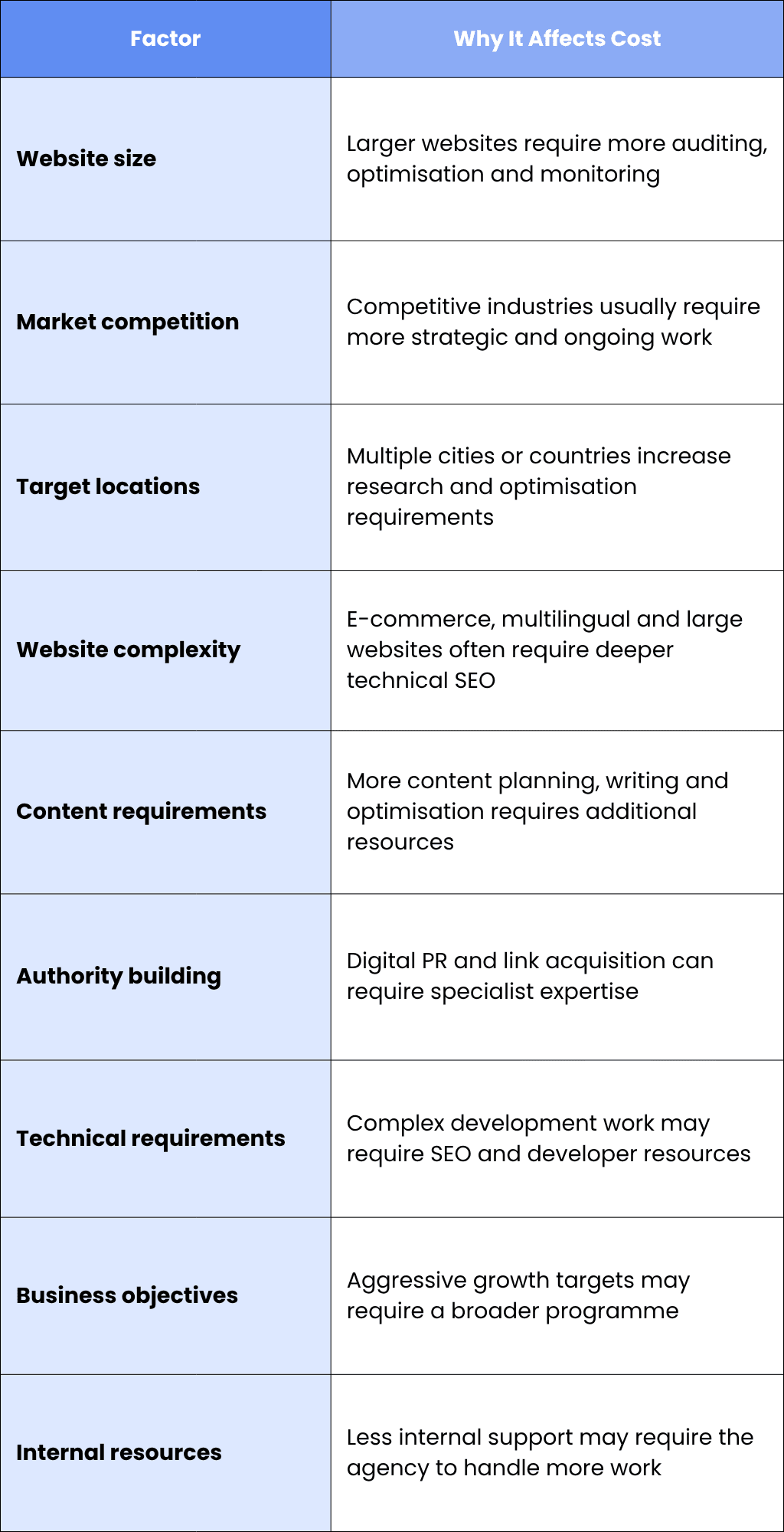
For example, a local café may only need local SEO, Google Business Profile optimisation, a technical review and improvements to several key pages.
By contrast, an international retailer may need technical SEO, category and product optimisation, content, international search, digital PR and ongoing website monitoring.
Naturally, these two programmes should not cost the same.
Common SEO Pricing Models
SEO agencies typically use several different pricing structures.
Monthly Retainer
A monthly retainer is one of the most common models for ongoing SEO.
The business pays a fixed amount each month in exchange for an agreed level of strategy, optimisation, content and reporting.
This model works well when SEO is treated as a long-term growth channel because the agency can continuously analyse performance and adjust priorities.
Project-Based SEO
Some businesses only need SEO for a specific project.
For example:
- Website migration
- Technical SEO audit
- International SEO setup
- SEO strategy development
- New website optimisation
- SEO content audit
A project-based approach can be useful when the business needs specialist expertise for a defined period rather than ongoing support.
Hourly Or Consultancy-Based SEO
Businesses may also pay for SEO consultancy by the hour or day.
This can work well when an internal marketing team already manages SEO but needs specialist advice for particular challenges.
For example, a retailer might have an internal SEO manager but bring in an external technical specialist to review a complex website migration.
What Does A Typical SEO Budget Need To Cover?
Rather than focusing on a specific monthly figure, businesses should consider what their budget needs to provide.
A comprehensive SEO programme may need to cover:
- Strategy: understanding the market, customers and commercial priorities.
- Research: analysing keywords, competitors and search opportunities.
- Technical SEO: identifying and resolving website issues.
- Content: creating or improving useful pages.
- Authority building: earning relevant mentions and links.
- Analytics: measuring performance and identifying opportunities.
- Management: coordinating work and communicating recommendations.
- Ongoing optimisation: improving the strategy based on results.
If a very low-cost package includes only a few of these areas, businesses should understand what is missing before comparing it with a more comprehensive proposal.
How To Compare SEO Agency Prices
Imagine two agencies provide the following proposals:
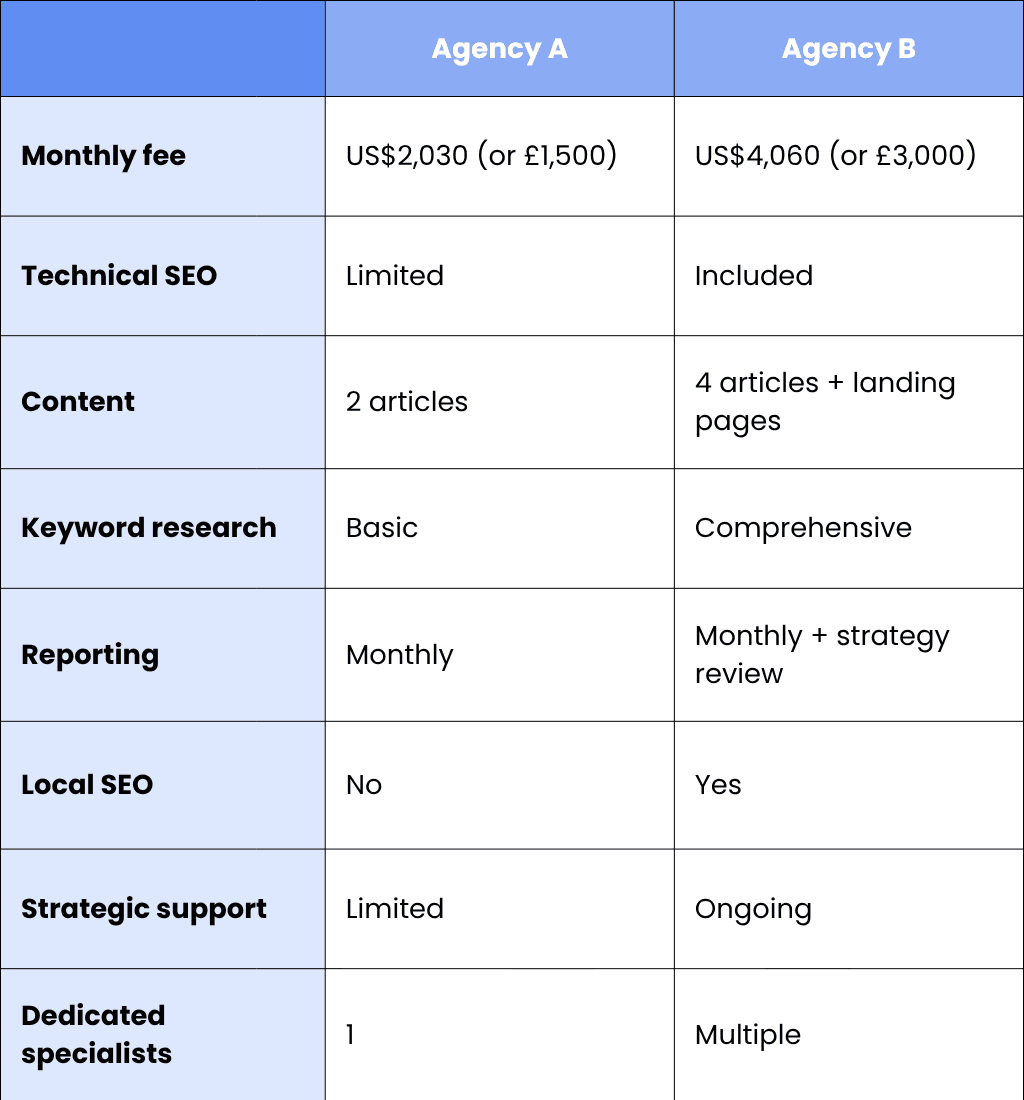
At first glance, Agency A appears to be 50% cheaper.
However, the lower price does not necessarily represent better value. If Agency B can address substantially more important SEO opportunities and generate significantly more qualified business, the additional investment may be justified.
Therefore, compare scope and expected value, not just the monthly fee.
A Simple Way To Think About SEO ROI
Businesses can also evaluate SEO from a return-on-investment perspective.
Suppose an SEO programme generates an additional 100 qualified enquiries per month.
If the business converts 10% of those enquiries and the average gross profit per new customer is £500 (US$676):
100 enquiries × 10% conversion × £500 (US$676) = £5,000 (US$6,760) potential gross profit per month
If the SEO investment is £2,500 (US$3,380) per month, the potential gross profit generated is twice the monthly SEO cost.
This is only a simplified example. Real SEO ROI calculations should account for factors such as customer lifetime value, attribution, sales cycles, margins and the time required for SEO to generate results.
Nevertheless, the principle is useful: SEO should ultimately be evaluated in relation to business value, not simply the cost of producing SEO tasks.
Beware Of Extremely Cheap SEO Packages
Low-cost SEO is not automatically bad. A small local business with straightforward requirements may genuinely need a relatively modest level of support.
However, businesses should be cautious when an agency promises a large amount of work for an unusually low fee.
If a package promises hundreds of backlinks, dozens of articles, technical optimisation and extensive reporting for a very small monthly payment, ask how the agency can realistically deliver that work.
Very low-cost services may rely heavily on automation, generic content or low-quality tactics that provide little long-term value.
How Long Does SEO Outsourcing Take To Produce Results?
One of the most common questions businesses ask before starting SEO outsourcing is, "How long will it take to see results?"
The honest answer is that there is no fixed timeline. SEO is influenced by factors such as website quality, competition, domain history, technical issues, content quality, industry and the amount of work implemented.
For this reason, businesses should think of SEO as a long-term investment rather than a quick marketing campaign.
When Can You Expect To See SEO Results?
A useful way to think about SEO is in stages rather than expecting one sudden jump in rankings or traffic.
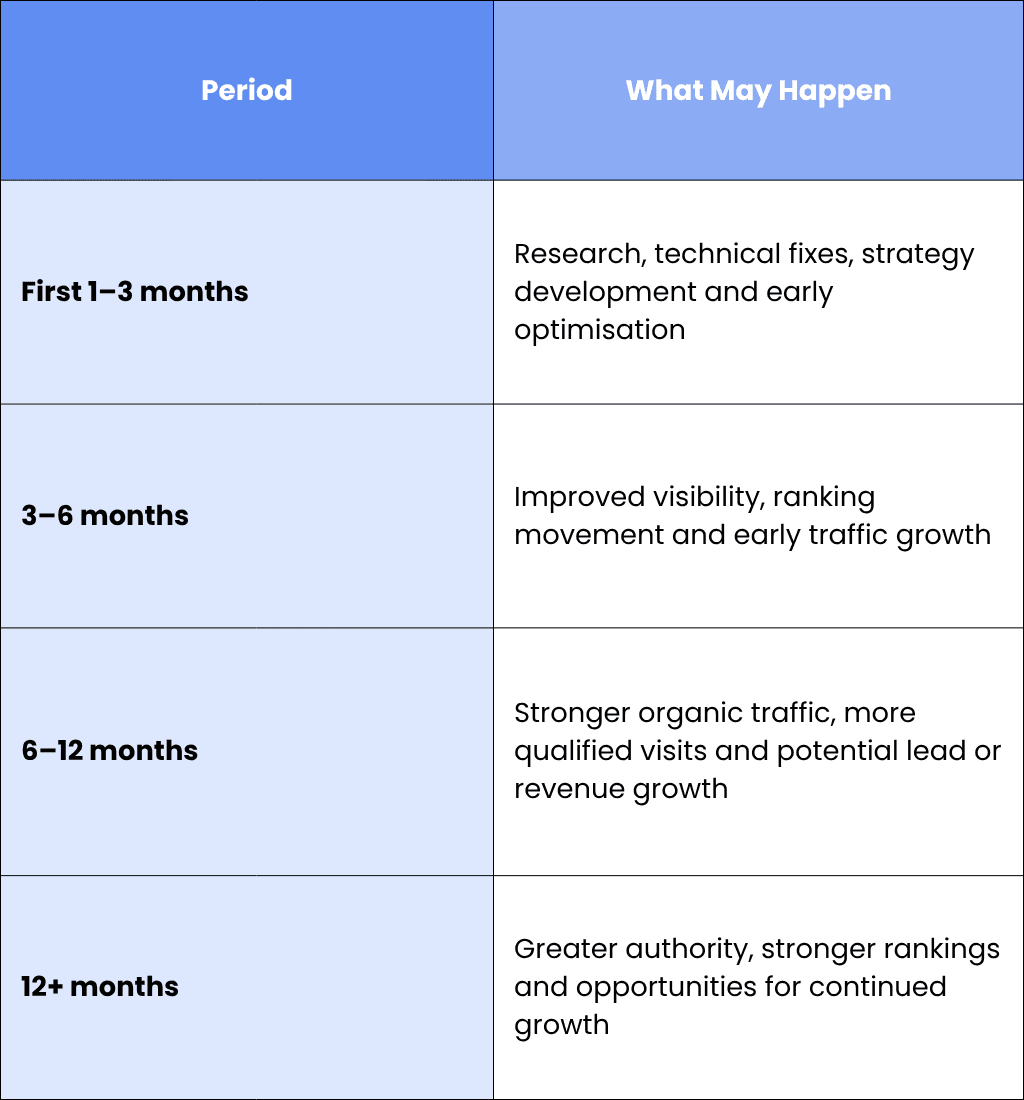
These are general timeframes rather than guarantees. Some websites may see meaningful improvements sooner, particularly when they already have strong authority and clear technical issues. Others may need considerably longer, especially in highly competitive markets.
The First 1–3 Months: Building The Foundation
The early stage of an SEO outsourcing programme is often focused on understanding the website and fixing the issues that could limit future growth.
An agency may begin with:
- Technical SEO audits
- Keyword and search intent research
- Competitor analysis
- Website structure reviews
- Content audits
- Internal linking analysis
- Analytics and tracking checks
- Local or international SEO research
- Identification of quick-win opportunities
For example, an agency might discover that an e-commerce website has important category pages that are poorly linked internally or that several valuable pages are not being indexed correctly.
Fixing these problems may not immediately produce a dramatic increase in organic traffic. However, these improvements can create a stronger foundation for future growth.
Therefore, businesses should not judge an SEO programme purely on traffic during the first few months. The quality and implementation of the strategy matter at this stage.
Months 3–6: Building Search Visibility
Once the initial foundations are in place, the focus can shift towards building visibility and authority.
This might involve:
- Publishing or improving content
- Optimising priority landing pages
- Strengthening internal links
- Building relevant authority
- Improving local search visibility
- Expanding into valuable keyword groups
- Addressing remaining technical issues
At this point, businesses may start seeing more noticeable movement.
For example, a retail website may initially rank on page three or four for valuable category searches. After improving the category pages, internal linking and supporting content, some of those pages may begin moving towards page one.
However, rankings can fluctuate, so businesses should look for consistent trends rather than individual keyword movements.
Months 6–12: Turning Visibility Into Business Growth
As more improvements accumulate, SEO can begin contributing more significantly to traffic and conversions.
A business may start seeing:
- More organic visitors
- Higher rankings for valuable searches
- Increased visibility across related topics
- More qualified enquiries
- More organic sales
- Stronger local visibility
- Growth in non-brand searches
For example, imagine an education provider receives 10,000 monthly organic visits before starting SEO outsourcing.
After several months of optimisation, it reaches 14,000 monthly visits — a 40% increase.
If the website also improves its conversion rate from 2% to 2.5%, the potential number of enquiries changes from:
10,000 × 2% = 200 enquiries
to:
14,000 × 2.5% = 350 enquiries
That represents 150 additional enquiries per month, despite the traffic increase being only 4,000 visits.
This illustrates why SEO should not be evaluated solely through rankings or traffic. Improving the quality of organic traffic and the website's ability to convert it can make a substantial difference to business results.
Why Some Websites See Results Faster Than Others
SEO performance varies significantly between businesses because websites do not all start from the same position.
Several factors can accelerate or slow progress.
Website Authority
Established websites with a history of producing useful content and earning relevant recognition may have an advantage over new websites with little search visibility.
A new domain generally needs more time to establish credibility and build a meaningful presence.
Competition
A local restaurant targeting a specific neighbourhood may face relatively limited competition.
However, a national retailer targeting highly competitive product searches may compete with major brands, marketplaces and specialist retailers.
The more competitive the search landscape, the more resources and time may be required.
Technical Health
Technical problems can hold back otherwise strong SEO strategies.
Issues such as poor indexation, slow performance, duplicate pages or weak website architecture may need to be addressed before content and authority-building efforts can reach their full potential.
Content Quality
Publishing useful, relevant content can help a website capture more search opportunities. However, creating content simply to meet a monthly publishing target is unlikely to produce sustainable results.
The quality, relevance and usefulness of the content matter more than the number of articles published.
Implementation Speed
SEO recommendations only create value when they are implemented.
For example, if an agency identifies important technical issues in January but the development team cannot implement the fixes until April, the SEO programme may naturally take longer to show results.
This is why successful SEO outsourcing requires collaboration between the agency and the business.
How to Make SEO Outsourcing Successful
Hiring a good agency is only part of the equation.
The client-agency relationship can have a major impact on performance.
Give the Agency Access to the Right Information
Your SEO partner needs to understand the business. Therefore, you should share information about:
- Best-selling products
- Most profitable services
- Target customers
- Priority locations
- Seasonal demand
- Sales objections
- Competitors
- Business expansion plans
- New products
- Common customer questions
This information can help an SEO team identify opportunities that keyword tools alone may miss.
Involve the Right Internal Stakeholders
SEO often touches several parts of a business.
Marketing may own the strategy. Developers may implement technical changes. Content teams may approve articles. Sales teams may provide customer insights. Senior stakeholders may control budgets and priorities.
If these teams do not communicate, SEO work can become unnecessarily slow.
Give Implementation Enough Attention
One of the most common challenges in SEO is not knowing what needs to be changed. It is getting the changes implemented.
An agency might identify twenty important technical issues, but those recommendations only create value when the business actually implements them.
Before starting an engagement, clarify who is responsible for implementation.
Focus on Priorities
SEO produces a long list of possible improvements.
Not all of them deserve equal attention.
A good agency should help you prioritise opportunities according to factors such as:
- Potential business impact
- Search demand
- Level of competition
- Implementation effort
- Technical risk
- Strategic importance
This prevents teams from spending months on minor changes while bigger opportunities remain untouched.
SEO Outsourcing in the Age of AI Search
SEO is changing because the way people discover information is changing.
Users increasingly interact with search through AI-generated answers and conversational interfaces. Google has also published guidance on optimising for generative AI features in Search, while emphasising that established SEO best practices remain foundational.
This creates a broader question for businesses: How do we make our brand discoverable not only in traditional search results, but also in AI-powered answers?
The answer is not to abandon SEO.
Strong technical foundations, useful content, clear information, structured data, genuine expertise and strong authority remain important.
However, businesses can also consider how their content is structured and presented so that AI systems can understand the organisation, products, services and areas of expertise.
This is where areas such as Generative Engine Optimisation (GEO), Answer Engine Optimisation (AEO), structured data and knowledge graph work are becoming increasingly relevant.
It is important to avoid treating these as magic replacements for SEO.
Google's current guidance specifically notes that there are misconceptions around AEO and GEO and that core SEO practices remain relevant for generative AI experiences.
For businesses, the practical lesson is simple: Build a website that is genuinely useful, technically accessible, authoritative and easy to understand — for both people and the systems that help people find information.
SEO Outsourcing is a Partnership, not a Hand-Off
The biggest misconception about SEO outsourcing is that the business can simply hand the work to an agency and forget about it.
Good SEO does not work that way.
The agency brings specialist knowledge, tools, research and execution. The client brings industry knowledge, customer insight, commercial context and decision-making authority.
Both sides need to contribute.
The best SEO outsourcing relationships are built around transparency and shared objectives. The agency should be able to explain what it is doing and why. The client should be able to explain what matters commercially and provide the information needed to make good decisions.
Over time, the relationship should become more informed rather than more complicated.
As the agency learns what works, the strategy becomes more focused. As the business understands organic search better, internal collaboration improves. As the website gains authority and useful content accumulates, new opportunities can emerge.
That is when SEO begins to behave less like a campaign and more like a long-term growth channel.
Why Choose Saigon Digital for SEO Outsourcing?
For businesses looking for an SEO outsourcing partner, Saigon Digital takes a broader approach than simply chasing rankings.
Our SEO service focuses on making search work for the business, from technical foundations and content to authority, local visibility and measurable commercial outcomes. We combine strategy, creativity and data to help ambitious brands build sustainable digital growth.
Our SEO capabilities include:
Site Optimisation & Technical Performance
We improve the technical foundations of your website, including site structure, speed, mobile performance, crawlability, indexing, redirects and on-page SEO.
Content & Authority Building
We develop useful, search-focused content and authority-building strategies designed to strengthen visibility and credibility rather than simply increase the number of pages on your website.
Local & Global Search Strategy
Whether your business needs stronger visibility in Vietnam, wants to expand internationally or operates across multiple locations, we build search strategies around your target markets and customers.
But search is no longer limited to traditional Google results.
Ready To Turn SEO Into Sustainable Growth?
SEO outsourcing can give your business access to specialist expertise, strategic insight and the resources needed to compete in an increasingly complex search landscape. The key is choosing a partner that understands your business and focuses on meaningful outcomes.
At Saigon Digital, we combine SEO, data, technology and AI to help ambitious brands build stronger digital visibility and measurable growth.
Ready to build a smarter SEO strategy?
Get in touch with Saigon Digital and let’s turn your search presence into a growth engine.
Frequently Asked Questions About SEO Outsourcing
1. What Is SEO Outsourcing?
SEO outsourcing is the practice of hiring an external SEO agency or specialist to manage some or all of a business's search engine optimisation activities. Depending on the business's needs, this can include technical SEO, keyword research, content, local SEO, authority building, analytics and ongoing strategy.
2. Is SEO Outsourcing Better Than Hiring An In-House SEO Team?
Neither approach is automatically better. SEO outsourcing can give businesses access to a wider range of specialists without the cost of building a full internal team. In-house SEO, meanwhile, provides greater direct control and deeper day-to-day knowledge of the business. Many companies also choose a hybrid approach, combining internal marketing expertise with external SEO support.
3. How Much Does SEO Outsourcing Cost?
SEO outsourcing costs vary depending on the website, market, scope and agency. In Vietnam, businesses may find ongoing SEO programmes ranging from around VND 5 million to VND 50 million+ per month, while larger international or enterprise programmes can cost considerably more. The most important consideration is not the lowest price, but whether the scope and expertise justify the investment.
4. How Long Does SEO Outsourcing Take To Produce Results?
SEO typically requires several months to produce meaningful results. Some technical improvements and quick wins may show an impact within the first few months, while more competitive SEO campaigns can take six to twelve months or longer to build significant organic visibility. Results depend on factors such as competition, website authority, content quality and how quickly recommendations are implemented.
5. How Do I Choose The Right SEO Outsourcing Agency?
Look for an agency that understands your business objectives, explains its strategy clearly and measures success through meaningful business outcomes. Ask about its technical SEO capabilities, content approach, reporting, communication, relevant industry experience and approach to AI-powered search. Most importantly, choose a partner that prioritises sustainable growth and measurable results over unrealistic ranking promises.