


As search evolves, businesses are no longer competing only for Google's first page. Today, they also need to earn visibility in AI-generated answers.
Whether a customer asks ChatGPT, Google AI Overviews, Gemini or Perplexity, "What's the best café near me?", "Which marketing agency in Ho Chi Minh City specialises in SEO?" or "Recommend a family-friendly hotel in Da Nang," AI platforms are increasingly providing direct recommendations instead of a list of blue links.
This is where local AI SEO comes in.
In this guide, we'll explain what local AI SEO is, why it matters, how AI selects businesses for local answers, and the practical steps your business can take to improve its visibility across AI-powered search experiences.
What is Local AI SEO?
Local AI SEO is the practice of optimising your business so artificial intelligence platforms can confidently recommend your company when users ask location-based questions.
Unlike traditional local SEO, which focuses on ranking webpages in search engine results, local AI SEO focuses on becoming a trusted source that AI systems reference when generating answers.
For example, someone might ask:
- "Best Japanese restaurant in District 1."
- "Which SEO agency in Vietnam specialises in AI optimisation?"
- "Recommend a luxury hotel near Ben Thanh Market."
- "Where can I find an international school in Ho Chi Minh City?"
Instead of showing ten websites, AI often produces a concise answer with several recommended businesses.
Your goal is to become one of them.
How AI Chooses Businesses for Local Answers
Many people assume AI simply copies Google's rankings.
It doesn't.
Instead, modern AI systems evaluate information from multiple trusted sources before generating recommendations.
These sources commonly include:
- Google Business Profile
- Official business websites
- Structured data (Schema markup)
- Review platforms
- Industry directories
- News publications
- Government databases
- Business citations
- Knowledge Graph information
- High-authority websites
AI then combines these sources to identify businesses that appear:
- legitimate
- trustworthy
- locally relevant
- consistently described
- well reviewed
- authoritative within their industry
This means your website is only one part of the picture.
Your entire digital footprint matters.
Traditional Local SEO vs Local AI SEO
Although the two disciplines overlap, they are not identical.
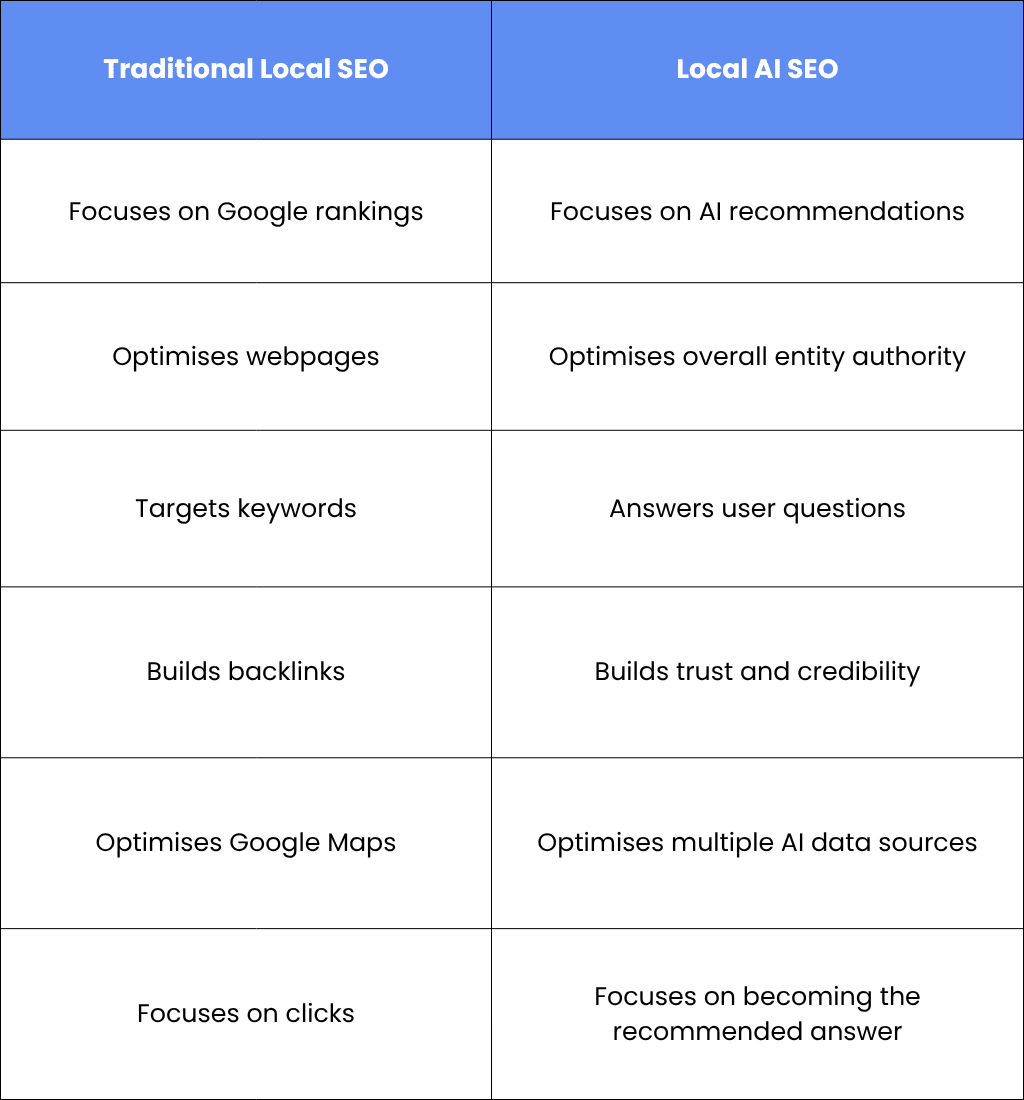
Businesses should think of local AI SEO as the natural evolution of local SEO rather than a replacement.
Strong fundamentals remain essential.
Step-by-Step Guide to Local AI SEO
Think of local AI SEO as building a strong foundation for your business's digital reputation. Each step builds upon the previous one. AI platforms don't rely on a single ranking factor when deciding which businesses to recommend. Instead, they evaluate hundreds of signals across your website and the wider web before determining whether your business is trustworthy enough to appear in an AI-generated answer.
By following the steps below in order, you'll gradually strengthen those trust signals and create a digital presence that AI systems can confidently understand and recommend.
Step 1: Build an Exceptional Google Business Profile
Before optimising your website, start with your Google Business Profile (GBP). It is one of the most authoritative sources of local business information on the internet and often acts as the foundation for your business's digital identity.
When someone searches for "best café near me" or "AI SEO agency in Ho Chi Minh City", Google's local data is frequently referenced by AI-powered search experiences. An incomplete or outdated profile makes it harder for AI to verify your business, even if your website is well optimised.
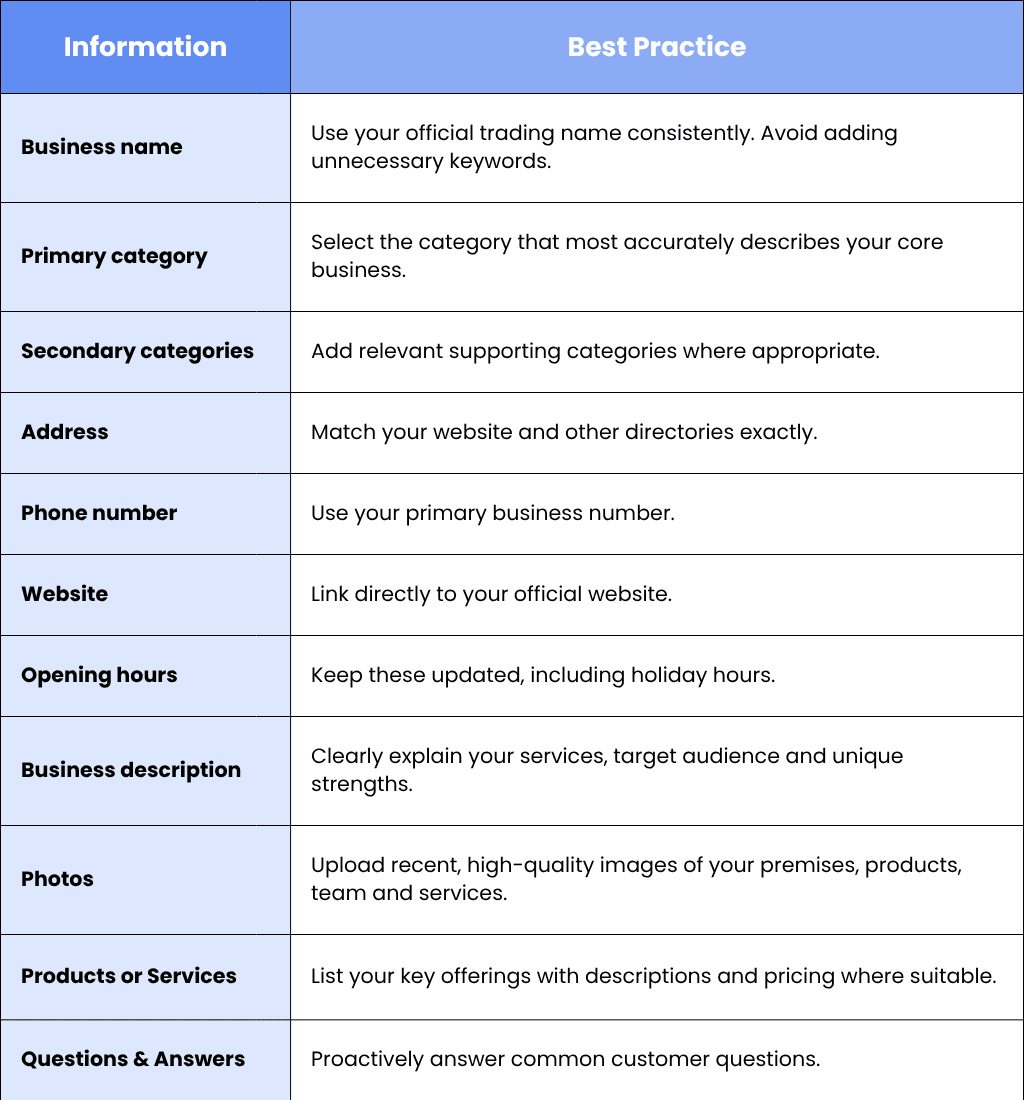
Make sure every section of your profile is completed accurately and kept up to date.
Your profile should include:
Example
Instead of writing: "We provide digital marketing."
Write something more descriptive, such as: "Saigon Digital helps businesses improve online visibility through SEO, AI-powered marketing, website optimisation and Generative Engine Optimisation (GEO), supporting organisations across retail, hospitality, education and other service industries."
The more complete your profile, the easier it is for AI systems to understand what your business does and who it serves.
Step 2: Keep Your Business Information Consistent Everywhere
Once your Google Business Profile is complete, the next priority is ensuring that the same information appears consistently across every platform where your business is mentioned.
This step is crucial because AI systems compare information from multiple sources to verify that a business is legitimate. If your address, phone number or business name differs across websites, AI may become less confident in the accuracy of your information.
This consistency is commonly referred to as NAP consistency (Name, Address and Phone number), although today it also extends to your website URL, business hours, email address and social media profiles.
Check your details across:
- Your website
- Google Business Profile
- Industry directories
- Chamber of Commerce listings
- Local business directories
- Review platforms
- Government or tourism websites (where applicable)
Example
Suppose your website says: Suite 201, 25 Nguyen Hue Boulevard
But another directory lists: Floor 2, 25 Nguyen Hue Blvd
Although they refer to the same location, AI systems may interpret them as different addresses. Standardising these details helps reinforce trust.
Once you've established a consistent business identity across the web, you can begin expanding your local relevance through dedicated website content.
Step 3: Create Dedicated Location Pages
After establishing a consistent business identity, the next step is helping AI understand where you operate and which local audiences you serve.
Many businesses only have a single "Contact Us" page that lists every office or service area. While this may be convenient for users, it provides limited context for search engines and AI systems.
Instead, create a dedicated landing page for each city, district or region you actively serve.
For example, an SEO agency might create pages such as:
- SEO Agency in Ho Chi Minh City
- SEO Services in Hanoi
- Local SEO for Businesses in Da Nang
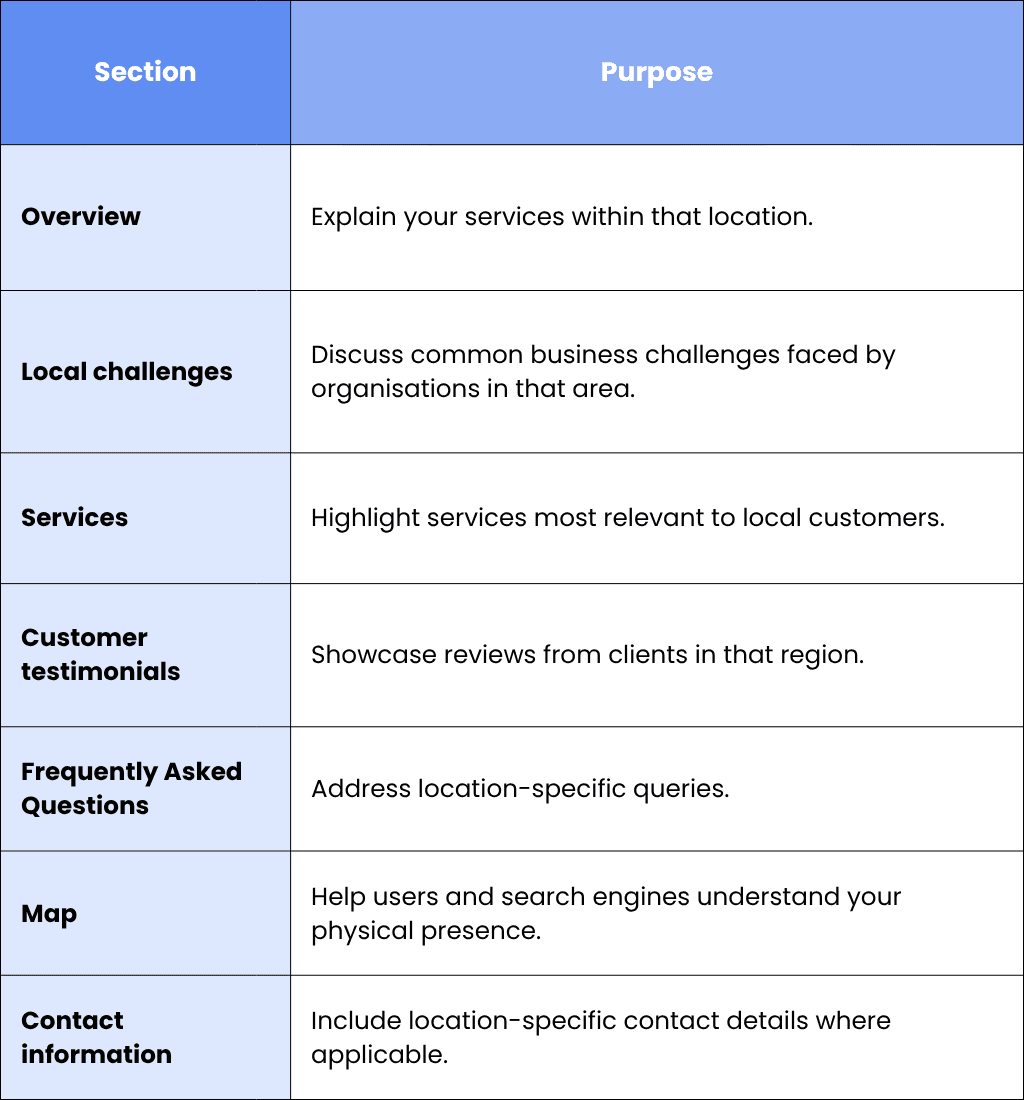
Each page should include unique, location-specific information rather than duplicated content.
A well-structured location page could include:
Example
Rather than saying: "We offer SEO services."
Expand it into: "Our SEO specialists work with retailers, restaurants, hotels and education providers across Ho Chi Minh City to improve local visibility, attract qualified leads and strengthen their presence in both traditional search engines and AI-generated search experiences."
Once AI understands where you operate, the next logical step is helping it understand what questions your customers typically ask.
Step 4: Answer Local Questions Clearly
AI assistants are designed to answer questions. Therefore, businesses that already answer those questions clearly on their websites are more likely to be referenced.
Instead of only describing your services, think about the questions potential customers ask before making a purchase.
For example:
Restaurant
- Is parking available?
- Do you offer vegetarian options?
- Can customers book online?
- Are you suitable for large groups?
Hotel
- Is breakfast included?
- Do you provide airport transfers?
- Is early check-in available?
SEO Agency
- How long does SEO take?
- Do you specialise in local businesses?
- What industries do you work with?
- Do you offer AI optimisation services?
Structure these answers using clear headings and concise paragraphs.
For example:
Question: Do you provide SEO for restaurants?
Answer: Yes. We work with restaurants and hospitality businesses to improve local search visibility, optimise Google Business Profiles, implement structured data and increase visibility in AI-generated search results.
This straightforward format makes it easier for AI systems to extract and present your answer.
Once you've created useful content for readers, the next step is making that information easier for machines to interpret.
Step 5: Implement Structured Data (Schema Markup)
Even though your website may clearly explain your business, AI systems still need help interpreting the information accurately.
This is where Schema markup becomes valuable.
Schema is structured code that tells search engines and AI platforms exactly what different pieces of information represent.
For example, instead of simply displaying: 9:00 AM – 6:00 PM
Schema explicitly tells AI: These are the business's opening hours.
Useful schema types include:
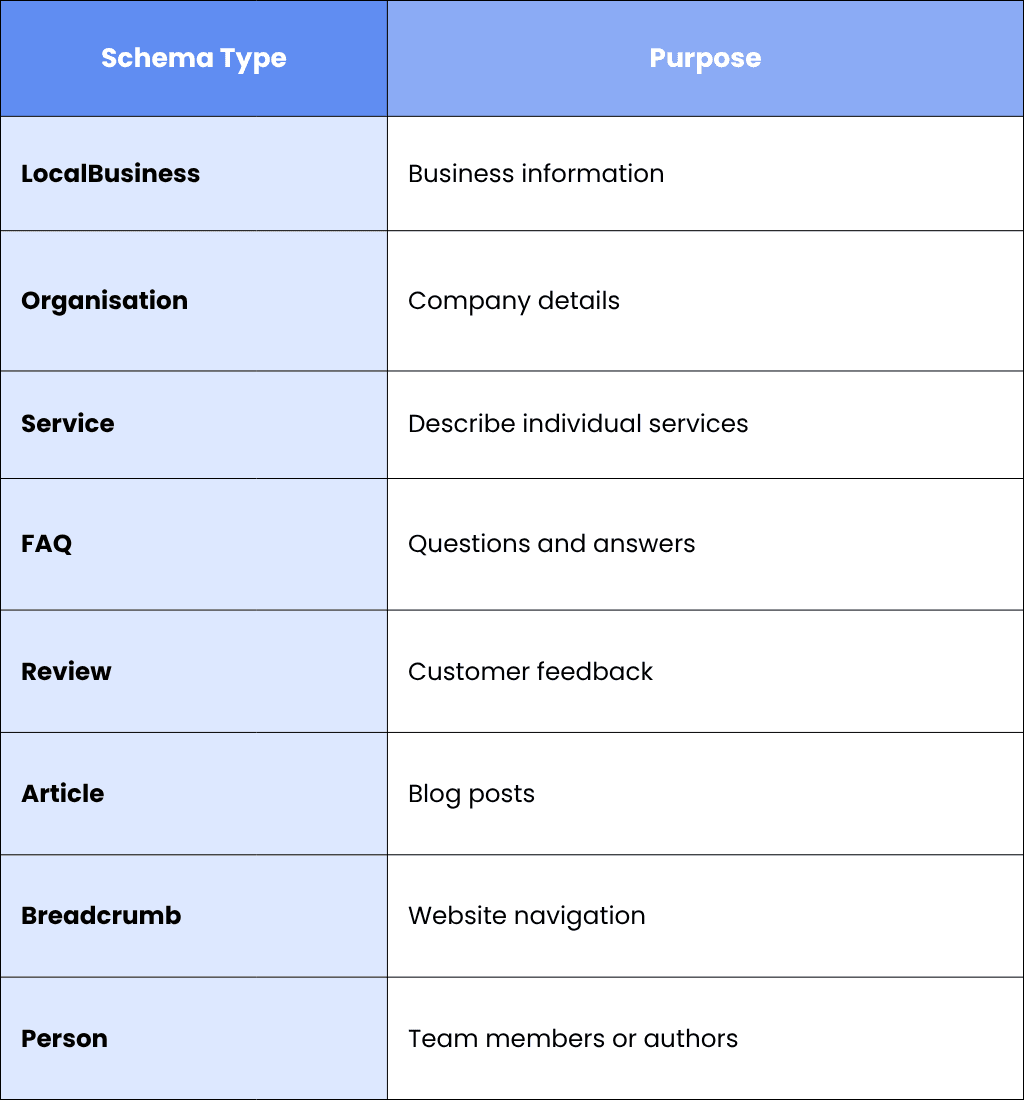
Although visitors won't see this code directly, AI systems use it to better understand your content and improve confidence in the information they present.
Once AI can accurately interpret your website, the next objective is demonstrating your expertise through valuable content.
Step 6: Publish Helpful Local Content
Your service pages explain what you do, but your content demonstrates why your business is knowledgeable and trustworthy.
AI systems increasingly prioritise content that educates rather than simply promotes.
Instead of publishing articles that repeatedly mention your services, create resources that genuinely help local customers.
Examples include:
Hospitality
- Hidden attractions near your hotel
- Weekend itineraries
- Travel tips for international visitors
Retail
- Buying guides
- Product comparisons
- Seasonal shopping advice
Education
- School selection guides
- Curriculum comparisons
- Parent resources
Food & Beverage
- Local dining guides
- Ingredient education
- Seasonal menu recommendations
A useful rule is the 80/20 principle:
- 80% educational content
- 20% promotional content
Businesses that consistently educate their audience naturally build authority over time.
However, expertise alone isn't enough. AI also evaluates whether other people trust your business.
Step 7: Earn High-Quality Reviews
Customer reviews provide independent validation that your business delivers on its promises.
AI platforms consider reviews as one of many trust signals because they reflect genuine customer experiences rather than self-published marketing claims.
Rather than focusing solely on increasing your average rating, encourage customers to leave detailed reviews describing:
- the service they received
- the products they purchased
- the location they visited
- what they particularly appreciated
For example, compare these two reviews:
❌ "Great service."
✅ "Saigon Digital helped improve our restaurant's local SEO strategy. Within six months we saw a significant increase in Google Business Profile enquiries and local organic traffic."
The second review provides much richer context for both search engines and AI systems.
Remember to respond professionally to every review, including negative ones. Constructive responses demonstrate transparency and a commitment to customer service.
As your customer reputation grows, you can begin strengthening your authority beyond your own website.
Step 8: Strengthen Your Local Authority
Once customers trust your business, the next objective is earning recognition from other reputable organisations.
Think of authority as your business's reputation across the wider internet.
AI places greater confidence in businesses that are referenced by respected third parties.
Opportunities include:
- Local newspapers
- Industry publications
- Business associations
- Universities
- Chambers of Commerce
- Tourism organisations
- Community events
- Professional directories
For example, if a hotel is featured in a respected travel publication as one of the city's top boutique hotels, that mention reinforces its authority far more than simply claiming the same thing on its own website.
The more trusted organisations mention your business, the stronger your digital credibility becomes.
Once your reputation is established externally, you should reinforce it with evidence of your own expertise.
Step 9: Demonstrate Expertise
Authority tells AI that other people trust your business. Expertise demonstrates why they should.
Modern AI systems increasingly favour businesses that produce original, experience-based knowledge instead of generic marketing content.
Consider publishing:
- Case studies
- Industry reports
- Original research
- Survey results
- Practical guides
- White papers
- Customer success stories
For example, rather than writing another article titled "Why SEO Matters", publish something more insightful, such as:
"How a Vietnamese Restaurant Increased Local Organic Traffic by 68% Through Google Business Profile Optimisation."
Original content like this is far more valuable because it reflects real-world experience rather than repeating commonly available information.
After demonstrating expertise, the final step is ensuring that AI can easily process everything you've created.
Step 10: Optimise for AI Readability
The final step brings together everything you've built.
Even the most authoritative content may not be referenced if AI struggles to interpret it.
Good AI readability improves the likelihood that your information can be extracted accurately and presented within AI-generated answers.
Follow these formatting principles consistently:
- Use descriptive headings.
- Keep paragraphs concise.
- Write in plain English.
- Include bullet points where appropriate.
- Add comparison tables.
- Define technical terminology.
- Answer questions directly before expanding with additional detail.
- Include summaries for longer sections.
For example, compare these two approaches:
Less effective: Our company delivers comprehensive strategic optimisation services through advanced methodologies and integrated digital frameworks.
More effective: We help businesses improve their visibility in Google Search and AI-powered search platforms through technical SEO, high-quality content and structured data.
The second version is clearer for both readers and AI systems.
Finally, remember that local AI SEO is not a one-off project. Search technology continues to evolve, customer expectations change, and AI models regularly update how they evaluate information.
Review your content, business information and technical implementation regularly to ensure your business remains accurate, authoritative and competitive. Organisations that consistently maintain and improve these signals are far more likely to appear in AI-generated local recommendations over the long term.
Local AI SEO Best Practices by Industry
Although the core principles of local AI SEO remain the same regardless of industry, the way you apply them should reflect your customers' search behaviour and the information AI systems are most likely to retrieve.
When users ask AI assistants for recommendations, they rarely ask broad questions. Instead, they ask highly specific, conversational questions based on their immediate needs.
For example:
- "Where can I find the best family-friendly restaurant near me?"
- "Which hotel in Da Nang has an ocean view and airport shuttle?"
- "Can anyone recommend an international school in Ho Chi Minh City?"
- "What's the best SEO agency for retail businesses in Vietnam?"
The more your content mirrors these real-world questions and provides complete, trustworthy answers, the more likely AI platforms are to reference your business.
Below are some industry-specific best practices to help you strengthen your local AI SEO strategy.
1. Restaurants and Cafés
Customers searching for restaurants often have immediate intent. They want quick, reliable answers about food, location, pricing and convenience. AI platforms therefore prioritise businesses with detailed, accurate and up-to-date information.
Beyond simply listing your menu, provide context that helps customers decide whether your restaurant meets their needs.
Prioritise information such as:
- Complete menus with current pricing
- Dietary options (vegetarian, vegan, halal, gluten-free, etc.)
- Opening hours, including public holidays
- Reservation options
- Parking availability
- Delivery and takeaway services
- Accessibility information
- Outdoor seating
- Family-friendly facilities
- Pet-friendly policies where applicable
Create locally relevant content
Restaurants often overlook the opportunity to publish educational content. However, useful local content can significantly strengthen your authority.
Examples include:
- Best brunch spots in District 1
- Vietnamese coffee culture explained
- Local food guides for tourists
- Seasonal ingredient spotlights
- Behind-the-scenes stories from your chefs
- Dining recommendations for nearby attractions
This type of content demonstrates expertise while naturally reinforcing your local relevance.
Example
Instead of writing:
"We serve authentic Vietnamese food."
Expand it into something more informative:
"Located in the heart of District 1, our restaurant specialises in traditional Southern Vietnamese cuisine using locally sourced ingredients. Visitors can enjoy indoor and outdoor seating, vegetarian options and convenient online reservations, making us an ideal choice for both residents and tourists exploring central Ho Chi Minh City."
This provides AI with much richer contextual information.
2. Retail Businesses
Retail customers increasingly ask AI assistants for product recommendations before they visit a shop.
Questions often include:
- Where can I buy running shoes near me?
- Which furniture store has sustainable products?
- Where can I find children's toys in Hanoi?
Rather than only promoting products, help AI understand what you sell, who your products are for and why customers should choose your business.
Optimise product information
Every important product should include:
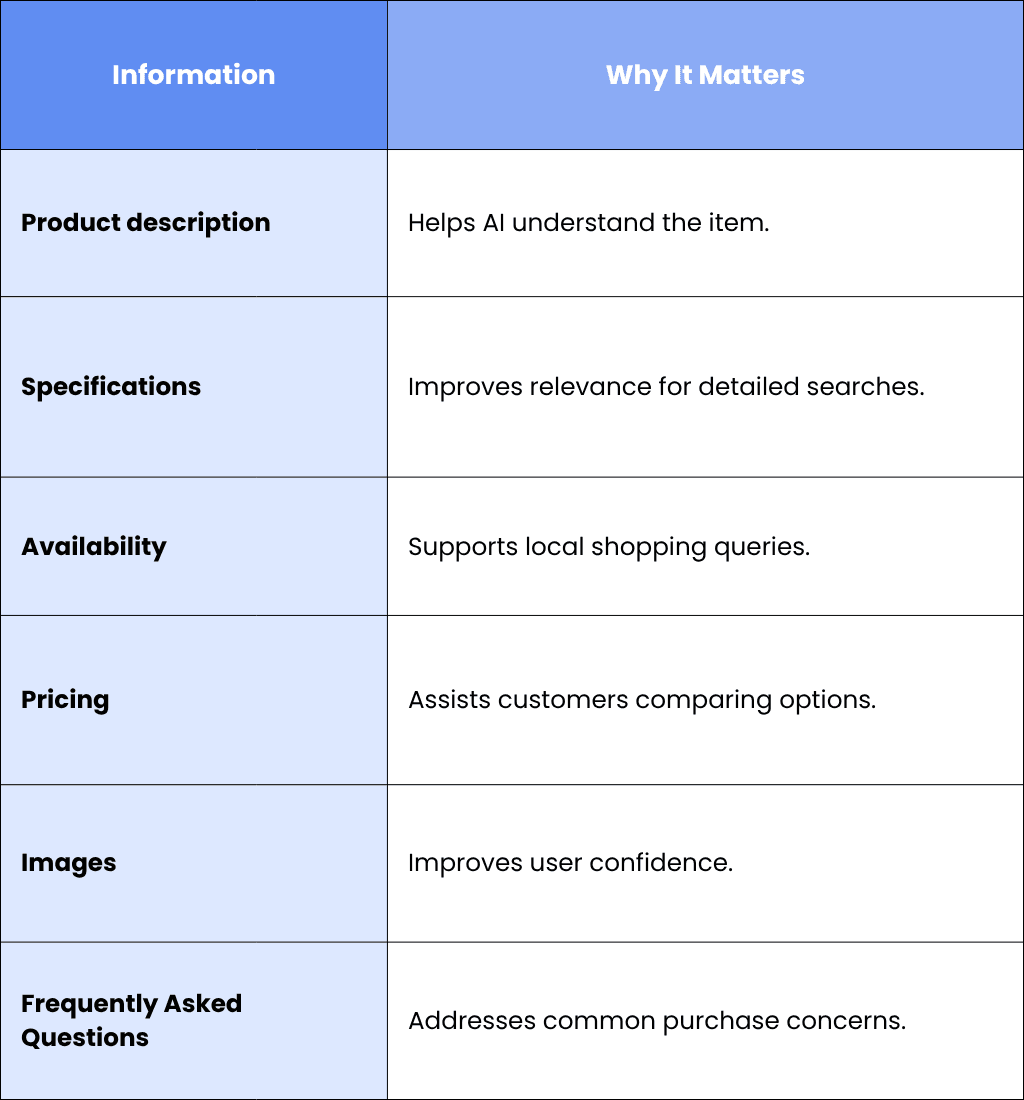
Publish buying guides
Educational content is particularly valuable for retailers because many customers conduct research before making purchasing decisions.
Examples include:
- How to choose the right office chair
- A guide to selecting school supplies
- Beginner's guide to skincare products
- Comparing different types of coffee machines
- Winter clothing buying guide
These resources help establish expertise while increasing your chances of appearing in AI-generated product recommendations.
Highlight local convenience
Don't forget to mention services that influence purchasing decisions, such as:
- Click-and-collect
- Same-day delivery
- Store pickup
- Product demonstrations
- Extended opening hours
- Warranty information
AI assistants frequently include these details when recommending local businesses.
3. Education Providers
Choosing a school or educational institution is a high-consideration decision. Prospective students and parents often ask detailed questions before making contact.
Rather than expecting visitors to search through multiple pages, answer these questions clearly throughout your website.
Common examples include:
- What curriculum do you offer?
- What age groups do you accept?
- How does your admissions process work?
- What qualifications do teachers hold?
- What extracurricular activities are available?
- Do you provide scholarships?
Build comprehensive resource hubs
Educational organisations can strengthen authority by publishing genuinely useful resources, such as:
- Parent guides
- University application advice
- Curriculum comparisons
- Study tips
- Student success stories
- Graduate outcomes
- Career pathways
These resources demonstrate expertise while helping AI recognise your organisation as a trusted educational authority.
Example
Instead of simply stating:
"We provide international education."
Consider expanding this into:
"Our international school follows the Cambridge curriculum from primary through secondary education, with experienced teachers, small class sizes and a strong focus on academic achievement, personal development and global citizenship."
Specific details improve both user understanding and AI interpretation.
4. Hospitality Businesses
Travellers increasingly use AI assistants as personal travel planners.
Instead of searching multiple websites, they ask questions such as:
- Which hotel is close to the airport?
- Where should I stay for a family holiday?
- Recommend a boutique hotel near Ben Thanh Market.
- Which hotel has a rooftop swimming pool?
To appear in these recommendations, your website should provide complete and detailed information about your property.
Include information such as:
- Room types
- Facilities and amenities
- Check-in and check-out times
- Nearby attractions
- Airport transfers
- Parking
- Accessibility
- Family facilities
- Business facilities
- Dining options
Create destination-focused content
Hotels can significantly improve local AI SEO by becoming a trusted source of travel information, not just accommodation.
Examples include:
- Three-day itinerary for Ho Chi Minh City
- Best cafés near our hotel
- Local attractions within walking distance
- Family activities in Da Nang
- Seasonal festivals visitors should experience
This type of content positions your hotel as a knowledgeable local expert rather than simply a place to stay.
Showcase authentic guest experiences
Feature detailed customer testimonials describing:
- Why guests chose your hotel
- Their favourite amenities
- Nearby attractions they enjoyed
- Overall travel experience
Authentic experiences help reinforce credibility for both potential customers and AI systems.
5. Professional Services (SEO, Marketing, Legal, Financial and Consulting)
Unlike hospitality or retail businesses, professional service providers are chosen primarily based on trust, expertise and proven results.
Potential clients often ask AI assistants questions such as:
- Which SEO agency specialises in retail?
- Who provides AI marketing services in Vietnam?
- Recommend a law firm for commercial contracts.
- Which accounting firm works with SMEs?
AI systems therefore look for evidence that your business has genuine expertise rather than simply claiming it.
Demonstrate Experience, Expertise, Authoritativeness and Trustworthiness (E-E-A-T)
Include:
- Detailed service pages
- Client case studies
- Industry-specific experience
- Certifications
- Awards
- Speaking engagements
- Research and insights
- Named authors with professional credentials
Publish practical thought leadership
Examples include:
- Local SEO strategies for restaurants
- AI marketing trends affecting retailers
- Digital transformation guides for education providers
- SEO case studies with measurable outcomes
- Industry benchmark reports
Original insights help distinguish your business from competitors publishing generic marketing content.
Use measurable outcomes wherever possible
Rather than saying:
"We improved our client's SEO."
Provide evidence:
"After implementing a local SEO strategy and optimising Google Business Profile, the client increased local organic traffic by 74% and generated 38% more qualified enquiries within eight months."
Specific, evidence-based content carries significantly greater weight with both prospective clients and AI systems.
A Common Principle Across Every Industry
Although each sector has unique requirements, the underlying objective of local AI SEO remains consistent.
AI platforms want to recommend businesses that provide the most accurate, trustworthy and complete answers to users' questions.
Regardless of whether you operate a restaurant, hotel, retail business, educational institution or professional services firm, your website should consistently answer four fundamental questions:
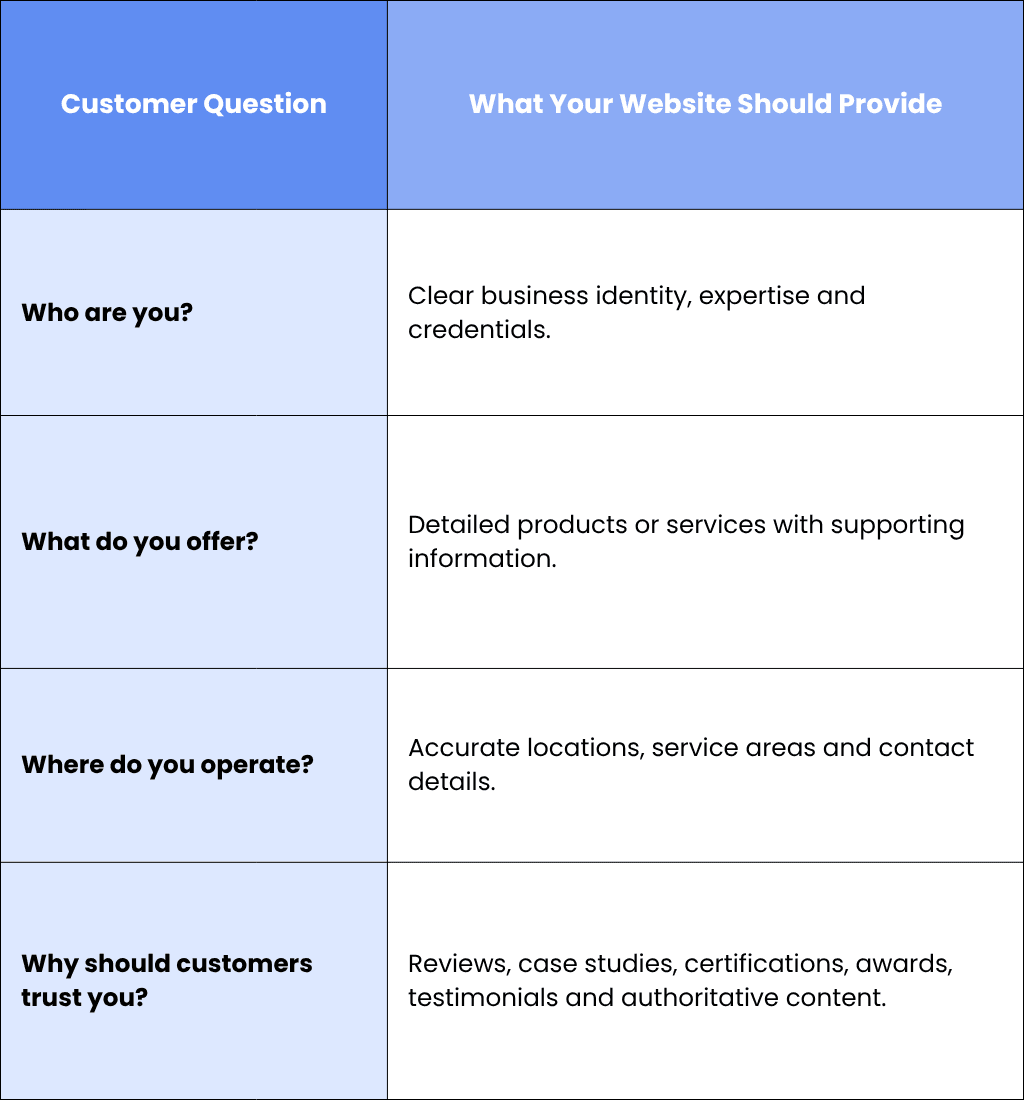
If your website can answer these questions clearly and consistently across every customer touchpoint, AI systems will have a much stronger foundation for understanding your business and recommending it in local search results.
Measuring Local AI SEO Success
Instead of focusing on a single metric, think of local AI SEO as measuring overall digital authority. Every improvement you make, from updating your Google Business Profile to publishing expert content and earning quality reviews, contributes to how AI platforms understand and recommend your business.
The following metrics provide a more complete picture of whether your local AI SEO strategy is moving in the right direction.
1. Monitor Branded Search Growth
One of the clearest indicators that your brand is becoming more visible is an increase in branded searches.
A branded search occurs when users search specifically for your business name rather than a generic service.
For example:
Generic search
- Coffee shops in Ho Chi Minh City
- Best café near me
- International school in District 2
Branded search
- Saigon Coffee
- ABC Coffee District 1
- XYZ International School
When AI platforms recommend your business, users often perform a second search to learn more before contacting you. As a result, branded search volume frequently increases before conversions do.
You can monitor branded searches using:
- Google Search Console
- Google Trends
- Google Ads Keyword Planner (for broader trends)
If branded searches continue growing over time, it often indicates that more people are discovering and recognising your business through search, AI recommendations or other digital channels.
2. Track Google Business Profile Performance
Since your Google Business Profile is one of the strongest local trust signals, monitoring its performance should become part of your regular reporting.
Within your Google Business Profile dashboard, review metrics such as:
- Profile views
- Website clicks
- Phone calls
- Direction requests
- Messages
- Photo views
- Customer actions
Rather than viewing these metrics individually, look for trends over time.
For example:
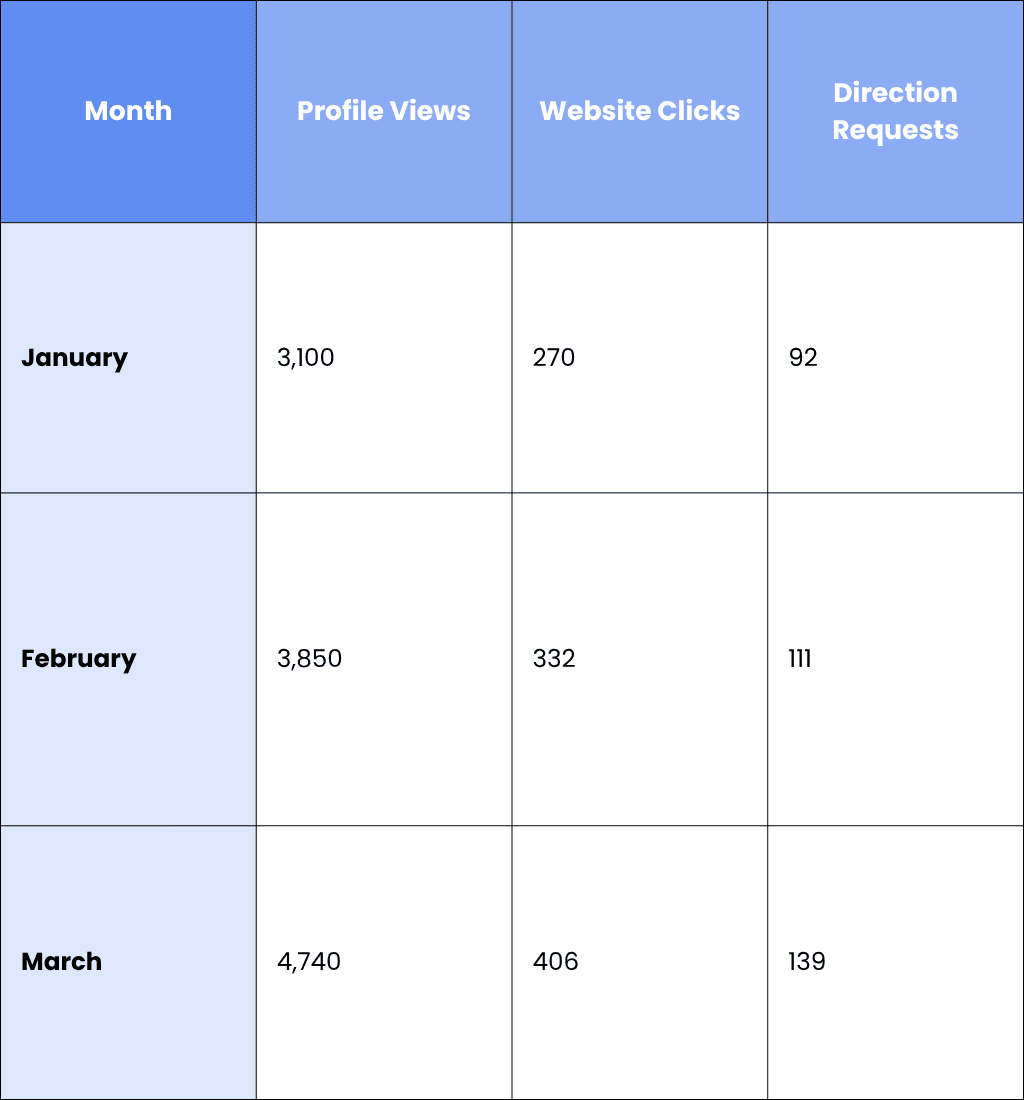
Consistent month-on-month growth suggests that your business is becoming more visible in local search results and attracting greater customer interest.
If profile views increase but website clicks remain flat, review your business description, photos, calls to action and service information to ensure your listing encourages users to take the next step.
3. Measure Local Organic Traffic
Website traffic remains one of the most valuable indicators of SEO performance, but not all traffic is equally meaningful.
Instead of measuring total visitors, focus specifically on local organic traffic, people who discover your website through unpaid search while looking for businesses in your target locations.
Using tools such as Google Analytics 4 (GA4), you can analyse:
- Organic sessions
- Landing pages
- Geographic locations
- New versus returning users
- User engagement
- Conversion rates
Pay particular attention to your location-specific landing pages.
For example:
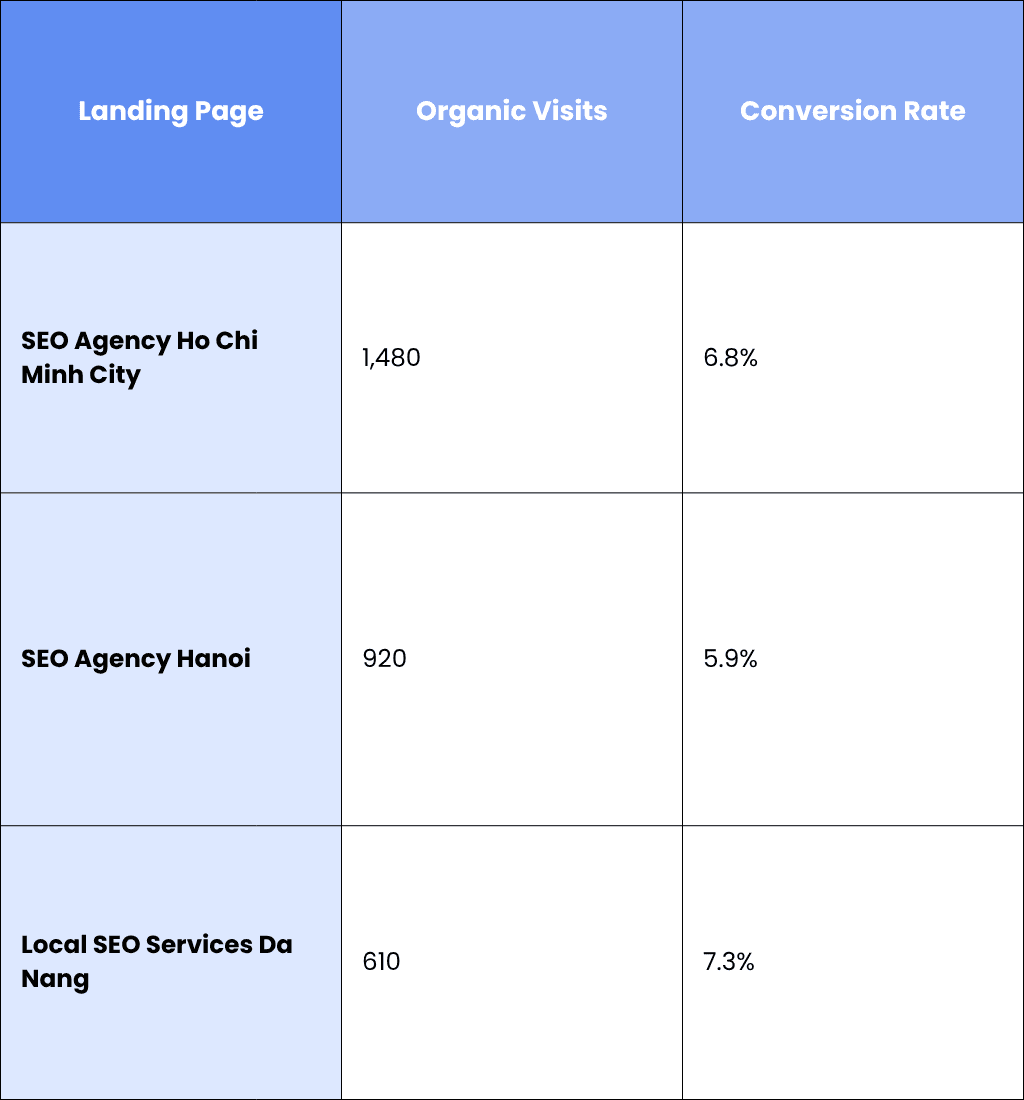
If one location page consistently outperforms others, examine why. It may contain more comprehensive content, stronger local signals or better user experience—insights that can be applied across your other pages.
4. Monitor Local Landing Page Conversions
Traffic alone does not generate business growth.
Ultimately, successful local AI SEO should help convert visitors into enquiries, bookings or sales.
For each important location page, define the conversions that matter most.
These might include:
- Contact form submissions
- Phone calls
- Online bookings
- Consultation requests
- Newsletter sign-ups
- Product enquiries
- Quote requests
For example, imagine two location pages:
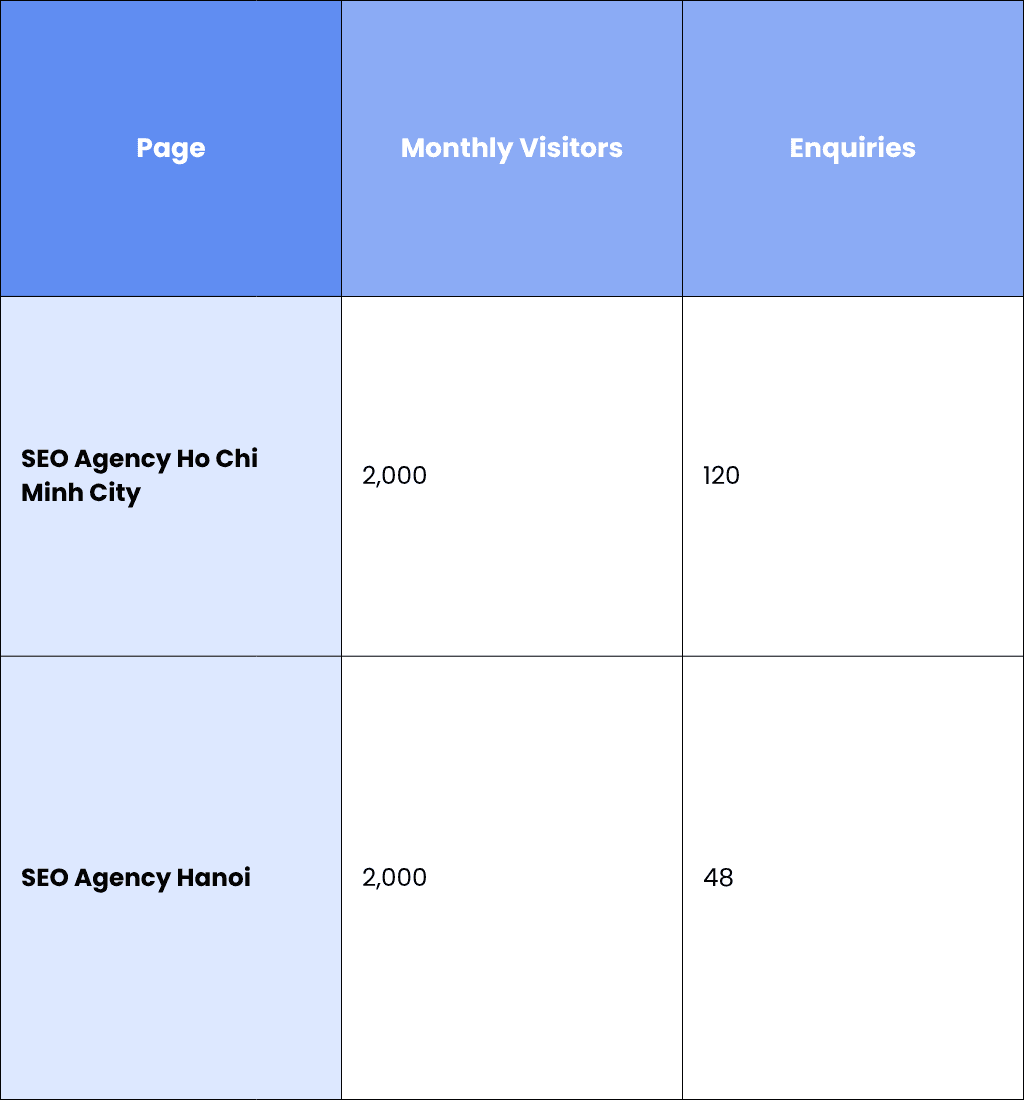
Although traffic is identical, the Ho Chi Minh City page converts significantly better.
This suggests there may be opportunities to improve the Hanoi page by strengthening local content, adding more testimonials, refining calls to action or addressing common customer questions more clearly.
In other words, don't just ask, "Are people finding us?" Ask, "Are the right people taking action once they do?"
5. Track Customer Reviews and Reputation
Customer reviews play a dual role.
They influence purchasing decisions while also acting as trust signals that AI platforms use when evaluating local businesses.
Rather than focusing solely on average star ratings, monitor broader reputation metrics such as:
- Number of new reviews
- Average rating
- Review frequency
- Review recency
- Review quality
- Response rate
- Response time
For example:
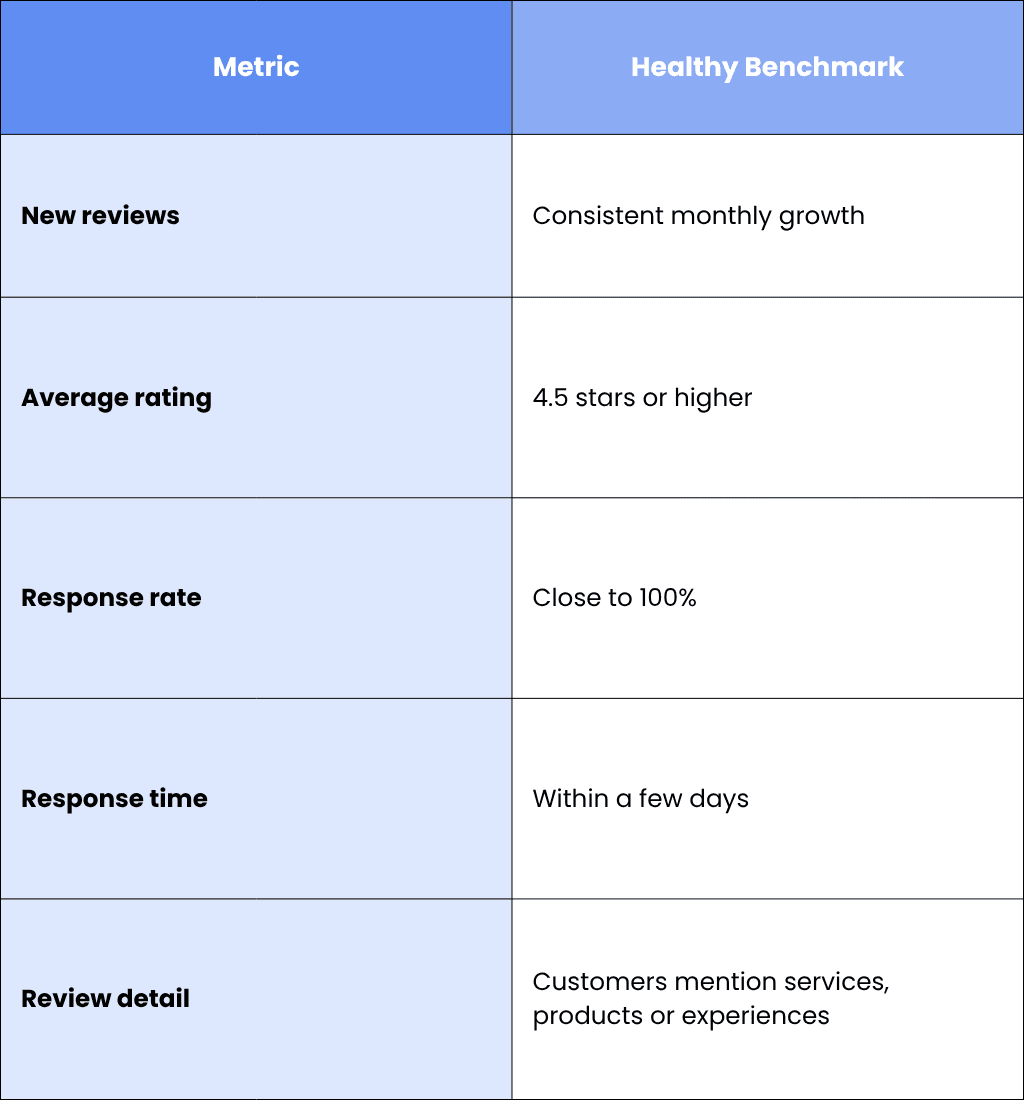
Detailed reviews that describe specific services, locations or outcomes provide richer information for AI systems than short comments such as "Great place" or "Excellent service."
6. Audit Citation Consistency
Earlier in this guide, we discussed the importance of maintaining consistent business information across the web.
This should not be treated as a one-time exercise.
Business information naturally changes over time:
- Offices relocate.
- Phone numbers change.
- Opening hours are updated.
- Websites are redesigned.
- Brands are refreshed.
If outdated information remains online, AI systems may receive conflicting signals.
Conduct regular citation audits by reviewing your business information across:
- Google Business Profile
- Bing Places
- Apple Maps
- Industry directories
- Chamber of Commerce listings
- Local business directories
Even small inconsistencies can gradually weaken AI confidence in your business data.
Scheduling a quarterly audit helps maintain long-term accuracy.
7. Monitor Visibility in AI Search Platforms
Unlike traditional SEO, there is currently no universal tool that accurately measures how frequently your business appears in AI-generated answers across every platform.
However, you can still perform regular qualitative assessments.
Consider testing prompts such as:
- "Recommend an SEO agency in Ho Chi Minh City."
- "Best hotel near Ben Thanh Market."
- "Top digital marketing agency for retail businesses."
- "Where can I find a family-friendly restaurant in District 7?"
Run these searches across multiple AI platforms, including:
- ChatGPT
- Google AI Overviews
- Gemini
- Perplexity
Keep a simple record of:
- Whether your business appears
- How often it appears
- Which competitors are mentioned
- What information AI includes
- Which websites AI appears to reference
For example:
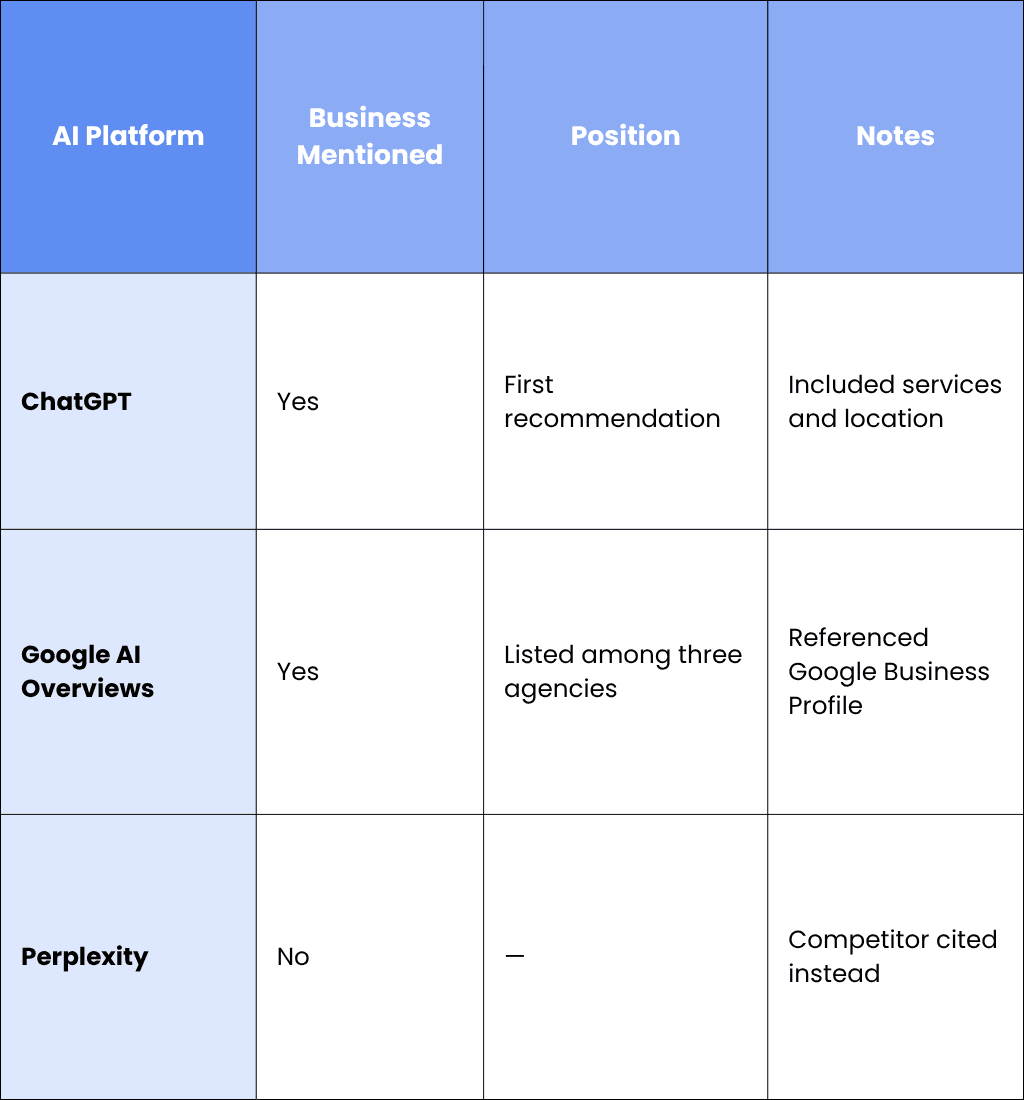
Although this process is more manual than traditional SEO reporting, it provides valuable insight into how different AI systems currently perceive your brand.
8. Evaluate Topical Authority
As AI search continues to evolve, one of the strongest competitive advantages is becoming recognised as an authority within your niche.
Rather than measuring individual keywords alone, assess whether your content comprehensively covers the topics your customers care about.
For example, an SEO agency targeting hospitality businesses might publish content covering:
- Local SEO
- AI SEO
- Google Business Profile optimisation
- Technical SEO
- Website performance
- Hotel marketing
- Review management
- Schema markup
- Content strategy
The broader and deeper your expertise across related topics, the easier it becomes for AI systems to understand what your business specialises in.
A useful exercise is to create a content map listing every major topic your ideal customers search for.
Where gaps exist, prioritise creating high-quality resources to strengthen your authority.
9. Focus on Business Outcomes, Not Just SEO Metrics
Finally, remember that the purpose of local AI SEO is not simply to increase rankings, impressions or website traffic.
Its real objective is to help your business grow.
Ultimately, success should be measured by commercial outcomes such as:
- More qualified enquiries
- Increased bookings
- Higher sales
- Greater lead quality
- Improved customer retention
- Stronger brand recognition
- Reduced customer acquisition costs
- Increased return on marketing investment (ROI)
For example, consider these two scenarios:
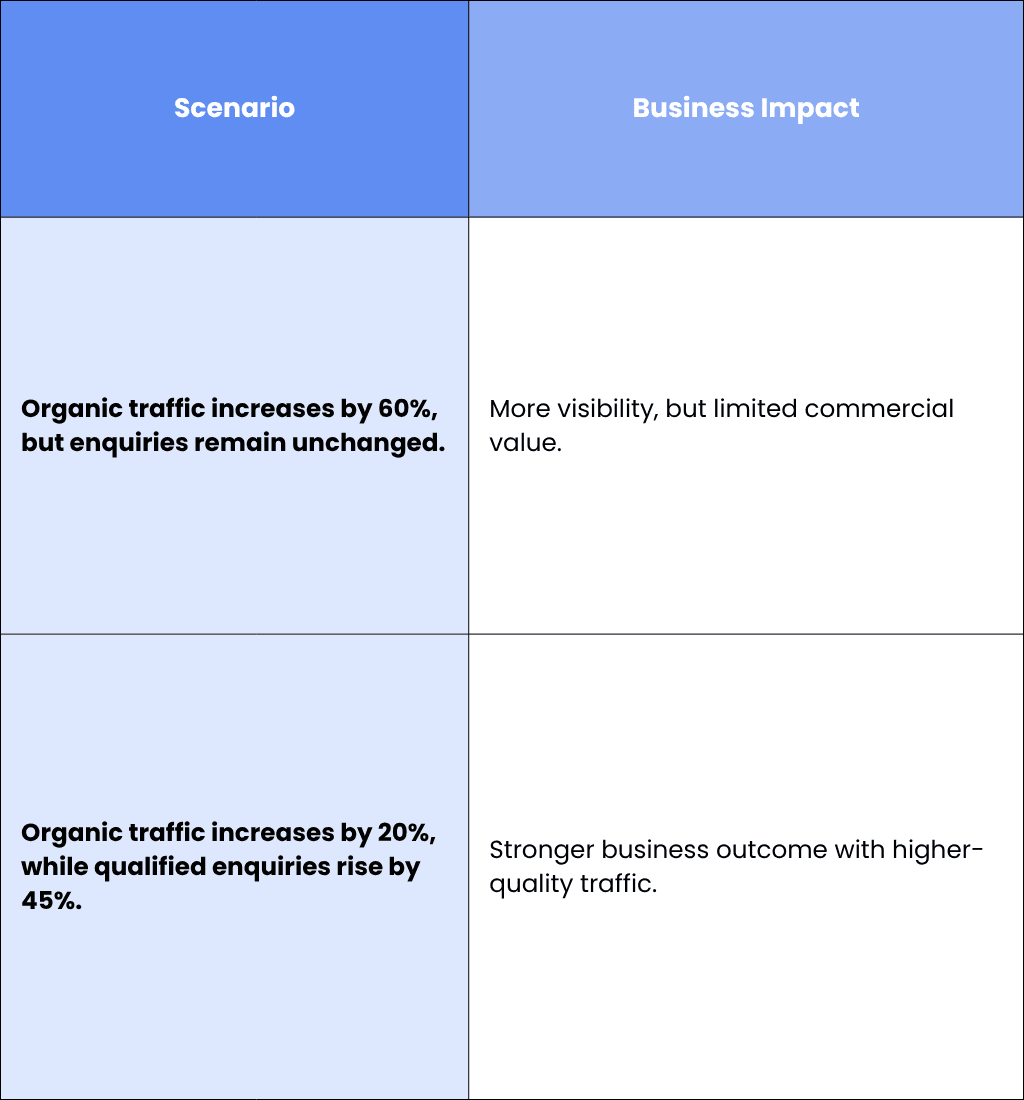
The second scenario demonstrates far greater success because the additional visibility is translating into meaningful business results.
How Saigon Digital Helps Businesses Succeed with Local AI SEO
Appearing in AI-generated answers requires more than traditional optimisation. It demands a strategic approach that combines technical SEO, structured data, authoritative content and AI-ready website architecture.
At Saigon Digital, we help ambitious brands stay ahead of this shift through integrated SEO and AI optimisation services.
Our capabilities include:
- SEO Services that improve technical performance, strengthen content, build authority and develop effective local and global search strategies.
- Generative Engine Optimisation (GEO) to help your brand become discoverable, trusted and cited by AI platforms such as ChatGPT, Gemini, Perplexity and Google AI. This includes AI Readability Optimisation, Answer Engine Optimisation (AEO), Knowledge Graph and Schema implementation, AI content audits and performance monitoring.
- AI Workflow Automation Services that streamline operations through intelligent automation, custom AI agents and scalable workflows, enabling your teams to work more efficiently while supporting long-term digital growth.
As AI continues to transform how customers discover businesses, organisations that combine strong SEO foundations with AI optimisation will be best placed to capture future demand.
If your business is ready to strengthen its visibility in both traditional search and AI-generated answers, Saigon Digital can help you build a future-ready digital strategy that delivers measurable results.
Future-Proof Your Local Visibility with Saigon Digital
Local search is evolving rapidly, and businesses that optimise for AI today will be better positioned to attract customers tomorrow. By combining strong local SEO fundamentals with AI-ready content, structured data and authoritative digital signals, you can improve your chances of being recommended by platforms like ChatGPT, Google AI Overviews, Gemini and Perplexity.
At Saigon Digital, we help ambitious brands stay ahead of this shift through tailored SEO, Generative Engine Optimisation (GEO), Answer Engine Optimisation (AEO) and AI-powered digital strategies.
Ready to make your business more visible in the age of AI search? Get in touch with Saigon Digital and discover how we can help your brand become the trusted answer your customers are looking for.
Frequently Asked Questions About Local AI SEO
1. What is local AI SEO?
Local AI SEO is the process of optimising your business so AI-powered search platforms, such as ChatGPT, Google AI Overviews, Gemini and Perplexity, can understand, trust and recommend your business in response to location-based queries. It builds on traditional local SEO by focusing not only on search rankings but also on the quality, consistency and authority of your digital presence across the web.
2. How is local AI SEO different from traditional local SEO?
Traditional local SEO aims to improve your visibility in search engine results pages (SERPs), while local AI SEO focuses on increasing your chances of appearing in AI-generated answers. Although both strategies share core elements—such as optimising your Google Business Profile, creating high-quality content and earning customer reviews—local AI SEO places greater emphasis on entity authority, structured data, content clarity and trust signals that help AI systems confidently recommend your business.
3. Which businesses can benefit most from local AI SEO?
Any business that serves customers within a specific geographic area can benefit from local AI SEO. This includes restaurants, cafés, hotels, retailers, educational institutions, healthcare providers, professional service firms and other location-based businesses. If potential customers are asking AI assistants for recommendations related to your products or services, investing in local AI SEO can help improve your visibility and attract more qualified leads.
4. How long does it take to see results from local AI SEO?
The timeframe varies depending on factors such as your website's current authority, the competitiveness of your industry and the improvements you implement. Many businesses begin to see improvements in local search visibility, website traffic and customer engagement within three to six months. However, building the authority and trust signals needed to appear consistently in AI-generated answers is an ongoing process that requires regular optimisation and high-quality content.
5. Can I do local AI SEO myself, or should I work with an agency?
Many businesses can implement the fundamentals of local AI SEO themselves, such as maintaining an accurate Google Business Profile, responding to customer reviews and publishing helpful local content. However, more advanced elements, including structured data implementation, Generative Engine Optimisation (GEO), Answer Engine Optimisation (AEO), technical SEO and AI performance monitoring, often require specialist expertise. Working with an experienced agency can help ensure your strategy is comprehensive, technically sound and aligned with how AI-powered search continues to evolve.