



Search has changed. People still use Google to find businesses, products, services and answers, but the journey is no longer as simple as typing a keyword, clicking the first result and making a decision.
Today, customers may discover a business through traditional search results, Google Maps, social platforms, review websites or AI tools. Google itself has introduced AI Overviews and AI Mode, while tools such as ChatGPT and other generative AI platforms are increasingly becoming part of how people research and compare their options. Google confirms that the same fundamental SEO practices remain relevant for its AI search experiences, with helpful, reliable and people-first content still at the centre.
This raises an important question for businesses investing in digital marketing: Is hiring a SEO company worth it in 2026?
For many businesses, the answer is yes. But SEO is not automatically a good investment simply because an agency offers it. The value depends on your business goals, your market, your website, your internal resources and, most importantly, whether the SEO work connects to measurable business outcomes.
Key Takeaways
- SEO can be a worthwhile investment in 2026 when it connects organic visibility to measurable business outcomes such as leads, bookings, sales or revenue.
- SEO companies come in different forms. Local, offshore, nearshore, international agencies, specialist consultancies and freelancers can all be suitable depending on a company's needs.
- SEO costs vary significantly by business. Small businesses may spend around $500–$1,500 per month, while larger or international businesses can require $5,000–$20,000+ depending on their market, website and objectives.
- AI is changing search, not replacing SEO. Businesses should prepare for visibility across Google and AI-powered platforms such as ChatGPT, Gemini and Perplexity.
- The right SEO company should understand your business, communicate its strategy clearly and focus on meaningful commercial results.
- SEO takes time and ongoing optimisation. Businesses should treat it as a long-term growth channel rather than a quick marketing fix.
- The best SEO partner is a growth partner. Look for an agency that can connect SEO, content, data, website performance and AI to support your wider business goals.
What Has Changed About SEO in 2026?
SEO is no longer just about ranking a page for a list of keywords.
A strong SEO strategy now considers the entire customer journey. That includes technical website performance, useful content, brand authority, local visibility, structured data, user experience and how your business is represented across the wider digital ecosystem.
AI has added another layer to this.
Google's current guidance explains that AI Overviews and AI Mode can use multiple related searches and sources to build responses, while supporting links can help users explore information further. Websites still need to meet Google's normal technical requirements and follow fundamental SEO best practices to be eligible.
In other words, businesses should not think of SEO and AI visibility as completely separate disciplines.
The foundations still matter: a technically sound website, clear information, useful content, strong authority and a website that genuinely helps its audience.
At the same time, businesses need to understand where their customers are searching and how those search behaviours are changing.
Recent consumer research from BrightLocal illustrates this shift. Its 2026 research found that 75% of consumers used more than one channel during their most recent local business search. Google remained important, but consumers also used social media, AI tools and review sites during the journey.
That makes modern SEO less about chasing one position in Google and more about making your business discoverable and credible wherever customers are looking.
So, Is Hiring a SEO Company Worth It?
For many businesses, yes — particularly when SEO can influence revenue, leads, bookings or other meaningful business outcomes.
However, the better question is not simply whether SEO is worth paying for. It is whether outsourcing SEO is the right way for your business to achieve its goals.
SEO requires a combination of technical knowledge, content strategy, research, data analysis, website development and ongoing optimisation. Some businesses can build these capabilities internally. Others will get better results by working with an experienced SEO company.
For example, imagine a hotel competing for searches around accommodation in a busy destination.
The opportunity is not limited to ranking for "hotels in [destination]". A comprehensive strategy could target searches around specific neighbourhoods, facilities, experiences, room types and travel questions. It could also improve technical performance, strengthen internal linking, optimise local visibility and make important information easier for both customers and search engines to understand.
The same principle applies to an F&B brand, retailer, university, B2B company or SaaS business.
The exact strategy changes, but the objective remains the same: connect the right people with the right information at the right stage of their decision-making process.
Why Businesses Choose to Hire a SEO Company
1. SEO Requires Specialist Knowledge
SEO may look simple from the outside, but effective SEO involves much more than adding keywords to a page. An experienced SEO team needs to understand technical performance, search intent, content quality, site structure, internal linking, authority and how search engines interpret a website. More importantly, these areas need to work together.
For example, an ecommerce retailer might have hundreds or thousands of product pages. If important pages are difficult for search engines to crawl or duplicate pages compete with one another, creating more content will not solve the underlying problem. An SEO specialist can identify these issues and prioritise the changes that are most likely to improve visibility and performance.
A good SEO company should therefore bring more than tools and reports. It should bring the experience to understand what needs to change, why it matters and how it can contribute to business growth.
2. It Can Save Your Internal Team Time
SEO can quickly become a full-time responsibility. Keyword research, technical audits, content planning, competitor analysis, performance tracking and ongoing optimisation all require time, and these tasks can be difficult for an internal marketing team to manage alongside their existing responsibilities.
For instance, a marketing manager may spend several hours each month reviewing organic performance when they could instead focus on campaigns, partnerships or customer acquisition. By working with a SEO company, the internal team can remain involved in the strategy while specialists handle the more technical and time-consuming work.
This does not mean your team needs to hand everything over. In fact, the best agency relationships usually involve collaboration. Your internal team provides industry knowledge and business context, while the SEO team provides specialist expertise and execution.
3. SEO Can Create A Long-Term Acquisition Channel
Unlike paid advertising, where visibility generally depends on continued media spend, organic search can continue generating traffic after you publish and optimise a successful page. However, this does not mean SEO is a "set and forget" channel. Rankings can change, competitors can improve their content and customer search behaviour can evolve.
The real opportunity is to build a library of useful pages that attract relevant visitors over time. For example, suppose a SaaS company creates an article that attracts 1,000 relevant organic visits a month. If just 2% of those visitors become qualified leads, that could generate 20 leads per month, or 240 leads a year, from one content asset.
The numbers will vary considerably by industry, but the principle remains the same: strong organic visibility can become a compounding acquisition asset when businesses consistently improve their website and content.
This is particularly valuable for businesses where customers research extensively before buying, such as B2B, education, hospitality and SaaS.
What Types Of SEO Companies Can Businesses Hire?
Not all SEO companies operate in the same way. Where an agency is based can influence its pricing, communication style, time-zone coverage and access to local market expertise. However, location alone should not determine whether an agency is good or bad.
Businesses can generally choose between local agencies, international agencies, offshore or nearshore providers, specialist consultancies and freelancers.
Local SEO Agencies
A local agency operates in the same country or market as your business. This can be particularly useful when your SEO strategy depends heavily on local knowledge, language and consumer behaviour.
For example, a UK restaurant group targeting customers in Manchester may benefit from an agency that understands the UK's search landscape, terminology and local market.
The trade-off is that agencies in established markets such as the UK, US or Australia often have higher operating costs, which can be reflected in their fees. Backlinko's 2026 research found that US-based SEO services typically cost several times more than services from emerging markets.
Offshore SEO Agencies
Offshore agencies operate from a different country, often in markets where operating costs are lower. Vietnam, India and other emerging markets have developed substantial digital marketing and technology industries, making offshore SEO an increasingly accessible option for international businesses.
The potential advantage is cost efficiency. A business may be able to access experienced SEO specialists at a lower cost than it would through an agency in a higher-cost market.
However, price should not be the only consideration. Businesses should also evaluate communication, English proficiency, strategic capability, technical expertise, reporting standards, working hours and experience in their particular industry or target market.
Saigon Digital, for example, is based in Ho Chi Minh City, Vietnam, but works with ambitious brands on international digital challenges. The important distinction is that an offshore agency should not simply provide cheaper execution; it should provide expertise and a strategy that matches the client's market.
Nearshore And International Agencies
A nearshore agency operates in a different country but often within a similar or convenient time zone. This model can provide a balance between cost efficiency and easy collaboration.
International agencies can also bring experience across multiple markets. This can be useful for businesses expanding into new countries because the agency may already understand international SEO, localisation and the technical considerations involved in managing multiple markets.
Specialist SEO Consultancies
Some businesses choose a specialist SEO consultancy rather than a larger agency. These providers may focus on a particular area, such as technical SEO, enterprise SEO, ecommerce SEO or international search.
This can work particularly well when a business already has an internal marketing team but needs specialist expertise for a specific challenge.
For example, an enterprise company might hire a technical SEO consultancy to resolve complex crawling and indexing issues while its internal team manages content and marketing.
Freelancers And Independent SEO Specialists
Freelancers can be a practical option for smaller businesses or companies that need support with a defined SEO task. They may offer lower costs and direct access to the person doing the work.
However, a single specialist may have limited capacity. If your business needs technical development, content production, analytics, authority building and AI search expertise at the same time, an agency with a broader team may be more suitable.
Does The Location Of Your SEO Company Matter?
Yes, but probably less than you think.
The right question is not simply whether an agency is based in the UK, US, Vietnam or somewhere else. Instead, consider whether it understands your market, your customers and your business objectives.
A Vietnamese agency can successfully support a UK SaaS company if it understands the UK market and has the skills to execute the strategy. Likewise, a UK agency may struggle with an international campaign if it lacks experience in the target markets.
When comparing agencies, consider:
- Expertise: Does the team have experience with businesses like yours?
- Market knowledge: Do they understand your target audience and markets?
- Communication: Can you communicate clearly and consistently?
- Capabilities: Can they handle technical SEO, content, analytics and emerging areas such as AI search?
- Transparency: Can they clearly explain what you are paying for?
- Results: Can they demonstrate meaningful outcomes from previous work?
Ultimately, the best SEO company is not necessarily the closest one or the cheapest one. It is the partner that can provide the right expertise, strategy and execution for the opportunity in front of your business.
How Much Does SEO Cost In 2026?
One of the first questions businesses ask when considering SEO is, naturally, “How much will it cost?”
There is no single price because SEO investment depends on the size of your website, the competitiveness of your industry, your target markets and how much work your business actually needs. Current industry research puts typical SEO retainers anywhere from around $500 to $5,000+ per month (£370–£3,700+), while larger and more competitive businesses can spend considerably more.
As a general guide, businesses might expect the following:
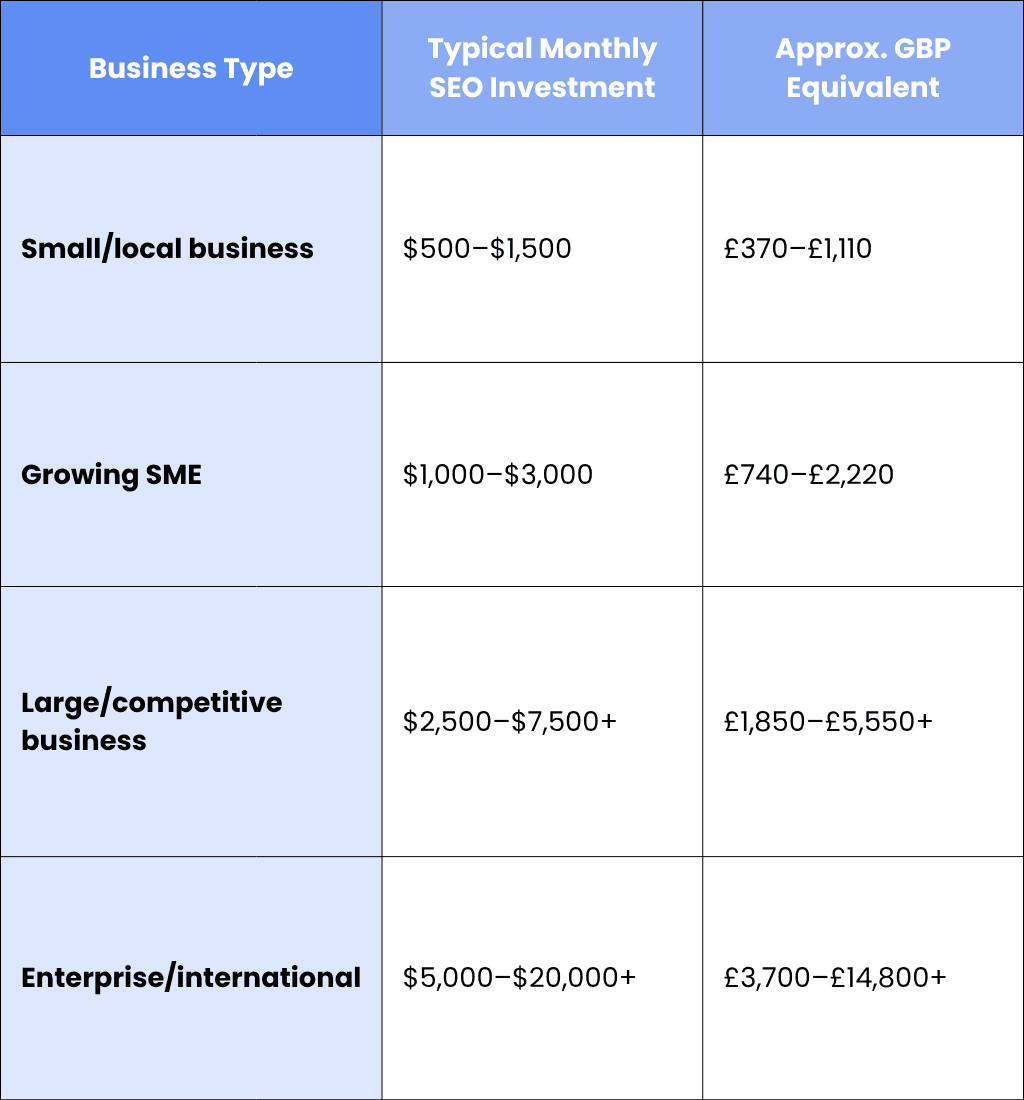
These figures are illustrative market ranges, not universal rates. For example, Ahrefs found that 63% of surveyed SEO providers charged between $500 and $5,000 per month, while Backlinko's 2026 research identified $1,001–$2,500 as the most common overall range.
Small And Local Businesses
A small restaurant, independent retailer, local education provider or single-location service business may invest around $500–$1,500 (£370–£1,110) per month in SEO.
At this level, the focus is usually on high-impact fundamentals rather than trying to compete for hundreds of keywords. Work might include technical improvements, local SEO, important service or product pages, keyword research and basic content optimisation.
For example, if a restaurant generates an average of $50 in revenue per customer and SEO brings in an additional 30 customers a month, that represents roughly $1,500 in monthly revenue before considering repeat visits or higher-value customers. The business can then compare that potential value against its SEO investment.
Growing SMEs
A growing business operating in a moderately competitive market may invest around $1,000–$3,000 (£740–£2,220) per month.
At this stage, an agency can usually work across several areas at once, such as technical SEO, content, authority building, conversion optimisation and local or international search.
For example, a growing ecommerce retailer might optimise its main category pages while also creating content around product comparisons, buying guides and customer questions. The objective is not simply to rank for more keywords, but to build a wider organic acquisition channel.
Large And Competitive Businesses
Businesses competing in highly competitive industries may need $2,500–$7,500+ (£1,850–£5,550+) per month, particularly when they have large websites, multiple locations or aggressive competitors.
At this level, SEO may involve more extensive technical work, content production, digital PR or authority building, international SEO and detailed data analysis.
For example, a large hospitality group with dozens of locations may need to optimise hundreds of location and service pages while also managing technical issues across the wider website. Consequently, the amount of work required can be significantly greater than for a single-location business.
Enterprise And International Businesses
Enterprise SEO can start around $5,000 (£3,700) per month and reach $20,000 (£14,800) or considerably more, depending on the scale and complexity of the organisation.
Large companies may have thousands or millions of pages, several websites, multiple countries and many internal stakeholders. They may also need SEO to work alongside development, content, analytics, product and marketing teams.
At this level, the question is less about finding the cheapest SEO provider and more about finding a partner capable of managing complexity and demonstrating a measurable return on investment.
What Determines The Price Of SEO?
The most important thing to remember is that you are not really paying for a number of keywords or blog posts. You are paying for expertise, strategy, execution and the potential business value those activities can create.
Pricing can increase when you have:
- A highly competitive industry
- A large or technically complex website
- Multiple countries or languages
- Hundreds or thousands of products or pages
- Significant technical SEO problems
- A need for substantial content production
- Strong competitors with established authority
- More demanding reporting and analytics requirements
Therefore, a $1,000 monthly SEO package is not necessarily better or worse than a $5,000 package. The more useful question is whether the scope of work matches the opportunity and the level of competition your business faces.
When Hiring a SEO Company May Not Be Worth It
SEO is not the right investment for every business.
If your business has no realistic search demand, has not established its core offering or has more urgent commercial problems to solve, SEO may not be the first priority.
It may also be unnecessary to hire an agency if you already have a capable internal SEO team with the expertise, technology and time required to execute the strategy.
Budget matters too.
SEO normally requires patience. A business looking for immediate results within a few weeks may be better served by methods such as paying for ads or utilizing PPC.
The important point is that SEO should be judged against the business's circumstances rather than treated as a universal solution.
What Should You Expect From A SEO Company In 2026?
Hiring a SEO company should give your business more than a list of keywords and a monthly ranking report. In 2026, SEO agencies need to understand how technical performance, content, authority, user experience and AI-powered search work together. More importantly, they should connect this work to the outcomes your business actually cares about.
Technical SEO
A strong SEO strategy starts with a website that search engines can properly crawl, understand and index. A SEO company should therefore review areas such as site architecture, page speed, mobile usability, internal linking, redirects, structured data and indexing issues.
For example, an ecommerce website with 5,000 product pages may have hundreds of pages that are duplicated, outdated or difficult for search engines to discover. Fixing these technical issues could be more valuable than publishing another 50 blog posts.
A good agency should also prioritise technical work based on business impact rather than simply producing a long list of recommendations. In other words, you should know which problems matter most, what the agency plans to change and how those changes support your goals.
Content And Authority
Creating more content does not automatically mean achieving better SEO results. Instead, your content should answer genuine customer questions, demonstrate your expertise and give people a reason to trust your business.
A SEO company should help identify topics based on search behaviour, customer needs and commercial opportunities. For example, a hotel might create useful guides covering neighbourhoods, local attractions and travel planning, while a B2B software company could develop practical resources that help potential customers solve problems related to its products.
At the same time, the agency should look beyond content volume. It should consider whether your website demonstrates genuine expertise and whether reputable websites and other relevant sources recognise your business.
The goal is simple: create content that is useful to people first and valuable to the business second, without sacrificing either.
Local And Global Search
Your SEO strategy should reflect where and how your customers search.
For a restaurant, hotel or retail business, local SEO may be particularly important. This can involve improving location pages, business information, reviews, map visibility and other signals that help customers find and evaluate nearby businesses.
Meanwhile, a SaaS or B2B company operating across several countries may need a global strategy. This could involve international keyword research, localised content, technical implementation and market-specific search strategies.
For example, a company expanding from Vietnam into Singapore, Thailand and the UK should not simply translate the same pages and expect identical results. Search behaviour, terminology, competition and customer expectations can differ between markets.
Therefore, your SEO partner should understand where your growth opportunities are and build the strategy around those markets, rather than applying the same approach everywhere.
Measurement And Reporting
SEO reporting should help you make better business decisions, not simply prove that an agency has completed its tasks.
Rankings and organic traffic remain useful metrics, but they should be connected to commercial outcomes wherever possible. Depending on your business model, this could include enquiries, qualified leads, bookings, ecommerce transactions, sign-ups or revenue.
For example, if a SEO campaign increases monthly organic traffic from 20,000 to 30,000 visitors but generates no additional leads or sales, you should ask why. Conversely, a smaller increase in traffic could be highly valuable if it brings significantly more qualified customers.
A useful SEO report should therefore answer questions such as:
- Which pages are bringing in valuable visitors?
- Which search terms are attracting potential customers?
- Are organic leads or sales increasing?
- Which SEO activities produced the strongest results?
- What should we prioritise next?
Ultimately, your agency should be able to explain not only what changed, but why it changed and what the business should do next.
AI Search And Generative Engine Optimisation
In 2026, businesses should also ask how their SEO partner approaches AI-powered search.
Customers can increasingly use platforms such as ChatGPT, Gemini and Perplexity to research products, services and companies. As a result, visibility is no longer limited to traditional search results. Businesses also need to make their information clear, trustworthy and easy for AI systems to interpret.
This does not mean abandoning traditional SEO. Google states that its existing SEO fundamentals remain relevant to AI features such as AI Overviews and AI Mode.
Instead, a SEO company should help you build a stronger digital foundation that supports both traditional and AI-powered discovery. This may include improving content structure, strengthening expertise signals, implementing appropriate schema and making important business information easier for machines to understand.
For example, a university could make its course information, entry requirements, locations and frequently asked questions clearer and more structured. This can help prospective students while also making the information easier for search engines and AI systems to interpret.
In 2026, therefore, a strong SEO partner should think beyond "How do we rank?" and also ask "How do we make this brand easier to understand, trust and recommend?"
What About AI Search and Generative Engine Optimisation?
This is one of the biggest reasons businesses are reconsidering their SEO strategies in 2026.
Customers can now ask AI tools questions such as:
"What are the best hotels for a family trip?"
"Which SaaS platforms are suitable for a growing business?"
"Where can I find a good restaurant for a business dinner?"
"Which university should I consider for this course?"
The challenge is no longer simply getting your website to appear as a blue link.
Businesses increasingly want their brand to be understood, referenced and trusted within AI-generated answers.
There is still plenty of uncertainty around how AI visibility will develop, and businesses should be wary of agencies promising guaranteed inclusion in AI answers.
However, the underlying work is familiar.
Clear information, authoritative content, strong technical foundations, structured data and consistent information across the web can all help machines understand what a business does and why it should be considered.
Google itself says that its existing SEO best practices remain relevant to AI features in Search and that there are no special technical requirements for appearing in AI Overviews or AI Mode.
This is why businesses should think about SEO and AI visibility together rather than treating them as competing strategies.
How Much Does SEO Need to Deliver to be Worth It?
There is no universal answer.
The value of SEO depends on the economics of your business.
Consider a B2B company where one new customer could be worth tens of thousands of pounds. A relatively small number of additional qualified leads could make a well-managed SEO programme highly valuable.
For a retailer with lower average order values, the business may need significantly more organic transactions for the same return.
For a hotel, additional bookings during periods of high demand may have substantial value.
For an F&B business, local visibility may help generate calls, reservations, directions and visits rather than traditional ecommerce sales.
The right way to evaluate SEO is therefore to start with the numbers.
Ask: How many customers do we need to acquire for SEO to pay for itself?
Then work backwards.
Estimate your average customer value, conversion rate, organic opportunity and realistic growth potential. This gives you a much more useful basis for deciding whether a SEO investment makes commercial sense.
How To Choose The Right SEO Company
Choosing a SEO company is an important decision because the wrong partner can consume your budget without creating meaningful business results. Therefore, instead of choosing an agency based solely on price, rankings or impressive promises, look for a partner that understands your business and can explain how SEO will support your growth.
Understands Your Business
A good SEO company should want to understand your business before recommending a strategy. They should ask about your customers, products or services, competitors, target markets and commercial goals.
For example, a SEO strategy for a luxury hotel will look very different from one for a B2B SaaS company. One may focus heavily on local discovery, destination searches and bookings, while the other may prioritise high-intent searches, thought leadership and lead generation.
If an agency immediately presents a generic package without asking about your business, consider that a warning sign. Good SEO starts with understanding the problem before proposing the solution.
Explains Its Strategy Clearly
SEO can be technical, but your agency should still be able to explain its strategy in straightforward language.
You should understand what the agency plans to work on, why those activities matter and what it expects them to achieve. For instance, if an agency recommends improving your site's internal linking, it should be able to explain how better internal linking can help search engines discover important pages and help users navigate your website.
This transparency also makes collaboration easier. Rather than receiving a list of technical tasks you do not understand, your team can see how each activity contributes to the wider strategy.
Measures Meaningful Outcomes
Rankings are useful, but they should not be the only measure of success.
An agency may improve your ranking for dozens of keywords without generating more customers. On the other hand, moving one commercially valuable keyword from position 8 to position 3 could have a meaningful impact if it attracts highly relevant prospects.
Before hiring an agency, ask which metrics it will track. Depending on your business, these might include:
- Qualified organic leads
- Online enquiries
- Bookings or purchases
- Organic conversion rates
- Revenue or pipeline
- Growth in valuable search visibility
The key is to connect SEO performance to the numbers that actually matter to your organisation.
Works Across Disciplines
Modern SEO rarely operates in isolation. Technical SEO may require developers, content work may involve writers and subject matter experts, while conversion improvements can require input from UX and analytics specialists.
This becomes even more important as search evolves. AI-powered discovery means businesses need to consider not only how pages rank, but also how clearly their information can be understood by search engines and AI systems.
Therefore, consider whether an agency has capabilities beyond traditional keyword optimisation. A partner that can connect SEO, content, website performance, data and AI can help you build a more complete digital growth strategy.
Is Realistic About Timelines
Be cautious of agencies that promise guaranteed first-page rankings or dramatic results within a few weeks.
SEO can produce significant results, but the timeline depends on factors such as your website's current condition, industry competition, authority, content quality and the amount of work required. A new website competing in a crowded market will usually need more time than an established site with strong authority and a solid technical foundation.
A trustworthy agency should set realistic expectations and explain what it can control. It should also establish clear milestones so you can see whether the strategy is moving in the right direction.
Treats SEO As An Ongoing Process
Search does not stay still, so your SEO strategy should not either.
Competitors publish new content, customer behaviour changes, websites are redesigned and search engines continue to improve their systems. Consequently, an effective SEO programme needs regular analysis, testing and refinement.
For example, a page that performs well today may lose visibility six months later because competitors have created better resources or search intent has changed. An active SEO partner can identify the decline, investigate the cause and adjust the page or strategy accordingly.
Ultimately, the best SEO company should feel less like a supplier completing a monthly checklist and more like a long-term digital growth partner that continuously looks for opportunities to improve your visibility and results.
Is Hiring a SEO Company Worth It in 2026? The Bottom Line
So, is hiring a SEO company worth it?
For businesses that depend on online discovery, the answer can be a strong yes.
But the value does not come from simply hiring an agency. It comes from having the right strategy, the right expertise and a clear connection between SEO activity and business growth.
In 2026, SEO is becoming broader rather than less important. Google remains a major part of the customer journey, while AI and other platforms are changing how people discover and evaluate businesses. Recent research shows that consumers are increasingly using multiple channels during their search journeys, with AI becoming part of the process while Google remains important for verification.
For companies in F&B, retail, education, hospitality, B2B, SaaS and other competitive industries, that creates both a challenge and an opportunity.
The businesses that invest in understanding their customers, building useful digital experiences and making their expertise easy to discover can establish an advantage that goes beyond individual keyword rankings.
Build Your Search and AI Visibility with Saigon Digital
At Saigon Digital, we believe SEO should solve a business problem, not simply produce a ranking report.
Our approach combines strategy, creativity and data to create measurable digital growth. As a SEO agency, we help ambitious brands improve their visibility, attract the right audiences and turn digital activity into meaningful business outcomes.
Our SEO Services cover:
- Site Optimisation & Technical Performance
- Content & Authority Building
- Local & Global Search Strategy
We also help businesses prepare for the changing search landscape through Generative Engine Optimisation (GEO). Our AI-focused services help brands become easier for platforms such as ChatGPT, Gemini, Perplexity and Google AI to understand, discover and reference.
This includes:
- AI Readability Optimisation
- Generative Engine Optimisation (GEO)
- Answer Engine Optimisation (AEO)
- Knowledge Graph & Schema Setup
- AI Content Audit & Reformatting
- AI Performance Dashboard
And because digital growth increasingly depends on efficient operations as well as visibility, we also provide AI Workflow Automation Services, helping businesses streamline repetitive processes and develop AI-powered workflows through AI-driven intelligence, automation templates and custom AI agents.
SEO is worth investing in when it helps your business get discovered, trusted and chosen. In 2026, that means looking beyond rankings and building visibility wherever your customers search.
Ready To Turn SEO Into Measurable Growth?
So, is hiring a SEO company worth it in 2026? For businesses that rely on online visibility, the right SEO partner can turn search from a marketing expense into a long-term growth channel.
At Saigon Digital, we combine SEO, AI and data-driven strategy to help ambitious brands become more visible, discoverable and trusted.
If you are ready to build a stronger search strategy and prepare your brand for the next era of digital discovery, talk to Saigon Digital and let’s turn your digital challenges into growth opportunities.
Frequently Asked Questions
1. Is Hiring A SEO Company Worth It In 2026?
Yes, it can be, particularly for businesses that rely on organic search to attract customers. A good SEO company can improve your website's visibility, attract more relevant traffic and support leads, bookings, sales or other business goals. However, the value depends on your industry, competition, website and how effectively the SEO strategy connects to measurable outcomes.
2. How Long Does SEO Take To Show Results?
SEO usually takes time, and there is no fixed timeline that applies to every business. Factors such as your website's current condition, industry competition, content quality and authority can all affect results. While some improvements may appear relatively quickly, businesses should generally view SEO as a long-term investment rather than a strategy designed to deliver instant results.
3. How Much Does It Cost To Hire An SEO Company?
SEO costs vary depending on the size of your website, the competitiveness of your industry, your target markets and the amount of work required. A local business may need a very different level of investment from an international ecommerce or SaaS company. Rather than choosing an agency based purely on price, consider the potential business value and whether the proposed work addresses your most important growth opportunities.
4. Can An SEO Company Guarantee Google Rankings?
No reputable SEO company should guarantee specific Google rankings. Search results depend on many factors that an agency cannot fully control, including competitors, search engine algorithms and changes in user behaviour. Instead, a good agency should focus on improving the factors it can influence and measuring meaningful outcomes such as qualified traffic, leads, conversions and revenue.
5. Does SEO Still Matter With AI Search In 2026?
Yes. AI-powered search is changing how people discover and evaluate information, but it has not made SEO irrelevant. Google states that its existing SEO fundamentals remain relevant to AI features such as AI Overviews and AI Mode. Businesses should therefore continue investing in strong technical foundations, useful content and trustworthy information while also considering how their brands can become more visible across AI-powered discovery platforms.