



Artificial intelligence is transforming how people discover information online. Instead of relying solely on traditional search engines, users increasingly ask AI assistants such as ChatGPT, Claude, Gemini and Perplexity for direct answers. Behind these AI-generated responses are specialised web crawlers that collect publicly available content from websites across the internet.
For businesses investing in SEO and digital marketing, this raises an important question: how to manage AI crawlers while maintaining visibility, protecting valuable content and supporting long-term business growth.
In this guide, we'll explain what AI crawlers are, how robots.txt works, which AI bots you should know about, and the best practices for managing them without harming your SEO strategy.
What Are AI Crawlers?
AI crawlers are automated bots that visit websites to collect publicly available information for artificial intelligence systems.
Depending on the organisation operating the crawler, the collected data may be used to:
- Train large language models (LLMs)
- Improve AI-generated answers
- Power AI search engines
- Retrieve content in real time
- Enhance citation quality
- Understand new websites and updated content
Unlike Googlebot or Bingbot, whose primary goal is indexing pages for search results, AI crawlers may use website content for broader machine learning purposes.
Examples include:
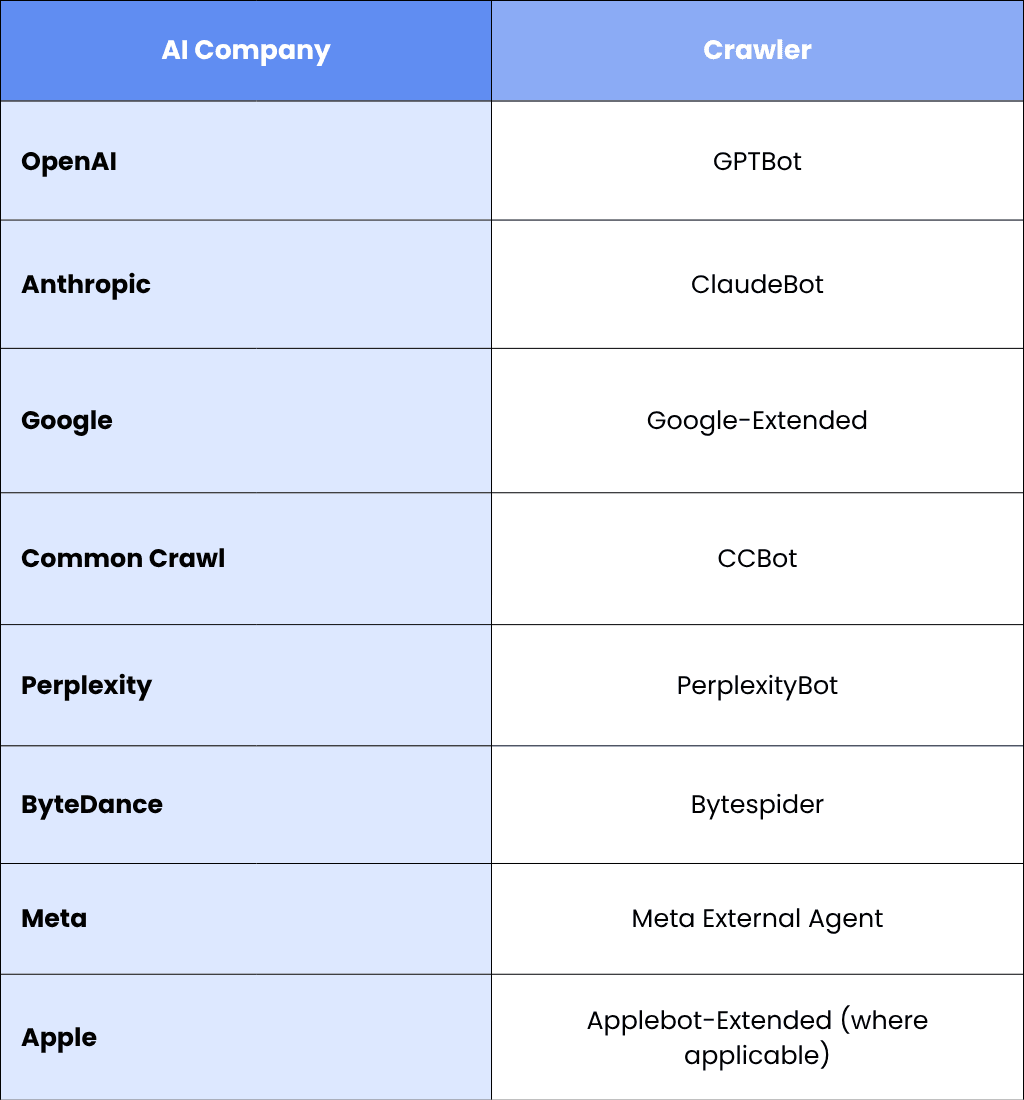
Each crawler follows its own purpose and documentation, making it increasingly important for website owners to understand exactly what they allow.
Why Businesses Should Care About AI Crawlers
For businesses in industries such as retail, hospitality, education, healthcare and F&B, website content is often one of their most valuable digital assets.
Your content may include:
- Original research
- Product descriptions
- Service pages
- Educational resources
- Industry insights
- Blog articles
- FAQs
- Pricing information
If AI platforms use this content to generate answers, businesses naturally want clarity over how their information is being accessed and used.
Managing AI crawlers allows organisations to balance several objectives:
- Protect proprietary content
- Maintain search visibility
- Increase brand exposure in AI-generated answers
- Control server resources
- Support content licensing strategies
- Reduce unnecessary crawling
Importantly, blocking AI crawlers does not automatically prevent your pages from ranking in Google Search.
Understanding robots.txt
The robots.txt file is a simple text file placed in the root directory of your website.
Below is an example of the robots.txt file on an example website:
https://yourdomain.com/robots.txt
It provides instructions to web crawlers about which areas of your website they may or may not access.
A basic robots.txt rule looks like this:
User-agent: GPTBot
Disallow: /
This tells GPTBot not to crawl any pages on your website.
Alternatively:
User-agent: GPTBot
Allow: /
This explicitly allows crawling.
It's important to understand that robots.txt is voluntary.
Reputable organisations such as OpenAI, Anthropic and Google publicly state that their crawlers respect robots.txt directives. However, malicious bots may ignore these instructions entirely.
How to Manage AI Crawlers Using robots.txt
If you're wondering how to manage AI crawlers, the first step is understanding that there is no universal approach that suits every website. Unlike traditional SEO decisions, where best practices are often well established, AI crawler management depends heavily on your business model, the type of content you publish, and your long-term digital strategy.
Rather than making an all-or-nothing decision, it's best to evaluate the benefits and trade-offs before updating your robots.txt file.
The following sections explain how to manage the most common AI crawlers and when you may want to allow or restrict them.
1. GPTBot (OpenAI)
GPTBot is OpenAI's official web crawler. Introduced in 2023, it collects publicly available web content that may be used to improve future versions of OpenAI's language models. OpenAI has stated that GPTBot respects robots.txt directives, allowing website owners to control whether their content is available for crawling.
For businesses that publish authoritative, educational or research-based content, allowing GPTBot may help increase the likelihood that their expertise is recognised by future AI systems. On the other hand, organisations with proprietary or commercially sensitive information may prefer to restrict access.
When should you allow GPTBot?
Allowing GPTBot may be beneficial if you want your website to contribute to the broader AI ecosystem and increase the likelihood that your brand becomes recognised as an authoritative source over time. Businesses that regularly publish high-quality educational content, industry insights or comprehensive guides may benefit most.
Examples include:
- Educational institutions publishing learning resources
- Agencies producing original research and case studies
- Hospitality brands with detailed travel guides
- Retail businesses creating buying guides and product advice
When should you block GPTBot?
Blocking GPTBot may be appropriate if your website contains:
- Proprietary research
- Subscription-only content
- Licensed publications
- Intellectual property you do not wish to be used for AI model improvement
robots.txt example
To block GPTBot from crawling your entire website:
User-agent: GPTBot
Disallow: /
To allow GPTBot:
User-agent: GPTBot
Allow: /
You can also restrict only specific sections instead of your entire website. For example:
User-agent: GPTBot
Disallow: /members/
Disallow: /premium-reports/
This approach allows GPTBot to access your public content while protecting premium resources.
Good practice: Review your content inventory before deciding. Many businesses find that allowing AI access to educational blog posts while restricting premium resources offers a balanced approach.
2. ClaudeBot (Anthropic)
ClaudeBot is operated by Anthropic and performs a similar function to GPTBot by collecting publicly available information from websites. Anthropic has stated that its crawler also follows robots.txt directives, giving publishers control over access.
For many businesses, the decision regarding ClaudeBot should align closely with their approach to GPTBot. However, it is still worth considering each crawler individually, as different AI platforms may become more or less important to your target audience over time.
Consider allowing ClaudeBot if:
- You want your expertise to be discoverable through AI assistants.
- You regularly publish factual, trustworthy content.
- Your website supports brand awareness and thought leadership.
Consider blocking ClaudeBot if:
- Your content is commercially sensitive.
- You have contractual obligations regarding content licensing.
- Your business relies heavily on exclusive intellectual property.
robots.txt example
Block ClaudeBot:
User-agent: ClaudeBot
Disallow: /
Allow ClaudeBot:
User-agent: ClaudeBot
Allow: /
You may also apply partial restrictions where appropriate.
3. Google-Extended
Google-Extended is not the same as Googlebot, and this distinction is crucial.
Many website owners mistakenly believe that blocking Google-Extended will remove their pages from Google Search. In reality, Google introduced Google-Extended to give publishers more control over whether eligible content may be used for certain Google AI features and model training, while leaving standard search indexing unaffected.
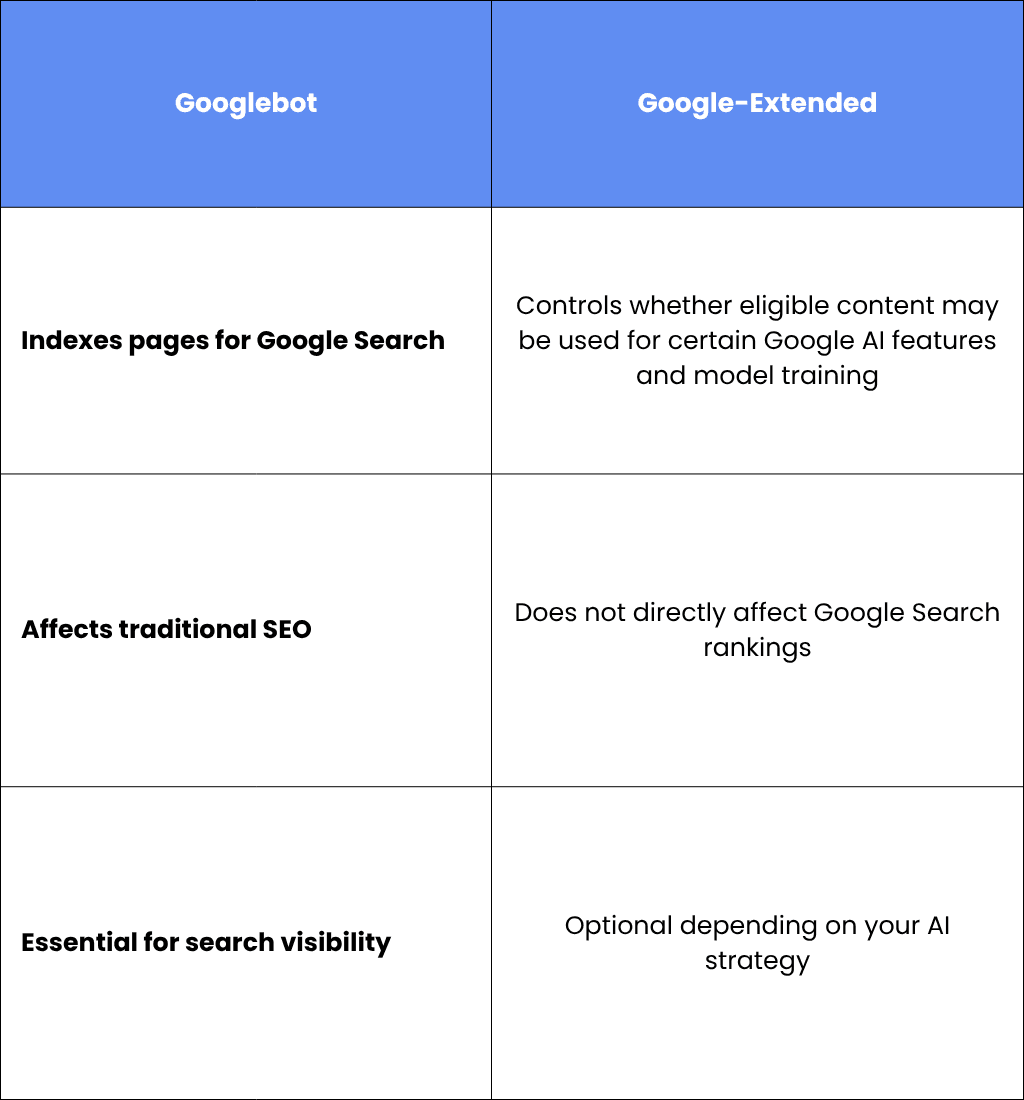
This distinction is important because blocking Google-Extended does not prevent your website from appearing in Google Search results.
Why might you block Google-Extended?
Some organisations prefer not to have their publicly available content used to improve Google's generative AI systems while still maintaining full search visibility.
robots.txt example
User-agent: Google-Extended
Disallow: /
If your goal is simply to rank well in Google Search, blocking Google-Extended alone should not negatively impact your organic rankings.
4. CCBot (Common Crawl)
Unlike commercial AI crawlers, CCBot is operated by Common Crawl, a non-profit organisation that creates one of the world's largest publicly available web archives.
Many AI companies, universities and research organisations use Common Crawl datasets when developing language models. As a result, content collected by CCBot may indirectly contribute to a wide range of AI systems beyond a single platform.
Why businesses choose to block CCBot
Some organisations decide to restrict CCBot because they prefer not to have their content included in large public datasets that may later be used by multiple AI developers.
Typical reasons include:
- Protecting original research
- Maintaining content licensing value
- Reducing large-scale data collection
- Preventing widespread redistribution
robots.txt example
User-agent: CCBot
Disallow: /
Before implementing this rule, consider whether broader visibility across future AI platforms aligns with your business goals.
5. PerplexityBot
Perplexity AI has become one of the fastest-growing AI-powered answer engines. Unlike some AI assistants that provide answers without clear attribution, Perplexity frequently cites the webpages used to generate its responses.
As a result, many organisations choose to allow PerplexityBot, particularly if they publish:
- Industry expertise
- Detailed tutorials
- Product comparisons
- Research reports
- Frequently asked questions
robots.txt example
To block access:
User-agent: PerplexityBot
Disallow: /
Alternatively, you can allow crawling by omitting a blocking rule or explicitly permitting access.
A practical example
Suppose your company publishes an in-depth guide titled How to Choose the Right POS System for Restaurants. If Perplexity AI references your article while answering a user's question, readers may follow the citation to your website, creating an additional source of qualified traffic.
For businesses investing in content marketing, this can become an increasingly valuable acquisition channel.
6. Bytespider
Bytespider is operated by ByteDance, the company behind platforms such as TikTok. Depending on your target markets and digital strategy, this crawler may or may not be relevant to your business.
Although Bytespider may currently receive less attention than GPTBot or ClaudeBot, it remains relevant for businesses targeting regions where ByteDance products have a significant user base. As AI capabilities continue to evolve across ByteDance's ecosystem, monitoring this crawler may become increasingly important.
For organisations focused on Southeast Asia or markets where ByteDance products have significant reach, monitoring Bytespider may become more important over time.
robots.txt example
User-agent: Bytespider
Disallow: /
As with other AI crawlers, the decision should reflect your overall content strategy rather than being based solely on the crawler's name.
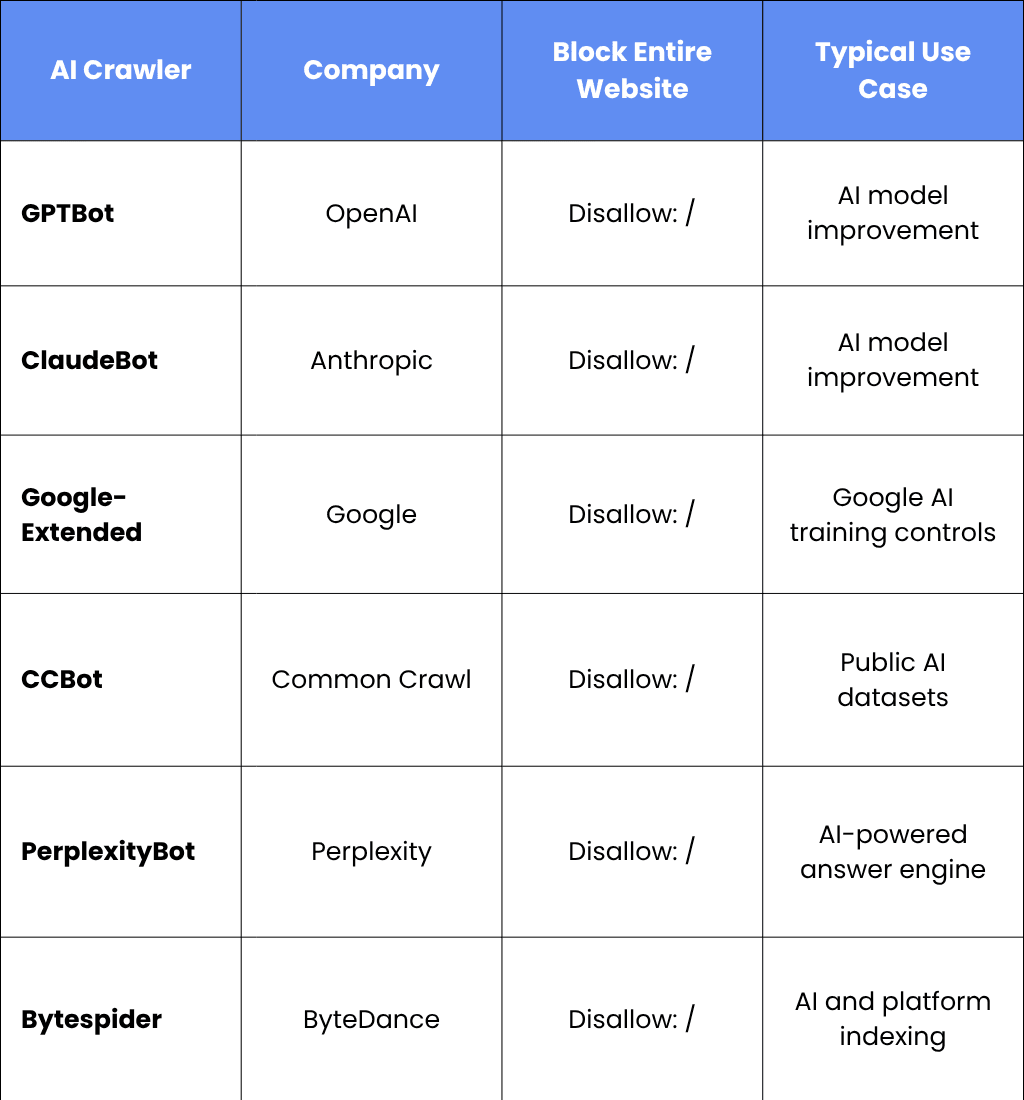
Quick Reference: Common robots.txt Rules for AI Crawlers
The following table summarises the most common robots.txt directives for major AI crawlers.
Before You Update Your robots.txt File
Before making any changes, it is worth asking a few strategic questions. Your answers will help determine whether allowing or restricting AI crawlers supports your wider business objectives.
Ask yourself:
- Is our goal to increase visibility in AI-generated answers?
- Does our website contain proprietary or commercially sensitive content?
- Could AI citations generate qualified traffic and strengthen brand awareness?
- Are we comfortable allowing our publicly available content to contribute to future AI models?
- Have we identified which AI crawlers are already visiting our website through server log analysis?
Answering these questions first will help you make informed decisions rather than reacting to changing AI trends.
Ultimately, how to manage AI crawlers is less about blocking bots and more about aligning crawler permissions with your content strategy, intellectual property considerations and long-term digital growth goals.
Should You Block AI Crawlers?
Many organisations immediately ask whether they should simply block every AI crawler.
In reality, the answer depends on your business objectives.
Reasons to Allow AI Crawlers
Allowing AI crawlers gives reputable AI platforms permission to access your publicly available content. While this does not guarantee that your website will be cited in AI-generated answers, it does create opportunities for your expertise to be recognised and referenced.
As AI-powered search experiences become more common, businesses that publish trustworthy, well-structured content may benefit from increased visibility beyond traditional search engines.
Potential Benefits of Allowing AI Crawlers
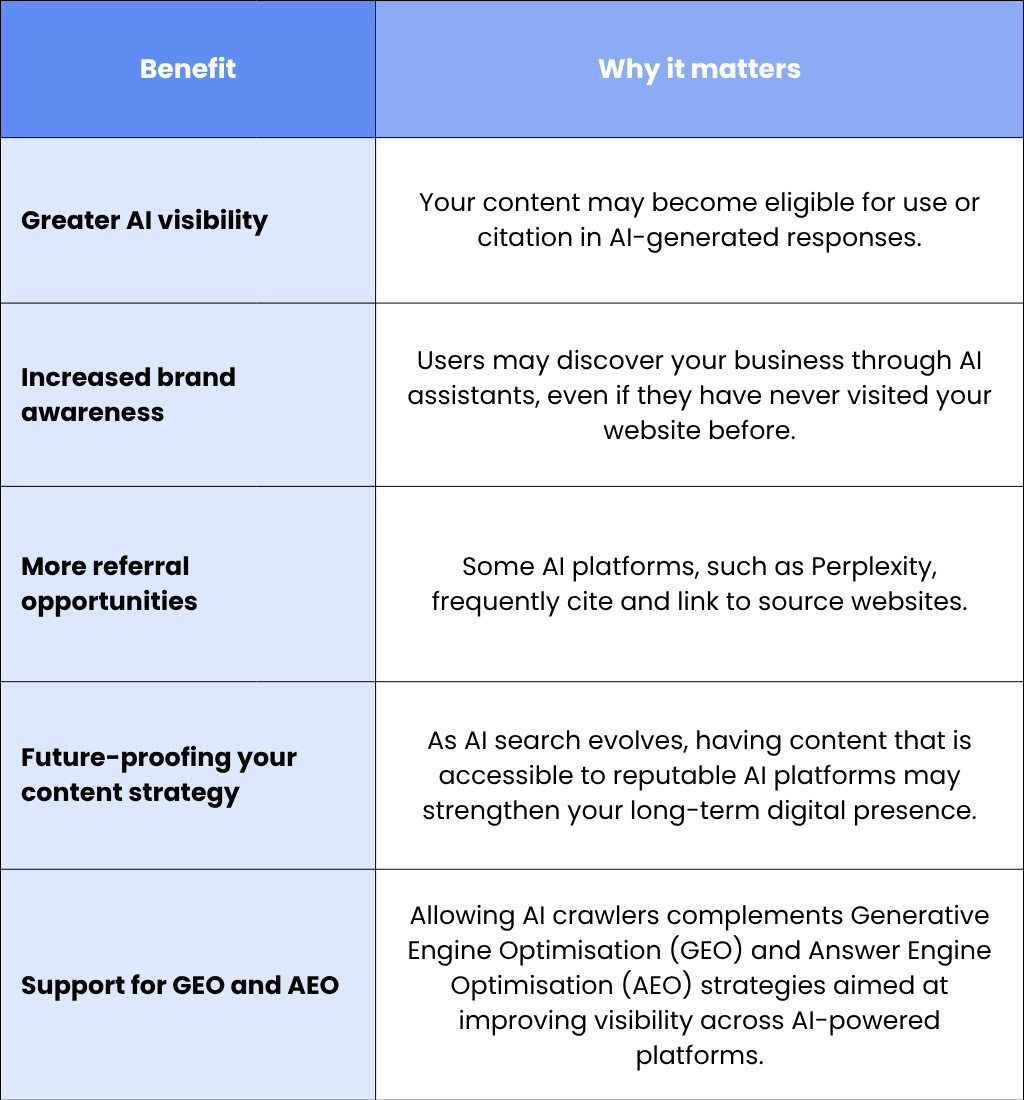
Businesses that Often Benefit from Allowing AI Crawlers
Many organisations publish content with the goal of educating potential customers and demonstrating expertise. In these cases, allowing AI crawlers can support wider digital visibility.
Examples include:
- Universities and education providers publishing learning resources.
- SEO and digital marketing agencies sharing practical guides.
- Hospitality businesses creating destination or travel content.
- Retail brands producing product comparisons and buying guides.
- Healthcare organisations providing general educational information.
- Professional service firms publishing industry insights and research.
For these businesses, AI visibility may become an extension of their existing content marketing strategy.
Remember: Allowing AI crawlers does not mean your content will automatically appear in ChatGPT, Claude or Gemini. AI systems evaluate many factors, including content quality, authority, accuracy, structure and relevance.
Reasons to Block AI Crawlers
On the other hand, allowing unrestricted access is not always the right choice.
Some organisations invest significant resources into producing original research, premium reports or subscription-based content. In these situations, limiting AI crawler access may better protect the commercial value of that content.
Common Reasons for Blocking AI Crawlers
Businesses may choose to block AI crawlers in order to:
- Protect proprietary research or intellectual property.
- Prevent publicly available content from contributing to AI model training.
- Preserve the value of licensed or subscription-only content.
- Reduce unnecessary server load from automated crawling.
- Meet contractual or legal obligations relating to content ownership.
- Maintain greater control over how their information is accessed and reused.
Businesses that Commonly Restrict AI Crawlers
Blocking AI crawlers may be more appropriate for organisations such as:
- News publishers with paid subscriptions.
- Research organisations selling proprietary reports.
- Financial data providers.
- Legal publishers.
- Membership-based knowledge platforms.
- Businesses with commercially sensitive documentation.
In these cases, unrestricted AI access could potentially reduce the exclusivity or commercial value of their content.
A Balanced Approach May Be the Best Option
For many organisations, the decision is not simply to allow or block every AI crawler.
Instead, a more strategic approach is to determine which content should remain open and which content should be protected.
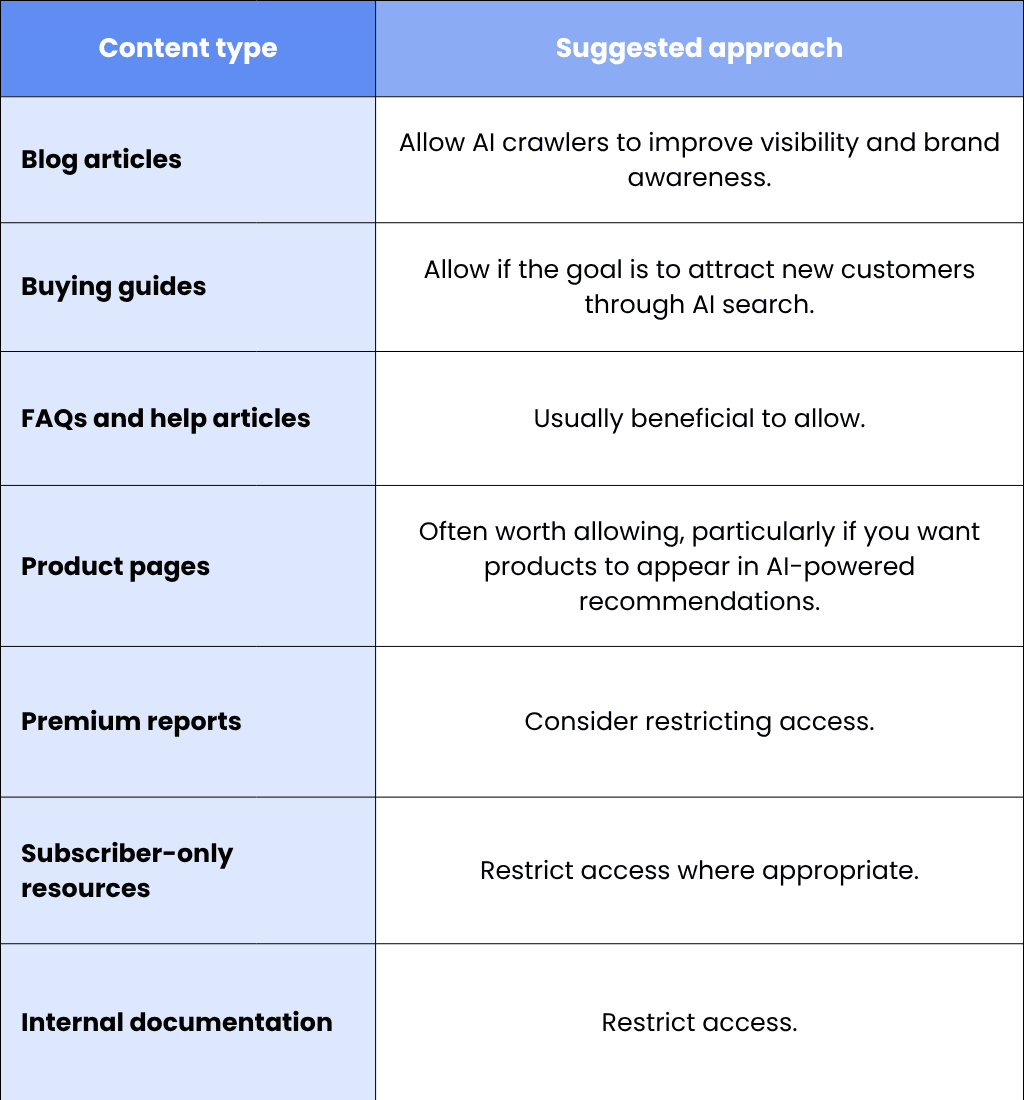
This selective approach enables businesses to maximise exposure for marketing content while protecting resources that generate direct commercial value.
AI Crawlers Are Only One Part of the Bigger Picture
Whether you allow or block AI crawlers, remember that crawler permissions alone do not determine your visibility in AI-powered search experiences.
AI platforms increasingly prioritise content that demonstrates:
- Experience and subject expertise.
- Clear, factual and well-structured information.
- Strong website authority.
- Helpful answers to real user questions.
- Technical optimisation, including structured data.
- High-quality user experience.
In other words, allowing AI crawlers simply makes your content available for consideration. It is the quality, credibility and usefulness of that content that ultimately influence whether AI systems choose to reference it.
For businesses looking to strengthen their presence across both traditional search engines and emerging AI platforms, managing crawler access should therefore form part of a broader SEO, content and Generative Engine Optimisation (GEO) strategy rather than being treated as a standalone technical task.
Will Blocking AI Crawlers Affect SEO?
In most situations, no.
Blocking GPTBot, ClaudeBot or Google-Extended does not automatically impact your rankings in traditional search engines.
Google Search still relies primarily on Googlebot.
Likewise:
- GPTBot is not Googlebot.
- ClaudeBot is not Bingbot.
- Google-Extended is separate from Google Search crawling.
This distinction is important because many businesses worry that restricting AI crawlers will damage their organic visibility.
Instead, your SEO performance continues to depend on factors such as:
- Technical SEO
- Website performance
- Helpful content
- Backlinks
- User experience
- Structured data
- Internal linking
Best Practices for Managing AI Crawlers
Managing AI crawlers is not simply a matter of adding a few lines to your robots.txt file and forgetting about them. As AI-powered search continues to evolve, businesses should treat crawler management as an ongoing part of their broader SEO, content and digital governance strategy.
The following recommendations can help you develop a sustainable approach to how to manage AI crawlers while avoiding common mistakes.
1. Audit Your Existing robots.txt File
Before adding rules for GPTBot, ClaudeBot or other AI crawlers, start by reviewing your existing robots.txt file.
Many websites already contain directives that were added years ago during a website migration, redesign or technical SEO project. Over time, these files can become outdated, contain conflicting instructions or inadvertently block important crawlers.
A thorough audit ensures you understand what permissions are already in place before introducing new ones.
During your audit, check for:
- Existing AI crawler rules that may already be present.
- Duplicate or conflicting directives.
- Syntax errors that could cause crawlers to ignore instructions.
- Outdated rules for discontinued bots.
- Sitemap references that are still valid.
- Sections of the website that may have been unintentionally blocked.
For example, imagine a retailer migrated to a new website several years ago. During the migration, an old development robots.txt file was accidentally left in place, blocking several directories that should now be publicly accessible. Without reviewing the file, adding AI crawler rules could compound existing issues rather than solve them.
Tip: Always validate your robots.txt file after making changes. A single misplaced character or incorrect directive can affect how compliant crawlers interpret your instructions.
2. Develop an AI Visibility Strategy Before Making Changes
One of the biggest mistakes businesses make is updating robots.txt without first deciding what role AI should play in their digital marketing strategy.
Instead of asking, "Should we block AI crawlers?", ask a broader question: "How do we want our business to be discovered in an AI-driven search landscape?"
This subtle shift encourages a more strategic discussion.
For example, if your organisation invests heavily in educational content, restricting every AI crawler may reduce opportunities for your expertise to be surfaced in AI-generated responses. Conversely, if your website primarily contains subscription-based research or commercially sensitive resources, a more restrictive approach may be appropriate.
Questions to consider
Business goals
- Do we want to increase brand awareness through AI platforms?
- Is our objective to generate more organic traffic?
- Are we positioning ourselves as an industry thought leader?
Content considerations
- Which pages are designed to attract new audiences?
- Which content is commercially valuable?
- Which resources should remain exclusive?
Future growth
- Are we planning to invest in Generative Engine Optimisation (GEO)?
- Could AI-generated citations become an important source of qualified traffic?
- How might AI search influence customer behaviour over the next few years?
By answering these questions first, your robots.txt decisions become part of a broader digital strategy rather than isolated technical changes.
3. Monitor Server Logs to Understand Crawler Activity
Many businesses rely solely on analytics platforms to understand website traffic. However, analytics tools only show visits after pages have been accessed. They do not always provide a complete picture of how crawlers interact with your website.
Server log analysis offers a much deeper level of insight.
By reviewing server logs, you can identify:
- Which AI crawlers are visiting your website.
- How frequently they crawl.
- Which pages they request most often.
- Whether they respect your robots.txt directives.
- Unexpected or unknown bots accessing your content.
- Crawl patterns that may impact server resources.
4. Protect Premium and Commercially Sensitive Content
robots.txt is a useful communication tool, but it is not a security feature.
The file tells compliant crawlers which areas they should avoid, but it does not prevent determined users or malicious bots from accessing publicly available URLs directly.
If certain content represents significant commercial value, stronger protection measures should be implemented.
Examples of content that may require additional protection
- Premium research reports.
- Subscription-only articles.
- Customer portals.
- Internal documentation.
- Licensed resources.
- Proprietary datasets.
- Private training materials.
More secure alternatives include:
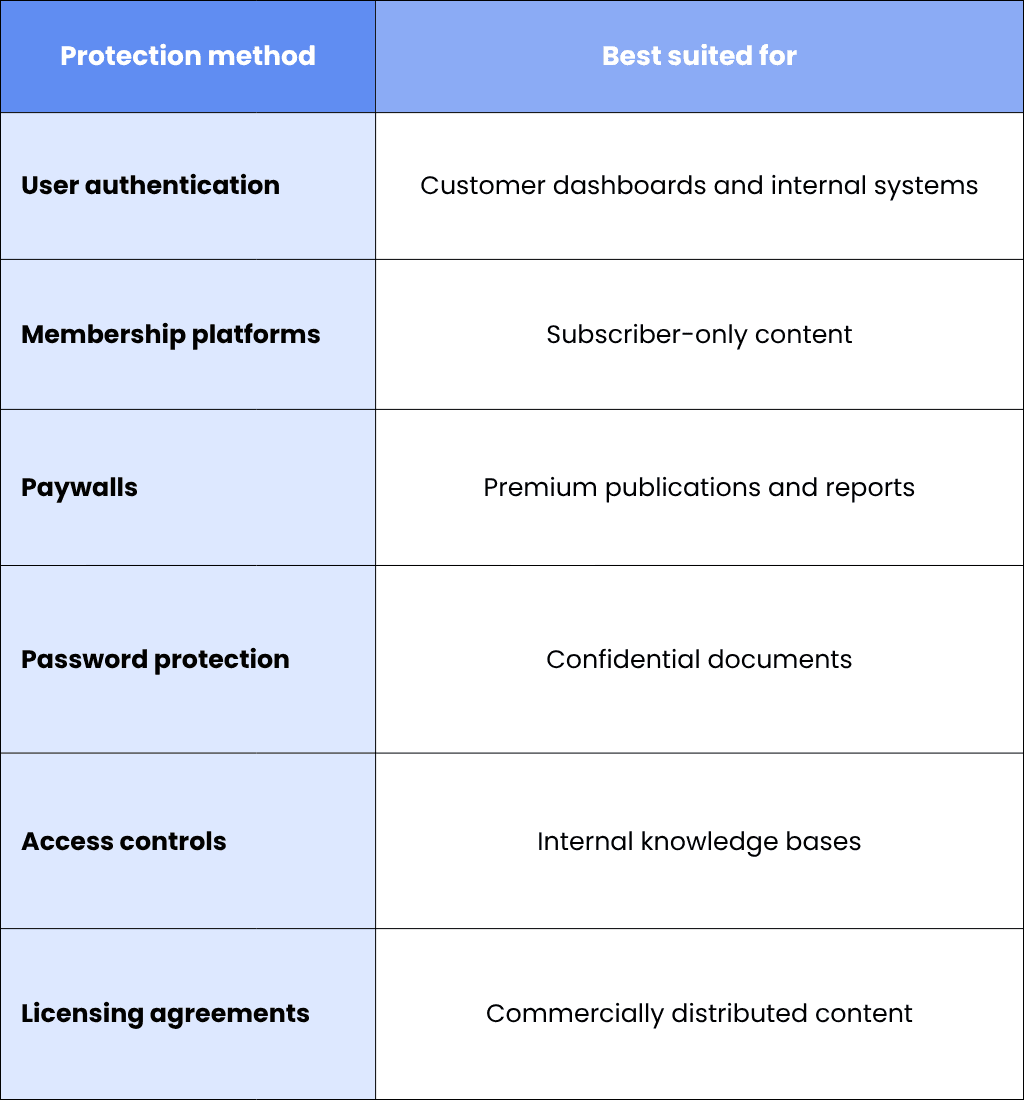
Think of robots.txt as a sign on a gate that says, "Please do not enter." Reputable AI crawlers will respect that request, but it is not the same as locking the gate.
Businesses that rely on exclusive content should therefore combine crawler management with appropriate technical security measures.
5. Review Your AI Crawler Strategy Regularly
The AI landscape is evolving at an extraordinary pace.
New AI companies continue to emerge, existing platforms regularly update their crawler policies, and additional user-agent names may be introduced over time. A robots.txt file that reflects today's AI ecosystem may no longer be sufficient a year from now.
Rather than treating crawler management as a one-off task, schedule regular reviews as part of your ongoing website maintenance.
A quarterly review is a good starting point
During each review, consider:
- Have any new AI crawlers become relevant?
- Are our robots.txt rules still accurate?
- Has our content strategy changed?
- Have we launched new premium resources?
- Are AI platforms becoming a larger source of traffic or brand exposure?
- Have industry best practices evolved?
Keeping your strategy up to date helps ensure your crawler permissions continue to support your wider business objectives.
6. Don't Overlook Content Quality and Technical SEO
Managing AI crawlers is only one part of preparing your website for AI-powered search.
Allowing GPTBot, ClaudeBot or other AI crawlers to access your website does not automatically mean your content will be used in AI-generated responses.
Modern AI systems increasingly favour content that is:
- Accurate and factually reliable.
- Clearly structured with logical headings.
- Comprehensive and genuinely helpful.
- Written by credible subject matter experts.
- Easy to understand.
- Supported by structured data where appropriate.
- Published on technically sound websites.
In other words, crawler permissions determine whether AI platforms can access your content, while content quality and technical SEO influence whether they choose to trust and reference it.
For this reason, organisations should view AI crawler management as one component of a broader optimisation strategy that also includes:
- Technical SEO.
- High-quality content creation.
- Schema markup and structured data.
- Internal linking.
- Website performance.
- User experience.
- Generative Engine Optimisation (GEO).
- Answer Engine Optimisation (AEO).
Businesses that combine all of these elements will be better positioned to remain visible as search continues to evolve beyond traditional search engines.
How AI Crawlers Fit into Modern SEO
SEO is no longer focused solely on search rankings.
Today's digital visibility increasingly includes:
- Google Search
- AI Overviews
- ChatGPT
- Gemini
- Claude
- Perplexity
- Voice search
- Answer engines
This shift has given rise to disciplines such as:
- Answer Engine Optimisation (AEO)
- Generative Engine Optimisation (GEO)
- AI Readability Optimisation
Instead of competing only for rankings, businesses now compete to become trusted sources that AI systems reference.
Managing AI crawlers is one part of this broader strategy.
Simply allowing a crawler does not guarantee your content will appear in AI-generated responses. Content quality, authority, structure, factual accuracy and technical optimisation all influence whether AI systems recognise and trust your website.
How Saigon Digital Can Help
Artificial intelligence is changing how customers discover businesses online. Managing AI crawlers is only one piece of the puzzle. Organisations also need a strategy that ensures their content is visible, trusted and ready for both traditional search engines and AI-powered platforms.
At Saigon Digital, we help ambitious brands navigate this evolving landscape with future-focused digital solutions that deliver measurable business growth.
Our SEO services strengthen your technical foundations, improve website performance and build lasting search visibility through site optimisation, content strategy and authority building.
As AI search becomes more influential, our Generative Engine Optimisation (GEO) services help brands become discoverable, quotable and trusted by platforms such as ChatGPT, Gemini, Perplexity and Google AI. From AI readability optimisation and Answer Engine Optimisation (AEO) to structured data implementation, knowledge graph development and AI content audits, we help position your content where tomorrow's customers are searching.
Beyond visibility, we also design AI-powered workflow automation solutions that streamline operations, improve productivity and support scalable business growth through intelligent automation and custom AI agents.
Prepare Your Website for the Future of AI Search
As AI-powered search continues to evolve, managing AI crawlers is becoming an essential part of a modern SEO strategy. The decisions you make today, whether to allow or restrict AI crawlers, optimise your content for generative AI, or strengthen your technical SEO, can influence how your brand is discovered in the years ahead.
At Saigon Digital, we help ambitious businesses navigate this changing landscape with future-focused SEO, Generative Engine Optimisation (GEO), Answer Engine Optimisation (AEO) and AI-powered digital solutions.
Ready to future-proof your online presence? Get in touch with Saigon Digital today to discover how we can help your business grow through smarter SEO and AI-driven digital strategies.
Frequently Asked Questions
1. What is an AI crawler?
An AI crawler is an automated bot that visits publicly accessible websites to collect information for artificial intelligence platforms. Depending on the organisation operating the crawler, the collected content may be used to train AI models, improve AI-generated answers or power AI search experiences. Examples include GPTBot (OpenAI), ClaudeBot (Anthropic), Google-Extended and PerplexityBot.
2. Will blocking AI crawlers affect my Google rankings?
In most cases, no. Blocking AI crawlers such as GPTBot or ClaudeBot does not directly affect your rankings in Google Search because they are separate from traditional search engine crawlers like Googlebot. However, blocking AI crawlers may reduce your opportunities to have your content discovered or referenced by AI-powered platforms.
3. Should every business allow AI crawlers?
Not necessarily. The right approach depends on your business goals and the type of content you publish. Businesses that rely on educational content, thought leadership or content marketing may benefit from allowing reputable AI crawlers to access their websites. On the other hand, organisations with proprietary research, premium resources or subscription-only content may prefer to restrict access to protect their intellectual property.
4. Can robots.txt completely stop AI crawlers from accessing my website?
No. The robots.txt file provides instructions that compliant crawlers choose to follow, but it is not a security mechanism. Reputable AI companies generally respect robots.txt directives, but malicious bots may ignore them. If you need to protect sensitive or commercially valuable content, use stronger measures such as authentication, password protection, membership systems or paywalls alongside your robots.txt configuration.
5. How can I optimise my website for AI-powered search?
Preparing your website for AI-powered search involves more than simply allowing AI crawlers. Focus on creating accurate, high-quality content that demonstrates expertise, answers users' questions clearly and is structured with descriptive headings. Combine this with strong technical SEO, schema markup, internal linking and emerging practices such as Generative Engine Optimisation (GEO) and Answer Engine Optimisation (AEO). This gives your content the best chance of being understood, trusted and referenced by both search engines and AI platforms.