



For years, businesses could think about SEO largely in terms of rankings, keywords, backlinks and organic traffic. Those fundamentals still matter, but the search journey is becoming more complex. People now search through longer, more conversational queries. Google introduced AI-powered experiences such as AI Overviews and AI Mode, while customers are also using generative AI platforms to research products, services, places and brands. ates a new challenge for businesses.
You do not simply need an SEO agency that knows how to improve a website’s Google rankings. You need a partner that understands how search behaviour is changing, how traditional SEO supports visibility in AI-powered search experiences, how to use AI responsibly, and how to connect organic visibility to actual business growth.
So, how to choose an SEO agency in the AI era?
It starts with asking better questions.
In this guide, we explore what to look for when choosing an SEO agency and the 10 questions worth asking before you sign an agreement.
Key Takeaways
- Start with your business goals, not rankings. The right SEO agency should connect search visibility to leads, sales, bookings, enquiries or other meaningful outcomes.
- Ask the right questions. Evaluate an agency’s strategy, SEO expertise, approach to AI, measurement, communication, transparency and delivery.
- Look beyond AI hype. Strong SEO foundations still matter, while AI-powered search requires a practical, evidence-based approach rather than promises of guaranteed visibility.
- Compare agencies objectively. Score shortlisted agencies against factors such as strategic fit, capability, industry experience, AI readiness, measurement and value.
- Choose a long-term partner. The best agency should understand your business, communicate clearly, adapt to change and focus on sustainable, measurable growth.
What Has Changed About SEO in the AI Era?
Before looking at agencies, it helps to understand what you are actually paying for.
SEO has never been just about putting keywords on pages. Good SEO brings together technical performance, content, site architecture, user experience, authority, local visibility, analytics and a clear understanding of search intent.
The AI era adds another layer.
Google’s current guidance makes an important point: the foundational SEO practices that help a site perform in Search also apply to AI-powered search experiences. Pages still need to be accessible, indexable and eligible for Search, while content should be helpful, reliable and created for people.
At the same time, AI-powered search can change how information is discovered and presented. Google says AI Overviews and AI Mode can use multiple related searches and supporting web pages to build responses, creating more ways for useful websites to be surfaced. This means your SEO agency should be thinking about more than a list of target keywords.
It should ask:
- Can search engines understand what our business does?
- Can customers find the right page at the right stage of their journey?
- Does our content genuinely answer important questions?
- Does the website demonstrate expertise and trust?
- Can our brand be clearly understood across search and AI-powered discovery experiences?
- Can we measure whether organic visibility is contributing to leads, revenue, bookings, enquiries or other business outcomes?
That is the standard worth using when you compare agencies.
How to Choose an SEO Agency: Start with Your Business, Not Rankings
One common mistake when choosing an SEO agency is focusing too much on rankings. While ranking well matters, it does not automatically translate into business growth.
Instead, start with your business goals. A good SEO agency should understand your customers, commercial priorities and industry before recommending keywords, content or technical work.
For a restaurant, that might mean more local discovery and reservations. For a retailer, it could mean more qualified traffic and online sales. For an education provider, it may be more enquiries and applications.
Ultimately, the right question is not, “Can this agency improve our rankings?”
but: “Can this agency turn search visibility into meaningful business results?”
The best agency will connect SEO activity with qualified traffic, conversions and long-term growth, rather than focusing on rankings alone.
>>> Read more: Top 7 AI SEO Agencies in Ho Chi Minh City to Secure Citations in AI Search
10 Questions to Ask When Choosing an SEO Agency
Choosing an SEO agency is easier when you know what you need to evaluate.
The ten questions below are designed to help you move beyond sales promises and assess an agency’s strategy, expertise, transparency and ability to contribute to business growth.
1. How will you connect SEO to our business goals?
Start here because SEO should support a business objective, not exist as a standalone marketing activity. Before an agency recommends keywords or content, ask how it would connect organic search to the outcomes that matter to your organisation.
A good agency should first understand how your business makes money, who your customers are and where SEO can influence their decision-making. For example, a hotel may care about direct bookings, while an education provider may prioritise course enquiries and applications. A retailer may focus on organic revenue, whereas an F&B group may care more about local discovery, reservations and visits.
Ask the agency to show this connection clearly:
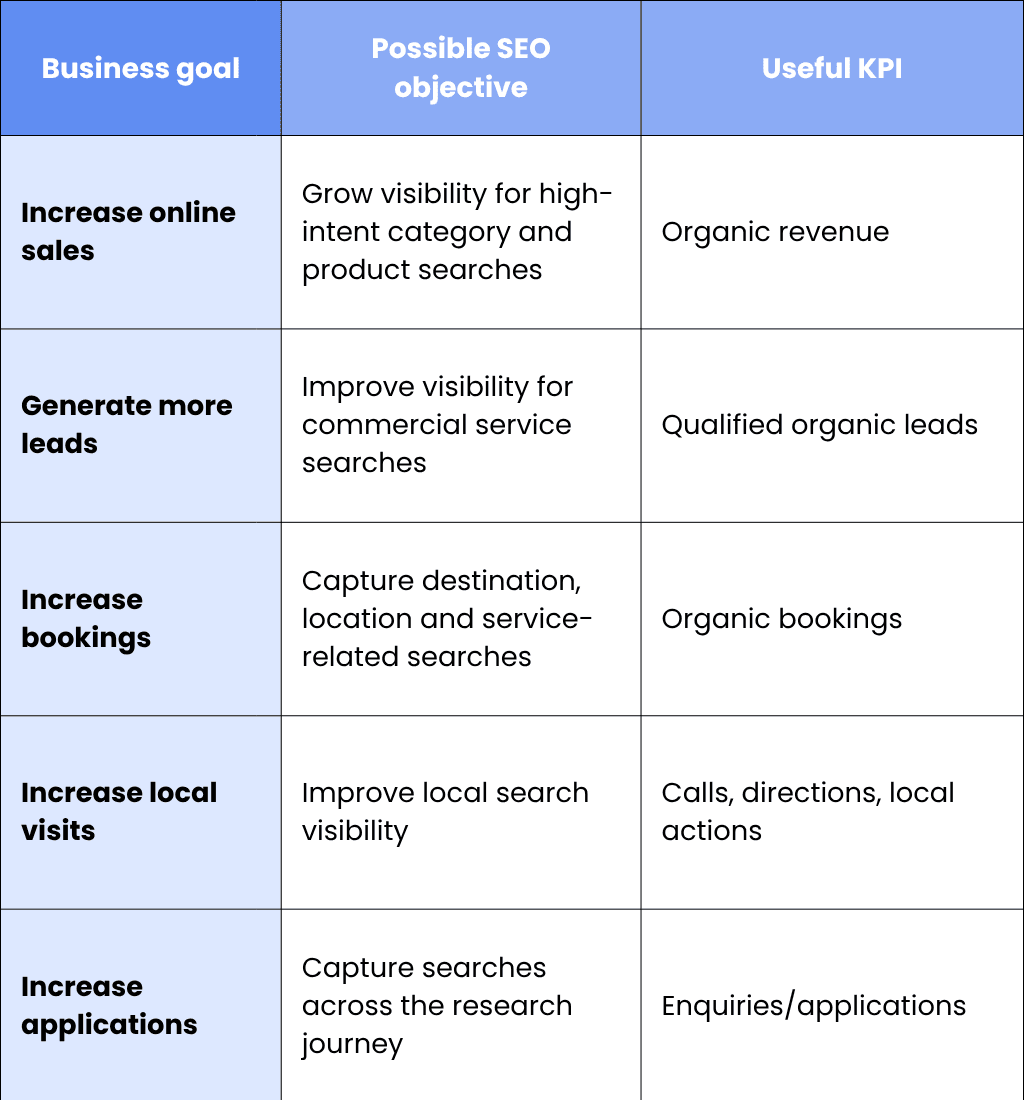
For example, suppose your website generates 500 organic leads a month and 5% become customers. That gives you 25 customers. If SEO increases qualified leads by 30%, you would reach approximately 650 leads, which could produce 32–33 customers at the same conversion rate. The agency should therefore discuss not only traffic growth, but how traffic can contribute to outcomes like these.
What to look for: a clear line from SEO activity → visibility → qualified traffic → conversion → business value.
Red flag: the agency talks almost entirely about rankings and traffic but cannot explain how those metrics support your commercial goals.
2. What would you audit before recommending a strategy?
Do not let an agency jump straight into a list of keywords or a six-month content calendar. A credible strategy should start with an understanding of what is already working, what is limiting growth and where the biggest opportunities are.
Ask the agency to explain what it would review during the initial audit. At a minimum, this should cover the website’s technical foundations, content, search performance and competitors.
A useful audit typically considers:
- Technical SEO: crawlability, indexation, site speed, mobile performance, redirects and technical errors.
- Website architecture: navigation, URL structure, internal linking and how important pages are organised.
- Content: quality, relevance, search intent, duplication, gaps and outdated information.
- Search performance: rankings, clicks, impressions, non-brand visibility and conversion data.
- Competitors: which businesses are winning valuable searches and why.
- Conversion journey: whether visitors can easily take the next step once they arrive.
- Local or international factors: depending on your locations and target markets.
More importantly, ask the agency to prioritise its findings.
A long audit containing 100 recommendations may look impressive, but it is not necessarily useful. Ask for the top five to ten actions, together with the expected impact, level of effort and reason for prioritisation.
For example:
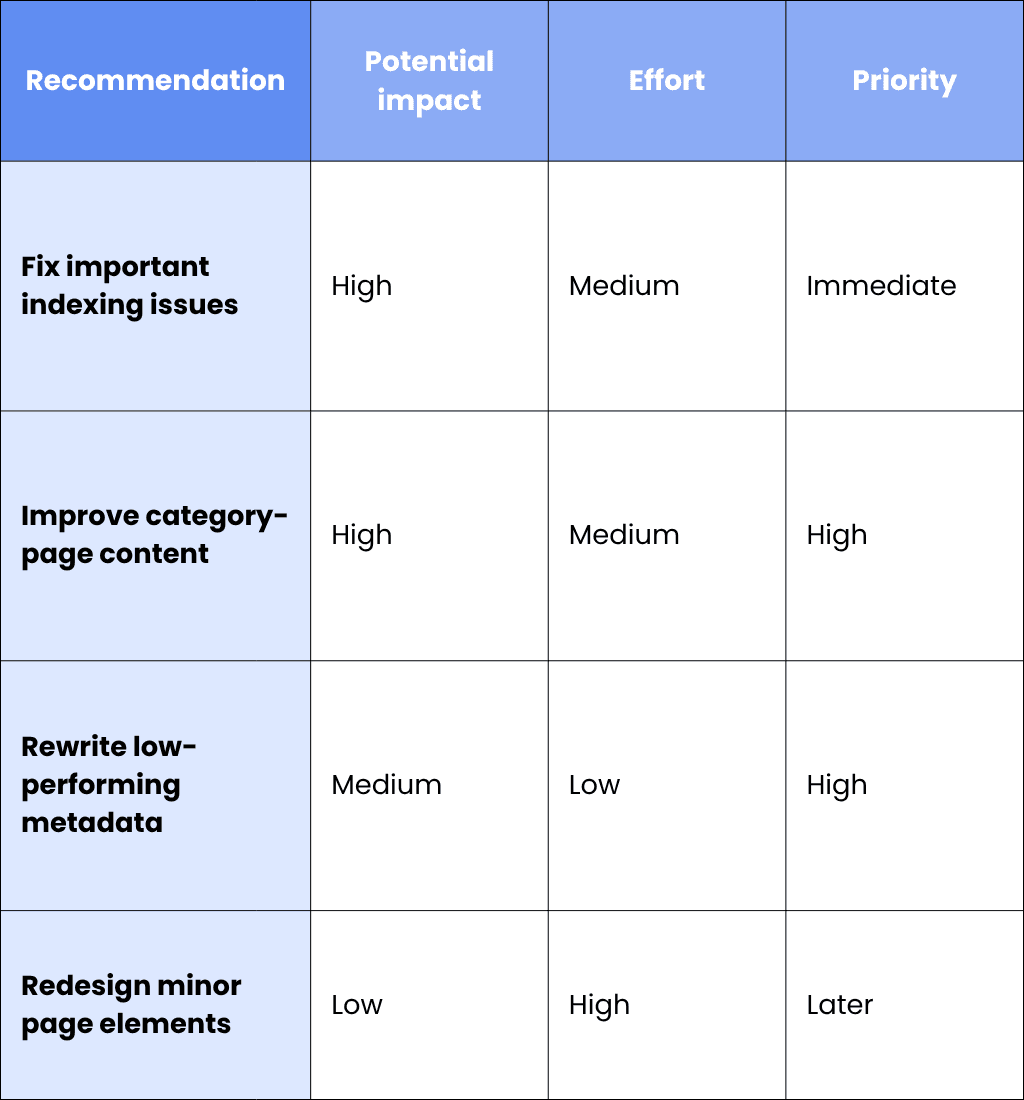
This makes it easier to decide where your budget and internal resources should go first.
What to look for: an agency that diagnoses before prescribing and can distinguish between important issues and cosmetic improvements.
3. How do you approach SEO for AI-powered search?
This question helps you identify whether an agency understands the difference between genuine AI readiness and AI marketing jargon.
The first thing to establish is that AI-powered search does not mean abandoning traditional SEO. Your website still needs strong technical foundations, useful content, clear information architecture and signals that help search systems understand your business.
Ask the agency to explain how it approaches visibility across both conventional search and newer AI-driven discovery experiences.
A sensible approach may include:
- Making important content easy for search engines and AI systems to access and understand.
- Structuring information clearly around topics, entities, services and products.
- Creating authoritative answers to the questions customers actually ask.
- Strengthening relevant structured data and knowledge signals.
- Building a recognisable and trustworthy brand presence.
- Monitoring how visibility changes as search experiences evolve.
For example, a hotel should not create dozens of pages simply because an AI platform can answer questions about hotels. Instead, it should make its information exceptionally clear: location, facilities, room types, policies, nearby attractions, accessibility, dining options and other details customers genuinely need.
Likewise, an education provider could structure its content around courses, entry requirements, career pathways, application information and subject expertise rather than publishing generic AI-generated articles.
Ask one particularly useful follow-up: “What would you do differently for AI-powered discovery, and which parts are simply good SEO practice?”
A strong agency should be able to separate established principles from emerging tactics.
Red flag: anyone promising guaranteed visibility in ChatGPT, Gemini or another AI platform. No credible agency can control exactly when or how an AI system will mention a brand.
4. How do you use AI in your SEO and content process?
The important question is not whether an agency uses AI. It is whether it uses AI responsibly and intelligently.
AI can speed up research, data analysis, clustering, content planning, technical checks and repetitive tasks. However, speed should never come at the expense of accuracy, originality or expertise.
Ask the agency to explain its workflow from research to publication. In particular, find out where human review happens.
A practical process might look like this:
Research → AI-assisted analysis → Expert input → Human writing/editing → Fact checking → SEO review → Publication → Performance monitoring
For instance, an AI tool might help an agency identify 200 common questions about a service. That does not mean the agency should publish 200 generic articles. Instead, it should identify the questions with real commercial value, combine overlapping topics and create fewer, stronger resources.
This is particularly important in industries where inaccurate information can damage trust.
For an education brand, course requirements should be checked against official information. For retail, product specifications and availability need to be accurate. For hospitality, hotel facilities, room details and local recommendations should reflect reality.
Ask the agency:
- Which tasks are automated?
- Which tasks require human review?
- How do you fact-check AI-assisted content?
- How do you prevent duplicated or generic content?
- How do subject-matter experts contribute?
What to look for: AI being used as a productivity and intelligence layer, rather than as a substitute for expertise.
5. How will you build authority without putting our website at risk?
Authority matters in SEO, but the quality of the strategy is more important than the number of links an agency can promise.
Ask the agency where its authority-building opportunities come from and how it evaluates them. A strong strategy should focus on relevance, credibility and genuine value rather than producing large volumes of low-quality backlinks.
For example, a hospitality brand might earn visibility through travel publications, destination organisations, industry associations and useful original resources. A retailer could build authority through expert commentary, product expertise, original research or relevant publications. An education provider may benefit from academic expertise, research, partnerships and reputable references.
Ask the agency to explain its selection criteria. For every proposed link or placement, you should be able to understand:
- Why is this website relevant?
- Why would our audience care?
- Is the website credible?
- Is the content genuinely useful?
- Is the opportunity worth the cost and effort?
You should also ask what the agency will not do.
Avoid agencies that rely on automated link building, private networks, irrelevant websites or large quantities of placements simply to hit a monthly target.
For example, “100 backlinks per month” sounds impressive until you discover that only a small number come from websites that are relevant to your market.
A better question to ask: “How will your authority strategy make our brand more credible to both customers and search engines?”
That shifts the conversation from link volume to business value.
6. Which metrics will you report, and how will you measure success?
Ask this before signing a contract, not after the first monthly report arrives.
The agency should be able to explain which metrics it will track, why they matter and how they relate to your objectives. The exact dashboard will depend on your business, but it should usually include a combination of visibility, traffic and commercial metrics.
A useful measurement framework might look like this:
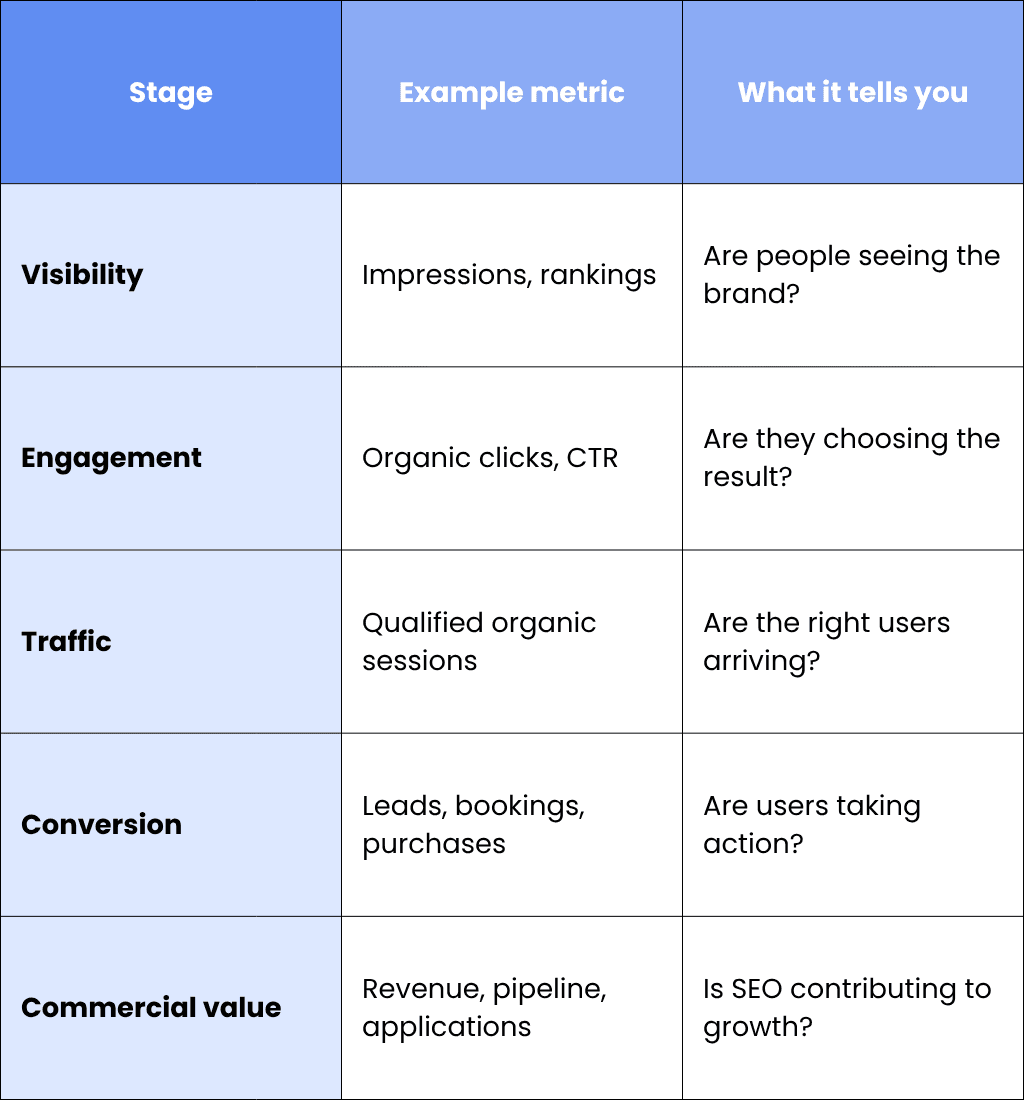
Do not automatically reject rankings or traffic as metrics. They are useful indicators. The problem comes when they become the entire definition of success.
For example, imagine an agency increases organic traffic from 100,000 to 130,000 visits, but conversions remain unchanged. That is a 30% traffic increase, but not necessarily a 30% business improvement.
Conversely, an agency might increase organic traffic by only 10% while increasing qualified leads by 25%. For many businesses, the second result is far more valuable.
Ask the agency to explain: “Which three metrics would you use to tell us whether SEO is genuinely working?”
The answer should be specific to your business rather than copied from a standard report template.
7. What will the first 90 days look like?
The first three months should give you a clear view of how the agency thinks, prioritises and communicates.
Ask for a practical 90-day roadmap rather than a vague promise to “increase rankings”.
A typical structure could look like this:
Days 1–30: Understand
- Business and audience discovery
- Technical and content audits
- Competitor analysis
- Analytics and tracking review
- Opportunity mapping
Days 31–60: Prioritise and improve
- Technical fixes
- On-page optimisation
- Content planning and production
- Internal linking improvements
- Priority landing-page enhancements
Days 61–90: Scale and refine
- Expand successful initiatives
- Build authority
- Measure early results
- Identify new opportunities
- Refine the roadmap using performance data
Your agency may use a different structure, but it should clearly explain what happens first and why.
It should also tell you what it needs from your team.
For example, a web development change may require support from your internal developer. Expert-led content may require input from your marketing or subject-matter teams. Analytics work may require access to your existing platforms.
Ask: “What do you need from us in the first 90 days to make this plan work?”
This question often reveals whether an agency has thought realistically about implementation.
Red flag: promises of dramatic results within a few weeks without an audit, baseline data or discussion of implementation constraints.
8. Who will actually work on our account?
The person presenting the proposal may not be the person running your SEO programme.
Ask to meet the people who will actually be involved in delivery. Their experience, communication style and understanding of your business can have a major effect on the success of the relationship.
At a minimum, clarify:
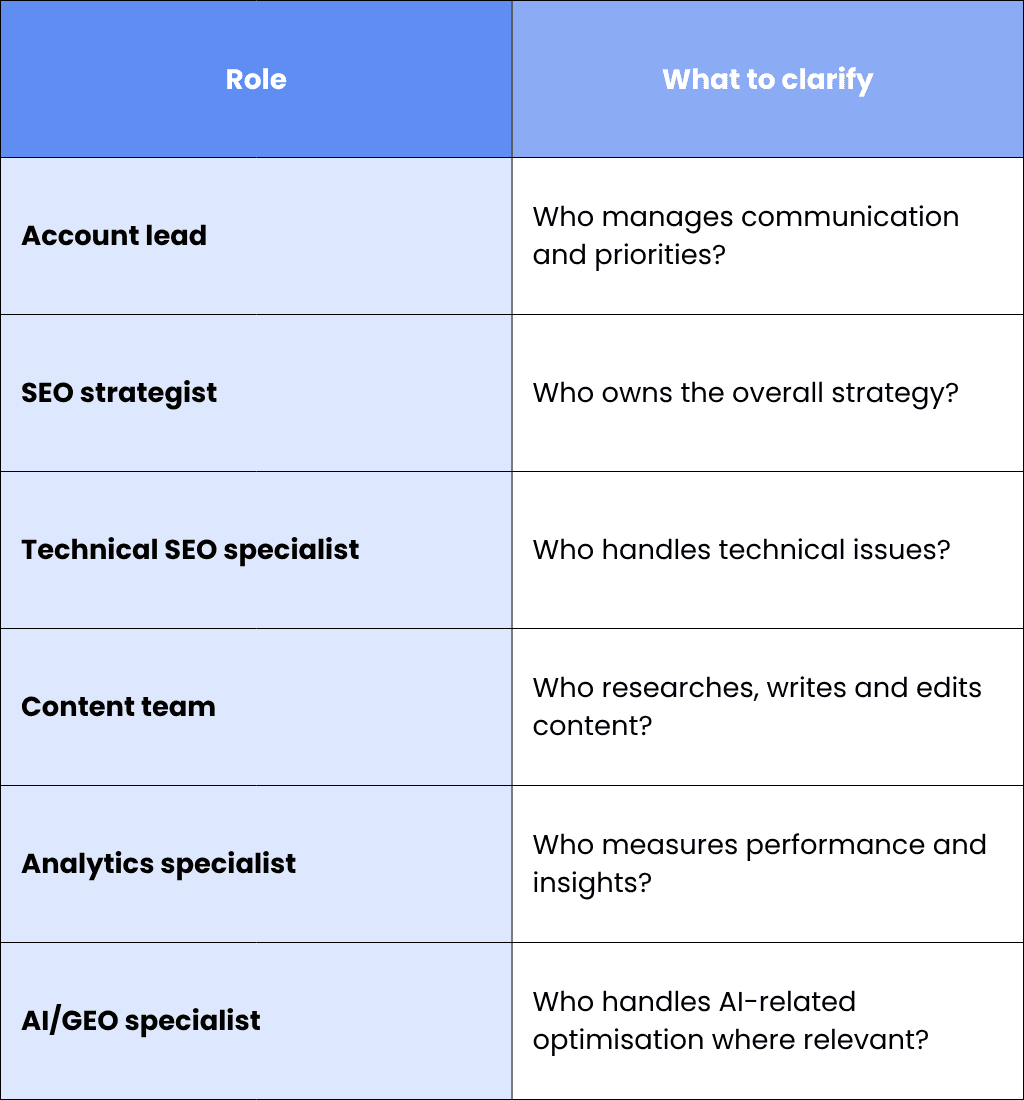
You should also understand how often you will communicate.
For a large retail or hospitality group, for example, monthly meetings may not be enough during major website migrations or launches. A smaller organisation may prefer a simpler monthly rhythm.
Ask directly: “Who should we call when we have an urgent SEO issue?”
Then ask whether that person will remain involved throughout the engagement.
A strong agency should give you access to people who can explain the work, challenge assumptions and make informed recommendations.
You are not simply buying deliverables. You are building an ongoing working relationship.
9. Can you show us relevant case studies and explain what you actually did?
Do not judge an agency solely by its biggest percentage increase.
Ask for case studies that resemble your business in terms of industry, website complexity, market or commercial objective. Then ask the agency to explain the work behind the numbers.
A useful case study should answer five questions:
1. What was the problem?
For example, organic traffic may have plateaued, a website may have suffered from technical issues, or important commercial pages may have lacked visibility.
2. What did the agency change?
Look for specific actions rather than phrases such as “implemented a comprehensive SEO strategy”.
3. How long did it take?
SEO results need context. A 50% increase over three months means something different from 50% over two years.
4. What changed commercially?
Look for leads, sales, bookings, applications or another relevant outcome.
5. What did the agency learn?
This gives you insight into how it thinks when the original plan does not go perfectly.
Suppose an agency reports: Organic traffic increased 60%.
That sounds positive, but you should ask a second question: “What happened to qualified leads or revenue during the same period?”
The answer gives you much more useful information.
Also pay attention to relevance. An agency with excellent SaaS experience may still need to demonstrate that it understands local F&B, retail, education or hospitality search behaviour.
Best practice: ask for one case study that is highly similar to your organisation and one that demonstrates the agency’s ability to solve a more complex SEO problem.
10. What exactly is included, and how transparent are your fees, contracts and recommendations?
Before signing, make sure the scope is completely clear.
An attractive monthly fee can become much less attractive when important work is treated as an “add-on”. Ask the agency to spell out what is included and what requires additional approval.
Clarify whether the retainer covers:
- SEO strategy
- Technical SEO
- Content strategy
- Content production
- Digital PR or authority building
- Development support
- Local SEO
- International SEO
- AI/GEO work
- Reporting and analytics
- Meetings and consultancy
The answer will vary by agency, but there should be no ambiguity.
You should also clarify ownership.
Ask who owns the website improvements, content, analytics accounts, dashboards and other assets created during the engagement. Ideally, your organisation should not be locked into an agency simply because it controls essential accounts or data.
Then look at the commercial model.
For example, imagine two agencies both charge $5,000 per month.
Agency A: $5,000 includes strategy, technical SEO, content and reporting.
Agency B: $5,000 includes strategy and reporting, while development, content production and digital PR are billed separately.
The headline monthly fee is identical, but the actual investment could be very different.
That is why you should compare total cost of delivery, not just the retainer.
A simple comparison can help:
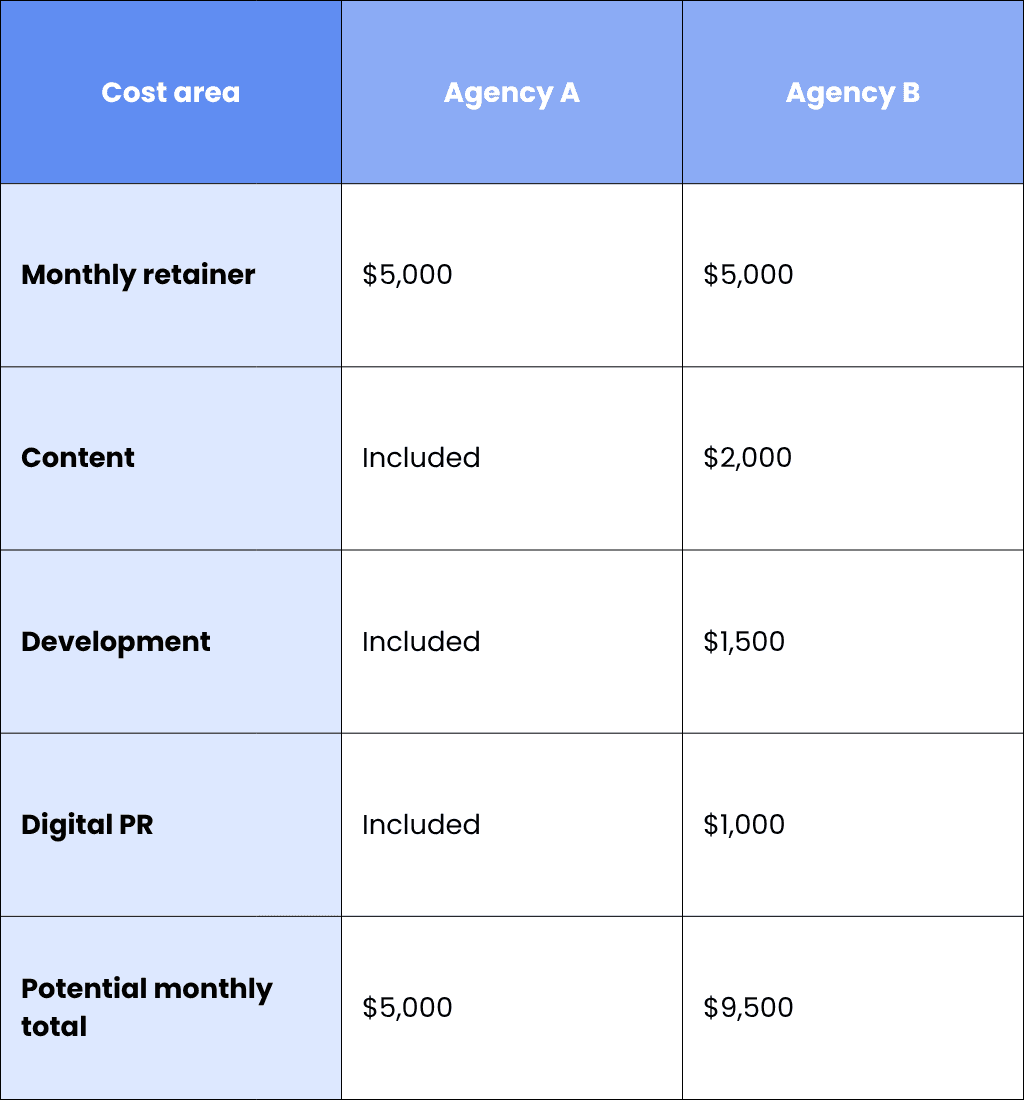
The numbers above are illustrative, but the principle is important: compare like for like.
Finally, ask how the agency decides what not to recommend.
A trustworthy partner should be willing to say, “This is not a priority right now,” when the evidence does not support the investment.
That is often a better sign than an agency that always finds another service to sell.
What to look for: clear scope, clear ownership, predictable costs and recommendations based on evidence rather than upselling.
A Practical Framework for Comparing SEO Agencies
Once you have asked the 10 questions above, you should have enough information to compare agencies more objectively. At this stage, the goal is not to find the agency with the biggest promises or the lowest monthly fee. Instead, assess which agency offers the strongest combination of expertise, strategic fit, transparency and long-term value for your business.
A simple scoring framework can make this process much easier.
Step 1: Score Each Agency Against the Same Criteria
Review the answers you received from every agency and score each one from 1 to 5 across the following areas:
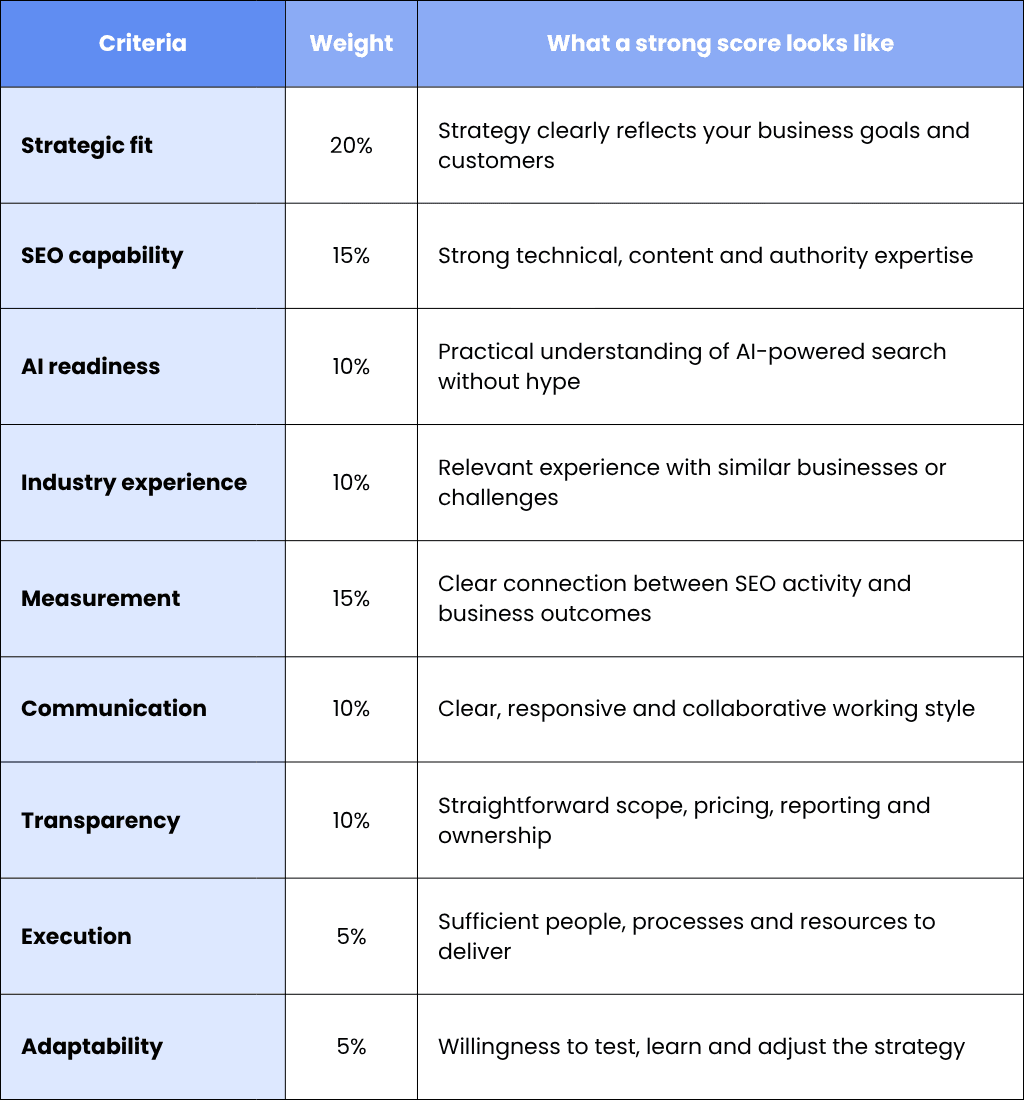
The weighting helps you give more importance to areas that can have a greater impact on the relationship.
For example, strategic fit carries more weight than execution because an agency can have excellent delivery capabilities but still pursue the wrong priorities for your business.
Step 2: Convert the Scores into a Comparable Result
Once you have scored each agency, calculate a weighted score.
For example, an agency that receives 4 out of 5 for strategic fit would receive: 4 ÷ 5 × 20 = 16 points
Repeat the calculation for each category and add the results together.
A simple comparison might look like this:
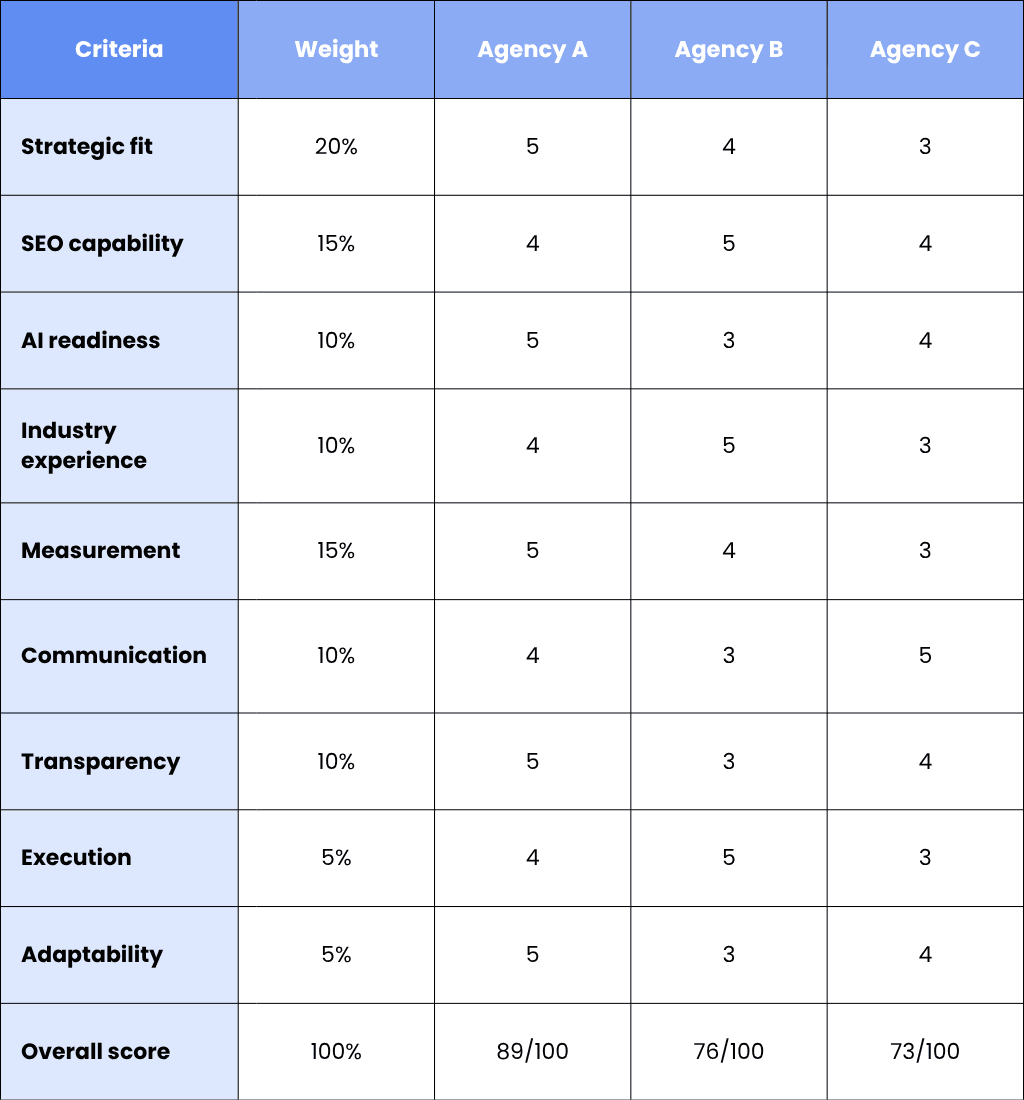
The numbers above are illustrative, but the method gives you a consistent way to compare different agencies after the initial conversations.
Step 3: Look at the Quality Behind the Scores
A high score is useful, but it should not be the only thing you consider.
Review the evidence behind each score. An agency might receive a strong rating for AI readiness, for example, but its proposed approach may still rely heavily on untested tactics. Another agency may score slightly lower but provide a much clearer and more realistic strategy.
Pay particular attention to whether the agency:
- Uses evidence to support its recommendations
- Understands the challenges specific to your industry
- Prioritises business outcomes rather than vanity metrics
- Sets realistic expectations
- Explains limitations as clearly as opportunities
- Has a practical plan for implementation
- Provides transparent reporting and costs
The strongest agency should demonstrate good judgement, not simply a high number of services.
Step 4: Compare Value, Not Just Price
Cost should form part of the decision, but it should not be the deciding factor on its own.
Instead, compare the total value of the engagement.
For example:
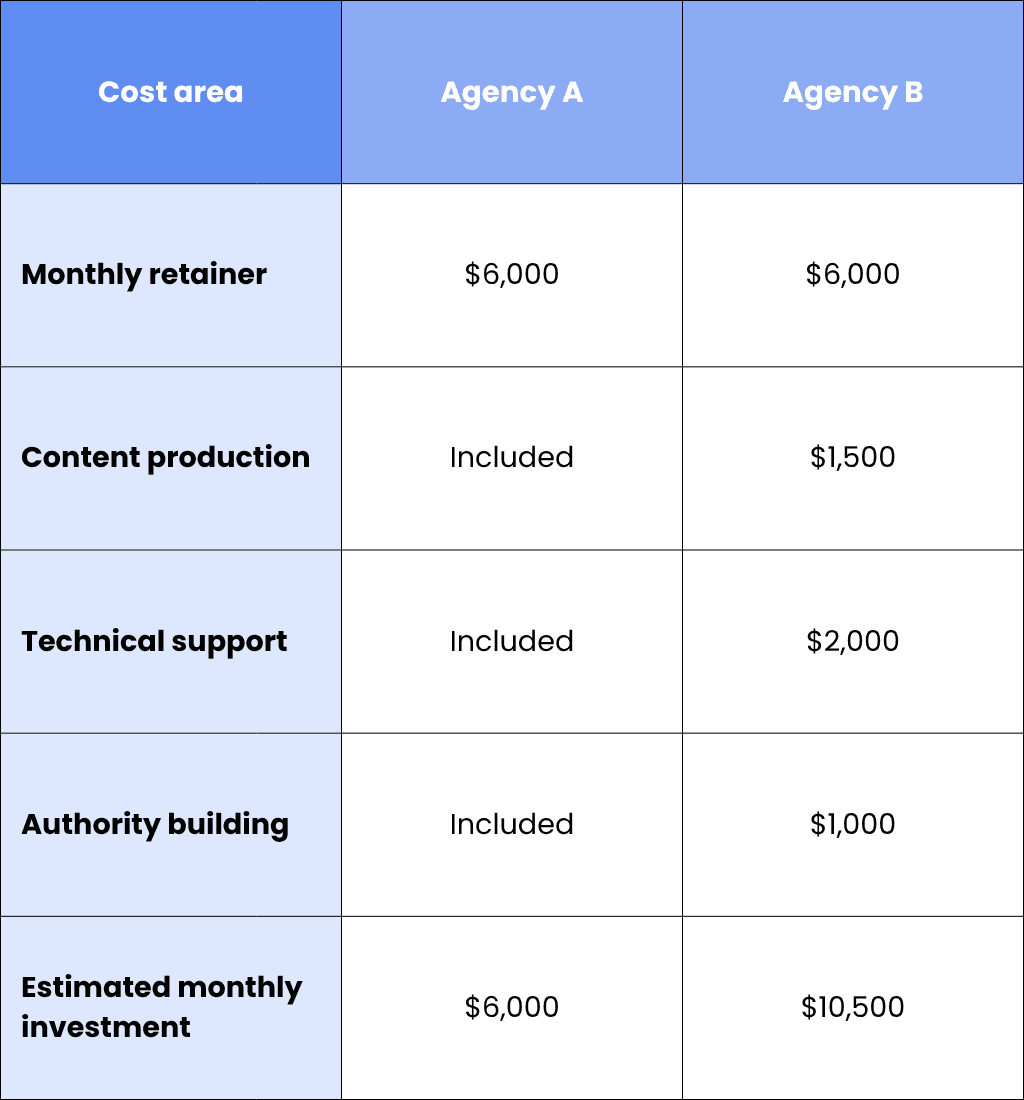
These figures are purely illustrative. The important point is that two agencies with the same headline retainer can have very different total costs once additional services are included.
However, the cheapest option is not automatically the best value either.
Suppose Agency A costs $10,000 per month and Agency B costs $7,000. If Agency A has significantly stronger technical expertise, better industry experience, clearer measurement and a more capable delivery team, the additional investment may be justified.
Think in terms of:
Expected business value ÷ total cost of engagement = potential return on investment
The calculation will rarely be exact at the beginning of an SEO programme, but the principle helps you evaluate price in the right context.
Step 5: Identify the Agency's Strengths and Weaknesses
Once you have scored all agencies, create a simple strengths-and-risks summary.
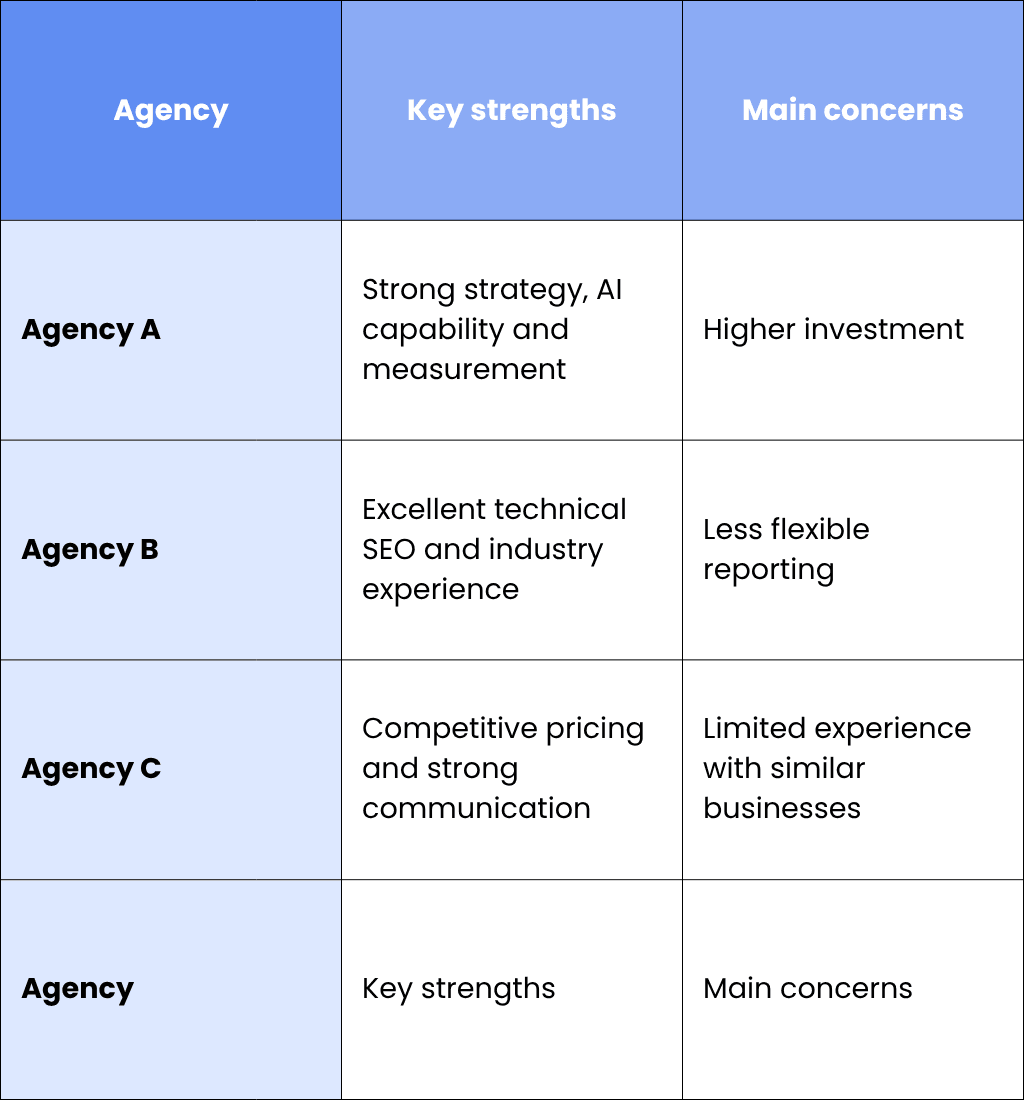
This makes the final decision easier because it shows what you are gaining and what trade-offs you are accepting.
No agency is likely to score perfectly across every category. The objective is to find the combination that makes the most sense for your organisation.
Step 6: Prioritise Strategic Fit Over Impressive Sales Presentations
A polished proposal can be persuasive, but it should not outweigh the substance behind it.
The best-fit agency is usually the one that demonstrates a strong understanding of:
Your business → Your customers → Your search behaviour → Your website → Your commercial goals
That understanding should appear consistently in its strategy, reporting, recommendations and proposed priorities.
Be particularly cautious when an agency presents the same strategy to you that it appears to use for every other client. SEO should have enough flexibility to reflect different industries, customer journeys, competitive environments and business models.
A tailored strategy is often a stronger sign of capability than a long list of deliverables.
Step 7: Check for Long-Term Compatibility
SEO is rarely a one-off project. It is usually an ongoing process of improvement, testing and adaptation.
For that reason, consider whether the agency is likely to remain a good partner as your business grows.
This includes practical factors such as:
- The quality of the team assigned to your account
- Ease of communication
- Reporting standards
- Strategic flexibility
- Ability to support new markets or services
- Understanding of emerging search behaviour
- Willingness to challenge recommendations when priorities change
A technically strong agency may not be the right choice if the working relationship is difficult. Similarly, an agency with excellent communication may not be suitable if it lacks the specialist capabilities your website requires.
The best fit balances both.
A Simple Way to Make the Final Decision
After completing your scoring, narrow the shortlist to the two strongest agencies rather than immediately choosing the highest-scoring one.
Then compare them across four final areas:
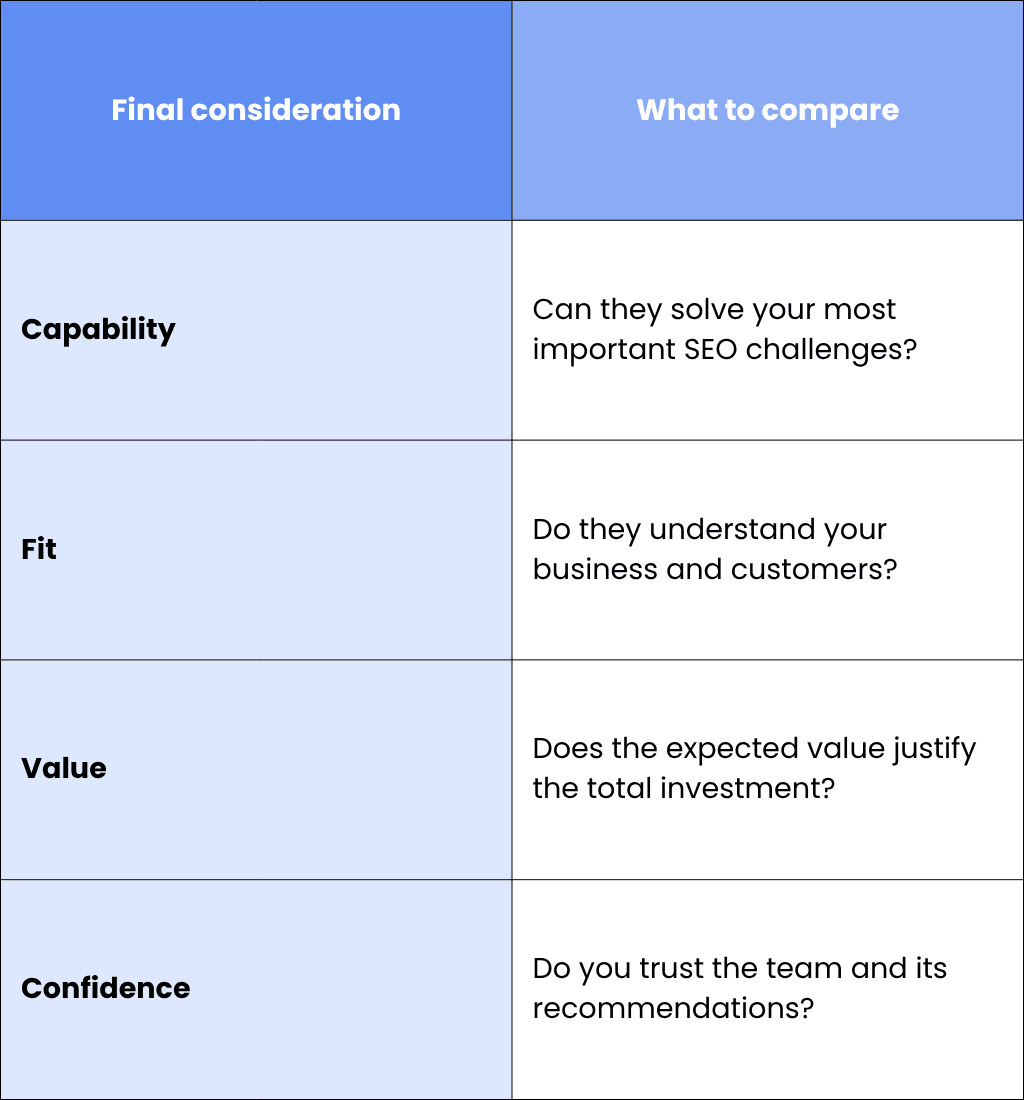
At this point, the decision should become much clearer.
The ideal agency may not have the cheapest proposal, the largest client list or the most impressive AI terminology. Instead, it should be the agency that gives you the greatest confidence that your SEO investment will be managed intelligently, measured properly and adapted as your business and search landscape evolve.
Ultimately, choosing an SEO agency is about choosing a long-term growth partner.
The right agency should combine strong SEO fundamentals with commercial understanding, technical expertise, thoughtful content, responsible use of AI and a clear focus on measurable results.
That is the standard worth using when comparing agencies in the AI era.
Looking For an SEO Agency that Understands Both Search and AI?
Saigon Digital helps ambitious brands turn strategy, creativity and data into measurable digital growth.
Our SEO approach goes beyond chasing rankings. We focus on building the visibility, relevance and technical foundations that help businesses attract the right audiences and turn organic demand into meaningful results.
Our SEO Services cover:
- Site Optimisation & Technical Performance
- Content & Authority Building
- Local & Global Search Strategy
For brands thinking beyond traditional search, our Generative Engine Optimisation services are designed to help businesses improve how they are understood and discovered across AI-powered experiences.
This includes:
- AI Readability Optimisation
- Generative Engine Optimisation (GEO)
- Answer Engine Optimisation (AEO)
- Knowledge Graph & Schema Setup
- AI Content Audit & Reformatting
- AI Performance Dashboard
We also help ambitious organisations use AI beyond marketing visibility through AI Workflow Automation Services, including AI-driven intelligence, pre-built automation templates and custom AI agents.
The future of digital growth is about combining strong SEO foundations, useful digital experiences, intelligent data and emerging AI capabilities to help your business stay visible, relevant and competitive.
That is the approach we believe in at Saigon Digital: forward-thinking, user-centric and bespoke solutions that turn digital challenges into measurable business growth.
Ready to Find the Right SEO Partner for Your Business?
With the right questions and a clear framework for comparing agencies, you can make a more informed decision and choose an SEO partner built for the long term.
Saigon Digital helps ambitious brands grow through SEO, AI-powered search and smarter digital solutions.
Ready to make search work harder for your business? Let’s build what’s next.
Get in touch with Saigon Digital today to start turning search intent into measurable results.
Frequently Asked Questions About Choosing an SEO Agency
1. How long does it take to see results from an SEO agency?
SEO results vary depending on your website, industry, competition and the work required. Some improvements may appear within a few months, while more competitive markets can take longer. A good agency should set realistic expectations, establish clear benchmarks and measure progress consistently rather than promise instant results.
2. How much does it cost to hire an SEO agency?
SEO costs vary widely depending on the scope, website size, target markets and level of expertise required. Instead of comparing monthly fees alone, consider what is included, what may cost extra and the potential business value of the work. The most affordable agency is not necessarily the best-value option.
3. Should an SEO agency specialise in my industry?
Industry experience can be valuable because different sectors have different search behaviours, customer journeys and SEO challenges. However, strong SEO fundamentals and the ability to understand your specific business are equally important. Ideally, choose an agency with relevant experience that can still develop a strategy tailored to your organisation.
4. Is SEO still important now that people are using AI search?
Yes. AI-powered search is changing how people discover information, but strong SEO foundations remain important. Websites still need to be technically accessible, useful, relevant and trustworthy. A modern SEO strategy should therefore account for both traditional search and emerging AI-powered discovery experiences.
5. How do I know whether an SEO agency is actually delivering results?
Look beyond rankings and traffic alone. A good SEO agency should connect its work to meaningful outcomes such as qualified leads, sales, bookings, enquiries or applications. Regular reporting should explain what changed, why it changed and what the agency plans to do next.