



Google has officially begun rolling out its June 2026 spam update, landing right on the heels of the turbulent May 2026 core update. If your rankings have been swinging over the past few days, this rollout is a prime suspect.
At Saigon Digital, we manage SEO across a wide portfolio of clients, so we watch these updates closely the moment they land. Below is what we know, what it means for your site, and the practical steps that matter right now.
Key Takeaway (Quick Recap)
- It's live and global. The June 2026 spam update applies to all languages and regions, rolling out from June 24.
- It's the second spam update of 2026, following March's record-fast rollout. No new spam policies were announced.
- Rank volatility is normal. Expect a few more days of movement, even after SpamBrain finishes deploying.
- Penalties now work at the page level. Modern Google detection can noindex a single bad page instead of punishing your whole domain.
- AI content without a human angle is most exposed. Rehashed, perspective-free articles are being filtered out fast.
- Watch Search Console. Annotate June 24 so you can separate this update's effects from whatever comes next.
Google June 2026 Spam Update
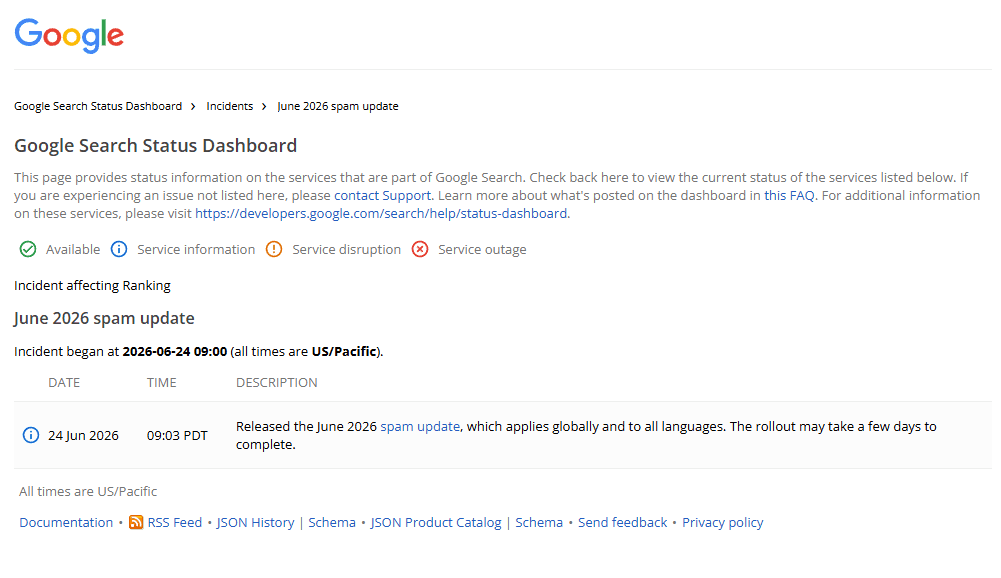
Google confirmed the update through its Search Status Dashboard on June 24, 2026, at 9:03 a.m. PDT. The release note was short and to the point: the June 2026 spam update is a normal spam update that rolls out for all languages and locations, and the rollout may take a few days to complete.
A few facts worth noting:
- This is the second confirmed spam update of 2026, after the March update that finished in under a day, the fastest spam rollout on record.
- Google announced no new spam policies with this release, so the existing spam policies remain the framework for judging any impact.
- The March update explicitly did not target link spam or site reputation abuse, and early reporting suggests this update does not target link spam or the site reputation abuse policy either.
When Google labels something a "standard" spam update, it usually means one thing: SpamBrain, their AI spam system, got sharper at catching things it was already built to catch. Not a brand new rulebook, a tuned one.
How Spam Updates Differ From Core Updates
This distinction matters for diagnosing your own data. The two update types do different jobs:
- Spam updates are targeted. They improve the automated systems (chiefly SpamBrain) that detect manipulation. Pages or sections using spammy tactics can drop sharply while the rest of the site stays stable.
- Core updates are broad. They re-evaluate how Google judges overall quality, relevance, and helpfulness across the entire index, affecting any site, not just rule-breakers.
Because the May 2026 core update only recently wrapped, some sites will struggle to tell the two effects apart. The cleaner your reporting windows, the easier this gets, which is exactly why annotating dates matters so much this week.
4 Things Every SEO Should Understand Right Now
Here is the practical read from our team, drawing on both Google's guidance and how detection has evolved over the past two years.
1. Erratic rankings are normal and will continue
Ranking positions jumping around during a rollout is completely expected, and it will keep happening for several more days, even after SpamBrain finishes deploying. Do not make panicked, drastic changes mid-rollout. Volatility during the deployment window is noise, not yet signal.
2. Helpful Content is no longer a standalone system
Here is a piece of essential background that many people still misread. Google retired the Helpful Content system (HCU) as a separate, standalone algorithm and folded it into core ranking (this happened with the March 2024 core update, and it reshaped how every update since behaves).
Important: this does not mean helpful-content evaluation disappeared. It means it's now baked into the core ranking systems and runs continuously. It joined a long list of once-famous standalone systems that were absorbed the same way, including Penguin, Panda, RankBrain, and the Link Spam system.
3. Penalties now hit single pages, not whole domains
This is the most important shift to understand, and it changes your recovery strategy completely.
The old way (standalone algorithms):
- A separate system only "hit" you after your site was already indexed.
- It penalized at the whole-domain level.
- The damage was brutal and slow to reverse: even your genuinely good articles got dragged down with the bad ones.
- Recovery could take a very long time.
The new way (integrated into core ranking):
- Evaluation happens in real time, right as Google crawls.
- It judges at the individual page level, not the entire domain.
- See a weak page? Google simply applies noindex to that page rather than punishing the whole site.
This is why you'll often see mass-produced "content factory" websites where only the homepage is indexed, the weak interior pages never made the cut. The upside: once you fix the content or correct the errors, strong pages can return to the top quickly, because the system is reassessing continuously rather than waiting for the next algorithm run.
4. Generic AI content gets filtered fast
The clearest pattern across recent updates: AI-generated content that rehashes existing material without a genuine human perspective is being eliminated rapidly. Google's systems increasingly reward first-hand experience, original insight, and a real point of view.
This isn't anti-AI. It's anti-empty. Content assembled at scale with no lived experience, no original angle, and nothing a reader couldn't get from ten identical pages is exactly what these updates filter out. This aligns directly with Google's E-E-A-T emphasis, where the first "E," Experience, is doing heavy lifting.
A Quick Look at Recent Update History
Context helps you read the current volatility. Here's how the recent cycle has run.
- August 2025 spam update — Aug 26 – Sep 22, 2025; ~27 days, longest in recent memory
- December 2025 core update — Dec 11 – 29, 2025; heavy publisher traffic losses
- Discover core update — Feb 5 – 27, 2026; first standalone Discover update
- March 2026 spam update — Mar 24, 2026; ~20 hours, fastest spam rollout ever
- May 2026 core update — May 21 – Jun 2, 2026; described as highly turbulent
- June 2026 spam update — Jun 24, 2026; live now, a few days to complete
The pattern is clear: Google released four broad ranking incidents in roughly 13 weeks between February and June. Enforcement is getting faster and the gaps between updates are shrinking.
Who Is Most at Risk?
Based on how standard spam updates behave, the sites most likely to feel this one are those leaning on shortcuts. The tactics that get burned in these rollouts are the shortcuts; the ones that survive are the boring, durable ones.
Higher-risk signals include:
- Mass-generated filler dressed up as content.
- AI content published at scale with no editing, experience, or original angle.
- Cloaking, doorway pages, and other manipulative tactics.
- Thin, repetitive pages that exist only to target keywords.
On the safer side: sites that have maintained clean link profiles, avoided scaled content abuse, and steered clear of site reputation abuse are unlikely to see significant movement.
What To Do This Week
A measured, evidence-led response beats forum-driven panic every time. Here's our recommended sequence.
- Annotate June 24 in your reporting. Mark the date in Search Console and analytics so you can isolate this update's effects from anything that rolls out after it.
- Wait for the rollout to finish before reacting. Movement during deployment is expected. Don't make sweeping changes mid-rollout.
- Segment your data. Break performance down by query intent, geography, and page type. A site-wide dip and a few specific pages dropping are very different problems.
- Audit at the page level. Since detection now works page by page, find the specific weak pages, thin, duplicative, or empty AI content, rather than assuming a whole-site penalty.
- Review the spam policies. Google's guidance is clear: sites that see changes should re-check the spam policies for compliance.
- Fix the root cause, then be patient. Add real experience and original insight to weak pages. Note that Google's systems can take months to reassess, so recovery isn't instant, even after good fixes.
Important note on recovery: Google states that improvements may take months for its systems to learn that a site now complies. A quick bounce-back isn't the expectation, so resist the urge to keep tweaking every few days.
The Bottom Line
The June 2026 spam update reinforces a direction Google has been heading for two years: real-time, page-level evaluation that rewards genuine experience and quietly filters out empty, scaled content. The brands that win aren't chasing loopholes, they're building pages a real person would find genuinely useful.
If you're seeing ranking movement and aren't sure whether it's this update, the May core update, or something else, that's exactly the kind of diagnosis our team handles daily.
Get in touch with Saigon Digital for a clear read on your data and a recovery plan grounded in evidence, not guesswork.