



AI-assisted writing has changed how businesses approach content marketing and SEO.
From generating initial ideas to researching topics, structuring articles and improving production efficiency, AI can help marketing teams create content faster than ever. For companies in competitive industries such as F&B, retail, education and hospitality, this efficiency can make it easier to publish consistently and respond to customer questions at scale.
But as AI-generated and AI-assisted content becomes increasingly common, businesses face a more important challenge: How can you use AI to improve content production without weakening the trust, expertise and credibility that your brand has worked hard to build?
This is where E-E-A-T for AI content becomes essential.
In this guide, we explore how businesses can approach E-E-A-T for AI content, build an effective AI-assisted content workflow, maintain factual accuracy and genuine expertise, avoid generic content, and measure whether their investment is actually improving trust and SEO performance.
Key Takeaways
- AI can improve content efficiency, but human expertise remains essential. Use AI to support research, drafting and optimisation while keeping people responsible for accuracy and quality.
- E-E-A-T should guide the entire content workflow. Build content around genuine Experience, Expertise, Authoritativeness and Trustworthiness rather than treating them as a final checklist.
- Add first-hand knowledge and original insights. Your team's real-world experience can make AI-assisted content more distinctive, useful and credible.
- Always apply human oversight. Expert review and fact-checking help prevent inaccuracies, generic content and unsupported claims from reaching your audience.
- Measure more than SEO rankings and traffic. Evaluate engagement, trust, authority and business outcomes alongside search visibility to understand the true impact of your content.
- Avoid scaling content at the expense of quality. The goal is not to publish more AI-generated content, but to create content that audiences can genuinely find, understand and trust.
What Is E-E-A-T for AI Content?
E-E-A-T stands for:
- Experience: Does the content demonstrate first-hand or practical experience?
- Expertise: Does the content show appropriate knowledge and competence?
- Authoritativeness: Is the content and its source recognised as credible within the topic?
- Trustworthiness: Can users rely on the information, the website and the organisation behind it?
Google's Search Quality Rater Guidelines use E-E-A-T as a framework for human evaluators who assess the quality of search results. These guidelines help explain the characteristics of high-quality content, although they are not a simple checklist or direct ranking formula.
For businesses, the concept is still highly valuable.
Consider a hospitality company publishing a guide to choosing a hotel in a particular destination. An AI tool could produce a polished article based on publicly available information. However, a stronger piece might include insights from the hotel's own team, practical advice based on real guest questions, local knowledge and clearly sourced information.
The difference is not simply that one article was written by AI and the other was written by a person.
The difference is depth, originality, accuracy, experience and trust.
This distinction matters because AI tools can produce fluent content without necessarily possessing genuine experience. They can summarise information, but they do not automatically understand the context of your business, your customers or your industry.
That means businesses should treat AI as a powerful assistant rather than an unquestioned authority.
A useful principle is: AI can help you produce content. Your people and your organisation must provide the credibility behind it.
This is the foundation of effective E-E-A-T for AI content.
The Four Pillars of E-E-A-T for AI Content
As AI-assisted writing becomes part of everyday content workflows, businesses need a reliable framework for deciding whether their content is genuinely useful and trustworthy.
This is where the four pillars of E-E-A-T: Experience, Expertise, Authoritativeness and Trustworthiness, become particularly useful.
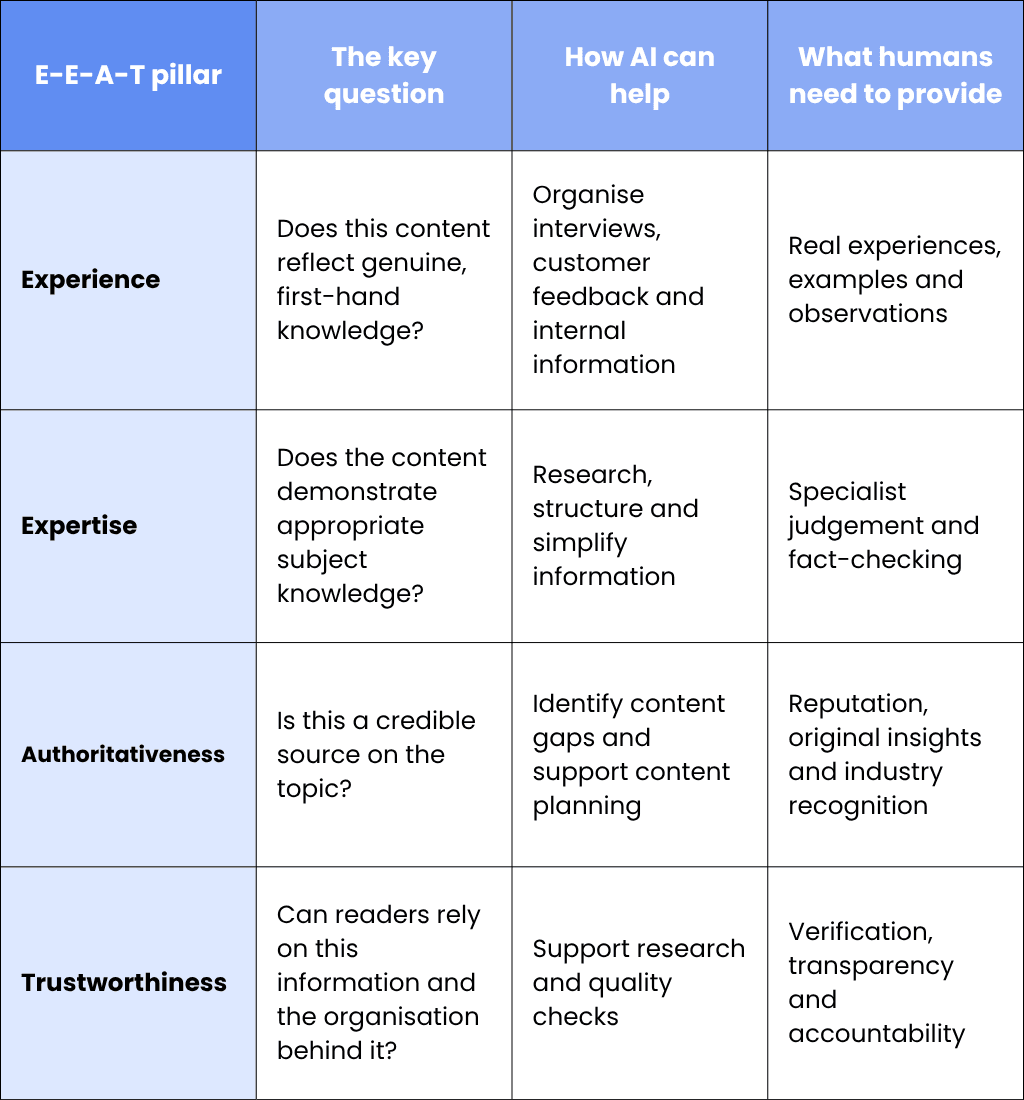
The important point is that AI can support every stage of this process, but it cannot automatically supply all four elements.
Therefore, a strong approach to E-E-A-T for AI content combines the efficiency of AI with the experience, knowledge and judgement of real people.
Let us look at each pillar in more detail.
1. Experience: Add What AI Cannot Personally Experience
Experience is the first "E" in E-E-A-T, and it is particularly important when creating content that benefits from first-hand knowledge.
AI can process information from existing sources and generate a coherent response, but it does not automatically have personal experience of the subject it describes. This creates an important opportunity for businesses: your real-world experience can become one of the strongest differentiators in AI-assisted content.
Consider a simple example.
Imagine two articles about choosing a hotel for a family holiday. The first provides general advice about room sizes, location and facilities. The second includes insights from a hotel team that regularly works with families. It explains which room configurations families tend to prefer, what questions parents commonly ask before booking, which local attractions are easiest to reach with children, and what guests often wish they had known before arriving.
Both articles may be well written. However, the second provides information that comes from direct experience.
That difference matters.
2. Expertise: Make Knowledge Visible
Experience and expertise are closely related, but they are not identical.
Experience is about what an individual or organisation has actually encountered or done. Expertise is about having the appropriate knowledge and competence to explain a subject accurately.
This distinction becomes especially important when businesses use AI to create content about technical, specialised or fast-changing topics.
AI can help summarise information, identify themes and structure an article. However, it can also misunderstand complex subjects or produce statements that sound convincing but are inaccurate.
For that reason, businesses should make expertise visible throughout the content process.
What does expertise look like in practice?
Imagine a retailer publishing a guide about choosing a laptop for university students.
A generic AI-generated article might discuss processor speed, RAM, storage and battery life. While this information may be broadly correct, an expert-led article could go further.
A product specialist might explain:
- Why certain specifications matter for different courses
- Which features are useful for students who travel frequently
- What specifications are unnecessary for basic study
- Which questions students should ask before purchasing
- How long different product categories typically remain practical
- What common mistakes customers make when choosing a device
The AI tool can help organise these insights, but the expertise comes from people who understand the products and the customers.
3. Authoritativeness: Build Authority Beyond Individual Articles
While experience and expertise focus heavily on the quality of the content itself, authoritativeness considers the broader credibility of the content creator and organisation.
In other words, it asks: "Why should someone consider this business a credible source on this subject?"
Authority is rarely built through one article. Instead, it develops gradually as a business consistently demonstrates knowledge, publishes useful information and becomes recognised within its field.
For this reason, AI-assisted content should form part of a broader content and authority strategy rather than exist as a series of isolated articles.
4. Trustworthiness: The Foundation of AI-Assisted Content
If experience, expertise and authority explain why content can be valuable, trustworthiness determines whether people are willing to rely on it.
This makes trust particularly important when discussing E-E-A-T for AI content.
AI tools can produce fluent, confident and professional-sounding text. However, confidence in the writing does not guarantee accuracy.
An AI-generated sentence can sound completely certain while containing an incorrect date, outdated statistic or unsupported claim.
Therefore, businesses should never confuse well-written content with verified content.
How the Four Pillars Work Together
The four pillars should not be treated as separate boxes to tick.
They reinforce one another.
Consider a hypothetical article from a hotel about planning a weekend in Hanoi.
Experience could come from the hotel's local knowledge and recommendations from its team.
Expertise could come from staff who understand the destination and regularly assist guests.
Authoritativeness could develop through consistent destination content, credible references and recognition from relevant travel sources.
Trustworthiness could come from accurate information, transparent authorship, reliable sources and regular updates.
Together, these elements create a much stronger content asset than an article produced from a generic AI prompt.
You can think of the relationship like this:
AI efficiency↓Human expertise and experience↓Fact-checking and editorial oversight↓Useful, original and trustworthy content↓Greater audience confidence↓Stronger long-term brand and search visibility
The process is not about adding AI to content creation and hoping that quality will take care of itself.
Instead, it is about designing a workflow in which AI makes the team more efficient while humans remain accountable for the qualities that matter most.
A Practical AI Content Workflow for E-E-A-T
Understanding E-E-A-T is one thing. Putting it into practice is another.
For businesses using AI-assisted writing, the real challenge is building a workflow that improves efficiency without allowing speed to compromise accuracy, originality or trust. Rather than treating AI as a shortcut from "brief" to "publish", businesses should create a structured process in which each stage builds on the one before it.
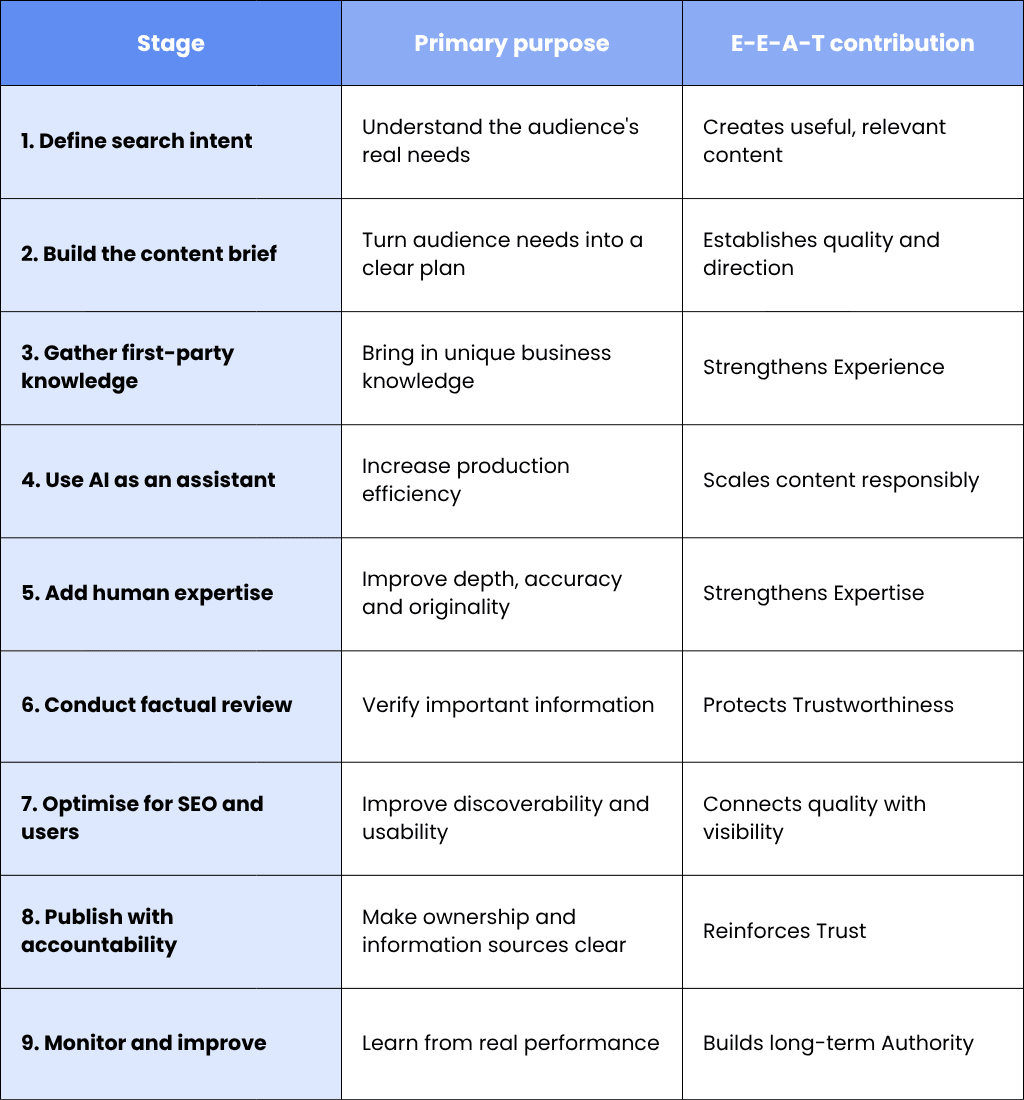
A strong workflow therefore looks like this:
Define the search intent → Build the content brief → Gather first-party knowledge → Use AI as an assistant → Add human expertise → Conduct a factual review → Optimise for SEO and users → Publish with accountability → Monitor and improve
Let us look at how the process works in practice.
Step 1: Start With Search Intent
Every effective content workflow should begin by understanding the reader, not by opening an AI writing tool.
Before generating an outline or drafting a paragraph, identify what the audience is actually trying to accomplish when they search for a particular topic.
This distinction matters because E-E-A-T is ultimately about creating content that is genuinely helpful to people. If an article does not address the user's underlying question, adding more AI-generated information will not make it more useful.
Ask these questions before creating content:
- What problem is the reader trying to solve?
- What question are they really asking?
- What information do they need to make a decision?
- What stage of the customer journey are they in?
- What would make them trust this information?
- What expertise or experience would be particularly valuable?
For example, a hotel targeting the search term "best area to stay in Hanoi" might discover that users are not simply looking for a list of neighbourhoods. They may actually want to understand which area is best for first-time visitors, families, business travellers or people interested in nightlife.
That insight changes the content strategy.
Instead of producing a generic list, the hotel could create a detailed guide comparing areas based on different travel needs, supported by genuine local knowledge.
Step 2: Establish a Detailed Content Brief
Once you understand the search intent, the next step is to define exactly what the content needs to accomplish.
The reason this comes after search intent is simple: you cannot create a useful content brief until you know what the audience needs.
The brief acts as a bridge between strategy and production.
It gives the content team, and any AI tools involved, enough context to produce relevant work rather than generic text.
A strong brief might include:
- Primary keyword
- Secondary keywords
- Search intent
- Target audience
- Customer journey stage
- Content objective
- Key questions to answer
- Topics to cover
- Topics to avoid
- Required sources
- Expert input required
- First-party information available
- Internal linking opportunities
- External references
- Brand voice
- Content format
- Target depth
- Review requirements
- Call to action
For example, an F&B brand creating a guide to choosing a healthy lunch could define its audience as office workers looking for convenient options during the working week.
The brief could then specify that the article should:
- Explain what makes a lunch balanced.
- Address common questions about portion sizes and ingredients.
- Provide practical meal examples.
- Include insights from the restaurant's culinary team.
- Avoid making unsupported nutritional or health claims.
- Direct readers towards relevant menu options.
This is far more useful than simply telling an AI tool to "write an article about healthy lunch ideas".
Step 3: Gather First-Party Knowledge
With the search intent and content brief established, the next priority is to identify what your organisation knows that other websites may not.
This is one of the most important stages in an AI-assisted content workflow because first-party knowledge is often what separates genuinely useful content from generic AI output.
AI can access and reorganise existing information, but your organisation has something unique: the knowledge accumulated through real business experience.
This knowledge may exist across the company without anyone formally recognising it as content.
Look for insights from:
- Subject matter experts
- Sales teams
- Customer service teams
- Product specialists
- Chefs and restaurant managers
- Teachers and lecturers
- Hotel and hospitality staff
- Internal reports
- Customer feedback
- Reviews
- Surveys
- Original research
- Case studies
- Frequently asked questions
For example, a retailer could discover that customers repeatedly ask whether a particular product is suitable for small apartments.
That question may not appear in the original product description, but it could become the foundation for a useful buying guide.
Similarly, a university may discover that prospective students repeatedly ask about balancing study with part-time work. A hotel may know which local attractions are most suitable for families. A restaurant may understand which menu items are most popular with customers following specific dietary preferences.
These insights are valuable because they come directly from real interactions.
A useful information-gathering process
The content team could:
Review customer questions → Interview internal experts → Analyse existing data → Collect examples → Identify recurring problems → Organise the findings
AI can assist with organising this information. For example, it can summarise interview transcripts, group customer questions into themes or identify recurring topics in large datasets.
However, the original information should come from the organisation itself.
Step 4: Use AI as an Assistant
Once you have established the search intent, created the brief and gathered first-party information, you have the right foundation for AI-assisted production.
This is where AI can create significant efficiency gains.
The key is to use AI as an assistant rather than an unquestioned source of truth.
Depending on your workflow, AI can help you:
- Organise research
- Summarise internal documents
- Structure interview notes
- Generate content outlines
- Identify potential content gaps
- Suggest FAQs
- Brainstorm alternative angles
- Improve readability
- Simplify complex explanations
- Repurpose existing content
- Suggest internal linking opportunities
- Create initial drafts
For example, a hotel could provide an AI tool with interview notes from its front-of-house team and ask it to organise the information into themes such as:
- Family travel
- Transport
- Dining
- Local attractions
- Seasonal considerations
A content writer can then use that structure to create the article.
The AI has improved efficiency, but the underlying information still comes from real people with relevant experience.
Step 5: Add Human Expertise
After AI has helped organise information or produce an initial draft, the content should return to people with genuine knowledge of the subject.
This is where the content becomes more authoritative and distinctive.
A subject matter expert should review the draft and ask:
- Is this accurate?
- Is anything missing?
- Does this reflect real-world experience?
- Are there misleading assumptions?
- Is the advice genuinely useful?
- Does this reflect how our customers actually think?
- Are there better examples we could provide?
- Does anything sound generic or exaggerated?
For example, suppose AI creates a guide for a retailer about choosing a television.
A product specialist may identify that the draft recommends a particular screen size based only on room dimensions. In reality, viewing distance, content type and personal preferences may also matter.
The expert can correct the oversimplification and add useful context.
That is precisely the value of human oversight.
Human review should add more than proofreading
There is an important difference between:
Proofreading: Checking grammar, spelling and formatting.
Expert review: Checking accuracy, nuance, context, experience and usefulness.
For E-E-A-T, businesses need both.
The human expert should not simply approve the AI-generated text. They should actively improve it.
Encourage experts to add:
- Original insights
- Real examples
- Practical recommendations
- Customer observations
- Industry-specific context
- Common mistakes
- Lessons learned
This is where generic content can become genuinely valuable.
Step 6: Conduct a Factual Review
Expertise improves content, but expertise alone does not guarantee that every detail is correct.
This is why factual review should follow expert input.
At this stage, the content team should verify important claims against reliable sources and internal information.
Review:
- Names
- Dates
- Statistics
- Numbers
- Prices
- Product specifications
- Service details
- Opening hours
- Regulations
- Policies
- Citations
- Quotes
- External links
For example, if a hotel article states that a particular attraction is a 10-minute walk away, someone should verify the claim.
If a retailer states that a product has a specific specification, the team should confirm it against the manufacturer's information.
If an education provider mentions an application deadline, the team should check the current official information.
Use a risk-based approach
Not every statement requires the same level of scrutiny.
A practical approach is to classify claims by potential impact:
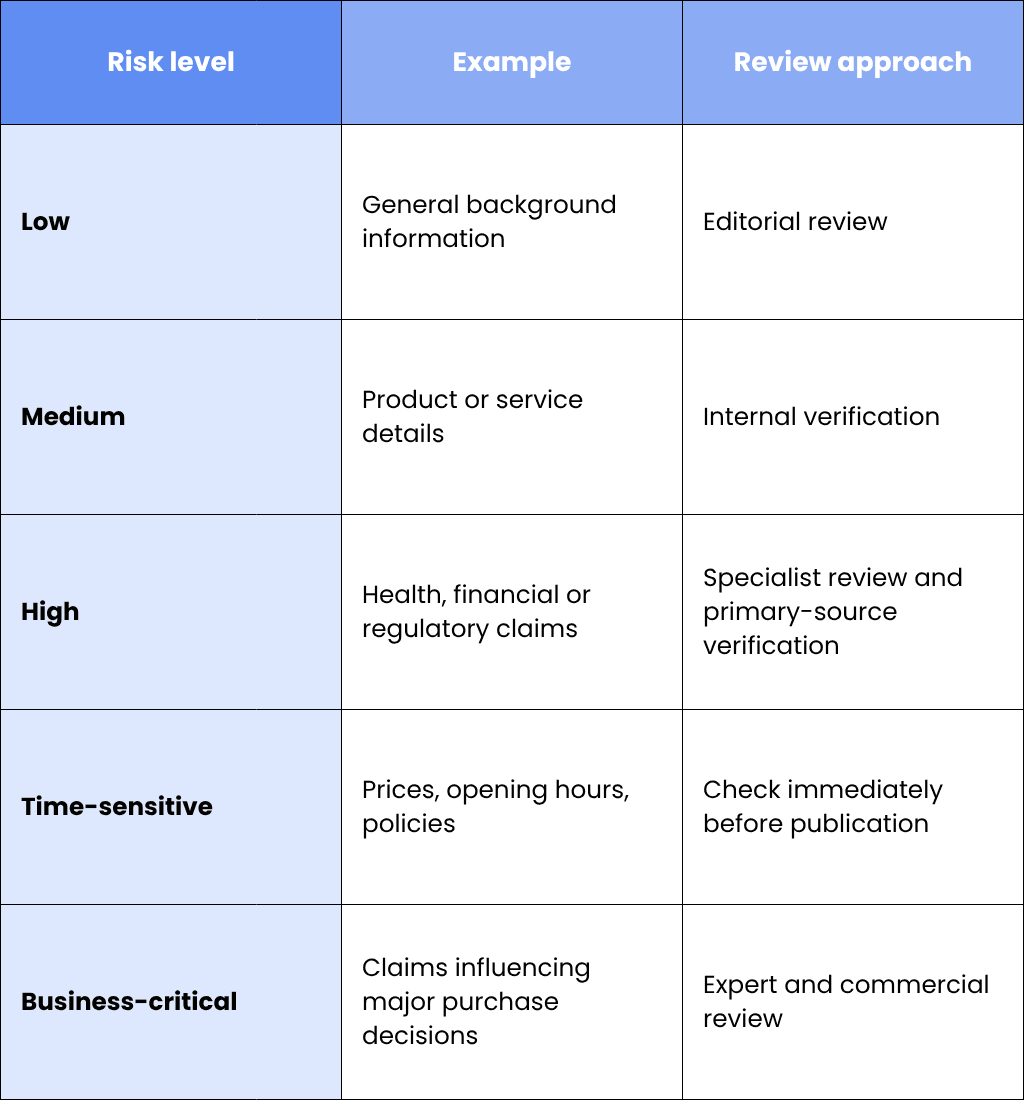
This approach helps teams use their time efficiently.
Step 7: Optimise for SEO and Users
Only after the content has been researched, drafted, reviewed and fact-checked should the team focus on final SEO optimisation.
This order matters.
SEO should help users discover valuable content. It should not determine what the content says at the expense of usefulness.
Review:
- Search intent alignment
- Primary keyword usage
- Secondary keyword relevance
- Heading structure
- Internal links
- External references
- Metadata
- Schema markup where appropriate
- Readability
- Mobile experience
- Page performance
- Content freshness
For example, if the primary keyword is "best family hotel in Hanoi", the content should naturally address what families actually want to know: location, room options, facilities, transport, nearby attractions and practical considerations.
The keyword should support the content rather than dictate unnatural wording.
Step 8: Publish With Clear Accountability
Once the content has passed expert review, factual checks and SEO optimisation, it is ready for publication.
However, publication should not mean that responsibility disappears.
Where appropriate, businesses should make the source and ownership of information clear.
Depending on the content, this might include:
- Author information
- Reviewer information
- Author biographies
- Publication dates
- Updated dates
- Sources and references
- Editorial policies
- Contact information
For example, an education provider could identify the academic contributor who reviewed an article about a specialist subject.
A hotel could identify the business as the source of its local recommendations.
A retailer could provide clear information about who created or reviewed a buying guide.
These details help readers understand the context behind the content.
Step 9: Monitor and Improve
The final stage of the workflow is measurement.
Once content is published, the team should monitor whether it is achieving its intended purpose.
This might include tracking:
SEO performance
- Organic traffic
- Search impressions
- Keyword rankings
- Non-branded visibility
- Click-through rate
- Organic conversions
- Leads
- Revenue influenced by organic search
Content engagement
- Engagement
- Scroll behaviour
- Returning visitors
- Internal link clicks
- Content-assisted conversions
Authority signals
- Quality backlinks
- Industry mentions
- Digital PR coverage
- Expert citations
- Brand mentions
- Relevant partnerships
Business outcomes
- Enquiries
- Bookings
- Product purchases
- Course applications
- Restaurant reservations
- Qualified leads
However, metrics should always be interpreted in context.
For example, a page that receives 10,000 organic visits but generates no relevant enquiries may be less valuable to a business than a page that attracts 500 highly qualified visitors and generates 50 leads.
The simple calculation illustrates the difference:
Page A: 10,000 visitors × 0.1% conversion rate = 10 conversions
Page B: 500 visitors × 10% conversion rate = 50 conversions
The numbers are illustrative, but the principle is important: traffic volume alone does not define content success.
Use performance data to improve the next cycle
Suppose an article ranks well but receives few clicks. The team might review its title and meta description.
If it attracts traffic but users leave quickly, the content may not meet search intent.
If it receives strong engagement but does not generate conversions, the next step may be to improve internal linking or calls to action.
If information becomes outdated, the team should update it.
This creates a continuous cycle:
Publish → Measure → Learn → Update → Improve
The insights gained from this stage should then feed into the next content brief.
For example, if customer behaviour reveals that readers consistently ask a question that the original article did not answer, that insight can become part of the next content plan.
In this way, the workflow becomes increasingly informed by real audience behaviour.
The Complete AI-Assisted E-E-A-T Workflow
When all nine steps are connected, the process looks like this:
How Long Should the Process Take?
There is no universal timeline for creating AI-assisted content because the level of review should depend on the topic, complexity and potential risk.
However, businesses can think about content production in terms of effort rather than simply word count.
For example, a straightforward 1,500-word article might require:
- 1 hour for search intent and briefing
- 1 hour for first-party research
- 30 minutes for AI-assisted structuring
- 1.5 hours for expert input
- 1 hour for fact-checking
- 30 minutes for SEO optimisation
- 30 minutes for final review
That is approximately 6 hours of combined effort.
The AI component might reduce the time spent on outlining and drafting, but it does not remove the need for strategy, expertise or quality control.
This is why businesses should measure AI success by more than how quickly an article can be generated.
A better question is: "How much time can AI save while maintaining or improving the quality of the final content?"
If AI reduces drafting time by 50% but the resulting content requires extensive rewriting, the efficiency gain may be limited.
On the other hand, if AI helps a subject matter expert turn their knowledge into a high-quality article in half the usual time, the business has created genuine productivity gains without sacrificing authority.
How to Measure Trust, Quality and SEO Performance
Once an AI-assisted content workflow is in place, the next question is naturally: How do you know whether it is working?
This is where measurement becomes an important part of E-E-A-T for AI content.
A useful measurement framework should answer four questions:
- Can people find our content?
- Do they find it useful and credible?
- Does our content strengthen our authority?
- Does that trust ultimately contribute to business growth?
The following framework helps connect these questions.
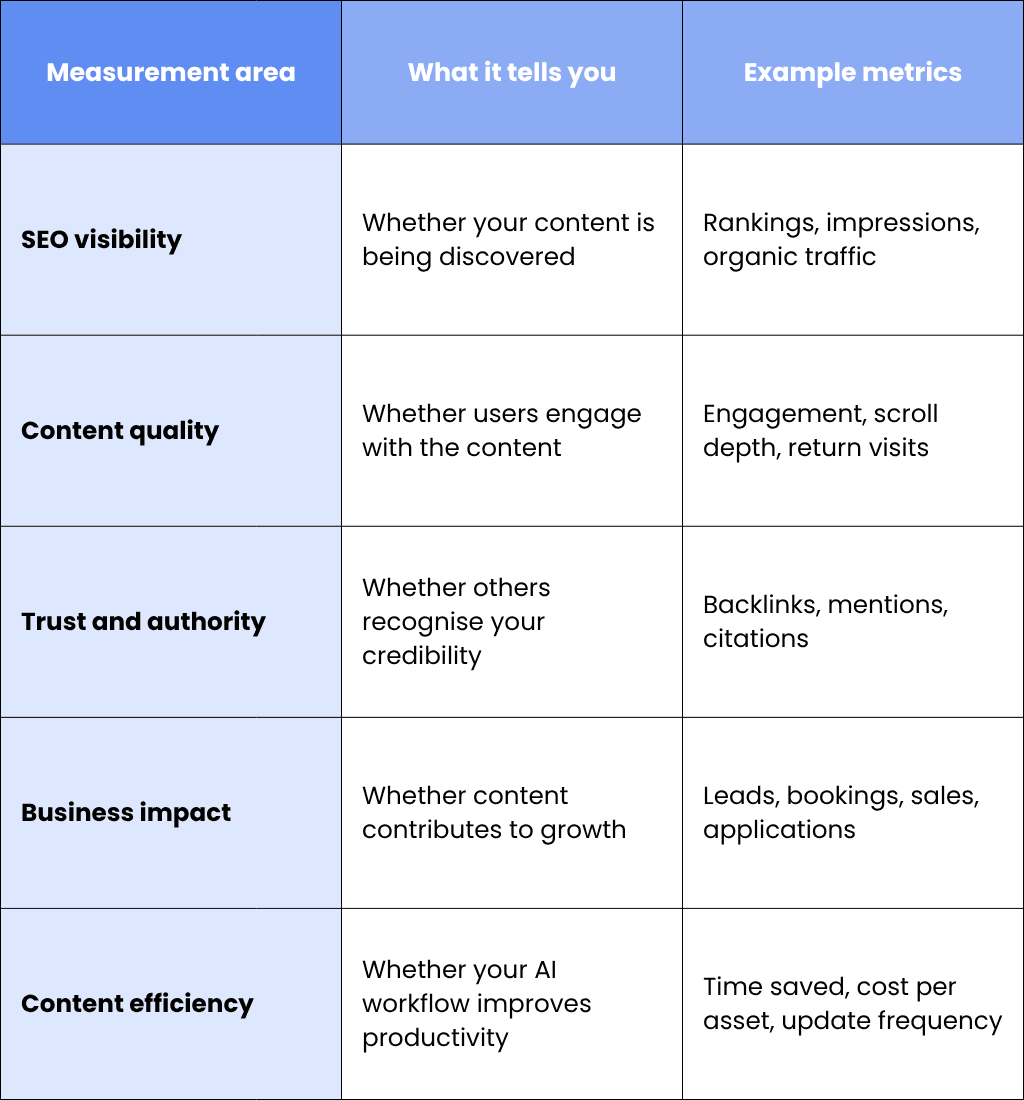
The goal is not to maximise every metric.
Instead, businesses should identify the metrics that best reflect their objectives and then look for relationships between them.
1. Start by Defining What Success Means
Before measuring performance, define what the content is supposed to achieve.
This may sound obvious, but it is one of the most commonly overlooked parts of content measurement.
A restaurant, for example, may create a guide about "best brunch in Hanoi" to increase local visibility and drive reservations. An education provider may publish a guide about choosing a degree to generate prospective student enquiries. A retailer may create buying guides to help customers make purchasing decisions.
Each page has a different purpose.
Therefore, the first step is to define the primary business outcome and the supporting content goals.
For example:
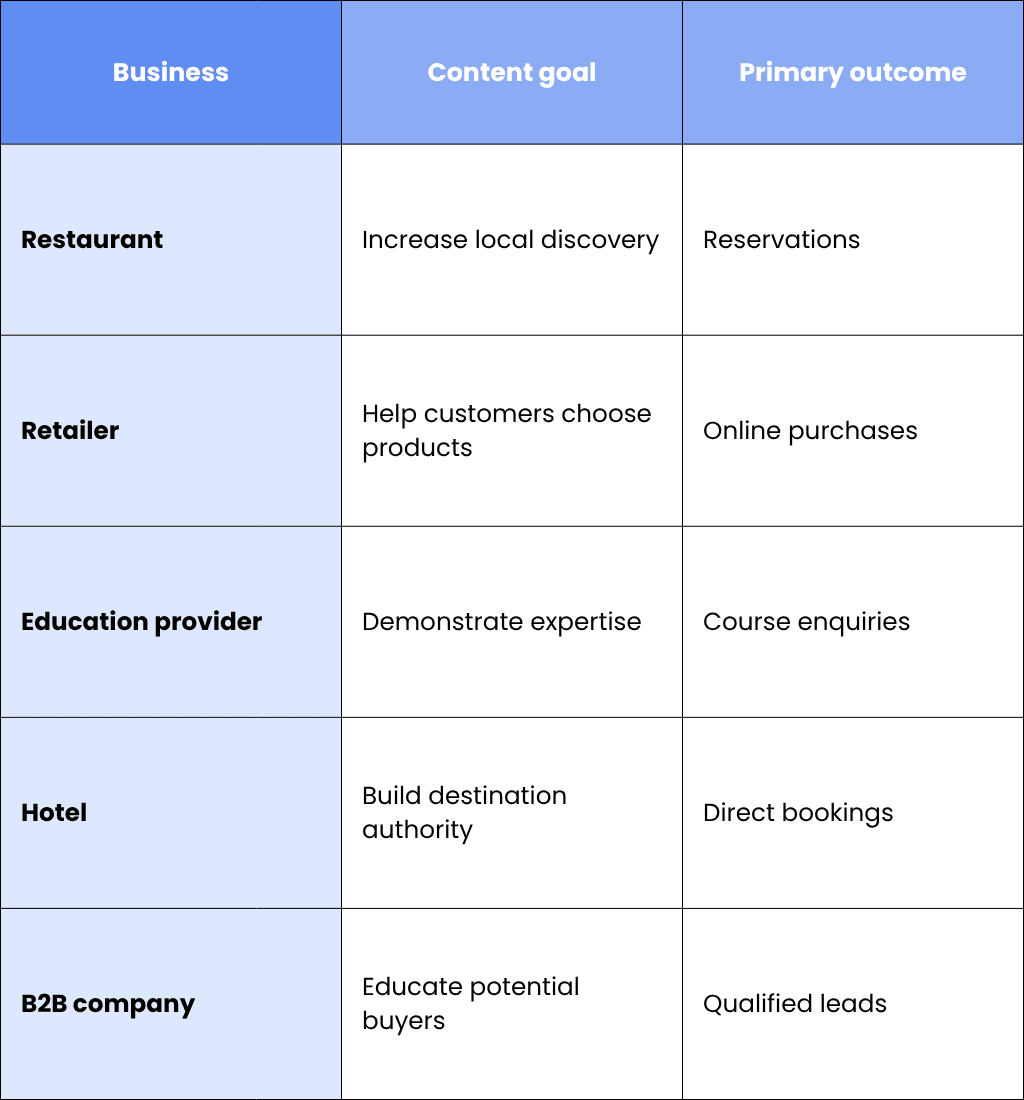
Once the goal is clear, the team can identify the metrics that matter.
For instance, if the objective is to generate qualified leads, organic traffic is useful, but it should not be the final measure of success.
A simple measurement hierarchy can help:
Visibility → Engagement → Trust → Conversion → Revenue
This does not mean every user moves through the journey in a straight line. Instead, it provides a useful way to understand how content contributes to business performance.
2. Measure SEO Performance: Can People Find Your Content?
The first layer of measurement is search visibility.
After investing time in creating accurate, useful and authoritative content, you need to know whether your target audience can actually discover it.
Useful SEO metrics include:
- Organic traffic
- Search impressions
- Keyword rankings
- Search visibility
- Click-through rate
- Non-branded organic traffic
- Organic conversions
These metrics provide different pieces of information.
Organic traffic
Organic traffic shows how many visitors arrive through unpaid search results.
However, traffic volume should always be considered alongside relevance.
Imagine two pages:
Page A: 10,000 monthly organic visitorsPage B: 1,000 monthly organic visitors
At first glance, Page A appears to be performing better.
However, suppose Page A attracts users looking for general information, while Page B attracts people actively considering a purchase.
If Page A generates 10 enquiries and Page B generates 100, the smaller page is creating more meaningful business value.
This is why businesses should avoid treating traffic as a standalone success metric.
Search impressions
Impressions indicate how often your content appears in search results.
If impressions are increasing, it may suggest that Google is showing your content for a wider range of relevant searches.
However, high impressions with a low click-through rate may indicate that the page is not compelling enough in the search results.
This can lead to questions such as:
- Does the title accurately match search intent?
- Is the content targeting the right audience?
- Does the title communicate a clear benefit?
- Is the page appearing for queries that are relevant to the business?
These insights can then inform future optimisation.
Keyword rankings
Rankings remain useful, but they should not be viewed in isolation.
A page ranking highly for an irrelevant keyword may generate little value. Conversely, a page ranking in a lower position for a highly commercial search term may still produce valuable leads.
Therefore, focus on relevant rankings, not simply the highest possible ranking.
A useful way to think about this is: Visibility matters most when it puts your brand in front of the right audience at the right stage of their journey.
3. Measure Content Quality Through User Behaviour
SEO metrics tell you whether people can find your content.
The next question is whether they find it useful once they arrive.
This is where user behaviour becomes important.
Depending on the website and analytics setup, businesses can review:
- Engagement
- Scroll depth
- Time spent on key pages
- Returning visitors
- Internal link clicks
- Content-assisted conversions
- Interaction with calls to action
However, these metrics should be interpreted carefully.
Similarly, a low time-on-page figure is not automatically a sign of poor content. A user may find the answer they need immediately and leave satisfied.
This is why context matters more than any single metric.
Look for patterns
Suppose a retailer publishes a 2,500-word buying guide.
After three months, the data shows:
- Strong organic traffic
- High scroll depth
- Frequent clicks on product links
- Above-average conversion rate
These signals together suggest that the content is successfully helping users move from information to action.
By contrast, if the page receives significant traffic but users rarely scroll beyond the introduction, the content team should investigate.
Possible explanations include:
- The introduction does not match search intent
- The answer is difficult to find
- The article is too generic
- The structure is unclear
- The content is too long for the user's needs
- The page has technical or usability issues
The data does not automatically tell you the answer.
It tells you where to investigate.
4. Measure Trust Through Behaviour and Feedback
Trust is more difficult to measure than traffic or rankings because it is partly a perception.
Nevertheless, businesses can look for indirect signals that indicate whether audiences are becoming more confident in the brand.
These may include:
- Repeat visitors
- Branded searches
- Direct traffic
- Customer enquiries
- Reviews
- Customer feedback
- Content-assisted conversions
- Returning customers
- Newsletter sign-ups
- Engagement with expert content
Consider a hotel that publishes a series of detailed destination guides.
A visitor may read one article, leave the website and return several weeks later through a branded search before booking.
The original article may not have generated the booking directly. However, it may have contributed to the visitor's decision to trust the brand.
This is why last-click attribution can sometimes undervalue informational content.
A more complete measurement approach considers the entire customer journey.
For example:
Organic article → Return visit → Brand search → Direct website visit → Booking
If the business only attributes the booking to the final direct visit, it may underestimate the role that the original content played in building trust.
5. Measure Authority Through External Recognition
Authority is not created entirely within your own website.
One of the strongest ways to understand whether your organisation is becoming recognised as a credible source is to examine how other relevant websites and organisations interact with your content.
Useful signals can include:
- Quality backlinks
- Industry mentions
- Digital PR coverage
- Expert citations
- Brand mentions
- Relevant partnerships
- References from trusted organisations
- Invitations for experts to contribute to external publications
For example, imagine an education provider publishes original research about student learning trends.
If other educational organisations, journalists or industry publications reference that research, the content is demonstrating value beyond the organisation's own website.
Similarly, a hotel that publishes genuinely useful destination research may attract references from travel publications or tourism organisations.
A retailer that produces original product research may earn coverage from relevant industry websites.
These signals can indicate that your organisation is contributing information that others consider valuable.
Not all links or mentions are equal
The goal should not be to collect the largest possible number of backlinks.
Instead, focus on relevance and quality.
For example:
100 irrelevant links from low-quality websites
may be less valuable than:
5 relevant references from respected industry publications.
This is another reason why original research, expert commentary and genuinely useful content can be powerful components of an E-E-A-T strategy.
When you publish something worth referencing, you give other organisations a reason to cite your work.
6. Measure Business Outcomes, Not Just SEO Metrics
Ultimately, most businesses invest in SEO and content because they want to grow.
Therefore, content measurement should eventually connect back to commercial outcomes.
Depending on the business, this might include:
- Leads
- Qualified leads
- Bookings
- Reservations
- Product purchases
- Course applications
- Enquiries
- Revenue
- Assisted conversions
For example, an education provider might find that an article receives only 1,000 monthly visitors but generates 30 course enquiries.
A broader article might receive 10,000 visitors but generate only 10 enquiries.
The first article has a conversion rate of:
30 ÷ 1,000 × 100 = 3%
The second has:
10 ÷ 10,000 × 100 = 0.1%
In this simplified example, the smaller article generates 30 times the conversion rate of the larger article.
That does not mean the high-traffic article has no value. It may contribute to brand awareness and introduce new audiences to the business.
However, the example demonstrates why businesses should evaluate content according to its intended role.
Different content has different jobs
A useful content strategy may include:
Awareness content: Designed to introduce new audiences to the brand.
Consideration content: Designed to educate users and build confidence.
Decision content: Designed to help users choose a product or service.
Conversion content: Designed to encourage a specific action.
Each type should be measured differently.
Trying to judge every page by the same KPI can create misleading conclusions.
7. Measure the Efficiency of Your AI Content Workflow
Because this article focuses on AI-assisted content, businesses should also measure whether AI is actually improving the production process.
The goal of AI should not simply be to increase the number of articles published.
Instead, measure whether it helps the team create better content more efficiently.
Useful operational metrics include:
- Average production time per article
- Time spent on research
- Time spent on drafting
- Time spent on editing
- Time spent on fact-checking
- Number of content updates completed
- Content production cost
- Number of expert hours required
- Percentage of content requiring significant rewrites
For example, suppose a team previously spent 10 hours producing an article.
After introducing AI into the workflow, the process takes:
- 2 hours for research
- 1 hour for AI-assisted outlining
- 2 hours for expert input
- 2 hours for editing
- 1 hour for fact-checking
- 1 hour for SEO
- 1 hour for final review
Total: 10 hours
In this example, AI has not reduced the total production time.
However, it may still have improved the process by allowing the team to spend less time on repetitive tasks and more time on expert input.
Now imagine that after refining the workflow, the same article takes 7 hours.
The time saving is: 10 hours − 7 hours = 3 hours
Percentage saving: 3 ÷ 10 × 100 = 30%
If the business produces 20 similar articles per month, that could represent: 3 hours × 20 articles = 60 hours saved per month
That is a meaningful productivity gain, provided content quality remains stable or improves.
This is why AI efficiency should be measured alongside quality.
A faster workflow is only successful if the output remains valuable.
8. Create a Balanced E-E-A-T Measurement Framework
Because E-E-A-T cannot be reduced to one metric, businesses should create a balanced dashboard that combines different types of evidence.
A practical framework might look like this:
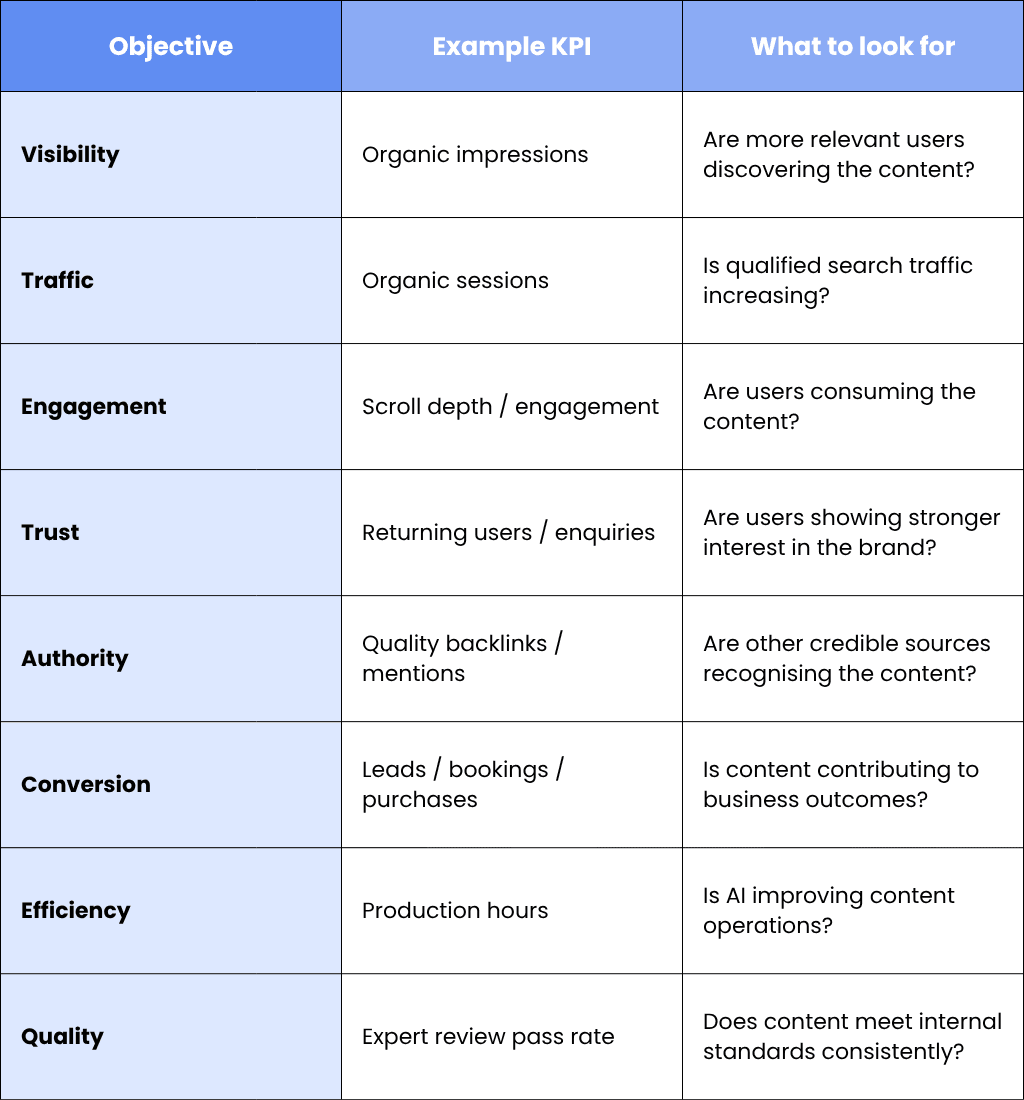
The important point is that these metrics should work together.
For example: Higher organic visibility + stronger engagement + more qualified leads
is a much more meaningful result than simply: Higher organic visibility.
Similarly: Reduced production time + stable or improved content quality
is more valuable than: Reduced production time + declining trust signals.
The ideal outcome is to improve efficiency without sacrificing quality.
9. Establish Baselines Before Introducing AI
One practical mistake businesses make is measuring performance only after implementing a new AI-assisted workflow.
Without a baseline, it becomes difficult to understand whether the process is actually improving results.
Before introducing AI, record relevant benchmarks such as:
- Average content production time
- Organic traffic
- Average rankings
- Conversion rates
- Engagement metrics
- Backlinks and mentions
- Content update frequency
- Number of published assets
Then compare performance over time.
For example:
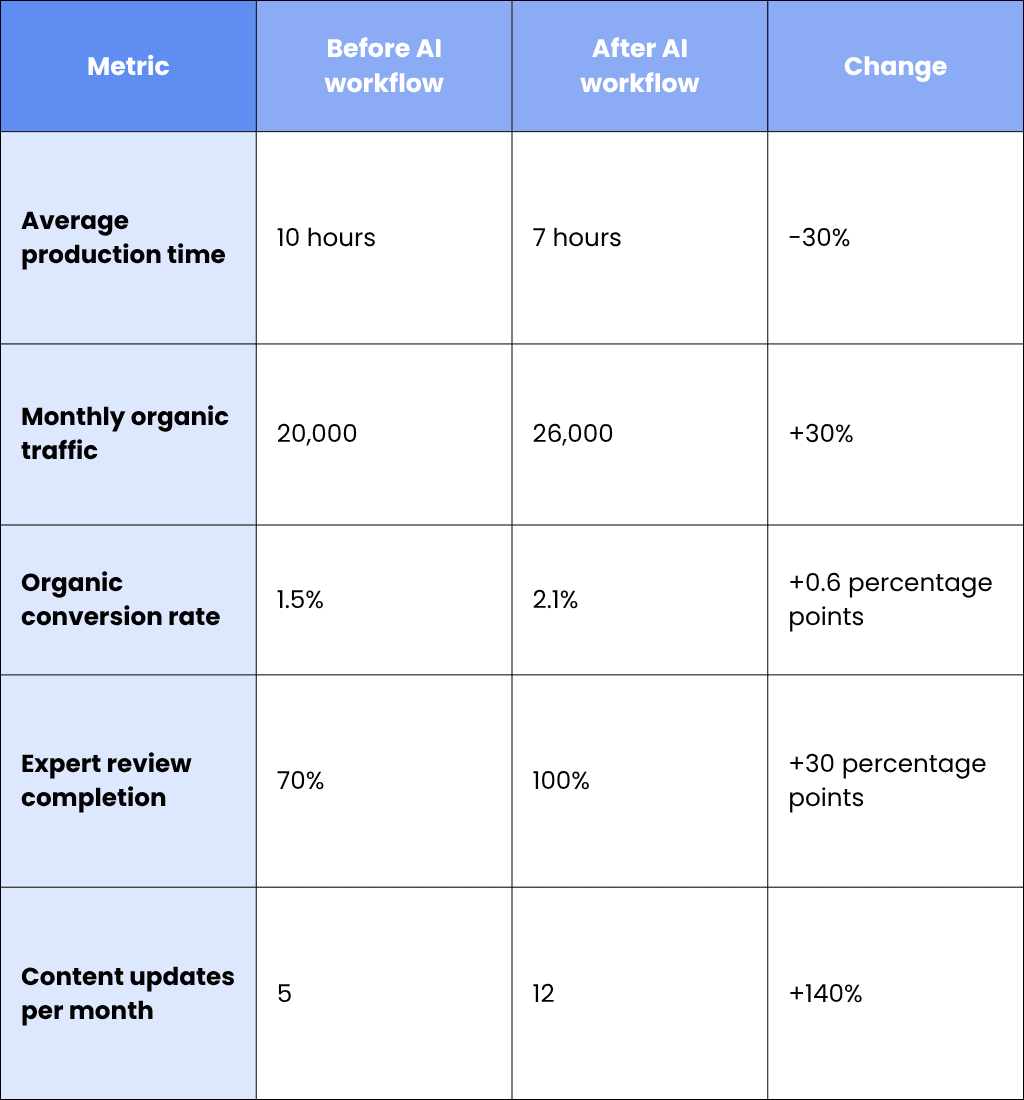
These numbers are illustrative, but the framework shows how businesses can evaluate the impact of their process.
It is also important to avoid attributing every change to AI.
SEO performance can be influenced by many factors, including:
- Search algorithm updates
- Seasonality
- Competition
- Website changes
- Technical SEO
- Digital PR
- Market trends
- Changes in consumer behaviour
Therefore, measurement should focus on trends and multiple sources of evidence rather than claiming that one change caused every result.
10. Use a Measurement Cycle Instead of a One-Time Report
Measuring E-E-A-T for AI content should not be a one-off activity carried out at the end of a campaign.
Instead, businesses should create a continuous cycle:
Publish → Measure → Analyse → Learn → Update → Republish → Measure again
For example, suppose a hotel publishes a guide to family-friendly attractions.
After six months, the team notices:
- Strong search impressions
- Moderate rankings
- High organic traffic
- Low engagement with the booking CTA
The team might conclude that the content successfully attracts users but does not move them towards booking.
The next step could be to:
- Improve internal links to relevant hotel pages.
- Add practical accommodation advice.
- Include a clearer booking pathway.
- Add first-hand recommendations from hotel staff.
- Review whether the content matches the needs of families planning a stay.
- Measure the results again.
This creates a feedback loop between content strategy and actual user behaviour.
The same principle applies to trust and authority.
If an article attracts backlinks but receives little organic traffic, the business may have created a valuable resource that needs stronger SEO optimisation.
If an article ranks well but receives no external references, the team may need to add more original research or distinctive insights.
Data does not replace human judgement.
Instead, it helps the team decide where human judgement is most needed.
A Practical E-E-A-T Measurement Scorecard
For businesses that want a simple way to review individual content assets, an internal scorecard can help.
For example, score each area from 1 to 5:
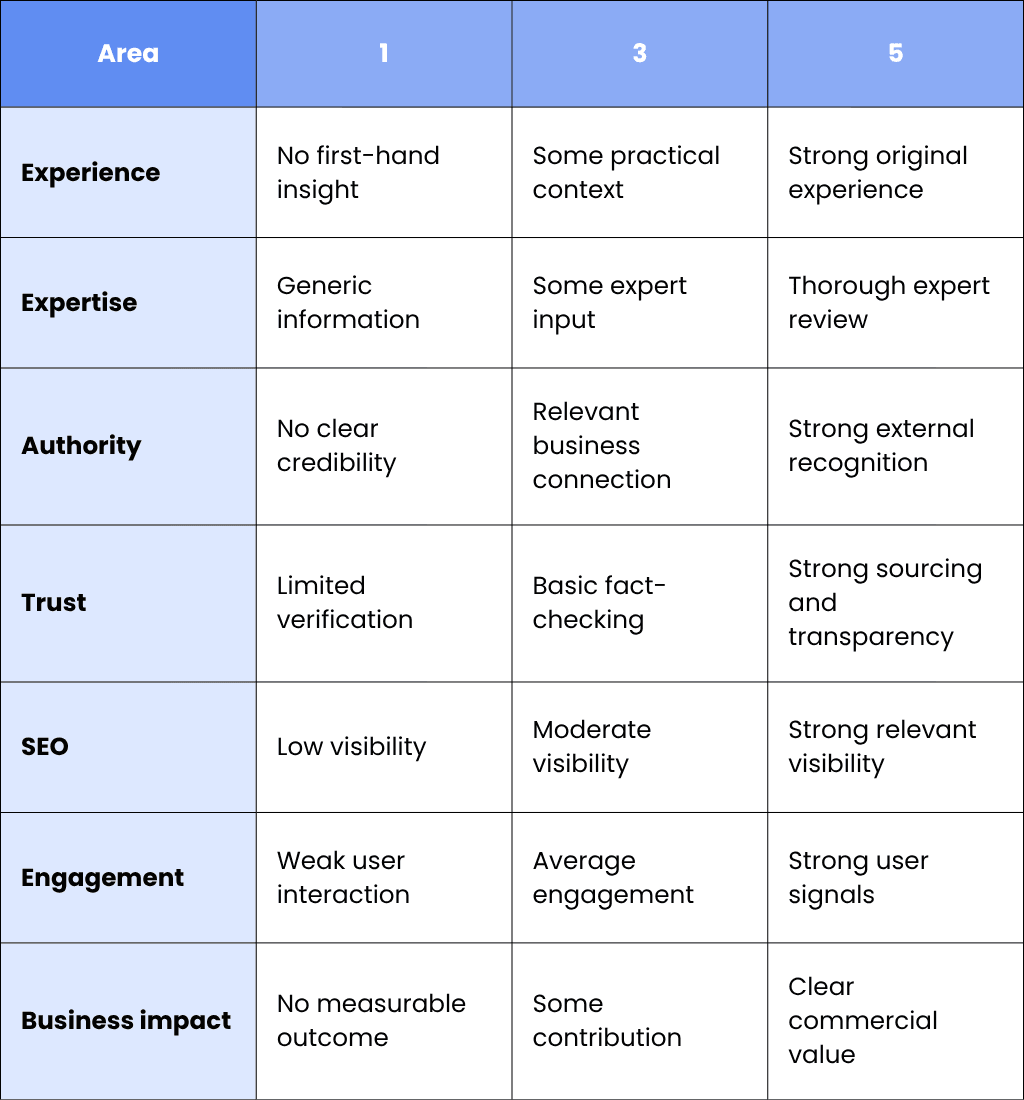
The maximum score would be:
7 categories × 5 points = 35 points
A business could then create internal benchmarks, for example:
- 28–35: Strong content asset
- 21–27: Good foundation with opportunities to improve
- 14–20: Requires optimisation
- Below 14: Consider substantial revision
These thresholds are not Google standards and should not be treated as an official E-E-A-T scoring system.
Instead, they provide an internal framework for encouraging consistent quality reviews.
The benefit is that they help teams move beyond subjective statements such as "this article feels good" and instead discuss specific areas for improvement.
E-E-A-T for AI Content: What Businesses Should Avoid
Measuring content performance helps businesses understand what is working. However, strong performance metrics alone do not guarantee that content is trustworthy or valuable.
A page can attract traffic while still containing inaccurate information. It can rank well while offering little original insight. It can also generate clicks without giving users a strong reason to trust the brand.
Therefore, as businesses scale AI-assisted content, they should be careful to avoid practices that may undermine E-E-A-T for AI content.
The following are some of the most common pitfalls to watch for.
1. Do Not Publish AI Content Without Human Review
AI-generated content can sound polished while still containing factual errors, outdated information or misleading statements.
For this reason, businesses should avoid treating AI output as publication-ready by default.
At a minimum, important content should go through human editorial review. For specialist topics, a subject matter expert should also verify the information.
Better approach: Use AI to accelerate research, drafting and editing, then let people take responsibility for accuracy and quality.
2. Do Not Invent First-Hand Experience
Experience is one of the most valuable ways to differentiate content from generic AI output. However, businesses should never manufacture it.
Do not ask AI to create fictional customer stories, pretend that someone personally tested a product or invent experiences that did not happen.
For example, a retailer should not claim that its team "tested five products in real-world conditions" unless it actually did so.
Better approach: Use genuine customer feedback, expert interviews, case studies and internal experience as the foundation for AI-assisted content.
3. Do Not Create Fake Experts or Citations
AI tools can sometimes generate incorrect references, citations or even names that appear credible but cannot be verified.
Publishing these claims can seriously damage trust.
Before including a quote, statistic, study or expert reference, verify that it exists and accurately represents the original source.
Better approach: Prioritise credible, verifiable sources and link to primary information where appropriate.
4. Do Not Let AI Erase Your Brand's Point of View
AI can produce fluent and professional writing, but it can also make different brands sound remarkably similar.
If every article follows the same generic structure and uses the same predictable language, your brand may lose its distinctiveness.
Your content should reflect your organisation's knowledge, perspective and experience.
Better approach: Use AI to support your brand voice, not replace it.
5. Do Not Skip the Fact-Checking Process
Fact-checking should not be an optional final step.
Information such as prices, opening hours, product specifications, policies, statistics and regulations can change over time. Even when AI provides accurate information, it may not reflect the latest update.
Better approach: Verify important claims against reliable and current sources before publication, and review time-sensitive content regularly.
6. Do Not Measure Success by Traffic Alone
High traffic can look impressive, but it does not necessarily mean that your content is successful.
A page with 10,000 visitors and no meaningful conversions may be less valuable to your business than a page with 1,000 highly relevant visitors that generates qualified leads.
Better approach: Measure visibility alongside engagement, trust, authority and business outcomes.
Think beyond: "How many people visited?"
Also ask: "Did the right people find us, trust us and take the next step?"
Build AI-Assisted Content That People and Search Engines Can Trust with Saigon Digital
AI can help businesses produce content faster, but authority still comes from people, expertise and evidence.
For companies in F&B, retail, education, hospitality and other competitive industries, the opportunity is to combine AI efficiency with the knowledge that already exists within the organisation.
At Saigon Digital, we help ambitious brands turn strategy, creativity, data and AI into measurable business growth. Our approach goes beyond rankings. We focus on building digital experiences and search strategies that help businesses become more visible, more useful and more trusted.
Our SEO Services cover site optimisation and technical performance, content and authority building, and local and global search strategy. We help businesses build the foundations needed to attract qualified organic traffic and turn visibility into measurable outcomes.
As search behaviour evolves, we also help brands prepare for AI-powered discovery through Generative Engine Optimisation (GEO). Our services include AI readability optimisation, GEO, Answer Engine Optimisation (AEO), Knowledge Graph and Schema setup, AI content audits and reformatting, and AI performance dashboards. The goal is to help your brand become more discoverable, quotable and trusted across platforms such as ChatGPT, Gemini, Perplexity and Google AI.
For organisations looking to scale their operations alongside their digital presence, our AI Workflow Automation Services help streamline processes through AI-driven intelligence, pre-built automation templates and custom AI agents.
Because the future of digital growth is not simply about producing more content.
Build Authority That AI Can’t Replace
AI can help your business create content faster, but lasting authority still comes from genuine expertise, first-hand experience, accuracy and trust.
At Saigon Digital, we help ambitious brands navigate the evolving search landscape with SEO, Generative Engine Optimisation and AI-powered solutions.
Ready to build a more trusted, visible and future-ready digital presence?
Get in touch with Saigon Digital and let’s turn your expertise into content that people and AI can trust!
Frequently Asked Questions About E-E-A-T for AI Content
1. Can AI-generated content still demonstrate E-E-A-T?
Yes. AI-assisted content can demonstrate strong E-E-A-T when businesses use AI responsibly and add genuine human expertise, first-hand experience, original insights and careful fact-checking. The key is not whether AI was used, but whether the final content is accurate, useful, trustworthy and demonstrates appropriate expertise.
2. How can businesses maintain authority when using AI to write content?
Businesses can maintain authority by using AI as a supporting tool rather than a replacement for human expertise. Subject matter experts should contribute real-world knowledge, review important information and add original insights. Businesses should also build authority through consistent high-quality content, credible sources and genuine industry recognition.
3. How should businesses review AI-assisted content before publishing?
AI-assisted content should go through human editorial review and, where appropriate, subject matter expert review. Teams should verify important facts, statistics, quotes, product information and time-sensitive details against reliable sources. The content should also be checked for originality, search intent, brand alignment and usefulness.
4. Does AI-generated content hurt SEO?
Using AI to assist with content creation does not automatically hurt SEO. The greater risk comes from publishing content that is inaccurate, generic, repetitive or created without providing meaningful value to users. Businesses should focus on producing helpful, original and trustworthy content that satisfies search intent, regardless of whether AI was involved in the workflow.
5. How can businesses measure the success of E-E-A-T for AI content?
There is no single metric that measures E-E-A-T. Businesses should assess a combination of signals, including organic visibility, relevant traffic, user engagement, quality backlinks, brand mentions, returning visitors and conversions. It is also useful to monitor content production efficiency and expert review processes to ensure AI is improving productivity without compromising quality or trust.