



The pace of change in artificial intelligence continues to accelerate, and every few months, a new release reshapes what businesses believe is possible. Anthropic's latest launch, Claude Fable 5, appears to be one of those defining moments.
At Saigon Digital, we spend a great deal of time evaluating emerging technologies through a practical lens: How will this impact search, content, customer experience, and business growth? More importantly, how can businesses leverage these advances responsibly and effectively?
After reviewing the early information available on Claude Fable 5, our first impression is clear: this is not simply another incremental upgrade. Claude Fable 5 represents a significant leap towards long-horizon AI systems capable of managing increasingly sophisticated workflows.
What is Claude Fable 5?
Claude Fable 5 is Anthropic's newest flagship AI model designed for complex reasoning, advanced knowledge work, software engineering, and autonomous task execution.
Unlike previous generations of AI models that excelled primarily at conversational tasks, Claude Fable 5 has been developed to handle multi-step projects while maintaining consistency across large amounts of information.
According to the current documentation, Claude Fable 5 offers:
- A 1 million token context window
- Up to 128,000 output tokens per request
- Advanced vision capabilities
- Enhanced analytical performance
- Long-horizon task management
- Adaptive reasoning functionality
Perhaps most notably, Claude Fable 5 belongs to Anthropic's newly introduced "Mythos" class of models.
For context, Anthropic's earlier model hierarchy consisted of Haiku, Sonnet, and Opus. The introduction of Mythos signals a new tier of capability that extends beyond traditional chatbot interactions into more autonomous forms of intelligence.
Our First Impression: Claude Fable 5 Feels Different
Every major AI release arrives with impressive benchmark scores and bold claims. However, what stands out about Claude Fable 5 is not merely its performance metrics.
It is the emphasis on sustained execution.
Historically, many AI tools have struggled with maintaining context over lengthy workflows. They could generate content or provide recommendations, but often required repeated prompting and human intervention.
Claude Fable 5 appears designed to address this limitation.
The model's substantial context window means it can theoretically analyse:
- Entire websites;
- Extensive technical documentation;
- Large content inventories;
- Multiple datasets simultaneously; and
- Long-running strategic projects.
From Saigon Digital's perspective, this capability could prove particularly valuable in SEO, technical audits, content planning, and AI-driven marketing automation.
Rather than functioning solely as an assistant, Claude Fable 5 begins to resemble a collaborative digital team member.
What Is New in Claude Fable 5?
While each new generation of AI models typically introduces incremental improvements, Claude Fable 5 appears to represent a more substantial step forward.
For businesses exploring the role of AI in marketing, operations, and digital transformation, understanding these advancements can provide valuable insight into where the technology is heading.
Below are some of the key innovations that distinguish Claude Fable 5 from previous models.
1. The Introduction of the Mythos-Class Architecture
Perhaps the most significant change is Anthropic's introduction of the Mythos category of models.
Previously, Anthropic's model family consisted of Haiku, Sonnet, and Opus, each designed to balance speed, capability, and cost differently. The emergence of Mythos suggests the beginning of a new tier altogether, one built to handle more demanding and complex tasks.
Although the full implications of this architectural shift will become clearer over time, early indications suggest that Mythos models are intended to move beyond simple question-and-answer interactions.
Instead, they may be designed to support activities that require sustained focus, broader contextual understanding, and more sophisticated decision-making.
For businesses, this evolution signals an important trend: AI is increasingly being developed not just as a productivity assistant, but as a tool capable of contributing to larger strategic initiatives.
2. Enhanced Support for Autonomous Workflows
Another noteworthy development is Claude Fable 5's apparent emphasis on managing longer, multi-step processes.
Traditional AI interactions often involve isolated prompts. Users ask a question, receive an answer, and then repeat the process for the next task. However, many real-world business challenges do not occur in neatly separated stages.
Developing a content strategy, conducting a technical SEO audit, or planning a digital campaign all involve multiple interconnected steps.
Claude Fable 5 appears to have been designed with these realities in mind.
Its capabilities may allow organisations to receive assistance throughout extended projects, including:
- Comprehensive research initiatives;
- Multi-stage content development;
- Technical website assessments;
- Campaign planning and refinement; and
- Workflow documentation and process improvement.
As a result, businesses may find that AI becomes increasingly useful as an ongoing collaborator rather than a standalone content generation tool.
That said, effective oversight remains essential. Human expertise continues to play a critical role in validating outputs, setting objectives, and ensuring alignment with broader business goals.
3. Improved Vision Capabilities
Claude Fable 5 also reportedly introduces stronger visual understanding capabilities, enabling the model to interpret and analyse images with greater accuracy.
While text-based functionality often receives the most attention, the ability to process visual information could unlock valuable applications across a range of industries.
For example, businesses may eventually use these capabilities to support:
- Website user experience evaluations;
- Competitor website analysis;
- Review and assessment of marketing assets;
- Extraction of insights from charts and visual reports; and
- Analysis of screenshots or interface designs.
For marketing teams in particular, this development reflects a broader shift towards multimodal AI systems that can understand information presented in different formats.
As digital experiences become increasingly visual, the ability to analyse both text and imagery may prove increasingly valuable.
4. Adaptive Reasoning and More Context-Aware Responses
Another feature attracting attention is Claude Fable 5's use of adaptive reasoning mechanisms.
In simple terms, this means the model appears capable of adjusting the depth and complexity of its analysis depending on the task it is asked to perform.
Straightforward requests may receive concise responses, whilst more challenging problems can trigger more extensive reasoning processes behind the scenes.
Importantly, users do not necessarily see this internal process. Instead, the intended outcome is greater reliability and more thoughtful outputs.
From a business perspective, this could lead to stronger support in areas such as:
- Strategic planning;
- Problem-solving;
- Data interpretation;
- Scenario analysis; and
- Decision support activities.
Of course, AI-generated recommendations should always be reviewed critically. Nevertheless, improvements in reasoning capability represent an important step towards creating systems that can engage more effectively with nuanced business challenges.
Why These Developments Matter
Taken individually, each of these enhancements is impressive. Collectively, however, they point towards a broader transformation in how AI may be used within organisations.
Claude Fable 5 appears to be moving beyond the role of a reactive chatbot and towards becoming a more capable partner in complex workflows.
For businesses, the implications extend beyond content generation alone. These advancements could influence how teams approach research, planning, optimisation, customer experiences, and operational efficiency.
At Saigon Digital, we believe the most successful organisations will be those that focus not simply on adopting new technologies, but on integrating them thoughtfully into strategies that prioritise long-term growth and measurable outcomes.
Claude Fable 5 may not replace human expertise, but it could significantly enhance the way that expertise is applied.
Pricing & Availability
As impressive as Claude Fable 5 appears to be, access to a model of this scale naturally comes at a cost. According to the information currently available, using Fable 5 can consume up to twice the usage credits required by Opus 4.8, reflecting the increased computational resources needed to support its advanced capabilities.
For Claude Chat Users
For the time being, Claude Fable 5 is available at no additional cost to users subscribed to Claude Pro, Max, and Enterprise plans. This provides businesses and professionals with an opportunity to explore the model's capabilities before deciding whether it fits into their long-term workflows.
However, this arrangement is only temporary. Anthropic has indicated that from 23 June 2026, Fable 5 will no longer be included within these standard subscription plans. Instead, users will need to purchase separate usage credits to continue accessing the model, unless Anthropic chooses to extend the current access period based on system capacity and demand.
For API Users
Developers and organisations looking to integrate Claude Fable 5 into their own applications can already access the model through Anthropic's API.
At the time of writing, pricing is set at:
- $10 per million input tokens, covering the information sent to the model; and
- $50 per million output tokens, which applies to the responses generated by the model.
For businesses considering more advanced use cases, such as AI-powered customer experiences, workflow automation, or large-scale content operations, understanding these usage costs will be an important part of evaluating the model's long-term viability and return on investment.
How Does Claude Fable 5 Compare to Other Models?
As with any major AI release, comparisons with existing models are inevitable. While independent testing will continue to evolve over time, the early information available suggests that Claude Fable 5 performs particularly well in several areas that matter to businesses and digital teams.
From technical implementation to strategic analysis, Claude Fable 5 appears designed to support more sophisticated workflows than many of its predecessors.
Coding and Technical Reasoning
One of the most notable areas of improvement is Claude Fable 5's performance in coding and technical problem-solving. According to the available benchmark data, the model achieved an 80% score on SW Bench Pro, a widely recognised evaluation that measures how effectively AI systems can tackle software engineering tasks.
While this figure may not mean much to non-technical readers, the practical implications are significant.
For businesses, stronger technical reasoning could eventually support activities such as:
- Website development and enhancement;
- Troubleshooting technical issues more efficiently;
- Reviewing and analysing codebases;
- Assisting with website migrations; and
- Building automation workflows that improve operational efficiency.
Furthermore, organisations investing in digital transformation may benefit from faster implementation cycles and improved collaboration between technical teams and AI-powered tools.
Although human expertise remains essential, Claude Fable 5 demonstrates how AI is becoming increasingly capable of supporting more specialised technical work.
Analytical Performance
Beyond technical execution, Claude Fable 5 also appears to excel in analytical tasks that require synthesising large volumes of information.
Modern businesses generate vast amounts of data. However, extracting meaningful insights from that information often proves challenging and time-consuming. This is where advanced AI models can provide substantial value.
Claude Fable 5's enhanced analytical capabilities could assist organisations in interpreting and connecting information from multiple sources, including:
- Google Search Console reports;
- Website analytics platforms;
- Customer relationship management (CRM) systems;
- Market research findings; and
- Customer reviews and feedback channels.
As a result, businesses may be better equipped to identify emerging trends, uncover opportunities, and make more informed strategic decisions.
From a marketing perspective, this could help teams move beyond simply collecting data towards actually understanding what that data means for future growth.
Long-Context Understanding
Perhaps the most distinctive feature of Claude Fable 5 is its ability to process and retain exceptionally large amounts of information at once.
With a reported 1 million token context window, the model can maintain awareness of significantly more material than many earlier AI systems. In practical terms, this means it may be capable of analysing extensive documents, multiple reports, or entire collections of content without losing sight of the broader picture.
For marketers and SEO professionals, this capability introduces some particularly compelling possibilities.
For example, Claude Fable 5 could potentially review and understand:
- Large website content libraries;
- Comprehensive SEO audits;
- Brand guidelines and messaging frameworks;
- Historical marketing campaigns; and
- Detailed competitor analyses.
Consequently, the model may deliver recommendations that are more consistent, contextually aware, and aligned with long-term business objectives.
From Saigon Digital's perspective, this represents one of the most exciting developments in AI. Rather than functioning purely as a prompt-response tool, Claude Fable 5 begins to resemble a strategic collaborator that can maintain continuity across complex projects.
Of course, effective implementation will still depend on human oversight and clear strategic direction. Nevertheless, the ability to work with broader contexts has the potential to significantly enhance productivity and decision-making across a range of business functions.
Claude Fable 5 vs Other AI Models: Comparison Table
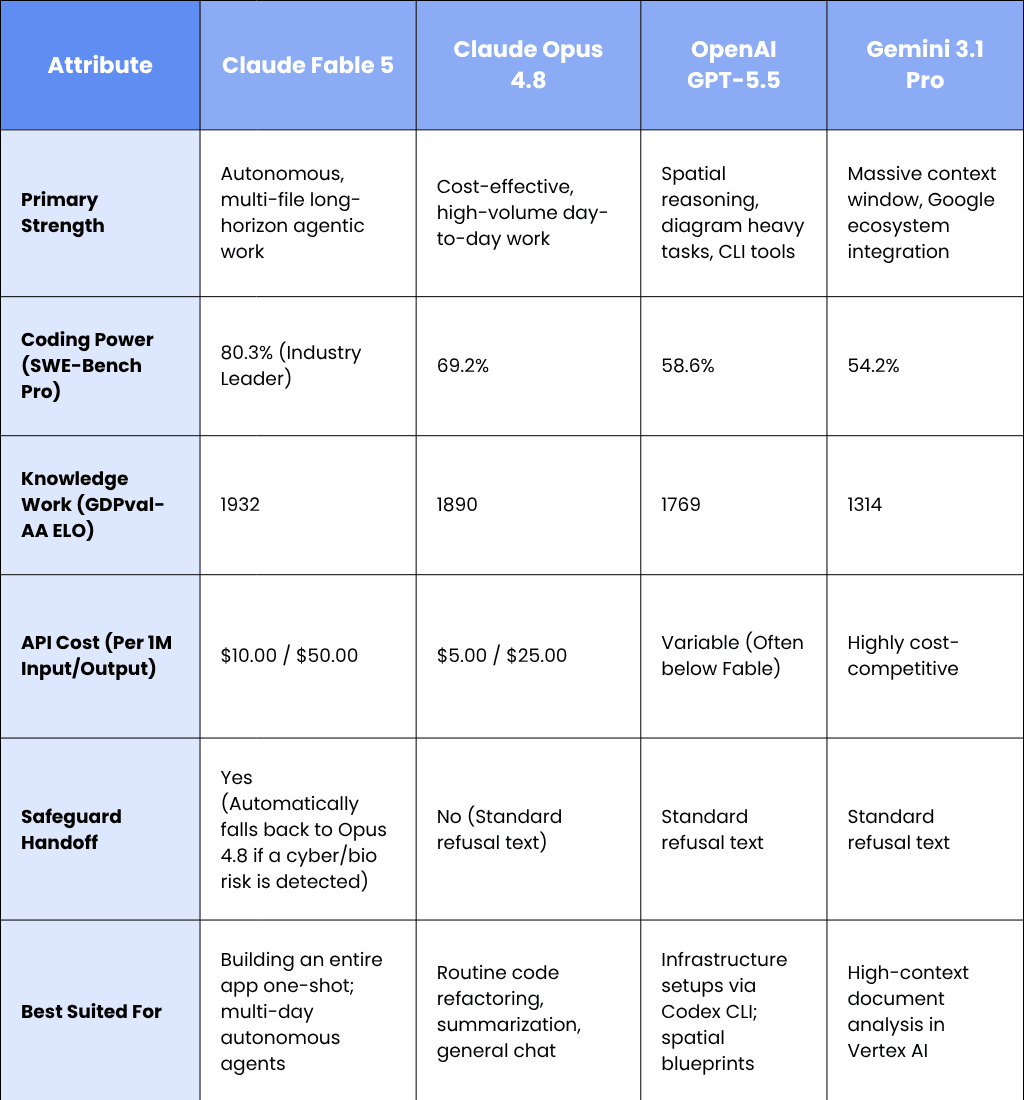
The Token Efficiency Factor: While Fable 5's $10/$50 pricing is exactly double that of Opus 4.8, it often uses significantly fewer reasoning tokens to solve complex problems. In frontier research testing, it has been shown to complete multi-day agent runs using up to one-third the reasoning tokens required by GPT-5.5, occasionally making it more cost-effective per solved task.
What Could Claude Fable 5 Mean for SEO?
The relationship between artificial intelligence and search is evolving rapidly. What was once viewed primarily as a tool for content generation is now becoming an influential force in how information is discovered, interpreted, and presented to users.
For businesses investing in digital growth, this shift raises an important question: how should SEO strategies adapt in an increasingly AI-driven landscape?
While Claude Fable 5 is not a search engine itself, its advanced reasoning capabilities, extensive context window, and ability to process complex information offer valuable insight into the direction that search technologies may be heading.
From Saigon Digital's perspective, several implications stand out.
Content Strategy May Become More Sophisticated
Creating large volumes of content has never been the ultimate objective of SEO. The real goal is to provide genuinely useful information that addresses user needs and supports business outcomes.
Claude Fable 5's ability to work with substantial amounts of information could help organisations approach content strategy more holistically.
Rather than producing isolated articles, businesses may be better positioned to develop interconnected content ecosystems that demonstrate expertise and topical authority.
For example, AI-assisted workflows could support activities such as:
- Identifying gaps within existing content libraries;
- Developing topic clusters around priority services or products;
- Maintaining consistency across multiple pieces of content;
- Mapping content to different stages of the customer journey; and
- Aligning editorial planning with evolving search behaviours.
However, quantity alone is unlikely to drive success.
As search engines continue to prioritise experience, expertise, authority, and trustworthiness, businesses will need to ensure that AI-supported content remains accurate, insightful, and reflective of genuine industry knowledge.
In other words, AI may improve efficiency, but human expertise remains the foundation of effective content marketing.
Technical SEO Could Become More Efficient
Technical SEO often involves reviewing large datasets, identifying patterns, and prioritising issues that affect website performance.
Traditionally, this process can be both time-consuming and resource-intensive.
Claude Fable 5's analytical capabilities suggest that future AI workflows may help teams streamline aspects of this work by processing information more efficiently and identifying opportunities that might otherwise be overlooked.
Potential applications could include:
- Highlighting crawl inefficiencies;
- Identifying internal linking opportunities;
- Detecting duplicate or thin content issues;
- Supporting site migration planning; and
- Reviewing website structures for optimisation opportunities.
For businesses operating large websites, particularly those within retail, hospitality, or multi-location environments, these efficiencies could prove valuable.
Nevertheless, technical recommendations still require validation from experienced SEO professionals who understand broader business priorities and implementation considerations.
AI can assist the diagnostic process, but strategic decision-making remains essential.
Generative Engine Optimisation (GEO) Is Becoming Increasingly Important
Perhaps one of the most significant developments for marketers is the rise of AI-powered discovery experiences.
Users are increasingly interacting with platforms such as ChatGPT, Gemini, Perplexity, and Google's AI-powered search features to obtain direct answers rather than clicking through multiple traditional search results.
As a result, businesses must begin considering not only how they rank within search engines, but also how they are represented within generative AI systems.
This is where Generative Engine Optimisation (GEO) becomes increasingly relevant.
GEO focuses on improving the likelihood that your brand's information is surfaced, cited, and trusted within AI-generated responses.
Achieving this often involves strengthening elements such as:
- Content clarity and readability;
- Structured data and schema implementation;
- Entity consistency across digital channels;
- Demonstrations of expertise and credibility;
- Comprehensive answers to common customer questions; and
- Strong supporting signals that reinforce brand authority.
For forward-thinking organisations, GEO should not be viewed as a replacement for traditional SEO.
Instead, it represents an important evolution of search optimisation in response to changing user behaviour.
User Experience Will Continue to Influence Visibility
As AI systems become more sophisticated, they are increasingly capable of recognising signals associated with content quality and user value.
This reinforces a principle that has long underpinned effective SEO: websites should be designed with people in mind.
Businesses that prioritise positive user experiences are more likely to create the kinds of digital environments that both users and intelligent systems value.
This includes investing in:
- Fast-loading websites;
- Clear navigation structures;
- Accessible content design;
- Mobile responsiveness;
- Helpful and informative content; and
- Seamless pathways towards conversion.
For sectors such as hospitality, education, retail, and F&B, user experience can directly influence both online visibility and commercial performance.
AI may change how information is discovered, but delivering exceptional digital experiences remains just as important as ever.
Preparing for the Future of Search
While it is still early days for technologies such as Claude Fable 5, one thing is becoming increasingly clear: the future of SEO will require adaptability.
Businesses that rely solely on tactics designed for yesterday's search landscape may struggle to maintain visibility as AI-driven experiences continue to evolve.
At Saigon Digital, we believe the most resilient strategies combine technical excellence, authoritative content, user-centric design, and an openness to innovation.
Claude Fable 5 offers an intriguing glimpse into what the next generation of AI tools may enable. However, sustainable success will depend not simply on adopting new technologies, but on understanding how to integrate them thoughtfully into broader marketing strategies.
For businesses willing to evolve alongside these changes, the opportunities are considerable.
Can Claude Fable 5 Replace SEO Professionals?
Our answer is straightforward: no.
Powerful AI systems do not eliminate the need for strategy. Instead, they raise the importance of human judgement.
Businesses still require specialists who understand:
- Search intent;
- Market positioning;
- Brand differentiation;
- Customer psychology;
- Regulatory considerations; and
- Commercial objectives.
Claude Fable 5 may automate aspects of execution, but determining what should be executed and why remains a fundamentally human responsibility.
The future of SEO is likely to involve closer collaboration between experts and intelligent systems.
User Experience: Is Claude Fable 5 Easy to Use?
Like many advanced technologies, the answer depends on the user.
For casual users seeking simple chatbot interactions, much of Claude Fable 5's potential may remain untapped.
However, organisations willing to integrate AI into their workflows could unlock substantial value.
Our early impression is that Claude Fable 5 rewards thoughtful implementation. The more context, structure, and strategic direction provided, the more useful its outputs become.
In other words, the technology may be powerful, but success still depends on the quality of the process surrounding it.
Practical Applications for Businesses
For many business leaders, the most important question is not whether Claude Fable 5 is impressive from a technological standpoint. Instead, it is whether these advancements can translate into tangible business value.
Whilst it is still early to determine the full extent of Claude Fable 5's impact, its ability to process large volumes of information, maintain context across extended workflows, and support complex analysis suggests that there may be meaningful opportunities across a range of industries.
Below are several examples of how businesses in key sectors could potentially benefit from these emerging capabilities.
Hospitality: Delivering Better Guest Experiences Through Smarter Insights
Hospitality businesses operate in an increasingly competitive environment where customer expectations continue to rise.
Hotels, resorts, and tourism providers must consistently deliver exceptional experiences whilst maintaining strong online visibility.
Claude Fable 5 could help support these efforts by assisting teams with tasks such as:
- Identifying opportunities for local SEO improvements;
- Analysing guest reviews to uncover recurring themes and service trends;
- Developing destination-focused content strategies that attract potential travellers;
- Reviewing website experiences from a customer perspective; and
- Supporting marketing teams with campaign planning and content ideation.
By helping organisations better understand both customer feedback and search behaviour, AI-powered tools may contribute to more informed decision-making and stronger digital experiences.
However, the warmth, empathy, and personalised service that define successful hospitality brands remain fundamentally human qualities.
Retail: Enhancing Visibility Across Complex Customer Journeys
Modern retail customers interact with brands across multiple touchpoints before making purchasing decisions.
As a result, retailers often face the challenge of managing extensive product catalogues whilst maintaining consistent messaging and discoverability.
Claude Fable 5's analytical and long-context capabilities may help retailers navigate this complexity more effectively.
Potential applications include:
- Supporting product category optimisation efforts;
- Identifying content gaps across ecommerce websites;
- Developing seasonal content aligned with customer interests;
- Reviewing internal linking structures across large websites; and
- Analysing customer feedback to identify opportunities for improvement.
These insights could help retailers create more seamless customer journeys whilst strengthening their visibility within both traditional and AI-powered search environments.
Ultimately, businesses that combine data-driven insights with strong brand experiences are likely to remain best positioned for sustainable growth.
Education: Creating Helpful and Accessible Learning Resources
Educational institutions face unique challenges when communicating with diverse audiences, including prospective students, parents, and existing learners.
Providing clear, trustworthy, and accessible information is therefore essential.
Claude Fable 5 could potentially support educational organisations by assisting with initiatives such as:
- Developing comprehensive resource hubs around frequently asked questions;
- Identifying information gaps within existing content ecosystems;
- Structuring educational materials for improved discoverability;
- Supporting the creation of student-focused content strategies; and
- Synthesising performance data to inform future communication efforts.
Importantly, educational content often requires a high degree of accuracy and sensitivity.
Whilst AI may improve efficiency, subject matter expertise and editorial oversight remain critical to maintaining credibility and trust.
F&B: Strengthening Local Presence and Customer Engagement
For restaurants, cafés, and food service brands, local visibility can have a direct impact on commercial success.
Consumers frequently rely on search engines and digital platforms to discover dining options, explore menus, and evaluate customer experiences before making decisions.
Claude Fable 5 could help support F&B businesses by enabling teams to:
- Develop location-specific content strategies;
- Identify opportunities to improve local search visibility;
- Analyse customer reviews to better understand audience preferences;
- Generate ideas for seasonal campaigns and promotions; and
- Support multi-location businesses in maintaining consistent digital experiences.
By combining operational insights with marketing intelligence, AI-powered workflows may help businesses respond more effectively to changing customer expectations.
That said, authentic brand personality and genuine customer experiences will continue to differentiate successful F&B businesses in an increasingly competitive market.
Looking Beyond Individual Use Cases
Although the examples above focus on specific industries, the broader lesson is applicable to organisations of all sizes.
Claude Fable 5 appears to be part of a wider shift towards AI systems capable of supporting more integrated and context-aware business processes.
Rather than treating AI as a standalone solution, businesses may derive greater value by identifying areas where technology can complement existing expertise and improve operational efficiency.
This could involve:
- Streamlining repetitive workflows;
- Supporting strategic planning with deeper analysis;
- Enhancing customer experiences through better insights;
- Improving content quality and discoverability; or
- Enabling teams to focus more time on higher-value activities.
At Saigon Digital, we believe the businesses that thrive in the years ahead will be those that approach AI with both curiosity and intention.
Adopting every new technology simply because it is available is unlikely to deliver lasting results. Instead, organisations should focus on implementing solutions that align with their objectives, strengthen their capabilities, and create meaningful value for their customers.
Claude Fable 5 may not provide all the answers. However, it offers a compelling glimpse into how AI could become an increasingly valuable partner in driving digital growth and innovation.
Our Perspective: Excitement with Caution
At Saigon Digital, we are optimistic about the opportunities Claude Fable 5 presents.
Its long-context capabilities and enhanced reasoning suggest meaningful progress towards more capable AI-assisted workflows.
Nevertheless, businesses should avoid viewing any single model as a silver bullet.
Technology evolves rapidly.
Search ecosystems evolve rapidly.
Customer expectations evolve rapidly.
Sustainable growth still depends upon:
- Clear strategy;
- High-quality experiences;
- Trustworthy information;
- Technical excellence; and
- Continuous adaptation.
Claude Fable 5 may accelerate these efforts, but it cannot replace them.
How Saigon Digital Helps Businesses Navigate the AI Era
As AI reshapes digital marketing, businesses need partners who understand both emerging technologies and the fundamentals of sustainable growth.
At Saigon Digital, we help ambitious brands transform strategy into measurable outcomes through integrated digital solutions.
SEO Services
We make search engines perform for your business by focusing on outcomes that matter.
Our services include:
- Site optimisation and technical performance;
- Content and authority building;
- Local and global search strategies.
Generative Engine Optimisation (GEO)
As AI-driven discovery becomes increasingly important, we help brands become trusted sources for intelligent systems.
Our GEO services include:
- AI readability optimisation;
- Generative Engine Optimisation;
- Answer Engine Optimisation (AEO);
- Knowledge graph and schema implementation;
- AI content audits and reformatting;
- AI performance dashboards.
AI Workflow Automation
We also help organisations streamline operations through practical AI implementation.
This includes:
- AI-driven intelligence solutions;
- Pre-built automation templates;
- Custom AI agents tailored to business needs.
Final Thoughts on Claude Fable 5
Our first impression of Claude Fable 5 is that it represents a significant milestone in the evolution of artificial intelligence.
Its ability to manage extensive context, support complex workflows, and assist with advanced analytical tasks could redefine how organisations approach digital operations.
The future of digital growth is already here. The question is whether businesses are prepared to embrace it.
Get in touch with Saigon Digital today and get a personalised AI search strategy to boost your business!
Frequently Asked Questions About Claude Fable 5
1. What is Claude Fable 5?
Claude Fable 5 is Anthropic's latest flagship AI model and the first to belong to its new Mythos class of systems. It has been designed to handle more complex reasoning, longer workflows, and larger volumes of information than previous Claude models. With a reported context window of up to 1 million tokens, Claude Fable 5 aims to support advanced use cases ranging from software engineering and research to strategic business analysis.
2. How is Claude Fable 5 different from previous Claude models?
One of the key differences is Claude Fable 5's ability to maintain context across significantly larger and more complex tasks. Compared with earlier models, it introduces enhanced reasoning capabilities, improved vision functionality, and stronger support for long-horizon workflows. Rather than focusing solely on individual prompts, Claude Fable 5 appears designed to assist with projects that require sustained analysis and continuity over time.
3. Can Claude Fable 5 be used for SEO and content marketing?
Claude Fable 5 has the potential to support various aspects of SEO and content marketing, including content planning, topic research, technical analysis, and workflow automation. However, it should be viewed as a tool that enhances human expertise rather than replacing it. Effective SEO still depends on strategic thinking, audience understanding, and the ability to create genuinely valuable content that reflects a brand's unique experience and insights.
4. What does Claude Fable 5 mean for the future of search?
Although Claude Fable 5 is not a search engine, its capabilities reflect broader trends shaping the future of online discovery. As AI-powered experiences become more prevalent, businesses may need to optimise not only for traditional search engines but also for generative platforms that provide direct answers to users. This growing shift highlights the importance of strategies such as Generative Engine Optimisation (GEO), Answer Engine Optimisation (AEO), and creating authoritative, well-structured content.
5. Should businesses start using Claude Fable 5 now?
Businesses interested in exploring AI-powered workflows may find value in experimenting with Claude Fable 5, particularly while access is more widely available. However, adoption should be guided by clear business objectives rather than the desire to follow the latest trend. Organisations that identify specific opportunities to improve efficiency, strengthen decision-making, or enhance customer experiences are more likely to realise meaningful benefits from emerging AI technologies.
At Saigon Digital, we encourage businesses to approach AI strategically, integrating new tools where they support long-term growth, while continuing to prioritise user experience, trust, and measurable outcomes.