



For many businesses, SEO starts with a simple question: What should we rank for?
The obvious answer is often a list of high-volume keywords related to the products or services the business offers. However, this approach can lead to a common problem: a website attracts plenty of visitors but very few enquiries, demos, bookings or sales.
This is where B2B keyword research becomes more important.
This guide explains how to approach B2B keyword research from a commercial perspective, how to identify high-value opportunities, how to map keywords to content and landing pages, and how to turn keyword data into an SEO strategy that supports measurable business growth.
Key Takeaways
- Focus on business value, not just search volume. The best B2B keywords attract relevant prospects with genuine commercial potential.
- Start with your customers. Build your seed list around products, services, customer problems, desired outcomes, industries and locations.
- Understand search intent. Identify whether users want to learn, compare, evaluate, buy or find a specific brand.
- Match keywords to the right pages. Use service pages for transactional searches, guides for informational queries, and comparison or industry pages where appropriate.
- Prioritise and group keywords. Create topic clusters and focus your resources on opportunities with strong relevance, intent and realistic ranking potential.
- Connect SEO to conversions. Give visitors a clear next step and measure leads, qualified opportunities and revenue alongside rankings and traffic.
- Keep improving your strategy. Use search data, competitor insights and changing customer behaviour to refine your B2B keyword research over time.
What Is B2B Keyword Research?
B2B keyword research is the process of identifying and evaluating the search terms that business customers use when researching problems, comparing solutions, evaluating suppliers and looking for products or services.
The important distinction is the B2B buyer.
A B2B searcher may not immediately search for the name of the service they eventually purchase. Instead, they may start with a problem.
For example, someone responsible for marketing at a growing company might search for:
- How to improve organic traffic
- Why is my website traffic declining?
- Enterprise SEO strategy
- SEO agency for SaaS
- Technical SEO audit
- SEO agency in Vietnam
- SEO services for B2B companies
These searches represent different levels of awareness and commercial intent.
Someone searching for "why is my website traffic declining?" may still be investigating a problem. Someone searching for "SEO agency for SaaS" is much closer to evaluating potential providers.
Both keywords can be valuable, but they should not be treated in the same way.
Google itself recommends thinking about the terms users might search for while also recognising that its systems can understand how pages relate to different queries and variations. In other words, businesses should build useful content around topics and user needs rather than forcing exact-match keywords into every paragraph.
That principle is particularly important for B2B SEO, where buying journeys can be complex and involve multiple searches.
Why B2B Keyword Research Is Different
B2B search behaviour tends to be more complicated than a straightforward consumer purchase.
A consumer might search for "best running shoes", compare a few options and make a purchase shortly afterwards.
A B2B buyer may spend weeks or months researching a problem, creating an internal business case, comparing suppliers, speaking with stakeholders, reviewing pricing and seeking approval before making a decision.
This creates a wider range of useful keyword opportunities.
Consider a company looking for workflow automation software. Its journey could look something like this:
Problem: "How to reduce repetitive admin tasks"
Research: "AI workflow automation"
Solution: "Business process automation software"
Evaluation: "Best AI automation platform for businesses"
Commercial investigation: "AI automation agency"
Decision: "AI workflow automation services"
The searches are connected, but the searcher has a different level of commercial intent at each stage.
A strong B2B keyword strategy accounts for the entire journey.
It does not simply target the final transactional keyword.
Start With Business Goals, Not Keyword Tools
Before opening a keyword research platform, start with the business.
This step is easy to overlook, but it can make the difference between a useful keyword strategy and a spreadsheet full of irrelevant search terms.
Ask:
- What does the business actually sell?
- Which products or services generate the most revenue?
- Which services have the strongest margins?
- Which customers are the best fit?
- Which industries does the business want to grow?
- Which locations or markets matter?
- What problems cause potential customers to look for a solution?
- What objections prevent people from becoming customers?
- What makes the business different from competitors?
For example, a generic keyword such as "SEO" may have significant search demand, but it tells you very little about whether the searcher is a suitable customer.
Compare that with:
- B2B SEO agency
- SaaS SEO agency
- enterprise SEO services
- international SEO agency
- technical SEO services
- SEO agency for technology companies
These searches provide more context.
The narrower keyword may have fewer searches, but the people behind those searches can be much more valuable.
This is the first principle of B2B keyword research: Search volume tells you how many people may be searching. Business relevance tells you whether those people matter.
Build Your B2B Keyword Seed List
Once you understand your business goals, customers and commercial priorities, the next step is to build a B2B keyword seed list. A seed list is your starting collection of topics, phrases and search ideas. You do not need hundreds of keywords at this stage. Instead, focus on creating a small but relevant set of terms that you can later expand using keyword research tools, competitor analysis and search data.
A practical approach is to build your seed list around five areas: products and services, problems, outcomes, audience and industry, and location. Together, these categories give you a much stronger starting point than simply listing the names of your products.
1. Products And Services
Start by listing the products or services your business wants to promote through organic search. Use the language your customers are likely to use, rather than relying only on internal terminology.
For example, an SEO agency might start with:
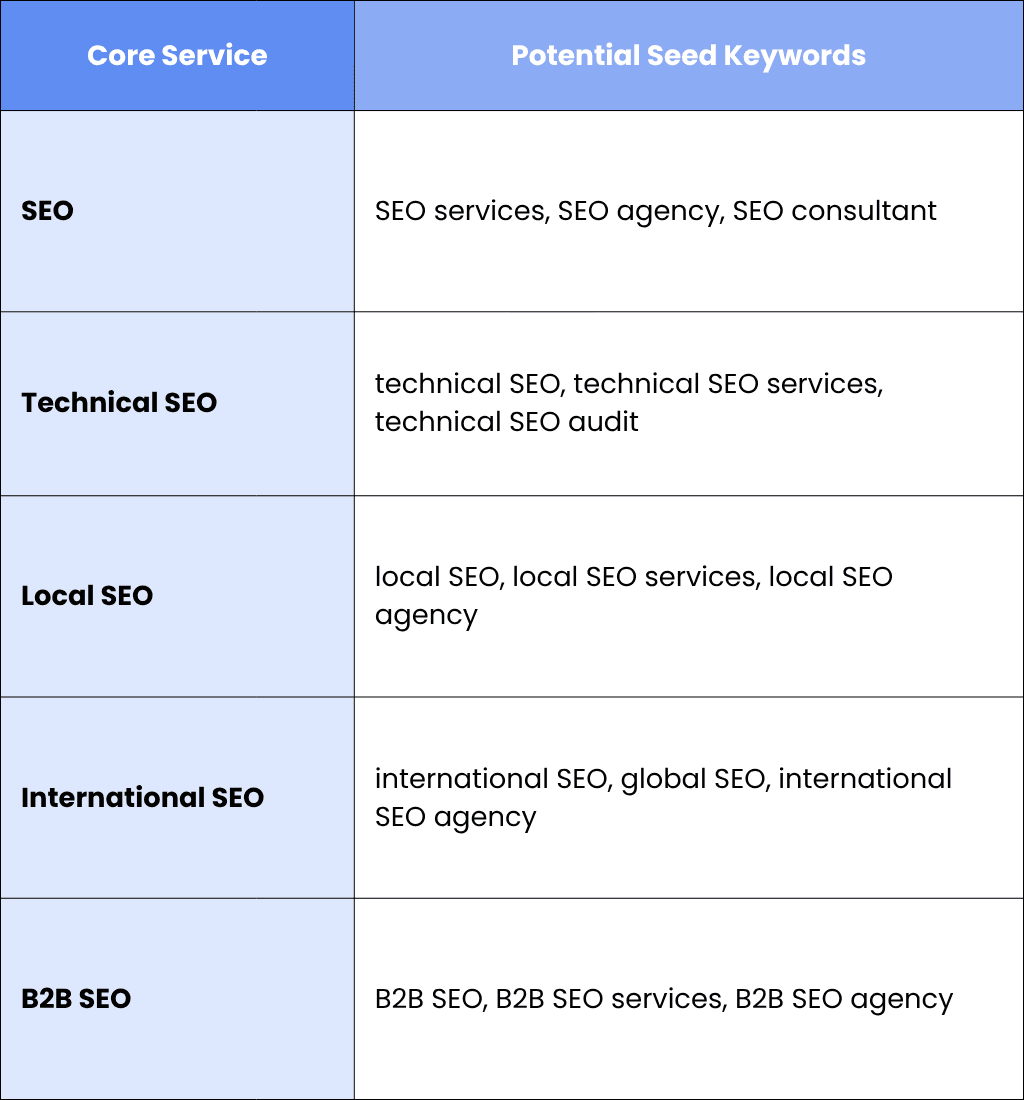
At this stage, do not worry about search volume or keyword difficulty. Your objective is simply to capture the different ways potential customers might describe what you offer.
Tip: Speak to your sales and customer service teams when building this list. They can often provide the exact phrases customers use during enquiries, which can be more valuable than assumptions made by the marketing team.
2. Problems
Next, move beyond what you sell and identify the problems your customers are trying to solve. This step is particularly important for B2B keyword research because buyers often search for a problem before they know which product, service or provider they need.
For example, a company may not initially search for "SEO agency". Instead, it might search for:
- Why has my organic traffic dropped?
- How to generate more B2B leads
- Why is my website not ranking?
- How to improve website conversion rates
- How to fix technical SEO issues
You can turn these problems into a simple keyword formula:
Problem + solution
For example:
"low organic traffic" → "how to increase organic traffic"
"manual reporting" → "automated reporting software"
"low B2B lead volume" → "how to generate more B2B leads"
This approach helps you discover potential customers before they reach the supplier-comparison stage.
3. Outcomes
After identifying customer problems, consider the results they actually want. Buyers rarely purchase a service simply because they want the service itself; they purchase it because they want a better business outcome.
For example, a company may not really want "SEO". It may want more qualified leads from Google.
Therefore, build keyword ideas around desired outcomes such as:
- Increase organic leads
- Generate more B2B enquiries
- Improve website conversions
- Increase online bookings
- Reduce manual work
- Improve customer acquisition
- Increase qualified website traffic
You can combine an outcome with a service, audience or industry to create more specific opportunities:
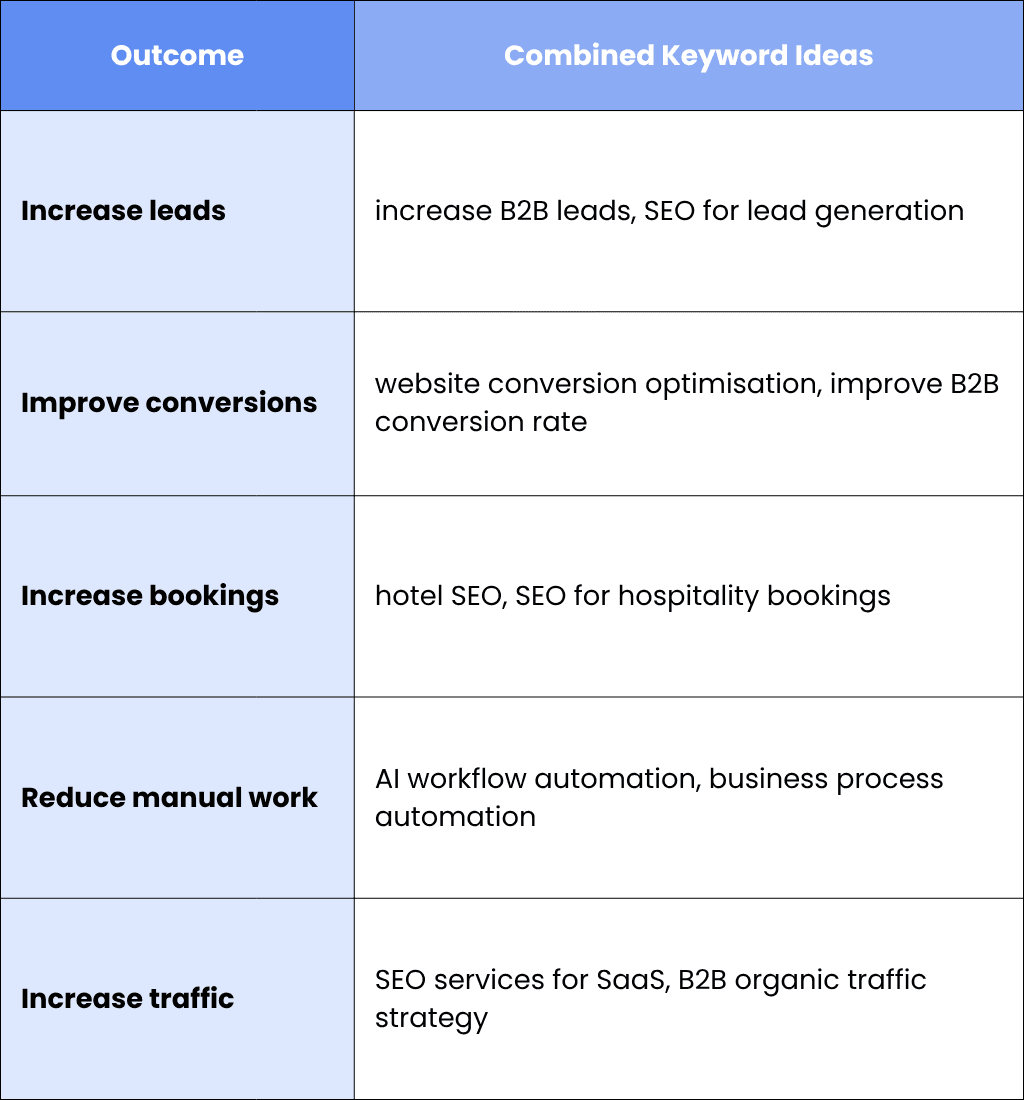
These keywords can be particularly useful for educational content because they align closely with the business goals your potential customers care about.
4. Audience And Industry
Once you know the problems and outcomes, add who you want to serve. Combining your service or solution with a specific industry can reveal highly relevant long-tail keywords that broader research may overlook.
For example:
- SEO for SaaS companies
- B2B SEO agency
- SEO for hospitality
- SEO for education
- SEO for retail
- AI automation for businesses
- SEO for restaurants
This can be especially valuable when your company has genuine experience in a particular sector. A keyword such as "SEO" may attract a broad audience, whereas "SEO for SaaS companies" provides much stronger context about the searcher's needs.
You can use a simple keyword-building formula:
[Service] + [Audience/Industry]
For example:
SEO + SaaS → SaaS SEO
SEO + hospitality → hospitality SEO
SEO + education → education SEO
AI automation + businesses → AI automation for businesses
Then expand each combination with commercial modifiers such as agency, services, consultant, company, provider, platform or solution.
For example:
SaaS SEO → SaaS SEO agency → SaaS SEO services
This gives you a structured way to expand your seed list without generating random keywords.
5. Location
Finally, add location if your business operates in specific cities, countries or markets. Location-based keywords can help you identify opportunities where search intent is closely connected to a specific service area.
For example:
- SEO agency Vietnam
- SEO agency Ho Chi Minh City
- SEO agency Singapore
- B2B SEO agency Vietnam
- SEO services for businesses in Singapore
A simple formula is:
[Service] + [Location]
For example:
SEO agency + Vietnam → SEO agency Vietnam
SEO services + Singapore → SEO services Singapore
B2B SEO + Ho Chi Minh City → B2B SEO Ho Chi Minh City
However, avoid creating location pages simply by changing the city name. Each page should provide genuine value for that market, such as local insights, relevant examples, market-specific challenges or evidence of experience.
How To Combine The Five Categories
Once you have populated all five categories, combine them to create a more complete seed list. For example, an SEO agency targeting SaaS businesses in Vietnam could build its initial list like this:
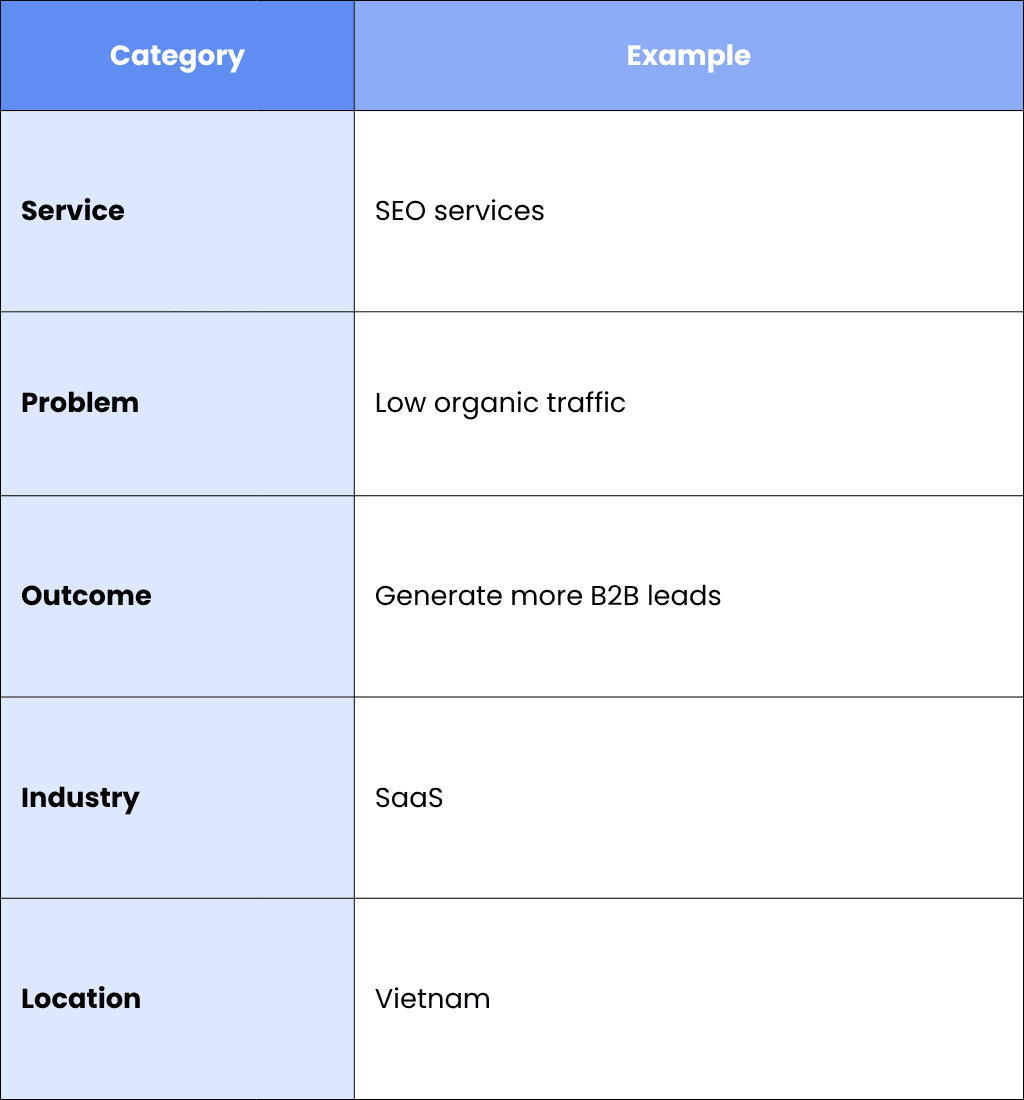
You can then combine these ideas:
- SaaS SEO services
- SaaS SEO agency
- SEO for SaaS companies
- B2B SEO for SaaS
- SaaS SEO Vietnam
- How to increase organic traffic for SaaS
- How to generate B2B leads through SEO
If you start with just 5 services × 5 problems × 5 industries × 3 locations, you already have the potential for 375 combinations before adding modifiers such as "agency", "services", "consultant" or "best".
However, do not automatically target all 375 combinations. The purpose of this exercise is to generate possibilities, which you can later filter according to search demand, intent, competition, business relevance and conversion potential.
The result should be a focused seed list that reflects how your customers think, search and buy. From here, you can expand these initial terms into a much larger keyword universe and then prioritise the opportunities most likely to generate business.
Understand Search Intent Before Choosing A Keyword
Once you have built your B2B keyword seed list, the next step is to understand why someone searches for each term. This is known as search intent: the underlying reason behind a search and the type of information, solution or action the user expects to find.
This matters because two keywords can look similar but represent completely different stages of the buying journey. For example, someone searching for "what is technical SEO?" is still learning, while someone searching for "technical SEO services" is likely comparing potential providers.
Therefore, do not choose keywords based on wording or search volume alone. Instead, identify the intent behind them and make sure your planned page matches what the searcher actually wants.
1. Informational Intent
Informational searches happen when someone wants to learn, understand or solve a problem. These searches are usually further away from an immediate purchase, but they can introduce your brand to potential customers early in their research.
Common examples include:
- What is technical SEO?
- How does B2B SEO work?
- How to improve organic traffic
- What is generative engine optimisation?
- How long does SEO take?
These keywords are often suitable for:
- Blog posts
- Guides
- Tutorials
- Educational resources
- FAQs
- Glossaries
For example, if a SaaS company provides workflow automation software, it could target "how to automate repetitive business tasks" with an educational guide. The article could then naturally introduce workflow automation as a potential solution.
Key point: Do not force a sales message into every informational page. Instead, answer the question thoroughly first, then provide a relevant next step for readers who want to learn more.
2. Commercial Investigation Intent
Commercial investigation searches indicate that the user is researching possible solutions, products or providers. They may not be ready to buy immediately, but they are getting closer to a commercial decision.
Examples include:
- Best SEO agency
- SEO agency vs freelancer
- Best CRM for small businesses
- AI workflow automation platforms
- Enterprise SEO services
- Best software for customer support
These keywords are particularly valuable for B2B businesses because the searcher is often evaluating alternatives.
Suitable content formats include:
- Comparison pages
- Service guides
- Product comparisons
- "Best" lists
- Case studies
- Buyer guides
- Detailed service pages
For example, someone searching for "SEO agency vs freelancer" may be deciding how to build their SEO function. A useful article could explain the differences in expertise, scalability, cost, accountability and resources before showing when each option makes sense.
Tip: Commercial investigation content should be balanced and evidence-based. If you are comparing your own service with alternatives, explain the differences honestly rather than turning the page into a sales pitch.
3. Transactional Intent
Transactional searches show a stronger intention to take action. The user may be looking for a provider, requesting a service, comparing prices or preparing to make a purchase.
Examples include:
- B2B SEO agency
- Technical SEO services
- SEO consultant
- AI workflow automation services
- SEO agency Vietnam
- Technical SEO audit service
These keywords should usually lead to pages that make the next step obvious.
Suitable page types include:
- Service pages
- Product pages
- Landing pages
- Pricing pages
- Consultation pages
- Booking or enquiry pages
For example, a company searching for "B2B SEO agency" is unlikely to want a basic explanation of what SEO means. It may want to know:
- What services you provide
- Whether you understand its industry
- What results you can deliver
- How your process works
- Why it should trust you
- How to contact you
Therefore, a transactional page should answer these questions clearly and make it easy to enquire.
4. Navigational Intent
Navigational searches happen when someone is looking for a specific brand, website, product or destination.
Examples include:
- Saigon Digital
- Saigon Digital SEO services
- Google Search Console
- HubSpot
- HubSpot login
These searches generally have limited value for acquiring people who have never heard of your business because the user already knows what they are looking for.
However, navigational keywords still matter because they can indicate brand awareness and demand.
For example, if more people search for your company name over time, it may suggest that your brand visibility is increasing across other marketing channels.
How To Identify Search Intent
You can make search intent classification much easier by asking three questions:
1. What does the searcher want?
Are they trying to learn, compare, buy or find something specific?
2. What type of page would satisfy them?
Would they expect a guide, comparison, service page, product page or another format?
3. What are the current search results showing?
Search the keyword on Google and look at the pages that rank.
For example:
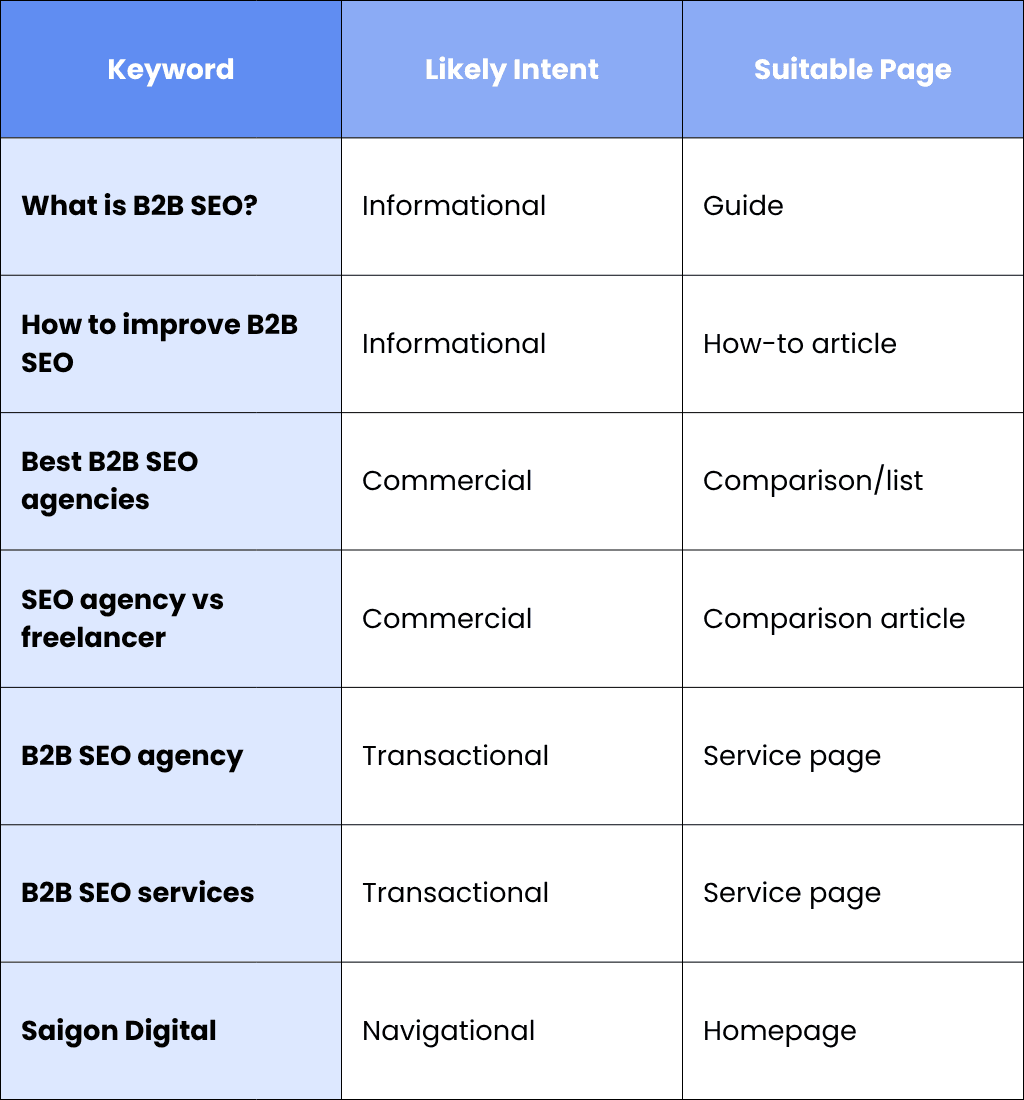
This simple exercise helps prevent a common SEO mistake: creating the wrong type of content for the keyword.
Use The SERPs To Confirm Your Assumptions
Keyword tools can suggest search intent, but the search engine results pages (SERPs) provide the strongest practical evidence.
Suppose you want to target "B2B SEO strategy". Before creating a page, search the term and review the top results.
If most results are detailed guides, Google is probably interpreting the query as informational. Therefore, creating a sales-focused service page may not be the best approach.
On the other hand, if "B2B SEO services" mainly returns agency service pages, the results suggest stronger commercial intent. A detailed service page is likely to be a better match.
When analysing the SERPs, look for:
- The type of pages ranking
- The format of the content
- The topics covered
- The depth of information
- Whether results are local or global
- Whether Google displays product, map, video or other search features
- The wording used in page titles and descriptions
You do not need to copy the top-ranking pages. Instead, use them to understand what Google currently considers relevant and then identify how your page can provide something more useful or more specific.
Remember That Intent Can Overlap
Search intent is not always perfectly divided into four categories.
A keyword such as "SEO pricing" could be informational because the searcher wants to understand costs, but it can also have commercial intent because they may be considering hiring an SEO provider.
Similarly, "best AI automation software" is both informational and commercial: the user wants information, but they are also evaluating products.
Therefore, think of search intent as a spectrum rather than a rigid label.
A useful way to visualise the B2B buying journey is:
Learn → Explore → Compare → Decide
For example:
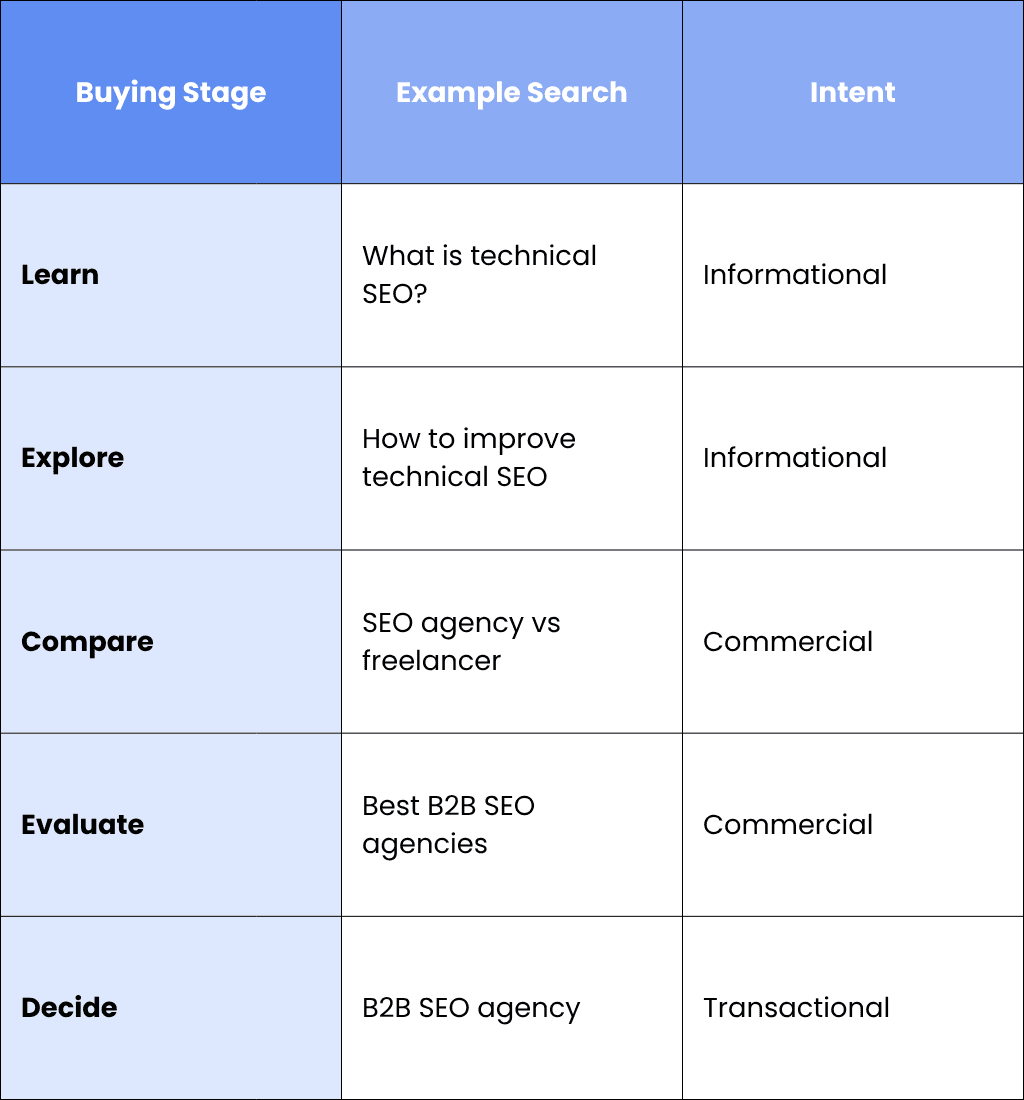
This progression also helps you build a more complete content strategy. Instead of targeting only people who are ready to buy, you can create useful content that supports potential customers throughout their research process.
Match Intent To Business Value
Finally, remember that not every keyword with commercial intent is automatically valuable.
Consider these hypothetical keywords:
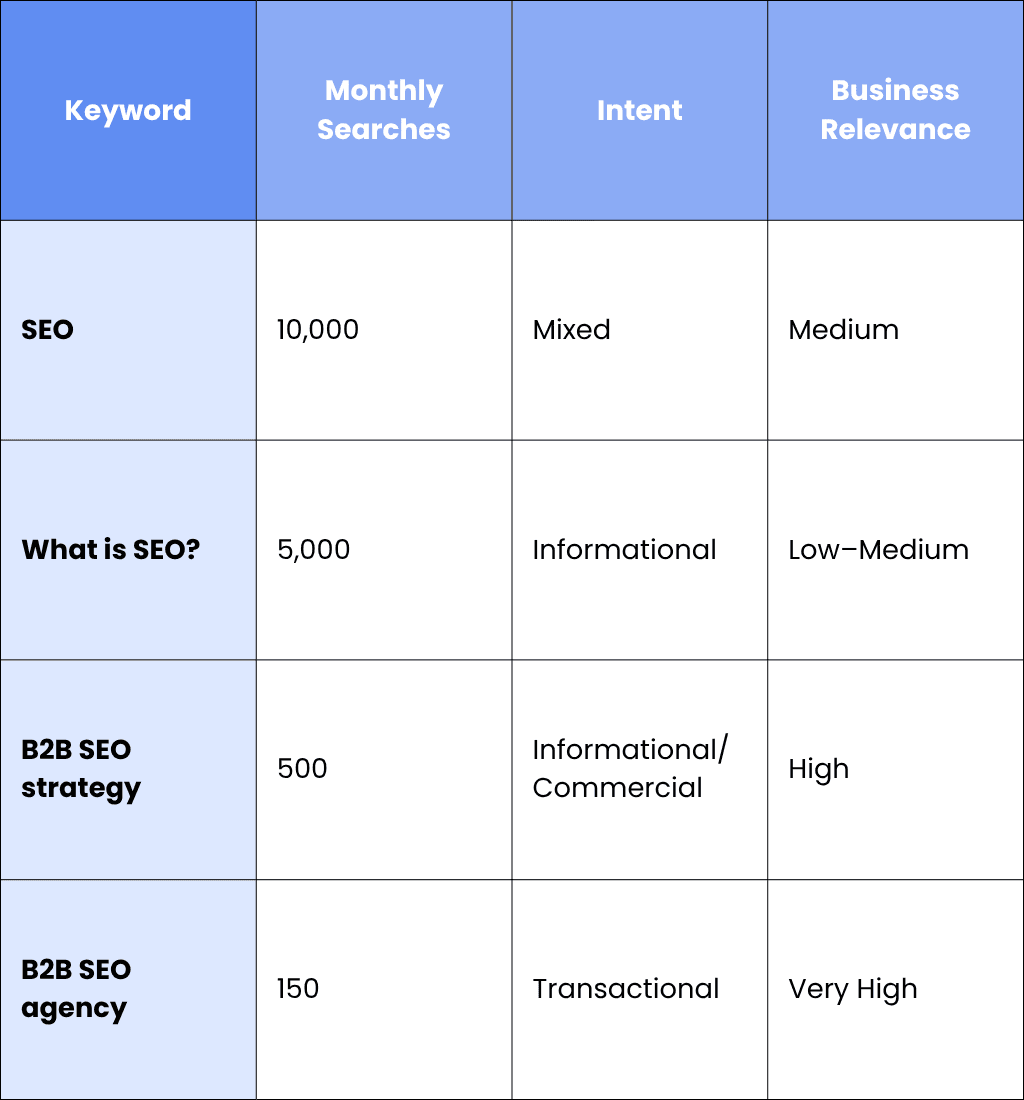
If your objective is to generate qualified B2B leads, the keyword with 150 monthly searches may be more commercially valuable than the one with 10,000.
For example, if a 150-search keyword generates 5% qualified enquiries, that represents:
150 × 5% = 7.5 potential enquiries per month
Meanwhile, if a 10,000-search keyword attracts a broad audience but only 0.05% become qualified enquiries:
10,000 × 0.05% = 5 potential enquiries per month
These are hypothetical figures, not guaranteed conversion rates, but they demonstrate an important principle:
The value of a keyword depends on the quality and intent of the traffic it can attract, not simply the number of searches.
Once you understand search intent, you can make much better decisions about which keywords deserve attention, which pages you should create and where each topic belongs within the buying journey. From there, the next step is to evaluate the actual search results and assess whether the opportunity is realistic for your website.
Use The Search Results As Your Reality Check
Once you understand search intent, the next step is to check whether your assumptions match what Google actually shows. Keyword tools can estimate search volume, difficulty and related terms, but the search results reveal something equally important: what type of content Google currently considers useful for that query.
Start by searching your target keyword in Google and review the first page. You do not need to analyse every result in detail. Instead, look for patterns.
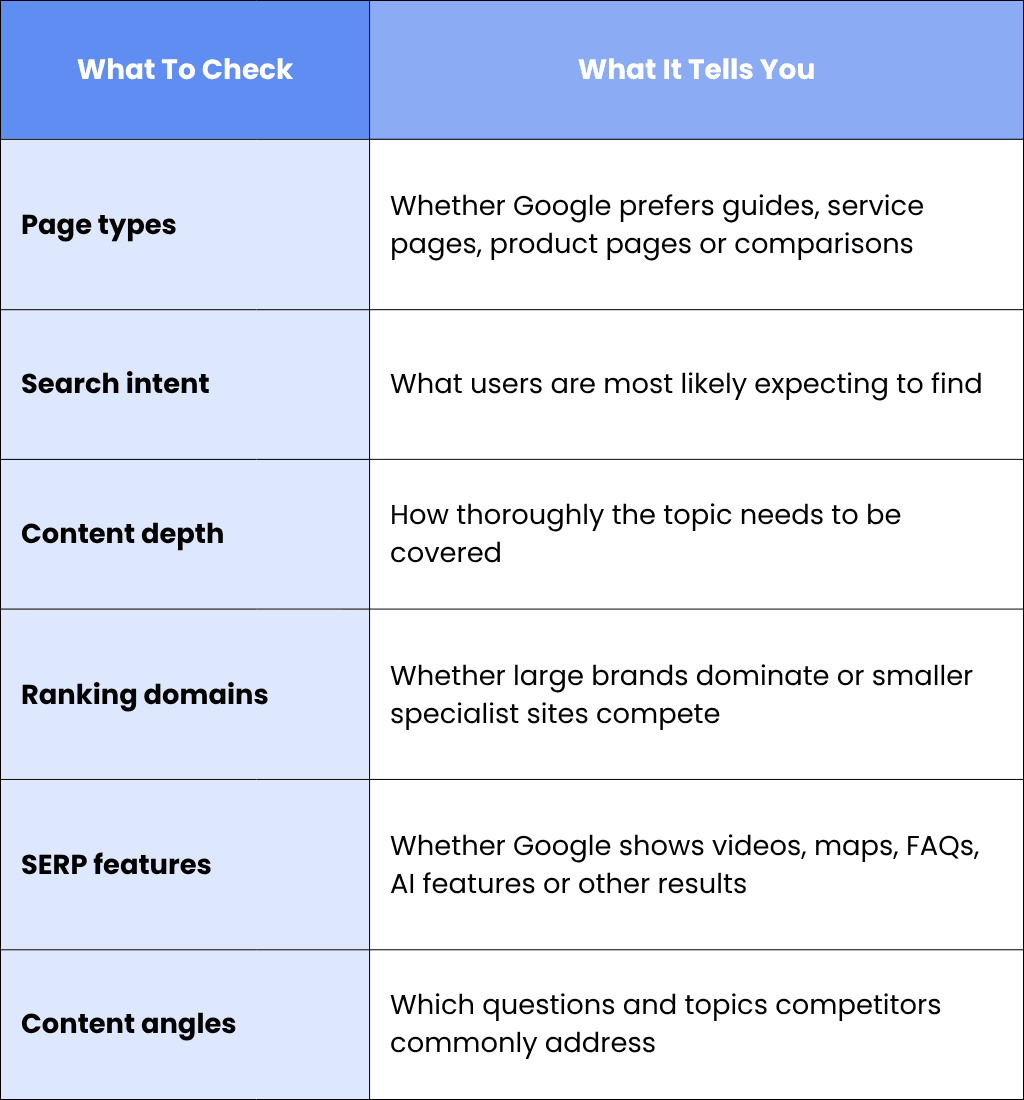
For example, imagine you want to target "enterprise SEO services". If most first-page results are agency service pages, a detailed service page is probably a better fit than a general blog article.
However, do not simply copy what already ranks. Instead, identify what those pages do well and where they leave questions unanswered. You may be able to create a more useful page by providing clearer explanations, stronger evidence, better examples or a more specific focus.
It is also worth checking the SERP periodically. Search results change as Google reassesses content, competitors publish new pages and user behaviour evolves. Therefore, SERP analysis should be part of both initial keyword research and ongoing SEO optimisation.
Look Beyond Search Volume
Search volume is useful because it gives you an indication of potential demand. However, it does not tell you whether that demand is commercially relevant to your business.
For example, suppose two keywords produce the following estimates:
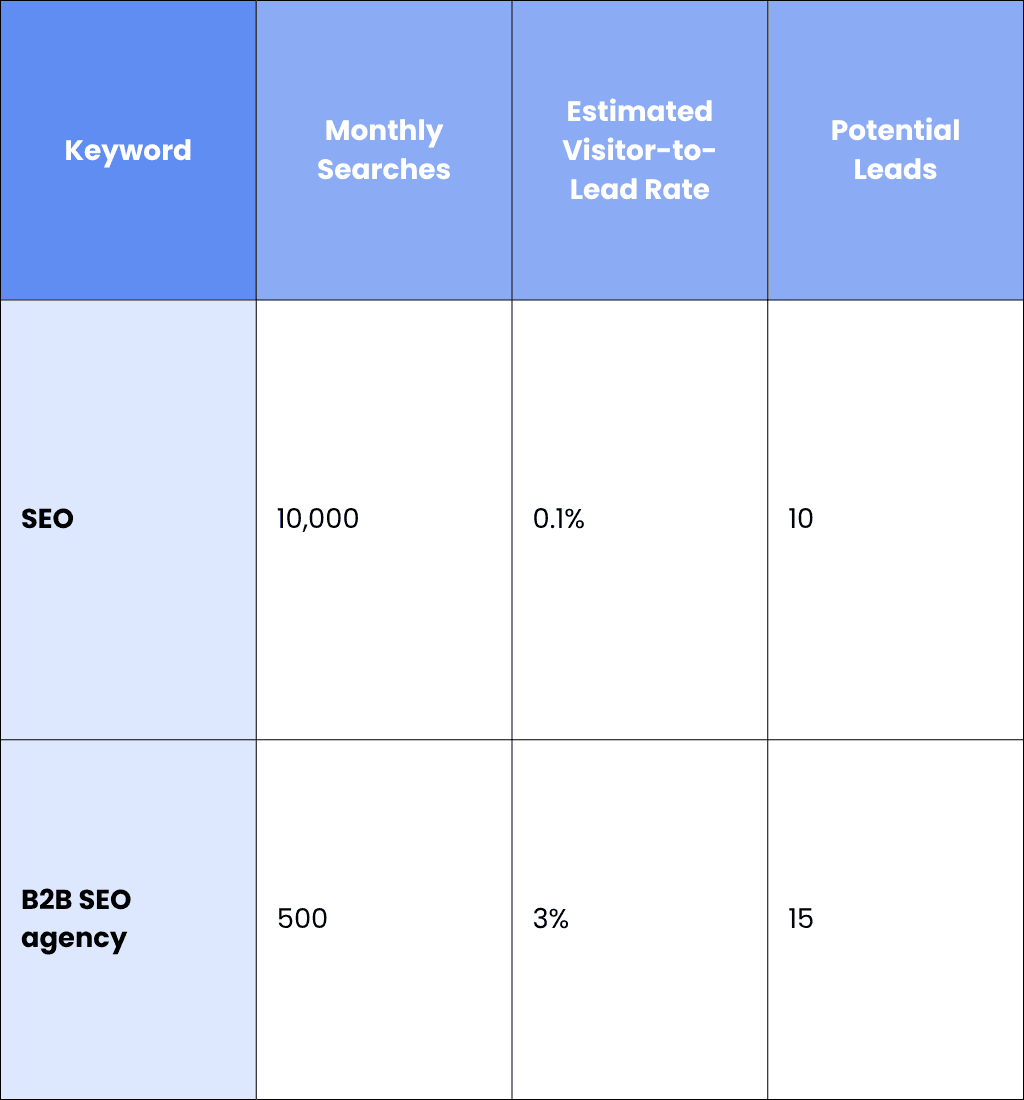
The second keyword has only 5% of the search volume of the first, but the hypothetical conversion rate could make it more valuable.
The calculation is simple:
10,000 × 0.1% = 10 leads
500 × 3% = 15 leads
These are illustrative figures, not expected results. Actual conversion rates vary significantly by industry, website, offer and audience. The example simply demonstrates why high search volume does not automatically mean high business value.
When evaluating a B2B keyword, consider:
- Business relevance: Does it relate directly to what you sell?
- Search intent: Is the person looking for information or a solution?
- Audience fit: Does the searcher resemble your ideal customer?
- Commercial potential: Could the search lead to an enquiry, demo or purchase?
- Competition: Can your website realistically compete?
- Conversion opportunity: Can you offer a logical next step?
A useful principle is to ask "What happens if we rank for this keyword?" If the answer is simply "we will receive more traffic", the keyword may not be a priority. If the answer is "we could reach companies actively looking for this service", the opportunity deserves closer attention.
Identify High-Intent Keyword Modifiers
After assessing broad keywords, look for words that indicate stronger commercial intent. These are often called keyword modifiers because they change the meaning or intent of a broader search.
For B2B businesses, useful modifiers include:
- Agency
- Services
- Consultant
- Company
- Provider
- Platform
- Software
- Solution
- Pricing
- Cost
- Quote
- Audit
- Specialist
- Implementation
- Location names
- Industry names
For example, start with the seed keyword "technical SEO" and expand it:
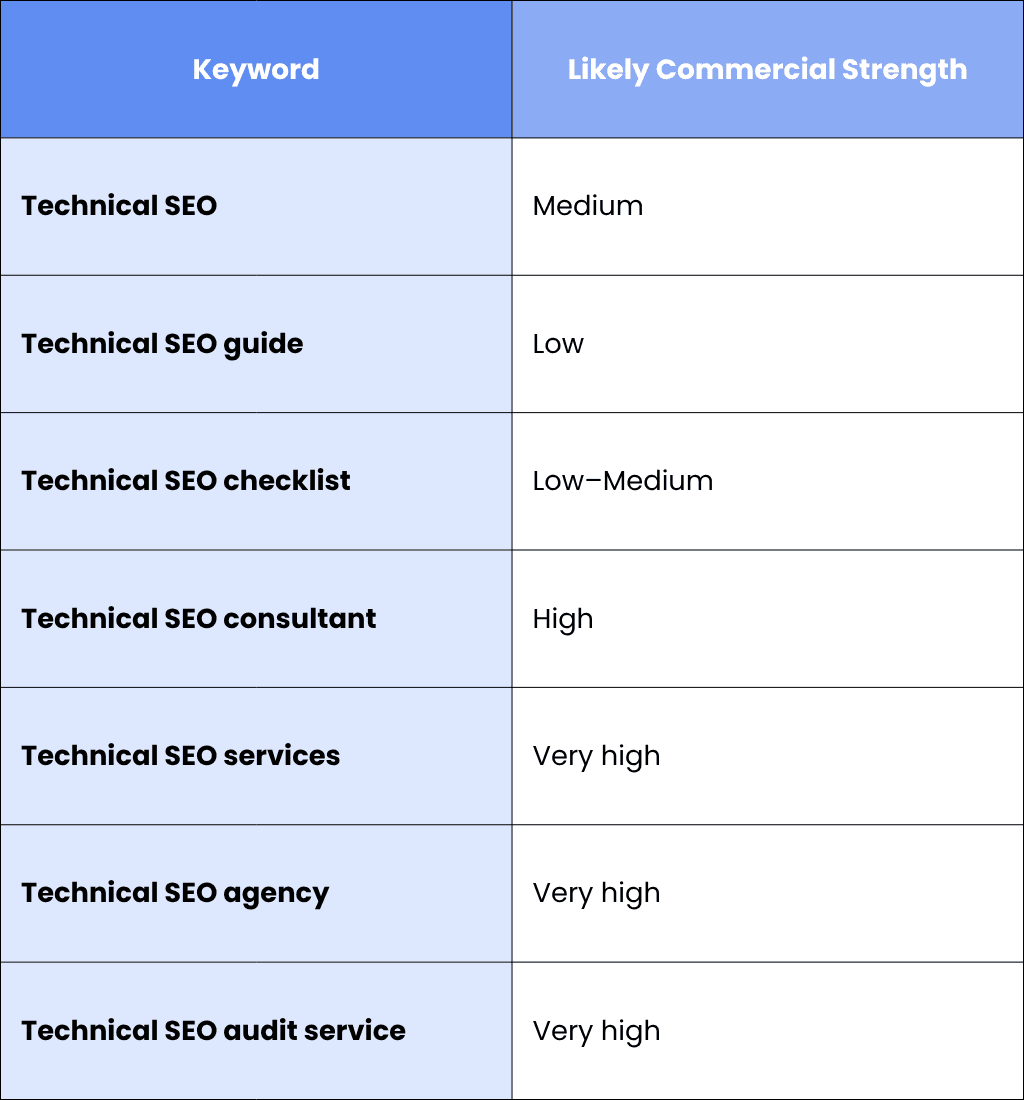
This does not mean that "technical SEO" or "technical SEO guide" has no value. Informational terms can introduce your brand to potential customers earlier in their research. However, high-intent modifiers help you identify searches that are more directly connected to commercial opportunities.
You can also combine modifiers with industries and locations:
[Service] + [Industry] + [Commercial Modifier]
For example:
SEO + SaaS + agency → SaaS SEO agency
SEO + hospitality + services → hospitality SEO services
AI automation + business + company → AI automation company
The key is to use modifiers as a discovery method rather than automatically creating a separate page for every combination.
Find The Questions Behind The Purchase
B2B buyers rarely make decisions based on a single search. Before contacting a supplier, they often research pricing, processes, risks, alternatives, implementation requirements and expected results.
Therefore, your keyword research should capture the questions that sit behind the purchase.
For example, someone considering SEO services may search:
- How much does SEO cost?
- How long does SEO take?
- What does an SEO agency do?
- Is SEO worth it for a B2B company?
- SEO agency vs in-house team
- How to choose an SEO agency
- What should an SEO agency report?
These questions can be valuable because they reveal concerns that may eventually influence a purchasing decision.
A simple way to find them is to ask your sales and customer service teams:
- What questions do prospects ask before requesting a proposal?
- What objections do prospects raise?
- What information do customers usually request?
- Why do prospects choose your company?
- Why do prospects decide not to proceed?
You can then turn those questions into content opportunities.
For example, if prospects frequently ask "How long does SEO take?", a useful article could explain that SEO does not have a universal timeline, identify the factors that affect results and explain what businesses should expect during the first few months.
This approach gives your content a clear purpose. Instead of writing because a keyword exists, you are answering a question that real buyers already have.
Map Keywords To The Buying Journey
Once you understand the questions your audience asks, organise your keywords according to where they sit in the buying journey.
A simple B2B journey might look like:
Awareness → Consideration → Evaluation → Decision
At the awareness stage, the customer may recognise a problem but not know how to solve it.
Example: "Why has my organic traffic dropped?"
During consideration, they begin researching potential solutions.
Example: "How to improve organic traffic for a B2B website"
During evaluation, they compare approaches and providers.
Example: "SEO agency vs in-house SEO"
Finally, at the decision stage, they may search for a provider.
Example: "B2B SEO agency"
You can map this into a practical content structure:
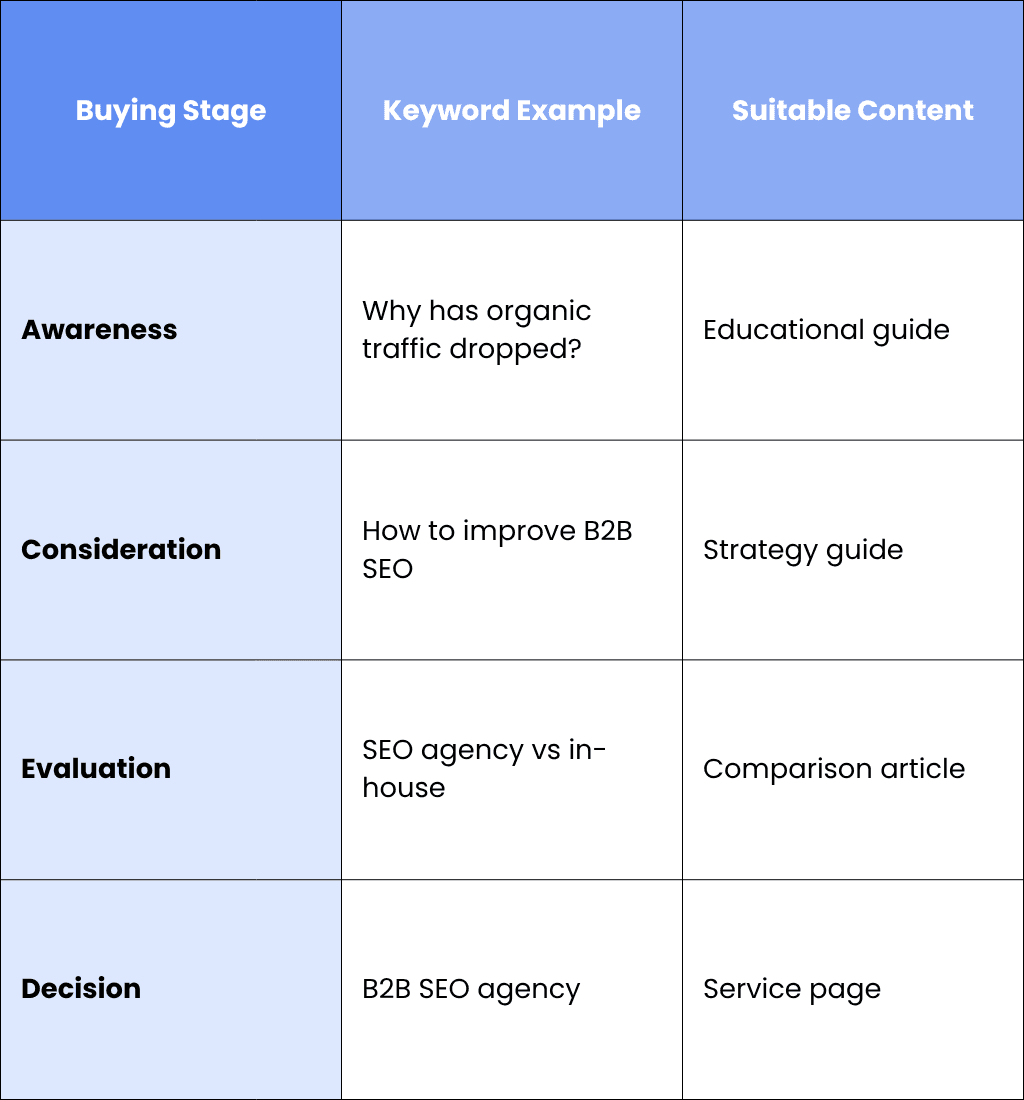
This structure prevents your SEO strategy from becoming overly focused on transactional keywords. Although bottom-of-funnel searches often have strong commercial value, educational content can help build familiarity and trust before a prospect is ready to contact you.
The important part is creating a clear connection between pages. Someone who reads an educational article should be able to discover a relevant service, case study or guide without having to search for it again.
Build Keyword Clusters Instead Of Individual Pages
Once you have mapped keywords to the buying journey, group closely related terms into keyword clusters. A keyword cluster is a group of searches that share the same topic and, importantly, can often be addressed by the same page.
For example, these keywords could belong to one B2B SEO service page:
- B2B SEO services
- B2B SEO agency
- B2B SEO company
- SEO services for B2B
- B2B search engine optimisation
Creating five almost identical pages would rarely be useful. Instead, one comprehensive page can address the topic naturally while supporting related searches.
For broader topics, you can create a pillar-and-supporting-content structure:
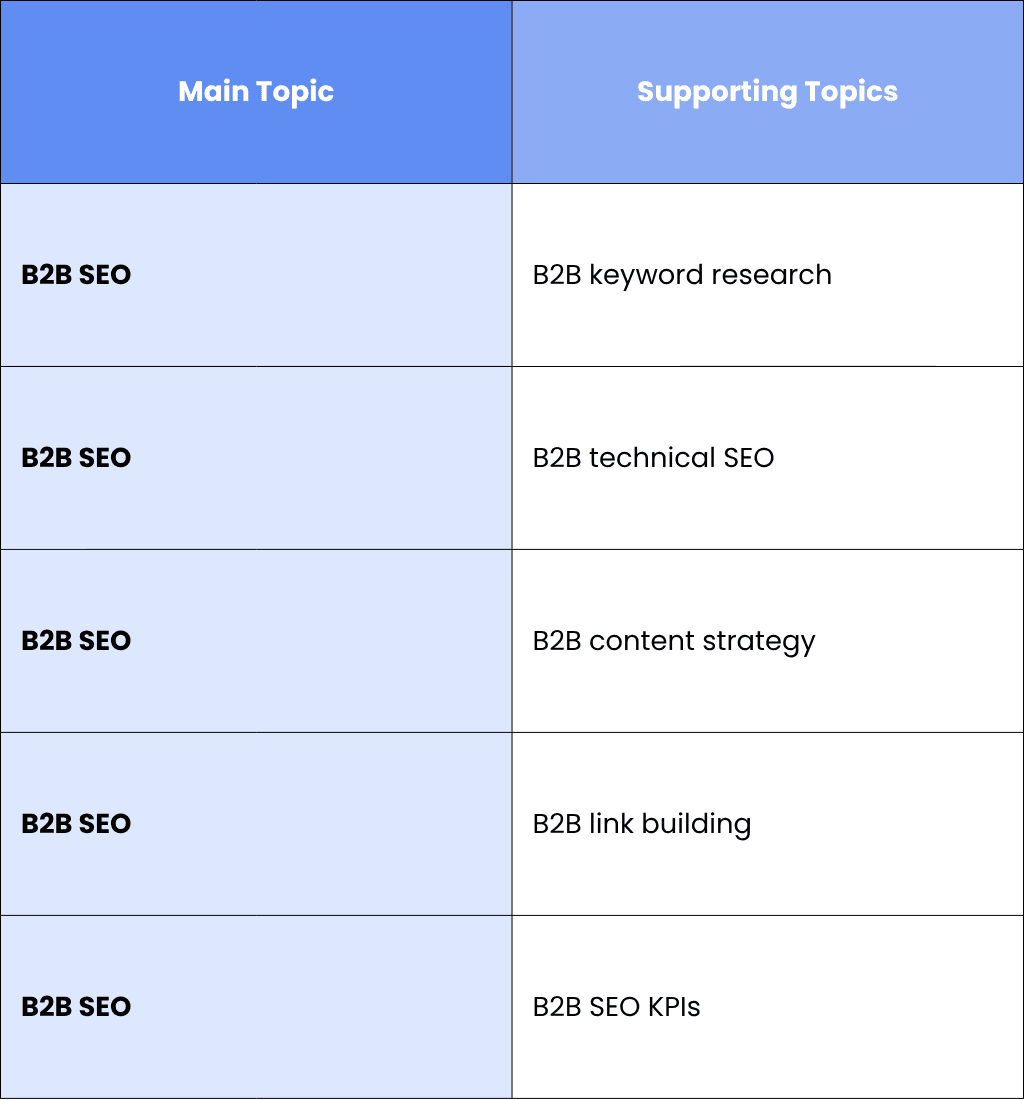
This approach also helps internal linking. Supporting articles can link to the main service or pillar page when appropriate, while the main page can link to deeper resources.
Google does not require a separate page for every keyword variation. Its systems can understand related searches and language variations, so focus on creating genuinely useful pages that comprehensively address the topic rather than repeating the same keyword throughout multiple URLs.
Analyse Competitors For Keyword Gaps
After creating your own keyword clusters, examine competitors to discover opportunities you may have missed.
However, focus on search competitors, not just business competitors. A website may compete with you in Google for a keyword even if you do not consider that company a direct commercial competitor.
For each relevant competitor, investigate:
- Which pages receive organic visibility?
- Which topics do they cover?
- Which services have dedicated landing pages?
- Which industries do they target?
- Which locations do they target?
- Which keywords appear repeatedly?
- Which topics receive strong rankings but weak content?
- Which important customer questions have they ignored?
You can organise your findings into a simple gap analysis:
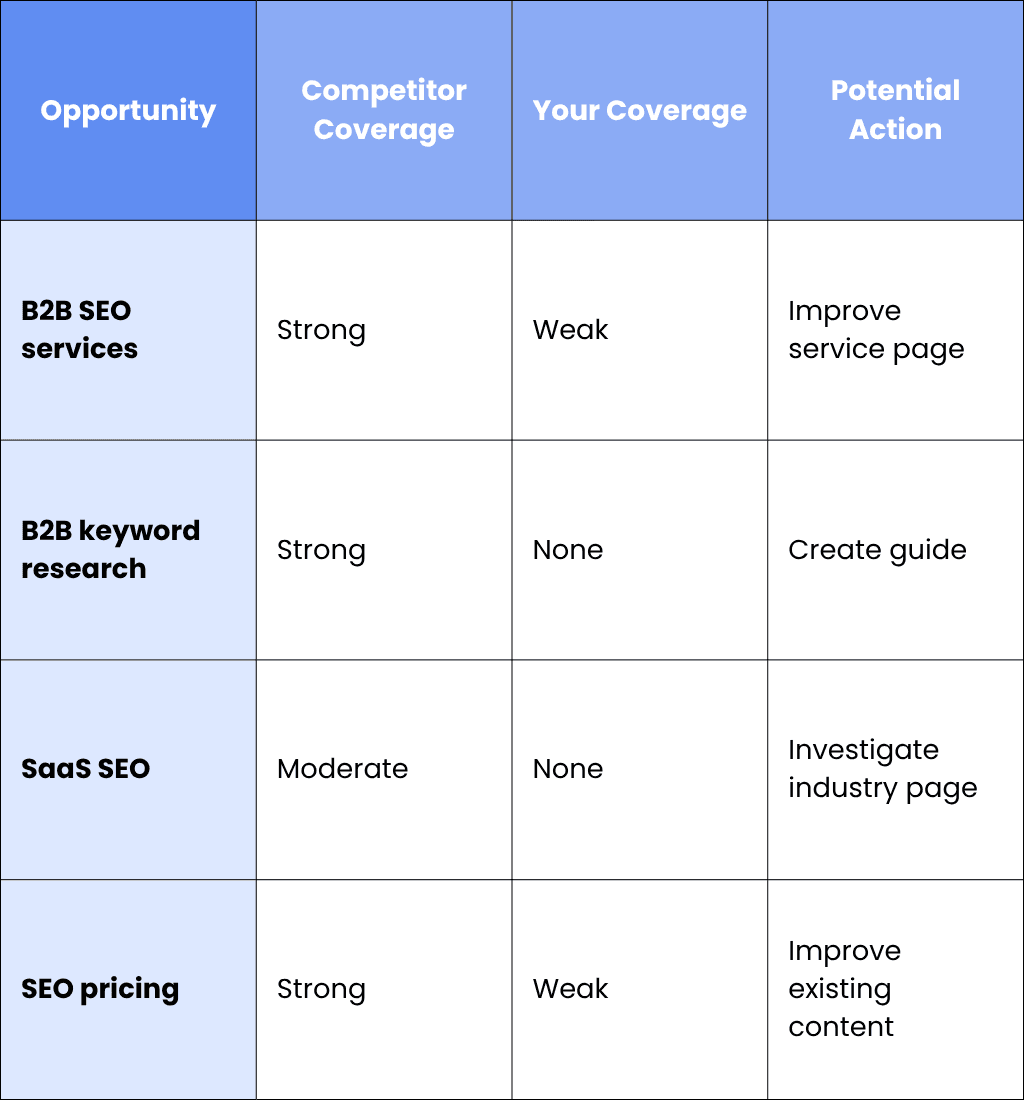
The objective is not to reproduce competitor content. Instead, ask "What can we explain better, more specifically or more usefully?"
For example, if competitors have generic pages about "SEO for SaaS", you might create a more specialised resource covering SaaS-specific challenges such as product-led growth, international markets, technical documentation, comparison searches and long customer journeys.
That additional relevance can give your content a stronger reason to exist.
Use Your Existing Data To Find Proven Opportunities
External keyword tools can help you discover opportunities, but your own website data can reveal something even more valuable: what is already working.
Google Search Console can show the queries for which your pages receive impressions and clicks. This can uncover keywords you may never have included in your original research.
Look for three particularly useful situations:
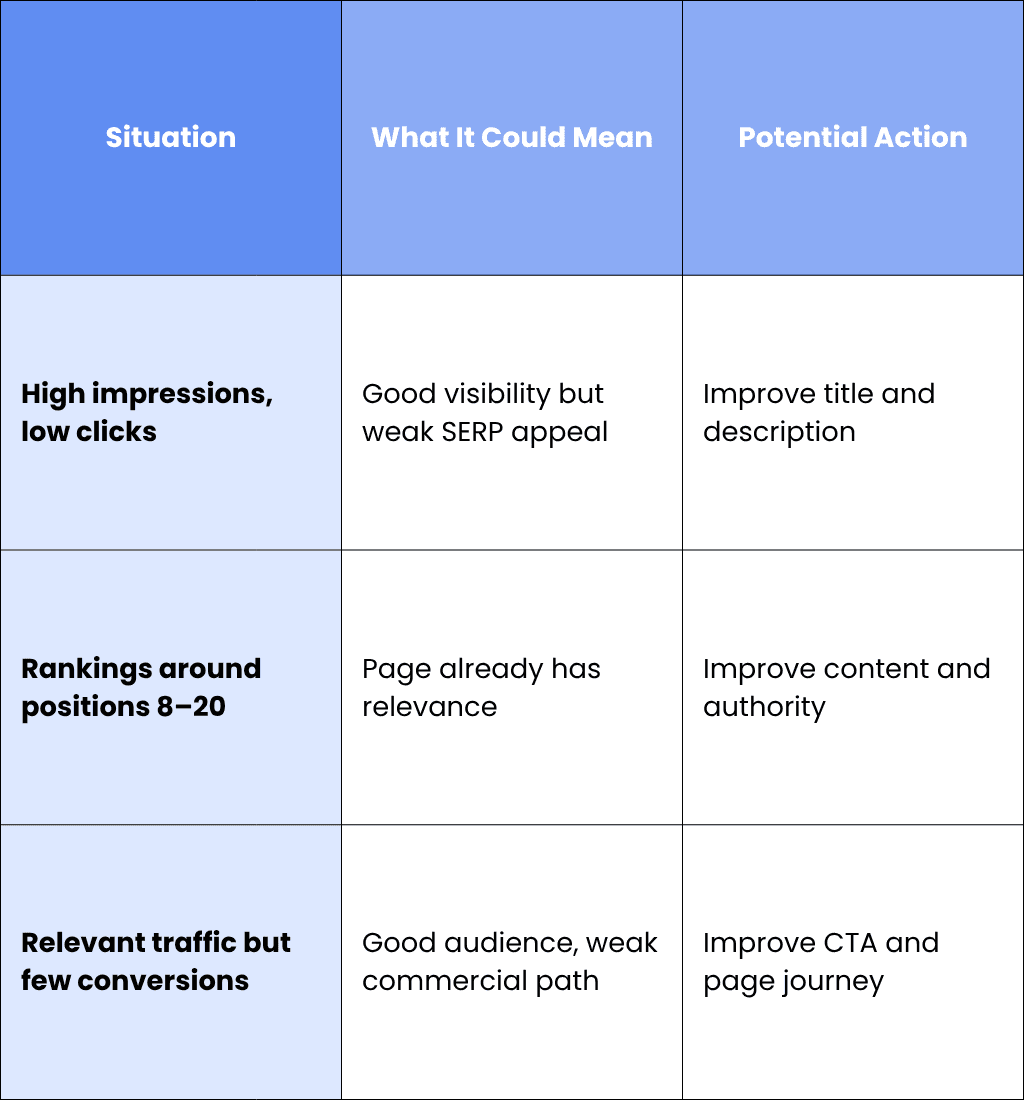
For example, imagine a page receives 10,000 impressions and 300 clicks.
Its click-through rate is:
300 ÷ 10,000 × 100 = 3%
If competing results achieve stronger visibility and your page ranks just outside the top positions, improving the page could potentially create more traffic without creating an entirely new URL.
Similarly, if a page attracts highly relevant visitors but generates very few enquiries, the problem may not be keyword selection. The page may need a stronger offer, clearer calls to action, better trust signals or a more logical next step.
This is why keyword research should continue after publication. Your actual search data can help you refine your strategy based on real user behaviour rather than assumptions.
Connect Keywords To Conversions
At this stage, you should have a clearer understanding of which keywords attract relevant audiences. The next question is more commercial:
What should those visitors do after they arrive?
Every important keyword opportunity should have a logical conversion path.
For example:
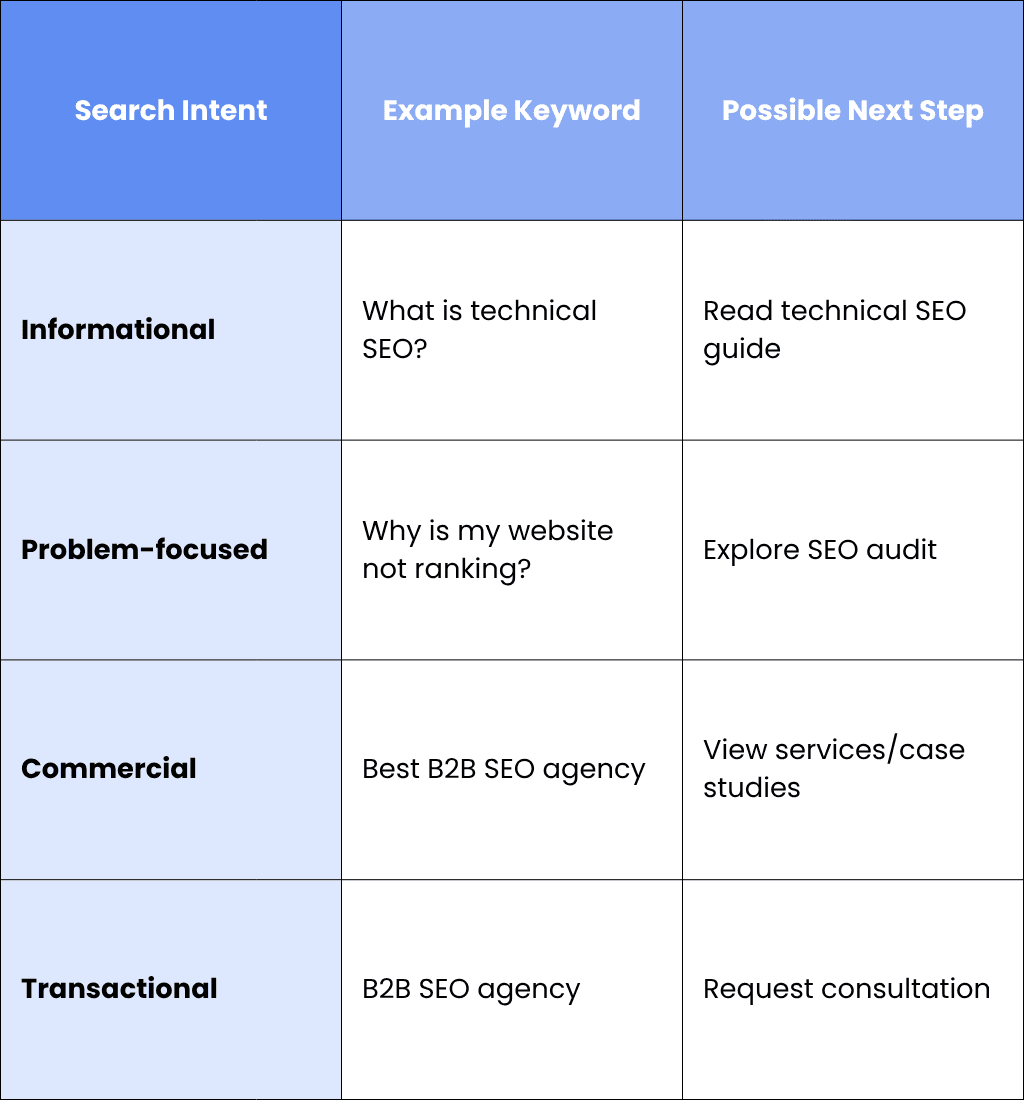
The conversion does not always need to be a direct sale. For early-stage visitors, a useful next step could be another article, a case study, downloadable resource or newsletter.
For high-intent visitors, the CTA can be more direct:
- Request a consultation
- Book a discovery call
- Request a proposal
- Start a demo
- Contact the team
The important principle is context. A person searching for an introductory definition may not be ready to contact your sales team, while someone searching for "SEO agency services" may expect an easy way to enquire.
When keyword targeting and conversion strategy work together, SEO can contribute to the entire customer journey rather than simply generating sessions.
Create A Keyword Prioritisation Model
After expanding your research, you may have hundreds or thousands of potential keywords. Trying to target everything at once will spread your resources too thin, so create a simple prioritisation system.
One practical method is to score each keyword from 1 to 5 across five factors:
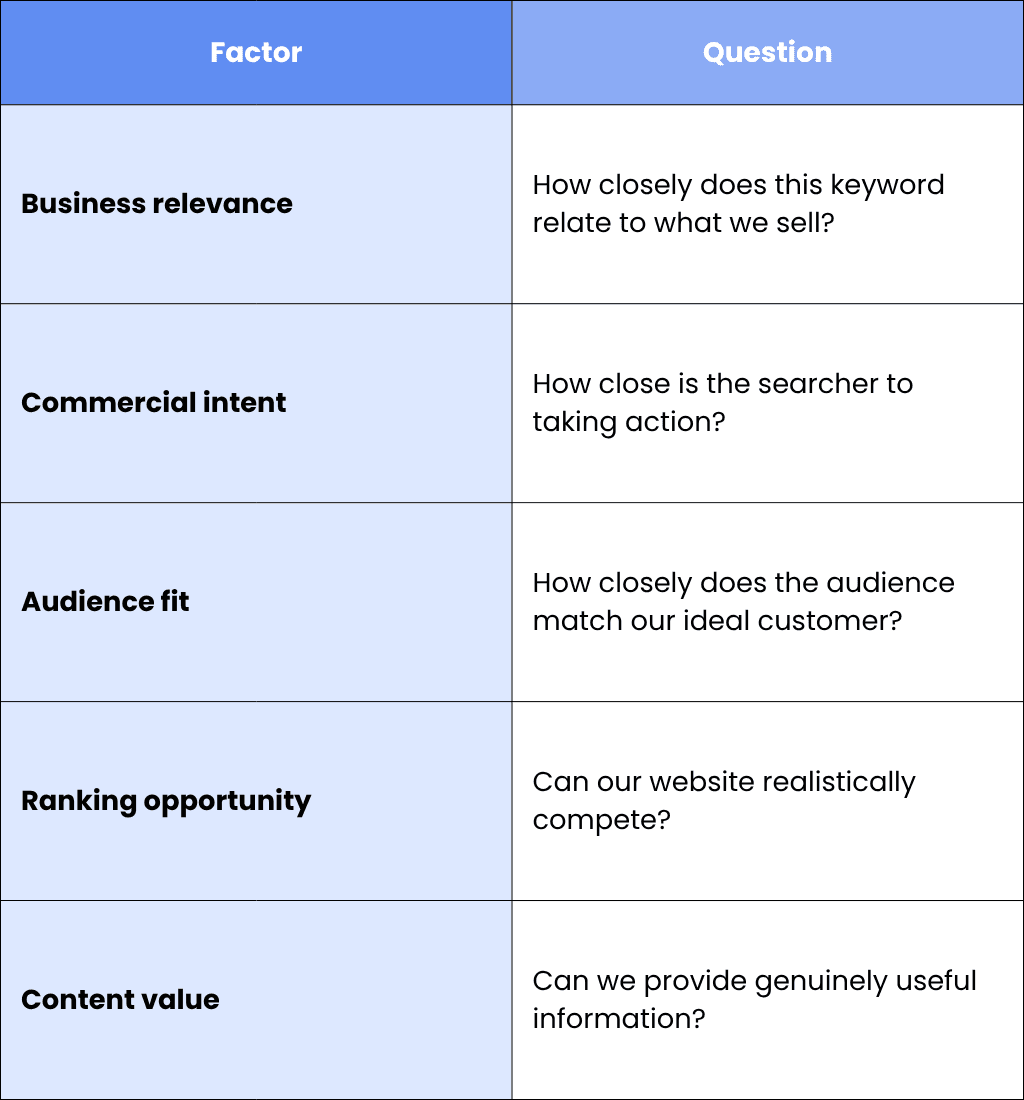
Again, this is a decision-making framework rather than a universal SEO formula. You can change the weighting depending on your business.
For a lead-generation campaign, for example, you might give commercial intent and audience fit more weight than search volume.
The result is a prioritised list that helps your team answer a practical question:
Which keywords should we work on first?
Build The Right Page For The Keyword
Once you have prioritised your keywords, the next step is to decide which page should target each keyword. This is more important than it may seem because the same keyword can require very different content depending on what the searcher wants to accomplish.
For example, someone searching for "technical SEO services" is likely looking for a provider, while someone searching for "what is technical SEO?" wants an explanation. Targeting both with the same type of page would make it harder to satisfy either audience.
A simple framework is:
Keyword → Search Intent → Page Type → Business Goal
Use this framework before creating a page, because it helps prevent wasted content and gives every URL a clear purpose.
Service Pages
Create a service page when the keyword shows that the searcher is actively looking for a service or provider.
Typical examples include:
- B2B SEO services
- Technical SEO agency
- Local SEO services
- AI workflow automation services
- Generative engine optimisation agency
These searches usually have stronger commercial intent, so the page should make it easy for the visitor to understand what you offer and why they should consider your business.
A strong service page should answer the questions a potential buyer is likely to have:
- What exactly do you provide?
- Who is the service for?
- What problems does it solve?
- How does your process work?
- What makes your approach different?
- What evidence supports your claims?
- What should the visitor do next?
For example, a B2B SEO services page could explain your technical SEO, content, authority-building and search strategy capabilities. It could then support those claims with relevant case studies, results or examples before offering a clear enquiry option.
Avoid: creating a thin page that simply repeats the keyword and says your company provides the service. If the searcher is evaluating providers, they need useful information that helps them make a decision.
Industry Pages
Create an industry page when your business has a genuine offering, experience or expertise for a particular sector.
Examples include:
- SEO for SaaS companies
- SEO for hospitality
- SEO for education
- SEO for retail
- B2B SEO
- AI automation for professional services
Industry pages work because customers often want to know whether an agency understands their specific business environment, not just whether it provides a generic service.
For example, an SEO page for SaaS companies could discuss issues such as:
- Long and complex B2B buying journeys
- Product-led and sales-led growth models
- Feature and solution-based searches
- International SEO
- Technical website structures
- Content for different stages of the funnel
This makes the page more useful than simply changing the phrase "SEO agency" to "SaaS SEO agency".
A useful formula is:
Service + Industry + Specific Challenge
For example:
SEO + SaaS + lead generationSEO for SaaS companies looking to generate qualified leads
This approach gives the page a clear audience and purpose.
Important: Do not create industry pages solely to capture additional keywords. If the business has no relevant experience, expertise or tailored solution for that industry, a generic page may provide little value to users.
Location Pages
Create a location page when your business genuinely serves a particular geographic market and the location influences the customer's decision.
Examples include:
- SEO agency Vietnam
- SEO agency Singapore
- SEO services Ho Chi Minh City
- B2B SEO agency in London
Location can be particularly important when customers prefer to work with a provider that understands their local market, language, regulations, customer behaviour or competitive landscape.
However, avoid creating dozens of pages using the same template and simply replacing the city name.
For example, if you create pages for:
- SEO agency Hanoi
- SEO agency Ho Chi Minh City
- SEO agency Singapore
- SEO agency Bangkok
each page should provide meaningful information about that market.
You could include:
- Local market considerations
- Relevant customer segments
- Local search behaviour
- Examples of work in the market
- Language considerations
- Service availability
- Relevant local expertise
The goal is simple:
A location page should be useful even if the visitor never looks at the URL or notices the location keyword.
If removing the city name leaves the page almost identical to another location page, you probably need to rethink the structure.
Educational Guides
Create an educational guide when the searcher is trying to understand a topic, solve a problem or learn how something works.
Examples include:
- How to build a B2B SEO strategy
- What is technical SEO?
- How to improve organic traffic
- How does generative engine optimisation work?
- How to conduct B2B keyword research
These pages are generally aimed at earlier stages of the buying journey, so the priority should be education rather than immediate selling.
A useful educational guide should:
- Answer the main question quickly
- Explain technical concepts in simple language
- Break complex subjects into logical steps
- Include relevant examples
- Address common follow-up questions
- Link to deeper resources
- Provide a relevant next step
For example, an article targeting "how to conduct B2B keyword research" could explain the research process, show how to evaluate search intent and demonstrate how to prioritise commercial opportunities.
At the end, it could naturally link to a relevant SEO service for readers who want professional support.
This creates a simple journey:
Learn → Explore → Consider → Contact
Comparison Pages
Create a comparison page when the searcher is actively evaluating two or more options.
Examples include:
- SEO agency vs freelancer
- In-house SEO vs SEO agency
- SEO vs PPC
- AI automation vs manual workflows
- CRM A vs CRM B
Comparison searches can have strong commercial value because the visitor is already considering a decision.
However, the page needs to be genuinely useful. Start by establishing the criteria that matter to the buyer.
For an SEO agency vs freelancer comparison, you could compare:
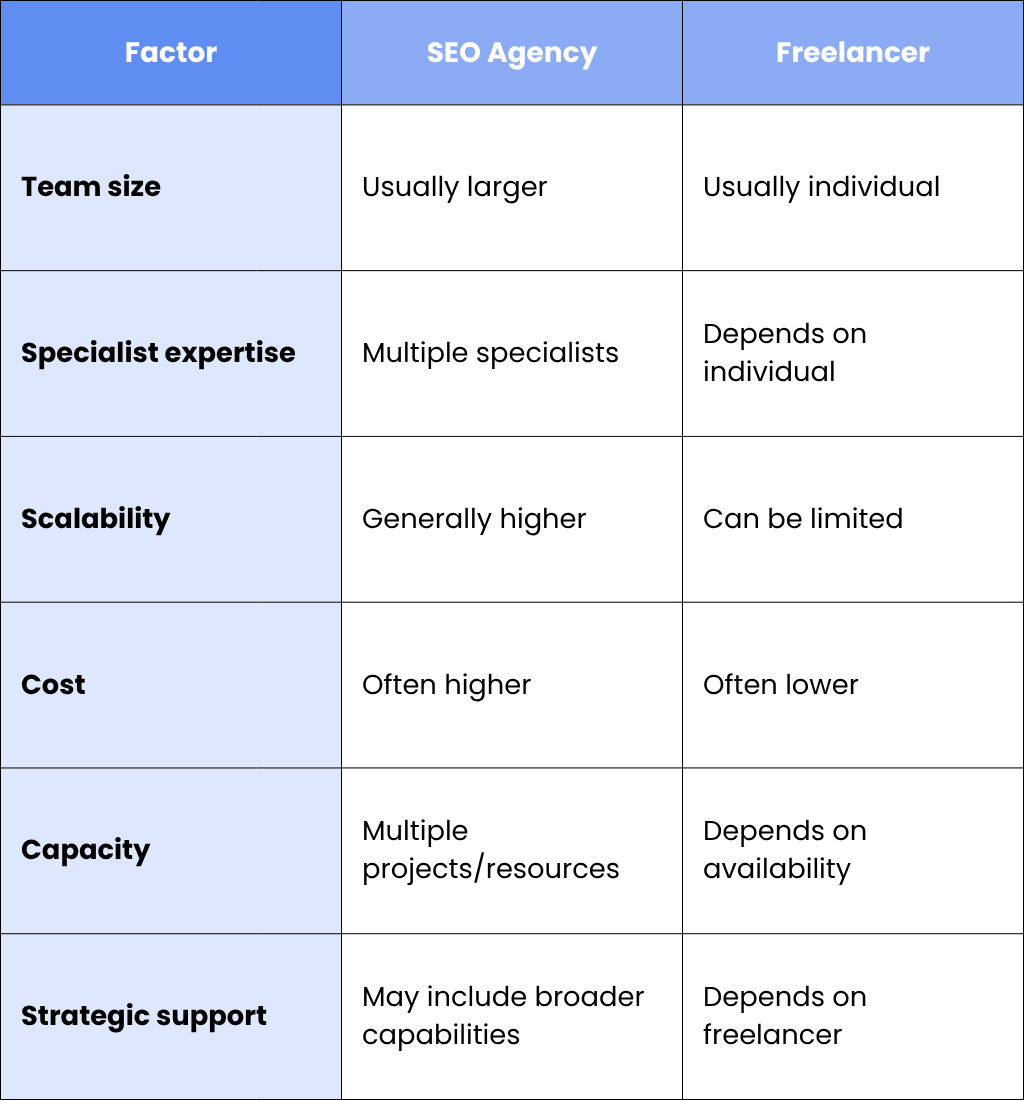
The comparison should then explain when each option makes sense rather than simply declaring one the winner.
If you are comparing your own service, be transparent about limitations as well as strengths. Balanced content builds more trust than an article that exists purely to promote your business.
Case Studies
Create a case study when you need to demonstrate how your solution worked for a real customer.
Case studies are especially valuable for B2B businesses because purchasing decisions often involve risk. A prospect may want evidence that you can handle a similar challenge before they contact you.
A strong case study can follow a simple structure:
Challenge → Strategy → Implementation → Results → Lessons
For example:
A SaaS company wanted to increase qualified organic leads.
You could then explain:
- What was limiting organic growth?
- Which keyword opportunities were identified?
- What technical improvements were made?
- What content strategy was implemented?
- How authority was developed?
- What changed after implementation?
Where reliable data is available, include measurable results.
For example:
Before: 20 qualified organic leads per monthAfter: 35 qualified organic leads per month
The increase is:
35 − 20 = 15 additional leads
Percentage growth:
15 ÷ 20 × 100 = 75%
The figures should always be accurate and clearly explained. Avoid presenting rankings, traffic increases or other SEO metrics as proof of business impact unless they genuinely connect to the customer's objectives.
Case studies also provide an opportunity to target industry-specific searches naturally. A page about improving SEO for a SaaS company, for example, can demonstrate relevant expertise while supporting broader SaaS SEO topics.
Pricing Pages
Although not always necessary, a pricing or cost page can be highly valuable when users frequently search for pricing information.
Examples include:
- SEO agency pricing
- How much does SEO cost?
- SEO services cost
- AI automation pricing
Pricing searches often indicate commercial research because the user is trying to determine whether a solution fits their budget.
If you cannot provide fixed pricing, you can still create a useful page that explains:
- What affects the price
- Different service levels
- Typical project factors
- What is included
- What can increase or reduce costs
- Why prices differ between providers
For example, SEO pricing may depend on:
Website size + market competitiveness + technical complexity + content requirements + authority-building needs
The objective is not necessarily to publish a single number. Instead, give potential customers enough information to understand what they are paying for and why.
This can also help qualify leads. Someone whose expectations are completely outside your typical service range may decide not to enquire, while a suitable prospect can approach the conversation with a better understanding of the investment involved.
Product Pages
For SaaS, retail and other product-led businesses, product pages should target searches where the user is evaluating a specific product, feature or solution.
Examples include:
- CRM software
- AI workflow automation software
- Hotel booking software
- Retail inventory management software
The page should explain the product in terms of customer needs and outcomes, not simply list features.
For example:
Feature: Automated reporting
Customer benefit: Spend less time compiling reports manually
Business outcome: Give teams more time to analyse performance and make decisions
This creates a stronger connection between the search query and the reason someone might buy the product.
Where appropriate, product pages can also include:
- Key features
- Use cases
- Industries served
- Integrations
- FAQs
- Pricing information
- Customer evidence
- Demonstrations
- Clear calls to action
Choose One Primary Purpose For Each Page
After deciding which page type fits your keyword, give the page one primary purpose.
For example:
Primary keyword: B2B SEO servicesIntent: TransactionalPage: Service pagePrimary goal: Generate qualified enquiries
Or:
Primary keyword: How to build a B2B SEO strategyIntent: InformationalPage: Educational guidePrimary goal: Attract and educate relevant prospects
This does not mean a page can only rank for one keyword. A well-optimised page can rank for many related searches.
Instead, the purpose of the exercise is to prevent your website from having multiple pages competing for the same intent.
Before publishing, use this quick check:
- Is the keyword relevant to the business?
- Does the page match the search intent?
- Is the page type appropriate?
- Does the content provide something genuinely useful?
- Is there a logical next step for the visitor?
- Does another page already serve the same purpose?
If all six answers are yes, you have a much stronger foundation for creating a page that can attract the right searchers and move them towards becoming customers.
Avoid Keyword Cannibalisation
As your website grows, different pages can begin targeting the same topic. This is often called keyword cannibalisation.
For example, you might have:
- B2B SEO
- B2B SEO services
- B2B SEO agency
- B2B SEO company
Having multiple pages is not automatically a problem. The real issue is whether those pages have distinct purposes.
A useful test is to ask:
"If I were the searcher, would I expect these two pages to provide meaningfully different information?"
If the answer is no, consider consolidating the content or giving each page a clearer role.
For example:
B2B SEO Services → commercial service information
B2B SEO Guide → comprehensive educational resource
B2B SEO Case Studies → evidence of results
This creates a cleaner structure and reduces unnecessary duplication.
You should also review internal links, titles, headings and page intent when resolving potential overlap. The objective is to make it clear to both users and search engines which page is the main resource for each topic.
Make Keyword Research Useful For AI Search Too
B2B keyword research should now account for a broader search environment in which users may discover information through traditional Google results, AI-generated search experiences and platforms such as ChatGPT, Gemini and Perplexity.
However, this does not mean creating a completely separate keyword strategy for AI search.
Google's guidance for AI features states that the same fundamental SEO practices remain important, including making content crawlable, indexable, useful and accessible. Google also emphasises the importance of clear internal linking and accurate structured data where relevant.
This means your keyword research should focus on the questions and entities behind a topic, not just exact keyword phrases.
For example, instead of creating separate pages for:
- What is GEO?
- Generative engine optimisation definition
- What does GEO mean?
- Generative search optimisation
you could create one strong resource that clearly explains the topic and naturally addresses these related questions.
To make B2B content easier for search engines and AI systems to understand:
- Answer important questions directly.
- Use descriptive headings.
- Explain specialist terms in simple language.
- Support important claims with credible evidence.
- Include relevant examples and first-hand experience.
- Maintain clear internal links.
- Use structured data where it genuinely applies.
- Keep important information accessible in text.
Google also states that there is no special schema markup required specifically to appear in AI Overviews or AI Mode.
The practical lesson is straightforward: do not chase an "AI SEO trick". Build useful, well-structured content that clearly demonstrates expertise and answers real questions.
Use AI Carefully During Keyword Research
AI can significantly speed up B2B keyword research, particularly when you need to organise a large amount of information.
For example, you can use AI to help:
- Expand seed keyword lists
- Group similar keywords
- Categorise search intent
- Turn sales questions into content ideas
- Identify potential topic clusters
- Analyse large keyword exports
- Generate initial content briefs
- Summarise competitor themes
However, AI-generated ideas still require validation.
For example, an AI tool might generate 100 keyword suggestions, but some may have little search demand, unclear intent or no commercial relevance. Others may be variations that should be covered by the same page rather than separate pages.
A useful workflow is:
AI generates ideas → SEO specialist validates them → keyword tools confirm demand → SERPs confirm intent → business team confirms relevance
This combines speed with human judgement.
You should also avoid using AI simply to produce hundreds of pages from a keyword list. Google's guidance states that generating content at scale without adding value can violate its policies on scaled content abuse.
The strongest use of AI is therefore not "How many articles can we produce?"
It is:
"How can we understand our audience, analyse information and produce genuinely better content more efficiently?"
Measure What Actually Matters
Once your keyword strategy is implemented, measurement closes the loop. Rankings and organic traffic remain useful indicators, but B2B businesses should ultimately connect SEO performance to commercial outcomes.
A useful measurement framework could look like this:
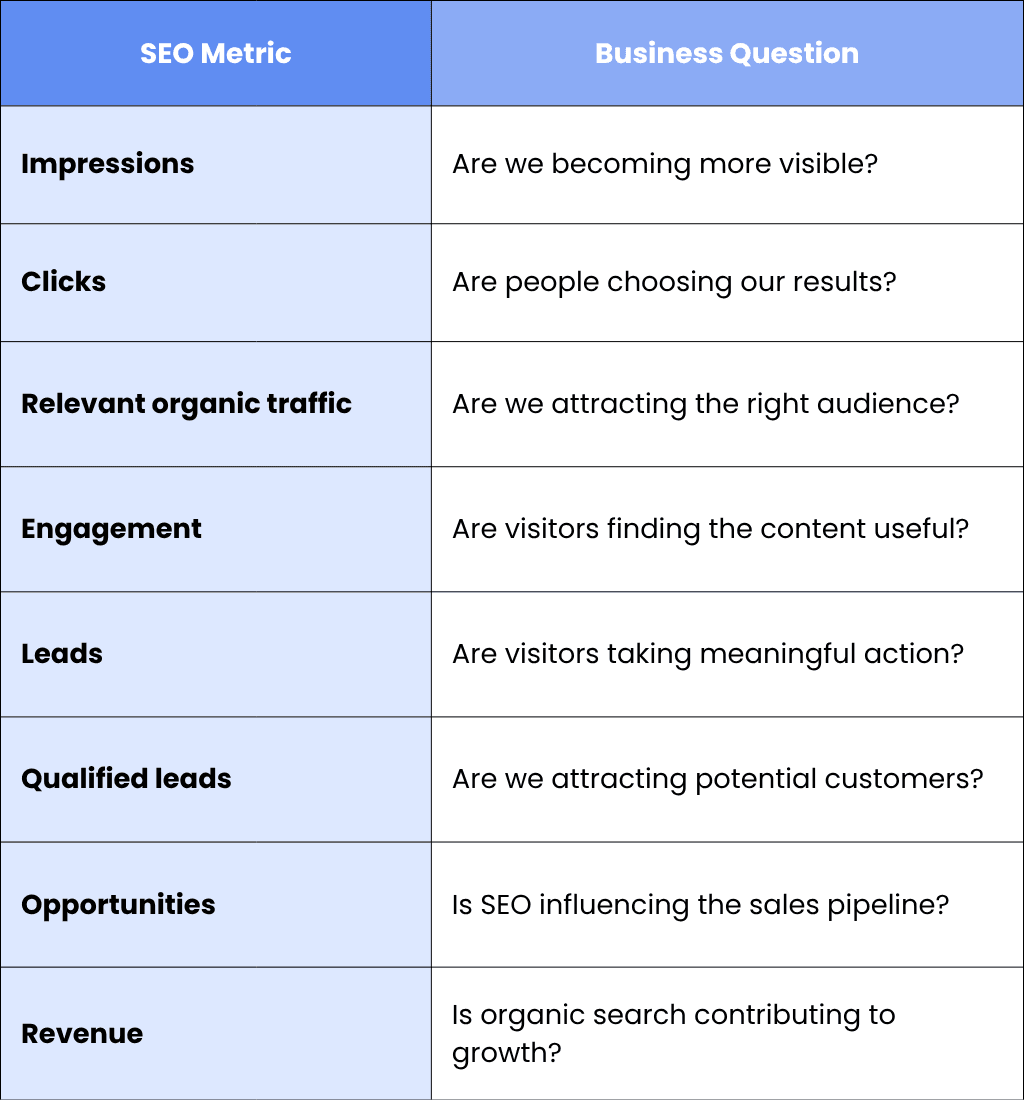
The right conversion depends on the business model.
For example:
- SaaS: demo requests, trials, qualified accounts and revenue
- F&B: bookings, reservations and enquiries
- Hospitality: room searches, bookings and revenue
- Education: course enquiries, applications and enrolments
- Retail: product views, transactions and revenue
- B2B services: enquiries, qualified leads, proposals and closed deals
Suppose organic search generates 100 leads in a month, but only 10 are qualified. Your SEO team should not simply celebrate the 100-lead figure.
The more useful question is:
What generated those 10 qualified leads, and can we create more of that traffic?
This allows keyword research to become a feedback loop. You identify valuable searches, create content, measure commercial outcomes and then reinvest in the topics that demonstrate the strongest potential.
Common B2B Keyword Research Mistakes
Even a well-planned keyword strategy can lose effectiveness when businesses focus too heavily on keywords and not enough on customers.
One common mistake is chasing search volume. A keyword with 20,000 searches may look attractive, but if most searchers are outside your target market, the traffic may have little value.
Another is ignoring search intent. If users want a comparison but you give them a sales page, or they want a detailed guide but you provide a short promotional article, the page may struggle to satisfy them.
Businesses also sometimes create a separate page for every keyword variation. This can lead to repetitive content and a confusing website structure. Instead, group related searches when one page can satisfy the same intent.
Other mistakes include:
- Copying competitor content instead of developing your own expertise.
- Ignoring keywords for which your existing pages already rank.
- Publishing content without a clear purpose or audience.
- Focusing on rankings instead of qualified leads.
- Writing for search engines instead of people.
- Creating generic industry pages without genuine industry relevance.
- Using AI to produce large volumes of low-value content.
- Failing to update pages when search intent or business priorities change.
- Researching keywords without involving sales and customer-facing teams.
A strong B2B keyword strategy should ultimately answer one question:
Does this keyword help us reach the right customer with something genuinely useful?
If the answer is no, it probably should not be a priority simply because a keyword tool gives it a high score.
A Practical B2B Keyword Research Workflow
With the principles above in place, you can turn B2B keyword research into a repeatable process.
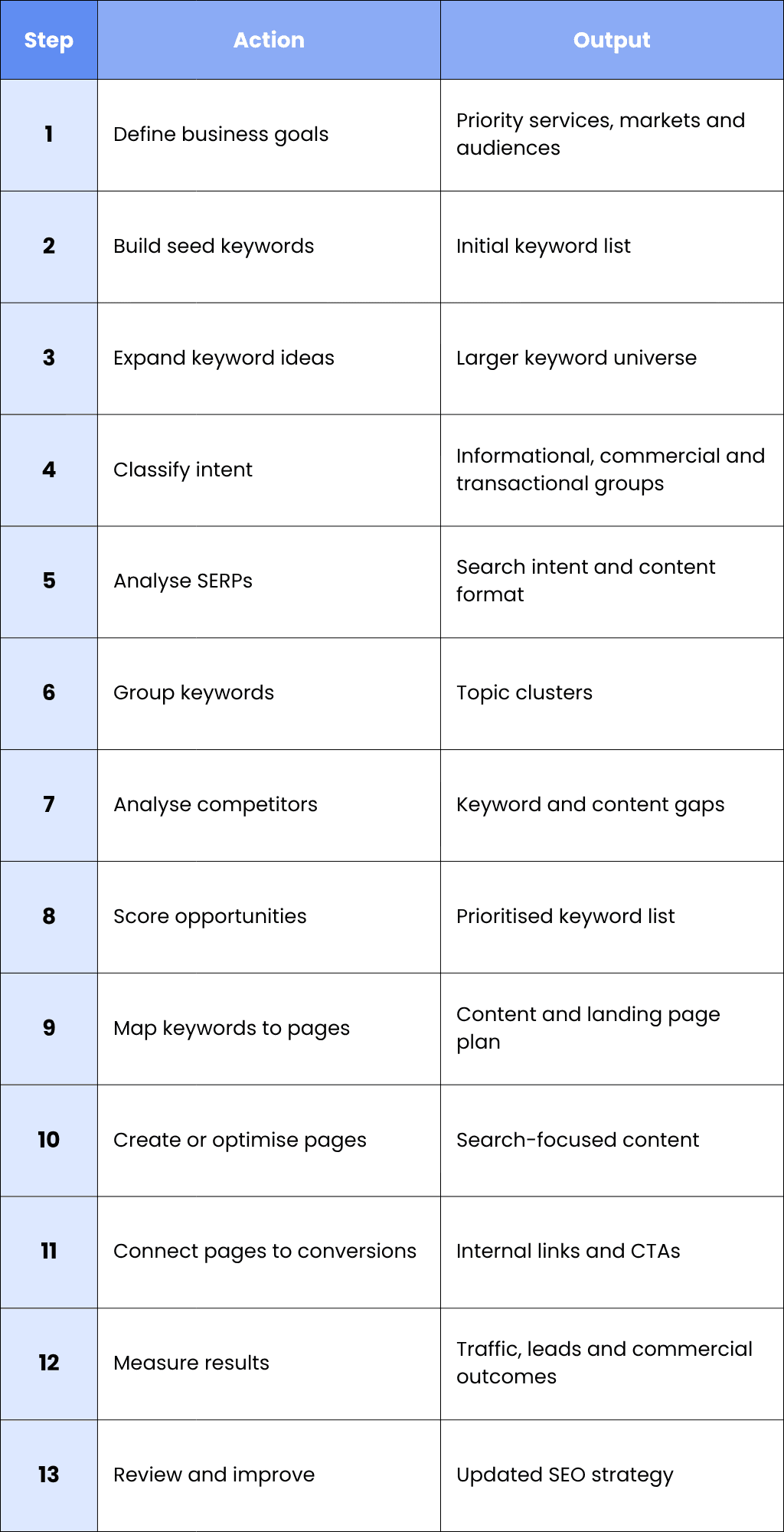
The process should not stop once the first content calendar is complete. Search demand changes, competitors publish new content and your business may introduce new services or enter new markets.
Therefore, revisit your keyword research regularly. A quarterly review is a useful starting point for many businesses, while competitive or rapidly changing industries may require more frequent analysis.
The Real Value Of B2B Keyword Research
When you bring everything together, the real purpose of B2B keyword research becomes clearer.
It is not simply a process for finding words to place on web pages. Instead, it gives your business a structured way to understand what potential customers need, how they search and what information influences their decisions.
The strongest strategies connect three areas:
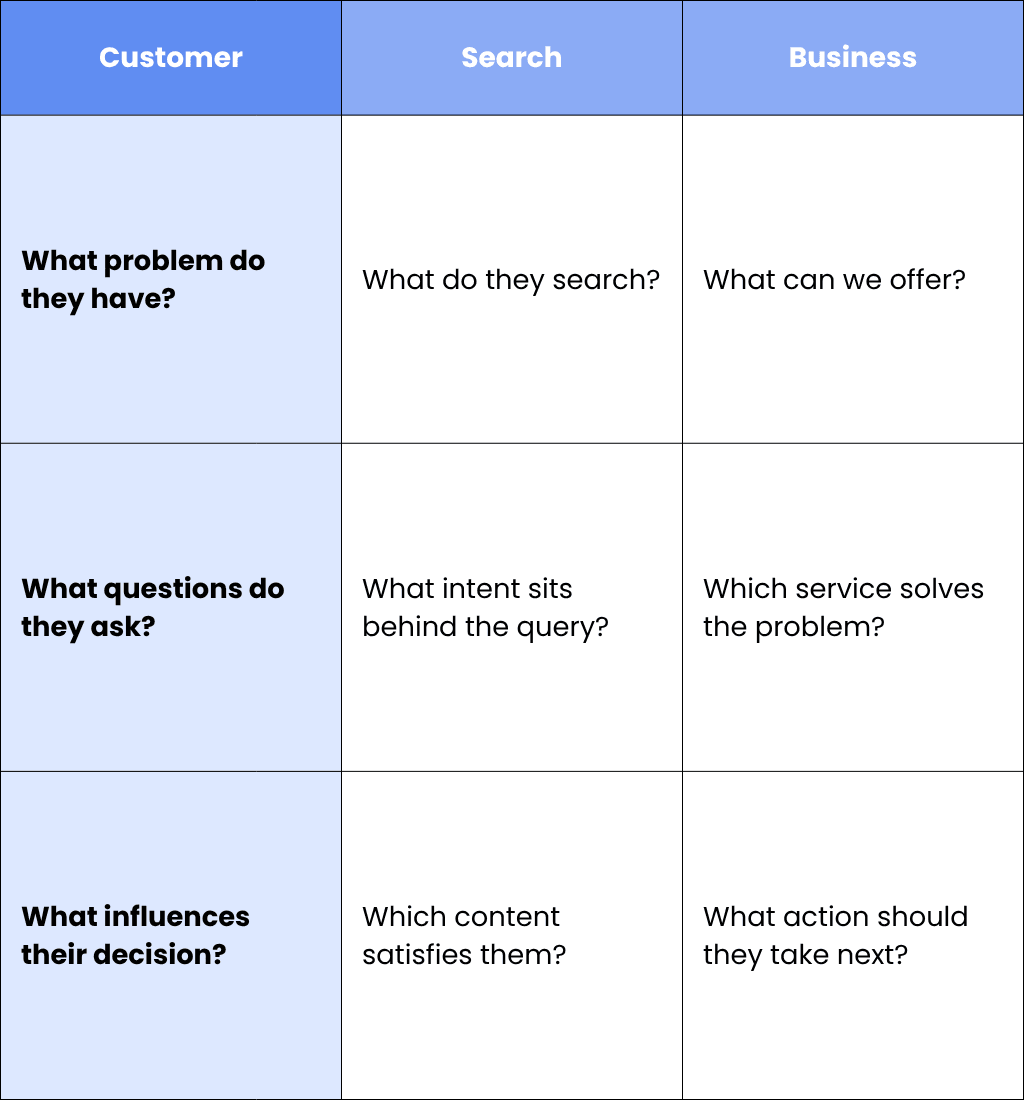
This connection is particularly valuable in B2B markets, where buying journeys can involve multiple people, longer research periods and more complex decisions.
A keyword such as "B2B SEO agency" may create a direct lead opportunity. However, a search such as "how to generate more B2B leads" could introduce the same potential customer months earlier.
Both searches matter because they represent different points in the same customer journey.
The best B2B SEO strategies therefore balance immediate commercial opportunities with longer-term demand generation.
How Saigon Digital Can Help
Saigon Digital is an SEO agency focused on solving digital challenges through forward-thinking, user-centric and bespoke solutions. The goal is not simply to increase rankings, but to turn strategy, creativity and data into measurable business growth.
Our SEO Services cover three core areas:
- Site Optimisation & Technical Performance: improving the technical foundations that allow search engines and users to access and navigate your website effectively.
- Content & Authority Building: creating useful content and strengthening the signals that support long-term organic visibility.
- Local & Global Search Strategy: developing SEO strategies for businesses targeting specific locations, regions or international markets.
As search evolves, we also help businesses understand how their brands can appear across AI-powered search and answer experiences.
Our Generative Engine Optimisation (GEO) service helps brands become more discoverable, quoted and trusted across platforms such as ChatGPT, Gemini, Perplexity and Google AI experiences. Our capabilities include:
- AI Readability Optimisation
- Generative Engine Optimisation (GEO)
- Answer Engine Optimisation (AEO)
- Knowledge Graph & Schema Setup
- AI Content Audit & Reformatting
- AI Performance Dashboard
The objective is not to replace traditional SEO. Instead, we build on strong SEO foundations while helping businesses prepare for how people increasingly discover and evaluate information.
Saigon Digital also provides AI Workflow Automation Services for businesses looking to improve productivity and reduce repetitive manual work. These services include:
- AI-driven intelligence
- Pre-built automation templates
- Custom AI Agents
Together, these capabilities allow businesses to approach digital growth from both sides: being easier to discover and making the business itself more efficient.
Turn Search Intent Into Business Growth
Effective B2B keyword research is not about chasing rankings or collecting keywords. It is about understanding what your customers are searching for, creating the right content for their needs, and turning relevant search traffic into meaningful business opportunities.
At Saigon Digital, we combine SEO strategy, technical expertise, content, data and AI to help ambitious businesses build stronger digital growth.
Ready to turn search visibility into business growth?
Speak to Saigon Digital and let’s build an SEO strategy that works for your business.
Frequently Asked Questions About B2B Keyword Research
1. What Is B2B Keyword Research?
B2B keyword research is the process of finding and evaluating the search terms that potential business customers use when researching problems, solutions, products or services. Unlike simply targeting high-volume keywords, effective B2B keyword research considers search intent, business relevance, buyer stage and commercial potential.
2. How Is B2B Keyword Research Different From B2C Keyword Research?
B2B searches often involve longer buying journeys, multiple decision-makers and more detailed research. Therefore, B2B keyword research needs to cover the entire journey, from problem-based informational searches to commercial and transactional searches such as service, agency or pricing queries.
3. How Do I Find Keywords That Can Generate Business?
Start with your products and services, then identify your customers' problems, desired outcomes, industries and locations. Next, assess search intent, search demand, competition and commercial relevance. Most importantly, prioritise keywords that attract the type of customers your business actually wants rather than simply choosing keywords with the highest search volume.
4. How Do I Know Which Page Should Target A Keyword?
Match the page type to the searcher's intent. For example, use an educational guide for "how to improve B2B SEO", a comparison page for "SEO agency vs freelancer", and a service page for "B2B SEO agency". Before creating a new page, check the search results and make sure another page on your website does not already serve the same purpose.
5. How Often Should I Review My B2B Keyword Research?
Keyword research should be an ongoing process rather than a one-time task. Review your keyword performance regularly, such as quarterly, and pay attention to changes in search behaviour, competitors, rankings, conversions and business priorities. Your Google Search Console data can also reveal new queries and opportunities that were not included in your original research.