



Artificial intelligence is changing the way people discover products online. Instead of browsing through pages of search results, customers are increasingly asking AI assistants direct questions such as:
- "What is the best espresso machine for a small café?"
- "Which eco-friendly food packaging supplier is most reliable?"
- "What are the best ergonomic office chairs under £500?"
Rather than displaying a list of blue links, AI platforms such as ChatGPT, Google AI Overviews, Gemini and Perplexity generate direct answers that often recommend specific brands, products and websites. As a result, businesses now face a new challenge: ensuring their products are not only indexed by search engines but also recognised, trusted and cited by AI systems.
In this guide, we'll explore everything businesses need to know about AI search visibility for E-Commerce, including how AI search works, why product citations matter, and the practical steps you can take to increase your visibility across today's leading AI search platforms.
What Is AI Search Visibility for E-Commerce?
AI search visibility for E-Commerce refers to how easily artificial intelligence search platforms can discover, understand, trust and recommend your products when generating answers for users.
Unlike traditional search engines that present users with a list of websites to explore, AI-powered search engines synthesise information from multiple trusted sources to provide a single, comprehensive response. These responses often include product recommendations, brand mentions, comparisons and buying advice.
For example, if someone asks: "Which commercial coffee grinder is best for a busy café?"
An AI assistant may recommend several products, explain their advantages and reference manufacturers, retailers or expert review websites. If your products are not recognised as reliable, authoritative or well-structured, they are unlikely to appear in those recommendations.
AI search visibility therefore extends beyond ranking highly on Google. It focuses on becoming a trusted source that AI systems confidently reference when answering real customer questions.
Why AI Search Visibility Matters More Than Ever
Consumer search behaviour is evolving rapidly.
Instead of typing short keywords, people now ask conversational questions that closely resemble discussions with a sales consultant. AI assistants can interpret context, compare options and provide personalised recommendations within seconds.
For e-commerce businesses, this creates both opportunities and challenges.
Businesses that optimise for AI search can benefit from:
1. Increased Brand Exposure
Every AI-generated recommendation introduces your brand to potential customers, even if they never visit a traditional search results page.
As AI assistants become trusted advisors throughout the buying journey, appearing in their responses can significantly increase brand awareness.
2. Higher Quality Traffic
AI-generated recommendations often reach users with strong purchase intent.
Someone asking: "Which POS system is best for a restaurant with multiple locations?"
is much closer to making a purchasing decision than someone searching for a broad keyword like "restaurant POS".
Being cited during these decision-making moments can attract visitors who are more likely to convert.
3. Greater Trust and Authority
People naturally place greater confidence in recommendations that appear within comprehensive AI-generated answers.
When your products are consistently referenced alongside reputable brands and authoritative sources, your business benefits from an additional layer of credibility.
4. Competitive Advantage
Many businesses continue to focus exclusively on conventional SEO.
Forward-thinking organisations are already investing in AI optimisation strategies to secure visibility before competitors fully adapt to this new search landscape.
As AI search continues to grow, businesses that establish authority early are likely to enjoy a lasting competitive advantage.
How AI Search Differs from Traditional SEO
Traditional SEO remains essential, but AI search introduces new priorities.
Understanding these differences helps businesses build a more effective digital strategy.
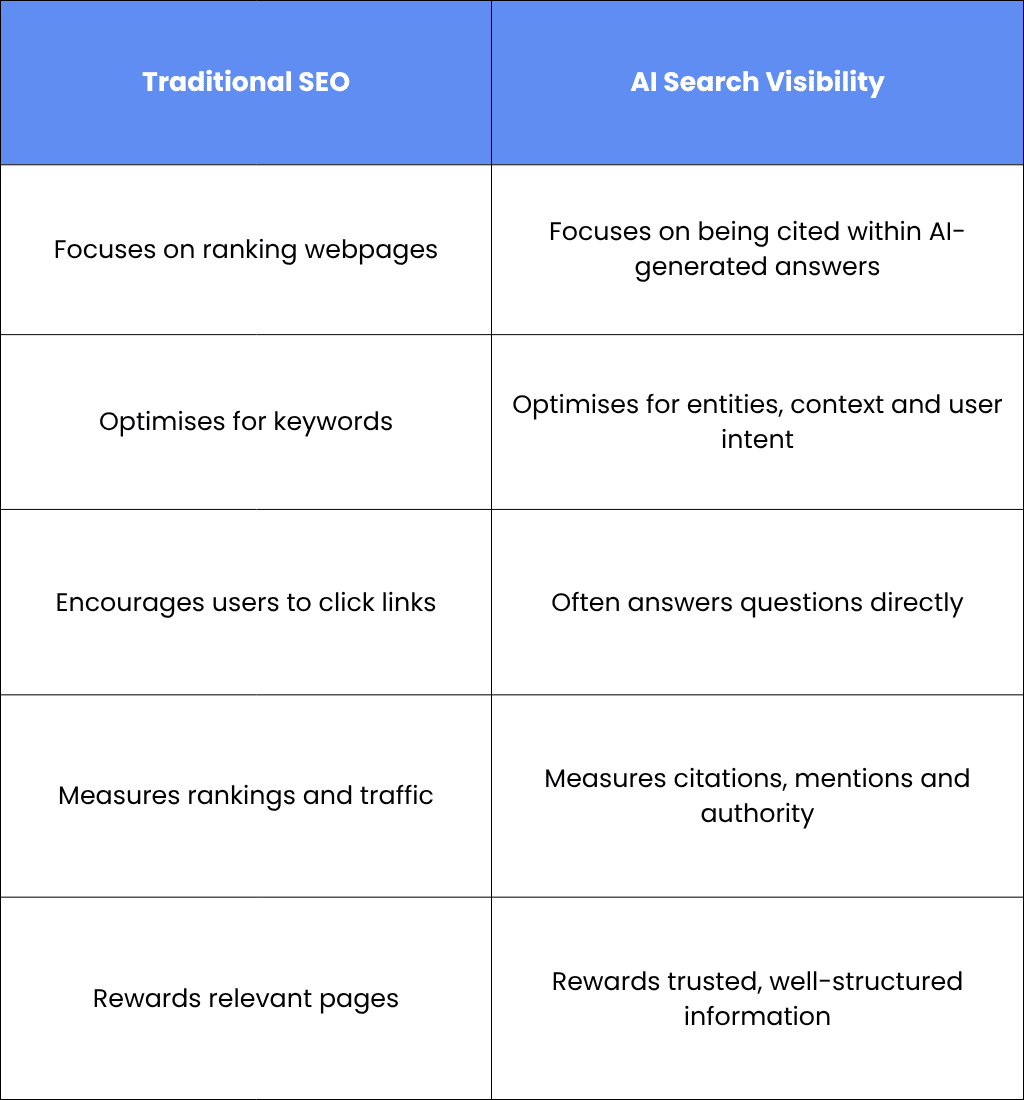
Rather than replacing SEO, AI search builds upon it.
A technically strong website, high-quality content and authoritative backlinks remain essential. However, AI platforms also evaluate how clearly information is structured, how consistently a brand is mentioned across the web, and whether content directly answers users' questions.
Businesses that combine strong SEO fundamentals with AI-focused optimisation are best positioned for long-term success.
How AI Search Engines Decide Which Products to Recommend
One of the biggest misconceptions about AI-powered search is that platforms simply display the highest-ranking page from Google. In reality, today's AI search engines use a much more sophisticated process.
Platforms such as ChatGPT, Google AI Overviews, Gemini and Perplexity aim to answer a user's question as accurately and helpfully as possible. Rather than relying on a single webpage, they analyse information from multiple trusted sources, compare the available evidence and generate a response that best matches the user's intent.
This means that AI search visibility for E-Commerce is no longer determined by rankings alone. Instead, AI models evaluate a combination of content quality, technical signals, brand authority and contextual relevance before deciding which products to mention.
Although each AI platform uses its own algorithms and data sources, they generally assess the following five areas.
1. Trustworthiness of the Source
Before recommending a product, AI systems first assess whether the source of the information appears reliable.
This is particularly important because AI platforms are designed to reduce misinformation and provide users with dependable answers. As a result, websites that consistently publish accurate, transparent and well-maintained information are generally more likely to be referenced than those with incomplete or outdated content.
For e-commerce businesses, trust extends far beyond having an attractive website. AI systems look for signals that indicate your business is legitimate, knowledgeable and customer-focused.
Some of these signals include:
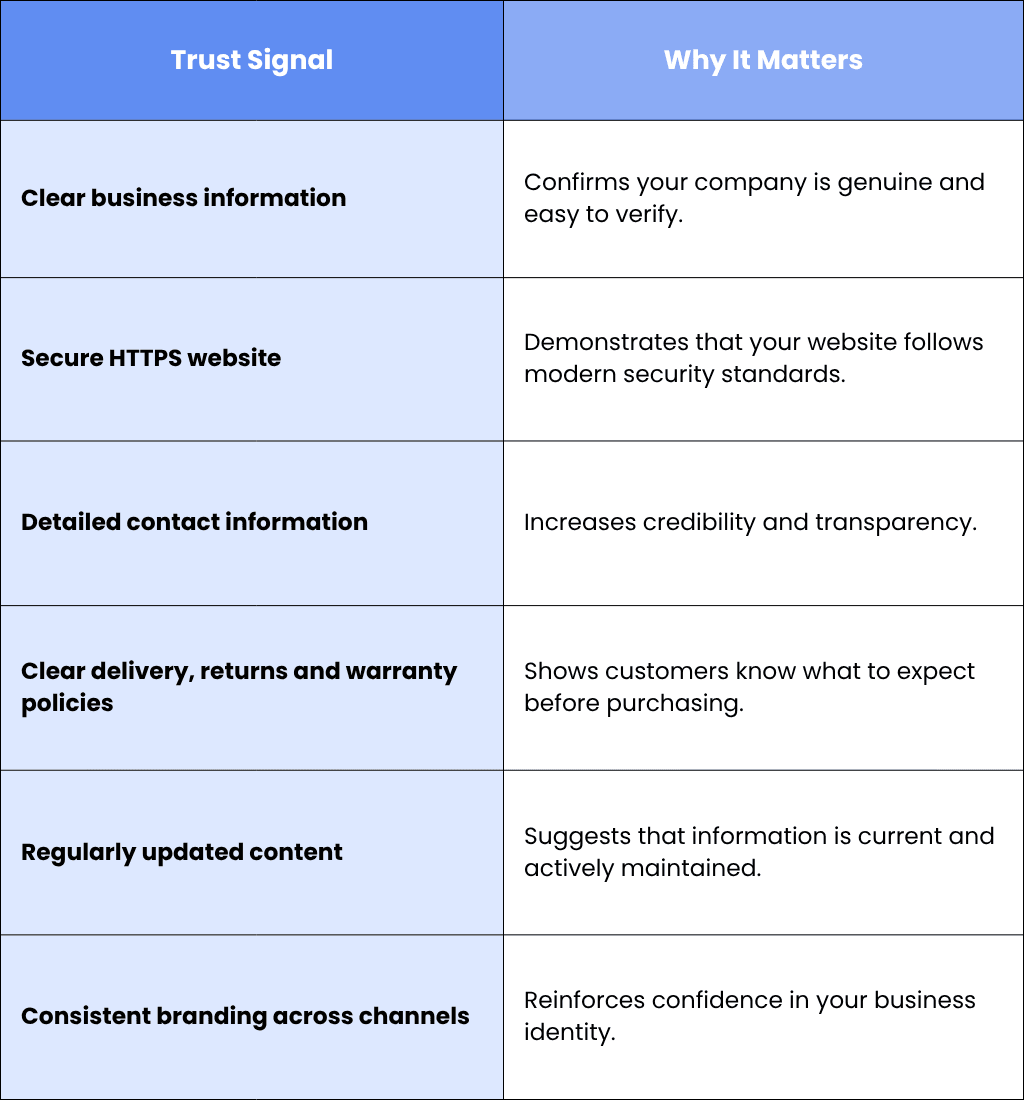
For example, imagine two online retailers selling the same commercial coffee grinder.
Retailer A provides only a short product description, no company background and minimal customer support information.
Retailer B offers detailed specifications, installation guidance, warranty information, verified customer reviews, comprehensive FAQs and clear contact details.
Even if both products are similar, Retailer B provides significantly stronger trust signals. Consequently, an AI platform is more likely to consider its content reliable enough to reference.
Practical Tip
Review your website as though you were a first-time customer.
Ask yourself:
- Can visitors easily identify who operates the business?
- Are your policies easy to find?
- Does every product page appear trustworthy?
- Would an AI system find enough information to confidently recommend your products?
Building trust is an ongoing process, but every improvement strengthens your long-term AI search visibility.
2. Content Quality
Once AI platforms establish that a source is trustworthy, they evaluate the quality and usefulness of its content.
Unlike traditional keyword-focused search, modern AI systems attempt to understand the complete context of a topic. They favour content that thoroughly answers user questions rather than pages written solely to rank for search terms.
For product pages, this means moving beyond basic descriptions.
Instead of simply stating what a product is, explain:
- Who it is designed for.
- What problems it solves.
- How it compares with alternatives.
- Which industries commonly use it.
- What customers should know before purchasing.
For example, compare the following descriptions.
Basic description: Commercial refrigerator with 600-litre capacity and stainless-steel finish.
AI-friendly description: This 600-litre commercial refrigerator is designed for restaurants, cafés and hotels that require reliable cold storage during busy service periods. Its stainless-steel construction supports easy cleaning, while energy-efficient cooling helps reduce operating costs. Adjustable shelving allows businesses to store a wide variety of fresh ingredients safely and efficiently.
The second version provides far more context, making it easier for both customers and AI systems to understand when the product should be recommended.
High-quality product pages often include:
- Original descriptions
- Technical specifications
- Benefits and practical applications
- Product comparisons
- Frequently asked questions
- Images and videos
- Customer reviews
- Maintenance advice
- Warranty information
The more comprehensive your content is, the more opportunities AI has to extract useful information when answering user queries.
3. Structured Information
Even the most detailed content can be difficult for machines to interpret if it lacks structure.
This is where structured data becomes invaluable.
Structured data uses schema markup to label important information on a webpage, helping search engines and AI systems understand exactly what each piece of content represents.
Think of it as providing AI with a well-organised spreadsheet instead of asking it to interpret an entire paragraph of text.
For example, rather than simply reading:
Price: £249
Schema markup explicitly identifies that value as:
- Product price
- Currency
- Current availability
- Product identifier
- Brand
This removes ambiguity and allows AI systems to process information more efficiently.
Key Schema Types for E-Commerce
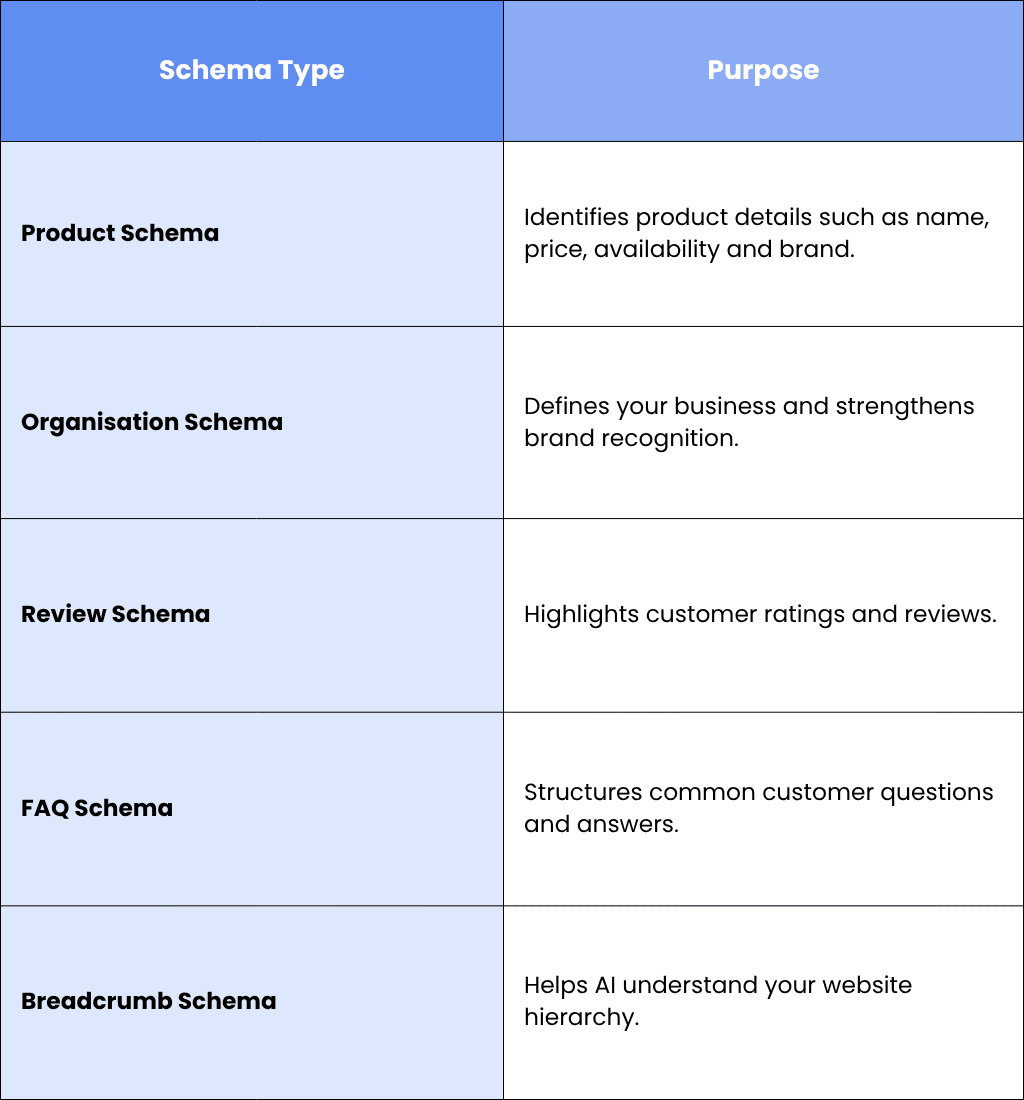
Example
Without schema: Premium ergonomic office chair with adjustable lumbar support.
With Product Schema, AI can also understand:
- Brand
- Model number
- SKU
- Price
- Availability
- Product category
- Aggregate rating
- Number of reviews
The richer the structured information, the easier it becomes for AI search engines to understand and reference your products accurately.
4. Reputation Across the Web
AI systems rarely rely on a single website when generating answers.
Instead, they compare information from multiple trusted sources to determine whether a brand is credible.
Think of it as a form of digital consensus.
If your products are consistently mentioned across respected publications, review websites, industry organisations and trusted marketplaces, AI gains greater confidence that your business is a recognised authority.
Common sources that strengthen online reputation include:
- Industry publications
- News websites
- Professional associations
- Manufacturer websites
- Retail partners
- Review platforms
- Government resources
- Educational institutions
For example, suppose a company sells sustainable food packaging.
If its products are mentioned by environmental organisations, hospitality magazines, restaurant associations and reputable distributors, those independent references reinforce the company's authority.
AI systems interpret this consistency as evidence that the brand is established and trustworthy.
5. User Intent
Ultimately, AI platforms are designed to answer the user's actual question, not simply match keywords.
This is one of the biggest differences between AI search and traditional search.
Consider these two searches.
Search A: Best laptop
Search B: What's the best lightweight laptop for a graphic designer who travels frequently?
Although both searches mention laptops, the second query contains much richer context.
An AI assistant will consider factors such as:
- Weight
- Battery life
- Processing power
- Graphics performance
- Display quality
- Portability
- Budget
- Intended use
The recommended products will therefore differ significantly.
What This Means For E-Commerce Businesses
Rather than creating content around generic keywords alone, consider the situations your customers face.
Ask questions such as:
- What problems are they trying to solve?
- What factors influence their purchasing decisions?
- Which industries do they work in?
- What concerns might they have before buying?
- Which alternatives are they comparing?
For example, instead of targeting only:
Commercial coffee machine
You could create content answering questions like:
- Which commercial coffee machine is best for a small café?
- How much capacity does a busy restaurant need?
- Should hotels choose bean-to-cup or traditional espresso machines?
- What maintenance costs should café owners expect?
This approach helps AI connect your products with real-world customer needs.
A Useful Framework For Mapping User Intent
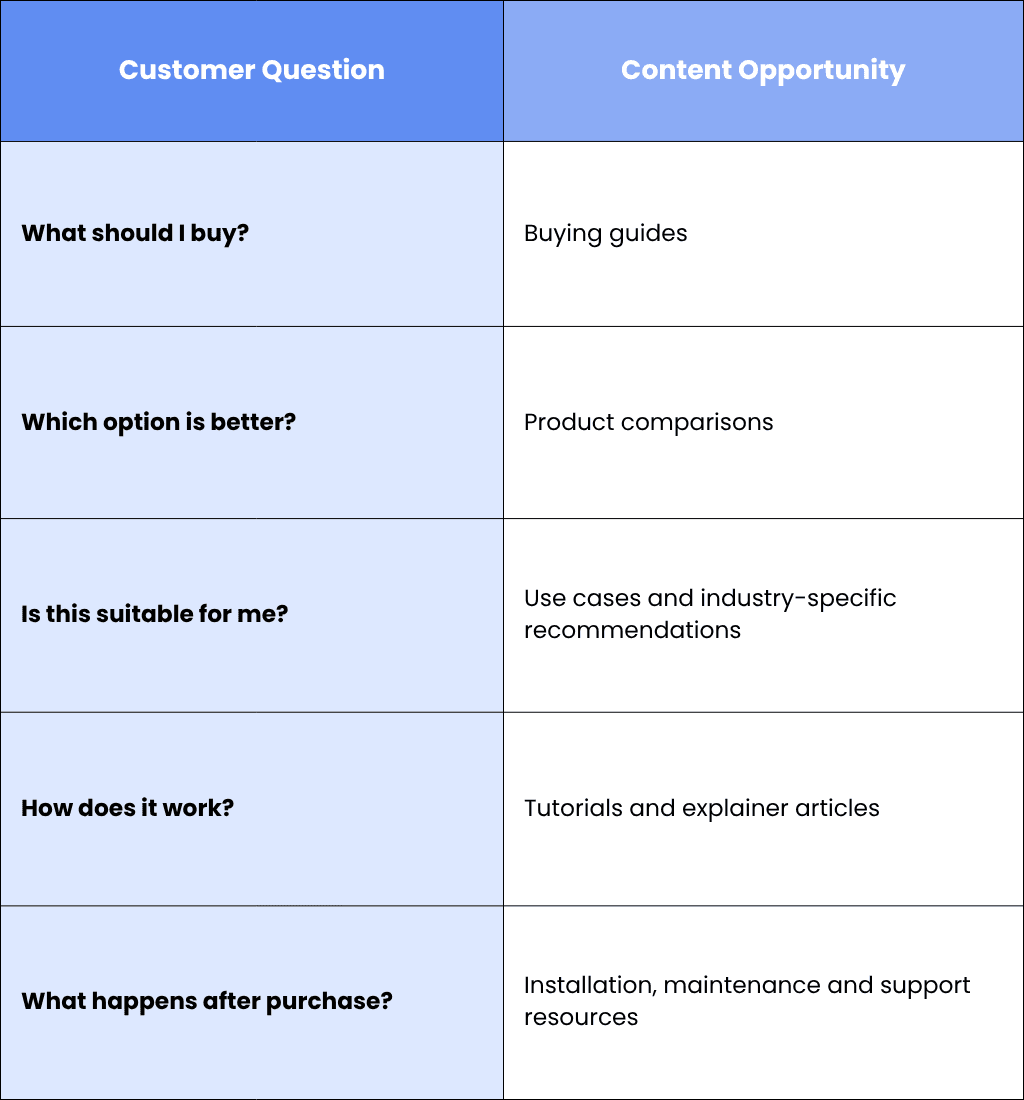
The more effectively your website answers these questions, the more opportunities AI platforms have to recommend your products during different stages of the buying journey.
How to Improve AI Search Visibility for E-Commerce
The following framework provides a practical, step-by-step approach that businesses can implement regardless of their industry. Each step builds on the previous one, so it's best to treat them as complementary rather than isolated tasks.
Step 1: Build AI-Friendly Product Pages
Your product pages are often the first source AI platforms use to understand what you sell. If these pages provide only basic information, AI has little context to determine when, or even if, your products should be recommended.
Instead of viewing a product page as a simple catalogue entry, think of it as a resource that answers every important question a potential customer may have before making a purchase.
Start with Complete Product Information
Begin by ensuring every product page includes the essential information customers expect.
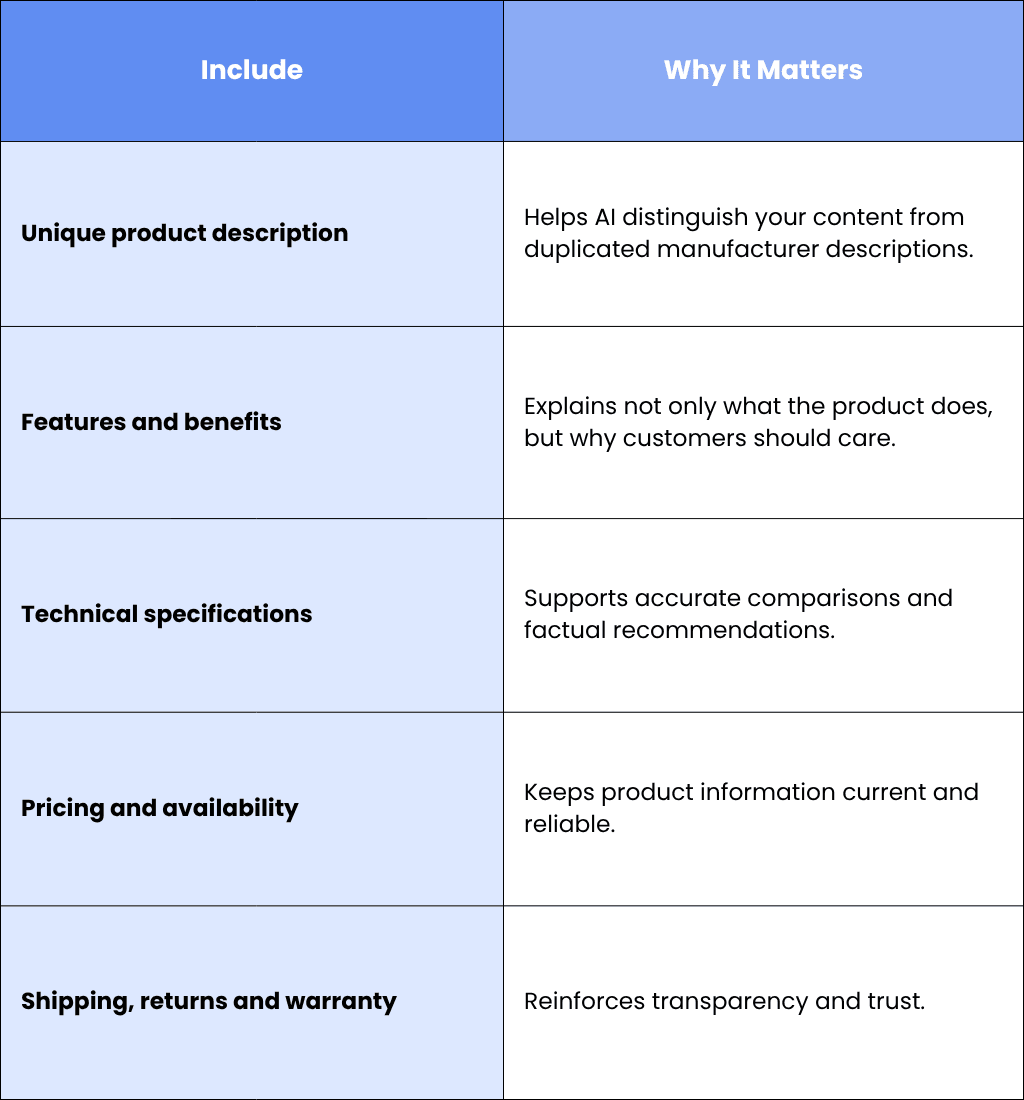
While these elements form the foundation, they rarely provide enough context on their own.
Explain the Product in Context
AI platforms increasingly answer detailed, scenario-based questions. Instead of simply asking, "What is the best coffee machine?", users might ask:
- Which espresso machine is suitable for a busy café?
- What display fridge is best for a convenience store?
- Which POS system works well for a boutique hotel?
Your product pages should therefore explain where, when and why a product is the right choice.
For example, rather than writing:
Commercial refrigerator with a 600-litre capacity and stainless-steel finish.
Expand the description to explain its practical value.
Designed for restaurants, cafés and hotel kitchens, this 600-litre commercial refrigerator provides ample cold storage while maintaining consistent temperatures during busy service periods. Adjustable shelving makes it easy to organise ingredients, while its energy-efficient cooling system helps reduce operating costs.
Notice how the second example provides context that helps both customers and AI understand the product's intended use.
Anticipate Customer Questions
Another effective way to improve product pages is by answering common questions before customers need to ask them.
Consider adding a dedicated FAQ section that addresses topics such as:
- Which businesses is this product designed for?
- Is installation included?
- Does it comply with industry regulations?
- What maintenance is required?
- Are replacement parts available?
- What accessories are compatible?
These questions closely mirror the conversational prompts users submit to AI platforms. By answering them directly, you create content that is easier for AI to reference while reducing uncertainty during the buying journey.
Step 2: Create Topic Clusters Around Customer Questions
Although product pages are essential, they represent only one stage of the customer journey. Before making a purchase, most buyers spend time researching options, comparing products and learning about potential solutions.
This is precisely where educational content supports AI search visibility.
AI platforms frequently recommend businesses that demonstrate expertise across an entire topic, not just those with well-written product pages. The more effectively your website answers customer questions, the more opportunities AI has to reference your content.
Think Beyond Keywords
Traditional SEO often focused on individual keywords. For example, an online retailer might create separate pages targeting:
- Commercial coffee machine
- Professional coffee machine
- Coffee machine for cafés
- Best café coffee machine
While each phrase differs slightly, the underlying user intent is largely the same.
Rather than creating multiple pages covering similar ground, develop one comprehensive resource that explores the topic in depth. This approach provides greater value for readers while helping AI understand the breadth of your expertise.
Build Topic Clusters
One of the most effective ways to organise educational content is through topic clusters.
A topic cluster consists of a central pillar page supported by several related articles, all connected through internal links.
For example:
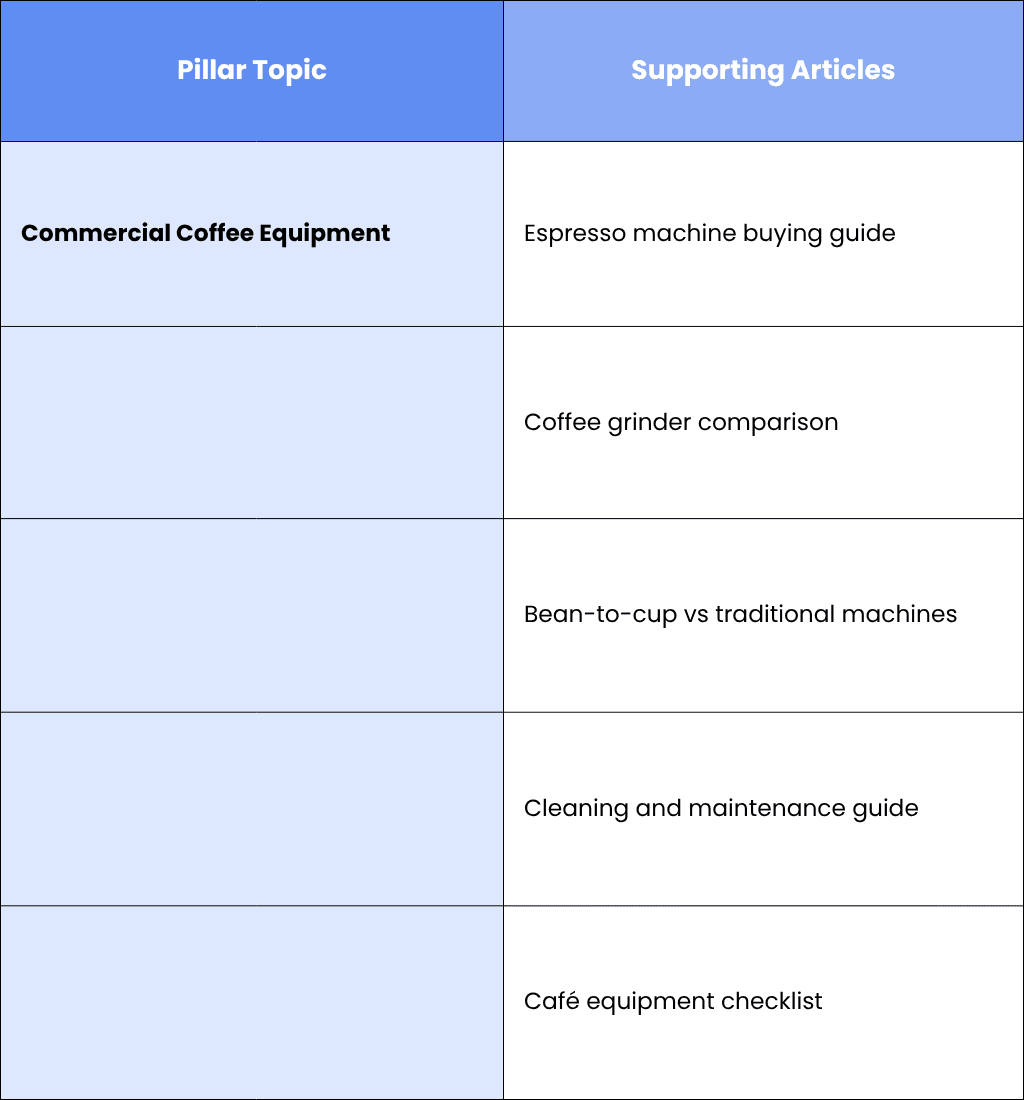
This structure signals to search engines and AI platforms that your website covers the subject comprehensively rather than superficially.
Match Content to the Buying Journey
Educational content should also reflect the different stages of the customer's decision-making process.
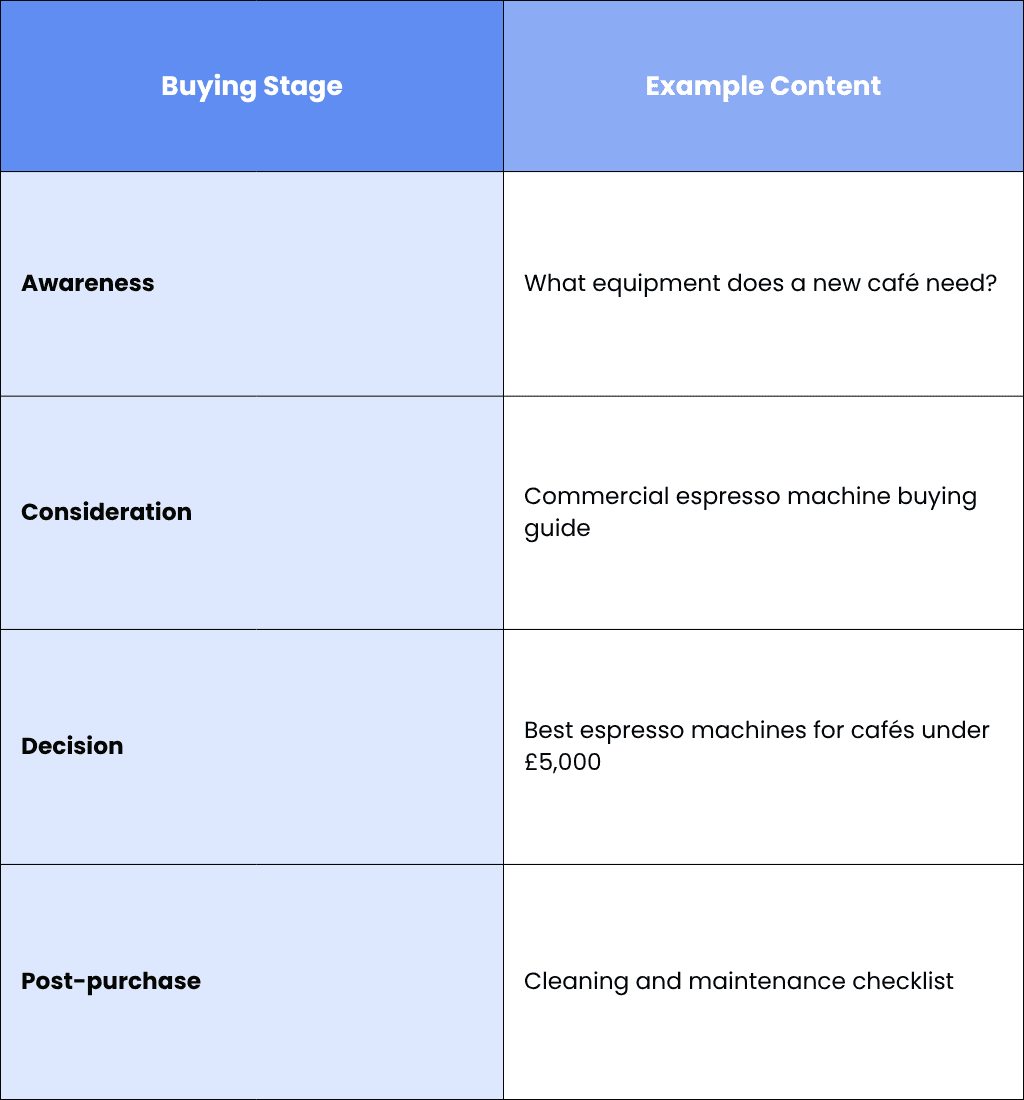
By supporting customers throughout the buying journey, you create multiple opportunities for AI to discover and reference your expertise.
Prioritise Helpful Content
When creating educational resources, ask yourself one simple question: Would this article genuinely help someone make a better purchasing decision?
If the answer is yes, it is likely to benefit both your audience and your AI search visibility.
As your library of educational content grows, however, AI platforms still need a reliable way to interpret the information on each page. This is where structured data becomes an essential part of your optimisation strategy.
Step 3: Implement Structured Data Correctly
Even the most informative website can be difficult for machines to understand if important information is not clearly labelled.
Structured data solves this problem by providing explicit information about your products, business and content using schema markup.
Think of schema as translating your website into a language that search engines and AI platforms can interpret with greater accuracy.
Prioritise the Most Valuable Schema Types
While Schema.org offers hundreds of different schema types, most e-commerce businesses should focus on a small number that provide the greatest value.
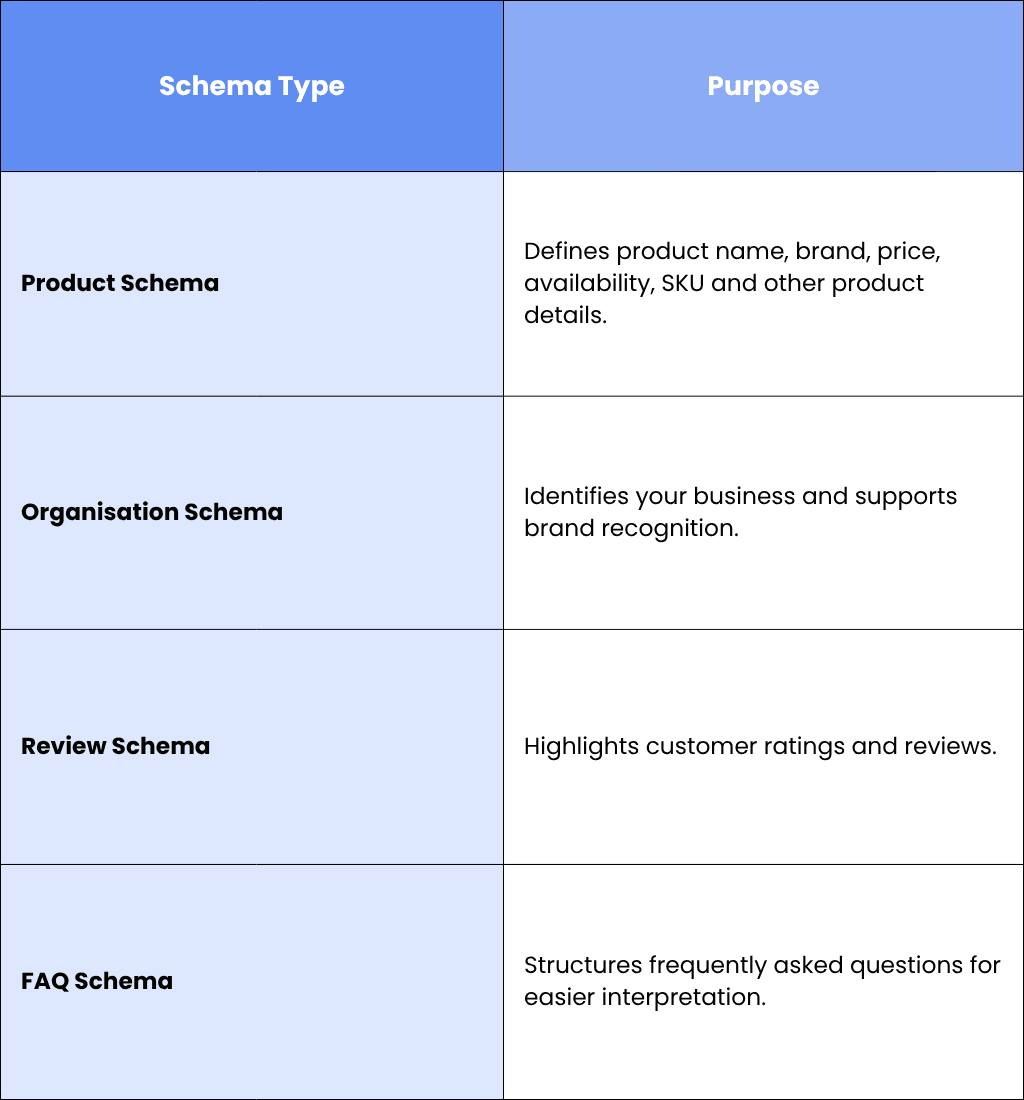
Together, these schema types help AI platforms interpret your content more accurately and reduce ambiguity.
Keep Structured Data Accurate
Schema is only useful if it reflects the information users actually see on the page.
For example, if Product Schema lists a product as In Stock while the page clearly states it is unavailable, this inconsistency can weaken trust.
Whenever product information changes, review your structured data to ensure it remains accurate.
Validate Your Implementation
After adding schema, test it regularly as part of your technical SEO process.
Check for:
- Missing required properties
- Invalid values
- Pricing inconsistencies
- Availability errors
- Incorrect product identifiers
Regular validation helps ensure search engines and AI platforms continue to interpret your content correctly.
Step 4: Optimise Product Images and Other Media
By this stage, you've created comprehensive product pages, organised your content around customer questions and implemented structured data. The next step is to ensure your visual content reinforces the same information.
Although AI platforms primarily rely on text, they are becoming increasingly capable of interpreting images alongside the surrounding content. Well-optimised visuals help AI better understand your products while also improving the user experience.
Use High-Quality, Original Images
Whenever possible, use original product photography instead of relying solely on manufacturer images. Original visuals make your website more distinctive and often provide additional context that stock images cannot.
For each product, include:
- Multiple viewing angles
- Close-up images of important features
- Lifestyle images showing the product in use
- Images that demonstrate scale or size
- Product demonstration videos where appropriate
For example, if you sell commercial kitchen equipment, don't just show the appliance on a white background. Include photographs of it being used in a restaurant kitchen to demonstrate its intended environment.
Help Search Engines Understand Your Images
Images should also be optimised behind the scenes.
Follow these best practices:
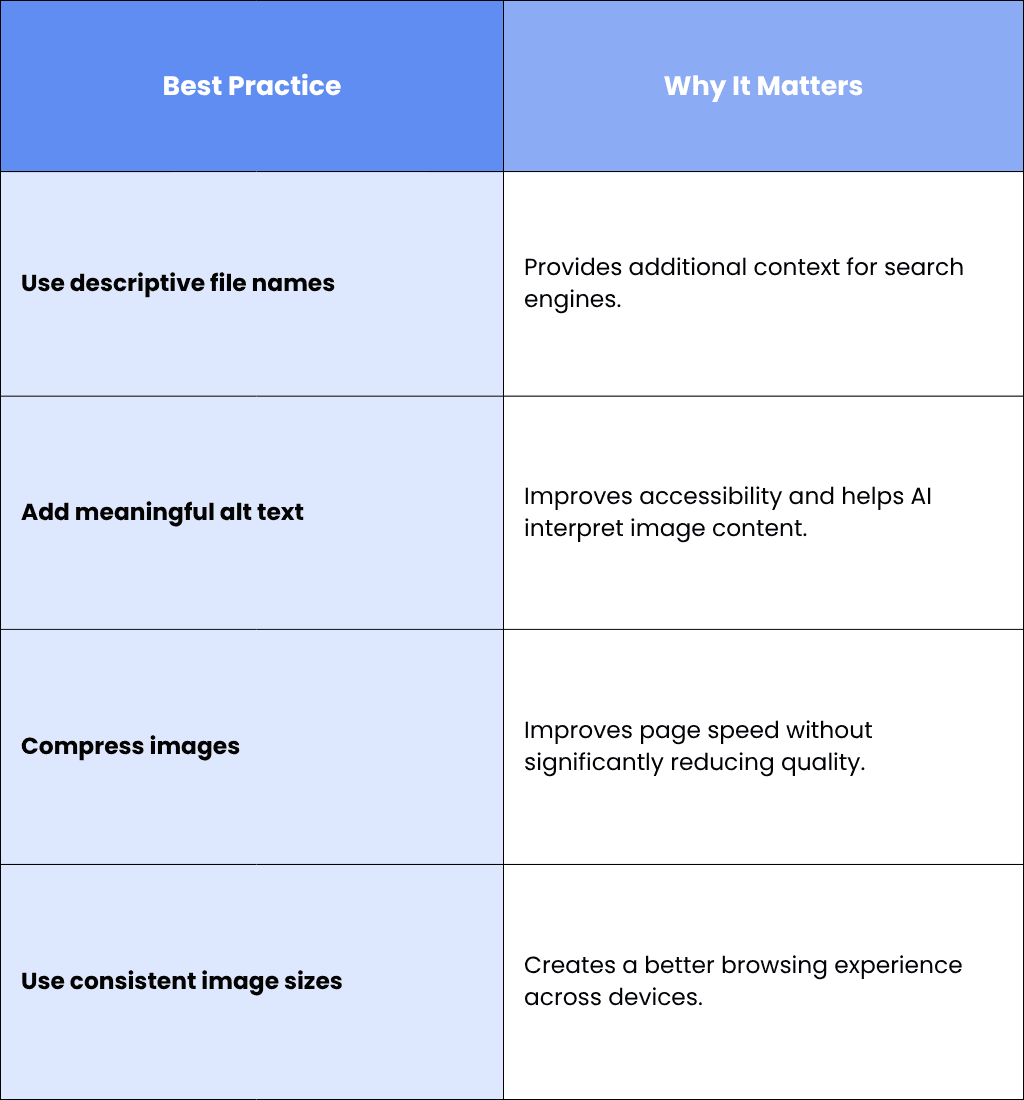
For example:
❌ IMG_4837.jpg
✔ commercial-stainless-steel-espresso-machine.jpg
Similarly, write alt text that describes the image naturally.
Instead of:
"Coffee machine"
Write:
"Commercial espresso machine with dual group heads installed in a busy café."
This provides useful context while supporting accessibility for users who rely on screen readers.
Keep Visuals Consistent
Your product images should reinforce the information presented elsewhere on the page.
If your description explains that a product is designed for boutique hotels or cafés, include visuals that reflect those environments. Consistent messaging helps customers make quicker decisions while giving AI additional confidence when interpreting your content.
Once you've strengthened your visual assets, the next priority is demonstrating that real customers trust your products.
Step 5: Strengthen Trust with Reviews and Social Proof
Trust is one of the strongest signals influencing whether AI platforms recommend a business. While your own content is important, independent opinions often carry additional weight because they provide third-party validation.
This is where customer reviews, testimonials and case studies become particularly valuable.
Encourage Detailed Customer Reviews
Rather than simply asking customers to "leave a review", encourage them to share information that will help future buyers.
For example, ask questions such as:
- What challenge were you trying to solve?
- Why did you choose this product?
- Which features have been most useful?
- How has the product performed since purchase?
- Would you recommend it to another business?
These detailed responses provide richer information than short comments such as "Excellent product" or "Fast delivery". They also introduce natural language that reflects the types of questions people ask AI assistants.
Showcase Business Outcomes
If you primarily sell to businesses, case studies can be even more persuasive than standard reviews.
Instead of simply stating that a customer was satisfied, explain the measurable outcomes your product delivered.
For example:
Before:
After:
These practical examples demonstrate expertise while giving AI additional evidence of your product's real-world value.
Display Reviews Throughout the Buying Journey
Reviews should not be limited to product pages.
Consider incorporating them into:
- Category pages
- Buying guides
- Comparison articles
- Case studies
- Homepage highlights
This reinforces trust at multiple stages of the customer journey and supports users as they move from research to purchase.
Focus on Authenticity
Resist the temptation to remove every negative review. A small number of constructive reviews often make your overall feedback appear more credible.
Instead, respond professionally, address concerns where appropriate and demonstrate your commitment to customer service.
Authenticity builds confidence—not only with prospective customers but also with search engines and AI systems evaluating your business.
Step 6: Keep Product Data Consistent Across Every Channel
After optimising your website, the next priority is ensuring that your product information remains consistent wherever your brand appears online.
Unlike traditional search engines, AI platforms often gather information from multiple sources before generating a response. They may compare your website with product feeds, business directories, retailer listings, manufacturer websites and other trusted sources. If this information conflicts, AI may be less confident about recommending your products.
For this reason, consistency should be treated as an ongoing maintenance task rather than a one-time project.
Standardise Your Product Information
Review your product catalogue regularly and ensure the following details remain consistent across every platform:
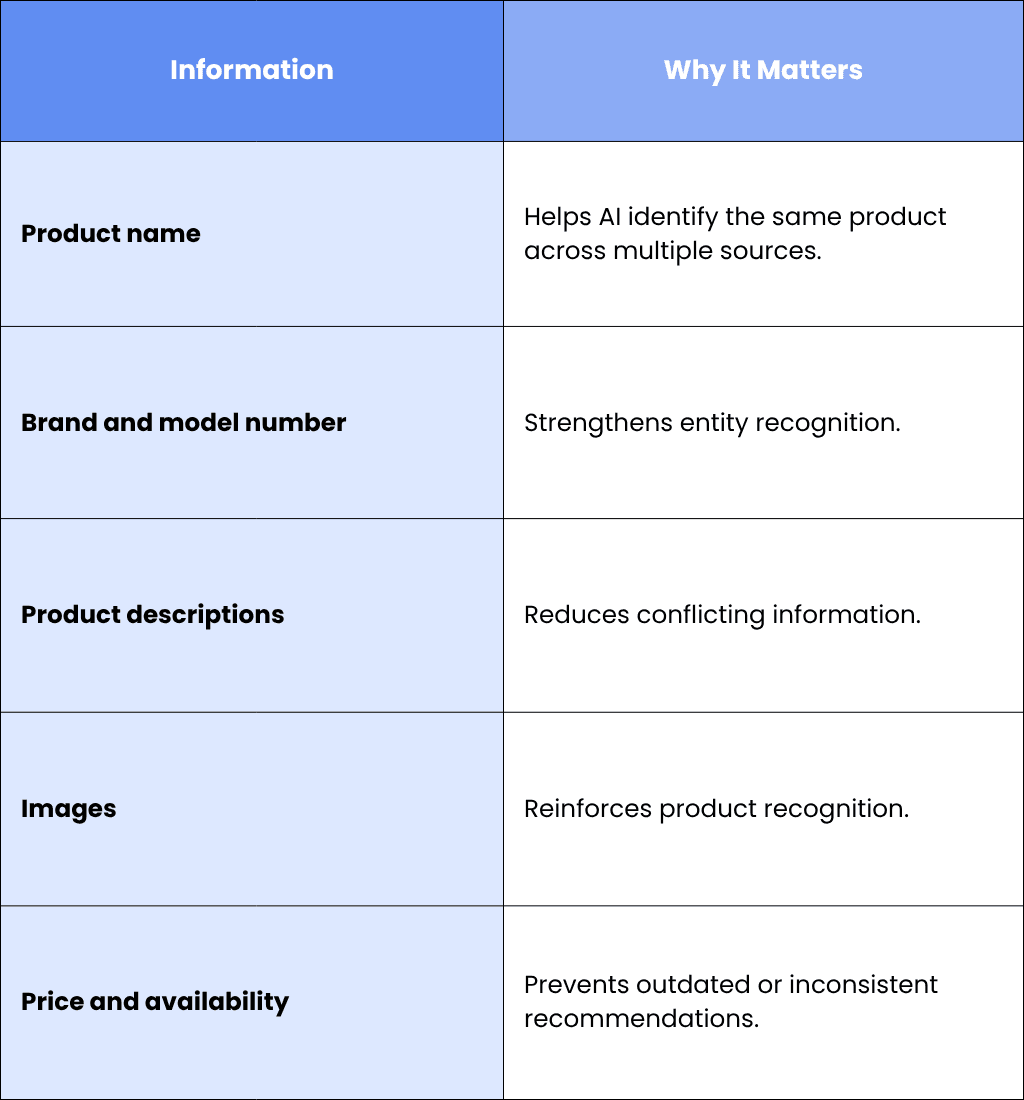
In addition to your own website, check information published on:
- Google Merchant Center
- Online marketplaces
- Distributor websites
- Manufacturer catalogues
- Business directories
- Social commerce platforms
Consistency builds confidence. When AI repeatedly encounters the same information across trusted sources, it becomes easier to recognise your business as a reliable authority.
Step 7: Optimise Your Google Merchant Center Feed
If your business sells products online, your Google Merchant Center feed should be viewed as more than a tool for Google Shopping. It is also an important source of structured product information that supports Google's understanding of your catalogue.
A well-maintained feed complements the work you've already done on your website by supplying clear, up-to-date product data.
As a minimum, review the following elements regularly:
- Product titles
- Descriptions
- GTINs or other product identifiers
- Product categories
- Pricing
- Availability
- Images
- Shipping information
Avoid using keyword-stuffed titles or vague descriptions. Instead, write titles that accurately describe the product while matching the terminology your customers are likely to use.
For example:
❌ Best Coffee Machine Cheap Sale
✔ Two-Group Commercial Espresso Machine for Cafés
Finally, schedule routine feed reviews to identify missing attributes, disapproved products or outdated information. Even small inaccuracies can reduce the quality of the data available to search engines and AI platforms.
With reliable product data in place, the next step is to strengthen the overall reputation of your brand.
Step 8: Build Brand Authority and Strengthen Your Knowledge Graph Presence
High-quality content and accurate product information are essential, but AI platforms also consider how your business is recognised beyond its own website.
Think of your digital presence as a network of trust signals. The more consistently your brand is referenced by credible sources, the easier it becomes for AI systems to understand who you are and why your business deserves to be cited.
Strengthen Your Brand Authority
One of the most effective ways to build authority is to become a recognised source of expertise within your industry.
This can be achieved by:
- Publishing original research or industry insights
- Contributing articles to reputable publications
- Speaking at industry events or webinars
- Earning high-quality backlinks
- Building partnerships with respected organisations
- Producing expert commentary on emerging trends
For example, a hospitality technology provider could publish an annual report on hotel booking trends. If industry publications reference that report, the business strengthens both its authority and its visibility across the web.
Improve Your Knowledge Graph Signals
Knowledge Graphs help search engines connect information about businesses, products and people. Although there is no single action that guarantees inclusion, businesses can strengthen these signals by maintaining consistent information across trusted platforms.
Focus on:
- Organisation Schema
- Google Business Profile
- Verified social media profiles
- Consistent business details
- Author biographies for key contributors
- Mentions from reputable industry websites
Together, these signals make it easier for AI systems to recognise your brand as a legitimate entity rather than simply another website.
As your authority grows, it becomes even more important that your website delivers a fast, reliable and accessible experience.
Step 9: Strengthen Your Technical SEO Foundations
Although AI search introduces new optimisation strategies, technical SEO remains the foundation that supports everything else.
If search engines struggle to crawl, index or interpret your website, even the most helpful content may fail to reach its full potential.
Rather than chasing technical perfection, prioritise the improvements that have the greatest impact on usability and discoverability.
Focus on the Fundamentals
Review your website regularly to ensure it performs well in the following areas:
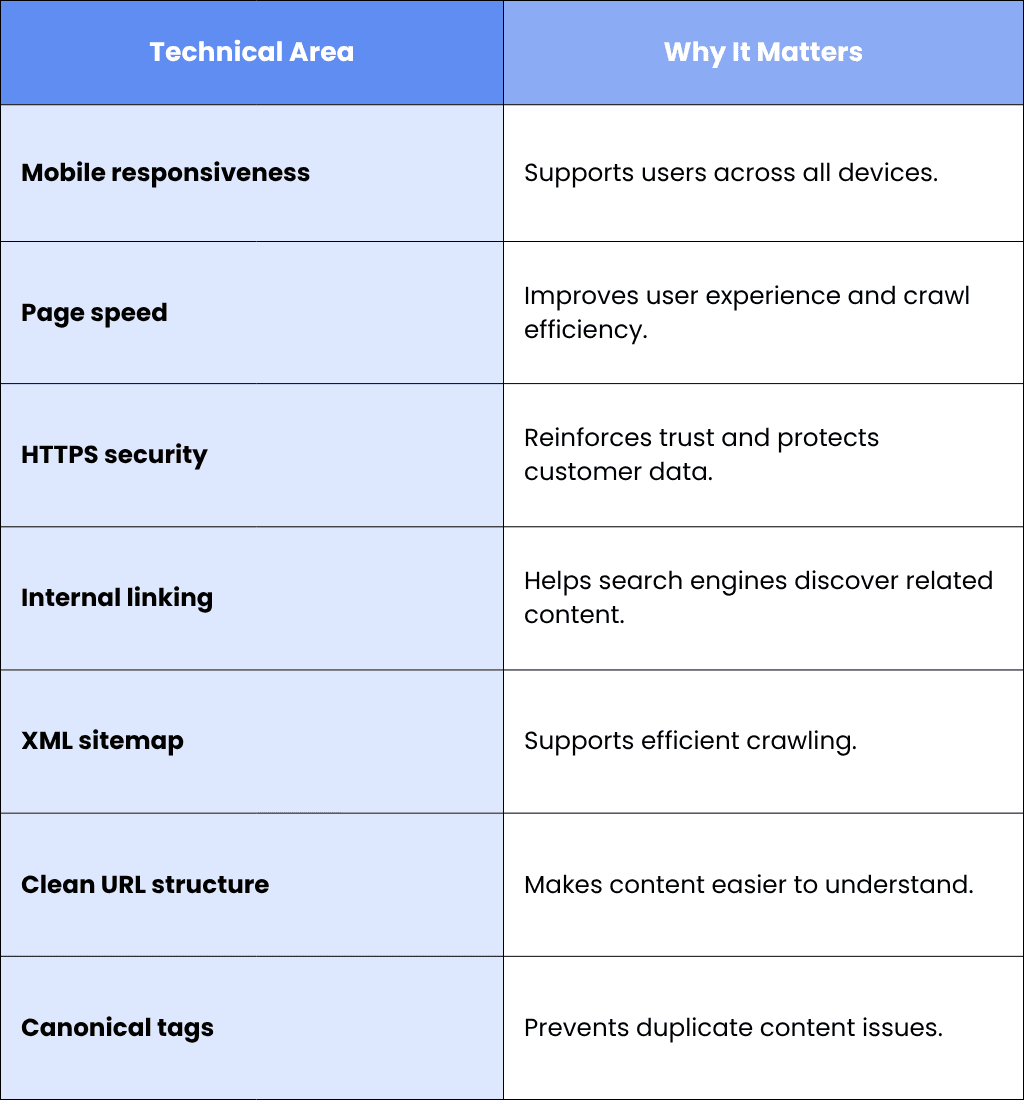
Technical SEO should support the work completed in the earlier steps. For example, fast-loading product pages make it easier for users to explore your buying guides, while clear internal links help AI understand the relationships between your products and educational content.
Once your technical foundations are in place, the final step is to measure your progress and refine your strategy over time.
Step 10: Measure, Refine and Continuously Improve
Improving AI search visibility for E-Commerce is an ongoing process rather than a one-off project.
AI platforms continue to evolve, customer behaviour changes and your own product catalogue will grow over time. Regular monitoring helps you identify what's working and where further improvements are needed.
Track the Right Metrics
Instead of focusing solely on keyword rankings, monitor a broader range of indicators.
Useful metrics include:
- Organic traffic
- Branded search volume
- Product page engagement
- Conversion rate
- Customer reviews
- High-quality backlinks
- Brand mentions across the web
- Visibility in AI-generated responses
Because AI-generated answers can vary depending on the platform, user location and search query, avoid judging performance based on a single prompt. Instead, test a range of relevant questions periodically and look for broader trends over time.
Conduct Regular Content Audits
Set aside time every quarter to review your content and identify opportunities for improvement.
Ask questions such as:
- Are product specifications still accurate?
- Have industry regulations changed?
- Can buying guides be expanded with new insights?
- Are customer questions evolving?
- Are there new products that require supporting content?
Small, regular improvements are often more effective than large-scale redesigns every few years.
How to Measure AI Search Visibility
Unlike traditional SEO, AI search visibility for E-Commerce cannot be measured by rankings alone. AI platforms generate responses dynamically based on the user's query, available information and the model being used.
Rather than focusing on a single metric, use the following framework to evaluate your progress.
1. Monitor Brand Mentions in AI Search Platforms
One of the simplest ways to assess your AI search visibility is to periodically test the types of questions your customers are likely to ask.
For example, instead of searching for your brand name, use prompts such as:
- What are the best POS systems for independent restaurants?
- Which commercial coffee machine is suitable for a busy café?
- What are the best hotel booking systems for boutique hotels?
Then, review whether your brand or products are mentioned and, just as importantly, how they are described.
Keep in mind that AI-generated responses can vary depending on the platform, user location and prompt wording. Rather than relying on a single result, track changes over time using a consistent set of prompts.
2. Track Organic Search Performance
Although AI search is changing how people discover products, traditional SEO remains an important indicator of your overall digital health.
Use tools such as Google Search Console and Google Analytics to monitor trends in:
- Organic traffic
- Click-through rate (CTR)
- Impressions
- Indexed pages
- Conversion rate from organic search
If these metrics improve alongside your AI optimisation efforts, it often suggests that your content has become more helpful, authoritative and easier for search engines to understand.
3. Measure Brand Authority
AI platforms are more likely to reference businesses that demonstrate expertise and credibility across the web. For this reason, it's important to monitor signals that indicate your brand's authority is growing.
Some useful indicators include:
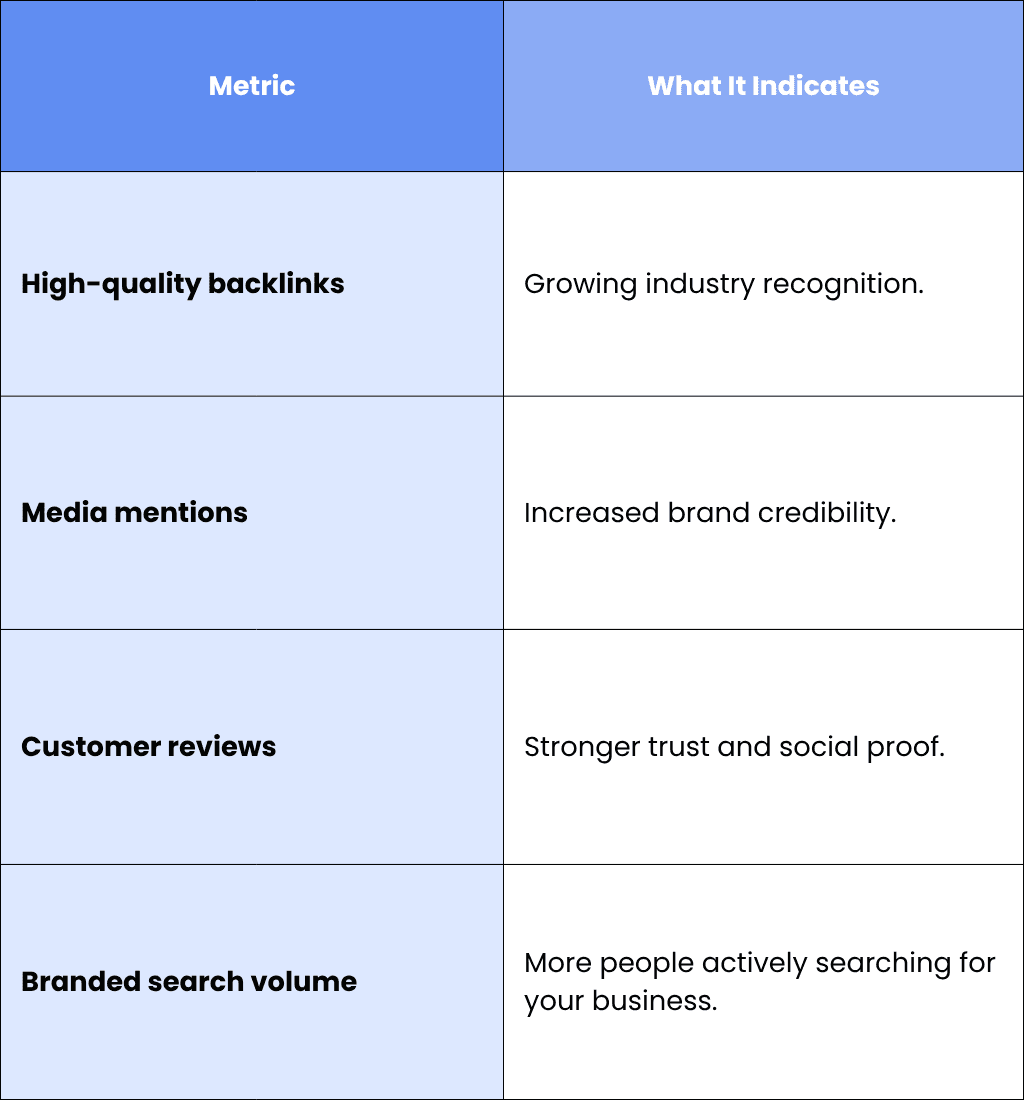
While these metrics don't directly measure AI citations, they contribute to the trust signals that AI platforms rely on when generating recommendations.
4. Review User Engagement
Ultimately, AI search aims to connect users with content that genuinely helps them. If visitors engage with your website after discovering it, that's a strong sign your content is meeting their needs.
Pay particular attention to metrics such as:
- Average engagement time
- Pages viewed per session
- Product enquiries or quote requests
- Newsletter sign-ups
- Purchases or completed conversions
Strong engagement often indicates that your content is answering the right questions and supporting customers throughout their buying journey.
5. Continuously Review and Refine
Measuring AI search visibility isn't a one-off task. As AI platforms evolve and customer behaviour changes, your content should evolve too.
Set aside time every few months to review your findings and ask questions such as:
- Which pages attract the most qualified traffic?
- Which customer questions are not yet answered?
- Have competitors published more comprehensive content?
- Are our product details, schema and reviews still up to date?
Small, ongoing improvements are often more effective than major overhauls. By regularly refining your content and monitoring the metrics above, you'll be better positioned to strengthen your AI search visibility for E-Commerce and maintain a competitive advantage as AI-powered search continues to evolve.
The Future of Search Belongs to Trusted Brands
AI-powered search is transforming how customers discover products, compare solutions and make purchasing decisions.
As search experiences become increasingly conversational, businesses need to think beyond rankings and focus on becoming trusted sources of information.
For e-commerce brands, this means creating comprehensive product content, publishing genuinely helpful resources, strengthening technical SEO and building a credible digital presence that AI platforms can understand and trust.
Ultimately, improving AI search visibility for E-Commerce is not about trying to optimise for a single AI model. It is about developing a website and content strategy that consistently demonstrates expertise, authority and value for your customers.
Businesses that invest in these fundamentals today will be well placed to adapt as AI search continues to evolve.
How Saigon Digital Helps Businesses Prepare for AI Search
As AI reshapes the digital landscape, businesses need more than traditional SEO to stay competitive. They need a strategy that combines technical excellence, authoritative content and AI-ready optimisation.
At Saigon Digital, we help ambitious brands navigate this shift with forward-thinking, user-centric and bespoke digital solutions that deliver measurable business growth.
Our approach combines proven SEO principles with the latest advancements in AI search, ensuring your business is well positioned to attract both search engines and AI-powered discovery platforms.
Our services include:
SEO Services
A strong SEO foundation remains essential for long-term visibility. We help businesses improve their online presence through:
- Site Optimisation & Technical Performance
- Content & Authority Building
- Local & Global Search Strategy
By strengthening your website's technical health, content quality and authority, we help create the conditions that support both traditional search performance and AI visibility.
Generative Engine Optimisation (GEO)
As AI platforms become an increasingly important source of traffic and brand discovery, our Generative Engine Optimisation (GEO) services help businesses prepare for the future of search.
Our GEO solutions include:
- AI Readability Optimisation
- Generative Engine Optimisation (GEO)
- Answer Engine Optimisation (AEO)
- Knowledge Graph & Schema Setup
- AI Content Audit & Reformatting
- AI Performance Dashboard
These services are designed to help your brand become more discoverable, more trustworthy and more likely to be referenced by AI platforms such as ChatGPT, Gemini, Perplexity and Google AI.
AI Workflow Automation Services
Beyond search visibility, AI also offers significant opportunities to improve operational efficiency.
Saigon Digital helps organisations streamline processes and scale productivity through:
- AI-driven intelligence
- Pre-built automation templates
- Custom AI agents
Whether you want to automate repetitive workflows, improve customer experiences or integrate AI into your business operations, our team can help you identify practical solutions aligned with your goals.
Ready to Future-Proof Your Digital Presence?
The way customers search is changing, but one principle remains the same: businesses that provide the most helpful, trustworthy and accessible information are the ones most likely to earn attention.
If you're looking to strengthen your SEO foundations, improve your AI search visibility or develop a broader AI strategy for your organisation, Saigon Digital can help you navigate the next generation of digital marketing with confidence.
Let’s build your next digital success story together. Get in touch with Saigon Digital today to start turning search intent into measurable results.
Frequently Asked Questions
1. Does AI search visibility replace traditional SEO?
No. AI search visibility complements rather than replaces traditional SEO. Search engines still rely on strong technical SEO, high-quality content and a well-structured website to discover and understand your pages. AI optimisation builds on these foundations by making your content easier for platforms such as ChatGPT, Google AI Overviews, Gemini and Perplexity to interpret and reference.
Businesses that combine SEO, Answer Engine Optimisation (AEO) and Generative Engine Optimisation (GEO) are generally better positioned to improve both organic search performance and AI visibility.
2. How long does it take to improve AI search visibility for an e-commerce website?
There is no fixed timeline, as results depend on factors such as your website's existing authority, content quality, technical SEO and the competitiveness of your industry.
For established websites, technical improvements like implementing structured data or enhancing product pages can have an impact relatively quickly. However, building topical authority, earning high-quality backlinks and strengthening your brand's reputation are longer-term efforts that require consistent investment.
Rather than expecting immediate results, focus on continuous improvement and regularly review your content, technical performance and customer experience.
3. Can AI-generated content improve AI search visibility?
AI can be a valuable tool for brainstorming ideas, creating outlines or producing initial drafts, but content should always be reviewed and refined by subject matter experts before publication.
AI search platforms prioritise content that demonstrates expertise, accuracy and originality. Publishing generic or unverified AI-generated content may reduce trust rather than improve it. The best approach is to use AI to support your content creation process while ensuring every article reflects your business's knowledge, experience and unique perspective.
4. Which types of e-commerce businesses benefit most from AI search visibility?
Businesses across almost every e-commerce sector can benefit from improved AI search visibility, particularly those selling products that require research or comparison before purchase.
Examples include:
- Retail and consumer goods
- Food and beverage suppliers
- Hospitality equipment providers
- Educational products and software
- Furniture and home improvement
- Health and wellness products
- B2B industrial equipment
If your customers ask questions, compare options or seek recommendations before buying, improving your AI search visibility can help your products appear earlier in the decision-making process.
5. What should businesses prioritise first when improving AI search visibility?
Start by strengthening the foundations of your website. Create comprehensive product pages, publish helpful content that answers customer questions, implement structured data and ensure your technical SEO is in good health.
Once these fundamentals are in place, focus on building brand authority through customer reviews, industry mentions, high-quality backlinks and consistent business information across trusted platforms. This combination of technical excellence, valuable content and credibility provides a strong foundation for improving AI search visibility for E-Commerce over the long term.