



Artificial intelligence has transformed the way businesses create content. From drafting blog articles and product descriptions to generating social media captions and customer support responses, AI tools have become part of everyday marketing workflows. As these technologies become more capable, audiences are also becoming more aware of how content is created.
This shift has made AI content disclosure an increasingly important consideration for brands. Customers and even technology platforms all expect greater transparency regarding AI-generated or AI-assisted content.
This guide explains what AI content disclosure means in 2026, why it matters, and how brands can implement practical disclosure policies that support both compliance and business growth.

Key Takeaways
- AI content disclosure is becoming an essential part of responsible digital marketing, helping brands build trust, improve transparency and prepare for evolving regulations.
- Search engines like Google focus on content quality and usefulness, not whether AI was used to create it. Human oversight, accuracy and expertise remain critical.
- Disclosure requirements vary across platforms, so businesses should understand and follow the latest guidance for websites, social media and AI-generated media.
- A clear AI content disclosure policy ensures consistent AI use, editorial review and governance across your organisation.
- Businesses that combine AI efficiency with human expertise will be better positioned to earn customer trust and improve visibility across both traditional search engines and AI-powered search platforms.
What Is AI Content Disclosure?
AI content disclosure refers to informing readers, viewers or customers when artificial intelligence has been used to create, edit or significantly modify content.
Disclosure does not necessarily mean stating that an article was "written entirely by AI". Instead, it provides appropriate transparency about AI's role in the content creation process.
Depending on how AI is used, disclosure may include:
- AI-assisted drafting of articles
- AI-generated images or illustrations
- AI-generated videos or voiceovers
- AI-assisted translation
- AI-generated product descriptions
- AI-assisted editing or proofreading
- AI-generated summaries
- AI-created social media content
The level of disclosure should reflect the extent to which AI contributed to the final output.
For example, a blog article researched, reviewed and extensively edited by subject matter experts may only require a simple statement that AI assisted during drafting. By contrast, an entirely AI-generated promotional video should clearly indicate that AI played a significant role in its creation.
The objective is transparency, not undermining the value of your content.
Why AI Content Disclosure Matters in 2026
AI adoption has accelerated across virtually every industry. As a result, customers have become more discerning about authenticity, expertise and trustworthiness.
Transparent disclosure offers several important benefits.
1. It Builds Customer Trust
Trust remains one of the strongest competitive advantages a business can have.
Consumers increasingly appreciate honesty regarding how brands use AI. Clear disclosure demonstrates that your organisation values openness rather than attempting to conceal the use of new technologies.
When customers understand that AI supports human expertise instead of replacing it, confidence often increases.
For example: "This article was developed with the assistance of AI and reviewed, edited and verified by our SEO specialists."
This statement reassures readers that humans remain responsible for the final content.
2. It Supports Brand Credibility
Businesses invest significant time in establishing authority within their industries.
Undisclosed AI use can damage that authority if customers later discover content was heavily AI-generated without acknowledgement.
Transparent disclosure helps reinforce values such as:
- integrity
- accountability
- professionalism
- expertise
These qualities become increasingly important as AI-generated content becomes more widespread.
3. It Aligns with Emerging Regulations
Governments around the world continue introducing legislation concerning AI transparency.
While disclosure requirements differ across jurisdictions, regulators generally focus on:
- preventing misleading content
- reducing deceptive AI practices
- protecting consumers
- improving transparency around synthetic media
Organisations that adopt clear disclosure policies today are better positioned to adapt to future regulatory developments.
4. It Supports Responsible SEO
One of the biggest misconceptions in digital marketing is that search engines automatically penalise AI-generated content.
That is not the case.
Search engines evaluate content primarily on its usefulness, originality and trustworthiness—not whether AI assisted during production.
Poor-quality content produced at scale without human oversight is far more likely to perform poorly than carefully reviewed AI-assisted content.
Businesses should therefore focus on producing genuinely valuable content that demonstrates:
- first-hand expertise
- accurate information
- original insights
- clear authorship
- editorial oversight
AI should accelerate quality content creation—not replace strategic thinking or subject matter expertise.
Does Every Piece of AI Content Need Disclosure?
Not necessarily.
A practical approach is to assess the significance of AI's contribution.
Appropriate Situations for Disclosure Include:
- Entire articles drafted using AI
- AI-generated images
- AI-generated videos
- Synthetic voice narration
- AI-created customer-facing reports
- AI-generated educational materials
- AI-produced marketing assets
- AI-generated testimonials (where permitted and clearly labelled)
Disclosure May Be Unnecessary When AI is Used Only For:
- grammar correction
- spelling checks
- formatting assistance
- brainstorming ideas
- keyword clustering
- research organisation
These functions are similar to using conventional productivity software rather than generating substantive content.
Brands should develop internal guidelines that define when disclosure becomes appropriate.
Human Oversight Remains Essential
AI is an incredibly capable assistant, but it is not an expert in your business.
Large language models can occasionally:
- generate inaccurate information
- cite non-existent sources
- misunderstand industry-specific terminology
- overlook legal considerations
- produce outdated advice
Every piece of customer-facing content should therefore undergo human review before publication.
This is particularly important for sectors including:
- healthcare
- finance
- education
- legal services
- hospitality
- food safety
- government
Businesses remain accountable for everything published under their brand, regardless of whether AI contributed to its creation.
Best Practices for AI Content Disclosure
As AI becomes a standard part of content production, simply adding a disclosure statement is no longer enough. Brands need a structured approach that ensures AI is used responsibly, consistently and transparently across every stage of the content lifecycle.
The following best practices will help your organisation build trust with customers, meet evolving platform expectations and create content that performs well in both traditional search engines and AI-powered discovery platforms.
Create an Internal AI Content Policy
Every organisation should establish a clear internal policy that defines how AI may be used in content creation. Without documented guidelines, different teams may apply AI inconsistently, leading to varying content quality, inaccurate disclosures or unnecessary compliance risks.
An effective AI content policy should answer questions such as:
- Which AI tools are approved for business use?
- What types of content can AI assist with?
- When is human review mandatory?
- Under what circumstances should AI use be disclosed?
- Who is responsible for approving AI-assisted content before publication?
For larger organisations, it is also worth identifying content categories that require additional oversight, such as legal, financial, medical or educational materials.
Example
A retail company may permit AI to generate first drafts of product descriptions but require a product manager to verify specifications, pricing and brand messaging before publishing. Likewise, an education provider may allow AI to assist with lesson planning while ensuring subject matter experts review all learning materials for accuracy.
By documenting these standards, businesses create a repeatable workflow that improves efficiency without compromising quality or trust.
Always Prioritise Accuracy
AI can generate content in seconds, but speed should never come at the expense of accuracy. Large language models can occasionally produce outdated information, incorrect statistics or fabricated references, making human verification an essential part of the publishing process.
Before any AI-assisted content goes live, review it carefully and verify:
- statistics and research findings
- legal or regulatory information
- pricing and product details
- dates and timelines
- quotations and attributed sources
- technical specifications
- industry terminology
For example, if AI drafts an article about food safety regulations for a restaurant business, the content should be checked against the latest government guidance rather than relying solely on AI-generated information.
A useful rule of thumb is to treat AI as a research assistant rather than a subject matter expert. While it can accelerate drafting, your organisation remains responsible for everything published under its brand.
Be Honest About AI's Role
Transparency does not mean drawing unnecessary attention to your internal workflows. Instead, it means accurately representing how AI contributed to the final piece of content.
If AI was used to generate an initial draft that was subsequently rewritten, fact-checked and refined by your editorial team, a simple disclosure is often sufficient. On the other hand, if AI generated an image, video or voice recording that could influence how audiences interpret the content, more explicit disclosure may be appropriate.
For example:
This article was drafted with the assistance of AI and reviewed, edited and fact-checked by our content specialists before publication.
Or:
Some images in this article were created using generative AI for illustrative purposes.
These statements reassure readers that humans remain accountable for the final output while demonstrating your organisation's commitment to responsible AI use.
Importantly, avoid overstating or understating AI's involvement. Misrepresenting how content was created can undermine the trust that disclosure is intended to build.
Keep Disclosure Consistent Across All Channels
Customers often interact with a brand across multiple touchpoints, from your website and blog to social media, email newsletters and downloadable resources. If your approach to AI disclosure varies significantly between these channels, it may create confusion or raise questions about your organisation's transparency.
Instead, establish a consistent framework that applies across your entire content ecosystem.
For example:
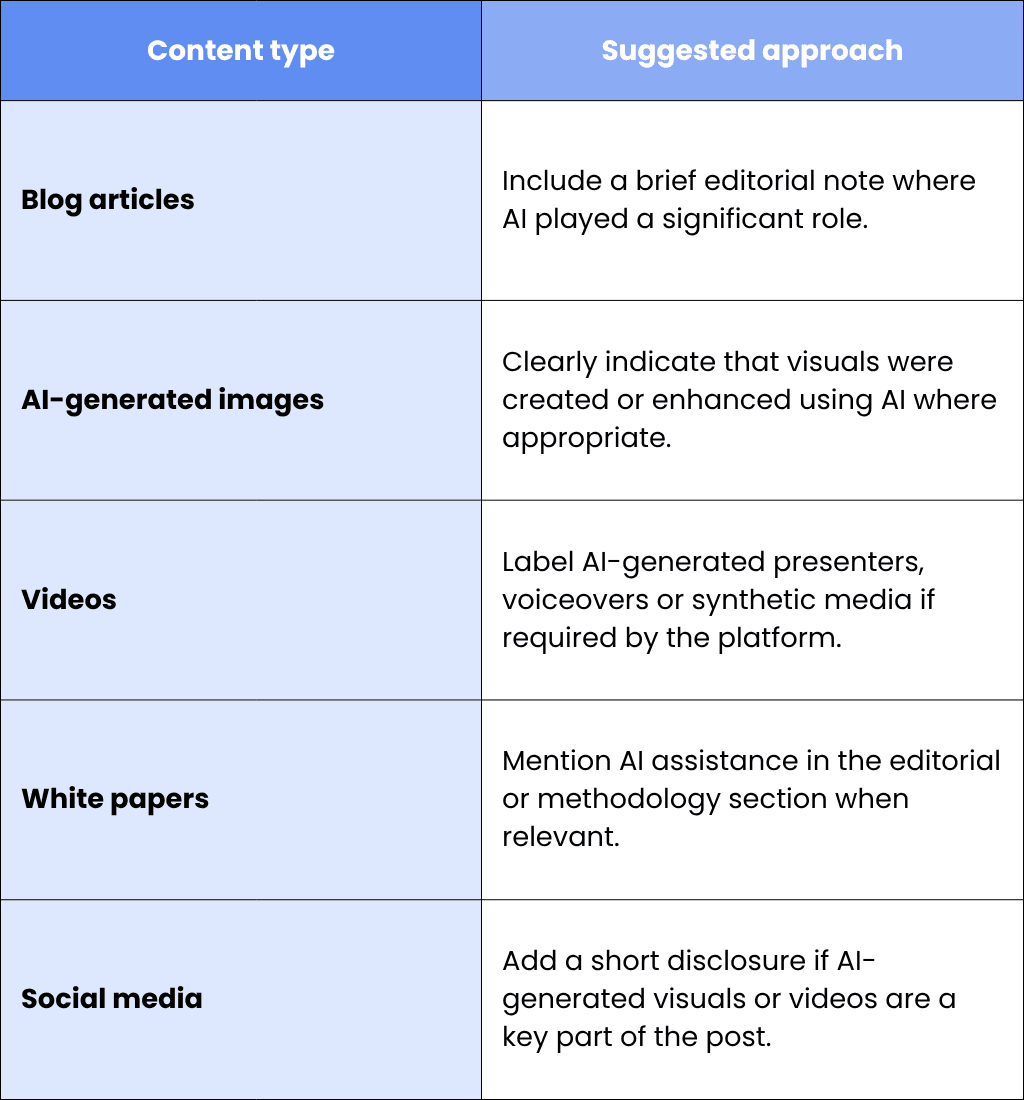
Consistency also extends to tone and wording. Rather than writing a different disclosure every time, develop a small library of approved disclosure statements that your marketing team can use across various content formats.
This saves time while ensuring your messaging remains clear and professional.
Match Your Disclosure to the Level of AI Involvement
Not every piece of AI-assisted content requires the same level of disclosure. The key is proportionality.
Ask yourself:
Would a reasonable reader want to know that AI played a significant role in creating this content?
If the answer is yes, a disclosure is likely appropriate.
The table below provides a practical guide.
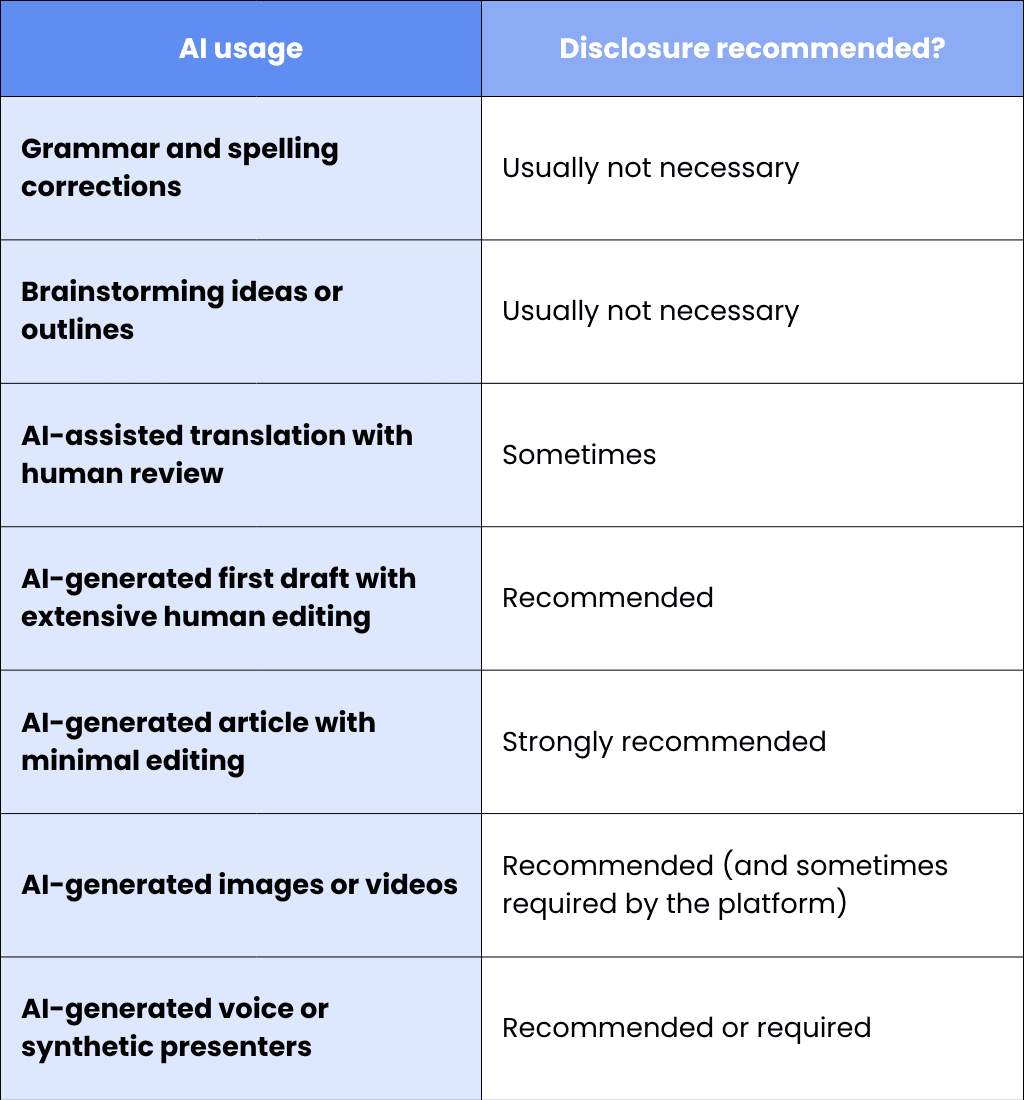
Using a proportionate approach helps avoid unnecessary disclosures while ensuring transparency where it matters most.
Train Your Teams on Responsible AI Use
Even the most comprehensive AI policy will have limited impact if employees are unsure how to apply it in practice.
Provide regular training so that marketing teams, copywriters, designers and external agencies understand:
- when AI may be used
- when disclosure is appropriate
- how to fact-check AI-generated content
- copyright and intellectual property considerations
- brand voice requirements
- data privacy obligations
This is particularly important for organisations with multiple contributors or decentralised content teams.
Regular training also helps employees stay informed as AI tools, regulations and platform policies continue to evolve.
Review Your Disclosure Policy Regularly
AI technology is advancing rapidly, and platform requirements continue to change. A disclosure policy that works today may need updating within the next year.
Schedule regular reviews, at least annually, or more frequently if your organisation publishes a high volume of AI-assisted content.
During each review, consider questions such as:
- Have any major platforms introduced new AI labelling requirements?
- Have relevant regulations changed in our operating markets?
- Are we using new AI tools that require updated governance?
- Does our disclosure wording still reflect current best practice?
- Are there recurring issues identified during editorial reviews?
Treat your AI content policy as a living document rather than a one-time exercise. By reviewing and refining it regularly, your organisation can continue to balance innovation with transparency, ensuring that AI supports your content strategy without compromising quality or customer trust.
Why AI Content Disclosure Is Becoming an SEO Advantage
Transparency is becoming a competitive advantage.
Search engines and AI-powered answer engines increasingly reward signals that demonstrate trustworthiness, expertise and accountability, according to the E-E-A-T signal.
Businesses that openly disclose responsible AI use while maintaining high editorial standards position themselves more favourably for both traditional search and AI-driven discovery.
Rather than asking whether AI should be used, organisations should ask a more important question: How can we use AI responsibly while continuing to deliver genuine value to our audience?
That mindset will increasingly separate trusted brands from those producing large volumes of low-value, generic content.
AI Content Disclosure Across Major Platforms in 2026
There is currently no single global standard for AI content disclosure, and each platform has taken a slightly different approach. While some require explicit labelling of AI-generated media, others focus on content quality, authenticity or preventing users from being misled.
Below is an overview of how major search engines, publishing platforms and social media networks currently approach AI-assisted content, along with practical recommendations for businesses.
1. Google Search
Google has made it clear that it does not penalise content simply because AI was used during its creation. Instead, Google's algorithms evaluate whether content is helpful, original and created primarily for people rather than search rankings.
This means businesses can confidently incorporate AI into their content workflows, provided they continue to produce accurate, valuable and well-reviewed content.
What Google expects
Google encourages content creators to demonstrate strong E-E-A-T signals:
- Experience: demonstrating first-hand knowledge where relevant
- Expertise: showcasing subject matter knowledge
- Authoritativeness: establishing credibility within your industry
- Trustworthiness: ensuring information is accurate, transparent and reliable
Whether content is written by a person, AI or a combination of both is less important than whether it genuinely helps users solve a problem.
Best practices
If your organisation uses AI to draft website content or blog articles:
- ensure a human editor reviews every page before publication
- verify all statistics, quotations and references
- include author biographies where appropriate
- update articles regularly as information changes
- avoid publishing large volumes of generic AI-generated pages
Example
Suppose an education provider uses AI to draft an article about university admissions. Before publishing, an admissions consultant reviews the article, updates application deadlines, adds first-hand advice and ensures the guidance reflects current regulations.
The result is content that benefits from AI efficiency while remaining accurate and genuinely useful.
2. Google AI Overviews and AI-Powered Search
Traditional search is evolving rapidly. Increasingly, users receive AI-generated summaries instead of clicking through multiple websites.
To become one of the sources that AI systems reference, businesses should prioritise content that is:
- clearly structured
- easy to understand
- factually accurate
- well organised
- supported by original insights
Rather than writing solely for search engines, brands should create content that directly answers customer questions.
For example, instead of publishing a generic article titled "Restaurant Marketing Tips", consider answering specific questions such as:
- How can restaurants use AI responsibly in marketing?
- Should restaurants disclose AI-generated menu images?
- Does AI-generated website copy affect local SEO?
Specific, authoritative answers are more likely to be surfaced by AI-powered search experiences.
3. LinkedIn
LinkedIn has embraced AI by introducing writing assistants for posts, profiles, recruitment and messaging. However, because the platform centres on professional expertise, authenticity remains especially important.
Decision-makers, recruiters and business leaders value original perspectives over generic AI-generated opinions.
Best practices
Use AI to:
- organise ideas
- improve readability
- draft initial versions
- summarise reports
Then strengthen the content by adding:
- personal experiences
- company insights
- case studies
- practical lessons
- industry observations
Example
Instead of posting an AI-generated article about digital marketing trends, a marketing director could include lessons learned from a recent campaign, measurable business outcomes and commentary on emerging industry developments.
This creates content that reflects genuine expertise rather than simply repeating widely available information.
4. Facebook and Instagram (Meta)
Meta has introduced greater transparency measures around AI-generated media, particularly where realistic synthetic images, videos or audio could confuse or mislead users.
For brands, this is particularly relevant when creating marketing campaigns using generative AI.
Consider disclosure when using:
- AI-generated lifestyle photography
- AI-generated product mock-ups
- synthetic influencers
- AI-generated promotional videos
- AI-generated customer testimonials (where permitted)
Simple edits such as background removal, colour correction or image enhancement generally do not require disclosure. However, if AI creates or substantially alters visual content in a way that changes how audiences perceive it, transparency becomes increasingly important.
Example
A hospitality brand creates an AI-generated image illustrating a concept for a future hotel interior. Rather than presenting the image as a completed project, the accompanying caption explains that it is a conceptual visual generated with AI.
This helps manage customer expectations while maintaining credibility.
5. YouTube
Video content presents unique challenges because AI can now generate realistic presenters, voices and entire scenes.
To reduce the risk of misleading viewers, YouTube expects creators to disclose realistic altered or synthetic content where appropriate.
Examples include:
- AI-generated presenters
- cloned voices
- AI-generated interviews
- realistic synthetic news footage
- digitally altered public figures
Routine editing tasks, such as AI-generated captions, background noise removal or thumbnail creation, generally do not require disclosure.
Best practices
Businesses producing educational or corporate videos should:
- disclose realistic AI-generated media
- review scripts carefully for factual accuracy
- distinguish demonstrations from real footage
- avoid creating misleading visual representations
Transparency helps audiences understand what they are watching while strengthening confidence in your brand.
6. TikTok
TikTok has become one of the fastest-moving platforms for AI-generated short-form content.
From virtual influencers to AI-generated voiceovers, businesses increasingly use AI to create engaging videos quickly. However, highly realistic synthetic media should be clearly labelled where required.
Consider disclosure when using:
- AI avatars
- AI presenters
- cloned voices
- AI-generated customer stories
- realistic AI-generated demonstrations
For simpler uses—such as AI-assisted scripting or caption writing—formal disclosure is generally unnecessary.
The guiding principle remains whether viewers could reasonably mistake AI-generated content for authentic footage.
7. X (formerly Twitter)
X encourages rapid conversations around current events, making accuracy particularly important.
Because AI-generated posts can spread quickly, organisations should avoid relying entirely on automated publishing.
Recommended workflow
Rather than allowing AI to publish directly:
- Generate a draft using AI.
- Review the content for accuracy.
- Verify any statistics or news references.
- Ensure the tone aligns with your brand.
- Obtain human approval before posting.
This process significantly reduces the risk of publishing misleading information during fast-moving news cycles.
8. WordPress
WordPress itself does not regulate AI-generated content, making editorial responsibility especially important for publishers.
Many organisations now include a short disclosure note for AI-assisted articles.
For example: This article was developed with AI assistance and reviewed by our editorial team for accuracy and quality.
Although optional, this type of statement reinforces transparency while assuring readers that human oversight remains central to the publishing process.
WordPress users should also maintain clear editorial workflows, version control and regular content reviews to ensure AI-assisted articles remain accurate over time.
9. Shopify
AI has transformed ecommerce content creation.
Retailers commonly use AI to generate:
- product descriptions
- category pages
- buying guides
- email campaigns
- frequently asked questions
- SEO metadata
While disclosure is rarely necessary for routine product copy, accuracy is critical.
Every AI-generated description should be reviewed to ensure it accurately reflects:
- product dimensions
- colours
- materials
- compatibility
- pricing
- warranty information
Publishing inaccurate AI-generated product information can increase customer complaints, returns and reputational damage.
For ecommerce businesses, AI should improve efficiency, not replace quality assurance.
10. Medium and Other Publishing Platforms
Most publishing platforms permit AI-assisted writing provided content meets their editorial standards.
However, audiences increasingly value transparency.
If AI played a significant role in producing an article, consider including a short editorial note explaining how it was used.
For example: AI assisted with drafting this article. Our editorial team reviewed, edited and verified the final version before publication.
This approach reassures readers that the content reflects human expertise rather than automated publishing.
A Practical AI Content Disclosure Framework for Businesses
Although each platform has its own guidance, the underlying principles of AI content disclosure remain remarkably consistent.
The five-step process below provides a practical starting point for organisations looking to implement responsible AI content disclosure at scale.
Step 1: Identify How AI Was Used
Before deciding whether a disclosure is necessary, first determine how AI contributed to the content. Not every use of AI requires the same level of transparency, so understanding its role is essential.
Consider questions such as:
- Did AI generate the first draft?
- Was AI used only for brainstorming or outlining?
- Did AI create or significantly alter an image or video?
- Was AI used to generate voice narration?
- Did AI simply assist with grammar or proofreading?
The answers will help determine whether disclosure is appropriate and what information should be shared with your audience.
For example, if AI was only used to improve sentence structure or correct spelling, a disclosure is unlikely to add value. However, if AI generated an entire article or created realistic marketing visuals, readers would generally benefit from knowing this.
Step 2: Assess the Potential Impact on Your Audience
The next step is to evaluate whether AI involvement could reasonably influence how people interpret the content.
A helpful question to ask is: "Would a customer expect to know that AI played a significant role in creating this?"
If the answer is yes, transparency is usually the best approach.
This is particularly important for content such as:
- educational resources
- research reports
- financial guidance
- healthcare information
- legal content
- news updates
- AI-generated images or videos
- customer-facing demonstrations
By considering the audience's perspective rather than your internal production process, you can make more consistent disclosure decisions.
Step 3: Apply Appropriate Human Oversight
No matter how sophisticated AI becomes, human expertise remains an essential part of producing trustworthy content.
Before publishing, ensure that someone with relevant knowledge reviews the content for:
- factual accuracy
- clarity
- brand voice
- legal compliance
- tone of voice
- formatting and accessibility
- relevance to your audience
For specialist industries such as education, hospitality, finance or healthcare, this review should ideally be completed by someone with subject matter expertise.
Remember, while AI can assist with content creation, your organisation is ultimately responsible for everything published under its name.
Step 4: Choose the Right Level of Disclosure
Disclosure should always be proportionate to AI's contribution. Over-disclosing routine AI assistance can overwhelm readers, while under-disclosing significant AI involvement may undermine trust.
The table below provides a practical guide.
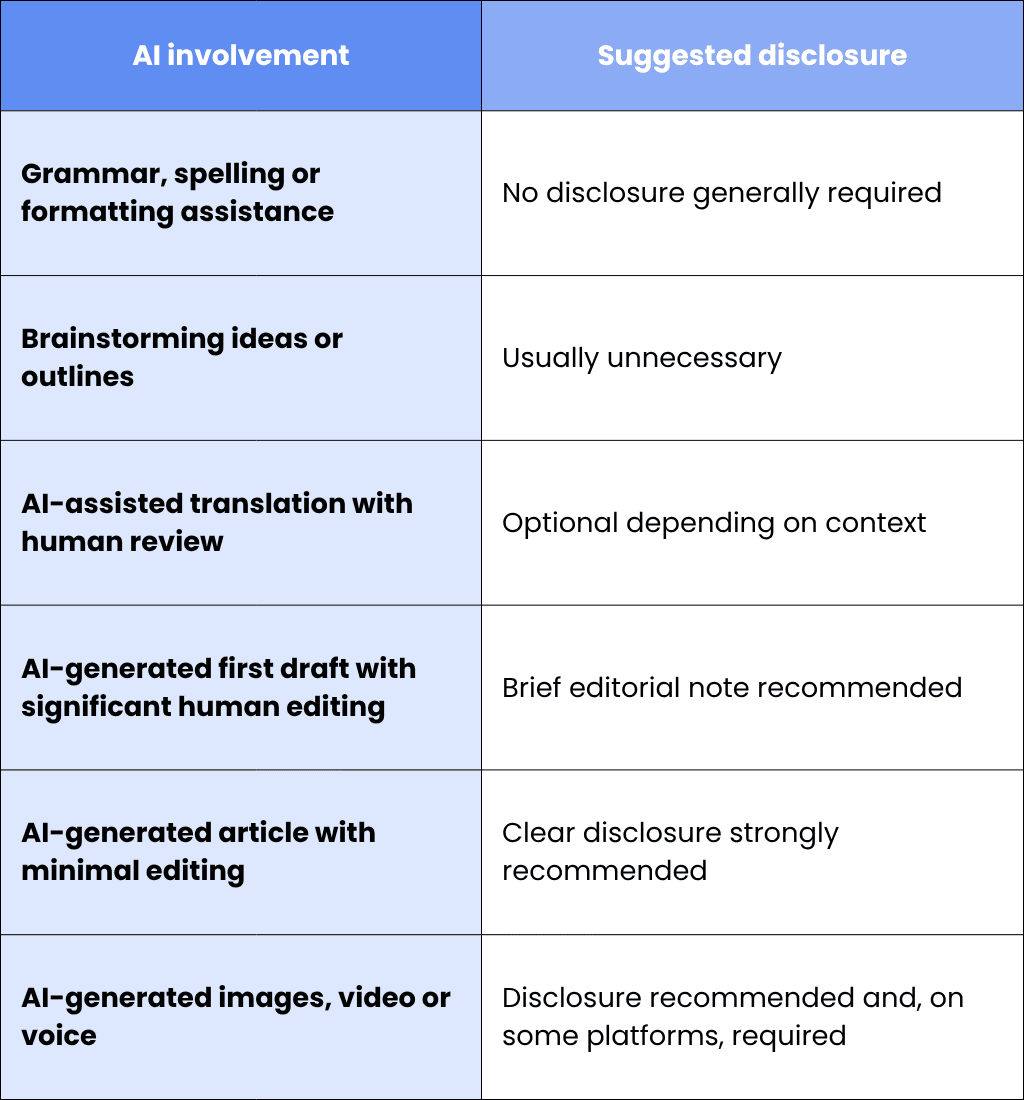
The goal is not to disclose every interaction with AI, but rather to provide meaningful transparency where it matters to your audience.
Step 5: Review Before Publishing
Before any AI-assisted content goes live, conduct one final editorial review.
A simple pre-publication checklist can help ensure consistency across your organisation.
Ask yourself:
- Have all facts and statistics been verified?
- Has the content been reviewed by a qualified person?
- Does the content accurately reflect our brand voice?
- Is any required AI disclosure included?
- Does the content comply with the platform's current guidance?
- Are AI-generated images or videos labelled appropriately?
- Does the content provide genuine value to readers?
If the answer to any of these questions is "no", take the time to address the issue before publishing.
Although this final review may add a few extra minutes to your workflow, it can prevent costly mistakes, protect your reputation and improve the overall quality of your content.
A Simple Decision Tree for AI Content Disclosure
If your team is unsure whether disclosure is needed, the following decision-making process can provide a useful starting point.
Question 1: Was AI used only for proofreading, grammar or formatting?
- Yes → Disclosure is generally unnecessary.
- No → Continue to Question 2.
Question 2: Did AI generate a substantial portion of the written, visual or audio content?
- Yes → Continue to Question 3.
- No → Disclosure may not be necessary, but apply human review.
Question 3: Could readers reasonably assume the content was entirely human-created?
- Yes → Consider including a clear disclosure.
- No → Continue to Question 4.
Question 4: Does the platform require AI-generated media to be labelled?
- Yes → Include the required disclosure.
- No → Use your organisation's AI disclosure policy to determine the most appropriate level of transparency.
This straightforward framework helps teams make consistent decisions while avoiding unnecessary complexity.
Should Every Business Have an AI Disclosure Policy?
Absolutely.
Even organisations that only use AI occasionally benefit from documenting how it is used internally.
An AI disclosure policy promotes consistency across marketing teams, agencies and content creators.
A practical policy should address:
- Approved AI tools
- Permitted use cases
- Human review requirements
- Fact-checking processes
- Disclosure standards
- Copyright considerations
- Data privacy and confidentiality
- Editorial approval workflows
As AI capabilities continue to evolve, regular policy reviews help ensure your organisation remains aligned with industry expectations.
Looking Beyond Disclosure: Building a Future-Ready Content Strategy
AI content disclosure is only one part of responsible digital marketing.
As search evolves beyond traditional rankings, businesses must also ensure their content is discoverable by AI-powered search experiences such as ChatGPT, Google AI Overviews, Gemini and Perplexity.
This means producing content that is:
- genuinely helpful
- technically well-structured
- easy for AI systems to understand
- supported by authoritative signals
- aligned with user intent
- consistently updated
Organisations that embrace transparency while investing in high-quality, people-first content will be better positioned to earn visibility across both traditional search engines and emerging AI platforms.
How Saigon Digital Helps Businesses Thrive in the AI Search Era
At Saigon Digital, we help ambitious brands solve digital challenges with forward-thinking, user-centric and bespoke solutions that deliver measurable business growth.
Our SEO Services combine technical optimisation, content strategy and authority building to improve visibility where it matters most.
As AI-powered search continues to evolve, our Generative Engine Optimisation (GEO) services help brands become trusted sources for platforms such as ChatGPT, Gemini, Perplexity and Google AI. From AI Readability Optimisation and Answer Engine Optimisation (AEO) to Knowledge Graph implementation, schema strategy and AI content audits, we help your content become part of the answers users increasingly rely on.
We also support businesses through AI Workflow Automation Services, helping teams streamline repetitive tasks, improve productivity and implement custom AI-powered workflows without sacrificing quality or governance.
Saigon Digital partners with you to build digital experiences that are trusted by both people and intelligent search systems.
Build a More Transparent and AI-Ready Content Strategy
AI is changing how customers discover, evaluate and trust brands. As AI-powered search and content generation continue to evolve, businesses that prioritise transparency, quality and human expertise will be best positioned to stand out.
At Saigon Digital, we help ambitious brands create content strategies that are built for both today's search engines and tomorrow's AI-driven experiences.
Ready to future-proof your content strategy?
Get in touch with Saigon Digital to discover how our SEO, GEO and AI solutions can help your business grow with confidence!
Frequently Asked Questions About AI Content Disclosure
1. Is AI content disclosure legally required?
It depends on your location, industry and the type of content you publish. While there is currently no universal law requiring businesses to disclose all AI-assisted content, many jurisdictions are introducing regulations that focus on transparency, particularly for AI-generated images, videos, audio and other synthetic media.
In addition, individual platforms may have their own disclosure requirements. To minimise compliance risks and build customer trust, businesses should stay informed about local regulations and platform policies and adopt a clear internal AI content disclosure policy.
2. Does AI-generated content affect SEO?
No—using AI to create content does not automatically harm your SEO performance. Search engines such as Google prioritise content that is helpful, accurate and created for people, regardless of whether AI was involved in the writing process. However, publishing large volumes of low-quality or unedited AI-generated content may negatively impact your search visibility. The best approach is to use AI to improve efficiency while ensuring every piece of content is reviewed, fact-checked and enhanced by human experts.
3. When should businesses disclose AI-generated content?
Businesses should consider disclosing AI use when it plays a significant role in creating written, visual or audio content that audiences might reasonably assume was created entirely by humans. Examples include AI-generated articles, images, videos, voiceovers or marketing materials. By contrast, disclosure is generally unnecessary when AI is used only for routine tasks such as grammar checking, spell checking or brainstorming ideas. A practical rule is to ask whether AI's involvement would influence how your audience interprets or trusts the content.
4. What should an AI content disclosure statement include?
An effective AI content disclosure statement should be concise, transparent and easy to understand. Rather than focusing on technical details, it should explain how AI contributed to the content while making it clear that humans were responsible for the final review and approval.
For example:
This article was created with the assistance of AI and reviewed, edited and fact-checked by our editorial team before publication.
The wording may vary depending on the type of content and the extent of AI involvement, but the goal should always be to provide meaningful transparency without distracting from the reader's experience.
5. How can businesses use AI responsibly while maintaining customer trust?
Responsible AI use starts with treating AI as a tool that supports—not replaces—human expertise. Businesses should establish clear AI governance policies, verify all AI-generated information, maintain editorial oversight and be transparent when AI has significantly contributed to customer-facing content. By combining AI's efficiency with human judgement, organisations can improve productivity while continuing to deliver accurate, trustworthy and high-quality content that strengthens long-term customer confidence.